
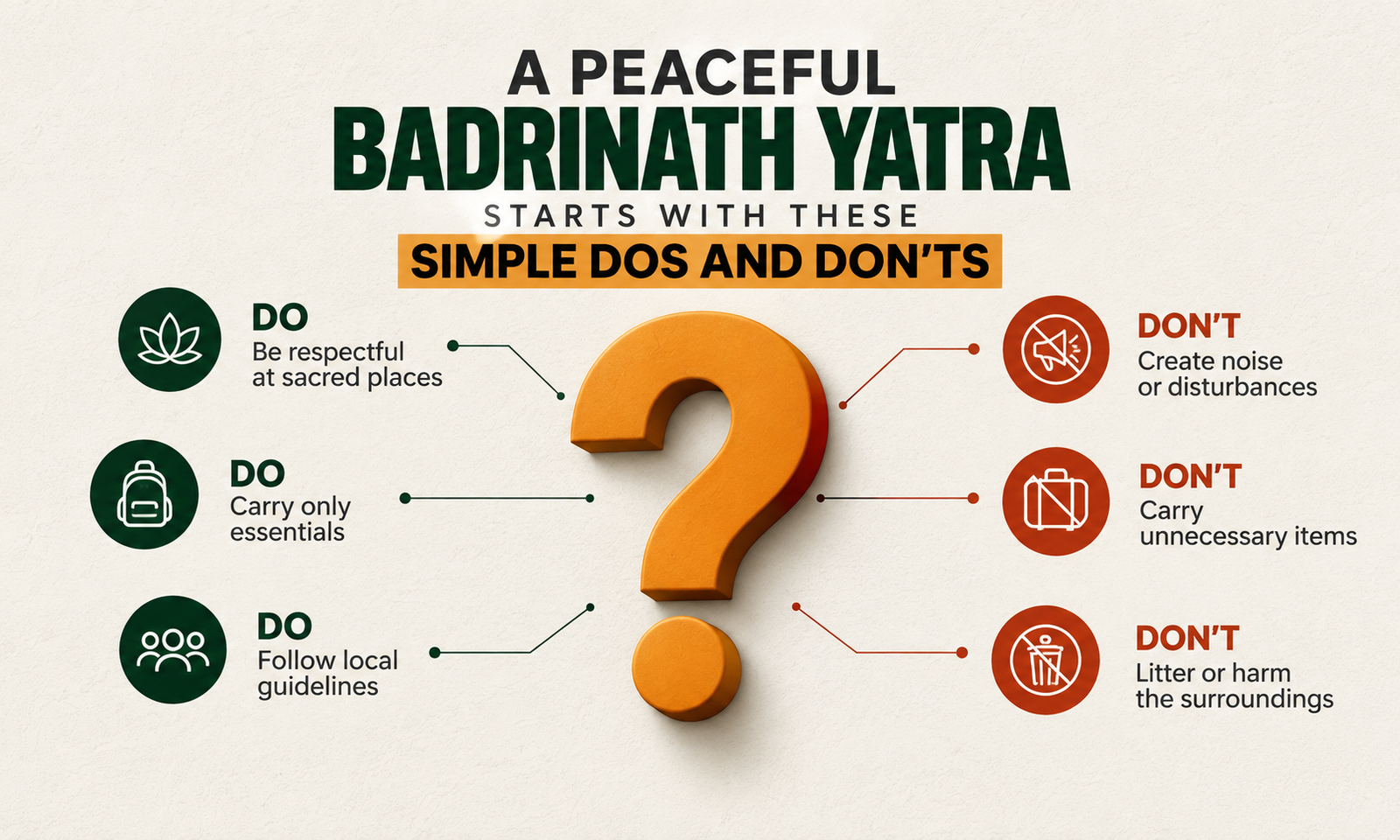
A Peaceful Badrinath Yatra Starts With These Simple Dos and Don’ts
Badrinath is road-accessible, but the pilgrimage should not be rushed. A Peaceful Badrinath Yatra Starts With These Simple Dos and Don’ts explains what deserves attention first and what can wait.
In Badrinath, travelers can consider Hotel Yoga Badrinath as a practical temple-town base near the bus stand.
Families can also compare the Badrinath hotel list on Mudras Stays for location, room type and current availability.
WHAT TO DO FIRST
Simple rules work best: stay warm, eat on time, respect the temple and avoid rushing elders.
THE PRACTICAL DOS AND DON'TS THAT MATTER MOST
A peaceful Badrinath day often has fewer priorities: darshan, food, family rest and only then optional local visits.
Use the first few hours in Badrinath to settle in, warm up, eat and understand the local layout before adding optional sightseeing.
Follow current temple instructions for entry, queue movement, footwear, phones and photography.
Treat Tapt Kund as a sacred bathing area, not a leisure pool, and do not pressure medically vulnerable family members to participate.
Senior citizens need a slower plan with warm clothing, regular meals and shorter walking stretches.
After darshan, allow time for rest or Brahma Kapal instead of immediately starting another long drive.
Mana can be added when weather, energy and traffic permit, but it should not become a compulsory checklist item.
Cold, rain and wind should shorten the plan rather than encourage the family to keep sightseeing in wet clothing.
Carry only small essentials while walking around Badrinath; leave large luggage at the hotel.
Use the hotel as a base for warmth, food and recovery rather than merely a place to store bags.
HOW TO AVOID TURNING THE JOURNEY INTO A RUSH
Do not compare your family's pace with strangers; age, health and acclimatisation differ too much.
Leave one block of the day unplanned for queues, weather, rest or a quiet spiritual moment.
If the day becomes difficult, remove an optional activity first rather than compromising the main pilgrimage.
Respect local workers, porters, drivers, volunteers and security staff; the route depends on their work.
Carry waste until a proper disposal point is available.
Keep a backup layer and medicines accessible rather than buried in luggage.
Agree on a meeting point and contact plan before entering crowded areas.
A spiritual journey is not improved by unnecessary suffering; warmth, food, rest and medical care are compatible with devotion.
The best pilgrimage days often move more slowly than expected, and that is not a failure.
Build the day around the slowest traveler rather than the fastest. A family pilgrimage works when everyone arrives with enough energy to experience the destination.
Treat weather and crowd conditions as inputs, not inconveniences. When the mountain or sacred site forces a slower pace, the schedule should adapt.
Food and hydration should be planned before fatigue appears. Small regular intake is easier to manage than waiting until someone is exhausted.
Use the phone for maps, tickets and emergency contacts, but do not let filming become the main purpose of the visit.
A nearby stay often saves more energy than a cheaper room farther away because local transport and repeated walking add hidden effort.
WHERE TO STAY AND HOW THE RIGHT BASE HELPS
In Badrinath, travelers can consider Hotel Yoga Badrinath as a practical temple-town base near the bus stand.
Families can also compare the Badrinath hotel list on Mudras Stays for location, room type and current availability.
Travelers searching for a hotel in Badrinath, hotel near Badrinath Temple or stay near Badrinath Temple may value having food, parking and lift access within the same property.
A CALMER WAY TO PLAN THE FULL DAY
Keep meals predictable for children and senior citizens.
Before leaving any rest point, check water, medicines, phone battery and the next realistic stop.
At the sacred site, handle practical needs before expecting the family to remain patient in a long queue.
After the main visit, a short rest often improves the return journey more than another attraction.
Plan the return before the final activity so the end of the day does not become chaotic.
Start earlier than the most optimistic schedule suggests so breakfast, traffic and small delays do not create stress.
Use the first serious fatigue signal as information and slow down early.
When weather worsens, protect warmth first and decide the next movement second.
Carry waste until a proper disposal point is available.
Keep a backup layer and medicines accessible rather than buried in luggage.
Agree on a meeting point and contact plan before entering crowded areas.
A spiritual journey is not improved by unnecessary suffering; warmth, food, rest and medical care are compatible with devotion.
The best pilgrimage days often move more slowly than expected, and that is not a failure.
Start earlier than the most optimistic schedule suggests so breakfast, traffic and small delays do not create stress.
Use the first serious fatigue signal as information and slow down early.
When weather worsens, protect warmth first and decide the next movement second.
Keep meals predictable for children and senior citizens.
Before leaving any rest point, check water, medicines, phone battery and the next realistic stop.
At the sacred site, handle practical needs before expecting the family to remain patient in a long queue.
After the main visit, a short rest often improves the return journey more than another attraction.
Plan the return before the final activity so the end of the day does not become chaotic.
In Badrinath, travelers can consider Hotel Yoga Badrinath as a practical temple-town base near the bus stand.
Families can also compare the Badrinath hotel list on Mudras Stays for location, room type and current availability.
Travelers searching for a hotel in Badrinath, hotel near Badrinath Temple or stay near Badrinath Temple may value having food, parking and lift access within the same property.
Use the first few hours in Badrinath to settle in, warm up, eat and understand the local layout before adding optional sightseeing.
Follow current temple instructions for entry, queue movement, footwear, phones and photography.
Treat Tapt Kund as a sacred bathing area, not a leisure pool, and do not pressure medically vulnerable family members to participate.
Senior citizens need a slower plan with warm clothing, regular meals and shorter walking stretches.
After darshan, allow time for rest or Brahma Kapal instead of immediately starting another long drive.
Mana can be added when weather, energy and traffic permit, but it should not become a compulsory checklist item.
Cold, rain and wind should shorten the plan rather than encourage the family to keep sightseeing in wet clothing.
Carry only small essentials while walking around Badrinath; leave large luggage at the hotel.
Use the hotel as a base for warmth, food and recovery rather than merely a place to store bags.
A peaceful Badrinath day often has fewer priorities: darshan, food, family rest and only then optional local visits.
Build the day around the slowest traveler rather than the fastest. A family pilgrimage works when everyone arrives with enough energy to experience the destination.
Treat weather and crowd conditions as inputs, not inconveniences. When the mountain or sacred site forces a slower pace, the schedule should adapt.
Food and hydration should be planned before fatigue appears. Small regular intake is easier to manage than waiting until someone is exhausted.
Use the phone for maps, tickets and emergency contacts, but do not let filming become the main purpose of the visit.
A nearby stay often saves more energy than a cheaper room farther away because local transport and repeated walking add hidden effort.
Do not compare your family's pace with strangers; age, health and acclimatisation differ too much.
Leave one block of the day unplanned for queues, weather, rest or a quiet spiritual moment.
If the day becomes difficult, remove an optional activity first rather than compromising the main pilgrimage.
Respect local workers, porters, drivers, volunteers and security staff; the route depends on their work.
Carry waste until a proper disposal point is available.
Keep a backup layer and medicines accessible rather than buried in luggage.
Agree on a meeting point and contact plan before entering crowded areas.
A spiritual journey is not improved by unnecessary suffering; warmth, food, rest and medical care are compatible with devotion.
The best pilgrimage days often move more slowly than expected, and that is not a failure.
Start earlier than the most optimistic schedule suggests so breakfast, traffic and small delays do not create stress.
Use the first serious fatigue signal as information and slow down early.
When weather worsens, protect warmth first and decide the next movement second.
Keep meals predictable for children and senior citizens.
Before leaving any rest point, check water, medicines, phone battery and the next realistic stop.
At the sacred site, handle practical needs before expecting the family to remain patient in a long queue.
After the main visit, a short rest often improves the return journey more than another attraction.
Plan the return before the final activity so the end of the day does not become chaotic.
In Badrinath, travelers can consider Hotel Yoga Badrinath as a practical temple-town base near the bus stand.
Families can also compare the Badrinath hotel list on Mudras Stays for location, room type and current availability.
Travelers searching for a hotel in Badrinath, hotel near Badrinath Temple or stay near Badrinath Temple may value having food, parking and lift access within the same property.
Use the first few hours in Badrinath to settle in, warm up, eat and understand the local layout before adding optional sightseeing.
Follow current temple instructions for entry, queue movement, footwear, phones and photography.
Treat Tapt Kund as a sacred bathing area, not a leisure pool, and do not pressure medically vulnerable family members to participate.
Senior citizens need a slower plan with warm clothing, regular meals and shorter walking stretches.
After darshan, allow time for rest or Brahma Kapal instead of immediately starting another long drive.
Mana can be added when weather, energy and traffic permit, but it should not become a compulsory checklist item.
Cold, rain and wind should shorten the plan rather than encourage the family to keep sightseeing in wet clothing.
Carry only small essentials while walking around Badrinath; leave large luggage at the hotel.
Use the hotel as a base for warmth, food and recovery rather than merely a place to store bags.
A peaceful Badrinath day often has fewer priorities: darshan, food, family rest and only then optional local visits.
Build the day around the slowest traveler rather than the fastest. A family pilgrimage works when everyone arrives with enough energy to experience the destination.
Treat weather and crowd conditions as inputs, not inconveniences. When the mountain or sacred site forces a slower pace, the schedule should adapt.
Food and hydration should be planned before fatigue appears. Small regular intake is easier to manage than waiting until someone is exhausted.
Use the phone for maps, tickets and emergency contacts, but do not let filming become the main purpose of the visit.
A nearby stay often saves more energy than a cheaper room farther away because local transport and repeated walking add hidden effort.
Do not compare your family's pace with strangers; age, health and acclimatisation differ too much.
Leave one block of the day unplanned for queues, weather, rest or a quiet spiritual moment.
If the day becomes difficult, remove an optional activity first rather than compromising the main pilgrimage.
Respect local workers, porters, drivers, volunteers and security staff; the route depends on their work.
Carry waste until a proper disposal point is available.
Keep a backup layer and medicines accessible rather than buried in luggage.
Agree on a meeting point and contact plan before entering crowded areas.
A spiritual journey is not improved by unnecessary suffering; warmth, food, rest and medical care are compatible with devotion.
The best pilgrimage days often move more slowly than expected, and that is not a failure.
Start earlier than the most optimistic schedule suggests so breakfast, traffic and small delays do not create stress.
Use the first serious fatigue signal as information and slow down early.
When weather worsens, protect warmth first and decide the next movement second.
Keep meals predictable for children and senior citizens.
Before leaving any rest point, check water, medicines, phone battery and the next realistic stop.
At the sacred site, handle practical needs before expecting the family to remain patient in a long queue.
After the main visit, a short rest often improves the return journey more than another attraction.
Plan the return before the final activity so the end of the day does not become chaotic.
In Badrinath, travelers can consider Hotel Yoga Badrinath as a practical temple-town base near the bus stand.
Families can also compare the Badrinath hotel list on Mudras Stays for location, room type and current availability.
Travelers searching for a hotel in Badrinath, hotel near Badrinath Temple or stay near Badrinath Temple may value having food, parking and lift access within the same property.
Use the first few hours in Badrinath to settle in, warm up, eat and understand the local layout before adding optional sightseeing.
Follow current temple instructions for entry, queue movement, footwear, phones and photography.
FREQUENTLY ASKED QUESTIONS
Where can I stay in Badrinath?
Consider Hotel Yoga Badrinath or compare the Badrinath hotel list on Mudras Stays.
Should I rush to the temple after a long drive?
If the family is exhausted, settling in first can improve the darshan experience.
Can Mana be added the same day?
Often yes, but it should remain optional when weather or fatigue makes the schedule uncomfortable.
Should I check the latest weather before travel?
Yes. Mountain and hill weather can change quickly, so current conditions matter more than an old forecast.
Should senior citizens follow the same pace as younger travelers?
No. The itinerary should be built around the slower and more vulnerable traveler.
What should I keep accessible?
Identification, medicines, water, a warm or rain layer, phone and basic booking details.
Is it better to stay near the sacred destination?
Often yes, because a nearby stay can reduce repeated local transport and walking fatigue.
Should I reconfirm local rules?
Yes. Current signage, volunteers, temple or Ashram staff and official instructions take priority over older online content.
How can I contact Mudras Stays?
Call 9599190222 for details and reservation support.
Where can I follow Mudras Stays?
Follow @mudras.stays on Instagram.