
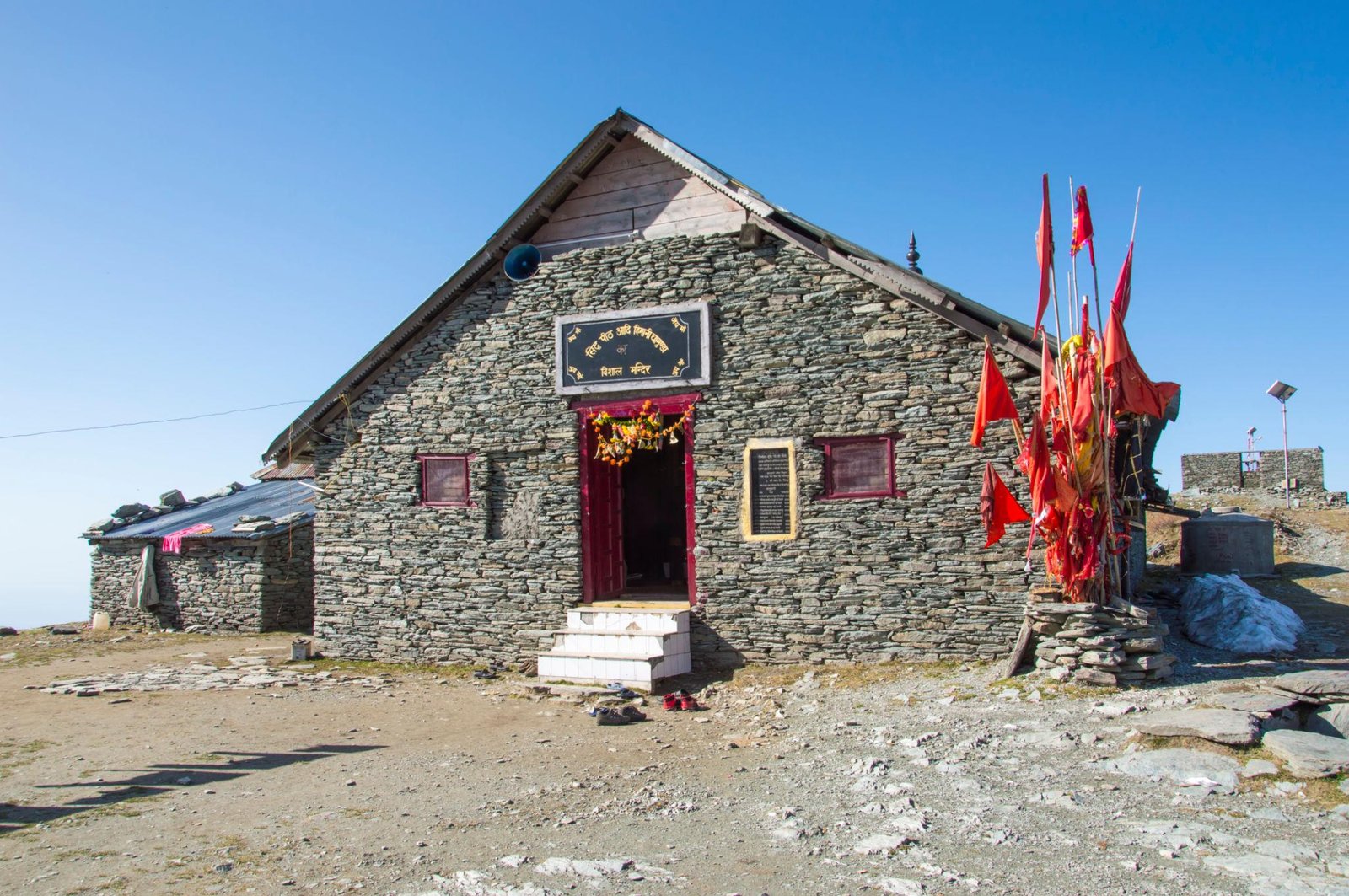
Aadi Himani Chamunda Temple is one of the most spiritually powerful and physically demanding pilgrimage destinations in Kangra district, Himachal Pradesh. Situated high in the Dhauladhar mountains at an elevation of approximately 3,185 metres, the temple is dedicated to Goddess Chamunda, a fierce and protective manifestation of the Divine Mother.
Also known as Shri Aadi Himani Chamunda Devi Temple, Himani Chamunda Temple, Aadi Chamunda Temple and Aadi Himani Chamunda Siddh Peeth, the shrine stands near Chandar Bhan mountain above the villages of Jia, Jadrangal and Kardiana.
Unlike the famous road-accessible Shri Chamunda Nandikeshwar Dham located beside the Baner River in the valley, Aadi Himani Chamunda can ordinarily be reached only by a long and steep mountain trek. Depending on the selected route and practical roadhead, pilgrims may need to walk approximately 9 to 13 kilometres one way.
The ascent commonly requires around five to seven hours for reasonably fit walkers, while slower pilgrims may take longer. The return descent also requires several hours and should never be underestimated.
The pilgrimage combines Goddess worship with forest walking, high-altitude meadows, steep stone paths, changing weather and expansive views across Kangra Valley. It is suitable for physically prepared devotees, experienced walkers, trekking groups and spiritual travellers who understand the demands of a full mountain journey.
Aadi Himani Chamunda Temple should not be promoted as an easy family sightseeing attraction. The altitude, long ascent, limited facilities, remote trail and rapidly changing Dhauladhar weather require disciplined preparation.
Those unable to undertake the trek can seek the blessings of Maa Chamunda at Chamunda Nandikeshwar Dham in the valley below. The two temples are spiritually connected through regional tradition but are separate destinations with very different access conditions.
## Spiritual Importance of Aadi Himani Chamunda
The word “Aadi” means original, primordial or ancient. “Himani” refers to a snowy or Himalayan setting.
Aadi Himani Chamunda is therefore regarded in local religious tradition as the original mountain abode of Goddess Chamunda before her worship was established at the more accessible valley temple.
Devotees believe that the high summit represents a more remote and intense form of the goddess’s presence. Reaching it requires effort, discipline and surrender, making the physical journey part of the spiritual experience.
Maa Chamunda is worshipped as a protector against fear, injustice, destructive forces and spiritual weakness.
Pilgrims may pray for courage, family welfare, health, children, employment, safety, clarity and the strength to overcome difficult circumstances.
Some devotees undertake the trek after making a personal religious vow. Others return to offer gratitude after experiencing what they consider the fulfilment of a prayer.
These experiences belong to personal faith. The temple should never be advertised as guaranteeing victory, healing, marriage, employment or any other outcome.
Its significance lies in the spiritual confidence, emotional strength and sense of connection experienced by worshippers.
The mountain setting reinforces these qualities. The long climb removes visitors from roads, markets, digital distractions and ordinary routines.
Every stage of the ascent requires patience. Pilgrims must manage fatigue, uncertainty, weather and limited resources before reaching the shrine.
For many devotees, the effort itself becomes an offering to the goddess.
## The Legend of Chanda and Munda
The name Chamunda is associated with the Hindu sacred narrative of the demons Chanda and Munda.
According to the Devi Mahatmya tradition, the Divine Mother manifested a fierce warrior form during a battle against destructive forces. This goddess defeated the demon generals Chanda and Munda and was honoured with the name Chamunda.
Chamunda therefore represents the power that destroys cruelty, uncontrolled pride, fear and forces that threaten spiritual and moral order.
Regional tradition connects the mountain around Aadi Himani Chamunda with this sacred battle.
One local account says that the goddess fought Chanda and Munda in the Dhauladhar region and hurled great stones from the mountain during the conflict.
A boulder visible near the lower Chamunda temple is sometimes associated with this legend.
These accounts belong to Hindu mythology and Kangra’s oral religious tradition rather than documented military or geological history.
Their spiritual meaning is more important than literal interpretation.
Chanda and Munda can symbolise negative tendencies within human life, including anger, arrogance, cruelty, greed and confusion.
The goddess’s victory represents the courage required to confront these forces both within society and within oneself.
## Relationship with Chamunda Nandikeshwar Dham
Aadi Himani Chamunda Temple is distinct from Shri Chamunda Nandikeshwar Dham, the major temple complex situated beside the Baner River on the Dharamshala–Palampur side.
According to regional tradition, the goddess was originally worshipped at the remote mountain shrine.
A local king and a Brahmin priest later prayed for permission to establish her worship in a location that ordinary devotees could reach more easily.
The goddess reportedly appeared in a dream and directed the priest to recover a sacred image from a specified place.
The image was then installed at the present valley temple.
This account explains the religious connection between the two shrines.
Aadi Himani Chamunda represents the original high mountain seat, while Chamunda Nandikeshwar Dham provides accessible daily worship in the valley.
The lower temple is associated with both Goddess Chamunda and Nandikeshwar Mahadev, reflecting the union of Shakti and Shiva.
It includes the principal Devi shrine, a sacred water area and a cave-like space where Lord Shiva is worshipped.
Pilgrims undertaking the Aadi Himani trek may visit the lower temple before the ascent to seek blessings and understand the complete Chamunda tradition.
However, visiting the valley shrine does not mean that the trek begins from inside the temple complex. The actual upper routes are approached through villages such as Jia, Jadrangal and Kardiana.
Transport and trail arrangements must be planned separately.
## Raja Chandar Bhan Tradition
The mountain area is associated with Raja Chandar Bhan Chand of the Katoch dynasty.
District information places the temple near ruins traditionally connected with the ruler and records that he died around 1660.
The shrine is therefore described as dating to at least the seventeenth century in its documented regional form, although local religious traditions may regard the sacred site as much older.
Visitors should distinguish between the age of the worship tradition, the age of surviving structures and the age of the present reconstructed temple.
High-altitude temples are frequently repaired or rebuilt because of snow, fire, lightning, wind and deterioration of timber or roofing.
The sacred identity of a Himalayan shrine can remain continuous even when the physical building changes.
Regional accounts concerning Raja Chandar Bhan connect the temple with the political and spiritual history of Kangra’s Katoch rulers.
The Katoch dynasty has a long association with Kangra Valley, its forts, temples and religious institutions.
Royal patronage may have supported paths, buildings, priests and the continuation of pilgrimage traditions in difficult mountain terrain.
Visitors should treat surviving ruins carefully and should not remove stones or enter unstable structures.
## Restoration and Reconstruction
After a period of limited use and neglect, the shrine was restored during the 1990s through the efforts of devotees and local residents.
District information specifically recognises the contribution of devotee P. D. Saini and community members in reviving the temple.
The temple later suffered major damage in 2014 because of fire and lightning.
The structure was subsequently reconstructed.
This history explains why the current building may appear newer than the sacred tradition associated with the location.
A rebuilt temple is not necessarily a newly established pilgrimage destination.
In the Himalayas, continuity often resides in the deity, sacred location, priestly customs and community memory rather than in every original piece of construction material.
The modern shrine uses stone and practical mountain roofing suited to the severe environment.
Visitors should avoid spreading exaggerated claims that the present structure has survived unchanged for thousands of years.
A more accurate understanding recognises the old religious tradition, seventeenth-century associations, twentieth-century restoration and twenty-first-century reconstruction.
## Architecture of the Mountain Shrine
Aadi Himani Chamunda Temple has a simple and functional appearance shaped by its remote high-altitude setting.
Stone walls provide strength and protection from cold winds.
A sloping metal or weather-resistant roof helps shed rain and snow.
Red flags, bells, sacred cloth and a clearly marked entrance identify the building as a Devi shrine.
The architecture is less elaborate than many valley temples because every construction material must be transported through difficult terrain.
The absence of monumental decoration does not reduce the spiritual importance of the shrine.
Its power comes from the location, deity, pilgrimage effort and continuing worship.
The grey stone walls blend naturally with the surrounding mountain landscape, while red religious flags create a strong contrast against snow, grass and blue sky.
Visitors should not scratch names onto the stone, attach plastic decorations or disturb the structural material.
High-altitude buildings require constant maintenance, and careless visitor behaviour can create unnecessary damage.
Photography inside the sanctum should only be undertaken when the priest permits it.
The principal deity, sacred objects and private rituals should not be recorded merely for social media.
## The Trek to Aadi Himani Chamunda
The trek is the defining practical feature of the pilgrimage.
Official district information describes the route as moderate to challenging, with an uphill distance of approximately 9 to 13 kilometres depending on the chosen starting point.
The journey can require five to seven hours of ascent.
Actual duration depends on fitness, weather, luggage, trail condition, rest stops and the number of pilgrims on the path.
The descent may be faster but places significant pressure on knees and ankles.
Pilgrims must preserve enough strength and daylight for the return.
Two principal approaches are commonly recognised: the route from Jia village and the route through Jadrangal or Kardiana.
Both require local confirmation before departure.
Trail starts, vehicle access, diversions and seasonal facilities may change because of road construction, landslides, weather and local arrangements.
No visitor should begin merely by following an old map or social-media video.
## Jia Village Route
Jia village is one of the principal gateways for the Aadi Himani Chamunda trek.
It lies in the broader Nagrota Bagwan–Kangra region and provides access to the mountain below the temple.
The route includes steep ascent through village surroundings, forest sections, open slopes and high meadows.
Some descriptions may give a shorter distance from a particular starting point, while others calculate the full journey from the practical vehicle stop.
This explains why online distances can differ.
Pilgrims should confirm the actual roadhead and current trail directly with local residents, an authorised guide or an experienced accommodation host.
The Jia route can be physically demanding because of sustained elevation gain.
Visitors arriving directly from the plains should not attempt it immediately after a long overnight journey without rest.
A nearby stay before the trek provides time to sleep, organise supplies and begin early.
## Jadrangal and Kardiana Route
The Jadrangal–Kardiana side provides another recognised approach.
Depending on road conditions, visitors may travel by vehicle towards the last practical motorable point before beginning the climb.
Parts of the route may contain stone steps, forest paths, exposed sections and meadows.
Temporary tea stalls or food points may operate during the pilgrimage season, but their availability should never be assumed.
A stall can remain closed because of weather, low visitor numbers or supply difficulties.
Pilgrims must carry sufficient water and food for their own safety.
The most appropriate route may depend on current trail condition, transport, accommodation location and whether the pilgrim plans a same-day return or overnight stay.
A local guide can help select the safer approach.
## Trek Difficulty
Aadi Himani Chamunda should be treated as a demanding pilgrimage trek rather than a casual recreational walk.
The distance is substantial, and the temple lies more than 3,000 metres above sea level.
The route involves continuous ascent, uneven stone surfaces, loose soil and sections exposed to sun, wind or rain.
A person who walks comfortably on flat roads may still struggle with the sustained mountain gradient.
Pilgrims should prepare through regular walking and stair climbing before the journey.
Heavy bags should be avoided.
A small backpack should contain water, energy-rich food, warm clothing, rain protection, a torch, first aid and essential medication.
The group should move at the pace of its slowest member.
Leaving a tired pilgrim behind is dangerous.
## Fitness and Medical Preparation
Travellers with heart disease, uncontrolled blood pressure, serious respiratory conditions, recent surgery, severe arthritis or major mobility limitations should obtain appropriate medical advice before attempting the trek.
The pilgrimage should not be undertaken during fever, infection, severe weakness or acute injury.
People with diabetes or other conditions requiring regular food and medication must carry sufficient supplies and maintain their schedule.
Senior citizens should assess the route realistically.
Age alone does not determine fitness, but the combination of distance, altitude and limited emergency access requires caution.
Young children may not be suitable for the full trek unless they are accustomed to mountain walking and accompanied by experienced adults.
Infants should not be carried casually on exposed or slippery routes.
Pregnant travellers should seek medical advice and consider the remote conditions carefully.
A walking pole can provide valuable support during ascent and descent.
Shoes should be broken in before the trek rather than worn for the first time on pilgrimage day.
## Altitude Considerations
At approximately 3,185 metres, the temple stands high enough for some visitors to experience altitude-related discomfort.
Symptoms may include headache, unusual fatigue, dizziness, nausea, poor appetite and breathlessness.
Visitors should ascend steadily, drink water regularly and avoid unnecessary competition.
Alcohol and smoking can worsen dehydration and breathing discomfort.
Severe headache, confusion, repeated vomiting, inability to walk normally or breathing difficulty at rest should never be ignored.
The affected person should descend and seek medical assistance.
There is limited medical infrastructure near the summit.
Essential medicines and a basic first-aid kit must be carried from the valley.
The religious importance of the destination does not remove ordinary physiological risks.
## What to Carry
Every pilgrim should carry adequate drinking water.
Seasonal water sources or tea stalls may be available on part of the route, but they are not guaranteed.
Packed food should be lightweight, nutritious and easy to carry. Suitable options may include fruit, nuts, energy bars, sandwiches or traditional dry food.
All packaging must be brought back.
A warm jacket is necessary even when the valley weather is hot.
The summit may be cold and windy.
A rain jacket or poncho is essential during periods of uncertain weather.
A torch or headlamp should be carried even for a planned daytime trek because delays can occur.
A charged phone and power bank are useful, although network coverage may be inconsistent.
Offline route information can assist but should not replace local guidance.
Other useful items include sunscreen, sunglasses, a cap, gloves during colder periods, spare socks, personal medicines, blister treatment and a whistle.
## Importance of an Early Start
Pilgrims should begin at first light or as early as safely practical.
An early start provides cooler climbing conditions, greater daylight and more time to manage unexpected delays.
Afternoon cloud formation is common around the Dhauladhar mountains.
Rain, fog and thunderstorms may develop even after a clear morning.
Visitors planning a same-day return must calculate the turnaround time before beginning.
A pilgrim who has not reached the summit by a safe predetermined time should be prepared to turn back.
Reaching the temple is not more important than completing the journey safely.
The descent should not begin after darkness unless an unavoidable emergency occurs and the group has reliable lighting and local assistance.
## Weather Risks
The Dhauladhar range is known for rapid weather changes.
Sunshine can be replaced by cloud, rain, hail or strong wind within a short period.
The high temple area may experience cold conditions even when Dharamshala, Palampur or Kangra feels warm.
Monsoon rain makes stone steps and soil slippery.
Fog can reduce visibility and obscure trail junctions.
Thunderstorms create lightning risk on exposed ridges and open meadows.
Snow and ice can block or conceal the trail during winter and early spring.
Pilgrims should check current forecasts and local reports, but they must also observe conditions during the trek.
When weather deteriorates seriously, the group should descend or seek safe shelter according to local guidance.
## Seasonal Opening and Winter Closure
The temple is generally seasonal because heavy snowfall makes access dangerous during winter.
District information commonly describes the annual pilgrimage period as extending from approximately 15 March to 15 November.
These dates should not be treated as automatic guarantees.
The actual opening or closing may depend on snow, trail condition, weather and temple committee decisions.
Early spring can still contain snow and ice.
Late autumn can bring sudden storms or freezing conditions.
Travellers must confirm the current status through local authorities, temple representatives, guides or accommodation providers.
A closed temple or unsafe trail should never be approached by bypassing local instructions.
## Spring Visit
Spring marks the gradual reopening of the mountain route.
Lower sections may become green while upper portions retain snow.
Early-season visitors should expect cold weather, wet ground and possible ice.
The route should only be attempted after confirmation that the temple and trail are officially accessible.
As the season advances, walking conditions generally improve.
Spring offers fresh vegetation, flowing water and views of snow-covered Dhauladhar peaks.
Warm clothing and waterproof footwear remain essential.
## Summer Visit
Late spring and early summer are among the most practical periods for the trek.
Days are longer, snow generally reduces and seasonal facilities may operate along the route.
Direct sunlight can become intense on open slopes.
Pilgrims should use sunscreen, sunglasses and a cap while continuing to carry a warm layer.
Weekend and holiday periods may bring larger groups.
An early start reduces crowding and heat.
Water requirements increase during warm weather.
## Monsoon Visit
The monsoon is one of the riskiest periods for Aadi Himani Chamunda.
Forests and meadows become green, but heavy rain can make the trail slippery and unstable.
Landslides, falling stones, swollen streams, poor visibility and thunderstorms may affect the route.
Temporary stalls may close, and rescue access can become difficult.
Visitors should avoid the trek during severe rain, official warnings or persistent storm conditions.
A religious vow does not require a pilgrim to ignore physical danger.
The journey can be postponed until safer weather.
## Autumn Visit
September and October are often considered favourable because rainfall generally reduces and visibility may improve.
The landscape remains green after the monsoon, while distant valley views can become clearer.
Morning and evening temperatures fall quickly.
Pilgrims require warm clothing and should watch for early frost.
Sharad Navratri may increase religious interest, but the upper temple’s actual access and event arrangements should be confirmed.
Autumn daylight gradually becomes shorter, making an early departure especially important.
## Winter Conditions
Winter travel should not be attempted casually.
Heavy snow can cover the route, remove visible trail markers and create avalanche, exposure and navigation risks.
The temple is normally closed during the severe winter period.
Unauthorised winter trekking may endanger both visitors and rescuers.
Snow photographs from a previous year do not prove that the trail is currently safe.
Only experienced winter mountaineers working with appropriate local professionals should consider mountain activity in the wider region, and such activity should remain separate from ordinary pilgrimage promotion.
## Temple Darshan
After the long ascent, the stone temple and red flags appear against the high mountain landscape.
Pilgrims should remove footwear where directed and follow the instructions of the priest or caretaker.
The sanctum is small compared with large valley temples.
During busy periods, visitors should complete darshan without blocking entry for others.
Offerings may include flowers, coconut, sweets, red cloth or other materials permitted by the temple.
Pilgrims should avoid carrying excessive puja material because every item must be transported up and waste must be removed.
Photography of the principal deity should only be undertaken when clearly allowed.
The summit should remain peaceful.
Loud music, shouting and disruptive video creation are inappropriate.
## Views from the Temple
The upper mountain location provides expansive views over Kangra Valley and surrounding Dhauladhar peaks during clear weather.
Villages, roads, agricultural land and lower hills appear far below.
Clouds may move beneath or across the temple, creating a dramatic atmosphere.
Views are never guaranteed.
Fog, haze, rain and snow can hide the complete landscape.
Pilgrims should not walk onto exposed ridges or unstable slopes to obtain photographs.
Strong wind can affect balance.
Loose hats, scarves and lightweight belongings should be secured.
Drones should not be operated without every necessary religious, local, environmental and aviation permission.
## Basic Summit Facilities
Facilities near the temple are limited.
A simple sarai or rest arrangement may be available according to season, management and capacity.
Basic bedding or utensils may sometimes be provided, but visitors should not assume hotel-like comfort.
Electricity, charging, hot water, bathrooms and food supplies may be limited or unavailable.
Accommodation should be confirmed before depending upon an overnight stay.
During busy periods, space may be prioritised for pilgrims according to temple arrangements.
Travellers should carry personal essentials and remain prepared for basic conditions.
The summit is not an appropriate place for luxury expectations.
## One-Day Trek Considerations
A same-day ascent and descent is physically demanding.
It is most suitable for fit, experienced walkers beginning very early with a local guide.
The group should maintain strict turnaround timing.
Adequate food, water and emergency lighting are essential.
Travellers should stay near the route base the night before rather than driving from a distant city and immediately beginning the climb.
After the descent, another nearby night is advisable because exhaustion can make long driving unsafe.
## Two-Day Pilgrimage Itinerary
A two-day plan provides a more manageable structure.
On the first day, travellers can arrive in Chamunda, Jia, Jadrangal, Dharamshala or another suitable base.
They should confirm the route, organise a guide, prepare supplies and rest early.
The trek begins before sunrise or at first light on the second day.
Physically prepared groups may return the same evening.
Those with confirmed and permitted summit accommodation may stay overnight and descend the following morning, but arrangements must be verified in advance.
## Three-Day Itinerary
A three-day pilgrimage allows more recovery time.
The first day can include arrival, a visit to Chamunda Nandikeshwar Dham and preparation near the trek route.
The second day is dedicated to the ascent and upper-temple darshan.
A confirmed overnight stay can be used where officially available and appropriate.
The third day includes descent and rest in the valley.
This structure is more suitable for groups wishing to avoid an extremely long single day.
## Staying Near Chamunda
The road-accessible Chamunda area provides hotels, guesthouses, dharamshalas and homestays near Chamunda Nandikeshwar Dham.
It is a useful base for pilgrims wishing to visit the lower shrine before the trek.
However, the driving distance from a Chamunda hotel to the selected Aadi Himani trailhead should be checked carefully.
The Jia route and Jadrangal–Kardiana route may require different transport arrangements.
A property described as being near Chamunda Devi Temple is not necessarily near the upper trek starting point.
MudrasStays can help visitors compare the practical distance from each property to the chosen route.
## Homestays Near Jia and Jadrangal
A village homestay near Jia, Jadrangal or Kardiana may provide the most practical accommodation for the pilgrimage.
Local hosts can help with updated trail information, early meals, guides and vehicle arrangements.
Facilities may be simpler than hotels in Dharamshala or Palampur.
Guests should confirm attached bathrooms, hot water, meals, electricity, parking and mobile connectivity.
Trekkers should ask whether packed food and safe drinking water can be arranged.
The host should be informed about the route and expected return time.
Supporting a local homestay also allows pilgrimage income to benefit communities maintaining access to the mountain.
## Dharamshala as a Base
Dharamshala offers the broadest selection of hotels, resorts, hostels, homestays, restaurants and medical facilities.
It can serve as an arrival and recovery base.
Travellers may spend the first night in Dharamshala and shift closer to Jia or Jadrangal before the trek.
Beginning the climb after a long pre-dawn drive from upper McLeod Ganj may create unnecessary fatigue.
Lower Dharamshala, Sidhpur, Yol, Nagrota Bagwan or another road-accessible area may be more practical depending on the route.
## Palampur as a Base
Palampur offers hotels, resorts, homestays, restaurants and medical support within the eastern Kangra Valley.
It is suitable for travellers combining the pilgrimage with tea gardens, Baijnath Temple and other destinations.
The road distance from Palampur to the selected trek start must be considered.
A nearby village stay remains preferable on the night before the ascent.
Palampur can serve as a comfortable recovery stop after the trek.
## Nagrota Bagwan and Kangra
Nagrota Bagwan can be practical for access towards Jia and for travellers arriving through Kangra Valley roads.
Kangra town and Gaggal provide hotels, transport, markets and medical services.
They are useful arrival bases but may not be the closest overnight locations for the trek.
Air travellers landing at Gaggal should rest before undertaking the pilgrimage.
Flight delays, road travel and immediate climbing should not be combined within an overly tight schedule.
## Nearby Spiritual Destinations
Chamunda Nandikeshwar Dham is the most important associated destination and should be included whenever practical.
Baijnath Temple is an important historic Shiva shrine east of Palampur and can be visited on a separate day.
Bajreshwari Devi Temple in Kangra is one of the major Shakti pilgrimage centres of the district.
Jwala Ji and Baglamukhi Temple can be included in a longer Kangra Devi circuit.
Aadi Himani Chamunda should never be added casually to a crowded same-day sightseeing programme because the trek itself requires complete attention.
## Choosing the Right Accommodation
The correct stay depends on the selected trek route.
Pilgrims using the Jia route should choose accommodation providing practical access to Jia or the current roadhead.
Those using the Jadrangal–Kardiana route should stay on the appropriate side of the valley.
Fit trekking groups may prioritise local guides, packed meals and route support.
Families accompanying trekkers but not climbing may prefer Chamunda, Dharamshala or Palampur, where they can visit accessible attractions.
Senior citizens who are not undertaking the trek should choose comfortable valley accommodation near Chamunda Nandikeshwar Dham.
Every booking should be checked for actual driving time, not only straight-line distance.
## Book Stays Near Aadi Himani Chamunda with MudrasStays
MudrasStays helps pilgrims and trekkers discover hotels, homestays, guesthouses and pilgrimage accommodation near Aadi Himani Chamunda Temple, Chamunda, Jia, Jadrangal, Nagrota Bagwan, Dharamshala and Palampur.
The platform is designed specifically for travellers searching for suitable places to stay near temples and spiritual destinations across India.
Visitors can compare properties according to the practical distance from their selected trailhead, room type, budget, group size and required facilities.
Booking near the route makes it easier to sleep properly, begin early and receive current information about weather and trail conditions.
Solo pilgrims can search for reliable homestays capable of connecting them with local guides.
Couples and trekking partners can choose peaceful village accommodation.
Families can select hotels offering meals, parking and comfortable rooms while physically prepared members complete the trek.
Pilgrimage groups can identify properties offering several rooms, early breakfast, packed meals and vehicle support.
Senior citizens can stay near the accessible valley temple while younger group members undertake the high-altitude pilgrimage.
Travellers can also use MudrasStays to organise separate accommodation for arrival, trail access and post-trek recovery.
A temple-focused platform helps visitors avoid booking a general Dharamshala hotel without understanding the location of the actual mountain route.
## Responsible Trekking
Every pilgrim must carry back plastic bottles, food wrappers, tissues and puja packaging.
Waste should not be buried, burned or thrown into the forest.
Disposable plates and cups should be avoided.
Water sources should not be contaminated with soap, food or religious material.
Visitors must stay on recognised trails.
Shortcuts damage vegetation, increase erosion and create navigation risks.
Flowers, medicinal plants and mountain herbs should not be collected.
Wildlife and livestock should not be chased or fed unsuitable food.
Smoking and open fires can create serious forest-fire danger.
Loud music should not be played along the route or near the shrine.
A spiritual pilgrimage should protect the mountain believed to be the goddess’s abode.
## Respecting Villages and Local Communities
The approach passes through living villages, grazing areas and community-managed landscapes.
Visitors should not enter homes, fields or private land without permission.
Residents should not be photographed without consent.
Livestock gates should be closed after passing where required.
Local water supplies should be used carefully.
Guides, porters, drivers, tea-stall operators and homestay hosts should be paid fairly.
Pilgrims should listen to local warnings about weather and trail conditions.
Community members understand the mountain through continuous experience and should not be ignored because an online post suggests a route is easy.
## Emergency Planning
Groups should share their route, expected return time and emergency contact details with their accommodation provider.
Pilgrims should remain together.
A person who becomes exhausted should not be left alone.
Emergency response in remote mountains can take considerable time.
Phone networks may fail.
Visitors should carry a whistle, torch and basic first aid.
Weather delays must be accepted without argument.
No itinerary should depend on reaching the temple at any cost.
Safe return remains part of responsible pilgrimage.
## A Sacred Journey into the Dhauladhar Mountains
Aadi Himani Chamunda Temple represents a powerful meeting of Goddess worship, physical endurance, mountain nature and Kangra’s living religious tradition.
The name Aadi preserves the belief that this is the original abode of Maa Chamunda.
The high elevation separates the shrine from ordinary valley life.
The trek transforms darshan into a journey of discipline and patience.
The Chanda and Munda narrative represents the victory of courage over destructive forces.
The relationship with Chamunda Nandikeshwar Dham connects the remote mountain shrine with accessible daily worship below.
The association with Raja Chandar Bhan Chand links the temple with Kangra’s regional history.
The restoration and reconstruction demonstrate the devotion of modern communities who preserved the shrine after neglect and natural damage.
The stone architecture reflects the practical demands of a snowy and wind-exposed environment.
The forest, meadows and Dhauladhar views make the landscape inseparable from the pilgrimage.
For devotees of Maa Chamunda, the temple is a place to seek strength, protection and spiritual courage.
For experienced trekkers, the route offers a demanding journey ending at a living sacred destination.
For photographers, the stone temple, red flags, mountain peaks and Kangra Valley provide memorable visual opportunities when safety and religious dignity are respected.
For cultural travellers, the relationship between the upper and lower Chamunda shrines provides insight into how Himalayan worship adapts to geography.
For spiritual seekers, the long ascent creates time for silence, self-examination and prayer.
For families, the pilgrimage requires an honest division between members physically able to trek and those better served by worship at the accessible valley temple.
Aadi Himani Chamunda Temple should never be treated merely as an adventure checkpoint or social-media summit.
It is a seasonal, remote and demanding sacred destination.
Visitors should prepare physically, respect local advice, carry adequate supplies and remain willing to turn back when conditions become unsafe.
Plan your pilgrimage to Aadi Himani Chamunda Temple with MudrasStays and experience one of Kangra’s most powerful high-altitude Devi journeys.
Seek the blessings of Maa Chamunda, walk through the forests and meadows of the Dhauladhar mountains and experience the spiritual silence of her original mountain abode.
Combine your journey with Chamunda Nandikeshwar Dham, Dharamshala, Palampur, Baijnath Temple, Bajreshwari Devi Temple and other sacred destinations across Kangra Valley.
Book hotels near Chamunda Devi Temple, discover homestays near Jia and Jadrangal, and explore trekking-friendly accommodation around Nagrota Bagwan, Dharamshala and Palampur through MudrasStays.
Stay closer to the correct trailhead, begin the climb early and avoid unnecessary travel before a demanding mountain pilgrimage.
MudrasStays connects pilgrims, trekkers, families and spiritual travellers with suitable accommodation near temples and sacred destinations across India.
Begin your Aadi Himani Chamunda Temple journey with a comfortable stay, responsible preparation and sincere devotion to Maa Chamunda in the heart of the Dhauladhar Himalayas.