
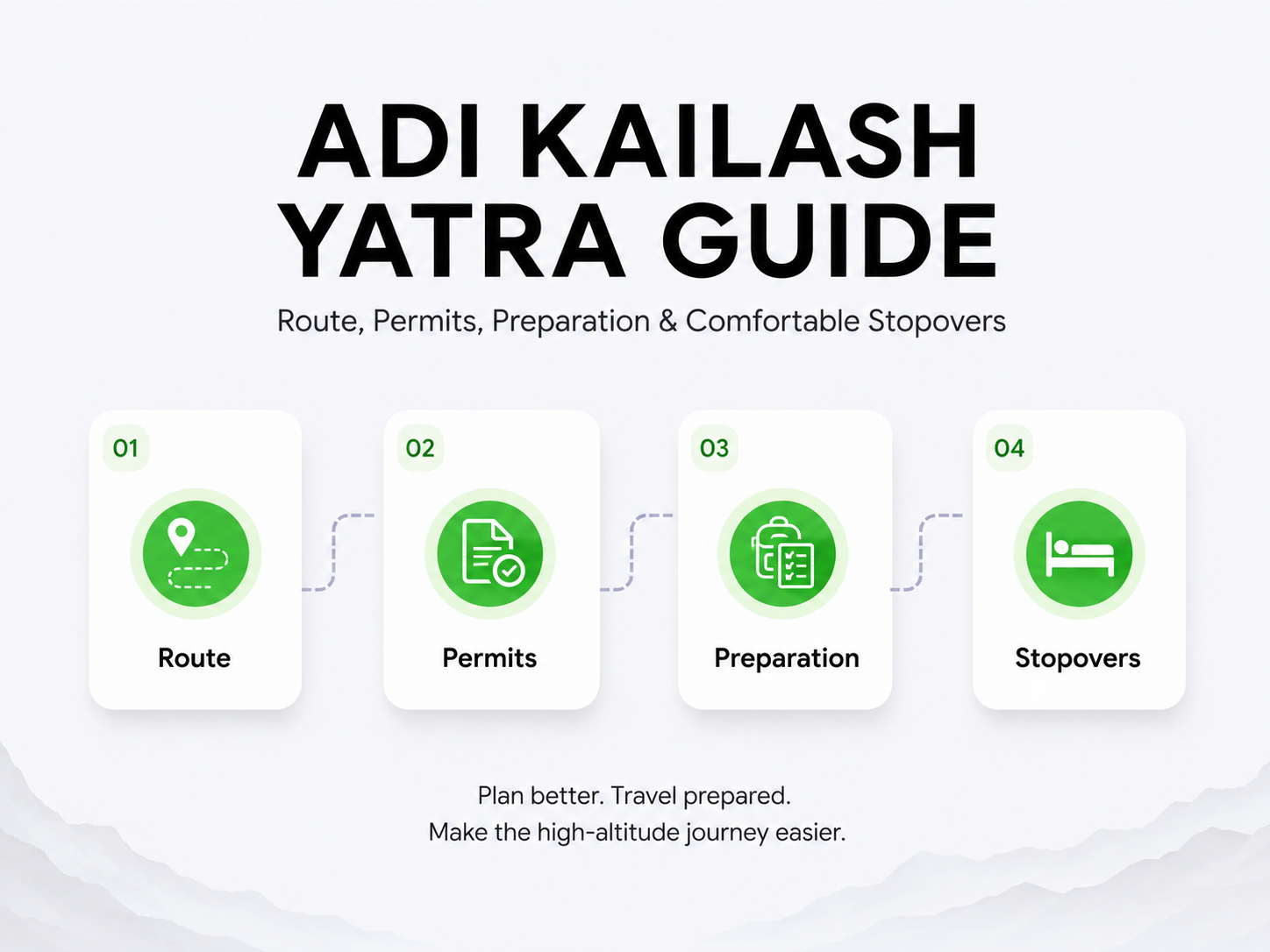
QUICK PLANNING ANSWER
Plan the Yatra through the Pithoragarh–Dharchula corridor, complete the currently required inner-line/administrative permissions, acclimatise before the highest road sectors and keep flexibility for temporary permit or road suspensions.
If you reached this guide by searching for a route guide, best stay, hotel near the pilgrimage, family accommodation, trek stopover or where to stay before the next temple, use one rule throughout: location must serve the itinerary. A room that looks inexpensive online can become poor value if it adds an extra taxi, a steep walk with luggage, a late-night arrival or an unnecessarily early start.
HOW TO USE THIS GUIDE
Build the journey in layers. First fix the sacred destination and operational route. Second identify the physically hardest day. Third choose the night before that day. Only after those three decisions should you compare hotel prices, photographs, room categories and meal plans. This order prevents the common mistake of booking attractive accommodation first and trying to force the pilgrimage around it later.
Estimated reading time: approximately 15–20 minutes. Mountain roads, permits, temple schedules, trek diversions, local transport rules and seasonal operations can change. Use this guide for planning, but reconfirm time-sensitive details from the relevant government, temple committee, district or authorised operator shortly before travel.
ROUTE AND STOPOVER LOGIC
The following sequence is designed as a planning framework, not as a promise that every road, trek or local transport arrangement will remain identical. In Uttarakhand, landslides, snow, monsoon rain, maintenance, crowd control and administrative decisions can change how a route operates. Reconfirm the live situation before each high-altitude stage.
DELHI/KATHGODAM OR HALDWANI
Use the Kumaon gateway to break the plains journey. A rest night can be smarter than driving continuously to Pithoragarh.
In this border-sensitive high-altitude region, administrative permission and local road control always take priority over a pre-written itinerary. Build flexibility into the night halt rather than arguing with a closure.
PITHORAGARH
A strong acclimatisation and logistics point with broader hotels, markets and medical facilities.
In this border-sensitive high-altitude region, administrative permission and local road control always take priority over a pre-written itinerary. Build flexibility into the night halt rather than arguing with a closure.
DHARCHULA
This is the critical administrative base for permits and movement into the higher valley. Do not leave documentation until the morning you want to depart.
In this border-sensitive high-altitude region, administrative permission and local road control always take priority over a pre-written itinerary. Build flexibility into the night halt rather than arguing with a closure.
TAWAGHAT AND UPPER VALLEY ROAD
Road conditions, convoy/security procedures and access can change; follow district and authorised operator instructions.
In this border-sensitive high-altitude region, administrative permission and local road control always take priority over a pre-written itinerary. Build flexibility into the night halt rather than arguing with a closure.
GUNJI
An important high-altitude base in the Vyas Valley. Use the halt to acclimatise rather than immediately rushing higher.
In this border-sensitive high-altitude region, administrative permission and local road control always take priority over a pre-written itinerary. Build flexibility into the night halt rather than arguing with a closure.
JOLINGKONG–ADI KAILASH SECTOR
The sacred mountain and Parvati Kund sector is extremely high. Weather, road and permit conditions determine access.
In this border-sensitive high-altitude region, administrative permission and local road control always take priority over a pre-written itinerary. Build flexibility into the night halt rather than arguing with a closure.
KALAPANI/NABHIDHANG–OM PARVAT EXTENSION
Often combined with Adi Kailash when the route is open, but this is a separate upper-valley movement and should not be assumed.
In this border-sensitive high-altitude region, administrative permission and local road control always take priority over a pre-written itinerary. Build flexibility into the night halt rather than arguing with a closure.
WHERE TO STAY AND HOW TO CHOOSE ACCOMMODATION
Comfortable stopovers matter most in Pithoragarh, Dharchula and authorised upper-valley homestays/camps. Expect facilities to become simpler as altitude and remoteness increase.
For SEO searches such as “best hotel”, “hotel near temple”, “stay near me”, “family stay”, “budget accommodation” or “rooms near the Yatra route”, do not judge relevance only from the town name shown by an OTA. Open the map, identify the actual walking or driving approach, and ask the property where the last vehicle point is. In mountain destinations, two properties that look equally close can involve very different slopes, stairs or road access.
THE PRACTICAL HOTEL CHECKLIST
- Confirm the exact date and number of adults, children and senior citizens.
- Ask for the final room category, bed configuration and maximum occupancy.
- Verify attached or shared bathroom arrangements and toilet type if relevant.
- Ask how hot water is provided and whether timings or charges apply.
- Confirm the room floor, stairs or lift when mobility matters.
- Get a map pin and ask where a taxi, bus or private vehicle can actually stop.
- Check dinner, breakfast and early-departure meal timing.
- Ask the final payable amount including taxes, extra beds and meals.
- Read cancellation and date-change rules before a non-refundable payment.
- Save the booking confirmation, payment proof and property contact offline.
BUDGET AND VALUE PLANNING
Pilgrimage accommodation should be compared by total journey cost, not only nightly tariff. A cheaper stay may add taxi charges, parking difficulty, extra porter expense or more walking. A slightly costlier room can deliver better value when it saves a tired family from an additional transfer. Avoid hard-coding a price from an old article; rates can change sharply with weekends, temple dates, school holidays, weather disruption and remaining inventory.
For a value comparison, calculate the cost per traveler after taxes and extra bedding. Then add any transport created by the location. Finally ask what practical problem the more expensive room solves. Pay more when the improvement is meaningful—safer access, private bathroom for seniors, family occupancy, shorter temple walk or a reliable early meal—not merely because the room has more decorative features.
FAMILY PLANNING
Families should plan the route around the slowest traveler. Keep children fed before long road sectors, avoid stacking two high-effort days back to back, and give grandparents enough time to use bathrooms and manage stairs without pressure. A multi-generation Yatra is successful when everyone reaches the temple with energy left for darshan; it is not successful simply because the vehicle covered the maximum possible distance each day.
SENIOR-CITIZEN CONSIDERATIONS
Age alone does not determine suitability, but high altitude, cold, long sitting, steep walking and rapid ascent can matter. Where a trek or very high road is involved, individual health should be considered in advance and professional medical guidance used when appropriate. During hotel selection, ask about vehicle drop-off, room floor, bathroom access, heating or blankets, and meal simplicity.
TRAVEL WITH CHILDREN
Children often tolerate a road trip differently from adults. Keep one accessible bag with dry layers, water, familiar snacks and necessary medicine. Do not make the child’s warm clothing part of the suitcase tied to a vehicle roof. At sacred sites, explain queue and silence expectations before entering rather than correcting them repeatedly inside a crowded temple or Ashram.
WEATHER AND BEST-SEASON STRATEGY
The Yatra generally operates in weather windows outside deep winter and the most disruptive monsoon conditions. Exact annual phases and permit dates can change.
The Himalayas reward flexible travelers. A forecast is useful, but local administration, police, temple committees, forest officials and authorised operators may have more immediate ground information. If a route is closed, a booked room, paid taxi or limited leave from work is never a reason to continue against official advice.
MONSOON PLANNING
During monsoon, keep at least one schedule buffer around long mountain-road or trekking sectors. Start early, avoid unnecessary night driving, carry waterproof layers and protect medicines and documents in dry pouches. Expect a journey to pause when debris is cleared or traffic is regulated. The correct response is to wait safely, not to search for an unverified shortcut.
COLD AND ALTITUDE PLANNING
Temperature can fall quickly after sunset and with altitude. Layering works better than one extremely bulky garment because you can adjust while walking or sitting in a vehicle. At high-altitude destinations, worsening severe headache, unusual breathlessness, confusion, poor coordination or other concerning symptoms need attention rather than being dismissed as normal pilgrimage tiredness.
PREPARATION BEFORE LEAVING HOME
Carry government ID, permit documents, warm layers, sunglasses, sunscreen, hydration supplies and personal medicines. Seek medical advice before rapid travel to very high altitude if you have relevant health concerns.
Train specifically for the journey you are planning. A road pilgrimage needs tolerance for long sitting and early starts; a trek requires walking endurance, stairs and recovery; a high-altitude road expedition needs acclimatisation discipline even if little walking is involved. Preparation should resemble the real physical demand rather than generic gym activity.
WHAT TO CARRY
- Government identification and required registrations or permits
- Warm layers appropriate to the highest point of the journey
- Rain jacket or poncho and a waterproof cover for the day bag
- Comfortable, already-used walking or trekking footwear
- Personal prescribed medicines and a small basic first-aid kit
- Refillable water bottle and compact familiar snacks
- Power bank, charging cable and offline copies of contacts/bookings
- Sunscreen, sunglasses and cap for high-altitude UV exposure
- A small amount of cash as backup where digital payments fail
- Only the luggage required for the next stage, not the entire holiday wardrobe
HOW TO PACK FOR A PILGRIMAGE HOTEL AND TREK
Use a two-bag system whenever the itinerary includes trekking: one main road bag that remains at the lower hotel and one light upper bag. Put dry socks, rain gear, warm layer, medicines and documents near the top. Do not pack by category alone; pack by urgency. An item needed during sudden rain should not be buried under night clothes.
FOOD AND HYDRATION
Simple meals usually work best before long drives and climbs. Eat enough to maintain energy without creating discomfort, and carry small snacks rather than one heavy meal in the backpack. Hydrate regularly, but do not force excessive water. In remote locations, use safe drinking-water sources and follow local guidance.
ROAD-SAFETY STRATEGY
Mountain road time is affected by curves, traffic, weather and road work. Do not calculate arrival by dividing distance by plains-highway speed. A rested driver is a safety requirement. If the group reaches a planned stop much later than expected, shorten the day rather than transferring the risk into a night drive.
BOOKING AND PAYMENT SAFETY
Verify the property identity before sending money. Use the property’s genuine listing or official contact, request written confirmation of the room and keep payment proof. Be especially careful when a stranger claims that only an immediate transfer can save the final room on a high-demand night. Urgency is common in pilgrimage season, but it should not replace verification.
CONNECTIVITY AND OFFLINE PLANNING
Save route maps, hotel pins, registration details, emergency contacts and the next day’s plan offline. Network strength varies across valleys and can worsen precisely when traffic or weather creates the greatest need to communicate. Tell family members the next planned stop before leaving a connected town.
PERMIT REALITY
Inner-line/administrative permissions are mandatory or controlled for upper sectors and can be temporarily suspended for weather, security or events. Verify with Pithoragarh/Dharchula authorities.
Use this point as a decision rule rather than a rigid instruction. The right choice depends on the group, current access and the season, but defining the decision in advance prevents confusion on the road.
ALTITUDE STRATEGY
Road access does not remove altitude risk. Rapid ascent by vehicle can expose the body faster than trekking would.
Use this point as a decision rule rather than a rigid instruction. The right choice depends on the group, current access and the season, but defining the decision in advance prevents confusion on the road.
VEHICLE CHOICE
Use vehicles and drivers permitted and experienced on the upper route; do not assume a normal city taxi can simply continue everywhere.
Use this point as a decision rule rather than a rigid instruction. The right choice depends on the group, current access and the season, but defining the decision in advance prevents confusion on the road.
KUMAON RECOVERY STOP
On the return to Delhi, some travelers add a lower-altitude Nainital/Jeolikote rest night rather than doing an extremely long final drive.
Use this point as a decision rule rather than a rigid instruction. The right choice depends on the group, current access and the season, but defining the decision in advance prevents confusion on the road.
SUGGESTED ITINERARY FRAMEWORK
The following structure is intentionally conservative. It protects sleep, daylight and recovery rather than maximising the number of attractions per day.
- Day 1 Delhi to Kumaon gateway
- Day 2 Pithoragarh
- Day 3 Dharchula permits
- Day 4 upper valley to Gunji
- Day 5 Adi Kailash/Jolingkong
- Day 6 Om Parvat sector if open
- Day 7–8 return with buffer
HOW TO MAKE THE ITINERARY SHORTER
If time is limited, remove optional sightseeing before removing sleep or safety buffer. Keep the core shrine/trek day intact, choose the closest sensible base and return another time for side trips. A shorter focused pilgrimage usually feels better than a longer checklist completed in exhaustion.
HOW TO MAKE THE ITINERARY MORE COMFORTABLE
Add a pre-trek or pre-high-altitude night, place a recovery night after the hardest day and reduce the number of hotel changes. Families can also keep two consecutive nights at a central base and make day excursions instead of repacking every morning.
COMMON MISTAKES TO AVOID
- Starting a long mountain drive after reaching the gateway late in the day
- Booking a hotel from the destination label without checking the real map location
- Carrying heavy luggage on a trek that only needs one overnight bag
- Assuming last year’s roadhead, permit, price or temple timing is still current
- Using the fastest traveler in the group to set everyone’s schedule
- Keeping no buffer during monsoon or around high-altitude aviation
- Ignoring stairs, bathroom type and vehicle access for senior citizens
- Booking non-refundable rooms across several days with no route flexibility
- Trying to combine a hard trek and a long night drive to save one hotel night
- Treating sacred places as ordinary sightseeing stops and rushing rituals
RESPONSIBLE PILGRIMAGE
Carry back non-biodegradable waste, refill bottles where safe, avoid loud music around sacred and village areas, and follow photography restrictions. Respect local communities, porters, drivers, temple workers and security staff. Mountain destinations bear the environmental cost of every visitor, so convenience should not become litter or unnecessary plastic.
FINAL PLANNING CHECKLIST
- Confirm the active route and opening/access conditions.
- Complete required registration or permits.
- Fix the hardest day and book the night before it first.
- Confirm critical accommodation and genuine payment details.
- Separate main luggage from day/trek luggage.
- Check weather and road status 24–48 hours before the high section.
- Reconfirm transport or driver reporting time.
- Keep offline documents, maps and emergency contacts.
- Leave schedule space for weather, fatigue and darshan queues.
- Travel only when the current official ground situation allows.
FREQUENTLY ASKED QUESTIONS
Is a permit required for Adi Kailash?
Upper Vyas Valley travel is controlled and inner-line/administrative permissions are required under current arrangements; verify the exact process for your date.
Can I drive my own car to Adi Kailash?
Do not assume so; upper-route vehicle permissions and road suitability should be confirmed locally.
How high is the route?
The upper pilgrimage reaches very high Himalayan terrain where altitude illness is possible.
Where should I acclimatise?
Pithoragarh, Dharchula and especially an upper halt such as Gunji are used to stage the ascent.
Can seniors travel?
Some do, but rapid altitude gain makes medical suitability more important than walking ability alone.
When should I avoid the Yatra?
Deep winter and periods of unsafe monsoon or road conditions; follow official closures.
Can I combine Om Parvat?
Often yes when access is open and permits allow, but never assume it is guaranteed.
What is the biggest mistake?
Treating improved road connectivity as proof that the trip no longer needs altitude, permit and weather planning.
FINAL THOUGHTS
The strongest Himalayan pilgrimage plan is not the one with the fewest hotel nights or the highest number of temples. It is the plan that keeps the route understandable, the luggage light, the group rested and the spiritual purpose intact. Use accommodation as part of route design, verify time-sensitive details before travel and let mountain conditions change the schedule when they need to.
For details / reservations: 9599190222