
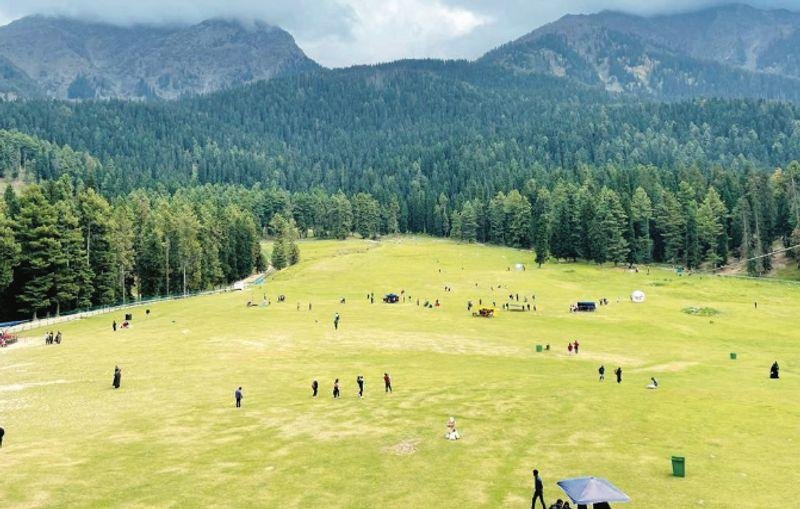
Baisaran Valley – A Scenic Himalayan Meadow Near Pahalgam and the Amarnath Pilgrimage Route
Baisaran Valley is a beautiful highland meadow near Pahalgam in the Anantnag district of Jammu and Kashmir. Surrounded by dense pine forests and overlooking the magnificent Lidder Valley, Baisaran is widely known as the “Mini Switzerland of Kashmir” because of its rolling green landscape, forest-covered slopes and distant mountain views. The meadow is reached from Pahalgam through a short uphill trek or pony ride rather than a direct road journey.
For devotees visiting Pahalgam as part of the Shri Amarnath Ji Yatra, Baisaran Valley offers a peaceful leisure experience before or after the pilgrimage. After spending long hours travelling, preparing for darshan or completing the physically demanding Amarnath route, pilgrims can enjoy a slower day surrounded by meadows, forests and mountain scenery.
Baisaran Valley can also be included after visiting the Shiva temples and sacred destinations around Pahalgam and Anantnag. By booking comfortable accommodation in Pahalgam through MudrasStays, travellers can combine temple darshan, pilgrimage preparation, nature sightseeing and proper rest within one well-planned spiritual journey.
A Peaceful Leisure Experience After Darshan
A temple journey is often physically and emotionally intense. Pilgrims may travel long distances, wake up early for darshan, stand in queues and walk across difficult mountain routes. Baisaran Valley provides a peaceful setting where devotees can pause after these experiences and spend relaxed time with their families.
The broad meadow is surrounded by pine, fir and cedar forests, with views extending towards Pahalgam and the wider Lidder Valley. Visitors can walk across the grass, sit quietly amid the mountains, take family photographs or simply enjoy the fresh Himalayan air. JKTDC identifies Baisaran Hills as a meadow a few kilometres from Pahalgam, enclosed by dense forests and overlooking the Lidder Valley.
The destination is especially suitable for:
Families extending an Amarnath pilgrimage
Devotees resting before or after darshan
Couples combining spiritual travel with a mountain holiday
Religious groups staying in Pahalgam
Families travelling with children
Nature lovers and photographers
Travellers interested in short treks and pony rides
Baisaran is not a place that needs to be explored through a crowded sightseeing schedule. Its greatest attraction is the opportunity to slow down, sit amid nature and experience the peaceful landscape surrounding Pahalgam.
Why Baisaran Is Called the Mini Switzerland of Kashmir
Baisaran Valley is commonly referred to as the Mini Switzerland of Kashmir because its gently undulating green meadow is framed by thick forests and mountain ranges. During the warmer months, the grassland becomes bright green, while the surrounding pine forest creates a dramatic natural boundary around the open meadow. The District Anantnag tourism portal uses the same popular description and presents Baisaran as a short trek or pony excursion offering views over Pahalgam and the Lidder Valley.
The meadow offers a visual experience that differs from the riverside landscapes of Betaab Valley or the village atmosphere of Aru Valley. Baisaran feels elevated and enclosed, with the open grassland appearing almost hidden inside the surrounding forest.
Visitors can enjoy:
Panoramic views of the meadow
Pine, fir and cedar forests
Distant mountain scenery
Leisurely nature walks
Pony rides from Pahalgam
Family picnics
Landscape photography
Seasonal snow views
Peaceful time away from the main market
The appearance of Baisaran changes with the season. Summer brings green grass and comfortable outdoor conditions, while colder periods may bring frost or snow depending on prevailing weather.
Baisaran Valley and the Amarnath Yatra
Pahalgam is one of the two principal gateways to the sacred Shri Amarnath Ji Cave. The traditional Pahalgam route begins near Nunwan and continues through Chandanwari, Pissu Top, Sheshnag and Panchtarni before reaching the holy cave. The official Shri Amarnath Ji Shrine Board identifies Nunwan near Pahalgam as the base camp for this route.
Baisaran Valley is not situated on the official Amarnath trekking route. It should therefore be planned as a separate leisure excursion from Pahalgam rather than as a yatra halt.
Pilgrims can visit Baisaran:
Before beginning the Amarnath Yatra, when they have a free day
After returning from darshan and taking adequate rest
During an additional sightseeing day in Pahalgam
As part of a family holiday centred around the pilgrimage
Travellers should avoid visiting Baisaran immediately before a fixed yatra reporting time. Registration requirements, health documentation, weather conditions and Shrine Board movement instructions should always receive priority.
A comfortable itinerary can include:
Pahalgam arrival – local Shiva temple darshan – Baisaran Valley – Amarnath Yatra preparation – Shri Amarnath Ji darshan – recovery stay in Pahalgam
This approach allows pilgrims to enjoy the mountain scenery without making the pilgrimage schedule unnecessarily tiring.
Begin the Day with Shiva Darshan in Pahalgam
Pahalgam is closely associated with Lord Shiva because of its connection with the Amarnath pilgrimage. Devotees can begin the day with prayers at a local Shiva shrine in the Pahalgam area and then proceed towards Baisaran Valley for a peaceful nature excursion.
This combination gives the day a balanced spiritual and leisure character. The morning can be devoted to darshan and prayer, while the afternoon can be spent walking through the meadows and enjoying the surrounding mountains.
Pilgrims should maintain enough time for the uphill journey to Baisaran and return to Pahalgam before weather or visibility deteriorates. Mountain conditions can change quickly, particularly during the monsoon and colder months.
Reach Baisaran by Trek or Pony Ride
Baisaran Valley is generally reached through an uphill trail from Pahalgam. Visitors can either walk or use locally available pony services. The District Anantnag tourism portal officially describes Baisaran as a popular short trek or pony ride from Pahalgam.
The walking route can be enjoyable for active travellers, but the trail may include steep, uneven or muddy sections depending on weather and ground conditions. Pilgrims who have recently completed the Amarnath Yatra should assess their energy levels before attempting the trek.
Visitors considering a pony ride should:
Use locally authorised or recognised operators
Confirm the full route before starting
Agree on the total charge in advance
Ask whether additional viewpoints are included
Avoid travelling during heavy rain or poor visibility
Check the saddle and basic safety arrangements
Follow local instructions throughout the journey
Senior citizens, small children, pregnant travellers and visitors with back, knee or mobility concerns should carefully assess whether the trek or pony journey is suitable for them.
The route should never be attempted alone during poor weather or late in the day.
Walk Through the Baisaran Meadow
Once visitors reach Baisaran, the landscape opens into an expansive grassland surrounded by forest. The contrast between the open meadow and the dense trees gives the destination its distinctive character.
Families can walk slowly across the meadow, rest at a suitable spot and enjoy views of the surrounding slopes. Children may enjoy the open space, while adults can appreciate the quiet environment and mountain scenery.
The meadow is particularly attractive for family and group photographs. However, visitors should avoid damaging grass, plants or forest areas while creating photographs. Loud music and littering should also be avoided so that the peaceful environment remains undisturbed.
Baisaran is part of an ecologically sensitive mountain landscape. Visitors should carry back all plastic bottles, food wrappers and disposable items rather than leaving waste in the meadow or along the forest trail.
A Gateway for Tulian Lake Trekkers
Baisaran is also associated with the trekking route towards Tulian Lake, a high-altitude alpine lake surrounded by snow-covered mountains. JKTDC identifies Baisaran as a campsite area, while Tulian Lake is presented as a destination for experienced trekkers who are advised to travel with a local guide.
The Tulian Lake trek is very different from an ordinary visit to Baisaran. It requires greater physical fitness, proper trekking equipment, suitable weather and professional local guidance.
Pilgrims visiting only for leisure should remain within the recognised Baisaran excursion area and return to Pahalgam on the same day. Those planning a longer trek should arrange it separately and should not combine it with a tightly scheduled temple or yatra day.
Travellers planning mountain trekking should:
Hire an experienced local guide
Check the latest route and weather conditions
Carry proper trekking shoes
Take sufficient water and food
Carry warm and waterproof layers
Inform the hotel about the intended route
Avoid trekking during unstable weather
Keep adequate time for acclimatisation
Combine Baisaran with Betaab Valley
Betaab Valley is another famous attraction near Pahalgam. It is known for riverside lawns, forested mountain views and its association with the Hindi film Betaab. In contrast, Baisaran is an elevated meadow reached through a trek or pony ride.
The two destinations offer different experiences:
Baisaran Valley: Elevated grassland, pine forests, short trek and pony journey
Betaab Valley: Road-accessible riverside scenery and family leisure
Aru Valley: Mountain village, meadows and trekking routes
Chandanwari: Gateway to the traditional Amarnath pilgrimage route
Visitors staying in Pahalgam for several days can explore these places separately rather than trying to cover everything in one rushed day.
A two-day leisure plan may include:
Day 1: Local temple darshan and Baisaran Valley
Day 2: Betaab Valley and Chandanwari
This is generally more comfortable for families, children and senior citizens.
Combine Baisaran with Aru Valley
Aru Valley is a picturesque village and meadow destination near Pahalgam. It is accessible by road and serves as a base for treks towards Lidderwat, Tarsar, Marsar and the Kolahoi region. Incredible India places Aru about 12 kilometres from Pahalgam and describes it as a peaceful rural destination known for mountains, lakes and scenic meadows.
Aru and Baisaran should preferably be explored on separate days because they involve different routes and experiences.
Baisaran is ideal for visitors seeking a forest trail and a broad hilltop meadow. Aru is better suited to travellers who want a scenic drive, village surroundings and access to longer trekking routes.
Visit Martand Sun Temple During the Journey
Travellers approaching Pahalgam through Anantnag can add the ancient Martand Sun Temple to their itinerary. The historic temple complex is dedicated to Surya, the Sun God, and is known for its monumental stone columns and distinctive Kashmiri architecture. The District Anantnag tourism portal identifies it as an eighth-century Hindu temple and one of the region’s important historical and religious attractions.
A wider temple and leisure circuit may include:
Martand Sun Temple – Pahalgam – local Shiva darshan – Baisaran Valley – Chandanwari – Shri Amarnath Ji
This itinerary connects Kashmir’s ancient Hindu heritage with the sacred Amarnath pilgrimage and the natural beauty surrounding Pahalgam.
The route should be divided across several days so that travellers have sufficient time for darshan, sightseeing and proper rest.
Best Time to Visit Baisaran Valley
Baisaran Valley offers different experiences throughout the year.
Spring
Spring brings fresh greenery, melting snow and pleasant weather. The trail may remain wet or muddy in certain sections, so suitable footwear is important.
Summer
Summer is the most popular period for green meadows, walking and family outings. It may overlap with the Amarnath Yatra season, leading to increased demand for hotels, transport and local services around Pahalgam.
Monsoon
Rain deepens the greenery but can make the uphill route slippery. Travellers should avoid the journey during heavy rain, thunderstorms or poor visibility.
Autumn
Autumn offers cooler temperatures, clearer skies and changing forest colours. It can be an attractive period for photography and quiet walks.
Winter
Snow may transform Baisaran into a white landscape. Access depends on snowfall, trail conditions and local instructions. Visitors should carry proper winter clothing and confirm whether the route is accessible before starting.
Weather in the Kashmir Himalayas can change quickly. Visitors should check the forecast and local travel conditions on the day of the excursion.
How Much Time to Keep for Baisaran Valley
Travellers should generally keep around half a day for the complete Baisaran experience, including the uphill journey, time in the meadow and return to Pahalgam.
Additional time may be required when:
Travelling with children or senior citizens
Walking rather than using a pony
Visiting during peak tourism periods
Stopping at intermediate viewpoints
Encountering muddy or difficult trail conditions
Spending extended time in the meadow
Travelling with a large group
Visitors should begin early enough to return before evening. The forested trail should not be attempted after dark.
Food and Refreshments
Small seasonal stalls may operate around tourist areas, but availability can change according to weather, visitor numbers and local permissions.
Families should carry essential supplies such as:
Drinking water
Light snacks
Food suitable for children
Required medicines
Warm clothing
Rain protection
Basic first-aid items
For a proper meal, travellers can return to Pahalgam, where hotels and restaurants serve Kashmiri, North Indian and vegetarian food.
Pilgrims following a satvik or strictly vegetarian diet should confirm ingredients directly with the restaurant before ordering.
Travel and Safety Advisory
Baisaran is a remote meadow without direct road access. Visitor arrangements, pony movement, security instructions and entry conditions can change according to weather and local administrative requirements.
Before starting the excursion, travellers should confirm current access with:
Their hotel in Pahalgam
The local tourism office
District or police authorities
An authorised guide or pony operator
The J&K Tourism Department is the government body responsible for tourism regulation and visitor promotion across the region, while the District Anantnag portal publishes information about recognised tourist attractions, including Baisaran.
Visitors should follow all checkpoints, security directions and local restrictions. Sightseeing plans should remain flexible if access is temporarily affected by weather or official instructions.
How to Reach Baisaran Valley
Pahalgam is the main base for visiting Baisaran. From the town, visitors continue uphill on foot or by pony through the forest trail. Official sources consistently describe the destination as a few kilometres from Pahalgam and accessible through a short trek or pony journey.
Travellers first reach Pahalgam by road from Anantnag or Srinagar. Local transport rules may vary, so hotel-arranged taxis or authorised transport services are generally the most convenient option for reaching Pahalgam.
Because the final section to Baisaran is not road-accessible, travellers should carry only essential belongings and leave heavy luggage securely at their hotel.
Where to Stay When Visiting Baisaran Valley
Pahalgam is the most convenient accommodation base for a visit to Baisaran Valley. The town offers hotels, resorts, cottages, yatri accommodation and family stays across different categories. JKTDC lists several accommodation options in Pahalgam, including resorts, hotels and Yatri Niwas facilities.
When selecting accommodation, pilgrims should consider:
Access to the Baisaran starting point
Distance from the Pahalgam market
Proximity to the Nunwan yatra base
Availability of vegetarian meals
Hot-water and heating facilities
Ground-floor or lift-accessible rooms
Family-room availability
Taxi and pony-booking assistance
Secure luggage storage during the yatra
Flexible check-in and check-out arrangements
Travellers undertaking the Amarnath Yatra should keep at least one proper rest period before or after the pilgrimage rather than combining the yatra and Baisaran excursion without recovery time.
Book Hotels Near Baisaran Valley with MudrasStays
MudrasStays helps pilgrims find comfortable accommodation near temples, pilgrimage destinations and the leisure attractions surrounding sacred routes.
Travellers planning a Pahalgam and Baisaran journey can explore:
Hotels near Baisaran Valley
Family stays in Pahalgam
Accommodation near local Shiva temples
Hotels near the Amarnath Yatra route
Stays near Nunwan base camp
Hotels close to the Lidder River
Accommodation near Betaab Valley and Aru Valley
Pilgrimage-friendly stays for families and senior citizens
Choosing the right accommodation reduces unnecessary travel and helps pilgrims divide their journey between temple darshan, sightseeing and proper rest.
A thoughtfully planned trip through MudrasStays can bring together:
Shiva temple darshan, Baisaran Valley sightseeing, Pahalgam exploration, Amarnath Yatra preparation, comfortable stays and meaningful family time.
Baisaran Valley is more than a picturesque meadow near Pahalgam. For temple travellers, it is a peaceful pause within a sacred Himalayan journey—a place where devotees can rest after darshan, walk through pine forests and experience the natural beauty surrounding the Amarnath pilgrimage circuit.
By adding Baisaran Valley to your itinerary and booking a suitable stay through MudrasStays, you can transform a demanding pilgrimage into a complete spiritual and leisure experience filled with faith, mountain scenery, relaxation and lasting family memories.