
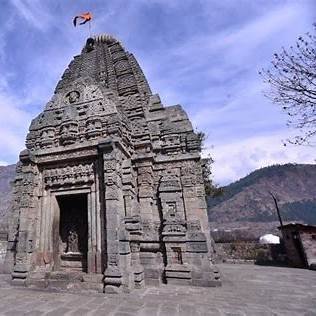
Basheshwar Mahadev Temple, also written as Basheshar Mahadev, Basheswar Mahadev, Bishweshwar Mahadev or Vishveshvara Mahadev Temple, is one of the most important ancient stone temples in the Kullu Valley of Himachal Pradesh. Located in Bajaura village near Bhuntar and Kullu, the temple is dedicated to Lord Shiva and is admired for its tall stone shikhara, richly carved exterior, sacred Shiva lingam and remarkable sculptural representations of Hindu deities.
Unlike many temples in the Kullu–Manali region that are constructed primarily from timber and crowned with layered pagoda-style roofs, Basheshwar Mahadev Temple is built almost entirely from stone. Its strong vertical tower, intricate relief work and compact architectural plan give it a distinctive appearance within the Himalayan landscape.
The temple stands in the lower part of the Kullu Valley, close to the Beas River and the important road corridor linking Mandi, Bhuntar, Kullu, Manali and the Parvati Valley. Its comparatively accessible location makes it suitable for families, senior citizens, heritage travellers, architecture enthusiasts and devotees who may not be able to undertake a demanding mountain trek.
Basheshwar Mahadev Temple is recognised as a protected heritage monument and remains an active place of Shiva worship. Visitors can seek the blessings of Mahadev while also observing an exceptional example of early Himalayan stone architecture.
The combination of religious importance, sculptural beauty, road accessibility and proximity to Bhuntar makes the shrine an ideal spiritual stop for travellers entering or leaving the Kullu Valley.
Pilgrims can include Basheshwar Mahadev Temple in itineraries covering Kullu, Bhuntar, Naggar, Manali, Bijli Mahadev, Manikaran, Kasol, Banjar and the Tirthan Valley. Travellers arriving through Kullu–Manali Airport can also plan a temple visit according to their flight schedule and available daylight.
## Spiritual Importance of Basheshwar Mahadev Temple
The principal deity of Basheshwar Mahadev Temple is Lord Shiva, worshipped through a sacred Shiva lingam within the sanctum.
Lord Shiva represents meditation, transformation, destruction of ignorance, spiritual awareness and liberation. Devotees approach him as Mahadev, the great deity who remains beyond ordinary limitations while also responding compassionately to sincere prayer.
The name Vishveshvara or Bishweshwar can be understood as “Lord of the Universe.” It expresses the idea that Shiva is not restricted to one location, form or community but represents the consciousness present throughout creation.
The locally used name Basheshwar or Basheshar is associated with this wider Vishveshvara tradition and has developed through regional pronunciation and usage.
Devotees visit the temple to pray for health, protection, family welfare, peace of mind, success in important work and relief from personal difficulties.
Some worshippers arrive before beginning a journey through the mountains and seek Mahadev’s protection for the road ahead. Others visit after completing a pilgrimage or experiencing what they regard as the fulfilment of a prayer.
Families may offer worship before marriage ceremonies, the birth of a child, the start of a business or another important phase of life.
Students and professionals may pray for discipline, clarity and courage. Spiritual seekers may visit for meditation and reflection.
These prayers belong to personal faith and should not be presented as guaranteed outcomes. The temple provides a sacred space for worship and emotional reassurance, while practical action and responsible decision-making remain essential in everyday life.
## The Shiva Lingam and Yoni Base
The sacred centre of the temple is the Shiva lingam installed within a yoni base.
In Shaivite philosophy, the lingam represents the formless and limitless presence of Lord Shiva. It is not intended merely as a physical representation of a human-like deity. Its simple form directs attention towards the universal nature of divine consciousness.
The yoni base is associated with Shakti, the creative and active power of the Divine Mother. Together, the lingam and yoni represent the inseparable relationship between Shiva and Shakti, consciousness and energy, stillness and creation.
This symbolism gives the sanctum a deeper spiritual meaning. Shiva and Shakti are not understood as competing forces but as complementary aspects of existence.
Devotees may offer water, flowers, bilva leaves and other permitted materials according to the directions of the priest.
Because Basheshwar Mahadev is both a living temple and a protected heritage structure, the use of milk, oil, colour, incense and other ritual materials may be regulated to prevent damage to old stone surfaces.
Visitors should follow the instructions of the priest and heritage authorities rather than assuming that practices allowed at a modern temple are automatically appropriate here.
The sacred lingam should not be touched, moved or photographed without permission. Flash photography inside the sanctum should be avoided unless explicitly authorised.
A simple prayer offered respectfully is more meaningful than excessive puja material that later becomes waste.
## History and Antiquity
Basheshwar Mahadev Temple is generally associated with the early medieval period of Himalayan temple construction.
Art-historical descriptions frequently place the temple between approximately the eighth and tenth centuries, with many accounts referring specifically to the late eighth or ninth century. Other descriptions suggest a broader period extending towards the eleventh century.
The precise original construction date is not stated definitively in the official protected-monument listing, so exact dating should be approached cautiously.
The temple’s architectural form, carvings and sculptural programme nevertheless demonstrate that Bajaura was an important religious and cultural location many centuries ago.
The lower Kullu Valley historically formed a passage between the plains, Mandi, the Beas Valley and the higher Himalayan regions. Travellers, traders, rulers, craftspeople and pilgrims moved through this landscape over long periods.
Bajaura’s location near the entrance to the wider Kullu Valley would have made it a strategically and culturally significant settlement.
The presence of an elaborate stone Shiva temple indicates access to skilled builders, sculptors, patronage and organised religious institutions.
Constructing a stone shikhara temple required considerable knowledge of proportion, weight distribution, carving and sacred architectural principles. The surviving structure reflects both technical achievement and continuing community care.
The temple has experienced weather, seismic activity, repairs and changes in its surroundings. Like most living heritage monuments, it may contain work from different periods rather than remaining completely unchanged from the moment of its first construction.
Visitors should therefore appreciate the temple as a structure whose religious life has continued while conservation and maintenance have protected it from deterioration.
## The Pandava Legend
A popular local tradition says that Basheshwar Mahadev Temple was built by the Pandavas during their exile.
According to the Mahabharata, the Pandavas travelled through forests and distant regions during periods of exile and concealment. Many places across the Himalayas preserve traditions connecting particular temples, caves, pathways and water sources with their journeys.
At Bajaura, one version of the story says that the Pandavas constructed the temple within a single night. Such one-night temple-building stories are found at several Himalayan shrines and usually emphasise supernatural ability, devotion and the sacred antiquity of the site.
The Pandava connection should be understood as local mythology and oral religious tradition rather than verified archaeological history.
There is no need to present the legend as proven fact in order to appreciate its cultural importance. For generations, the story has helped local communities connect Basheshwar Mahadev Temple with the sacred geography of the Mahabharata.
The narrative also reinforces the belief that the Pandavas were devotees of Lord Shiva and established or worshipped Shiva lingams during their Himalayan journeys.
Visitors may hear different versions from priests, residents and guides. These variations are normal in oral traditions and should be listened to respectfully.
The genuine architectural and archaeological significance of the temple remains strong even when its legendary origin is clearly distinguished from documented history.
## Protected Heritage Status
The Archaeological Survey of India recognises the Temple of Basheshar Mahadeo at Hat, Bajaura, as a centrally protected monument.
This status confirms that the temple possesses importance extending beyond the immediate community. It forms part of India’s nationally protected architectural and cultural heritage.
Protected status also places responsibilities on visitors.
The temple walls, sculptures, doorway, shikhara and surrounding archaeological features should not be touched unnecessarily.
Visitors must not carve names, scratch marks, apply paint or attach stickers to the stone.
Coins, oil, vermilion, water and other substances should not be applied to protected exterior sculptures unless a specific ritual remains officially permitted.
People should not lean against carved walls, place luggage on sculptures or climb onto the raised temple base for photographs.
Children should be supervised and taught that the temple is not an ordinary playground.
Professional photography, commercial filming, large lighting equipment, tripods and drones may require official permission.
The absence of a ticket counter or visible guard at a particular moment should not be interpreted as permission to ignore heritage regulations.
A protected monument can suffer permanent damage from small repeated actions. Thousands of visitors touching the same carving, applying colour or sitting on the same stone surface can gradually erase historic detail.
Responsible darshan allows religious worship and heritage preservation to continue together.
## Stone Shikhara Architecture
The most striking architectural feature of Basheshwar Mahadev Temple is its tall stone shikhara.
A shikhara is the tower rising above the sanctum of a North Indian Hindu temple. It symbolically represents a sacred mountain and directs the eye upward from the earthly courtyard towards the sky.
At Basheshwar Mahadev, the tower has a strong pyramidal and vertically rising appearance. Its surface is divided into architectural bands, projections, miniature forms and carved sections.
The structure appears compact and powerful rather than spread horizontally across a large complex.
The shikhara is crowned by an upper element that completes the vertical movement of the building. A sacred flag may also be visible above the temple according to current arrangements.
The stone surface changes appearance throughout the day. Morning light reveals fine carving on one side, while afternoon shadows emphasise the depth of niches and sculptural projections.
During cloudy weather, the dark stone can appear especially dramatic against the green valley and mountain background.
The architectural experience is very different from visiting the wooden pagoda temples for which Himachal Pradesh is widely known.
A traveller can compare Basheshwar Mahadev with Tripura Sundari Temple in Naggar, Hadimba Devi Temple in Manali or other timber shrines to understand the diversity of Himalayan sacred architecture.
The stone form also creates connections with Gauri Shankar Temple at Naggar, the Shiva temples of Jagatsukh and historic shrines found elsewhere across the western Himalayas.
## Exterior Carvings
Basheshwar Mahadev Temple is particularly celebrated for the richness of its exterior stone carving.
The walls contain decorative bands, floral designs, pot motifs, divine figures, animals, mythical beings and complex ornamental patterns.
The sculptural programme transforms the outer surface into a visual expression of religious philosophy, natural abundance and artistic skill.
Carved foliage can symbolise fertility, continuity and the life-giving power of nature.
Pot or kalasha forms are associated with abundance, purity and sacred presence.
Animals and birds may carry religious symbolism while also reflecting the sculptors’ observation of the natural world.
Figures commonly described as kinnars or celestial beings appear within the decorative composition. In Hindu and Himalayan traditions, kinnars are associated with music, beauty and celestial realms.
Naga figures and serpent-related motifs may represent water, fertility, protection and the sacred powers associated with the earth.
Visitors should observe these carvings patiently rather than rushing directly into the sanctum and leaving immediately.
The outer walls form an essential part of the temple’s meaning and artistic achievement.
A knowledgeable heritage guide can help identify sculptural themes, but visitors should be cautious about accepting every dramatic explanation given by an unverified source.
Some figures may be weathered, incomplete or interpreted differently by scholars.
The safest approach is to describe what can be clearly seen and treat uncertain identifications with care.
## Ganesha, Vishnu and Durga Sculptures
Prominent niches around the temple are commonly identified with images of Lord Ganesha, Lord Vishnu and Goddess Durga.
Their presence makes the temple more than an isolated shrine devoted to a single divine form. It reflects a wider sacred universe in which Shiva, Vishnu, Devi and Ganesha are honoured within one architectural programme.
Lord Ganesha represents wisdom, auspicious beginnings and the removal of obstacles. Devotees often remember him before beginning worship or undertaking important work.
The Ganesha sculpture at Basheshwar Mahadev is traditionally described as being seated upon a lotus-related throne supported by animal forms.
Lord Vishnu represents preservation, order and protection. His sculptural image is generally recognised through attributes such as the conch, discus, mace and lotus.
Goddess Durga represents courage, protection and the victory of divine order over destructive forces. The exterior image is commonly described as an armed form of the goddess defeating a demon.
These sculptures demonstrate the extraordinary ability of the temple’s artisans to create complex divine figures from stone.
Visitors should not touch the images or apply substances merely because they depict worshipped deities. Protected sculptures may require different conservation treatment from modern idols inside active shrines.
Where a sculpture continues to receive authorised ritual worship, the appropriate practice should be confirmed with the priest.
## River Goddesses at the Entrance
The entrance area is commonly associated with carved female figures representing the river goddesses Ganga and Yamuna.
River goddesses frequently appear at the doorways of North Indian temples. Their presence symbolically purifies the devotee before entry into the sacred interior.
Ganga and Yamuna are among the most revered rivers in Hindu tradition. Their placement near a temple doorway transforms the threshold into a symbolic crossing from ordinary space into the divine realm.
The visitor does not merely enter a building. The doorway represents spiritual preparation, purification and transition.
Travellers should pause at the entrance rather than blocking it for photographs.
The carved doorway, guardians and associated figures deserve careful observation, but the movement of devotees must remain uninterrupted.
If a guide identifies particular sculptures as Ganga or Yamuna, visitors may also observe the attributes, attendants or vehicle forms traditionally used to distinguish them.
Some details may have weathered over time, and interpretation should remain cautious.
## Shiva, Vishnu and Shakti in One Temple
The combined presence of Shiva, Vishnu, Ganesha and Durga reflects an inclusive vision of Hindu worship.
Although Basheshwar Mahadev is primarily a Shiva temple, its sculptural programme recognises multiple forms of divine power.
This can be understood through the principle that different deities express different dimensions of one sacred reality.
Shiva represents transformation and consciousness.
Vishnu represents preservation and cosmic order.
Durga represents divine power and protection.
Ganesha represents wisdom and auspicious beginnings.
The Shiva lingam and yoni together represent the union of consciousness and creative energy.
For pilgrims, the temple can therefore become a place to pray for balance rather than only one narrowly defined blessing.
A family may seek protection from Durga, guidance from Ganesha, stability from Vishnu and spiritual clarity from Shiva within the same sacred environment.
## Bajaura and the Beas Valley
Bajaura is located in the lower Kullu Valley near Bhuntar, where the landscape begins opening towards Kullu, Manali and the Parvati Valley.
The wider region is shaped by the Beas River, mountain slopes, settlements, orchards and important transport routes.
The Beas is one of the principal rivers of Himachal Pradesh and has supported agriculture, habitation and travel throughout the valley.
Its presence also contributes to the sacred geography of the region.
Visitors should treat the river with care. Strong currents, sudden depth changes and changing water levels can make Himalayan rivers dangerous even when they appear calm.
Travellers should not enter the Beas at unauthorised locations or climb onto wet rocks for photographs.
Nothing should be thrown into the river, including flowers, plastic, food packaging or religious material.
Protecting the river is consistent with the values expressed through temple pilgrimage.
Bajaura is a lived-in settlement rather than a purpose-built tourist attraction. Visitors should respect village roads, homes, shops and agricultural property.
Private orchards and courtyards should not be entered without permission.
Local residents should not be photographed without consent.
## Mahashivratri at Basheshwar Mahadev
Mahashivratri is one of the most important occasions for visiting Basheshwar Mahadev Temple.
The festival is dedicated to Lord Shiva and is observed through fasting, prayer, mantra recitation, abhishek and night worship.
The temple may receive devotees from Bajaura, Bhuntar, Kullu and surrounding villages.
Flowers, bells, lamps and devotional chanting can transform the usually quiet heritage shrine into a vibrant centre of worship.
Visitors planning to attend during Mahashivratri should expect larger crowds and possible traffic or parking limitations.
Families with senior citizens or young children may prefer visiting during the earlier hours of the day.
Accommodation near Bhuntar and Kullu should be reserved in advance when Mahashivratri coincides with a weekend or busy travel period.
Temple timings and the exact festival programme may change annually. Pilgrims should confirm current arrangements through local priests, residents or accommodation providers.
Religious ceremonies should take priority over photography. Visitors should not obstruct darshan queues or remain directly in front of the sanctum while creating videos.
## Shravan and Monday Worship
The Hindu month of Shravan is especially sacred for devotees of Lord Shiva.
Pilgrims may visit Basheshwar Mahadev to offer water, bilva leaves, flowers and prayers during this period.
Mondays are traditionally associated with Shiva worship and may attract additional local devotees throughout the year.
Shravan often overlaps with the monsoon season in Himachal Pradesh. Travellers should therefore balance religious plans with weather and road safety.
Heavy rain can cause landslides, falling stones, traffic delays and rising river levels across the Kullu region.
Visitors should monitor official advisories and avoid travel during severe weather warnings.
A temple visit can be postponed; personal safety should not be compromised for a fixed religious schedule.
## Best Time to Visit Basheshwar Mahadev Temple
The temple can generally be visited throughout the year because it is located at a comparatively accessible elevation near Bajaura and Bhuntar.
Every season offers a different experience.
### Spring
Spring is one of the most pleasant periods for visiting.
Temperatures are generally comfortable, trees and orchards begin showing new growth and the valley becomes suitable for temple and heritage travel.
Morning and evening may remain cool, so a light jacket is useful.
Spring is suitable for families, senior citizens, architecture enthusiasts and travellers combining Bajaura with Naggar or Manali.
### Summer
Summer is a popular travel period in the Kullu Valley.
The weather is considerably more comfortable than in many cities of the plains, although Bajaura and Bhuntar can feel warmer than higher destinations such as Manali.
Early morning or late afternoon is suitable for temple visits and architectural photography.
Visitors should carry water and sun protection.
Traffic may increase on the Kullu–Manali and Parvati Valley routes during school holidays. Travellers should allow additional road time.
### Monsoon
The monsoon makes the valley green and atmospheric.
Moisture can darken the old stone surfaces and emphasise the depth of the temple carvings.
However, heavy rainfall creates risks including landslides, falling stones, road closures and flooding.
The Beas and its tributaries can rise rapidly.
Travellers should not approach riverbanks during high-water conditions.
The stone courtyard and access path may become slippery, so footwear with dependable grip is recommended.
Flexible itineraries are essential during monsoon travel.
### Autumn
Autumn is among the best seasons for visiting Basheshwar Mahadev Temple.
Rain generally reduces, the landscape remains fresh and road conditions may become more stable.
The period around Kullu Dussehra provides an opportunity to experience the wider deity culture of the valley.
Accommodation in Kullu, Bhuntar and Manali may fill quickly during the festival, so advance booking is advisable.
### Winter
Winter provides a quiet and peaceful temple experience.
Bajaura and Bhuntar are generally more accessible than higher mountain destinations, but cold mornings, fog, frost and occasional weather disruption remain possible.
Snowfall at Basheshwar Mahadev Temple itself should not be guaranteed for a specific date.
Travellers seeking snow usually need to continue towards higher parts of the valley, subject to current road conditions.
Visitors should carry warm clothing and confirm heating and hot-water facilities at their accommodation.
## Morning and Evening Darshan
Morning is one of the best times to visit the temple.
The courtyard is quieter, the air is fresh and soft sunlight can reveal fine details in the eastern and southern carvings.
An early visit also leaves sufficient time for onward travel towards Kullu, Manali, Naggar, Kasol or Tirthan.
Evening creates a different atmosphere as lamps, bells and fading mountain light bring attention back to the active religious life of the shrine.
Visitors planning evening darshan should confirm closing times and complete onward travel carefully.
The temple’s timings may vary according to season, festivals, priestly arrangements and conservation work.
Travellers should not rely entirely on old online listings. Current timings should be checked locally before making a tightly scheduled visit.
## Reaching Basheshwar Mahadev Temple
Basheshwar Mahadev Temple is located in Bajaura village near Bhuntar in Kullu district.
It lies along the principal road corridor used by travellers entering the Kullu Valley from Mandi and continuing towards Kullu and Manali.
Himachal tourism information commonly places the shrine approximately 15 kilometres from Kullu.
Bhuntar is the nearest major transport junction and contains the regional airport, bus connections, markets and road access towards both Kullu–Manali and the Parvati Valley.
From the main road or nearest practical vehicle point, visitors generally complete a short walk through the local approach towards the temple.
The exact vehicle access and parking arrangement should be confirmed locally because narrow lanes, roadworks and traffic management may change.
Visitors should avoid blocking residential roads or private entrances.
Families and senior citizens can ask a local driver to identify the closest safe drop-off point.
The temple does not require a mountain trek, making it one of the more accessible ancient Shiva shrines in the Kullu region.
## Arriving by Air
Kullu–Manali Airport is located at Bhuntar, close to Bajaura.
Travellers arriving by air can include the temple in their itinerary if the flight timing, weather and available daylight allow.
Mountain flights may experience delays or cancellations due to weather. A temple visit should therefore not be scheduled through an inflexible connection immediately before departure.
Visitors arriving late should check into accommodation in Bhuntar or Kullu and visit the temple the following morning.
Taxis are generally the most convenient option for airport transfers and temple access.
## Arriving by Road
Bajaura can be approached from Mandi, Chandigarh, Delhi, Kullu, Manali and the Parvati Valley through the regional highway network.
Long-distance buses travelling towards Kullu and Manali generally pass through the broader Bhuntar–Bajaura area.
Travellers should confirm the most appropriate stopping point and local transport connection before boarding.
Private vehicles and taxis offer greater flexibility for families and groups.
Road travel times can increase because of traffic, construction, landslides or seasonal tourism demand.
Visitors should avoid stopping vehicles at blind curves or congested roadside locations while searching for the temple entrance.
## Accessibility
Basheshwar Mahadev Temple is significantly more accessible than hilltop shrines such as Bijli Mahadev.
There is no long forest trek, high-altitude climb or ropeway requirement.
However, the final approach may still involve an uneven village lane, a short walk, steps or limited parking.
Senior citizens should wear stable footwear and request assistance where needed.
Wheelchair users and travellers with substantial mobility limitations should verify the latest access directly with a local property or driver before arrival.
The historic temple doorway and raised architectural base may present barriers even when a vehicle can reach nearby.
Families should supervise children around the old stone structure and adjoining roads.
## Nearby Spiritual Destinations
### Bijli Mahadev Temple
Bijli Mahadev is a hilltop Shiva shrine above Kullu associated with a sacred lightning tradition.
Unlike Basheshwar Mahadev, it requires mountain-road travel followed by an uphill walk.
The two temples can be combined as part of a Shiva-focused Kullu itinerary, but they should normally be visited on separate days.
Basheshwar Mahadev offers accessible heritage darshan, while Bijli Mahadev provides a physically demanding hill pilgrimage and panoramic views.
### Raghunath Temple, Kullu
Raghunath Temple is one of the principal religious centres of Kullu.
Dedicated to Lord Rama, it is closely connected with the royal and Dussehra traditions of the valley.
A combined journey allows visitors to experience the ancient Shiva heritage of Bajaura and the central Vaishnava traditions of Kullu town.
### Gauri Shankar Temple, Naggar
Gauri Shankar Temple is another protected stone Shiva shrine in the Kullu Valley.
Located below Naggar Castle, it is known for its carved shikhara and the combined worship of Shiva and Parvati.
Travellers interested in architecture can compare the stone temples of Bajaura and Naggar during a multi-day heritage itinerary.
### Tripura Sundari Temple, Naggar
Tripura Sundari Temple is a wooden pagoda-style Devi shrine in upper Naggar.
Combining it with Basheshwar Mahadev demonstrates the contrast between stone shikhara architecture and Himachali timber temple design.
### Hadimba Devi Temple, Manali
Hadimba Devi Temple is a major wooden shrine surrounded by deodar forest in Manali.
Its multi-tiered roof and carved timber architecture create another valuable comparison with the stone construction of Bajaura.
### Manikaran
Manikaran is an important Hindu and Sikh pilgrimage centre in the Parvati Valley.
It is known for temples, the gurdwara and natural hot springs.
A visit should be planned as a separate day or onward journey rather than rushed immediately after temple darshan.
### Jagannathi Devi Temple
Jagannathi Devi Temple is a hill shrine overlooking parts of the Kullu Valley.
Its access requirements should be confirmed before travel because the route may involve climbing or walking.
### Maha Devi Tirth
Maha Devi Tirth, often known locally as Vaishno Devi Temple, lies near Kullu and can be included in a wider family pilgrimage.
### Great Himalayan National Park Region
The Great Himalayan National Park and Tirthan Valley lie farther from Bajaura and require separate planning.
They provide opportunities for nature tourism, village stays and guided trekking.
Protected forest routes should only be entered according to current regulations and with suitable local arrangements.
## Suggested One-Day Itinerary
A one-day heritage and spiritual itinerary can begin with morning darshan at Basheshwar Mahadev Temple.
Visitors should spend time observing the stone shikhara, doorway and exterior sculptures rather than leaving immediately after the sanctum visit.
The journey can continue towards Bhuntar and Kullu.
In Kullu, travellers may visit Raghunath Temple and explore the local market or shawl traditions.
The evening can be spent at accommodation in Kullu, Bhuntar or Naggar according to the onward plan.
This itinerary is suitable for families, senior citizens and visitors arriving through Bhuntar.
## Suggested Two-Day Shiva and Heritage Itinerary
On the first day, travellers can visit Basheshwar Mahadev Temple, Raghunath Temple and nearby Kullu attractions.
An overnight stay can be arranged in Kullu or Naggar.
The second day can include Gauri Shankar Temple, Tripura Sundari Temple, Naggar Castle and the Roerich estate.
This itinerary allows travellers to compare stone, wood and timber-bonded Himalayan architecture.
## Suggested Three-Day Spiritual Journey
The first day can focus on Basheshwar Mahadev Temple, Bajaura and Kullu.
The second day can include Naggar’s temples and heritage attractions.
The third day can be dedicated to Bijli Mahadev for physically prepared travellers or to Manali’s temples for families preferring road-accessible sightseeing.
Bijli Mahadev should not be added casually to an already crowded day because it requires walking, weather preparation and sufficient daylight.
## Extended Kullu Pilgrimage
A longer temple itinerary can include Basheshwar Mahadev, Raghunath Temple, Bijli Mahadev, Gauri Shankar Temple, Tripura Sundari Temple, Hadimba Devi Temple, Manu Temple and the sacred sites of Manikaran.
The journey should be organised geographically to avoid repeated travel through traffic-heavy sections of the valley.
Travellers beginning from the plains can first stay near Bajaura or Bhuntar, continue towards Kullu and Naggar, and then proceed to Manali or the Parvati Valley.
MudrasStays can help pilgrims compare accommodation according to the actual temple route rather than selecting one distant hotel for the entire valley.
## Where to Stay Near Basheshwar Mahadev Temple
Accommodation is available in Bajaura, Bhuntar, Kullu and nearby settlements.
The best base depends on whether the temple is the primary destination or part of a larger Kullu–Manali journey.
### Homestays and Guesthouses Near Bajaura
A local stay near Bajaura provides the easiest access to the temple.
Guests can attend peaceful morning darshan and avoid travelling through Kullu or Manali traffic before the visit.
Accommodation may include homestays, small guesthouses and locally operated rooms.
Facilities can be simpler than those available in major tourist centres.
Visitors should confirm attached bathrooms, hot water, meals, parking, power backup and mobile connectivity before booking.
The actual walking distance to the temple should also be verified.
### Hotels in Bhuntar
Bhuntar is suitable for airport travellers and visitors continuing towards the Parvati Valley.
The town offers hotels, guesthouses, markets, restaurants, pharmacies and transport services.
A Bhuntar stay can be practical for an early flight, late arrival or onward journey towards Kasol and Manikaran.
Travellers should select accommodation away from excessive highway noise where possible while maintaining convenient vehicle access.
### Hotels in Kullu
Kullu offers a wider selection of hotels, homestays and essential services.
It is a practical base for combining Basheshwar Mahadev Temple with Raghunath Temple, local markets and Bijli Mahadev.
Families may prefer Kullu for hospitals, restaurants and developed facilities.
Actual driving time to Bajaura should be considered when planning morning darshan.
### Hotels and Heritage Stays in Naggar
Naggar is suitable for travellers combining Basheshwar Mahadev with Gauri Shankar Temple, Tripura Sundari Temple and heritage attractions.
Accommodation includes homestays, cottages, heritage rooms and orchard properties.
Naggar lies farther up the valley, so it is better used as the next stage of the journey than as the closest base for Bajaura.
### Hotels in Manali
Manali provides the widest range of resorts, hotels, hostels and restaurants.
It can serve as an alternative base, but the additional road journey and traffic should be considered.
Travellers whose principal purpose is Basheshwar Mahadev Temple may find Bajaura, Bhuntar or Kullu more convenient.
## Choosing the Right Accommodation
Travellers should choose their property according to practical road access rather than only the destination name.
Pilgrims prioritising early darshan should stay in Bajaura or Bhuntar.
Families requiring markets and medical facilities may prefer Kullu.
Airport travellers may find Bhuntar most convenient.
Couples seeking heritage or orchard accommodation can continue to Naggar after the temple visit.
Visitors combining the pilgrimage with a Manali holiday can split their stay rather than repeatedly driving between Manali and Bajaura.
Senior citizens should check stairs, lift availability, parking and bathroom accessibility.
Winter guests should confirm heating, hot water and warm bedding.
Monsoon travellers should ask whether the property’s approach road is vulnerable to waterlogging or landslide disruption.
Guests requiring internet access should verify Wi-Fi and mobile connectivity directly with the property.
Pilgrimage groups should confirm multiple-room availability, vegetarian meals and vehicle parking in advance.
## Book Stays Near Basheshwar Mahadev Temple with MudrasStays
MudrasStays helps pilgrims, families and heritage travellers discover hotels, homestays, guesthouses and comfortable accommodation near Basheshwar Mahadev Temple, Bajaura, Bhuntar and Kullu.
The platform is designed specifically for travellers looking for places to stay near temples and spiritual destinations across India.
Visitors can compare properties according to practical distance from Basheshwar Mahadev Temple, room type, travel budget, group size and required facilities.
Booking closer to Bajaura makes it easier to attend peaceful morning darshan and explore the carvings before the arrival of larger visitor groups.
Solo pilgrims can search for simple rooms and affordable guesthouses.
Couples can explore quiet homestays, orchard properties and mountain-view accommodation.
Families can choose hotels offering meals, parking and suitable room capacity.
Senior citizens can prioritise accessible rooms and a short vehicle approach.
Pilgrimage groups can identify properties providing multiple rooms, vegetarian food and parking for their vehicle.
Air travellers can select stays near Bhuntar according to arrival and departure timings.
Visitors continuing towards Kasol and Manikaran can choose properties convenient for the Parvati Valley road.
Travellers proceeding towards Kullu, Naggar and Manali can select accommodation based on the actual sequence of their itinerary.
MudrasStays helps visitors create a connected pilgrimage around the Kullu Valley rather than booking a general hotel without considering temple access.
## Responsible Temple and Heritage Travel
Basheshwar Mahadev Temple requires careful behaviour because it is both an active place of worship and a protected monument.
Visitors should dress respectfully and remove footwear wherever instructed.
Photography of the Shiva lingam, sanctum, priest or private ritual should only be undertaken with permission.
Exterior sculptures should not be touched, climbed upon or used to support bags and cameras.
Oil, colour, vermilion and water should not be applied to protected carvings.
Visitors should not scratch names or messages into the stone.
Flowers, incense and other puja materials should be placed only in designated areas.
Plastic packaging, bottles and food wrappers must be carried away from the site.
Loud music and disruptive video recording are inappropriate.
Drone use and commercial filming may require official approval.
Visitors should respect nearby homes, private land and village roads.
Vehicles must not block narrow lanes or residential entrances.
The Beas River and surrounding landscape should remain free from religious waste and plastic.
Local priests, guides, drivers, shops, homestays and restaurants should be supported fairly so that pilgrimage tourism benefits the community preserving the shrine.
## An Ancient Stone Testament to Lord Shiva
Basheshwar Mahadev Temple represents a rare meeting of Shiva worship, early Himalayan architecture, sculpture and living village tradition.
The sacred lingam remains the spiritual centre of the shrine.
The yoni base expresses the inseparable relationship between Shiva and Shakti.
The stone shikhara demonstrates the technical skill and sacred vision of earlier builders.
The carved doorway symbolically marks the passage from ordinary space into the divine realm.
The figures of Ganesha, Vishnu and Durga connect Shaivite worship with the wider Hindu sacred tradition.
The river goddesses recall purification and the importance of water within religious life.
The Pandava legend connects the temple with the Mahabharata and the oral traditions of the Himalayas.
The protected status recognises its importance to the cultural heritage of India.
For Shiva devotees, Basheshwar Mahadev Temple is a place to seek courage, clarity and spiritual peace.
For families, its accessible location offers an opportunity to experience an ancient Himalayan temple without a demanding trek.
For senior citizens, the short final approach makes the shrine comparatively manageable with suitable assistance.
For architecture enthusiasts, it is one of the finest stone temples in the Kullu Valley.
For photographers, the carved shikhara, doorway and mountain background provide memorable visual opportunities when conservation rules are respected.
For cultural travellers, the shrine provides insight into the relationship between regional craftsmanship, trade routes and religious institutions.
For visitors arriving through Bhuntar, it offers a meaningful spiritual introduction to the Valley of Gods.
Basheshwar Mahadev Temple should not be treated only as a quick roadside stop while travelling to Manali or Kasol.
Visitors should allow time for darshan, architectural observation and quiet reflection within the courtyard.
A nearby stay can help pilgrims visit during peaceful morning or evening hours and avoid rushing through the protected complex.
Plan your pilgrimage to Basheshwar Mahadev Temple with MudrasStays and experience one of the most significant ancient Shiva shrines in Himachal Pradesh.
Seek the blessings of Lord Basheshwar Mahadev, observe the sacred Shiva lingam and explore the intricate stone carvings preserved at Bajaura.
Combine your journey with Bhuntar, Kullu, Raghunath Temple, Bijli Mahadev, Naggar, Gauri Shankar Temple, Tripura Sundari Temple, Manikaran and Manali.
Book hotels near Basheshwar Mahadev Temple, discover homestays in Bajaura and explore comfortable pilgrimage accommodation around Bhuntar and Kullu through MudrasStays.
Stay closer to your spiritual destination, attend morning darshan comfortably and reduce unnecessary travel on busy mountain roads.
MudrasStays connects pilgrims, families and heritage travellers with suitable accommodation near temples and sacred destinations across India.
Begin your Basheshwar Mahadev Temple journey with a comfortable stay and experience a meaningful pilgrimage centred on Lord Shiva, ancient stone architecture, Kullu’s spiritual heritage and the natural beauty of the Beas Valley.