
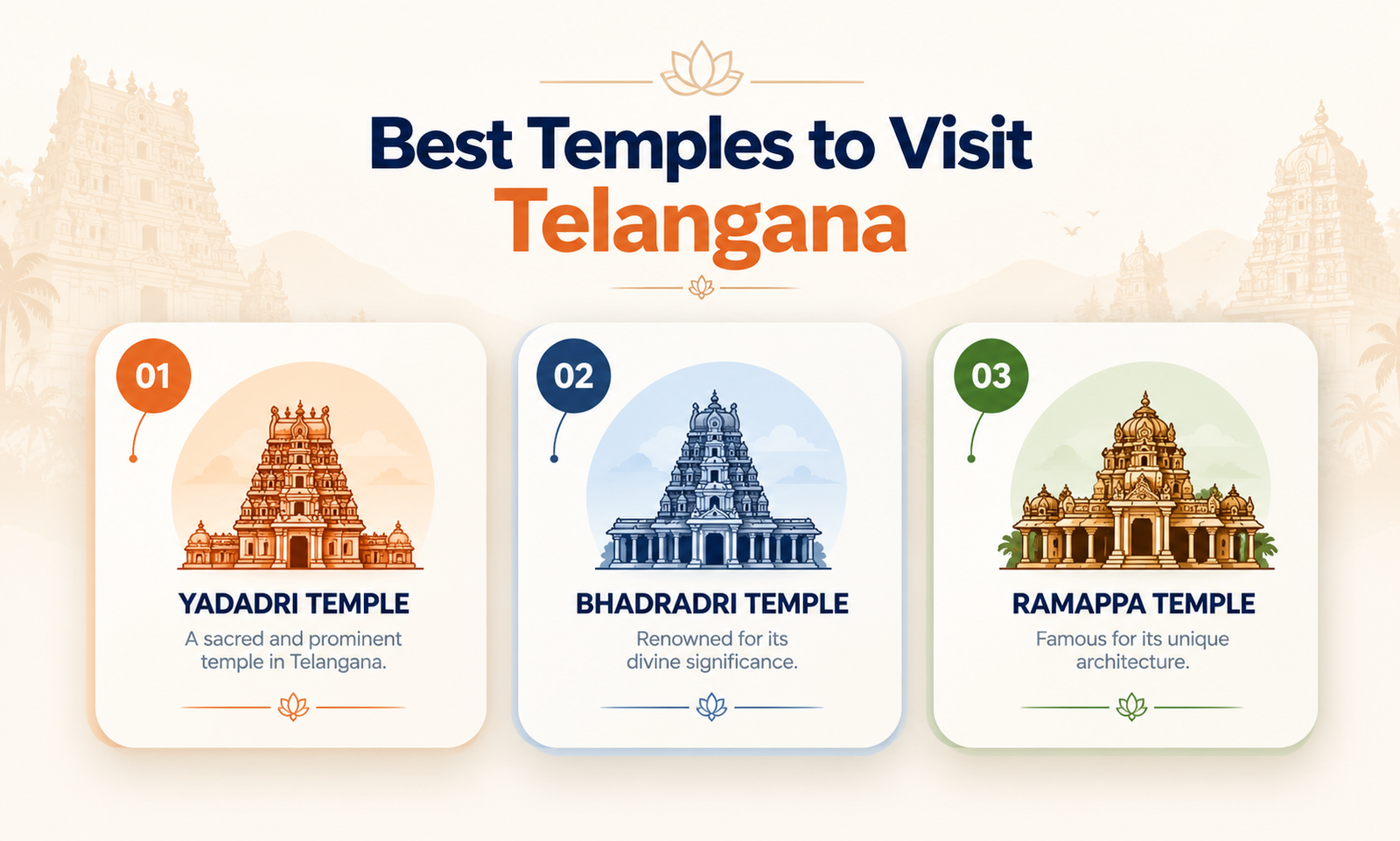
Best Temples to Visit Telangana
Telangana’s temple landscape ranges from Yadadri and Bhadrachalam to Vemulawada, Basar and Kakatiya heritage temples around Warangal.
A useful temple article should answer two questions at the same time: why the destination matters and how a real traveller should organise the journey. Pilgrimage is affected by queue uncertainty, local access, ritual practices, weather, traffic and the needs of the people travelling together. A route that looks simple on a map can become tiring if it ignores these details.
This guide is written for first-time visitors, families and senior travellers. It avoids assuming that live timings or procedures remain unchanged forever; official temple or government sources should always be checked close to departure. The practical goal is to protect the main darshan while keeping transport, accommodation and rest manageable.
How to Structure the Day
Make the main temple the fixed point and everything else flexible. Keep arrival, security, queue, darshan, meals and rest in the same mental timetable rather than allocating only the minutes spent inside the sanctum. When the family finishes early, add a nearby shrine or cultural stop. When the day runs late, remove optional sightseeing without compromising the pilgrimage.
For a two- or three-day stay, alternate demanding and lighter periods. A major queue day can be followed by a compact local-temple morning or a later departure. This simple rhythm reduces cumulative fatigue and is particularly helpful for senior citizens and children.
Temples and Places to Consider
1. Yadadri Lakshmi Narasimha Swamy Temple
Yadadri Lakshmi Narasimha Swamy Temple in Telangana is associated with Lord Narasimha and is one of Telangana’s most prominent hilltop Hindu pilgrimage centres. For travellers, the importance of this stop is not only religious; it also determines how the day should be structured. Pilgrimage time includes approach, security, queues, barefoot movement, ritual or prayer time, meals and recovery, so a famous temple should not automatically be treated as a quick sightseeing point.
It is usually approached by road or rail from Hyderabad and nearby districts. Festival and weekend crowds can materially change the visit. If this temple is a primary reason for the journey, keep the period before and after darshan flexible. Families should avoid a critical train, flight or very long road transfer immediately after an uncertain queue, while senior citizens benefit from a slower arrival and the option to return to the hotel for rest.
Accommodation searches such as hotel near temple, family stay, budget hotel or rooms near me are useful for discovery, but the final choice should reflect the actual route to the shrine. Check whether vehicles can approach the property, how much walking is required, whether local traffic restrictions apply and whether the room arrangement suits the group. During major festivals, reconfirm access shortly before arrival because temporary controls can change normal movement.
2. Sri Sita Ramachandra Swamy Temple, Bhadrachalam
Sri Sita Ramachandra Swamy Temple, Bhadrachalam in Telangana is associated with Lord Rama and is a major Rama pilgrimage town on the Godavari. For travellers, the importance of this stop is not only religious; it also determines how the day should be structured. Pilgrimage time includes approach, security, queues, barefoot movement, ritual or prayer time, meals and recovery, so a famous temple should not automatically be treated as a quick sightseeing point.
Road and regional rail connections support travel from Telangana and neighbouring states. Treat the town as a dedicated pilgrimage stop rather than a quick Hyderabad excursion. If this temple is a primary reason for the journey, keep the period before and after darshan flexible. Families should avoid a critical train, flight or very long road transfer immediately after an uncertain queue, while senior citizens benefit from a slower arrival and the option to return to the hotel for rest.
Accommodation searches such as hotel near temple, family stay, budget hotel or rooms near me are useful for discovery, but the final choice should reflect the actual route to the shrine. Check whether vehicles can approach the property, how much walking is required, whether local traffic restrictions apply and whether the room arrangement suits the group. During major festivals, reconfirm access shortly before arrival because temporary controls can change normal movement.
3. Sri Raja Rajeshwara Swamy Temple, Vemulawada
Sri Raja Rajeshwara Swamy Temple, Vemulawada in Telangana is associated with Lord Shiva and is a major Telangana Shaiva pilgrimage destination. For travellers, the importance of this stop is not only religious; it also determines how the day should be structured. Pilgrimage time includes approach, security, queues, barefoot movement, ritual or prayer time, meals and recovery, so a famous temple should not automatically be treated as a quick sightseeing point.
Road travel from Hyderabad or Karimnagar-region gateways is common. Build in road buffer and check current temple arrangements before festival travel. If this temple is a primary reason for the journey, keep the period before and after darshan flexible. Families should avoid a critical train, flight or very long road transfer immediately after an uncertain queue, while senior citizens benefit from a slower arrival and the option to return to the hotel for rest.
Accommodation searches such as hotel near temple, family stay, budget hotel or rooms near me are useful for discovery, but the final choice should reflect the actual route to the shrine. Check whether vehicles can approach the property, how much walking is required, whether local traffic restrictions apply and whether the room arrangement suits the group. During major festivals, reconfirm access shortly before arrival because temporary controls can change normal movement.
4. Gnana Saraswati Temple, Basar
Gnana Saraswati Temple, Basar in Telangana is associated with Goddess Saraswati and is one of India’s best-known Saraswati pilgrimage centres, especially for Aksharabhyasam. For travellers, the importance of this stop is not only religious; it also determines how the day should be structured. Pilgrimage time includes approach, security, queues, barefoot movement, ritual or prayer time, meals and recovery, so a famous temple should not automatically be treated as a quick sightseeing point.
Basar is reached by road and rail in northern Telangana. Families travelling for a child’s ritual should verify current requirements and crowd conditions. If this temple is a primary reason for the journey, keep the period before and after darshan flexible. Families should avoid a critical train, flight or very long road transfer immediately after an uncertain queue, while senior citizens benefit from a slower arrival and the option to return to the hotel for rest.
Accommodation searches such as hotel near temple, family stay, budget hotel or rooms near me are useful for discovery, but the final choice should reflect the actual route to the shrine. Check whether vehicles can approach the property, how much walking is required, whether local traffic restrictions apply and whether the room arrangement suits the group. During major festivals, reconfirm access shortly before arrival because temporary controls can change normal movement.
5. Ramappa Temple
Ramappa Temple in Telangana is associated with Lord Shiva and is a major Kakatiya-era temple celebrated for architecture and heritage value. For travellers, the importance of this stop is not only religious; it also determines how the day should be structured. Pilgrimage time includes approach, security, queues, barefoot movement, ritual or prayer time, meals and recovery, so a famous temple should not automatically be treated as a quick sightseeing point.
Road travel from Warangal-region bases is common. Approach it as both a sacred site and heritage visit, allowing time for architectural observation. If this temple is a primary reason for the journey, keep the period before and after darshan flexible. Families should avoid a critical train, flight or very long road transfer immediately after an uncertain queue, while senior citizens benefit from a slower arrival and the option to return to the hotel for rest.
Accommodation searches such as hotel near temple, family stay, budget hotel or rooms near me are useful for discovery, but the final choice should reflect the actual route to the shrine. Check whether vehicles can approach the property, how much walking is required, whether local traffic restrictions apply and whether the room arrangement suits the group. During major festivals, reconfirm access shortly before arrival because temporary controls can change normal movement.
6. Thousand Pillar Temple, Hanamkonda
Thousand Pillar Temple, Hanamkonda in Telangana is associated with Shiva, Vishnu and Surya traditions and is a celebrated Kakatiya temple known for historical and architectural importance. For travellers, the importance of this stop is not only religious; it also determines how the day should be structured. Pilgrimage time includes approach, security, queues, barefoot movement, ritual or prayer time, meals and recovery, so a famous temple should not automatically be treated as a quick sightseeing point.
Warangal and Hanamkonda provide the practical urban base. Combine it with nearby heritage sites instead of treating it as a long standalone detour. If this temple is a primary reason for the journey, keep the period before and after darshan flexible. Families should avoid a critical train, flight or very long road transfer immediately after an uncertain queue, while senior citizens benefit from a slower arrival and the option to return to the hotel for rest.
Accommodation searches such as hotel near temple, family stay, budget hotel or rooms near me are useful for discovery, but the final choice should reflect the actual route to the shrine. Check whether vehicles can approach the property, how much walking is required, whether local traffic restrictions apply and whether the room arrangement suits the group. During major festivals, reconfirm access shortly before arrival because temporary controls can change normal movement.
Telangana’s major pilgrimage regions
Yadadri works naturally with Hyderabad access, Warangal combines active shrines with Kakatiya heritage, northern Telangana includes Basar and Vemulawada, and Bhadrachalam is a dedicated Godavari pilgrimage destination. These are better understood as several regional circuits than as one same-day loop.
Mix pilgrimage and heritage carefully
Ramappa and the Thousand Pillar Temple reward architectural attention, while Yadadri, Bhadrachalam and Vemulawada are primarily living pilgrimage centres. Keep enough daylight for heritage sites and enough schedule flexibility for darshan queues.
How Long Should You Stay?
Stay length should follow the intensity of the pilgrimage rather than a fixed formula. A compact city temple can fit into an arrival or departure day when transport is reliable. A major hill shrine, Jyotirlinga, high-footfall darshan or island pilgrimage is better given its own day. When the destination also has several associated sacred places, a second night can turn a rushed visit into a comfortable one.
Families should avoid changing hotels every night unless the route genuinely requires it. Two nights in a useful base reduce luggage handling and allow a slower start after a demanding darshan. Senior citizens benefit from the option to return to the room during the day. Solo or younger travellers may move faster, but they should still avoid building an itinerary that collapses if one queue takes longer than expected.
Accommodation and Stay Planning
A temple trip becomes easier when the stay supports the religious schedule. Travellers often search for a hotel near me, best hotel near me, hotel near temple, family stay, budget hotel, affordable stay, rooms near me or pilgrimage accommodation. These searches are useful for discovery, but the final decision should be based on actual access, current property information, cancellation flexibility and the physical needs of the group.
For early darshan, proximity can reduce uncertainty. For a road trip, easier vehicle access and parking arrangements may matter more. In historic temple cores, a property that looks nearby may still involve pedestrian streets, traffic diversions or a longer walking route. Senior citizens should prioritise steps, lift access where required and the ability to return to the room for rest. Families should confirm the room setup rather than assuming every listing accommodates children comfortably.
Before you book hotel online, compare at least two location strategies: very close to the temple versus a slightly wider transport-friendly area. During festivals, reconfirm how vehicles reach the property because local authorities may change normal traffic patterns. A cheap hotel that creates repeated transport problems can cost more in time and fatigue than an affordable stay with a practical route.
Food, Rest, Clothing and Temple Etiquette
Plan meals around the expected darshan rather than assuming food will be convenient afterward. Children, older travellers and anyone taking regular medicines need predictable meal windows. Carry simple travel snacks outside restricted temple areas and stay hydrated, particularly in hot or humid destinations. If the pilgrimage involves sacred bathing, hill walking or a long queue, allow time to change clothes and recover before sightseeing.
Dress conservatively and follow the specific temple’s current rules. Photography, phones, footwear, bags and entry eligibility can differ from one shrine to another. A rule followed at the previous temple should never be assumed to apply at the next one. Carry only essential belongings into crowded pilgrimage zones and use designated storage where required.
Keep identity documents and official booking confirmations available offline. Agree on a meeting point before entering a very crowded complex and make sure children know which adult they should stay with. These precautions are simple but important when mobile signals are weak or the group becomes separated.
Pre-Departure Checklist
Recheck the official temple or government tourism source close to the travel date because timings, festival controls, booking procedures and entry rules can change. Confirm the first night’s accommodation, arrival transport and the following morning’s plan. Keep one optional stop identified in advance so the group knows what can be dropped if the day runs late.
Carry identification, regular medicines, a small amount of cash for local needs and only the belongings necessary for the temple day. Share bookings with another adult, keep emergency contacts accessible and avoid storing every important document on a single phone. For road trips, check fuel, tyre condition, driver rest and daylight margin before entering hill or remote sectors.
Official Resources to Check
Use current official temple, trust, government tourism or district sources before travel:
- https://www.tourism.telangana.gov.in/experience/spiritual
- https://www.tourism.telangana.gov.in/attractions/bhadrachalam
Frequently Asked Questions
How much time should I allow for the main temple?
Allow enough time for arrival, security, queue, darshan and rest rather than estimating only the time inside the sanctum. Major pilgrimage days can vary significantly.
Should I stay close to the temple?
Proximity helps for early or repeat darshan, but check the actual walking and vehicle route. A slightly farther stay may be easier for families arriving by car.
How early should accommodation be booked?
Book earlier for festivals, school holidays, weekends and pilgrimage seasons. Where darshan is pre-booked, align the hotel dates with the confirmed plan.
What should senior citizens consider?
Shorter transfers, easy access, medication timing, rest and realistic queue expectations are more important than maximising the number of temples.
What should families carry?
Carry identification, official confirmations, regular medicines, suitable clothing and light essentials. Avoid unnecessary large bags in crowded temple zones.
Can current temple rules change?
Yes. Dress, entry, booking, festival traffic and permitted items can change, so verify the official source shortly before travel.
Should I book through agents?
Use authorised temple or trust systems where available. Be especially cautious when an official body warns about unauthorised agents or fake websites.
Is one major temple per day enough?
For high-footfall or physically demanding pilgrimages, one major temple can be a full day. Add nearby stops only when time and energy genuinely allow.
How do I keep the itinerary flexible?
Mark sightseeing and secondary temples as optional, protect the main darshan, and avoid tight onward flights or trains after uncertain queues.
Mudras Stays — For Details
For Details: 9599190222
For current stay information at destinations served by Mudras Stays, contact the team or follow the latest updates on Instagram.