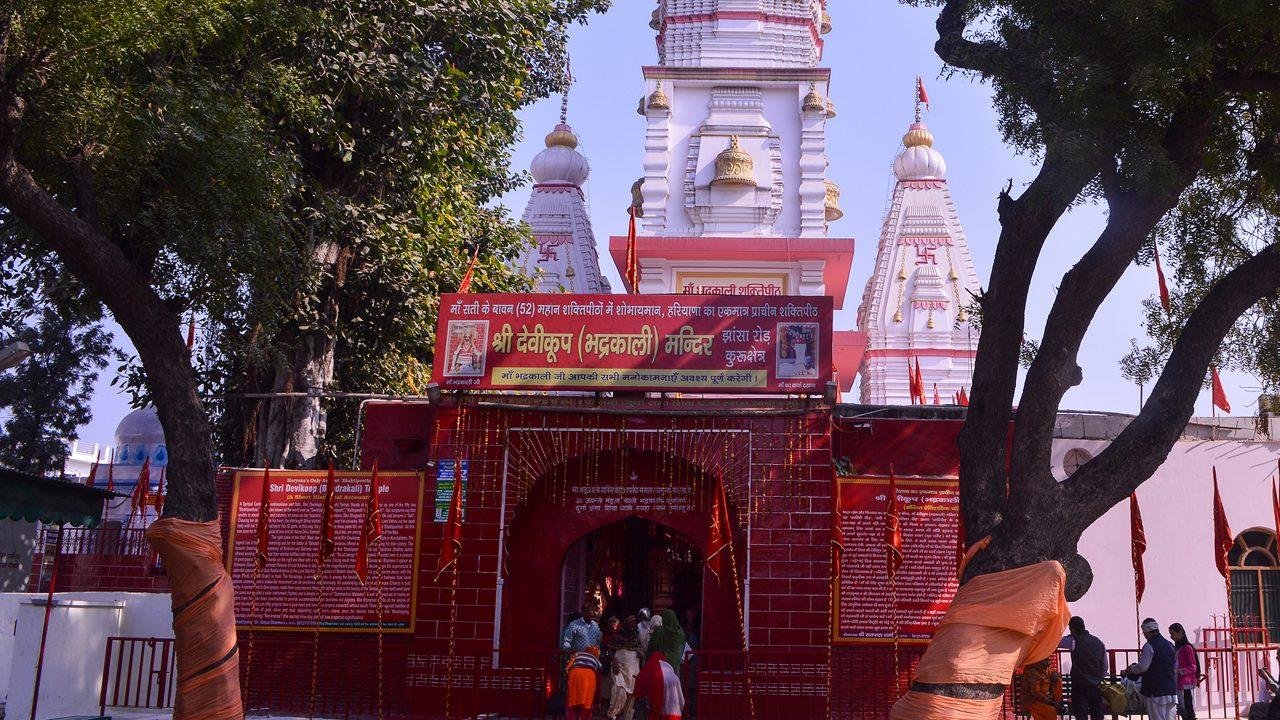
Bhadrakali Temple is one of the most important Shakti pilgrimage destinations in Kurukshetra and one of the defining sacred temples of historic Thanesar in Haryana. Located on Jhansa Road, the temple is officially and popularly known as Shri Devikoop Bhadrakali Shaktipeeth.
The shrine brings together several major traditions of Hindu sacred geography:
The story of Mata Sati and the Shakti Peethas
The worship of Maa Bhadrakali
The sacred Devi Koop or Goddess well
The Mahabharata traditions of Lord Krishna and the Pandavas
The offering of miniature horses
The mundan traditions associated with Krishna and Balarama
Navratri, Durga Puja and Goddess worship
The wider 48-kos pilgrimage landscape of Kurukshetra
The temple is also known by several related names:
Shri Devikoop Bhadrakali Temple
Bhadrakali Mandir Kurukshetra
Shakti Peeth Bhadrakali Temple
Devi Koop Temple
Savitri Peeth
Devi Peeth
Kalika Peeth
Aadi Peeth
Prachin Bhadrakali Mandir
Maa Bhadrakali Shaktipeeth
These names generally refer to the same sacred complex on Jhansa Road.
Travellers arranging local transport should clearly specify:
**Shri Devikoop Bhadrakali Shaktipeeth, Jhansa Road, Thanesar, Kurukshetra, Haryana.**
This helps distinguish the temple from Bhadrakali shrines found in other parts of India.
Bhadrakali Temple is road-accessible and does not require a trek. Its urban location makes it suitable for families, senior citizens, children, solo pilgrims and organised groups.
The complex is comparatively compact, but the spiritual experience is layered.
Visitors first encounter a red-toned entrance and temple façade, saffron flags and rising white or gold-toned shikharas. Inside, the principal image of Maa Bhadrakali is richly dressed and ornamented.
The sacred Devi Koop forms the theological centre of the Shakti Peeth tradition.
A marble lotus or symbolic representation marks the sacred association with Mata Sati.
Miniature horses offered by devotees create one of the temple’s most distinctive visual and ritual features.
Some horses are made from clay.
Others may be created from metal, including silver, according to a devotee’s means and family custom.
The temple should not be visited only as a brief photographic stop.
Its complete meaning becomes clearer when the visitor understands the relationship between Shakti, the sacred well, the Pandavas and the horse-offering tradition.
For Goddess devotees, Bhadrakali Temple is a place to seek courage, protection and spiritual clarity.
For Mahabharata pilgrims, it represents an important sacred stop associated with Krishna and the Pandavas.
For families, it provides an accessible temple experience within Kurukshetra city.
For parents, its mundan tradition gives the destination additional religious importance.
For cultural travellers, the miniature horses reveal how mythology becomes a continuing community ritual.
For visitors searching for hotels near Bhadrakali Temple, homestays in Thanesar, pilgrimage accommodation near Jhansa Road, family hotels near Kurukshetra Junction or places to stay for the Kurukshetra temple circuit, MudrasStays can help identify conveniently located options.
## Spiritual Importance of Maa Bhadrakali
Maa Bhadrakali is a powerful manifestation of Shakti, the universal divine energy represented through the Goddess.
The name Bhadrakali combines two important ideas.
“Bhadra” can mean auspicious, benevolent, blessed or protective.
“Kali” is associated with time, transformation and the destruction of ego and harmful forces.
Bhadrakali therefore represents a form that is fierce towards injustice but protective towards sincere devotees.
Her appearance may include dark colouring, large eyes, weapons, ornaments and other powerful symbols.
These features should not be misunderstood as evil or uncontrolled violence.
The Goddess uses fierce energy to confront cruelty, arrogance, fear and spiritual ignorance.
Bhadrakali is protective because she refuses to allow destructive forces to remain unchallenged.
She is auspicious because her intervention restores balance.
A mother can be gentle when a child requires comfort and firm when danger must be removed.
Bhadrakali expresses this protective maternal strength at a cosmic level.
Devotees may pray to Maa Bhadrakali for courage, family welfare, emotional strength, safe travel, responsible success and protection during difficult circumstances.
Students may seek concentration and confidence.
Parents may pray for their children.
Families may visit before weddings, journeys or important responsibilities.
Professionals may seek clarity when facing difficult decisions.
Some devotees return after the completion of a vow and offer a miniature horse.
These prayers belong to personal faith.
The temple should not be promoted as guaranteeing wealth, employment, marriage, childbirth, legal success, medical recovery or the fulfilment of every wish.
Spiritual practice can provide emotional strength and discipline, while practical concerns should continue to receive suitable medical, legal, financial or personal attention.
## Meaning of Shakti
Shakti is the divine power through which consciousness becomes active.
Within Hindu philosophy, Shiva may represent pure awareness, while Shakti represents the energy through which the universe appears, changes and continues.
Shakti is present in life, thought, courage, knowledge, compassion and transformation.
She is not limited to one emotional quality.
As Durga, she represents disciplined courage.
As Kali, she represents time and the destruction of illusion.
As Lakshmi, she represents nourishment and balanced prosperity.
As Saraswati, she represents knowledge and expression.
As Bhadrakali, she represents protective power that restores what has been disturbed.
A pilgrimage to Bhadrakali Temple can therefore become an opportunity to ask what kind of power the devotee is developing.
Power without responsibility becomes harmful.
Knowledge without compassion becomes arrogant.
Wealth without fairness creates suffering.
Courage without discipline becomes aggression.
The Goddess represents power governed by dharma.
## The Shakti Peeth Tradition
Bhadrakali Temple is revered within the Shakti Peeth tradition.
According to Hindu sacred mythology, Mata Sati was the daughter of King Daksha and the wife of Lord Shiva.
Daksha organised a major yajna but did not invite or honour Shiva.
Sati attended the gathering and experienced deep pain when her husband was insulted.
Unable to bear the humiliation and conflict, she gave up her body in the sacrificial fire.
Lord Shiva was overwhelmed by grief.
He carried Sati’s body and moved through the universe in sorrow.
The balance of creation was disturbed by the intensity of his grief and divine power.
Lord Vishnu used the Sudarshan Chakra to divide Sati’s body.
The locations where parts of her body or ornaments fell became sacred centres of Shakti worship known as Shakti Peethas.
Different religious texts and regional traditions identify different totals, commonly 51, 52 or another number.
The precise names and body-part associations also vary.
These variations are normal within a sacred tradition transmitted across many centuries, languages and regions.
Bhadrakali Temple should therefore be respectfully described as one of the recognised Shakti Peeth traditions of Kurukshetra.
## Which Part of Mata Sati Fell at Devi Koop?
Different official and religious sources preserve several versions.
Some say that Mata Sati’s right ankle fell here.
Some refer to the right heel.
Others describe the right knee.
Another version states that an anklet or ornament associated with her foot fell into the sacred well.
The temple’s marble representation is commonly associated with the ankle or lower limb.
Rather than selecting one version and dismissing all others, a responsible description should explain that the traditions vary.
The central belief is that Devi Koop marks the fall of a sacred part or ornament associated with Sati’s right lower limb.
The spiritual meaning is more important than anatomical debate.
The foot and ankle carry the body forward.
They support pilgrimage.
They connect the human body with the earth.
For devotees, the Shakti Peeth tradition expresses the continuing presence of the Divine Mother within the landscape.
## Devi Koop: The Sacred Well
The name Shri Devikoop refers to the sacred well within the temple.
“Devi” means Goddess.
“Koop” or “kupa” means well.
The well is therefore understood as the sacred well of the Divine Mother.
According to Shakti Peeth tradition, the sacred part or ornament of Mata Sati fell at this location.
The present shrine uses a marble lotus and associated representation to mark the sacred point.
The lotus carries deep symbolic meaning.
It grows from water and mud but rises cleanly above the surface.
It represents purity, spiritual awakening and the possibility of living responsibly even within difficult circumstances.
The well represents depth.
Its most important dimension lies below the visible surface.
Spiritually, this can represent the depth of consciousness and inherited sacred memory.
Visitors should follow all barriers and temple instructions around Devi Koop.
Coins, plastic, flowers, oil or other material should not be thrown into the well unless a specific authorised ritual system is provided.
Children must remain supervised.
No visitor should lean dangerously over railings or attempt to touch inaccessible sacred features.
## Marble Lotus and Sacred Representation
The marble lotus is one of the most distinctive objects within the temple.
It marks the sacred association with Mata Sati and gives physical form to a tradition that cannot be represented through ordinary historical evidence.
The lotus is not merely decorative.
It creates a focal point for prayer and remembrance.
Visitors should not touch, climb upon or place unauthorised material directly on the marble structure.
Photography should follow the current rules.
During festivals, flowers and ceremonial decoration may partly cover the lotus or change its appearance.
The most respectful experience is to understand what the lotus represents before photographing it.
## Maa Bhadrakali’s Image
The principal image of Maa Bhadrakali is richly decorated with garments, jewellery, garlands and a ceremonial crown.
Her dark face and prominent eyes express divine power and alertness.
Weapons represent the ability to confront destructive forces.
The crown represents spiritual authority.
Red garments and flowers are commonly associated with Shakti, energy and active divine power.
The image may be decorated differently according to the day, festival or special worship.
During Navratri and Durga Puja, the sanctum can receive elaborate floral and textile decoration.
The sacred image is the focus of living worship rather than an object displayed for tourism.
Visitors should avoid blocking the queue while taking photographs.
Close photography, flash and video may be restricted.
The deity, priests and private rituals should only be recorded when permission is clear.
## Mahabharata Association
Bhadrakali Temple is closely connected with the Mahabharata traditions of Kurukshetra.
According to local belief, Lord Krishna and the Pandavas worshipped Maa Bhadrakali before entering the great war.
They sought the blessings of the Goddess during a period of profound uncertainty and moral conflict.
After their victory, they are believed to have returned to the temple and offered the horses that had pulled their chariots.
This tradition became the foundation of the miniature-horse offering practised by devotees today.
The story belongs to Hindu sacred and regional tradition.
The visible temple architecture should not automatically be dated to the Mahabharata period.
A sacred association can continue across generations even when the buildings are repeatedly reconstructed.
The deeper meaning of the Pandavas’ worship deserves attention.
The Mahabharata war was not presented as an ordinary competition for territory.
It followed failed negotiation, injustice and the refusal to restore the Pandavas’ rights.
Even when the war became unavoidable within the epic narrative, it carried enormous suffering.
The Pandavas’ prayer to the Goddess can therefore be interpreted as a request for courage, protection and moral clarity rather than a simple request to defeat personal enemies.
## Lord Krishna at Bhadrakali Temple
Lord Krishna is believed to have accompanied the Pandavas during their worship.
Krishna represents wisdom, strategic understanding and the ability to act without becoming controlled by fear or ego.
His presence connects Bhadrakali Temple with the wider Bhagavad Gita landscape of Kurukshetra.
In the Gita, Krishna does not encourage careless violence.
He guides Arjuna through a deep moral crisis involving duty, attachment, consequence and the nature of the self.
At Bhadrakali Temple, Krishna’s association reinforces the idea that courage must be guided by wisdom.
A devotee should not ask for victory without examining whether the goal is ethical.
Success achieved through dishonesty or cruelty does not represent divine blessing.
## The Pandavas
The five Pandava brothers represent different qualities within the Mahabharata.
Yudhishthira represents responsibility and the difficult pursuit of dharma.
Bhima represents strength and loyalty.
Arjuna represents skill, discipline and moral questioning.
Nakula represents service, beauty and responsible care.
Sahadeva represents knowledge and considered judgement.
Draupadi, whose dignity and suffering shape the epic, represents courage and resistance to injustice.
Their association with Bhadrakali Temple makes the shrine relevant to anyone facing a difficult decision.
The spiritual question is not merely, “Will I win?”
A more important question is, “Am I acting responsibly?”
## The Horse-Offering Tradition
The miniature horses are the most visually distinctive devotional tradition of Bhadrakali Temple.
According to local belief, the Pandavas offered their horses to the Goddess after returning victorious from the Mahabharata war.
Modern devotees continue the tradition symbolically.
After a prayer or family vow is completed, they may offer a small horse made from clay, terracotta, silver or another material.
The value and material depend upon family custom and financial means.
The horse represents several qualities.
It represents movement.
It represents strength.
It represents the ability to complete a journey.
It represents service during a difficult undertaking.
It also represents gratitude after success.
A devotee offering a horse symbolically acknowledges that personal achievement depends upon many forms of support.
No success is completely individual.
Families, teachers, colleagues, workers, animals, nature and society all contribute to human accomplishment.
The horse offering should not be presented as a compulsory payment for receiving divine favour.
No visitor should be pressured to purchase an expensive silver horse.
A simple clay offering made sincerely is spiritually meaningful.
Devotees can also express gratitude through food service, charitable support and responsible conduct.
## Clay, Metal and Silver Horses
Clay horses connect the ritual with the earth and with regional craft traditions.
Terracotta has been used for sacred and domestic objects throughout India for thousands of years.
A clay horse is humble, biodegradable and connected with the soil.
Metal horses are more durable.
Silver offerings are associated with purity, value and ceremonial importance.
The material does not determine the worth of a devotee.
A family of limited means should never feel inferior because it offers clay rather than silver.
The Goddess is not worshipped through financial competition.
The appropriate offering is one that does not create debt, pressure or waste.
## Completing a Vow
Many devotees make a mannat or religious vow.
They may pray for support during an examination, family responsibility, illness, journey or difficult decision.
After the event, they return to express gratitude.
A vow should not become a commercial transaction in which the deity is expected to deliver a guaranteed result.
The deeper purpose is to develop discipline, gratitude and responsible action.
A person who prays for success should also prepare carefully.
A person who prays for health should continue medical treatment.
A person who prays for family harmony should communicate respectfully and correct harmful behaviour.
The return offering becomes meaningful when accompanied by improved conduct.
## Mundan Tradition of Krishna and Balarama
Official temple and tourism traditions associate Bhadrakali Temple with the mundan or first-haircut ceremonies of Lord Krishna and Balarama.
This tradition has made the temple popular among families arranging mundan ceremonies for children.
Mundan is an important samskara within several Hindu communities.
The child’s first hair is removed as part of a ritual associated with purification, transition and family blessing.
Customs vary according to region, caste, family and religious lineage.
Families planning a mundan at Bhadrakali Temple should confirm:
Whether advance registration is required
The priestly arrangements
Hair-cutting facilities
Hygiene standards
Permitted days and timings
Crowd levels
Disposal or ritual handling of the hair
Charges and authorised service providers
The child’s safety and comfort must remain the priority.
Clean, sterilised equipment should be used.
A frightened child should be calmed rather than restrained harshly.
Hair should not be scattered around the temple.
Religious tradition and hygiene should support one another.
## Navratri at Bhadrakali Temple
Navratri is the most important festival period at the temple.
The word Navratri means nine nights.
The festival honours different manifestations of the Divine Mother and celebrates the victory of divine courage over destructive forces.
Two principal Navratri periods are observed.
Chaitra Navratri generally falls during March or April.
Sharad Navratri generally falls during September or October.
During Navratri, the temple is decorated with flowers, lights, flags and devotional cloth.
Special aarti, havan, recitation, bhajan, kirtan and community food service may be organised.
The temple becomes crowded from early morning.
Ashtami and Navami are particularly important.
Visitors should expect long queues, regulated parking, security checks and changes to the normal darshan route.
Families should keep children and senior citizens close.
Groups should choose a meeting point before entering the most crowded area.
## The Nine Forms of Durga
The nine principal Navdurga forms provide a complete spiritual framework.
Shailaputri represents stability.
Brahmacharini represents discipline.
Chandraghanta represents courage.
Kushmanda represents creative energy.
Skandamata represents nurturing responsibility.
Katyayani represents action against injustice.
Kalaratri represents the removal of fear.
Mahagauri represents purification and renewal.
Siddhidatri represents spiritual fulfilment.
A Navratri pilgrimage can therefore become an opportunity to examine which qualities require development in daily life.
The festival should not be reduced only to receiving material benefits.
## Durga Puja
Durga Puja celebrates the victory of the Goddess over Mahishasura and the restoration of dharma.
The scale and style of observance at Bhadrakali Temple may differ from the elaborate community pandal traditions of Bengal.
The central meaning remains the triumph of disciplined divine power over arrogance and destructive conduct.
Festival arrangements should be confirmed annually.
## Raksha Bandhan
Official tourism information also identifies Raksha Bandhan among important occasions associated with the temple.
Raksha Bandhan celebrates protection, affection and responsibility within families.
The festival should not be understood only as a sister asking a brother for protection.
Its deeper meaning includes mutual care, respect and the commitment to protect another person’s dignity.
Temple programmes and crowd levels should be confirmed for the relevant year.
## Saturdays and Other Busy Days
Saturday worship is regarded as important by some devotees, and official tourism information notes local belief in the spiritual value of visiting on this day.
Navratri, weekends, public holidays and major Kurukshetra events can substantially increase attendance.
Visitors seeking quiet darshan should choose an ordinary weekday morning.
## Temple Timings
Published tourism information presently gives the following general schedule:
Summer: approximately 6:00 AM to 8:00 PM
Winter: approximately 6:15 AM to 7:30 PM
These hours should be treated as a planning guide rather than an unchangeable guarantee.
The sanctum may close temporarily for bhog, decoration, cleaning, special puja or crowd management.
Festival hours may be extended or reorganised.
Families arranging mundan or a specific ritual should confirm the schedule directly.
## Architecture of Bhadrakali Temple
The present temple complex displays several phases of construction, renovation and decoration.
The entrance commonly appears in deep red or brick-red tones.
White, cream or gold-toned shikharas rise above the lower structure.
Saffron flags identify the sacred complex from a distance.
The main architectural elements include:
A prominent entrance gateway
Tall North Indian temple spires
Smaller domed or shikhara elements
Decorative niches
Covered worship areas
Queue railings
Courtyards
The Devi Koop sacred zone
The principal Bhadrakali sanctum
Spaces containing miniature horse offerings
The temple should not be assigned one exact architectural date without verified historical documentation.
The Shakti Peeth tradition may be regarded as ancient, while much of the visible architecture reflects later rebuilding and modern maintenance.
Living temples change because they receive large numbers of devotees.
Walls are repaired.
Floors are replaced.
Shikharas are repainted or gilded.
Electrical systems and safety barriers are added.
Spiritual continuity can survive through these physical changes.
## Red and White Architectural Symbolism
Red is strongly associated with Shakti, energy, courage and active divine power.
White can represent purity, calmness and spiritual clarity.
The combination of a red entrance and pale temple towers creates a visual relationship between energy and peace.
The Goddess is powerful, but her power is directed towards protection and balance.
## Temple Bells and Flags
Bells announce entry into the sacred environment and help the devotee focus attention.
They should be rung respectfully rather than continuously or aggressively.
Saffron flags represent continuing worship, sacrifice and divine presence.
Visitors should not climb the roof, poles or temple structures to touch flags.
## Is Bhadrakali Temple Ancient?
The sacred tradition is regarded as ancient because of its connection with Mata Sati, Krishna and the Pandavas.
However, the exact archaeological age of the current building is not established merely by these traditions.
It is more accurate to say:
Bhadrakali Temple preserves an ancient Shakti Peeth and Mahabharata tradition, while its visible structures have been rebuilt and renovated over time.
This formulation respects religious belief without assigning an unsupported construction date to every wall.
## Best Time to Visit Bhadrakali Temple
The temple can generally be visited throughout the year.
### October to March
The cooler months provide the most comfortable weather for temple and heritage exploration.
Morning and evening can become cold during December and January.
Fog may affect road and rail travel.
### Chaitra Navratri
March or April brings one of the temple’s largest annual pilgrimage periods.
The atmosphere is vibrant but crowded.
Accommodation and transport should be arranged early.
### April to June
Kurukshetra can become extremely hot.
Early-morning or evening darshan is preferable.
Visitors should carry drinking water and protect children and senior citizens from midday heat.
### July to September
The monsoon brings humidity and rainfall.
Temple floors and approach roads may become slippery.
Sharad Navratri may fall towards the end of this broader period.
### Sharad Navratri and Durga Puja
September or October offers the strongest Goddess-festival atmosphere but also heavy crowd pressure.
Visitors seeking quiet prayer should choose another week.
### International Gita Mahotsav
The annual Gita Mahotsav generally brings increased tourism to Kurukshetra around late November or December.
Even when Bhadrakali Temple is not the main event venue, city hotels, roads and pilgrimage sites can become busier.
## Suggested Time of Day
Early morning is normally the most comfortable time.
The weather is cooler.
Queues are often shorter than during the evening.
Families can complete darshan and continue to nearby Kurukshetra attractions.
Evening aarti can provide a powerful devotional atmosphere, but visitors should arrange return transportation and consider seasonal closing time.
## Reaching Bhadrakali Temple
Bhadrakali Temple is situated on Jhansa Road in Thanesar, Kurukshetra.
It is accessible by auto-rickshaw, e-rickshaw, taxi, private vehicle and local transport.
Drivers should be given the complete destination name.
The old and central areas of Thanesar can become congested, especially during school hours, festivals and Gita Mahotsav.
## Reaching from Kurukshetra Junction
Kurukshetra Junction is the principal railway gateway.
A local taxi, auto-rickshaw or e-rickshaw can complete the road journey.
Visitors carrying heavy luggage should first check into accommodation or use secure storage.
Large suitcases should not be carried into the temple complex.
## Reaching from the Bus Stand
Local transport connects Kurukshetra’s bus terminals with Thanesar and Jhansa Road.
The precise journey depends upon the bus terminal and current traffic.
Festival diversions can increase travel time.
## Reaching from Pipli and NH-44
Pipli is the principal highway gateway for many road travellers.
Kurukshetra lies a short distance from NH-44.
Visitors arriving from Delhi, Karnal, Ambala, Chandigarh or Punjab can enter through Pipli and continue towards Thanesar.
## Reaching from Delhi
Delhi is approximately 160 kilometres from Kurukshetra depending upon the starting point and road.
A same-day visit is possible, but a one- or two-night stay is preferable for a complete pilgrimage circuit.
Traffic around Delhi, Sonipat, Panipat and Karnal can affect travel time.
## Reaching from Chandigarh
Chandigarh provides one of the nearest major airports and is connected with Kurukshetra by road and rail.
A day trip is possible, but an overnight stay allows visitors to explore the temple, Brahma Sarovar, Jyotisar and museums without rushing.
## Accessibility for Senior Citizens
Bhadrakali Temple is road-accessible and does not require a hill trek.
This makes it suitable for many senior citizens.
Visitors may still encounter thresholds, steps, wet flooring, narrow queues and crowd-control barriers.
Navratri can create long waiting periods and greater walking distance from parking.
A quiet weekday morning is generally most comfortable.
Wheelchair users should confirm the current accessible entrance and the nearest vehicle drop-off.
## Visiting with Children
Children can learn about Maa Bhadrakali, the Pandavas, Krishna and the horse-offering tradition.
They must remain supervised around Devi Koop, lamps, stairs and crowded queues.
Parents should explain that the miniature horses represent gratitude rather than magical toys.
Children attending a mundan ceremony should be supported calmly and hygienically.
During Navratri, children should carry identification with a parent’s phone number.
## Temple Etiquette
Visitors should dress respectfully and remove footwear wherever directed.
Phones should remain silent near the sanctum.
The deity, marble lotus, Devi Koop, priests and private rituals should only be photographed when permission is clear.
Queue barriers should not be crossed.
Miniature horses and other offerings should be submitted through the authorised system.
Visitors should not touch or rearrange horses for photographs.
Donations should be made through recognised counters or boxes.
## Responsible Offerings
Flowers, coconuts, chunri, prasad and symbolic horses should be offered according to temple practice.
Excess plastic packaging should be removed responsibly.
No visitor should be pressured into purchasing an expensive ritual item.
Clay and modest offerings are spiritually valid.
Food and prasad should not be wasted.
## Nearby Attractions
### Sthaneshwar Mahadev Temple
Sthaneshwar Mahadev Temple is one of Kurukshetra’s most important Shiva shrines.
It is associated with Krishna, the Pandavas, Emperor Harshavardhana and the sacred tank of old Thanesar.
Bhadrakali and Sthaneshwar Mahadev form a natural Shiva–Shakti pilgrimage circuit.
### Brahma Sarovar
Brahma Sarovar is one of Kurukshetra’s principal sacred water bodies.
Its ghats, aarti, Sarveshwar Mahadev Temple and Gita Mahotsav celebrations make it an essential destination.
### Sannihit Sarovar
Sannihit Sarovar is associated with the symbolic meeting of sacred rivers and is especially important during Amavasya and eclipse observances.
### Jyotisar
Jyotisar is traditionally identified as the place where Lord Krishna delivered the Bhagavad Gita to Arjuna.
Its sacred banyan tree, chariot representation and interpretive attractions make it central to the Mahabharata circuit.
### Sri Krishna Museum
The Sri Krishna Museum presents sculptures, paintings and objects connected with Krishna and Indian artistic traditions.
Opening days and hours should be checked.
### Kurukshetra Panorama and Science Centre
The centre combines a large Mahabharata panorama with science exhibits and is particularly suitable for families and school groups.
### Harsh Ka Tila and Thanesar Archaeological Museum
Harsh Ka Tila preserves evidence of historic Thanesar.
The archaeological museum helps visitors understand the city beyond its mythological identity.
### Sheikh Chilli’s Tomb
Sheikh Chilli’s Tomb is an important Mughal-period heritage complex with a tomb, madrasa, garden and archaeological displays.
### Bhishma Kund
Bhishma Kund at Narkatari is associated through Mahabharata tradition with Bhishma’s bed of arrows and Arjuna bringing water from the earth.
### Ancient Mound Amin
Amin is traditionally connected with Abhimanyu and the Chakravyuha episode.
It requires a separate road journey.
## Suggested Half-Day Bhadrakali Itinerary
Begin with early-morning darshan at Shri Devikoop Bhadrakali Temple.
Visit the principal Bhadrakali sanctum.
Pay respect at the marble lotus and Devi Koop area.
Observe the miniature-horse tradition without touching offerings.
Continue to Sthaneshwar Mahadev Temple.
Visit Harsh Ka Tila or the Thanesar archaeological area according to current access.
Return to accommodation before midday heat.
## Suggested One-Day Kurukshetra Pilgrimage
Begin at Bhadrakali Temple.
Continue to Sthaneshwar Mahadev Temple.
Visit Sannihit Sarovar and Brahma Sarovar.
Explore the Sri Krishna Museum or Panorama and Science Centre.
Travel to Jyotisar during the later part of the day.
Avoid rushing through sacred places merely to complete a checklist.
## Suggested Two-Day Spiritual Journey
On the first day, explore Bhadrakali Temple, Sthaneshwar Mahadev, Harsh Ka Tila, Sannihit Sarovar and Brahma Sarovar.
On the second day, visit Jyotisar, Bhishma Kund, Sri Krishna Museum and other recognised Mahabharata sites.
This schedule is more comfortable for families and senior citizens.
## Suggested Three-Day 48-Kos Heritage Journey
Day one can focus on Thanesar’s Goddess, Shiva and sacred-water sites.
Day two can cover Jyotisar, museums and Mahabharata interpretation centres.
Day three can include Amin, Pehowa, Narkatari or other established locations within the wider 48-kos Kurukshetra pilgrimage landscape.
A knowledgeable driver or guide can help organise the geographical sequence.
## Accommodation Near Bhadrakali Temple
Kurukshetra and Thanesar provide hotels, guesthouses, dharamshalas, resorts and homestays across several budget levels.
The best location depends upon the complete itinerary.
## Hotels in Thanesar
Staying in Thanesar provides practical access to Bhadrakali Temple, Sthaneshwar Mahadev, Sannihit Sarovar and historic areas.
Old-city roads can be congested, and parking may be limited.
Guests should verify whether the property can be reached easily by car.
## Hotels Near Kurukshetra Junction
Railway-area hotels are convenient for short stays and early departures.
Travellers should compare cleanliness, noise, family suitability, breakfast and luggage-storage facilities.
## Hotels Near Brahma Sarovar
Accommodation near Brahma Sarovar is suitable for pilgrims planning morning or evening aarti and visits to the nearby museums.
The area can become crowded during Gita Mahotsav and eclipse gatherings.
## Hotels in Modern Kurukshetra Sectors
Modern residential and commercial sectors may provide wider roads, restaurants, parking and newer accommodation.
A local vehicle will be required for Bhadrakali Temple.
## Hotels Near Pipli and NH-44
Highway hotels are convenient for travellers driving between Delhi, Chandigarh, Punjab and Himachal Pradesh.
They may offer easier parking but involve additional travel into Thanesar.
## Dharamshalas
Economical pilgrim accommodation is available in different parts of Kurukshetra.
Facilities may be simple and can include shared bathrooms, restricted check-in procedures or limited housekeeping.
Availability should be confirmed directly, especially during Navratri and Gita Mahotsav.
## Homestays in Kurukshetra
Verified homestays can offer local meals, residential hospitality and personalised route guidance.
Guests should confirm attached bathrooms, cooling, heating, parking and actual travel time to the temple.
## Choosing the Right Place to Stay
Pilgrims focused mainly on Bhadrakali and Sthaneshwar Mahadev should choose accommodation in Thanesar or a nearby central area.
Visitors prioritising Brahma Sarovar, museums and Jyotisar may choose a property closer to the modern pilgrimage zone.
Road travellers can consider Pipli or NH-44.
Families should confirm room capacity, meals and parking.
Senior citizens should prioritise lifts, ground-floor rooms and dependable transport.
Couples may prefer quieter hotels or homestays outside congested lanes.
Solo pilgrims should choose populated and well-connected properties.
Groups should verify multiple rooms, vegetarian meals, driver accommodation and bus parking.
Navratri and Gita Mahotsav visitors should reserve early.
## Book Hotels Near Bhadrakali Temple with MudrasStays
MudrasStays helps pilgrims, families and heritage travellers discover hotels, homestays, guesthouses and pilgrimage accommodation near Bhadrakali Temple and throughout Kurukshetra.
The platform is designed specifically for travellers searching for places to stay near Shakti Peethas, temples, sacred water bodies and Mahabharata destinations.
Visitors can compare accommodation according to practical driving distance from Shri Devikoop Bhadrakali Temple, room category, budget, family size and required facilities.
Booking in Thanesar can make peaceful morning darshan easier.
Rail travellers can choose properties balancing Kurukshetra Junction access with temple proximity.
Families can select hotels offering comfortable rooms, meals and safe parking.
Senior citizens can prioritise accessible properties with lifts and reliable taxis.
Solo pilgrims can search for economical guesthouses in populated areas.
Pilgrimage groups can identify accommodation providing multiple rooms, vegetarian food and parking for larger vehicles.
Families planning a mundan ceremony can choose properties with early breakfast, suitable bathrooms and convenient transport.
Travellers attending Chaitra Navratri, Sharad Navratri, Durga Puja or Gita Mahotsav can reserve accommodation early and avoid uncertain last-minute availability.
Visitors combining Bhadrakali Temple with Sthaneshwar Mahadev, Brahma Sarovar, Sannihit Sarovar, Jyotisar, Bhishma Kund and Kurukshetra’s museums can select accommodation according to the actual route of the journey.
MudrasStays helps travellers avoid booking a property that appears close on a map but requires unnecessary travel through congested old-city roads.
## Responsible Pilgrimage
Bhadrakali Temple is an active Shakti Peeth and a sensitive sacred-well environment.
Visitors should dress respectfully and follow the designated route.
The Goddess, marble lotus, Devi Koop, priests and private rituals should only be photographed when permission is clear.
Children should remain supervised.
Miniature horses should not be moved or used as photography props.
Offerings should be submitted through authorised arrangements.
Food and prasad should not be wasted.
Plastic waste must be placed in designated bins.
## Respecting Devi Koop
No plastic, oil, packaged flowers, coins or food should be thrown into the sacred well unless an authorised system specifically allows an offering.
Visitors should not lean over barriers.
The sacred location should remain clean and safe.
Protecting Devi Koop is an essential part of honouring Maa Bhadrakali.
## Respecting the Horse Tradition
The miniature horses represent vows, gratitude and the Mahabharata tradition.
They should not be treated as souvenirs or decorative objects available for handling.
Visitors should purchase offerings from recognised sources and submit them properly.
No person should feel pressured to offer expensive metal or silver horses.
## Respecting Thanesar’s Community
Bhadrakali Temple stands within a living urban area.
Vehicles should not block homes, shops or emergency access.
Unnecessary horn use should be avoided.
Local residents, priests, vendors, drivers and accommodation providers should be treated fairly.
Responsible pilgrimage should support the city rather than creating only congestion and waste.
## A Sacred Meeting of Shakti, the Pandavas and Devi Koop
Bhadrakali Temple represents a powerful meeting of the Divine Mother, sacred geography, Mahabharata memory and living ritual.
Maa Bhadrakali represents auspicious protective power.
The Shakti Peeth tradition connects the shrine with Mata Sati and Lord Shiva’s grief.
Devi Koop represents depth and the continuing presence of the Goddess.
The marble lotus represents purity and spiritual awakening.
The Pandava tradition connects the shrine with courage, duty and moral struggle.
Lord Krishna represents wisdom and guidance.
The horse offering represents gratitude after completing a difficult journey.
Clay horses represent humility and connection with the earth.
Silver horses represent ceremonial devotion according to a family’s means.
The mundan tradition connects the temple with childhood, Krishna and Balarama.
Navratri brings the temple into its largest cycle of Goddess worship.
Durga Puja celebrates the restoration of dharma.
The temple’s proximity to Sthaneshwar Mahadev creates a natural Shiva–Shakti pilgrimage circuit.
For Shakti devotees, Bhadrakali Temple is a place to seek courage and protection.
For Mahabharata pilgrims, it is one of Kurukshetra’s most meaningful sacred stops.
For families, it offers an accessible pilgrimage and an important samskara destination.
For children, the miniature horses create an engaging introduction to mythology and gratitude.
For senior citizens, its urban location makes darshan manageable when festival crowds are avoided.
For cultural travellers, the temple reveals how epic tradition becomes a continuing community practice.
For photographers, the red entrance, white shikharas, decorated Goddess and horse offerings provide memorable images when worship rules are respected.
For spiritual seekers, Bhadrakali communicates an important lesson: real victory requires courage, wisdom, gratitude and responsibility.
Bhadrakali Temple should not be treated merely as a short stop before Brahma Sarovar.
Receive darshan of Maa Bhadrakali without rushing.
Understand Devi Koop’s Shakti Peeth tradition.
Recognise that official accounts preserve different lower-limb and ornament traditions.
Observe the miniature horses respectfully.
Learn why the Pandavas are believed to have returned after victory.
Use offerings responsibly.
Protect the sacred well.
Carry the meaning of Bhadrakali beyond the temple by confronting fear, arrogance and harmful conduct.
Plan your pilgrimage to Bhadrakali Temple with MudrasStays and experience one of Haryana’s most important Shakti shrines.
Seek the blessings of Maa Bhadrakali, visit the sacred Devi Koop and understand the temple’s enduring horse-offering tradition.
Combine your journey with Sthaneshwar Mahadev Temple, Brahma Sarovar, Sannihit Sarovar, Jyotisar, Sri Krishna Museum, Bhishma Kund and the wider Mahabharata heritage of Kurukshetra.
Book hotels near Bhadrakali Temple, discover homestays in Thanesar and choose suitable pilgrimage accommodation through MudrasStays.
Stay closer to the shrine, attend peaceful morning darshan and reduce unnecessary travel through crowded city roads.
MudrasStays connects pilgrims, families and heritage travellers with suitable accommodation near temples, Shakti Peethas and sacred destinations across India.
Begin your Bhadrakali Temple journey with a comfortable stay and experience a meaningful pilgrimage centred on Maa Bhadrakali, Devi Koop, the Pandavas, sacred gratitude and the living spiritual landscape of Kurukshetra.