
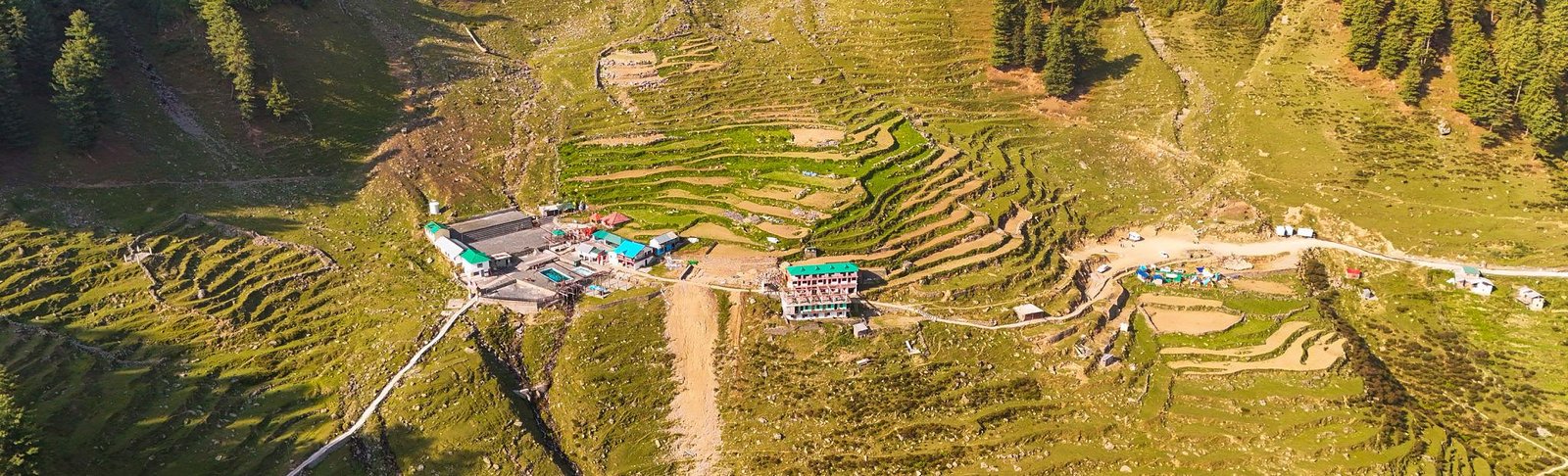
Bharmani Mata Temple is one of the most important spiritual destinations in Bharmour, a historic mountain town in the Chamba district of Himachal Pradesh. Situated on a scenic ridge above the main settlement, the temple is dedicated to Maa Bharmani, also written as Brahmani Mata, Bharmani Devi or Brahmani Devi.
The shrine overlooks Bharmour, the Budhil Valley, terraced fields, forests and the surrounding Himalayan ranges. Its elevated position, sacred water kund, local legends and close connection with the Manimahesh pilgrimage make it an essential destination for devotees visiting this remote part of Himachal Pradesh.
Bharmani Mata Temple is commonly described as being approximately 4 kilometres above Bharmour town. The actual distance travelled depends upon whether a pilgrim walks on the traditional uphill route, uses the motorable road or begins from another local point.
The driving route can be longer than the direct walking distance because it follows mountain curves. Road condition, parking access and the final walking section may change due to rain, snow, maintenance and seasonal pilgrimage arrangements.
Some visitors complete the journey as a moderate uphill walk from Bharmour. Others travel most of the way by local taxi and walk the remaining distance. Pilgrims should confirm the current route through their hotel, homestay host, taxi driver or local administration before departure.
The temple is generally reported at an elevation of roughly 2,600 to 2,700 metres, several hundred metres above Bharmour town. Exact elevation figures vary between travel descriptions, so visitors should understand this as an approximate range rather than a surveyed figure for every point within the complex.
The hilltop location provides a sense of separation from ordinary town life. As pilgrims move upward through village roads, terraced slopes and forested surroundings, Bharmour gradually appears below them.
The temple complex contains the principal shrine of Maa Bharmani, red religious flags, courtyards, resting spaces and a sacred water tank or kund. During the main pilgrimage season, temporary shops, food arrangements and other facilities may operate according to local administration and temple arrangements.
Bharmani Mata Temple is suitable for Devi devotees, families, Manimahesh pilgrims, photographers, cultural travellers, trekkers and visitors interested in the living spiritual traditions of the Gaddi region.
Its accessibility is easier than the Manimahesh Lake pilgrimage, but the uphill location, cold weather, uneven paths and remote road still require preparation.
## Spiritual Importance of Maa Bharmani
Maa Bharmani is worshipped as the guardian goddess of Bharmour and the surrounding mountain region.
For local devotees, she is not simply one temple deity among many. She is understood as the divine mother connected with the spiritual identity, protection and welfare of Bharmour.
People visit the shrine to pray for family welfare, courage, health, children, prosperity, safe journeys, agricultural success and relief from difficult circumstances.
Manimahesh pilgrims seek her blessings before beginning the more demanding journey towards Hadsar, Dhancho, Gauri Kund and Manimahesh Lake.
Local families may also visit during festivals, important life events, religious vows and occasions of gratitude.
The goddess is approached as a protective manifestation of Shakti, the divine feminine power present within Hindu spiritual traditions.
Shakti represents energy, courage, compassion, creation and the power through which consciousness becomes active in the world.
Maa Bharmani may therefore be understood both as a nurturing mother and as a strong guardian capable of protecting the land and its people.
Claims that the goddess guarantees a particular cure, marriage, child, business result or other outcome should not be made. Devotional experiences are matters of faith and personal interpretation.
The temple provides a sacred environment for prayer, hope and emotional strength, while medical, legal, financial and personal matters continue to require appropriate practical action.
## Bharmani Mata and the Identity of Bharmour
Bharmour was historically known as Brahmapura or Brahampura and served as an early capital of the rulers of Chamba.
Regional tradition connects the older name of the town with Goddess Brahmani.
According to local belief, the region was once considered the garden or sacred domain of Maa Brahmani. Her presence was believed to protect the settlement and give the land its spiritual identity.
The exact linguistic relationship between Brahmapura and Brahmani Devi cannot be established solely through oral tradition. However, the story remains important because it expresses how closely the goddess is connected with the memory of the town.
Bharmour is sometimes described as the land of Shiva because of the Manimahesh tradition and the numerous shrines within the Chaurasi Temple complex.
Bharmani Mata adds the essential Shakti dimension to this sacred landscape.
Shiva represents consciousness, meditation and transformation.
Shakti represents energy, creation, protection and active divine power.
The relationship between Bharmani Mata, Chaurasi Temple and Manimahesh therefore reflects a broader union of Shiva and Shakti across the geography of Bharmour.
## The Legend of Bharmani Mata and the Eighty-Four Siddhas
One of the most widely narrated regional traditions links Maa Bharmani with Lord Shiva and eighty-four siddhas or spiritually accomplished beings.
According to one version, Maa Bharmani originally lived in the area later known as Brahmapura. Lord Shiva and a group of eighty-four siddhas arrived while travelling towards Manimahesh.
The goddess was initially displeased by their presence within her sacred territory.
In some versions of the story, the visitors requested permission to remain for a single night. The place where they stayed later became associated with the Chaurasi or Eighty-Four Temple complex.
The word “Chaurasi” means eighty-four.
The legend continues differently depending upon the narrator. Some accounts say Maa Bharmani eventually moved from the central settlement to the ridge above Bharmour.
Lord Shiva then granted her an important place within the pilgrimage tradition.
Pilgrims travelling towards Manimahesh were expected to seek her blessings and bathe in the sacred water associated with her shrine before continuing.
This narrative belongs to regional Hindu tradition rather than documented political history.
Its spiritual meaning is significant because it establishes balance between the presiding goddess of Bharmour and Lord Shiva of Manimahesh.
The pilgrimage is therefore not presented only as an ascent towards Shiva. It begins with respect for the Divine Mother who guards the gateway to the sacred mountain.
## Connection with the Manimahesh Yatra
Bharmani Mata Temple is deeply connected with the Manimahesh Yatra, one of the principal Himalayan pilgrimages of Himachal Pradesh.
Manimahesh Lake lies high in the Budhil Valley at the foot of the Manimahesh Kailash peak.
The principal organised pilgrimage takes place around the Hindu month of Bhadon, generally between Janmashtami and Radhashtami according to annual religious and administrative arrangements.
Thousands of devotees travel through Chamba and Bharmour before proceeding towards Hadsar, the recognised roadhead for the main trekking route.
From Hadsar, pilgrims walk towards Dhancho, Sundrasi, Gauri Kund and Manimahesh Lake.
Regional custom holds that the Manimahesh pilgrimage is spiritually complete only after receiving the blessings of Maa Bharmani.
Many devotees visit Bharmani Mata Temple before beginning the main yatra.
Some bathe in the sacred kund, offer prayers and then return to Bharmour to continue their journey.
This custom should be understood as a matter of religious belief. Travellers should not be pressured into bathing if their health, mobility, weather conditions or personal circumstances make it unsuitable.
The Manimahesh Yatra is regulated through annual administrative arrangements that may include registration, medical checks, traffic restrictions, prescribed routes and official travel dates.
Pilgrims should verify the current rules before reaching Bharmour because mobile connectivity and internet speed can be inconsistent in the region.
A visit to Bharmani Mata Temple does not replace the formal registration or health requirements of the Manimahesh Yatra.
## The Sacred Kund
The sacred water tank at Bharmani Mata Temple is one of the most important features of the pilgrimage.
Devotees traditionally bathe or touch the water before seeking the blessings of the goddess and proceeding towards Manimahesh.
The water is associated with purity, preparation and the beginning of a sacred journey.
Within Hindu traditions, bathing before worship can symbolise the removal of physical and mental impurity.
At Bharmani Mata Temple, the kund has an additional regional meaning because it is connected with the blessing traditionally granted by Lord Shiva to Maa Bharmani.
Local stories concerning the source of the water vary.
One tradition says that the goddess brought or redirected sacred water from another mountain source.
Another describes several streams emerging near the shrine and supplying water to Bharmour.
These accounts belong to local religious tradition and should not be presented as verified hydrological explanations.
Visitors should avoid claims that the water can medically cure diseases.
Natural spring water may contain microorganisms, sediment or seasonal contamination even when it is spiritually sacred.
People with open wounds, weak immunity or health concerns should make an informed personal decision before bathing.
Soap, shampoo, detergent and chemical products must never be used in the kund.
Clothes, plastic packets, flowers and food should not be left in or beside the water.
Children should remain under close supervision because wet stone can be slippery.
Visitors should follow separate bathing arrangements and local customs where applicable.
## Temple Architecture and Setting
Bharmani Mata Temple is a living mountain shrine whose present complex has developed through maintenance, rebuilding and practical additions.
The principal shrine is relatively modest compared with the monumental stone temples of Chaurasi.
Its identity comes from the sacred location, deity, kund and pilgrimage tradition rather than from enormous architectural scale.
The complex commonly displays brightly painted roofs, red sacred flags, metal railings, stone courtyards and functional buildings for worshippers and temple activity.
Buildings are arranged across the sloping and terraced mountain site.
Steps connect different levels of the complex.
Traditional stone, timber and slate or metal roofing may be seen alongside newer construction intended to withstand rain, snow and heavy seasonal use.
A mountain temple requires regular repair because roofing, walls, water channels and paths are exposed to cold, wind, snow and monsoon rainfall.
Visitors should not assume that every visible building belongs to the same historical period.
The religious institution may be old even when parts of the present physical structure have been rebuilt.
Photography of the principal deity or inner sanctum should only be undertaken when clearly permitted by the priest.
Visitors must not climb onto roofs, boundary walls or water structures for photographs.
Religious cloth, flags and ornaments should not be touched or rearranged.
## Views from Bharmani Mata Temple
The ridge provides extensive views across Bharmour and the surrounding Himalayan landscape.
On clear days, visitors can see terraced fields, forested slopes, scattered villages and the wider Budhil Valley.
Bharmour town appears below, allowing travellers to understand its position within a mountain basin surrounded by high ridges.
Snow-covered peaks may be visible according to season and cloud conditions.
Mountain views are never guaranteed.
Fog, monsoon clouds, haze and sudden weather changes can hide the entire landscape.
Early morning often provides better visibility, softer light and a quieter temple experience.
Even when distant mountains remain hidden, the changing clouds, cool wind and forested setting create a memorable atmosphere.
Visitors should remain inside safe areas.
Steep slopes, wet grass and loose stones can be dangerous.
No photograph is worth crossing a barrier or standing on an unstable edge.
## Traditional Walking Route
The traditional approach from Bharmour involves an uphill walk through the mountain landscape.
Descriptions of the walking distance vary because travellers begin from different parts of town and may use different shortcuts, village paths or road sections.
Some pilgrims describe a walk of a few kilometres, while others calculate a longer route beginning from their accommodation.
The climb can take approximately one to two hours for an average walker, depending on fitness, rest stops and route condition.
This should be treated only as a broad estimate.
The slope, altitude and sunlight can make the walk tiring for people unaccustomed to hills.
Comfortable shoes with reliable grip are essential.
Slippers and smooth-soled footwear are unsuitable.
Visitors should carry water, a light snack, sun protection, rainwear and any essential personal medicines.
A walking stick can assist senior citizens during the descent.
The journey should preferably begin in the morning so that pilgrims have enough daylight for darshan and return.
## Reaching the Temple by Road
A motorable mountain road connects Bharmour with the broader Bharmani Mata Temple area.
The road route can be longer than the direct walking trail because of bends and elevation gain.
Local taxis or suitable vehicles are commonly used.
The condition of the final road can vary considerably.
Rain, landslides, snow, repair work and heavy pilgrimage traffic may affect access.
Visitors should not assume that every private car can safely reach the same parking point throughout the year.
A local driver familiar with the route is preferable.
Large vehicles may face difficulty on narrow sections.
The final approach may still require walking on steps or an uneven path.
Senior citizens and travellers with mobility concerns should confirm the closest safe drop-off point before departure.
Vehicles should be parked only in permitted areas without blocking turning points, local homes, temple access or emergency movement.
## Accessibility for Senior Citizens
Bharmani Mata Temple is more accessible than the full Manimahesh trek, but it is not completely barrier-free.
The road journey involves mountain curves, and the final approach may include steps, slopes and uneven surfaces.
Senior citizens who can walk short distances with assistance may be able to visit using a local taxi and the closest practical drop-off point.
A family member should remain with them throughout the visit.
People with severe heart, breathing, balance or mobility problems should assess the journey carefully.
Cold weather and altitude can increase fatigue.
Visitors should not skip regular medication or fasting requirements prescribed for medical reasons merely because they are undertaking a pilgrimage.
The sacred kund may have slippery steps and cold water. Senior citizens should not be pressured to take a complete bath.
Receiving darshan and respectfully touching or sprinkling a small amount of water may be considered according to personal belief and local guidance.
## Visiting with Children
Families can visit Bharmani Mata Temple when road and weather conditions are suitable.
Children should wear warm layers and dependable footwear.
They must be supervised near the kund, steps, railings and steep slopes.
Young children can become tired during an uphill walk more quickly than adults expect.
Parents should carry water, food, spare clothing and necessary medicines.
Children should be taught that the shrine is an active place of worship rather than a playground.
They should not ring bells continuously, climb on railings, enter restricted areas or disturb ritual objects.
## Main Pilgrimage Season
The busiest period is connected with the annual Manimahesh Yatra.
During this season, Bharmour receives large numbers of pilgrims, vehicles, religious groups and temporary service providers.
The road to Bharmani Mata Temple and the temple complex can become crowded.
Temporary shops and food arrangements may operate under administrative allotment and local management.
Accommodation in Bharmour, Hadsar and surrounding areas should be booked early.
Traffic restrictions or vehicle-control measures may be introduced.
Pilgrims should follow instructions from the police, administration and temple authorities.
Darshan queues may become longer, and access to the kund may be regulated for safety.
Families should remain together and agree upon a meeting point.
Cash may be useful because card and digital-payment connectivity can fail.
Visitors should carry identification and preserve any required yatra documents.
## Navratri and Devi Worship
Navratri is an important period for the worship of the Divine Mother.
Both Chaitra Navratri and Sharad Navratri may bring additional devotees to Bharmani Mata Temple.
Worship can include lamps, flowers, coconuts, red cloth, sweets, devotional songs and prayers.
The precise festival programme depends upon local customs and annual arrangements.
Visitors should confirm the schedule through temple representatives or local accommodation providers.
Excessive offerings wrapped in plastic should be avoided.
A simple prayer is more appropriate than creating waste within a fragile mountain environment.
Private rituals should be arranged only through authorised priests.
Claims of guaranteed wish fulfilment should not be made.
## Best Time to Visit Bharmani Mata Temple
The best period depends upon road condition, pilgrimage plans and the traveller’s tolerance for cold or rain.
### Spring
Spring marks the gradual improvement of access after winter.
Snow or ice may remain on shaded upper sections early in the season.
As temperatures rise, the surrounding fields and forests begin to turn green.
Morning and evening remain cold.
Visitors should confirm that the road and water facilities are functioning normally before travel.
Spring is suitable for quieter darshan when conditions are stable.
### Summer
Summer is one of the most comfortable periods for visiting Bharmour and Bharmani Mata Temple.
Days are longer, roads are generally more accessible and the surrounding landscape becomes green.
Direct mountain sunlight can be strong even when the air feels cool.
Visitors should carry water, sunscreen, sunglasses and a cap.
Evenings can become cold, so a light jacket remains necessary.
Summer weekends and holiday periods may bring additional travellers.
### Monsoon
The monsoon makes the Bharmour landscape lush and dramatic.
Clouds move through the valley and the temple can appear surrounded by mist.
Heavy rain also creates serious road and walking risks.
Landslides, falling stones, slippery paths and poor visibility may affect both the Chamba–Bharmour road and the local temple approach.
Visitors should monitor official weather and road advisories.
Travel should be postponed during severe rain.
A waterproof jacket or poncho is generally more practical than an umbrella on exposed mountain roads.
Shoes with strong grip are essential.
### Manimahesh Yatra Period
The yatra period has the greatest religious significance and the largest crowds.
Devotees can experience the complete pilgrimage atmosphere, temporary camps, group worship and the movement of pilgrims through Bharmour.
The same period also brings congestion, limited rooms and pressure on local services.
Advance registration, accommodation and transport planning are essential whenever required by the administration.
Travellers who are not undertaking the Manimahesh trek may prefer visiting Bharmani Mata early in the morning to avoid peak crowding.
### Autumn
The post-monsoon period can provide clear skies, green landscapes and improved visibility.
September and early October are often pleasant, although nights become colder.
Pilgrimage activity may remain high around traditional religious dates.
Later autumn brings shorter days and the possibility of frost.
Visitors should carry warm clothing and complete the return journey before dark.
### Winter
Winter can bring snow, ice and extremely cold conditions to the Bharmani ridge.
The road may become difficult or inaccessible.
Temple services and transport can be limited.
Snowfall cannot be guaranteed for a specific travel date.
Visitors should never attempt the journey merely because old photographs show an accessible snow-covered route.
Current information from Bharmour residents or authorities is essential.
Winter travellers need insulated jackets, gloves, warm footwear and realistic expectations regarding accommodation and transport.
## Bharmour as the Main Stay Base
Bharmour is the most practical accommodation base for visiting Bharmani Mata Temple.
The town offers hotels, guesthouses, homestays, dharamshalas, restaurants, shops, taxis and basic medical facilities.
Staying in Bharmour allows pilgrims to visit Chaurasi Temple, Bharmani Mata and other nearby shrines without repeated long-distance travel.
A property near the main market, Chaurasi Temple or the beginning of the Bharmani road can provide convenient access.
Visitors should confirm parking because central Bharmour has narrow roads and limited space.
Senior citizens should ask about stairs, room location and vehicle access.
During the Manimahesh Yatra, rooms should be reserved well in advance.
Walk-in availability should never be assumed during peak dates.
## Homestays in Bharmour
Homestays provide an opportunity to experience local hospitality, food and the cultural life of the Gaddi region.
Hosts can help with updated information about temple roads, Manimahesh registration, local taxis and weather.
A homestay may provide simple home-cooked meals and a quieter environment than the market area.
Facilities vary widely.
Guests should confirm attached bathrooms, hot water, heating, electricity, parking and mobile connectivity.
The actual road distance to Bharmani Mata Temple should be checked before booking.
A property described as being in Bharmour may still lie on a different slope or outside the central town.
## Staying Near the Bharmani Route
Some properties are situated near the beginning of the road or walking approach towards Bharmani Mata Temple.
These can be useful for early departure and reduced local travel.
Visitors should still ask whether a taxi can reach the property and whether the road remains open in their season of travel.
A hill property may offer excellent views but involve steep steps.
Families carrying luggage and senior citizens should verify accessibility before arrival.
## Accommodation in Hadsar
Hadsar is the principal roadhead for the recognised Manimahesh trekking route.
Pilgrims may stay in Hadsar before beginning the main yatra, subject to seasonal accommodation and administrative arrangements.
Hadsar should not be confused with the location of Bharmani Mata Temple.
The goddess’s shrine is above Bharmour, while Hadsar lies farther along the road towards Manimahesh.
A well-planned itinerary may include Bharmour for Bharmani Mata and Chaurasi darshan, followed by a separate night near Hadsar before the trek.
## Hotels in Chamba
Chamba town provides a wider selection of hotels, markets, hospitals and transport services.
It is suitable as an arrival or departure base.
However, Bharmour is approximately 65 kilometres from Chamba through a winding mountain road, and journey time can be considerable.
Visitors whose main purpose is Bharmani Mata Temple should stay in Bharmour rather than attempting a hurried return from Chamba on the same day.
A Chamba stay can be used before or after the Bharmour pilgrimage.
## Reaching Bharmour
Bharmour is approached primarily by road from Chamba.
The mountain route follows the Ravi and Budhil valleys through settlements, narrow sections and steep terrain.
Road conditions can change after rain, landslides, snowfall or construction.
Travellers should obtain current information before departure.
Public buses may operate between Chamba and Bharmour according to schedule and road conditions.
Private taxis provide greater flexibility for families and groups.
The journey should preferably be completed during daylight.
Visitors travelling from Pathankot, Dalhousie, Dharamshala or other distant places should allow sufficient time rather than relying upon map distance alone.
## Chaurasi Temple Complex
The Chaurasi Temple complex stands in the heart of Bharmour and is the town’s principal architectural and religious attraction.
The name refers to a group of shrines traditionally connected with eighty-four siddhas.
The complex contains important temples associated with Lord Shiva, Ganesha, Narsimha, Lakshana Devi, Dharmeshwar Mahadev and other divine forms.
Some of the surviving temples date to the early medieval period and preserve important examples of Chamba’s stone and wooden architecture.
A combined visit to Chaurasi Temple and Bharmani Mata is essential for understanding the sacred geography of Bharmour.
Chaurasi represents the central settlement and the gathering of Shiva-related traditions.
Bharmani Mata represents the guardian goddess on the ridge above.
Pilgrims can visit Chaurasi in the morning and Bharmani Mata later, or reverse the sequence according to weather and crowd conditions.
## Lakshana Devi Temple
Lakshana Devi Temple is one of the most important ancient shrines within the Chaurasi complex.
It is dedicated to a form of the Divine Mother and is particularly valued for its historic wooden doorway and early temple art.
The shrine creates a meaningful connection with Bharmani Mata because both represent important Shakti traditions within Bharmour.
Visitors should respect conservation rules and avoid touching old carvings.
Photography inside the sanctum should only be undertaken with permission.
## Manimahesh Temple
The Manimahesh Temple within the Chaurasi complex is associated with Lord Shiva and the sacred Manimahesh Kailash tradition.
It provides an accessible place for worship in Bharmour before or after the high-altitude journey.
Pilgrims unable to undertake the full trek can still experience an important part of the local Shiva tradition through this temple and the wider Chaurasi complex.
## Dharmeshwar Mahadev Temple
Dharmeshwar Mahadev is locally associated with Dharamraj or Yama, the deity connected with justice, death and moral accountability.
Regional beliefs surrounding the temple are powerful and should be explained carefully as religious traditions rather than established information about life after death.
Visitors should maintain silence and avoid sensationalising the shrine.
The temple forms part of the distinctive spiritual character of Chaurasi.
## Hadsar and the Manimahesh Trek
Hadsar lies beyond Bharmour and serves as the principal starting point for the recognised Manimahesh walking route.
From Hadsar, pilgrims trek towards Dhancho and onward to the sacred lake.
The route is substantially more demanding than the visit to Bharmani Mata Temple.
It requires health preparation, suitable clothing, registration when mandated and compliance with official travel hours.
Bharmani Mata should be visited as a separate part of the Bharmour pilgrimage rather than being added carelessly immediately before an exhausting trek.
A night’s rest in Bharmour can improve safety and spiritual focus.
## Kugti Village and Kartik Swami Temple
Kugti is a remote village in the wider Bharmour region and a gateway towards difficult mountain routes, including Kugti Pass.
The area contains a temple dedicated to Lord Kartikeya or Kartik Swami.
It requires separate road and walking arrangements and should not be added casually to a short Bharmani Mata visit.
Visitors should use local guidance and confirm seasonal access.
The route may be affected by snow, rain and limited transport.
## Gaddi Culture
Bharmour is strongly associated with the Gaddi community, whose traditions are connected with pastoralism, seasonal movement, mountain agriculture, temples and regional devotional practices.
Gaddi shepherds historically travelled with sheep and goats across high mountain passes and seasonal grazing areas.
Their knowledge of weather, routes and landscapes developed through generations of experience.
Temples such as Bharmani Mata, Manimahesh and other regional shrines form part of this cultural world.
Visitors should respect local dress, language, religious customs and livelihoods.
People should not be photographed without consent.
Livestock should not be disturbed.
Supporting local homestays, guides, drivers, artisans and food providers enables tourism to benefit the community.
## Suggested One-Day Bharmour Itinerary
A one-day itinerary is suitable for travellers already staying in Bharmour.
Begin with morning darshan at the Chaurasi Temple complex.
Spend time visiting the principal shrines and understanding the historic centre of Bharmour.
After breakfast, proceed towards Bharmani Mata Temple by local taxi or on foot according to fitness and road condition.
Attend darshan, visit the sacred kund respectfully and enjoy the valley views.
Return to Bharmour before evening.
This itinerary should remain flexible during rain or crowded pilgrimage dates.
## Suggested Two-Day Itinerary
On the first day, arrive in Bharmour and check into a hotel or homestay.
Visit Chaurasi Temple, the local market and nearby shrines.
On the second morning, travel to Bharmani Mata Temple.
Spend adequate time at the complex before returning to Bharmour.
Travellers not continuing to Manimahesh can depart towards Chamba after rest.
Pilgrims beginning the yatra should use the remainder of the day to complete registration, medical preparation and transport arrangements.
## Suggested Three-Day Spiritual Itinerary
The first day can focus on arrival, Chaurasi Temple and Bharmour town.
The second day can be dedicated to Bharmani Mata Temple, the sacred kund and nearby viewpoints.
The third day can include travel towards Hadsar or another road-accessible regional attraction.
Those beginning the Manimahesh trek should add the number of days required by the official route and should not treat it as an ordinary extension of sightseeing.
## Choosing Accommodation Near Bharmani Mata Temple
Pilgrims seeking the most convenient access should stay in Bharmour.
A property near Chaurasi Temple or the starting point of the Bharmani road provides a practical base.
Families should check room capacity, meals, parking and bathroom facilities.
Senior citizens should prioritise ground-floor rooms, minimal stairs and easy vehicle access.
Couples may prefer peaceful mountain-view homestays outside the busiest market area.
Solo pilgrims can select affordable guesthouses or dharamshala-style accommodation with reliable local guidance.
Manimahesh groups should confirm multiple rooms, early meals, luggage storage and transport towards Hadsar.
Winter travellers should verify room heating, hot water and road access.
Monsoon guests should ask whether the property’s approach road is vulnerable to landslides or falling stones.
Guests requiring internet access should confirm Wi-Fi and mobile network quality directly with the property.
## Book Stays Near Bharmani Mata Temple with MudrasStays
MudrasStays helps pilgrims, families and spiritual travellers discover hotels, homestays, guesthouses and pilgrimage accommodation near Bharmani Mata Temple, Bharmour, Chaurasi Temple and the Manimahesh route.
The platform is designed specifically for travellers searching for suitable places to stay near temples and spiritual destinations across India.
Visitors can compare properties according to practical distance from the Bharmani Mata road, room type, budget, group size and required facilities.
Booking a stay in Bharmour makes it easier to attend peaceful morning darshan, visit the sacred kund and explore Chaurasi Temple without unnecessary travel from Chamba.
Solo pilgrims can search for affordable rooms and locally operated guesthouses.
Couples can explore peaceful homestays with mountain and valley views.
Families can choose hotels offering meals, parking and comfortable room capacity.
Senior citizens can prioritise properties with direct vehicle access and fewer stairs.
Manimahesh pilgrimage groups can identify accommodation offering several rooms, vegetarian food, early breakfast and transport support.
Travellers can select separate stays in Bharmour and Hadsar according to the sequence of their pilgrimage.
A temple-focused booking platform helps visitors avoid choosing a property that appears nearby on a map but lies on an inconvenient mountain road.
## Responsible Temple Travel
Bharmani Mata Temple stands within a sensitive mountain environment and active pilgrimage landscape.
Visitors must carry back plastic bottles, wrappers and puja packaging.
Waste should not be thrown into the kund, forest or valley.
Soap and detergent must not be used in sacred water.
Religious cloth and plastic decorations should be placed only where permitted.
Visitors should not tie synthetic material randomly to trees or railings.
Loud music and disruptive video recording are inappropriate.
Photography of the deity, priest and private rituals requires permission.
Children should not climb on railings, roofs or water structures.
Smoking and open flames can create serious fire risks.
Drivers should avoid blocking narrow roads and emergency access.
Visitors should use authorised shops, guides and transport providers fairly.
Responsible pilgrimage protects the goddess’s sacred landscape and supports the people who maintain it.
## A Sacred Gateway to Manimahesh
Bharmani Mata Temple represents a powerful meeting of Goddess worship, Himalayan landscape, sacred water and the pilgrimage traditions of Bharmour.
Maa Bharmani is revered as the guardian goddess of the town.
The older name Brahmapura preserves the memory of Bharmour’s historic identity.
The legend of Lord Shiva and the eighty-four siddhas connects the goddess with the Chaurasi Temple complex.
The sacred kund symbolises purification and spiritual preparation.
The Manimahesh custom places Maa Bharmani at the beginning of the journey towards Shiva’s sacred mountain.
The hilltop temple connects the spiritual centre of Bharmour with the forests, fields and valleys surrounding it.
For Devi devotees, the shrine is a place to seek courage, protection and maternal blessings.
For Manimahesh pilgrims, it marks the traditional spiritual beginning of the yatra.
For families, it offers a meaningful hill pilgrimage that is less demanding than the full Manimahesh trek.
For senior citizens, local taxi access can make the journey manageable when road conditions are favourable.
For photographers, the temple, flags, terraced slopes and valley views provide memorable images when religious dignity and physical safety are respected.
For cultural travellers, the shrine provides insight into Bharmour’s Gaddi traditions and the relationship between Shiva and Shakti worship.
For slow travellers, a stay in Bharmour creates time to experience Chaurasi Temple, Maa Bharmani and the surrounding mountain culture without rushing.
Bharmani Mata Temple should not be treated only as a quick stop before Manimahesh.
Its own spiritual identity, guardian-goddess tradition, sacred water and relationship with Bharmour deserve time and respect.
Plan your pilgrimage to Bharmani Mata Temple with MudrasStays and experience one of the most important Devi shrines in Chamba district.
Seek the blessings of Maa Bharmani, visit the sacred kund and observe the mountain landscape overlooking historic Bharmour.
Combine your journey with Chaurasi Temple, Lakshana Devi Temple, Manimahesh Temple, Dharmeshwar Mahadev, Hadsar, Kugti and the wider spiritual destinations of Chamba.
Book hotels near Bharmani Mata Temple, discover homestays in Bharmour and explore comfortable pilgrimage stays near Chaurasi Temple and the Manimahesh route through MudrasStays.
Stay closer to your spiritual destination, begin darshan early and reduce unnecessary travel on narrow mountain roads.
MudrasStays connects pilgrims, families and spiritual travellers with suitable accommodation near temples and sacred destinations across India.
Begin your Bharmani Mata Temple journey with a comfortable stay and experience a meaningful pilgrimage centred on Maa Shakti, sacred Himalayan waters, Gaddi culture and the timeless spiritual heritage of Bharmour.