
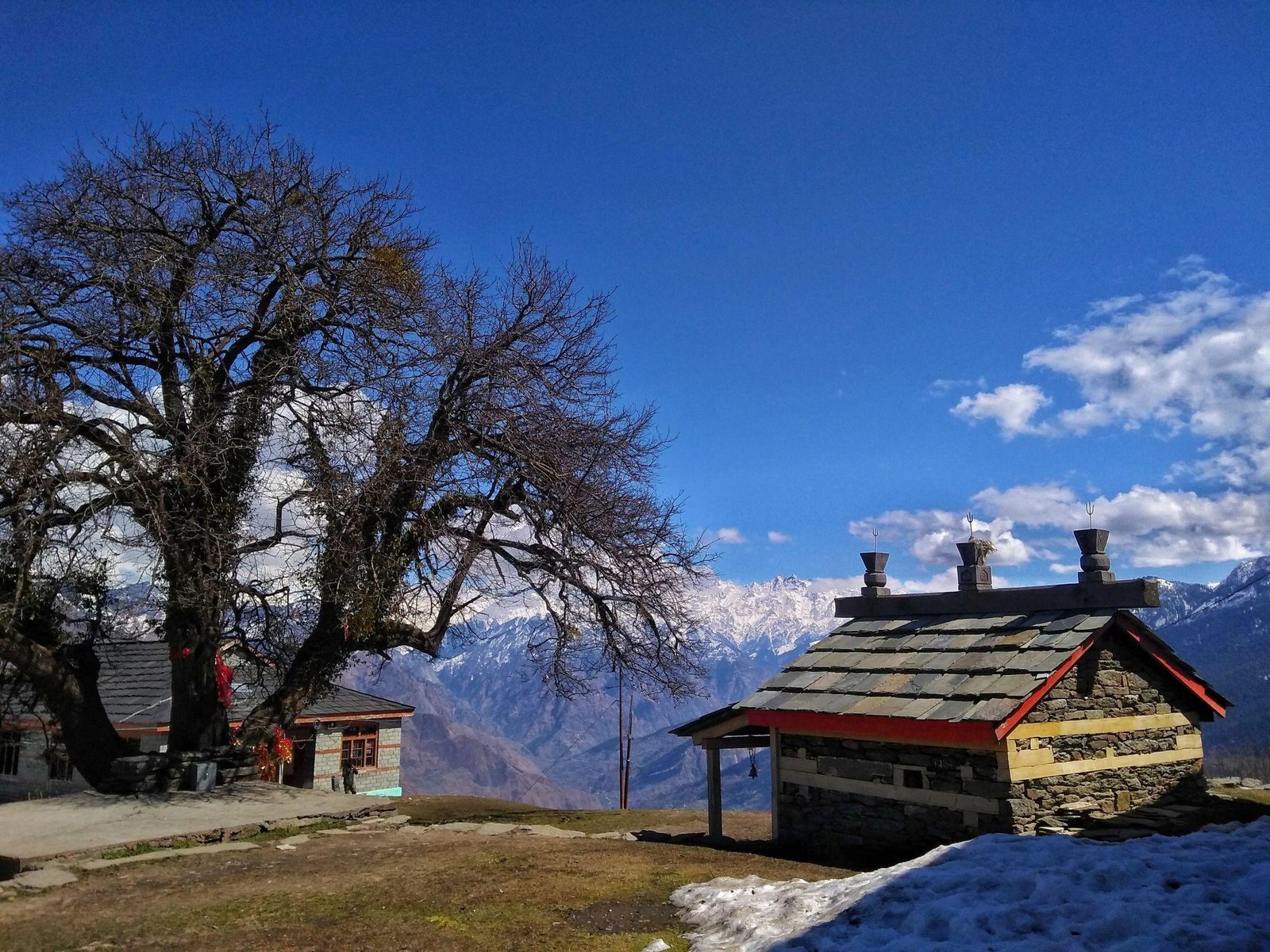
Bijli Mahadev Temple is one of the most distinctive and spiritually significant Shiva temples in the Kullu district of Himachal Pradesh. Situated on a high ridge above the Kullu Valley at an elevation of approximately 2,438 metres, the temple is dedicated to Lord Shiva and is surrounded by mountain forests, open meadows, traditional villages and extensive views across the Beas and Parvati valleys.
The name “Bijli Mahadev” translates approximately as “Lord Shiva of Lightning.” The shrine is known throughout Himachal Pradesh for a remarkable religious tradition connecting the temple, a tall sacred staff and lightning from the mountain sky.
According to temple belief, lightning strikes the tall staff installed near the shrine and the force may affect or break the Shiva lingam inside the temple. Priests then gather the separated portions and ritually restore the sacred form using butter and sattoo.
Different popular accounts give different descriptions of how frequently this occurs. Some describe it as an annual event, while others attach longer intervals to the tradition. Since lightning cannot be predicted according to a religious timetable, visitors should understand the account as a sacred temple tradition rather than expect to witness a strike during their visit.
The ritual of restoring the Shiva lingam carries a deeper spiritual meaning. It represents destruction followed by renewal, the ability of faith to rebuild what has been broken and the continuing presence of Lord Shiva through natural change.
This connection between lightning, mountains and Mahadev gives Bijli Mahadev Temple an identity unlike most other Shiva shrines in India.
The temple is located above Kullu town and can be reached through mountain roads followed by an uphill walk. Himachal tourism information commonly places the temple around 14 kilometres from Kullu, with the final approach involving a trek of approximately 3 kilometres from the nearest practical roadhead.
However, the exact trekking distance can vary according to the route used, where the vehicle is permitted to stop and the condition of the mountain road. Some travellers begin walking from Chansari or another nearby settlement and may therefore cover a longer distance.
Visitors should confirm the current route with their hotel, homestay host, local taxi driver or residents before departure. Road development, weather damage, construction activity and seasonal restrictions can change the most practical starting point.
The trek is relatively short compared with major Himalayan expeditions, but the gradient, altitude and exposed mountain conditions should not be underestimated. The pilgrimage requires suitable footwear, steady pacing and enough daylight for a safe return.
Bijli Mahadev Temple is suitable for Shiva devotees, families with older children, trekking enthusiasts, photographers, solo pilgrims and travellers interested in the living deity culture of Kullu.
The shrine should not be treated only as a scenic viewpoint. Its spiritual importance, local customs and sensitive mountain environment deserve the same respect as its panoramic surroundings.
## Spiritual Importance of Bijli Mahadev
Lord Shiva is worshipped at Bijli Mahadev as the powerful deity who receives the energy of lightning and protects the surrounding valley.
In Hindu philosophy, Shiva represents transformation, meditation, detachment, destruction of ignorance and the renewal that follows change.
Lightning is one of nature’s most dramatic forces. It arrives suddenly, creates intense light and sound and demonstrates power beyond ordinary human control.
At Bijli Mahadev, this natural force is interpreted through faith as a form of divine interaction. The lightning tradition connects the sky, mountain, sacred staff and Shiva lingam within one spiritual narrative.
Devotees visit the temple to pray for courage, protection, family welfare, health, prosperity, success in important work and relief from difficult circumstances.
Some pilgrims undertake the climb as part of a personal vow. Others visit after experiencing what they regard as the fulfilment of a prayer and offer gratitude to Mahadev.
Families from villages across the Kullu region may maintain traditional relationships with the deity and participate in ceremonies, processions and community worship.
The temple belongs to the wider devta culture of Kullu, where local deities remain closely connected with village administration, festivals, agricultural cycles and community identity.
For outsiders, understanding this relationship is important. A deity in Kullu is not regarded merely as an image placed inside a building. The deity may have ceremonial representatives, attendants, musicians, a palanquin and established relationships with surrounding communities.
Visitors should therefore avoid treating sacred processions or ritual objects as entertainment. They form part of an active system of faith and local governance preserved over generations.
## The Sacred Lightning Tradition
The most famous religious tradition at Bijli Mahadev concerns the tall metal or wooden staff associated with the temple.
The staff rises prominently near the shrine and is believed to attract lightning during storms.
According to local belief, the force of the lightning may pass through the staff and cause the Shiva lingam within the temple to break into pieces.
The temple priest then gathers the fragments and joins them using butter and sattoo in a ritual process. Over time, the sacred form is believed to become whole again.
This account should be presented respectfully as religious tradition. Visitors should not demand demonstrations, touch the lingam without permission or attempt to investigate the staff during stormy weather.
No person should remain near the metal staff or on the exposed summit during a thunderstorm merely because the temple is associated with lightning.
Lightning is dangerous and unpredictable. The spiritual story does not make the summit physically safe during electrical activity.
If thunder is heard or dark storm clouds gather, visitors should follow the instructions of priests and local authorities, move away from exposed ridges and avoid isolated trees, metal structures and open ground.
The safest response to severe weather is to delay or end the visit rather than remain at the summit hoping to witness a dramatic event.
The temple tradition is spiritually significant because it transforms an act of natural destruction into a ritual of renewal.
The breaking and restoration of the Shiva lingam can be interpreted as a reminder that life includes sudden disruption, but healing and reconstruction remain possible.
Butter is associated with nourishment and purity, while sattoo represents simple food and the contribution of the community.
The restored lingam therefore reflects both divine continuity and human participation in maintaining the sacred tradition.
## Local Legends Connected with Bijli Mahadev
Several local legends explain the origin and importance of Bijli Mahadev Temple.
One popular regional narrative connects the shrine with a powerful being named Kulant or Kulanta. According to the story, Kulant took the form of a giant serpent and attempted to block the flow of water, threatening to flood the surrounding valley.
Lord Shiva defeated the destructive force and protected the people of the region. The mountain landscape is sometimes interpreted through this story, with parts of the valley associated with the serpent’s body.
Versions of the legend differ between narrators, and the account belongs to mythology and regional oral tradition rather than documented geological history.
The story communicates an important symbolic theme: Lord Shiva protects the valley by preventing uncontrolled destruction.
Another interpretation connects the temple’s lightning tradition with Shiva accepting natural danger upon himself so that surrounding communities remain protected.
These beliefs reveal how Himalayan societies understood storms, floods, mountains and other powerful natural events through sacred narratives.
They should not be used to claim that the temple physically prevents every lightning strike, flood or disaster. Modern visitors must continue to follow weather warnings and scientific safety guidance.
Religious tradition and practical safety can exist together. Devotees may seek Lord Shiva’s blessings while also respecting forecasts, road restrictions and emergency instructions.
## Architecture of Bijli Mahadev Temple
Bijli Mahadev is a comparatively modest temple whose importance comes from its sacred tradition and location rather than monumental scale.
The shrine reflects traditional Himachali mountain architecture through the use of wood, stone, painted surfaces and a sloping roof designed for rain and snow.
The exterior may display white-painted walls, coloured lower sections, carved or decorated doors and roof edges influenced by the architectural traditions of Kullu.
The temple’s simple form allows it to stand naturally within the exposed meadow and mountain landscape.
The entrance generally requires climbing a short set of steps. Bells, religious signs, flags and sacred objects can be seen around the temple area.
The sanctum contains the Shiva lingam that forms the principal focus of worship.
Visitors should follow instructions regarding entry, footwear, offerings and photography. Photography inside the sanctum or of the Shiva lingam should only be undertaken when clearly permitted.
The tall sacred staff is one of the most recognisable external features of the complex. It should never be touched, climbed upon or approached during electrical storms.
The temple has experienced repairs and maintenance over time because high-altitude buildings face strong wind, rain, snow, lightning and seasonal temperature changes.
Visitors should not expect the structure to appear exactly as it does in an older photograph. Paint, roofing, access paths and adjoining facilities may change after restoration work.
## The Trek to Bijli Mahadev Temple
The uphill walk is an essential part of the Bijli Mahadev pilgrimage.
The popular approach begins from the road-accessible village side, often associated with Chansari, before continuing uphill through forest and open mountain terrain.
Official tourism descriptions commonly refer to an approximately 3-kilometre final trek, although the distance may be longer when vehicles stop farther below the traditional roadhead.
The trail includes ascending sections and may involve stone steps, earthen pathways, forest tracks and exposed meadow terrain.
Regular walkers may complete the climb comfortably, but people unaccustomed to hills may find it tiring.
Visitors should begin slowly and maintain a pace at which they can speak without severe breathlessness.
The walk should never be treated as a race. Frequent short rests are more effective than climbing too quickly and becoming exhausted.
Comfortable trekking shoes or sports shoes with dependable grip are strongly recommended.
Slippers, sandals with smooth soles and formal shoes may become unsafe on loose soil, wet stone or steep descents.
A small backpack is more practical than hand-carried luggage.
Travellers should carry drinking water, light food, basic first-aid supplies, sun protection, a rain layer and any essential personal medicines.
Water and snacks may be available seasonally near parts of the route, but visitors should not depend entirely on temporary stalls.
Every item carried uphill should be brought back down unless an authorised waste facility is available.
The trek should preferably begin in the morning. Early departure provides cooler temperatures, better visibility and enough daylight for the descent.
Afternoon cloud formation is common in the mountains, particularly during the monsoon and seasonal weather changes.
Visitors should avoid beginning the climb late in the afternoon merely to watch sunset unless they have a guide, suitable lighting and confirmed overnight arrangements.
Descending an unfamiliar forest route after dark can be difficult and unsafe.
## Fitness and Accessibility
Bijli Mahadev is not an extreme high-altitude expedition, but the uphill route requires moderate physical effort.
Families with active older children can undertake the walk with sufficient rest and supervision.
Senior citizens should assess their fitness, joint health and breathing capacity before attempting the complete climb.
People with heart, lung, severe knee or mobility conditions should seek appropriate medical advice and confirm the latest vehicle access.
A walking stick can provide useful support during the descent.
Visitors should avoid carrying heavy bags, especially when helping children or older family members.
The altitude is approximately 2,438 metres, which is lower than many major Himalayan pilgrimage sites but still high enough for some visitors to feel mild breathlessness or fatigue.
Travellers arriving directly from the plains should walk slowly, remain hydrated and avoid excessive exertion.
Severe or persistent breathing difficulty, chest pain, confusion or faintness should never be ignored.
The temple area has limited medical infrastructure. Necessary medicines should be carried from Kullu or Bhuntar.
## Panoramic Views from the Temple
Bijli Mahadev Temple is known for commanding views across the Kullu and Parvati valleys.
From the upper ridge, visitors may observe layers of forested mountains, villages, cultivated slopes, the Beas valley and the direction of the Parvati Valley.
During clear conditions, the meeting of river valleys and the wider mountain geography become easier to understand from above.
Snow-covered Himalayan ranges may also be visible depending on the season, weather and atmospheric clarity.
Mountain views are never guaranteed. Fog, haze, rain and cloud may completely cover distant ridges.
Early morning generally provides a better possibility of clear visibility than late afternoon, but conditions can change within minutes.
The landscape remains meaningful even when the distant mountains are hidden. Clouds moving through the meadow, temple bells and changing light create a deeply atmospheric setting.
Visitors should remain within safe areas and avoid standing on unstable edges for photographs.
The summit is exposed to strong winds. Loose scarves, hats and lightweight belongings should be secured.
Drone photography should never be assumed to be permitted. It may require religious, local, environmental and aviation approvals and can disturb worshippers, livestock and wildlife.
## Bijli Mahadev and Kullu’s Devta Culture
Kullu is frequently described as the Valley of Gods because of the large number of village deities worshipped throughout the district.
These deities participate in local festivals, processions and community events through ceremonially decorated palanquins accompanied by musicians, priests and attendants.
Bijli Mahadev is an important part of this living religious culture.
The deity’s ceremonial presence is associated with wider religious gatherings in Kullu, including the region’s renowned Dussehra traditions according to annual arrangements.
Kullu Dussehra differs from many Dussehra celebrations elsewhere in India. Instead of focusing only on the burning of Ravana effigies, the festival brings numerous regional deities together around Lord Raghunath in Kullu.
Visitors attending Kullu Dussehra may gain a deeper understanding of how village deities remain connected with social, agricultural and spiritual life.
Exact participation can vary each year, and visitors should confirm the official programme rather than assume that a particular deity will appear on a specific day.
Religious palanquins should not be touched without permission. Processions should be given sufficient space, and musicians, priests and local worshippers should not be obstructed for photographs.
## Shravan and Shiva Festivals
The Hindu month of Shravan is particularly important for Shiva worship.
Devotees may visit Bijli Mahadev to offer water, flowers, bilva leaves and prayers during this period.
Himachal tourism calendars have historically recorded a Shravan fair at Bijli Mahadev, accompanied by local cultural programmes and community participation.
The exact dates and scale of the fair may change annually. Visitors should verify the current festival programme before planning travel.
Mahashivratri is another important occasion associated with Lord Shiva. Special prayers, fasting and worship may be conducted according to temple customs and seasonal accessibility.
Mahashivratri occurs during a period when the upper route may still be affected by winter snow or ice.
Travellers should not assume that the temple can be reached safely simply because it is a major religious date.
Road, trail and weather conditions must be confirmed before departure.
During fairs and festivals, parking areas and the trail can become crowded. Families and groups should remain together and establish a meeting point.
Accommodation in Kullu and nearby villages should be booked in advance.
## Best Time to Visit Bijli Mahadev Temple
The most suitable period depends upon trail conditions, weather and the traveller’s preferred experience.
### Spring
Spring brings gradual improvement in access after winter.
Snow or ice may remain on shaded upper sections during the early part of the season.
As temperatures rise, the forest begins to display new growth and the meadows become suitable for walking.
Morning and evening conditions remain cool, so visitors should carry warm layers.
Road and trail conditions should still be confirmed locally before beginning the trek.
### Summer
Summer is one of the most convenient seasons for visiting Bijli Mahadev.
The trek is generally more accessible, daylight hours are longer and the temperature is pleasant compared with the plains.
Direct sunlight can be strong on exposed sections. Visitors should carry water, sunscreen, sunglasses and a cap.
Weekends, school holidays and religious dates can bring larger crowds.
Starting early helps avoid heat, traffic and afternoon cloud formation.
### Monsoon
The monsoon creates a green and misty landscape across the Kullu Valley.
Forests become dense, clouds move over the ridge and the temple may appear surrounded by fog.
However, heavy rain can make the trek slippery and increase the risk of landslides, falling stones, road damage and lightning.
The exposed temple summit should be avoided during thunderstorms.
Visitors should check district weather and road advisories before departure and postpone the journey during severe rain.
A waterproof jacket or poncho is generally more practical than an umbrella in strong wind.
Shoes with dependable grip are essential.
### Autumn
Autumn is among the best periods for visiting Bijli Mahadev.
Rain usually reduces, mountain visibility may improve and walking conditions become comfortable.
The post-monsoon landscape often remains green.
The period around Kullu Dussehra can provide an opportunity to experience the region’s broader deity culture, although accommodation demand may increase significantly.
### Winter
Winter can bring snow, ice and cold winds to the temple ridge.
The route may become difficult or inaccessible depending on snowfall and road conditions.
Winter photographs should not be used as proof that a route is currently open.
Only reliable local information should determine whether the journey is safe.
Visitors attempting a winter pilgrimage require insulated clothing, waterproof footwear, gloves, caps and sufficient daylight.
Ordinary vehicles may not be able to reach the usual roadhead after snowfall.
Snowfall cannot be guaranteed for any particular travel date.
## Reaching Bijli Mahadev Temple
Kullu town is the principal urban base for the pilgrimage.
Travellers usually proceed from Kullu towards the Chansari or Kashwari side before beginning the final uphill route.
The exact road and parking point should be confirmed locally because mountain access can change.
Private taxis offer the greatest flexibility for families and groups.
A local driver familiar with the route is preferable to a driver attempting the mountain road for the first time.
Local buses or shared vehicles may operate towards nearby villages, but their frequency and final destination can vary.
Visitors relying on public transport should confirm both the morning service and the last return option.
The road should preferably be travelled during daylight.
Mountain curves, construction, rain and village traffic can make the journey longer than expected.
Travellers should not schedule a tightly timed flight or long-distance bus immediately after the temple excursion.
## Ropeway Status
A ropeway project connecting the lower valley with Bijli Mahadev has been proposed and has been the subject of construction activity, legal proceedings, environmental concerns and local opposition.
Visitors should not assume that a functioning passenger ropeway is currently available.
Online articles, videos or maps may mention the project without accurately reflecting its present operating status.
The traditional pilgrimage continues to involve mountain-road travel and walking.
Before travelling, visitors should ask their accommodation provider or local tourism information centre about the latest access arrangements.
The uncertainty surrounding the project also reinforces the need for responsible tourism.
Bijli Mahadev is a sacred meadow and temple landscape closely connected with local faith and ecology. Visitors should respect community concerns and avoid treating the area only as a mass-tourism attraction.
## Kullu as the Main Accommodation Base
Kullu is the most practical base for visiting Bijli Mahadev Temple.
The town offers hotels, homestays, guesthouses, restaurants, markets, hospitals, pharmacies, taxis and transport connections.
Staying in Kullu allows visitors to begin the temple journey early and return before darkness.
Properties around Dhalpur, Akhara Bazaar, Sarvari and the wider Kullu area provide different levels of comfort and access.
Travellers should check whether their chosen property has parking and whether a taxi can reach its entrance easily.
Some hill properties may involve narrow lanes or steps.
Families should select hotels offering suitable room size, meals and convenient vehicle access.
Senior citizens should prioritise lifts, ground-floor rooms and minimal stairs.
Solo pilgrims may choose budget guesthouses or local homestays.
Groups should confirm multiple-room availability, vegetarian meals and parking for their vehicle.
## Homestays Near Chansari and the Temple Route
Village homestays closer to the Bijli Mahadev trail can provide a quieter and more locally connected experience.
Staying near Chansari or another recognised route village may reduce morning travel time and allow pilgrims to begin walking early.
Local hosts can provide valuable information about weather, trail conditions and the current roadhead.
Facilities may be simpler than those in central Kullu. Guests should confirm attached bathrooms, hot water, meals, electricity, parking and mobile connectivity.
The actual walking distance from a homestay to the temple should be checked before booking.
A property describing itself as “near Bijli Mahadev” may still be located on a different slope or require a substantial drive.
Village guests should respect residential areas, agricultural land, livestock and local customs.
## Bhuntar as a Travel Base
Bhuntar is useful for visitors arriving by air or travelling through the junction of the Kullu and Parvati valleys.
Kullu–Manali Airport is located near Bhuntar, while road routes separate towards Kullu–Manali and Kasol–Manikaran.
Bhuntar offers hotels, guesthouses, transport, markets and essential services.
It can serve as an arrival-night base, although Kullu or a route village may be more convenient for the temple trek itself.
Visitors arriving on a late flight should rest overnight rather than immediately attempting a mountain road.
## Manali as an Alternative Base
Manali offers the largest selection of hotels, resorts, hostels and tourism facilities in the wider valley.
It can be used as a base for Bijli Mahadev, but it involves additional road travel through Kullu.
Visitors staying in Manali should leave early and account for traffic, particularly during weekends and peak seasons.
Travellers whose primary purpose is Bijli Mahadev darshan may find Kullu more practical and economical.
A combined itinerary can include one night in Kullu for the temple and additional nights in Manali for other attractions.
## Nearby Spiritual Destinations
### Raghunath Temple, Kullu
Raghunath Temple is one of the most important religious sites in Kullu town.
Dedicated to Lord Rama, the temple is closely connected with the royal and Dussehra traditions of the valley.
A journey combining Raghunath Temple and Bijli Mahadev allows travellers to experience both the central deity culture of Kullu and a hilltop Shiva pilgrimage.
### Jagannathi Devi Temple
Jagannathi Devi Temple is another hill shrine overlooking the Kullu region.
It is associated with Goddess worship and offers a different mountain pilgrimage experience.
The route and walking requirements should be confirmed before travel.
### Basheshwar Mahadev Temple, Bajaura
Basheshwar Mahadev Temple at Bajaura is an important historic stone temple dedicated to Lord Shiva.
It can be combined with Bhuntar, Kullu and Bijli Mahadev as part of a Shiva-focused itinerary.
Visitors interested in architecture should allow time to observe its stone construction and sculptural details respectfully.
### Manikaran
Manikaran is a major Hindu and Sikh pilgrimage destination in the Parvati Valley.
It is known for temples, the gurdwara and natural hot springs.
Bijli Mahadev and Manikaran should generally be planned on separate days because each involves substantial road or walking time.
### Naggar
Naggar is known for its castle, temples, traditional architecture and mountain scenery.
Longer trekking routes have historically connected the Bijli Mahadev region with Naggar, but these should only be attempted with proper guidance and preparation.
Ordinary visitors can travel between Kullu and Naggar by road on a separate day.
### Great Himalayan National Park Region
The Great Himalayan National Park lies within Kullu district and protects extensive forests, wildlife habitat and high-altitude landscapes.
Entry into regulated areas requires appropriate planning, guides and permissions according to the selected route.
It should not be treated as an informal extension of the Bijli Mahadev trek.
## Suggested One-Day Itinerary
A one-day pilgrimage is practical for travellers staying in Kullu.
The day should begin early with a taxi or local vehicle towards the nearest safe roadhead.
Visitors can complete the uphill trek at a comfortable pace, attend darshan and spend time observing the valley views.
The descent should begin with enough daylight remaining.
After returning to Kullu, travellers may visit Raghunath Temple or rest at their accommodation.
Adding Manikaran or Manali sightseeing to the same day may create an unnecessarily tiring schedule.
## Suggested Two-Day Itinerary
On the first day, visitors can arrive in Kullu, check into a hotel or homestay and visit Raghunath Temple and the local market.
The second day can be dedicated to Bijli Mahadev.
An early departure provides sufficient time for the drive, trek, darshan, rest and descent.
Guests can return to Kullu for another night before continuing towards Manali, Naggar or the Parvati Valley.
## Suggested Three-Day Shiva and Valley Itinerary
The first day can include Kullu and Raghunath Temple.
The second day can be dedicated entirely to Bijli Mahadev Temple.
The third day can include Basheshwar Mahadev Temple and travel towards Naggar, Manali or Manikaran.
Travellers interested in slower village tourism can instead spend the third day around a local homestay, orchard or forest route.
## Choosing the Right Accommodation
The best accommodation depends on the traveller’s primary purpose and onward route.
Kullu is suitable for most pilgrims because it provides developed facilities and reasonable access.
A homestay near the trail is best for visitors seeking an early start and village experience.
Bhuntar is convenient for airport arrivals and Parvati Valley connections.
Manali is suitable for travellers combining pilgrimage with a longer holiday but requires additional driving.
Families should check room size, meals, parking and bathroom facilities.
Senior citizens should confirm lifts, stairs and vehicle access.
Trekkers should select a property that can provide updated trail information and arrange an early taxi.
Winter travellers should verify heating, hot water, bedding and road access.
Monsoon visitors should ask whether the property’s approach road is affected by landslides.
Guests requiring internet access should confirm network and Wi-Fi quality directly with the property.
## Book Stays Near Bijli Mahadev Temple with MudrasStays
MudrasStays helps pilgrims discover hotels, homestays, guesthouses, cottages and mountain accommodation near Bijli Mahadev Temple, Kullu, Bhuntar and the surrounding villages.
The platform is designed specifically for travellers looking for suitable places to stay near temples and spiritual destinations across India.
Visitors can compare properties according to their practical distance from the Bijli Mahadev route, budget, room type, group size and required facilities.
Booking a nearby stay makes it easier to begin the climb early, avoid excessive road travel and return safely before darkness.
Solo pilgrims can search for affordable guesthouses and local homestays.
Couples can explore peaceful mountain-view rooms, cottages and orchard stays.
Families can choose hotels offering meals, parking and suitable room capacity.
Senior citizens can prioritise accessible properties and assistance with local transport.
Pilgrimage groups can identify accommodation offering multiple rooms, vegetarian food and parking for their vehicle.
Trekkers can search for stays capable of arranging local drivers, guides and packed meals.
Travellers combining Bijli Mahadev with Kullu, Manikaran, Naggar or Manali can select accommodation according to the sequence of their journey.
Choosing a temple-focused booking platform helps visitors understand the real road and walking distance instead of selecting a general hotel located far from the pilgrimage route.
## Responsible Pilgrimage
Bijli Mahadev stands within a sensitive mountain meadow and forest environment.
Visitors must carry back plastic bottles, food wrappers, disposable plates and puja packaging.
Waste should not be buried, burned or thrown down the slope.
Religious offerings should be placed only in authorised areas.
Plastic flags and synthetic cloth should not be tied randomly to trees or sacred structures.
Smoking and open flames can create serious forest-fire risks.
Visitors should remain on recognised paths and avoid creating shortcuts through vegetation.
Livestock, birds and wildlife should not be chased or fed unsuitable food.
Loud music is inappropriate along the trail and near the shrine.
The tall sacred staff must not be touched, climbed upon or approached during a thunderstorm.
Visitors should leave the exposed summit immediately when advised by priests or authorities because of lightning or severe weather.
Photography should not obstruct worship.
The Shiva lingam, sanctum, priests and private rituals should only be photographed when permission is clearly granted.
Local residents, farmers and devotees should not be photographed without consent.
Travellers should support local taxis, homestays, shops, guides and food providers fairly.
Responsible pilgrimage protects both the natural landscape and the community that maintains the temple tradition.
## A Sacred Meeting of Lightning, Mountains and Lord Shiva
Bijli Mahadev Temple represents a rare meeting of natural power, Shiva worship and the living culture of the Kullu Valley.
The lightning tradition gives the shrine its name and spiritual identity.
The ritual restoration of the Shiva lingam represents healing and continuity after destruction.
The tall sacred staff connects the temple symbolically with the mountain sky.
The uphill pilgrimage requires patience and effort.
The forest creates a gradual transition from village life to the sacred summit.
The panoramic views connect the Kullu and Parvati valleys within one landscape.
The local deity tradition links Bijli Mahadev with the wider religious and cultural life of Himachal Pradesh.
For Shiva devotees, the temple is a place to seek courage, protection and spiritual strength.
For families, it provides a meaningful pilgrimage combined with a manageable mountain walk when conditions are suitable.
For trekkers, the route offers forests, meadows and broad valley views.
For photographers, the temple, sacred staff, clouds and Himalayan landscape provide memorable visual opportunities when safety and religious dignity are respected.
For cultural travellers, the shrine provides insight into the devta traditions of Kullu.
For solo pilgrims, the climb offers time for reflection and personal prayer.
For couples and families, nearby hotels and homestays provide an opportunity to combine temple darshan with a peaceful Kullu Valley stay.
Bijli Mahadev should not be treated only as an Instagram viewpoint or a place to search for a lightning spectacle.
Its true importance lies in the continuing worship of Lord Shiva, the ritual traditions maintained by priests and the relationship between the shrine and surrounding communities.
Visitors should allow enough time for the mountain journey, trek, darshan and safe descent.
Staying in Kullu or near the temple route allows travellers to begin early and avoid rushing through the pilgrimage.
Plan your journey to Bijli Mahadev Temple with MudrasStays and experience one of the most remarkable Shiva shrines in Himachal Pradesh.
Seek the blessings of Lord Bijli Mahadev, walk through the forests above Kullu and experience panoramic views across the Kullu and Parvati valleys.
Learn about the sacred lightning tradition and the ritual restoration of the Shiva lingam with butter and sattoo.
Combine your journey with Raghunath Temple, Basheshwar Mahadev Temple, Jagannathi Devi Temple, Naggar, Manikaran, Bhuntar and Manali.
Book hotels near Bijli Mahadev Temple, discover homestays near the trekking route and explore suitable pilgrimage accommodation in Kullu through MudrasStays.
Stay closer to your spiritual destination, begin the trek early and reduce unnecessary travel on mountain roads.
MudrasStays connects pilgrims, trekkers, families and spiritual travellers with suitable accommodation near temples and sacred destinations across India.
Begin your Bijli Mahadev Temple journey with a comfortable stay and experience a meaningful pilgrimage centred on Lord Shiva, Himalayan nature, Kullu’s deity culture and the extraordinary spiritual tradition of the Lord of Lightning.