
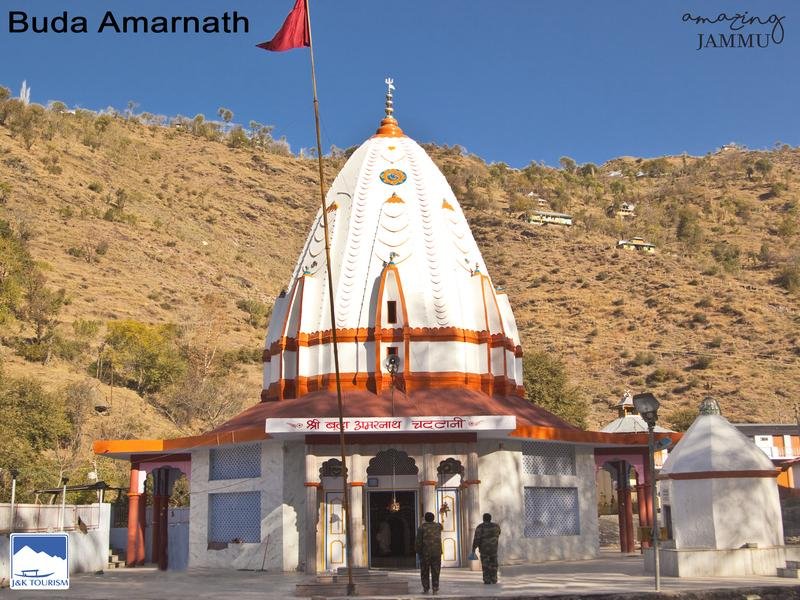
Budha Amarnath Temple is one of the most revered Shiva pilgrimage destinations in the Pir Panjal region of Jammu and Kashmir. Situated at Rajpura–Mandi in Poonch district, the temple stands beside mountain streams, wooded slopes, cultivated valleys and the sacred watercourse traditionally known as the Pulsta or Pulastya River.
The shrine is also known as Baba Budha Amarnath Temple, Swami Budha Amarnath Ji Mandir, Shri Budha Amarnath Ji Chattani, Budha Amarnath Mandi, Buddha Amarnath Temple and Budha Amarnath Chattani Mandir.
The spelling “Budha” is commonly used in the official and local name of the shrine. It should not be confused with Gautama Buddha or with the Sanskrit word Budha referring to the planet Mercury.
Within the temple’s devotional identity, Budha or Buda generally conveys the sense of ancient, elder or primordial. The name therefore expresses the belief that this is an ancient manifestation of Lord Shiva.
The temple is located approximately 20–25 kilometres northeast of Poonch town, depending upon the selected route and the point from which distance is measured.
Mandi is the closest developed settlement and the principal local base for visiting the shrine. It lies within a narrow and attractive valley surrounded by the lower slopes and higher ranges of the Pir Panjal.
Unlike the high-altitude Amarnath Cave in the Kashmir Valley, Budha Amarnath Temple can ordinarily be approached by road. Pilgrims do not need to undertake a multi-day alpine trek or cross a high mountain pass simply to reach the principal temple.
This makes Budha Amarnath suitable for families, children, senior citizens, organised pilgrimage groups and Shiva devotees who may not be physically prepared for the larger Amarnath Cave Yatra.
Road accessibility does not mean the journey should be taken casually.
Poonch is a remote mountain and border district. Travel involves long hill roads, variable weather, security arrangements and limited services outside the main towns.
The annual organised Budha Amarnath Yatra may involve registration, authorised convoys, fixed reporting points, security screening, identification checks and designated accommodation.
Visitors travelling independently outside the main yatra period should still verify current road, weather and local security conditions before departure.
Travellers searching for hotels near Budha Amarnath Temple, homestays in Mandi Poonch, pilgrimage accommodation near Rajpura, places to stay in Poonch or family hotels for the Budha Amarnath Yatra can use MudrasStays to plan a convenient and geographically practical journey.
## Spiritual Importance of Budha Amarnath Temple
Budha Amarnath Temple is dedicated to Lord Shiva, worshipped here through a naturally revered white-stone Shiva lingam.
Lord Shiva represents pure consciousness, meditation, transformation, time, detachment and liberation.
He is Mahadev, the Great God.
He is worshipped as the ascetic yogi of the Himalayas, the compassionate husband of Goddess Parvati, the lord of all beings and the divine force that removes ignorance and harmful attachment.
At Budha Amarnath, Shiva is encountered through a distinctive combination of natural stone, sacred water and mountain landscape.
The lingam is not traditionally described as a conventional dark-stone image installed within an elaborate sculptural sanctum.
It is recognised through a white stone commonly called chakmak in local and official descriptions.
This unusual sacred form gives the temple a visual and devotional identity different from many other Shiva shrines.
The original temple is traditionally described as being formed from one large rock or stone mass. This is reflected in the name Chattani, derived from chattan, meaning rock.
The mountain stone becomes the temple.
The natural lingam becomes the centre of worship.
The streams and springs provide sacred water.
The surrounding Pir Panjal landscape completes the pilgrimage environment.
For devotees, this unity expresses the belief that Shiva is not confined to structures created by human hands. Mahadev can be experienced through rock, river, forest, silence and the physical elements of the earth.
Pilgrims may pray for peace, family welfare, courage, health, safe travel and freedom from fear.
Some visit during Shravan.
Others join the annual pilgrimage that culminates around Raksha Bandhan.
Local families may visit on Mondays or during important family occasions.
Organised groups travel from Jammu and other regions to participate in the Chhari Mubarak Yatra.
These prayers and practices belong to personal faith.
The temple should not be promoted as guaranteeing medical recovery, marriage, employment, wealth, fertility or the fulfilment of every wish.
Spiritual worship can provide courage, community support and emotional strength, while practical matters should continue to receive appropriate medical, legal, financial or personal attention.
## Meaning of Budha Amarnath
The name Budha Amarnath combines two powerful ideas.
Amarnath means Lord of Immortality.
“Amar” means immortal, while “Nath” means lord, protector or master.
Within Hindu philosophy, immortality does not simply mean continuing indefinitely within the same physical body.
It refers to the eternal nature of consciousness beyond birth and death.
The physical body changes and eventually ends, but the deepest spiritual reality is understood as timeless.
The word Budha or Buda in the shrine’s name is commonly interpreted as ancient or elder.
Budha Amarnath can therefore be understood devotionally as the ancient Lord of Immortality.
The title also distinguishes the Poonch shrine from Shri Amarnath Cave in the Kashmir Valley.
Both are dedicated to Shiva and connected with the idea of immortality, but they are separate destinations with different landscapes, sacred forms and pilgrimage arrangements.
Visitors should never book travel or accommodation using only the word “Amarnath” without confirming whether they mean:
Budha Amarnath Temple in Mandi, Poonch district.
Or Shri Amarnath Cave reached from Pahalgam or Baltal in the Kashmir Valley.
The two pilgrimages should not be confused.
## Budha Amarnath and Shri Amarnath Cave
Shri Amarnath Cave is famous for the naturally forming ice lingam inside a high-altitude Himalayan cave.
Its annual yatra requires registration, medical preparation and a demanding trek from the Pahalgam or Baltal side.
Budha Amarnath Temple is located at Mandi in Poonch district and contains a white-stone lingam within a constructed rock shrine.
Budha Amarnath is road-accessible, followed by a relatively short temple approach.
The major pilgrimage celebration here concludes around Raksha Bandhan and includes the Chhari Mubarak procession from Poonch.
The similarities lie in Shiva worship, the concept of Amarnath and Himalayan sacred geography.
The differences lie in location, altitude, sacred form and physical route.
Visiting Budha Amarnath does not replace official registration for the Kashmir Amarnath Yatra.
Similarly, a registration issued for the Kashmir Amarnath Cave should not automatically be assumed to cover the organised Budha Amarnath Yatra in Poonch.
Each annual administration may establish separate procedures.
## The Natural White-Stone Shiva Lingam
The principal sacred object inside the temple is a white-stone Shiva lingam.
Official district descriptions refer to the material through the local term chakmak.
The sacred form is regarded by devotees as natural or swayambhu.
Swayambhu means self-manifested rather than made and installed as an ordinary sculpture.
This belief belongs to the religious tradition of the shrine.
Visitors should not attempt to test, scrape, measure or classify the lingam physically.
Darshan is an act of worship, not a geological examination.
The white colour gives the lingam a distinctive appearance.
White can symbolise purity, peace, clarity and freedom from attachment.
Within Shaiva traditions, the lingam represents Shiva beyond the limitations of ordinary human form.
It has no single face, costume or posture because Mahadev cannot be contained within one physical representation.
The surrounding base represents Shakti, the active divine energy through which consciousness becomes visible creation.
Together, Shiva and Shakti express the unity of awareness and energy, stillness and movement, meditation and life.
Devotees may offer water, flowers, bilva leaves or other approved materials according to temple custom.
Large quantities of milk, oil, synthetic colour or packaged offerings should not be used without permission.
Excessive offerings can create waste, damage surfaces and affect drainage.
Simple prayer performed respectfully is more meaningful than material excess.
## Why the Temple Is Called Chattani
The word Chattani refers to the shrine’s association with a large rock or stone mass.
Official local tradition describes the original temple as being constructed from one big stone.
The sacred rock therefore becomes more than a building material.
It represents stability, permanence and the mountain presence of Shiva.
Lord Shiva is traditionally associated with Kailash, caves, cliffs and remote Himalayan landscapes.
A rock-built shrine fits naturally within this sacred identity.
The massive stone form may also have encouraged the belief that the temple is extremely ancient.
However, a distinction should be maintained between the antiquity of the sacred site and the age of every visible architectural element.
Living temples undergo repeated repair.
Roofs, plaster, flooring, paint, railings, queue corridors and subsidiary rooms may be reconstructed according to weather and pilgrim requirements.
The sacred core can preserve old traditions while the surrounding complex includes later additions.
## The Four Doors of the Temple
The original shrine is described as having four doors facing the four principal directions—north, south, east and west.
Official local interpretation connects these doors with openness to the four traditional varnas.
The broader and most meaningful understanding for the modern pilgrim is that the doors of Mahadev remain open to devotees from every direction and background.
Shiva is often worshipped as the lord of those who stand outside rigid social boundaries.
His companions include gods, sages, animals, forest beings, ascetics and ordinary householders.
The four doors therefore create a strong architectural symbol of spiritual accessibility.
A pilgrim may arrive from any direction.
No one direction owns the divine presence.
Visitors should nevertheless use the entrance and exit currently designated by the temple management. Crowd-control barriers may mean that not every historic doorway functions as a public entrance on a particular day.
## Sacred Springs at Budha Amarnath
The temple has a strong relationship with natural springs.
Official district tradition records that four holy springs were historically associated with the shrine.
Water from three was later directed towards the fourth spring on the southern side of the temple.
Pilgrims traditionally bathe or perform purification before entering for worship.
Water represents life, cleansing, renewal and the movement of divine grace.
The bathing tradition should be followed only according to current local instructions.
Natural springs can be affected by seasonal flow, maintenance, crowding and water-quality conditions.
People with reduced immunity, open wounds, skin problems or other health concerns should make an informed decision before bathing.
Soap, shampoo, detergent and chemical products must never be used in a sacred spring.
Plastic, food, cloth and flower packaging should not be thrown into the water.
Wet stone can become slippery.
Children and senior citizens require supervision.
Ritual purification does not remove a person’s moral responsibility. Bathing becomes spiritually meaningful when accompanied by honest reflection and better conduct.
## Pulastya River Tradition
The temple stands near a watercourse officially described as Pulsta Nadi and commonly associated in local tradition with the sage Pulastya.
Pulastya is remembered within Hindu sacred literature as a great rishi and as an important figure within ancient genealogical traditions.
He is also described as an ancestor of Ravana through Vishrava.
Regional religious belief connects Pulastya with spiritual practice in the Poonch and Mandi landscape.
The river’s name preserves this association.
The connection should be presented as Hindu tradition and sacred geography rather than verified archaeological evidence that a particular historic individual lived at one precisely identified riverbank.
Its spiritual meaning remains significant.
A river named for a sage links water with meditation, learning and transmission of knowledge.
The flowing water reminds pilgrims that sacred teaching moves from one generation to another.
## Gagri Stream and the Sacred Confluence
Budha Amarnath Temple is situated near the meeting of two mountain watercourses, identified as Gagri Nallah and Pulsta Nadi.
A confluence has deep symbolic importance in Hindu pilgrimage.
When two streams meet, separate movements become one flow.
The meeting can represent the union of Shiva and Shakti, knowledge and devotion, individual effort and divine grace.
Mountain streams can change dramatically with the season.
During dry weather, the flow may appear gentle.
Rain and snowmelt can increase volume and current.
Visitors should not stand within an active stream channel during unstable weather.
Apparently shallow water can become dangerous after upstream rainfall.
Children should remain away from unprotected edges.
All bathing and water access should follow local arrangements.
## The Pir Panjal Setting
Budha Amarnath lies within the broad landscape of the Pir Panjal range.
The surrounding region includes hills, high ridges, forests, pastures, agricultural land and clear mountain streams.
Seasonal appearance changes considerably.
Spring brings fresh vegetation.
Summer remains cooler than the Jammu plains.
The monsoon can make the hills green but also creates landslide and flash-water risk.
Autumn often provides clear skies and comfortable travel.
Winter can bring cold, frost, rain and snow to the higher surrounding areas.
Mountain views depend upon weather and visibility.
Cloud, rain or haze may hide distant peaks.
The scenic setting should not reduce the temple to a photography location.
For devotees, the mountains are part of Shiva’s spiritual environment.
Their scale encourages humility.
Their silence supports reflection.
Their physical difficulty reminds pilgrims that spiritual growth requires patience.
## Religious Traditions Concerning the Shrine’s Antiquity
Budha Amarnath is frequently described as an extremely ancient temple.
Some devotional accounts call it older than the Kashmir Amarnath shrine or connect it with remote mythological periods.
Precise archaeological proof for an exact construction year is not widely established in the sources generally available to visitors.
It is therefore best to describe the temple as traditionally ancient rather than assigning every visible structure to a specific millennium.
A sacred place may be older than its current temple building.
A natural lingam may have been worshipped before a permanent shrine was created.
Later rulers, priests, local communities and pilgrimage organisations may have repaired or expanded the complex.
The continuity of worship can be historically important even when the architecture has changed.
## The Annual Budha Amarnath Yatra
The organised Budha Amarnath Yatra is one of the most important annual religious events in Poonch district.
The pilgrimage normally takes place in the period leading to Raksha Bandhan.
Exact dates change according to the Hindu calendar and administrative announcement.
Pilgrims from Jammu and other parts of India may travel through organised batches or convoys.
Arrangements can include registration, lodgement centres, food, sanitation, medical support, security escort and designated transport.
The yatra period should not be planned solely from the previous year’s dates.
Travellers must verify the announcement for the actual year of travel.
Security and weather conditions can cause schedule changes, route controls or temporary suspension.
Pilgrims should carry government-issued identity documents and comply with every screening process.
Large bags, prohibited objects and unauthorised drones should not be carried.
## Raksha Bandhan at Budha Amarnath
Raksha Bandhan is the principal festival associated with the shrine.
Across India, Raksha Bandhan is known for the tying of a protective thread between siblings and family members.
At Budha Amarnath, the occasion also marks the culmination of the annual Shiva pilgrimage and the arrival of the sacred Chhari Mubarak.
Protection is a central spiritual theme.
The rakhi represents a promise of care and responsibility.
The Chhari represents sacred authority and the continuity of pilgrimage.
Lord Shiva represents refuge from fear and the spiritual protection offered through awareness and ethical conduct.
The festival therefore joins family responsibility with collective religious devotion.
The temple and approach roads become extremely crowded.
Visitors should expect controlled queues, waiting time, parking restrictions and security checks.
Families should agree upon a meeting point.
Children and senior citizens should remain close to responsible adults.
## The Chhari Mubarak Procession
The Chhari Mubarak, or sacred mace, is central to Budha Amarnath’s annual tradition.
Religious preparations begin at Dashnami Akhara in Poonch.
Havan, puja, bhajan, kirtan and spiritual discourses are conducted before the procession.
The sacred mace is then carried from Poonch towards the temple at Mandi.
The Mahant may travel in a palki accompanied by sadhus, devotees and local participants.
Chandak is traditionally an important halt on the route.
The procession continues towards Rajpura–Mandi, where it is formally received before the sacred mace is taken into the shrine and aarti is performed.
The Chhari procession should be experienced as a living religious tradition rather than a parade for entertainment.
Participants should remain disciplined, avoid obstructing the route and respect all security directions.
Photography should not interfere with worship or procession movement.
## Community Participation and Shared Hospitality
Official district descriptions record that people from different local communities participate in welcoming the Chhari and the pilgrims.
Refreshment stalls and langars have historically been arranged along the route, including support from Muslim residents.
This shared hospitality is an important part of Poonch’s cultural identity.
The pilgrimage demonstrates how a religious event can also become an expression of neighbourhood cooperation and mutual respect.
Visitors should honour this tradition by behaving respectfully towards every local community.
Religious tourism should not be used to create hostility or provocative social-media content.
Poonch contains Hindu temples, Sikh gurdwaras, Muslim shrines and communities with interconnected cultural histories.
A responsible pilgrim recognises that hospitality and security depend upon trust among residents.
## Mahashivratri
Mahashivratri is another important occasion for Shiva worship at Budha Amarnath.
Devotees may observe fasting, prayer, mantra recitation and abhishek.
The festival usually falls during late winter or early spring.
Poonch and Mandi can remain cold during this period.
Rain, frost or snow in higher surrounding areas may affect the road.
Temple schedules and transport should be confirmed locally.
## Shravan and Monday Worship
The Hindu month of Shravan is sacred to Lord Shiva.
Mondays may attract additional devotees.
Pilgrims may offer water, flowers and bilva leaves according to temple custom.
Shravan often overlaps with the monsoon.
This is also the period in which the annual Budha Amarnath Yatra commonly occurs.
The landscape becomes green, but roads can experience landslides, falling stones, waterlogging and reduced visibility.
Pilgrimage plans must remain flexible.
A religiously important date does not make severe weather harmless.
## Daily Darshan and Aarti
Daily temple timings can vary according to season, security arrangements, festivals and priestly routine.
Visitors planning an early-morning or late-evening visit should confirm the current schedule through their accommodation provider, driver or authorised temple representatives.
Morning is generally the most practical time.
The weather is cooler, roads are easier to navigate in daylight and visitors have sufficient time to return to Poonch.
Evening aarti can be deeply atmospheric, but travellers should not begin an unfamiliar mountain-road return after dark without a dependable vehicle and local advice.
## Best Time to Visit Budha Amarnath Temple
Budha Amarnath Temple can be approached during much of the year when roads remain open and local conditions permit.
### Spring
Spring brings improving temperatures and fresh vegetation.
Higher peaks may retain snow.
Roads can remain wet because of rain or snowmelt.
A warm waterproof layer and footwear with good grip are useful.
### Summer
Summer is a popular period for visiting Poonch and Mandi.
The weather is generally cooler than Jammu.
Longer daylight makes road travel easier.
Direct sunlight can still be strong, so water and sun protection are important.
### Monsoon and Yatra Period
The annual pilgrimage commonly falls within the rainy season.
The hills become green and streams become fuller.
The same conditions increase the risk of landslides, falling stones, slippery roads and sudden water flow.
Visitors must follow convoy and administration instructions.
Independent detours should be avoided.
### Autumn
Autumn is one of the best periods for quiet pilgrimage and regional sightseeing.
Rain generally reduces, visibility can improve and daytime temperatures remain manageable.
Mornings and evenings become colder as the season progresses.
### Winter
Winter is cold and quieter.
Snow may affect higher surrounding areas and occasionally influence roads within the district.
Regular snow at the temple should not be guaranteed.
Frost and ice can still make roads and courtyards slippery.
Current access should be verified before departure.
## Reaching Budha Amarnath from Poonch
Poonch town is the principal transport and accommodation base.
The temple lies approximately 20–25 kilometres away towards Mandi and Rajpura.
A private taxi, locally arranged cab, bus or authorised yatra vehicle may be used according to current availability.
During the organised yatra, pilgrims may be required to travel within designated convoys or follow prescribed reporting procedures.
Outside the yatra period, travellers should arrange a dependable return vehicle because public transport frequency can be limited.
The route passes through mountain and valley roads.
Travel time should be calculated according to terrain rather than distance alone.
## Reaching Poonch from Jammu
Poonch is approximately 240 kilometres from Jammu by road through the Rajouri side.
The journey commonly takes six to eight hours and can take longer because of traffic, road work, security checks and weather.
Buses, shared vehicles and private taxis operate according to current schedules.
Pilgrims travelling in the organised annual yatra may begin from designated lodgement or reporting centres in Jammu.
A same-day journey from Jammu to Budha Amarnath, darshan and return to Jammu is generally too demanding.
At least one night in Poonch or Mandi is more practical.
## Reaching from Srinagar
Poonch can be approached seasonally from the Kashmir side through the Mughal Road and Pir Ki Gali when the road is officially open.
This high mountain route is affected by snow, landslides and seasonal closure.
It should never be assumed operational merely because a map displays it.
Travellers must verify the current status before departure.
When Mughal Road is closed, reaching Poonch may require the longer Jammu-side route.
## Reaching by Train
Poonch has no operational railway station for ordinary passenger arrival.
Jammu Tawi is the principal long-distance rail gateway.
Shri Mata Vaishno Devi Katra Railway Station may also be useful for certain travel plans, but Poonch still requires a long road journey.
Visitors should arrange accommodation and onward transport before arriving.
## Reaching by Air
Jammu Airport is the principal air gateway for most travellers approaching Poonch from the Jammu side.
Srinagar Airport may be relevant when Mughal Road is open and the visitor’s itinerary begins in Kashmir.
Both options require substantial onward road travel.
A flight should not be scheduled immediately after temple darshan without a large time buffer.
## Road and Security Considerations
Poonch is a border district.
Visitors may encounter identity checks, security checkpoints, temporary traffic restrictions and regulated photography.
Government-issued identification should be carried.
Sensitive locations, security installations and restricted zones should not be photographed.
Drones should never be used without explicit permission.
Road access can change because of weather or security developments.
Travellers should rely upon district administration, police and authorised local operators rather than unverified social-media claims.
## Accessibility for Senior Citizens
Budha Amarnath is more accessible than high-altitude cave pilgrimages because the principal shrine is road-based.
The final approach may still include steps, queue corridors, wet flooring and crowded spaces.
Senior citizens should visit during quieter hours where possible.
Stable footwear and family assistance are advisable.
Visitors with serious mobility limitations should confirm the nearest authorised drop-off point.
Festival queues and convoy schedules can be tiring.
A non-festival weekday may provide a more comfortable experience.
## Visiting with Children
Children can participate in the pilgrimage when supervised carefully.
Parents can explain the white lingam, four doors, sacred springs and Chhari tradition through themes of openness, responsibility and devotion.
Children should not run near streams, springs or wet temple flooring.
They should not touch sacred objects without permission.
Warm clothing may be required even when the plains are hot.
## Mandi
Mandi is the closest town and the natural local base for Budha Amarnath Temple.
It lies in a narrow valley near the meeting of mountain streams.
The settlement provides basic shops, local transport and limited accommodation.
Facilities are less extensive than in Poonch town.
Travellers planning to stay in Mandi should confirm the room, bathroom, meals, electricity, hot water and parking before arrival.
## Poonch Town
Poonch offers the widest range of accommodation, restaurants, markets, medical services and transport within the district.
It is the best base for most first-time visitors.
The town is also associated with Dashnami Akhara and the starting traditions of the Chhari Mubarak.
Staying in Poonch allows travellers to explore its heritage buildings and broader cultural landscape.
## Loran Valley
Loran lies deeper within the scenic Mandi region and is traditionally described as a historic settlement near the foot of the Pir Panjal.
The Loran stream and surrounding mountains create an attractive landscape.
Loran should be visited only when road, weather and local conditions are favourable.
It is not an immediate five-minute extension of temple darshan.
A separate half-day or full-day plan is preferable.
## Noori Chamb
Noori Chamb is a scenic waterfall associated by tradition with Mughal Queen Noor Jahan.
It lies along the Mughal Road region and requires separate road travel.
The waterfall should be approached only through recognised areas.
Wet rock and strong flow can be dangerous.
## Nandishool Waterfall
Nandishool is a high waterfall in the wider Loran landscape.
Access may involve remote roads or walking.
It should not be added casually to a pilgrimage itinerary without a local guide and current route confirmation.
## Poonch Fort and Heritage Buildings
Poonch town contains the historic fort and other buildings associated with the former rulers of the region.
Access conditions and permitted sections should be confirmed.
Visitors should avoid restricted or structurally unsafe areas.
A heritage visit can be combined with Dashnami Akhara and the town market.
## Nangali Sahib
Gurdwara Nangali Sahib is an important Sikh pilgrimage destination near Poonch and represents the district’s diverse sacred heritage.
Visitors should cover their heads, remove footwear where directed and follow gurdwara etiquette.
A respectful itinerary can include Shiva worship at Budha Amarnath and Sikh heritage without reducing either place to casual sightseeing.
## Suggested One-Day Temple Itinerary from Poonch
Begin with an early departure from Poonch.
Travel towards Mandi and Rajpura.
Visit Budha Amarnath Temple during the quieter morning hours.
Complete any permitted purification ritual at the sacred spring.
Receive darshan of the white-stone lingam.
Observe the rock shrine and four-door architecture respectfully.
Spend time beside the streams only within safe areas.
Return to Mandi for a simple meal.
Continue to Poonch before evening.
## Suggested Two-Day Poonch Pilgrimage
On the first day, arrive in Poonch and check into accommodation.
Visit Dashnami Akhara and selected heritage sites in the town.
On the second morning, travel to Budha Amarnath Temple.
Include Mandi and one nearby road-accessible viewpoint if conditions permit.
Return to Poonch for the night.
## Suggested Three-Day Spiritual and Scenic Journey
The first day can focus on Poonch town, Dashnami Akhara and local heritage.
The second day can be dedicated to Budha Amarnath Temple and Mandi.
The third day can include Loran or another verified scenic destination according to road and weather conditions.
Noori Chamb or Mughal Road should be planned separately if they require a different route.
## Accommodation Near Budha Amarnath Temple
Accommodation immediately beside the temple is limited compared with Poonch.
During the annual yatra, temporary lodgement, pilgrim facilities or organised arrangements may be established.
These should not be assumed available throughout the year.
The most dependable accommodation bases are Poonch town and, where verified, Mandi.
## Pilgrim Accommodation During the Yatra
Organised pilgrimage arrangements may include designated lodgement centres, shared halls, temporary camps or dharamshala-style facilities.
The exact system changes annually.
Pilgrims should register only through officially announced channels.
Basic pilgrim accommodation may not provide hotel-style privacy, attached bathrooms, room service or heating.
Travellers with senior citizens, children or medical requirements should assess whether a private hotel is more suitable.
## Hotels in Poonch
Poonch offers the broadest local selection of hotels and guesthouses.
Properties range from simple lodges to more comfortable family accommodation.
Guests should verify parking, hot water, room heating, meals, power backup and the availability of an early taxi to Mandi.
Mobile and internet connectivity can vary.
## Guesthouses and Homestays in Mandi
A verified Mandi guesthouse or homestay can reduce the morning journey to the temple.
Facilities are likely to be simpler than in Poonch.
Guests should confirm attached bathrooms, bedding, hot water, meals, electricity and road access.
A local host can provide current information about temple timing and weather.
## Government and Institutional Rest Houses
Government rest houses may exist within the district, but access can depend upon prior permission, availability and official priority.
An old online mention should not be treated as a confirmed reservation.
Written confirmation is advisable.
## Choosing the Right Stay
Pilgrims focused on comfort, markets and medical support should stay in Poonch.
Visitors seeking early temple access may choose a verified Mandi property.
Families should confirm room size, bathrooms and meals.
Senior citizens should prioritise ground-floor rooms or lifts, hot water and dependable taxis.
Couples may prefer quieter homestays when facilities are clearly verified.
Solo pilgrims should choose populated accommodation with confirmed transport.
Groups should verify multiple rooms, vegetarian meals, driver lodging and parking for buses.
Yatra-period visitors should book early and follow the official accommodation allocation system.
Winter guests should confirm room heating.
Monsoon travellers should ask specifically about road condition and drainage.
## Book Hotels Near Budha Amarnath Temple with MudrasStays
MudrasStays helps pilgrims, families and spiritual travellers discover hotels, homestays, guesthouses and pilgrimage accommodation near Budha Amarnath Temple, Mandi and Poonch.
The platform is designed for travellers searching specifically for places to stay near temples, annual yatras and sacred mountain destinations.
Visitors can compare accommodation according to practical road distance from Budha Amarnath Temple, room type, budget, family size and required facilities.
Booking in Poonch provides access to hotels, markets, restaurants, transport and medical support.
Booking in Mandi can reduce early-morning road travel when a suitable verified property is available.
Solo pilgrims can search for economical guesthouses.
Couples can explore peaceful valley homestays.
Families can choose properties offering meals, parking and comfortable rooms.
Senior citizens can prioritise accessible accommodation with dependable taxi arrangements.
Organised groups can identify stays providing multiple rooms, vegetarian food and suitable parking for larger vehicles.
Travellers attending the annual Budha Amarnath Yatra can use MudrasStays to plan accommodation around the announced registration and convoy schedule.
Visitors combining Budha Amarnath with Loran, Poonch Fort, Nangali Sahib or the Mughal Road region can select accommodation according to the actual geographical sequence.
MudrasStays helps pilgrims avoid choosing a property that appears nearby in straight-line distance but lies across a difficult mountain route or far from dependable transport.
## Responsible Temple Travel
Budha Amarnath is an active Shiva shrine within a sensitive mountain and river environment.
Visitors should dress respectfully and follow the designated queue.
Photography of the lingam, sanctum, priests and private rituals should only be undertaken when clearly permitted.
The sacred white stone should not be touched, scraped or tested.
Springs and streams must not be polluted.
Soap, chemicals, plastic, cloth and food waste should not enter the water.
Offerings should be presented through authorised arrangements.
Religious flags and cloth should not be tied to trees without permission.
Children should remain supervised near water.
Smoking and alcohol are inappropriate within the pilgrimage environment.
Donations should be made through recognised counters or temple representatives.
## Responsible Travel in a Border District
Visitors must respect every security instruction.
Identity documents should remain accessible.
Photography of military facilities, checkpoints, bridges or other sensitive infrastructure should be avoided.
Drones should not be used.
Unapproved routes and shortcuts should not be attempted.
Travel plans should remain flexible because security or weather conditions can change.
Responsible behaviour protects pilgrims, local residents and security personnel.
## Respecting Local Communities
Mandi and Poonch are living communities with diverse religious and linguistic traditions.
Residents use the roads, water sources, markets and agricultural land surrounding the pilgrimage.
Vehicles should not block homes, shops or emergency routes.
Private land should not be entered without permission.
Local residents should not be photographed casually.
Drivers, priests, volunteers, shopkeepers, food providers and accommodation hosts should be treated fairly.
The shared hospitality associated with the Chhari Yatra should be answered with gratitude and respect.
## An Ancient Shiva Shrine in the Pir Panjal
Budha Amarnath Temple represents a powerful meeting of Shiva worship, natural stone, sacred water and the mountain culture of Poonch.
The white lingam gives the shrine its distinctive sacred identity.
The Chattani temple expresses stability and the presence of Mahadev within rock.
The four doors represent openness in every direction.
The sacred springs connect purification with environmental responsibility.
The Pulastya River preserves the memory of sage traditions.
The Gagri confluence joins separate streams within one sacred landscape.
The Pir Panjal setting connects Shiva with mountain silence.
The Chhari Mubarak links modern pilgrims with earlier generations.
Raksha Bandhan transforms family protection into collective devotion.
Community participation demonstrates the power of shared hospitality.
For Shiva devotees, Budha Amarnath is a place to seek peace, courage and spiritual clarity.
For families, it provides an accessible mountain pilgrimage without a demanding high-altitude trek.
For senior citizens, road access makes darshan possible when transport and queues are planned carefully.
For children, the springs, mountains and four-door temple provide lessons about nature, openness and respect.
For cultural travellers, the Chhari procession reveals the living pilgrimage traditions of Poonch.
For photographers, the white-and-saffron temple, mountain slopes and stream landscape provide memorable images when sanctum and security rules are respected.
For spiritual travellers, the shrine expresses a timeless teaching: the eternal presence of Shiva can be discovered within stone, flowing water and disciplined awareness.
Budha Amarnath should not be treated merely as an alternative to the Kashmir Amarnath Cave.
It possesses its own sacred form, traditions and regional identity.
Travel to Poonch with sufficient time.
Stay overnight rather than rushing across long mountain roads.
Visit the temple during peaceful morning hours.
Approach the white lingam with attention.
Protect the sacred springs.
Listen to the story of the Chhari Mubarak.
Respect the communities that welcome pilgrims.
Carry the calmness and responsibility of Mahadev beyond the temple.
Plan your pilgrimage to Budha Amarnath Temple with MudrasStays and experience one of the most important Shiva destinations in the Pir Panjal region.
Seek the blessings of Swami Budha Amarnath Ji, receive darshan of the natural white-stone lingam and experience the sacred meeting of rock, springs and mountain streams at Mandi.
Combine your journey with Poonch town, Dashnami Akhara, Loran Valley, Nangali Sahib, Poonch Fort and the wider spiritual and natural attractions of the district.
Book hotels near Budha Amarnath Temple, discover homestays in Mandi and explore suitable pilgrimage accommodation throughout Poonch through MudrasStays.
Stay closer to the shrine, attend peaceful morning darshan and reduce unnecessary same-day travel through long mountain roads.
MudrasStays connects pilgrims, families and spiritual travellers with suitable accommodation near temples, annual yatras and sacred destinations across India.
Begin your Budha Amarnath journey with a comfortable stay and experience a meaningful pilgrimage centred on Lord Shiva, the white lingam, the sacred Chhari and the timeless Pir Panjal landscape of Poonch.