Budha Kedar Temple is one of the most peaceful and culturally significant Shiva pilgrimage destinations in the Tehri Garhwal district of Uttarakhand. Also known as Buda Kedar, Boodha Kedar or Budha Kedarnath Temple, the shrine is dedicated to Lord Shiva and stands within a beautiful mountain settlement near the confluence of the Bal Ganga and Dharam Ganga rivers.
Surrounded by forested hills, terraced farms, traditional Garhwali villages and the sound of two flowing rivers, Budha Kedar offers a spiritual experience very different from the heavily visited pilgrimage centres of Uttarakhand. The temple remains closely connected with local community life, regional legends, older Himalayan pilgrimage routes and the worship of Lord Shiva.
The name “Budha Kedar” is generally understood as “Old Kedar” or “Kedar in the form of an elderly person.” The word “Budha” refers to an aged or elderly form, while “Kedar” is one of the sacred names associated with Lord Shiva.
According to regional religious tradition, Lord Shiva appeared before the Pandavas at this location in the form of an old man. This divine appearance is believed to have given the place its name.
The temple is situated in the Bhilangana region of Tehri Garhwal and is approached through mountain roads connecting New Tehri, Ghansali, Chamiyala and the surrounding valleys. The final journey towards the shrine passes through a landscape shaped by rivers, village paths, bridges, cultivated slopes and traditional homes.
Budha Kedar is especially suitable for travellers seeking a less-commercial Himalayan pilgrimage. Unlike destinations dominated by large markets, heavy traffic and extensive tourism infrastructure, the temple retains the character of a living village shrine.
Devotees can attend darshan, listen to the rivers, observe traditional mountain architecture and spend time within a community where temple worship remains part of daily life.
The confluence of the Bal Ganga and Dharam Ganga is one of the most important natural features of Budha Kedar. The two mountain rivers meet close to the temple settlement, creating a sacred and visually impressive landscape.
In Hindu pilgrimage traditions, river confluences are frequently treated as places of purification, prayer and spiritual transition. The meeting of two rivers symbolises the coming together of separate paths, energies and forms of life.
At Budha Kedar, the confluence contributes to both the religious and environmental identity of the destination. The sound of the water can be heard from different parts of the village, while bridges and walking routes offer views across the river valley.
Visitors should approach the rivers carefully. Himalayan water levels and currents can change quickly according to rainfall, snowmelt and upstream weather.
A shallow-looking section may still contain strong currents, slippery stones or sudden depth changes. Travellers should not enter the river unless local authorities or residents confirm that a particular area is safe.
Children should remain under continuous supervision near bridges, riverbanks and wet rocks. Visitors should avoid risky photographs, crossing unauthorised channels or standing close to rapidly flowing water.
Nothing should be thrown into the Bal Ganga or Dharam Ganga. Flowers, plastic packets, food waste, cloth and ritual materials can damage the river ecosystem and reduce the dignity of the sacred landscape.
Religious offerings should be placed only in areas identified by the priests or temple management. Respecting the rivers is an important part of worship at Budha Kedar.
The principal shrine is dedicated to Lord Shiva, who is worshipped here in a naturally significant sacred form. Regional descriptions frequently identify the Shiva lingam at Budha Kedar as unusually large and deeply connected with the temple’s Pandava traditions.
Devotees approach Lord Budha Kedar with prayers for protection, courage, health, family welfare, spiritual strength and relief from difficulties.
Some pilgrims visit before beginning an important journey, while others come after completing a religious vow. Families may offer prayers during marriages, the birth of children, new employment or other important stages of life.
Many local residents regard Budha Kedar as a guardian shrine connected with the welfare of the surrounding valleys and villages.
The temple’s importance comes not only from its physical structure but also from the continuity of worship maintained by generations of priests, residents and pilgrims.
Lord Shiva is traditionally associated with the Himalayas, meditation, detachment, transformation and liberation. The quiet mountain environment of Budha Kedar naturally reflects these qualities.
The rivers create a continuous background sound, the surrounding hills separate the village from urban noise, and the relatively limited commercial activity allows visitors to experience the shrine at a slower pace.
The most widely told legend of Budha Kedar is connected with the Pandavas of the Mahabharata.
According to regional tradition, the Pandavas travelled through the Himalayas seeking Lord Shiva and spiritual release from the consequences of the great war.
During their journey, they are believed to have reached the area now known as Budha Kedar and rested near the meeting of the mountain rivers.
Lord Shiva appeared before them in the form of an elderly man. The Pandavas initially did not recognise him, but through their devotion and understanding they eventually realised that the old man was Mahadev himself.
The appearance of Shiva in an aged form is believed to have inspired the name Budha Kedar.
Different local narrators may preserve different versions of the story. Some connect the event with the Pandavas’ journey towards heaven, while others place it within their wider search for Shiva before reaching the Panch Kedar region.
These narratives belong to Hindu sacred tradition and regional oral heritage rather than modern documentary history. Their importance lies in the spiritual values they communicate—humility, repentance, recognition of the divine and the need to look beyond external appearances.
The legend also explains why Budha Kedar was historically considered an important stop for pilgrims travelling towards Kedarnath.
Before the development of modern motor roads, Himalayan pilgrimage routes depended on walking trails, village paths, river crossings and traditional resting places.
Budha Kedar served as a religious halt where pilgrims could worship Lord Shiva, rest and prepare for the continuing journey through the mountains.
Local accounts remember a period when darshan at Budha Kedar was regarded as an important part of the larger Kedarnath pilgrimage.
Although modern road networks have changed common travel routes, the historical connection remains central to the identity of the temple.
Visitors today can appreciate Budha Kedar as part of a broader network of Shiva worship extending across Tehri, Uttarkashi, Rudraprayag and the upper Garhwal Himalayas.
The temple is not officially one of the Panch Kedar shrines, and it should not be confused with Kedarnath Temple in Rudraprayag. However, local devotees may respectfully describe Budha Kedar as an additional or fifth sacred destination within a wider Uttarakhand pilgrimage tradition.
Such descriptions represent regional faith and should be understood separately from the established Char Dham and Panch Kedar classifications.
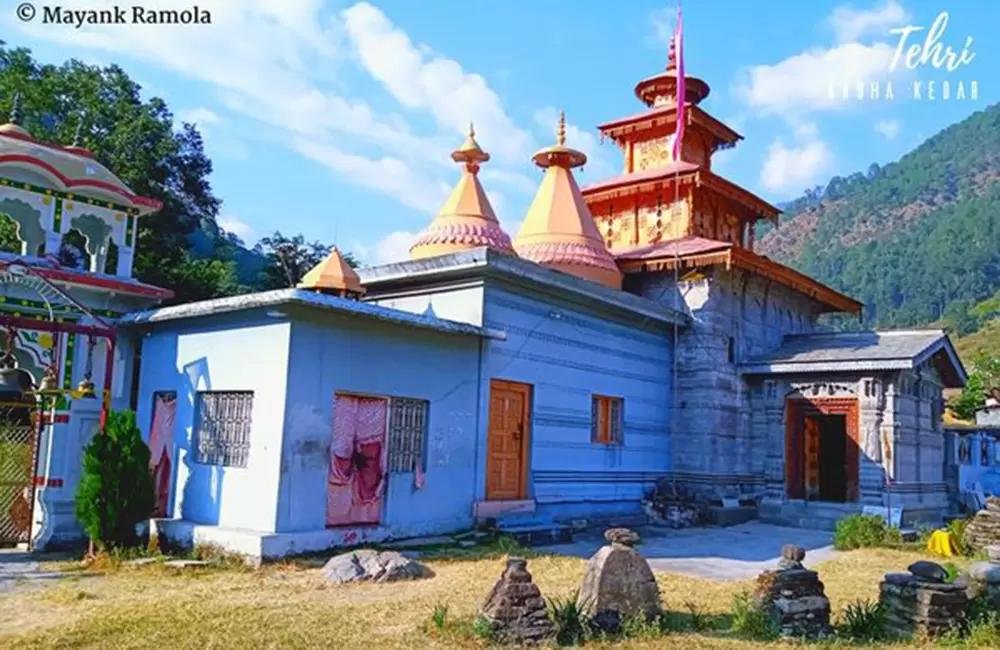
The temple architecture combines traditional Himalayan stone construction with later additions and restoration work.
The principal shrine contains a stone-built structure, a wooden upper section and a multi-tiered roof form suited to the mountain environment. The roof and tower create a distinctive silhouette against the surrounding forested slopes.
Carved wooden elements, stone walls, painted structures and neighbouring shrines create a layered temple complex reflecting different periods of construction and repair.
Like many living Himalayan temples, Budha Kedar has changed over time. Repairs, improvements and protective work have been undertaken to support the shrine and accommodate devotees.
Visitors should not expect the temple to appear exactly as it does in older photographs, as beautification and structural work may alter exterior colours, pathways or adjoining facilities.
The temple complex may contain smaller sacred structures, stone forms, bells, flags and objects offered by devotees.
Every religious object should be treated respectfully. Visitors should not move stones, rearrange offerings or climb upon old structures for photographs.
Photography inside the sanctum or of the principal Shiva lingam should only be undertaken when clearly permitted by the priests.
Even where exterior photography is allowed, visitors should avoid blocking temple entrances, queues or spaces used for worship.
The traditional approach to Budha Kedar includes a short walk through the village and a steep final section leading towards the shrine.
Travellers may begin near a bridge across the river and continue through a concreted or paved village lane before reaching steps and the temple gateway.
The overall walking distance is relatively short compared with a high-altitude Himalayan trek, but the steep gradient can still feel demanding.
Senior citizens, visitors with knee difficulties and travellers with limited fitness should proceed slowly and take breaks whenever needed.
Comfortable footwear with good grip is strongly recommended. Smooth-soled shoes and slippers may become unsafe during rain, frost or on wet steps.
A walking stick may be helpful during the descent, particularly for older visitors.
Families should supervise children on bridges, steep lanes and stairways.
The village route may pass close to homes and private property. Visitors should move respectfully, keep noise levels low and avoid photographing residents without permission.
Budha Kedar should not be promoted as a difficult trekking destination for ordinary temple visitors. The main shrine can be reached through a comparatively short approach.
However, the wider region includes longer forest trails, village walks and routes towards higher mountain landscapes. These should be treated as separate activities requiring appropriate planning.
The confluence walk and nearby nature routes allow travellers to experience the river landscape, terraced agriculture and traditional village environment.
Visitors interested in longer walks should obtain current route information from local residents or guides before leaving the recognised path.
Forest trails can become slippery and confusing during rain or fog. Mobile connectivity may be weak, and unauthorised shortcuts may lead onto private land or unstable slopes.
Travellers should carry water, light food, basic first-aid supplies and personal medication even during a short excursion.
The destination is particularly attractive to travellers interested in slow tourism and village-based spiritual journeys.
Instead of visiting only for a few minutes, pilgrims can spend a night in the area, attend morning or evening prayers, experience local food and observe the rhythm of a Garhwali mountain settlement.
Staying locally allows tourism income to reach families, shopkeepers, drivers, guides and small accommodation providers in the Budha Kedar valley.
It also reduces the need to complete long mountain drives and temple darshan within the same day.
Mahashivratri is among the most important festivals celebrated at Budha Kedar Temple.
Dedicated to Lord Shiva, Mahashivratri is observed through fasting, prayer, mantra recitation, water offerings and extended worship.
During the festival, devotees may arrive from surrounding villages, Tehri Garhwal and other regions to seek the blessings of Mahadev.
The temple complex becomes more active with bells, flowers, sacred flags, devotional singing and community gatherings.
Visitors planning to attend Mahashivratri should confirm the festival programme, transport arrangements and accommodation in advance.
Local rooms and pilgrimage facilities may be limited, while mountain roads can become busier.
Families and senior citizens should arrive with sufficient time and remain prepared for queues.
Photography should not interfere with prayer, rituals or the movement of devotees.
The month of Shravan is another important period for Shiva worship.
Devotees may visit Budha Kedar to offer water, bilva leaves and prayers during this sacred month.
Regional traditions also include Kanwar-related journeys in which devotees carry sacred water and connect worship at Budha Kedar with larger Shiva pilgrimage routes.
The monsoon often overlaps with Shravan, making travel conditions more challenging. Religious enthusiasm should always be balanced with road, river and landslide safety.
Visitors should check weather conditions before travelling and avoid routes affected by official restrictions.
Morning is one of the most suitable times to visit Budha Kedar Temple.
The village is usually quieter, the air is fresh and the temple surroundings may be less crowded.
Morning darshan allows visitors to spend time near the shrine and confluence before continuing towards Ghansali, New Tehri or another destination during daylight.
The soft morning light across the river valley also creates a peaceful environment for photography and reflection.
Evening worship offers another meaningful experience. Temple bells, lamps and the sound of the rivers create a distinctly Himalayan spiritual atmosphere.
Travellers planning an evening visit should arrange nearby accommodation or complete their return journey carefully.
Driving on unfamiliar mountain roads after dark can be difficult because of sharp curves, limited lighting, fog and the possibility of animals or falling stones.
Temple timings and ritual schedules may change according to season, festivals and local arrangements. Visitors should confirm current information through priests, accommodation providers or local residents.
Spring is one of the most comfortable periods for visiting Budha Kedar.
The surrounding hills begin to display fresh vegetation, village fields become active and daytime temperatures are generally suitable for walking and road travel.
Morning and evening conditions may remain cool, so light warm clothing is useful.
Summer offers relief from the intense heat of the plains and is suitable for families interested in a quieter Himalayan destination.
Direct sunlight can still feel strong during midday, particularly on open roads and village paths. Visitors should carry drinking water and sun protection.
Accommodation options are limited compared with major hill stations, so advance booking is advisable during holidays and festival periods.
The monsoon transforms the Budha Kedar valley into a lush green landscape. Rivers become stronger, waterfalls appear on surrounding slopes and clouds move through the mountains.
Although the region can look especially beautiful during rain, the monsoon is also the season requiring the greatest caution.
Mountain roads may experience landslides, falling stones, blocked drains and temporary closures. The Bal Ganga and Dharam Ganga may rise rapidly.
Village lanes, steps and bridges can become slippery. Visitors should wear dependable footwear and carry proper rain protection.
The riverbanks should be avoided during heavy rainfall or high-water conditions.
Travellers should check official district weather and road advisories before departure and keep their itinerary flexible.
Autumn is among the best periods for visiting Budha Kedar.
The post-monsoon landscape remains green, rainfall usually reduces and skies may become clearer.
Road travel and walking conditions are often comfortable, while the rivers continue to add beauty to the valley.
The season is suitable for photography, village stays and combining Budha Kedar with New Tehri or other regional destinations.
Winter offers a calm pilgrimage experience with fewer visitors.
Days may be pleasant under clear sunlight, while mornings and evenings can become very cold.
Frost may affect shaded roads and steps. Snowfall in the immediate temple area should not be guaranteed, although higher surrounding mountains may receive snow.
Visitors should carry thermals, warm jackets, gloves, caps and suitable footwear.
Accommodation providers should be asked about hot water, warm bedding, room heating and power backup.
Road conditions should be checked before winter travel, particularly after rain, snow or freezing nights.
Budha Kedar can be approached from New Tehri through the road network leading towards Ghansali and the Bhilangana valley.
The exact route and travel time depend on the traveller’s starting point, road condition and current traffic.
Mountain distances should never be estimated only through straight-line measurements. Curves, road repairs, rainfall and village traffic can substantially increase the journey.
Private taxis are generally the most convenient option for families, senior citizens and groups.
Shared jeeps and buses may operate on selected routes, but their schedules can be limited or concentrated in the morning.
Travellers relying on public transport should confirm both the onward and return services before beginning the journey.
New Tehri is a major regional base offering hotels, markets, restaurants, medical facilities, banking services and transport.
Visitors can stay in New Tehri and undertake the Budha Kedar journey as a long day excursion, although an overnight stay closer to the shrine provides a more relaxed experience.
Ghansali is another practical road and service centre in the wider Bhilangana region.
The town offers markets, transport and basic facilities and may be more convenient than New Tehri for travellers continuing deeper into the valley.
Chamiyala is also useful for essential purchases, medicines, fuel and local transport arrangements.
Travellers should complete major banking, fuel and medicine requirements before continuing towards smaller villages.
Cash should be carried in reasonable quantities because digital payment networks and ATM availability may be inconsistent.
Mobile connectivity may vary between valleys and settlements.
Rishikesh and Haridwar serve as major gateways for travellers arriving from the plains.
Visitors can travel by road through Narendra Nagar, Chamba and New Tehri before continuing towards the Budha Kedar region.
The journey is substantial and should not be combined with temple darshan immediately after a late arrival.
Breaking the trip with an overnight stay in Rishikesh, Chamba, New Tehri or Ghansali can improve safety and comfort.
Dehradun’s airport is the nearest major commercial airport commonly used for reaching Tehri Garhwal.
The onward mountain drive requires considerable time. Travellers arriving by air should avoid beginning a remote road journey after dark.
Budha Kedar can be combined with several spiritual and scenic destinations in Tehri Garhwal.
New Tehri and Tehri Lake offer the widest range of tourism facilities in the district.
The lake landscape, mountain views and authorised boating activities can be included in a separate day.
Water activities should only be booked through recognised operators, and life jackets and safety instructions must be followed.
A combined New Tehri and Budha Kedar itinerary provides a balance between pilgrimage, village travel and leisure tourism.
Ghansali can act as a transport and accommodation stop for travellers exploring the Bhilangana valley.
The surrounding region contains rivers, villages, agricultural landscapes and routes towards trekking areas.
Panwali Kantha is a well-known high-altitude meadow and trekking destination in Tehri Garhwal.
The trek is a separate multi-day undertaking requiring guides, fitness, equipment, weather planning and current route information.
It should not be treated as a casual extension of the temple visit.
Khatling Glacier is another significant adventure destination in the wider Bhilangana region.
The glacier journey is demanding and requires dedicated preparation, multiple days and reliable local support.
Ordinary pilgrims visiting Budha Kedar should not attempt remote glacier routes without professional planning.
Travellers interested in local nature can instead choose shorter village walks or forest trails around the temple, subject to local guidance.
The traditional relationship between Budha Kedar and Kedarnath adds spiritual depth to a longer Uttarakhand pilgrimage.
Visitors may worship at Budha Kedar before travelling separately towards Rudraprayag, Guptkashi, Sonprayag and Kedarnath.
The modern route between the two destinations involves substantial road travel and should not be treated as a short direct connection.
Kedarnath requires separate registration, transport, accommodation and trekking arrangements according to current government procedures.
Budha Kedar can also be combined with temples around New Tehri, Chamba and Devprayag.
Chandrabadni Temple is an important hilltop Shakti shrine in Tehri Garhwal. It can form part of a longer Shiva–Shakti pilgrimage, although route and distance should be confirmed carefully before combining the two.
Devprayag is the sacred confluence of the Alaknanda and Bhagirathi rivers and can be included while travelling between Rishikesh and the upper Garhwal region.
Raghunath Temple in Devprayag is dedicated to Lord Rama and offers another important spiritual stop.
A one-day Budha Kedar visit is most practical for travellers already staying in Ghansali, Chamiyala or another nearby settlement.
The journey should begin early, allowing sufficient time for the mountain drive, final walk, darshan and confluence visit.
Visitors can return to their accommodation before darkness.
A same-day journey from New Tehri may be possible but can feel tiring because of mountain road conditions.
Families with children and senior citizens should avoid adding multiple distant attractions to the same day.
A two-day itinerary offers a more comfortable experience.
On the first day, travellers can arrive in Ghansali or Budha Kedar village, check into a homestay or guesthouse and explore the local surroundings.
Evening darshan can be attended if timing and access permit.
The second morning can begin with peaceful temple worship, followed by a visit to the confluence and village areas.
After breakfast or lunch, visitors can continue towards New Tehri or their next destination.
A three-day itinerary can include New Tehri and Tehri Lake on the first day, travel towards Ghansali or Budha Kedar on the second day and temple darshan on the third morning.
Travellers interested in village tourism can spend additional time learning about local agriculture, food and community traditions.
A longer Tehri Garhwal pilgrimage may include Devprayag, Chandrabadni Temple, New Tehri, Budha Kedar and other temples across the district.
The itinerary should be organised according to the actual road sequence rather than destination popularity.
Accommodation near Budha Kedar Temple is available through a limited collection of local guesthouses, pilgrimage facilities and village homestays.
These properties may provide simple rooms, home-cooked meals and direct access to the temple environment.
A homestay allows visitors to experience Garhwali hospitality and receive useful local information about temple timings, weather and road conditions.
Facilities may be more basic than those available in New Tehri. Guests should confirm attached bathrooms, hot water, electricity, meals, parking and mobile connectivity before booking.
Visitors should also confirm how far the property is from the temple and whether the final approach requires walking or stairs.
Pilgrimage accommodation and dharamshalas may be available according to season and management arrangements.
Travellers should not assume that a room will be available without advance confirmation, particularly during Mahashivratri, Shravan and local events.
Ghansali provides a wider selection of basic hotels, guesthouses and local accommodation than the immediate temple village.
It may be suitable for families requiring markets, medical support and transport access.
New Tehri offers the broadest range of hotels, restaurants and developed tourism facilities.
Staying in New Tehri is suitable for visitors combining Budha Kedar with Tehri Lake, Chamba and other district attractions.
However, the road journey to the temple should be considered before selecting it as the primary base.
Families should look for accommodation offering larger rooms, meals, safe parking and comfortable bathrooms.
Senior citizens should prioritise direct vehicle access, minimal stairs and clear information about the temple’s final walking approach.
Couples may prefer peaceful village homestays or mountain-view properties.
Solo pilgrims can select simple rooms close to the temple route.
Pilgrimage groups should confirm multiple-room availability, vegetarian meals, driver accommodation and parking for larger vehicles.
Winter visitors should verify heating, hot water and warm bedding.
Monsoon travellers should confirm the condition of the property’s approach road and any current landslide advisory.
Guests requiring internet access should check connectivity directly with the host.
MudrasStays helps pilgrims discover hotels, homestays, guesthouses and spiritual accommodation near Budha Kedar Temple, Ghansali, Chamiyala and New Tehri.
The platform is designed specifically for travellers searching for places to stay near temples, pilgrimage destinations and sacred routes across India.
Visitors can compare properties according to practical distance from Budha Kedar Temple, room type, budget, group size and required facilities.
Booking a nearby stay allows devotees to attend morning or evening darshan without completing a long mountain drive on the same day.
Solo pilgrims can search for affordable village rooms and simple guesthouses.
Couples can explore peaceful homestays surrounded by rivers, forests and mountain scenery.
Families can choose accommodation offering meals, parking and suitable room capacity.
Senior citizens can prioritise accessible properties and shorter temple approaches.
Pilgrimage groups can identify stays offering several rooms, vegetarian meals and space for vehicles.
Travellers combining Budha Kedar with New Tehri, Devprayag, Chandrabadni or Kedarnath can select accommodation according to each stage of the journey.
A temple-focused booking platform helps visitors understand the real travel route to the shrine instead of choosing a general tourism property located far away.
Responsible tourism is essential at Budha Kedar because the shrine stands within a sensitive Himalayan river and village environment.
Visitors should carry back plastic bottles, food wrappers and disposable materials.
Waste should not be thrown into the rivers, hidden beneath stones or left along village paths.
Religious offerings should be deposited only in designated areas.
Synthetic cloth, plastic flags and packaging should not be tied randomly to trees, railings or river structures.
Smoking and open flames can create fire risks in forested and village areas.
Visitors should use incense, lamps and ritual fire only where permitted.
Loud music should be avoided. The sound of the rivers and temple bells is an important part of the destination’s peaceful atmosphere.
Travellers should respect village homes, agricultural fields and private property.
Residents should not be photographed without consent.
Wildlife and domestic animals should not be teased, chased or fed unsuitable food.
Visitors should support local drivers, shops, guides, priests and homestays fairly so that pilgrimage tourism benefits the community maintaining Budha Kedar.
Budha Kedar Temple represents a powerful connection between Lord Shiva, the Pandava tradition, Himalayan rivers and the older pilgrimage geography of Garhwal.
The story of Shiva appearing as an old man reminds devotees that the divine may not always appear in an expected form.
The Pandava legend represents repentance, humility and the search for spiritual peace.
The confluence of the Bal Ganga and Dharam Ganga represents the meeting of natural and sacred forces.
The temple architecture preserves the identity of a traditional Himalayan shrine.
The village keeps religious traditions connected with everyday community life.
The older route towards Kedarnath links Budha Kedar with the history of pilgrimage before modern roads transformed mountain travel.
For devotees of Lord Shiva, the temple is a place to seek courage, protection and inner peace.
For families, it offers an accessible but meaningful Himalayan pilgrimage.
For senior citizens, the short final approach may be manageable with careful planning and assistance.
For cultural travellers, the village, architecture and oral traditions offer insight into the spiritual heritage of Tehri Garhwal.
For nature lovers, the river confluence, forests, farms and mountains create a peaceful environment.
For photographers, the stone temple, wooden roof, blue-painted structures, rivers and surrounding hills provide memorable visual opportunities when approached respectfully.
For slow travellers, a village stay offers a chance to experience Garhwali food, hospitality and local life.
For pilgrims travelling towards Kedarnath, Budha Kedar provides an opportunity to understand an older layer of Shiva worship and Himalayan pilgrimage history.
Budha Kedar should not be treated merely as a brief photo stop or an alternative spelling of Kedarnath.
It is an independent sacred destination with its own deity, local traditions, riverside setting and community identity.
Visitors should allow time for darshan, the village walk, the river confluence and quiet reflection.
An overnight stay can transform the journey from a tiring road excursion into a meaningful spiritual experience.
Plan your pilgrimage to Budha Kedar Temple with MudrasStays and discover one of the most peaceful Shiva shrines in Tehri Garhwal.
Seek the blessings of Lord Budha Kedar, experience the sacred meeting of the Bal Ganga and Dharam Ganga and learn about the Pandava traditions preserved in the valley.
Combine your journey with New Tehri, Tehri Lake, Ghansali, Devprayag, Chandrabadni Temple and other spiritual destinations across Uttarakhand.
Book homestays near Budha Kedar Temple, discover guesthouses around Ghansali and explore comfortable hotels in New Tehri through MudrasStays.
Stay closer to your place of worship, attend peaceful morning darshan and reduce unnecessary travel on winding mountain roads.
MudrasStays connects pilgrims, families and spiritual travellers with suitable accommodation near temples and sacred destinations across India.
Begin your Budha Kedar Temple journey with a comfortable stay and experience a meaningful pilgrimage centred on Lord Shiva, Garhwali culture, sacred rivers and the quiet beauty of the Tehri Himalayas.