
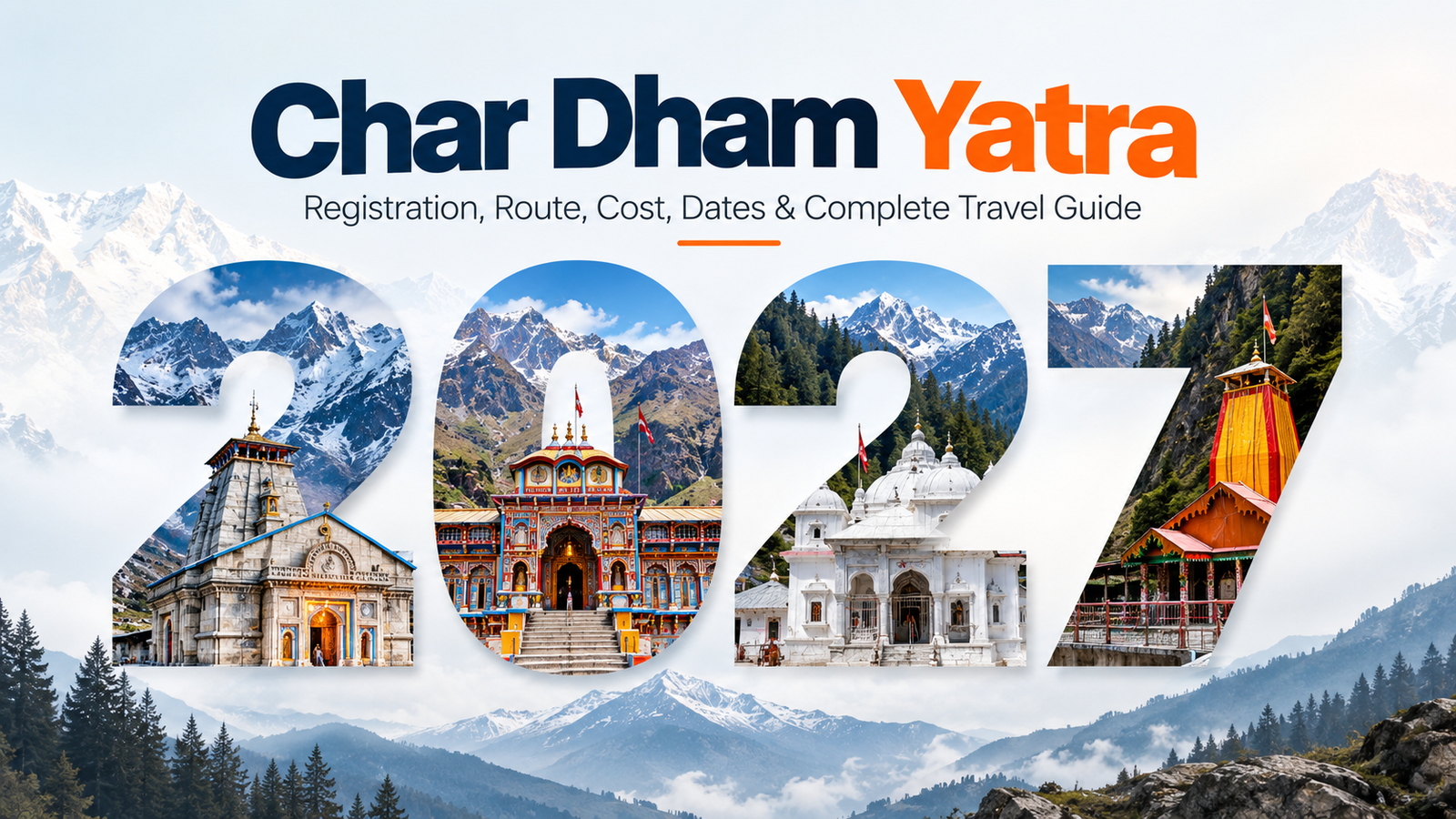
Char Dham Yatra 2027: Registration, Route, Cost, Dates & Complete Travel Guide
The 2027 Char Dham dates are not yet official. Any page publishing exact 2027 opening dates before the shrine authorities announce them should be treated cautiously. Use current 2026 GMVN package prices only as a reference point, not as a confirmed 2027 cost.
2027 update: As of September 18, 2026, the official 2027 opening dates have not yet been announced. Do not publish or rely on an exact 2027 opening date until BKTC issues it.
2027 update: For reference only, BKTC's 2026 schedule opened Kedarnath on April 22, 2026 and Badrinath on April 23, 2026. These 2026 dates are historical context, not predictions for 2027.
2027 update: The Uttarakhand Tourist Care portal is the current official registration system. Registration is compulsory under the present policy, but the 2027 registration window should be checked when it is officially activated.
ROUTE, TIMING AND PLANNING BASICS
The Tourist Care registration portal currently requires compulsory registration and verification for Char Dham pilgrims and vehicles.
Exact 2027 package rates have not been published. Current 2026 GMVN examples vary by season and package, so 2027 costs should be treated as a planning estimate until official rates appear.
A self-arranged Char Dham budget depends heavily on vehicle type, hotel category, meals, porter/pony/heli use and whether the trip is private or shared.
For Do Dham, a 5-day plan is possible for efficient travelers, but a 6-day plan gives more recovery time around the Kedarnath trek and the Badrinath road journey.
Do not treat the Kedarnath trek as just another road stop; it changes the pacing of the entire Do Dham itinerary.
Haridwar is a logical staging point because it is rail-connected and is officially described by Uttarakhand Tourism as a gateway to the Char Dham circuit.
Char Dham in Uttarakhand refers to Yamunotri, Gangotri, Kedarnath and Badrinath. The traditional road circuit usually begins from Haridwar/Rishikesh and moves through the Garhwal Himalaya.
The official Uttarakhand Tourism package page currently describes a 10-day Char Dham itinerary from Haridwar covering more than 1,500 km.
HOW TO PLAN THE JOURNEY WITHOUT RUSHING
Use the slowest family member to set the pace. A pilgrimage plan that works only for the youngest traveler is not a good family itinerary.
Build buffer time for traffic, queues, weather and meal breaks instead of using the shortest possible map time.
Confirm current road, temple and registration information close to departure because mountain and pilgrimage operations can change.
Keep identification, medicines, booking confirmations, water and emergency contacts accessible rather than buried in luggage.
For senior citizens, lift access, bathroom convenience, meal availability and walking distance matter more than decorative hotel features.
Book the return or onward leg at the same time as the outward journey so the final day does not become a transport scramble.
Avoid overloading arrival day with too many spiritual and sightseeing stops. Travel fatigue can reduce the quality of darshan.
Use official booking portals for temple services, registration and pilgrimage permits whenever such systems exist.
Keep some cash as backup even when digital payment is widely available.
During monsoon or high-altitude travel, weather should be allowed to change the itinerary without turning the trip into a failure.
WHERE TO STAY WITH MUDRAS STAYS
For Kedarnath, review Mudras Kedarnath and the Kedarnath stay list on Mudras Stays.
For Badrinath, consider Hotel Yoga Badrinath and compare the Badrinath hotel list on Mudras Stays.
For a Haridwar starting night, travelers can also review Hotel Wisteria and the Haridwar stay list on Mudras Stays.
DETAILED TRAVEL NOTES FOR FIRST-TIME VISITORS
The best itinerary is not the one with the largest number of stops; it is the one the family can complete safely and meaningfully.
Keep one extra half-day or overnight buffer in mountain itineraries when possible, especially around monsoon or peak-season travel.
Use current hotel reviews mainly for practical clues such as access, stairs, parking and noise rather than treating every subjective opinion as fact.
Carry only the day essentials into crowded sacred areas and leave large luggage securely at the hotel.
Respect photography, footwear, security and queue rules even when other tourists appear to be ignoring them.
A pilgrimage day should have one or two non-negotiable priorities and several optional ones. This keeps the trip useful even when a queue or road delay takes longer than expected.
Families travelling in a private vehicle should still plan fuel, toilet and meal stops rather than assuming every mountain halt will offer the same facilities.
Public-transport travelers should save the hotel address and local transfer plan offline before the final leg.
Do not use an old social-media reel as the final source for temple timings, registration or road status. Future dates and procedures need current confirmation.
Crowd patterns are often more important than kilometre distance. A short temple approach can take much longer during a festival or weekend.
Weather and altitude affect appetite, sleep and walking pace. Keep the first evening lighter when arriving at a high-altitude destination.
A nearby hotel can improve the pilgrimage by reducing repeated local transport and giving the family a reliable place for meals, medicines and rest.
When a destination has a very early ritual or aarti, hotel location becomes part of the spiritual itinerary rather than a separate booking decision.
If the trip includes children, keep temple days shorter and add food/rest breaks before irritability becomes exhaustion.
If the trip includes elderly parents, discuss assistance, stairs, walking and toilet access before confirming the hotel.
Confirm current road, temple and registration information close to departure because mountain and pilgrimage operations can change.
Keep identification, medicines, booking confirmations, water and emergency contacts accessible rather than buried in luggage.
For senior citizens, lift access, bathroom convenience, meal availability and walking distance matter more than decorative hotel features.
Book the return or onward leg at the same time as the outward journey so the final day does not become a transport scramble.
Avoid overloading arrival day with too many spiritual and sightseeing stops. Travel fatigue can reduce the quality of darshan.
Use official booking portals for temple services, registration and pilgrimage permits whenever such systems exist.
Keep some cash as backup even when digital payment is widely available.
During monsoon or high-altitude travel, weather should be allowed to change the itinerary without turning the trip into a failure.
A pilgrimage day should have one or two non-negotiable priorities and several optional ones. This keeps the trip useful even when a queue or road delay takes longer than expected.
Families travelling in a private vehicle should still plan fuel, toilet and meal stops rather than assuming every mountain halt will offer the same facilities.
Public-transport travelers should save the hotel address and local transfer plan offline before the final leg.
Do not use an old social-media reel as the final source for temple timings, registration or road status. Future dates and procedures need current confirmation.
Crowd patterns are often more important than kilometre distance. A short temple approach can take much longer during a festival or weekend.
Weather and altitude affect appetite, sleep and walking pace. Keep the first evening lighter when arriving at a high-altitude destination.
A nearby hotel can improve the pilgrimage by reducing repeated local transport and giving the family a reliable place for meals, medicines and rest.
When a destination has a very early ritual or aarti, hotel location becomes part of the spiritual itinerary rather than a separate booking decision.
If the trip includes children, keep temple days shorter and add food/rest breaks before irritability becomes exhaustion.
If the trip includes elderly parents, discuss assistance, stairs, walking and toilet access before confirming the hotel.
The best itinerary is not the one with the largest number of stops; it is the one the family can complete safely and meaningfully.
Keep one extra half-day or overnight buffer in mountain itineraries when possible, especially around monsoon or peak-season travel.
Use current hotel reviews mainly for practical clues such as access, stairs, parking and noise rather than treating every subjective opinion as fact.
Carry only the day essentials into crowded sacred areas and leave large luggage securely at the hotel.
Respect photography, footwear, security and queue rules even when other tourists appear to be ignoring them.
For Kedarnath, review Mudras Kedarnath and the Kedarnath stay list on Mudras Stays.
For Badrinath, consider Hotel Yoga Badrinath and compare the Badrinath hotel list on Mudras Stays.
For a Haridwar starting night, travelers can also review Hotel Wisteria and the Haridwar stay list on Mudras Stays.
Char Dham in Uttarakhand refers to Yamunotri, Gangotri, Kedarnath and Badrinath. The traditional road circuit usually begins from Haridwar/Rishikesh and moves through the Garhwal Himalaya.
The official Uttarakhand Tourism package page currently describes a 10-day Char Dham itinerary from Haridwar covering more than 1,500 km.
The Tourist Care registration portal currently requires compulsory registration and verification for Char Dham pilgrims and vehicles.
Exact 2027 package rates have not been published. Current 2026 GMVN examples vary by season and package, so 2027 costs should be treated as a planning estimate until official rates appear.
A self-arranged Char Dham budget depends heavily on vehicle type, hotel category, meals, porter/pony/heli use and whether the trip is private or shared.
For Do Dham, a 5-day plan is possible for efficient travelers, but a 6-day plan gives more recovery time around the Kedarnath trek and the Badrinath road journey.
Do not treat the Kedarnath trek as just another road stop; it changes the pacing of the entire Do Dham itinerary.
Haridwar is a logical staging point because it is rail-connected and is officially described by Uttarakhand Tourism as a gateway to the Char Dham circuit.
Use the slowest family member to set the pace. A pilgrimage plan that works only for the youngest traveler is not a good family itinerary.
Build buffer time for traffic, queues, weather and meal breaks instead of using the shortest possible map time.
Confirm current road, temple and registration information close to departure because mountain and pilgrimage operations can change.
Keep identification, medicines, booking confirmations, water and emergency contacts accessible rather than buried in luggage.
For senior citizens, lift access, bathroom convenience, meal availability and walking distance matter more than decorative hotel features.
Book the return or onward leg at the same time as the outward journey so the final day does not become a transport scramble.
Avoid overloading arrival day with too many spiritual and sightseeing stops. Travel fatigue can reduce the quality of darshan.
Use official booking portals for temple services, registration and pilgrimage permits whenever such systems exist.
Keep some cash as backup even when digital payment is widely available.
During monsoon or high-altitude travel, weather should be allowed to change the itinerary without turning the trip into a failure.
A pilgrimage day should have one or two non-negotiable priorities and several optional ones. This keeps the trip useful even when a queue or road delay takes longer than expected.
Families travelling in a private vehicle should still plan fuel, toilet and meal stops rather than assuming every mountain halt will offer the same facilities.
Public-transport travelers should save the hotel address and local transfer plan offline before the final leg.
Do not use an old social-media reel as the final source for temple timings, registration or road status. Future dates and procedures need current confirmation.
Crowd patterns are often more important than kilometre distance. A short temple approach can take much longer during a festival or weekend.
Weather and altitude affect appetite, sleep and walking pace. Keep the first evening lighter when arriving at a high-altitude destination.
A nearby hotel can improve the pilgrimage by reducing repeated local transport and giving the family a reliable place for meals, medicines and rest.
When a destination has a very early ritual or aarti, hotel location becomes part of the spiritual itinerary rather than a separate booking decision.
If the trip includes children, keep temple days shorter and add food/rest breaks before irritability becomes exhaustion.
If the trip includes elderly parents, discuss assistance, stairs, walking and toilet access before confirming the hotel.
The best itinerary is not the one with the largest number of stops; it is the one the family can complete safely and meaningfully.
Keep one extra half-day or overnight buffer in mountain itineraries when possible, especially around monsoon or peak-season travel.
Use current hotel reviews mainly for practical clues such as access, stairs, parking and noise rather than treating every subjective opinion as fact.
Carry only the day essentials into crowded sacred areas and leave large luggage securely at the hotel.
Respect photography, footwear, security and queue rules even when other tourists appear to be ignoring them.
For Kedarnath, review Mudras Kedarnath and the Kedarnath stay list on Mudras Stays.
For Badrinath, consider Hotel Yoga Badrinath and compare the Badrinath hotel list on Mudras Stays.
For a Haridwar starting night, travelers can also review Hotel Wisteria and the Haridwar stay list on Mudras Stays.
Char Dham in Uttarakhand refers to Yamunotri, Gangotri, Kedarnath and Badrinath. The traditional road circuit usually begins from Haridwar/Rishikesh and moves through the Garhwal Himalaya.
The official Uttarakhand Tourism package page currently describes a 10-day Char Dham itinerary from Haridwar covering more than 1,500 km.
The Tourist Care registration portal currently requires compulsory registration and verification for Char Dham pilgrims and vehicles.
Exact 2027 package rates have not been published. Current 2026 GMVN examples vary by season and package, so 2027 costs should be treated as a planning estimate until official rates appear.
A self-arranged Char Dham budget depends heavily on vehicle type, hotel category, meals, porter/pony/heli use and whether the trip is private or shared.
For Do Dham, a 5-day plan is possible for efficient travelers, but a 6-day plan gives more recovery time around the Kedarnath trek and the Badrinath road journey.
Do not treat the Kedarnath trek as just another road stop; it changes the pacing of the entire Do Dham itinerary.
Haridwar is a logical staging point because it is rail-connected and is officially described by Uttarakhand Tourism as a gateway to the Char Dham circuit.
Use the slowest family member to set the pace. A pilgrimage plan that works only for the youngest traveler is not a good family itinerary.
Build buffer time for traffic, queues, weather and meal breaks instead of using the shortest possible map time.
Confirm current road, temple and registration information close to departure because mountain and pilgrimage operations can change.
Keep identification, medicines, booking confirmations, water and emergency contacts accessible rather than buried in luggage.
For senior citizens, lift access, bathroom convenience, meal availability and walking distance matter more than decorative hotel features.
Book the return or onward leg at the same time as the outward journey so the final day does not become a transport scramble.
Avoid overloading arrival day with too many spiritual and sightseeing stops. Travel fatigue can reduce the quality of darshan.
Use official booking portals for temple services, registration and pilgrimage permits whenever such systems exist.
Keep some cash as backup even when digital payment is widely available.
During monsoon or high-altitude travel, weather should be allowed to change the itinerary without turning the trip into a failure.
A pilgrimage day should have one or two non-negotiable priorities and several optional ones. This keeps the trip useful even when a queue or road delay takes longer than expected.
Families travelling in a private vehicle should still plan fuel, toilet and meal stops rather than assuming every mountain halt will offer the same facilities.
Public-transport travelers should save the hotel address and local transfer plan offline before the final leg.
FREQUENTLY ASKED QUESTIONS
Are the 2027 Char Dham opening dates announced?
Not yet as of September 18, 2026.
Is registration compulsory?
Under the current Uttarakhand policy, yes. Check the Tourist Care portal for 2027 activation.
How long should Char Dham take?
Official package examples commonly use around 10 days from Haridwar; private itineraries vary.
How long should Do Dham take?
Five days is possible; six days is more comfortable for many families.
Are 2027 costs fixed?
No. Use current rates only as a planning reference until 2027 transport and hotel prices are available.
Where should I stay at Kedarnath and Badrinath?
Use Mudras Kedarnath and Hotel Yoga Badrinath alongside the destination stay pages.
Should I verify timings before travel?
Yes. Temple, Ashram, registration and transport schedules can change, especially around festivals, weather and future 2027 announcements.
Should I book accommodation in advance?
Yes for peak weekends, festivals and seasonal pilgrimages, especially when travelling with family or senior citizens.
How can I contact Mudras Stays?
Call 9599190222 for stay and reservation support.
Where can I follow Mudras Stays?
Follow @mudras.stays on Instagram.