
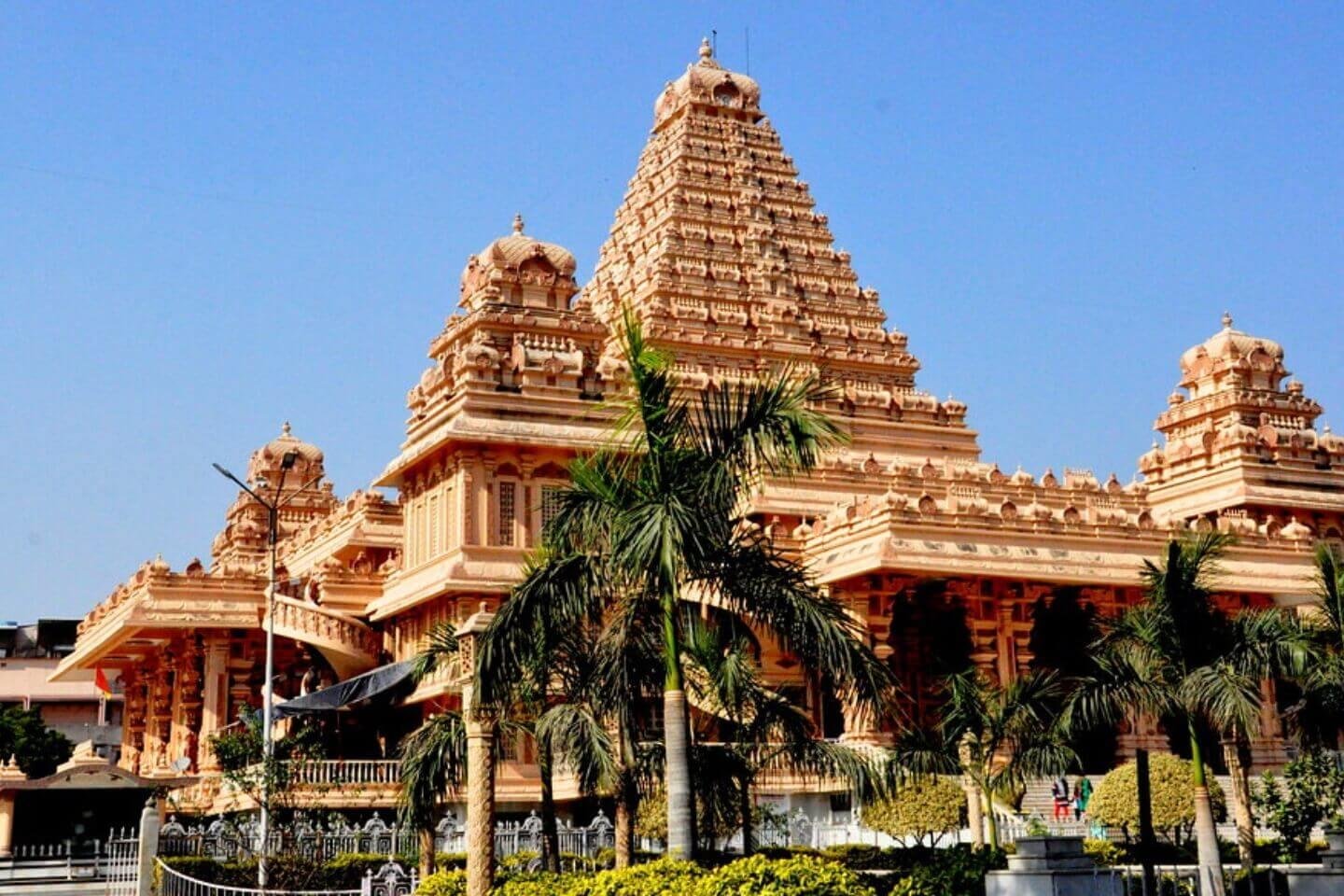
Chhatarpur Temple, Delhi – The Grand Shrine of Maa Katyayani in South Delhi
Chhatarpur Temple, officially known as **Shri Adya Katyayani Shaktipeeth Mandir**, is one of Delhi’s largest and most visited Hindu temple complexes. Located in Chhatarpur near Mehrauli in South Delhi, the temple is primarily dedicated to **Maa Katyayani**, the sixth manifestation of Goddess Durga worshipped during Navratri.
Spread across a large multi-building campus, the complex contains shrines dedicated to Maa Katyayani, Lord Shiva, Goddess Parvati, Lord Ganesha, Lord Rama, Sita, Lakshmana, Lord Hanuman, Radha-Krishna, Lakshmi-Vinayak, Maa Annapurna, Mahishasuramardini, Bhairav Baba and several other deities.
The temple is particularly famous for its grand Navratri celebrations. During Chaitra and Sharad Navratri, enormous numbers of devotees visit for darshan, havan, Durga Saptashati recitation, Ramayana Path, special shringar, langar and religious programmes.
Unlike Delhi’s ancient temples associated mainly with mythology or medieval history, Chhatarpur Temple has a clearly identifiable modern origin. The present complex was founded during the 1970s by **Sant Shree Nagpal Baba**, whose devotion to the Divine Mother transformed an undeveloped area near Chhatarpur village into a vast spiritual, charitable and educational centre.
The temple’s architecture combines North Indian and South Indian design traditions. White marble, carved latticework, domes, shikharas, sculpted pillars, broad courtyards and South Indian-style temple towers appear across different sections of the complex.
Travellers looking for hotels near Chhatarpur Temple, family accommodation close to Chhatarpur Metro Station or convenient stays for Navratri darshan can explore suitable options through **MudrasStays**.
## Who Is Maa Katyayani?
Maa Katyayani is the sixth form of Navadurga and is worshipped on the sixth day of Navratri.
She represents divine courage, righteous anger, protection, strength and the destruction of evil. Devotees worship her as a compassionate mother who removes difficulties while also displaying the power necessary to defeat injustice.
According to sacred tradition, Sage Katyayana performed severe penance and prayed that the Divine Mother should be born as his daughter. Pleased with his devotion, the Goddess manifested in his household and became known as **Katyayani**, meaning the daughter of Katyayana.
In another closely related tradition, the divine energies of Brahma, Vishnu, Shiva and other deities combined to create the Goddess who would defeat the buffalo demon Mahishasura. Sage Katyayana worshipped her, and she later destroyed Mahishasura, restoring dharma.
Maa Katyayani is generally depicted:
* Riding a lion
* Holding weapons associated with divine protection
* Displaying a blessing gesture
* Destroying demons and negativity
* Radiating courage and golden divine energy
Devotees pray to Maa Katyayani for:
* Protection from adversity
* Courage during difficult situations
* Removal of obstacles
* Family welfare
* Marriage and relationship blessings
* Health and emotional strength
* Success in righteous work
* Freedom from fear
* Victory over harmful habits
* Spiritual discipline
* Fulfilment of sincere wishes
In many families, unmarried devotees also worship Maa Katyayani for a suitable marriage partner, inspired by traditions connected with the Katyayani Vrata.
## Is Chhatarpur Temple an Ancient Shakti Peeth?
The temple’s formal name includes the word **Shaktipeeth**, meaning a powerful seat of Goddess worship.
However, visitors should not confuse the modern Chhatarpur complex with the ancient Shakti Peethas traditionally associated with the places where parts or ornaments of Goddess Sati are believed to have fallen.
The present Chhatarpur Temple was founded in the twentieth century and is not generally identified as one of the classical ancient Shakti Peethas.
Here, the title Shaktipeeth expresses:
* The powerful presence of Maa Katyayani
* The temple’s importance as a centre of Shakti worship
* The spiritual vision of Baba Sant Nagpal
* The complex’s role as a major Devi pilgrimage destination
* The faith of millions of visiting devotees
Its spiritual significance comes from continuing worship, devotion, service and the living tradition established around Maa Katyayani.
## History of Chhatarpur Temple
The history of Chhatarpur Temple is inseparably connected with its founder, **Shree Durga-Charan-Anuragi Baba Sant Nagpal Ji**, commonly known as Baba Nagpal.
### Baba Nagpal’s Childhood and Devotion to the Divine Mother
According to the temple’s official history, Baba Nagpal lost his parents when he was very young.
During the cremation of his mother, an unknown woman is said to have taken the grieving child to a nearby temple of the Mother Goddess and told him that the Divine Mother was his eternal mother and would always protect him.
The experience became the spiritual foundation of his life. Baba Nagpal developed complete devotion to Maa Durga and regarded the Goddess as a living divine presence who guided his decisions.
He eventually became a mendicant and was raised, educated and trained by sadhus.
### Pilgrimage Across India
Baba Nagpal travelled extensively across India and visited important centres of pilgrimage.
His journeys reportedly included:
* Himalayan pilgrimage regions
* Kailash and Mansarovar
* Kashmir
* Northern Indian sacred destinations
* Southern Indian temples
* Northeastern pilgrimage regions
* Major Shakti shrines
These journeys exposed him to the different ritual, architectural and cultural traditions of Indian temples.
This broad experience later influenced the Chhatarpur complex, where buildings reflect architectural ideas drawn from different parts of India.
### Baba Nagpal Comes to Delhi
After spending several years in Kashmir, Baba Nagpal moved to Delhi.
He initially stayed in Arjun Nagar, where he established a temple. He later moved to Durga Ashram near Chhatarpur village.
Durga Ashram subsequently became connected with the wider Shaktipeeth organisation.
Around the middle of the 1970s, Baba Nagpal shifted to the location where the present main Chhatarpur Temple complex stands.
At the time, the land was described as uneven, undeveloped and covered with bushes.
### Establishment of the Temple in the 1970s
The founding of the present complex is commonly dated to **1974**, although the temple’s official account more broadly describes the development as beginning in the mid-1970s.
Devotees gradually gathered around Baba Nagpal, and construction started with limited resources.
Temple tradition remembers Baba as personally involved in the work. He reportedly designed details of the complex and even carried bricks during the early phase of construction.
Land was acquired gradually in separate phases, and buildings were added as donations and volunteer support increased.
Over approximately three decades, the site developed into a large temple township containing shrines, halls, kitchens, educational institutions, medical services, accommodation facilities and administrative buildings.
### A Temple Built Through Collective Devotion
The temple was not constructed as a royal monument or government project. Its development was supported through contributions from devotees of different economic backgrounds.
This origin remains central to its identity.
The complex represents:
* Baba Nagpal’s devotion to Maa Katyayani
* Collective public participation
* Volunteer service
* Community food distribution
* Religious education
* Social welfare
* Interregional temple architecture
* Respect for different spiritual traditions
### Baba Nagpal’s Samadhi
Baba Nagpal attained samadhi in December 1998.
His samadhi is situated within the wider temple complex beneath the Nageshwar Temple. Devotees visit the samadhi to remember his spiritual service and seek blessings.
The shrine is not presented as separate from Maa Katyayani worship. Baba Nagpal consistently directed devotion towards the Divine Mother rather than towards his own personal glorification.
## Baba Nagpal’s Spiritual Mission
Baba Nagpal believed that spirituality should be expressed through service, education, compassion and social responsibility.
According to the temple’s account, he emphasised:
* Purity and selflessness
* Religious tolerance
* Brotherhood
* Patriotism
* Education
* Scientific outlook
* Human dignity
* Service to the poor
* Respect for workers and farmers
* Assistance to the sick and vulnerable
* Food for every visitor
* Relief during disasters
He described dedicated work as a form of worship.
In his understanding, farms, educational institutions and factories could all become sacred spaces when people worked honestly and selflessly for the welfare of society.
The temple trust later developed educational, medical and charitable activities inspired by these principles.
## Architecture of Chhatarpur Temple
Chhatarpur Temple is architecturally distinctive because the complex does not follow one single regional style.
Its different buildings combine:
* North Indian Nagara-style elements
* South Indian Dravidian influences
* Domed pavilions
* Tall shikharas
* Temple towers
* Carved pillars
* Marble latticework
* Decorative arches
* Courtyards and halls
* Sculpted religious figures
The temple is often described as having a mixed or composite architectural character.
### Marble and Stonework
White marble is used extensively throughout the complex.
Visitors can observe:
* Carved marble surfaces
* Perforated jali screens
* Decorative balconies
* Sculpted pillars
* Floral and geometric designs
* Broad staircases
* Polished courtyards
* Ornamental gateways
The extensive jali work allows light and air to pass through while creating delicate visual patterns.
### North and South Indian Influences
The main Devi sections include shikharas and architectural forms associated with North Indian temple building.
Other structures, particularly the Lakshmi-Vinayak Temple in the Nutan Bhawan complex, reflect a South Indian architectural style. The temple’s official history records that craftsmen from South India were specially brought for this part of the construction.
The combination reflects Baba Nagpal’s desire to represent India’s diverse sacred traditions within one complex.
## Main Maa Katyayani Shrine
The main sanctum is dedicated to Maa Katyayani.
Visitors reach the shrine after passing through other parts of the complex and climbing the designated stairs.
Lord Ganesha is represented near the feet of Maa Katyayani, symbolising devotion, auspiciousness and readiness to serve the Divine Mother.
The sanctum becomes especially important on:
* The sixth day of Navratri
* Chaitra Navratri
* Sharad Navratri
* Purnima
* Major Devi festivals
* Special puja days
Visitors should follow the queue and avoid stopping for extended periods directly before the deity during crowded hours.
## Mahishasuramardini Shrine
The temple contains a shrine dedicated to **Maa Mahishasuramardini**, the form of the Goddess who defeats Mahishasura.
This shrine is generally opened on Purnima and during Navratri.
The image represents the triumph of divine strength over:
* Arrogance
* Violence
* Disorder
* Ignorance
* Misuse of power
* Harmful tendencies
Devotees may sit in the adjoining hall and listen to the continuing recitation of the Ramayana.
Because access can be limited to particular religious occasions, visitors should confirm whether the shrine will be open on the day of their visit.
## Ashtabhuji Temple
Maa Ashtabhuji is the eight-armed form of the Goddess.
Her shrine is generally opened during Navratri. The multiple arms represent the many forms of divine power used to protect devotees and restore dharma.
Each weapon or sacred object symbolises a different spiritual quality, including courage, wisdom, protection, discipline and the destruction of negativity.
## Shiva and Parvati Temple
A visit to the complex may begin with darshan of Lord Shiva and Goddess Parvati.
Their presence represents the divine parental family of Sanatana tradition and connects the Devi-centred complex with Shaiva worship.
Maha Shivaratri is celebrated with special rituals. The temple trust traditionally arranges puja materials for Rudrabhishek, subject to the current festival programme.
## Ram Darbar and Radha-Krishna
The Ram Darbar section contains representations of:
* Lord Rama
* Goddess Sita
* Lakshmana
* Lord Hanuman
Nearby worship also includes Radha and Krishna.
These shrines broaden the complex beyond Shakti worship and allow devotees to offer prayers within Vaishnava and Ram-bhakti traditions.
## Lakshmi-Vinayak Temple
The Lakshmi-Vinayak Temple is situated in the Nutan Bhawan area and is designed in a South Indian architectural style.
It is dedicated to:
* Goddess Lakshmi, associated with prosperity and well-being
* Lord Vinayak or Ganesha, remover of obstacles
The structure demonstrates the temple complex’s conscious blending of regional styles.
## Maa Annapurna and the Langar Tradition
Maa Annapurna is worshipped as the Divine Mother who provides food and nourishment.
Before food is distributed in the temple’s langar, it is offered to Maa Annapurna.
The langar hall is designed to serve large numbers of devotees. During major Navratri celebrations, the temple prepares and distributes free meals and prasad on a very large scale.
Visitors should:
* Sit where directed.
* Accept only the quantity they can finish.
* Avoid wasting food.
* Cooperate with volunteers.
* Keep the eating area clean.
* Respect devotees observing Navratri fasts.
Langar availability and meal periods should be confirmed for ordinary non-festival days.
## Baba Nagpal Museum
The temple complex includes a museum dedicated to Baba Nagpal.
It preserves objects associated with his life, including items used by him or presented by devotees.
A wax representation recalls the place where Baba gave darshan and interacted with followers.
The museum helps visitors understand that Chhatarpur Temple developed not only as an architectural project but as the result of a particular spiritual and humanitarian vision.
## Nageshwar Temple and Baba Nagpal’s Samadhi
Baba Nagpal’s mortal remains rest beneath the Shiva Lingam of the Nageshwar Temple.
The Shiva Lingam is represented above Sheshnag, symbolising Lord Shiva’s transcendence beyond the changing cycles of time.
Visitors may pray at the samadhi and Nageshwar shrine after completing darshan of Maa Katyayani.
The area should be approached quietly and respectfully.
## Bhairav Baba Temple
A Bhairav Baba shrine stands within the wider complex near the Yagyashala area.
Bhairava is worshipped as a guardian form of Lord Shiva and protector of sacred space.
Many Devi traditions include Bhairava as the guardian of the Goddess’s temple.
Devotees may pray for protection, fearlessness, discipline and freedom from negative influences.
## Yagyashala and Navratri Havan
The Yagyashala contains multiple havan kunds arranged for ritual fire ceremonies.
During Navratri, activities may include:
* Havan
* Durga Saptashati Path
* Rudrabhishek
* Ramayana recitation
* Rath Puja
* Langar Puja
* Purna Ahuti
Participants in extended religious ceremonies may be expected to follow particular rules of fasting, conduct and ritual purity.
Families should arrange formal participation only through authorised temple channels.
## Markandeya Mandapam
Markandeya Mandapam is a large hall used for religious gatherings, discourses, ceremonies and crowd management.
The surrounding section includes shrines associated with:
* Lord Vishnu
* Goddess Lakshmi
* Maa Annapurna
* Maa Durga
* Maa Mahishasuramardini
* Dash Mahavidya
During Navratri, the hall and adjoining areas help accommodate the very large number of pilgrims arriving for darshan.
## The Large Hanuman Statue
A prominent open-air statue of Lord Hanuman is one of the complex’s recognisable features.
Hanuman Ji represents:
* Strength
* Devotion
* Courage
* Humility
* Protection
* Service to Lord Rama
The illuminated statue creates an impressive view in the evening and is especially popular with families and children.
## The Ceremonial Chariot
The Rath Ghar contains the temple’s ceremonial chariot.
It is used in connection with Navratri rituals and processions within the temple tradition.
Visitors should not climb onto or touch the chariot unless explicitly permitted.
## Navratri at Chhatarpur Temple
Navratri is the most important festival period at Chhatarpur Temple.
The temple celebrates:
### Chaitra Navratri
Observed in March or April and culminating around Ram Navami.
### Sharad Navratri
Observed in September or October and culminating around Vijayadashami.
During Navratri, the complex may remain open throughout the day and night under special arrangements.
Religious activities include:
* Special shringar of Maa Katyayani
* Kumbhabhishek
* Havan
* Durga Saptashati recitation
* Ramayana Path
* Rudrabhishek
* Rath Puja
* Cultural programmes
* Langar
* Prasad distribution
* Devotional music
* Special darshan arrangements
The temple’s official account states that thousands of volunteers assist with parking, queues, footwear counters, security, food service and prasad distribution.
## Maa Katyayani’s Special Shringar
During Navratri, Maa Katyayani is ceremonially adorned early in the morning.
The shringar may include:
* Sarees or lehengas
* Chunri
* Jewellery
* Flowers
* Garlands
* Decorative ornaments
* Special seasonal colours
Darshan during shringar is considered especially auspicious by devotees.
Access, timing and queue arrangements can change every year.
## Temple Timings
Commonly published daily timings for Chhatarpur Temple are approximately:
* **Morning darshan:** 6:00 AM to 12:00 PM
* **Evening darshan:** 4:00 PM to 10:00 PM
Some sources describe the wider complex as open from approximately 6:00 AM to 10:00 PM.
During Navratri, the temple’s official website states that the complex remains open round the clock under special arrangements.
Timings may change for:
* Navratri
* Purnima
* Maha Shivaratri
* Janmashtami
* Special pujas
* Security arrangements
* Maintenance
* Crowd control
Visitors should confirm the exact darshan, aarti and sanctum-opening schedule before travelling.
The Maa Mahishasuramardini and Ashtabhuji shrines are not necessarily open every day.
## Temple Etiquette
Visitors should:
* Dress modestly.
* Remove footwear at the designated counters.
* Cooperate with security screening.
* Follow the queue.
* Avoid carrying large bags.
* Keep mobile phones silent.
* Respect photography restrictions.
* Do not touch deities or ritual objects.
* Use official donation boxes and counters.
* Keep children supervised.
* Avoid pushing during darshan.
* Respect volunteers and sewadars.
* Do not waste langar or prasad.
* Keep the complex clean.
* Follow separate entry and exit routes during festivals.
## Best Time to Visit
### October to March
Cooler weather is comfortable for walking across the large complex.
### Chaitra and Sharad Navratri
These periods offer the most powerful devotional atmosphere but also bring the heaviest crowds.
### Purnima
Certain special shrines may be opened, and visitor numbers can be higher.
### Weekday Mornings
Weekday mornings outside festivals are generally preferable for quieter darshan.
### April to June
Delhi can become extremely hot. Early-morning or evening visits are advisable.
### July to September
Rain may make marble surfaces and walkways slippery. Carry suitable rain protection.
## How Much Time to Keep
Keep at least two to three hours for a complete visit.
The complex is large, and a proper pilgrimage may include:
**Shiva-Parvati Temple – Ram Darbar – Radha-Krishna – Maa Katyayani – Mahishasuramardini Shrine, when open – Satsang Hall – Lakshmi-Vinayak Temple – Yagyashala – Bhairav Baba – Baba Nagpal Museum – Nageshwar Temple and Samadhi – Hanuman Statue**
During Navratri, queues may require several additional hours.
Senior citizens should avoid trying to cover every section without rest.
## How to Reach Chhatarpur Temple
The temple is located on Main Chhatarpur Road in South Delhi near Mehrauli.
### By Metro
**Chhatarpur Metro Station on the Yellow Line** is the most convenient metro connection.
The official temple website describes the station as being near the boundary of the complex, with the main temple reachable on foot.
### By Road
Visitors can use:
* Auto-rickshaw
* E-rickshaw
* App-based cab
* Private taxi
* Local bus
* Personal vehicle
* Hotel-arranged transport
Traffic can become extremely heavy during Navratri, weekends and public holidays.
### Parking
The temple complex has designated parking areas, including spaces associated with the dharamshala and other sections of the campus.
Festival parking plans may differ from ordinary-day arrangements. Visitors should follow current signage and police instructions.
## Nearby Pilgrimage and Heritage Attractions
### Yogmaya Temple
An ancient Devi shrine in Mehrauli associated with Delhi’s older sacred traditions.
### Qutub Minar and Qutub Complex
The UNESCO World Heritage complex contains Qutub Minar, the Iron Pillar, Alai Darwaza and several historic structures.
### Mehrauli Archaeological Park
The park preserves tombs, stepwells and monuments from different periods of Delhi’s history.
### Dargah of Qutbuddin Bakhtiar Kaki
One of Delhi’s most important Sufi shrines and a central part of Mehrauli’s spiritual landscape.
### Ahinsa Sthal
A Jain spiritual site known for its large statue of Lord Mahavira.
### Garden of Five Senses
A landscaped leisure attraction suitable for a separate family visit.
### Uttara Swami Malai Temple
A prominent South Indian temple dedicated to Lord Murugan in R.K. Puram.
## Suggested Itineraries
### Short Devi Pilgrimage
**Maa Katyayani Darshan – Shiva-Parvati Temple – Baba Nagpal Samadhi – Hanuman Statue**
### Complete Temple Visit
**Main Temple Complex – Lakshmi-Vinayak Temple – Yagyashala – Markandeya Complex – Nageshwar Temple – Museum – Langar**
### South Delhi Spiritual Circuit
**Chhatarpur Temple – Yogmaya Temple – Dargah Qutbuddin Bakhtiar Kaki**
### Temple and Heritage Day
**Morning Chhatarpur Temple Darshan – Qutub Complex – Mehrauli Archaeological Park**
During Navratri, visitors should focus primarily on temple darshan rather than attempting multiple sightseeing stops.
## Where to Stay Near Chhatarpur Temple
Travellers may choose accommodation in Chhatarpur, Mehrauli, Saket, Qutub Institutional Area, Vasant Kunj or nearby Gurugram-facing areas.
### Stay in Chhatarpur For:
* Early-morning darshan
* Navratri pilgrimage
* Reduced dependence on city traffic
* Access to Chhatarpur Metro Station
* Family and group visits
### Stay in Saket For:
* A wider selection of hotels
* Restaurants and shopping
* Medical facilities
* Metro connectivity
* Access to Mehrauli attractions
### Stay in Vasant Kunj For:
* Airport-road access
* Premium hotels
* Family accommodation
* Restaurants and shopping
* Access to South Delhi
Before booking, verify:
* Actual distance from the temple gate
* Final vehicle access
* Navratri traffic diversions
* Parking
* Lift or ground-floor rooms
* Family-room configuration
* Vegetarian meals
* Secure luggage storage
* Metro connectivity
* Early check-in
* Festival cancellation policies
A hotel shown as being near Chhatarpur may still require a long road journey during Navratri traffic controls.
## Book Hotels Near Chhatarpur Temple with MudrasStays
**MudrasStays** helps pilgrims discover suitable accommodation near temples, sacred heritage areas and important spiritual routes.
Travellers visiting Chhatarpur Temple can use MudrasStays to explore:
* Hotels near Chhatarpur Temple
* Family stays near Chhatarpur Metro Station
* Accommodation for Navratri pilgrims
* Rooms suitable for senior citizens
* Hotels offering vegetarian food
* Group accommodation for Devi pilgrimages
* Properties with parking
* Stays near Mehrauli
* Hotels near Qutub Minar
* Accommodation for South Delhi temple circuits
Choosing a convenient stay near the temple can make early darshan easier, reduce festival travel fatigue and help families manage children, elderly devotees and pilgrimage belongings more comfortably.
Chhatarpur Temple is more than an impressive collection of marble buildings. It represents Baba Sant Nagpal’s vision of combining devotion to the Divine Mother with food service, education, healthcare, compassion and respect for India’s diverse sacred traditions.
By seeking the blessings of Maa Katyayani, exploring the complete temple complex respectfully and booking a comfortable nearby stay through **MudrasStays**, pilgrims can experience one of Delhi’s most significant modern centres of Shakti worship.