
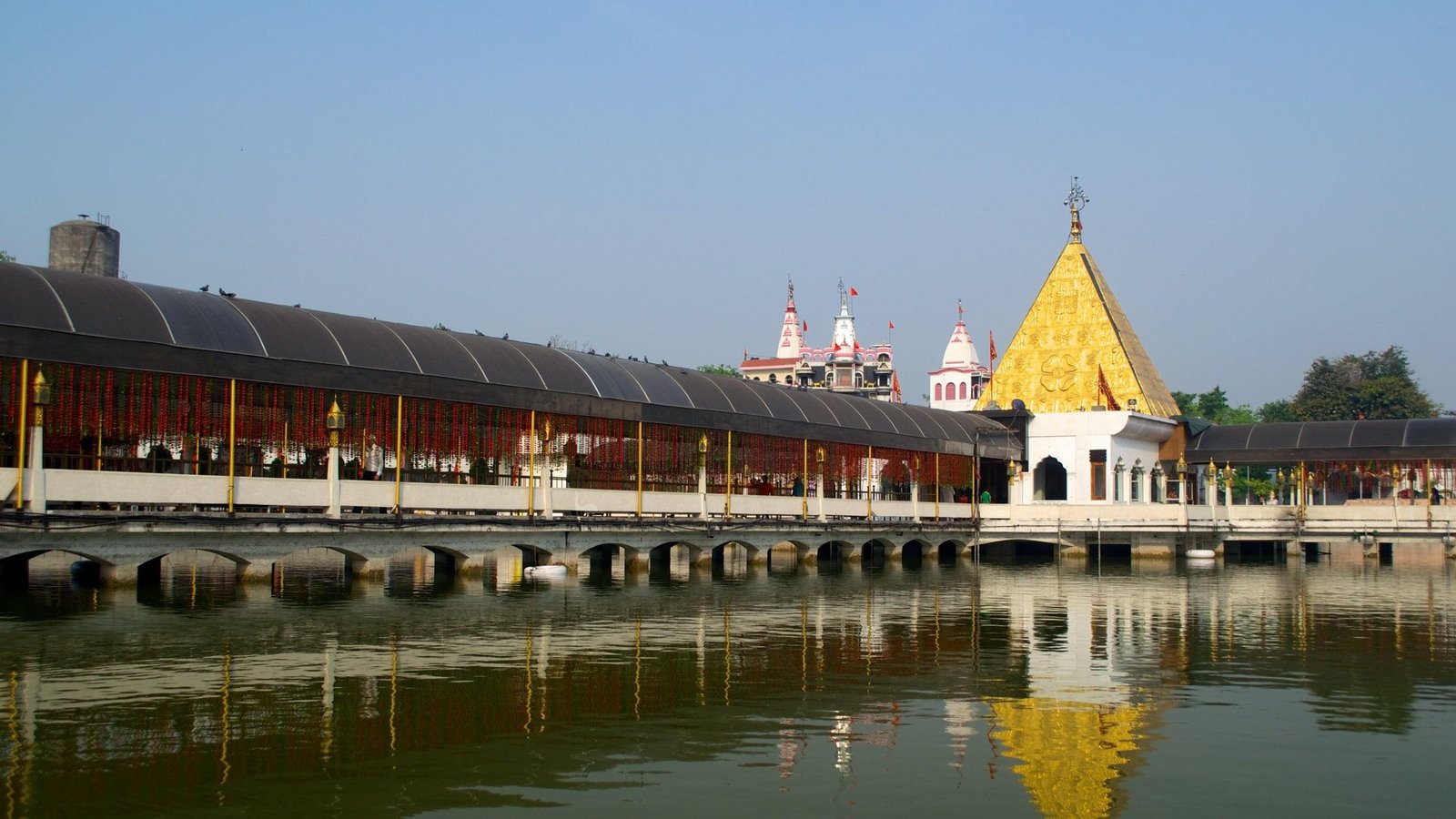
Devi Talab Temple is one of the most important Hindu pilgrimage destinations in Punjab and one of the defining spiritual landmarks of Jalandhar. Situated on Tanda Road within the city, the temple complex is built around a large sacred water tank known as the Devi Talab.
The calm water, golden-roofed shrine, covered walkways, temple towers, courtyards, bells, devotional paintings and multiple sacred spaces create a spiritual environment that feels separated from the movement of the surrounding city.
The destination is also known as:
Shree Devi Talab Mandir
Devi Talab Temple
Maa Tripurmalini Shakti Peeth
Tripurmalini Temple Jalandhar
Siddh Peeth Shri Devi Talab
Maa Durga Mandir Jalandhar
Devi Talab Shakti Peeth
These names generally refer to the same large temple complex, although individual names may emphasise different shrines or traditions found within the premises.
Travellers arranging local transportation should clearly specify:
**Shree Devi Talab Mandir on Tanda Road, Jalandhar.**
This helps distinguish the temple from smaller local Devi shrines, Durga temples and other sacred tanks located across Punjab.
Devi Talab Mandir is primarily dedicated to the Divine Mother and is traditionally recognised as one of the major Shakti Peethas of the Indian subcontinent.
The Goddess is worshipped here as Maa Tripurmalini.
According to the sacred tradition maintained by the temple, this is the place where the right breast of Mata Sati fell after her body was divided by the Sudarshan Chakra of Lord Vishnu.
Different Shakti Peeth lists occasionally preserve different names, numbers and body-part associations.
The Devi Talab tradition should therefore be understood as an important regional and temple-based expression of the wider Sati and Shakti Peeth narrative.
The spiritual importance of Devi Talab extends beyond one sanctum.
The complex contains the principal darbar of the Goddess, the Maa Tripurmalini shrine, an old Kali temple, Shiva temples, Ram temples, a Bhairav shrine, a Vaishno Devi cave representation, an Amarnath cave representation, a yajna area, shrines connected with saints and an extensive sacred tank.
The temple also provides community services through accommodation, langar, economical meals, charitable medical work and other humanitarian activities.
One of its most distinctive cultural features is its relationship with the Shree Baba Harivallabh Sangeet Sammelan.
Held at the sacred seat of music at Devi Talab since 1875, the Sammelan has become one of India’s most respected annual gatherings of Hindustani classical music.
This unusual relationship between Shakti worship and classical music makes Devi Talab Mandir both a pilgrimage centre and a major cultural landmark.
For Shakti devotees, the temple is a place to honour the Divine Mother.
For families, it offers an accessible urban pilgrimage without a difficult trek.
For senior citizens, its road location and developed complex make the principal shrines comparatively manageable.
For children, the sacred tank, cave representations and multiple temples create an engaging introduction to Hindu sacred traditions.
For musicians and students, the Harivallabh heritage connects devotion with disciplined artistic practice.
For travellers exploring Punjab, the temple reveals a spiritual dimension of Jalandhar beyond its reputation for sports goods, industry and commerce.
Visitors searching for hotels near Devi Talab Temple, homestays near Tanda Road, pilgrimage accommodation near Maa Tripurmalini Shakti Peeth, family hotels near Jalandhar railway station or places to stay near Jalandhar temples can use MudrasStays to plan a comfortable and geographically convenient journey.
## Spiritual Importance of Devi Talab Temple
Devi Talab Mandir is dedicated to Shakti, the universal divine energy represented through the Goddess.
Within Hindu philosophy, Shakti is the active power through which consciousness becomes creation, movement, protection, wisdom and transformation.
The Divine Mother is not limited to one emotional quality.
She is nurturing like a mother.
She is protective like a guardian.
She is disciplined like a teacher.
She is courageous like a warrior.
She is abundant like the earth that provides food.
She is wise like Saraswati and powerful like Durga and Kali.
At Devi Talab, these different expressions of the Goddess appear within one large sacred environment.
Maa Tripurmalini represents the central Shakti Peeth identity.
Maa Kali represents fierce transformation and the destruction of harmful forces.
The Vaishno Devi representation connects the temple with Mahakali, Mahalakshmi and Mahasaraswati.
Other sacred images and shrines represent abundance, learning, family responsibility, courage and protection.
The Devi Talab itself adds the symbolism of water.
Water nourishes life, receives reflection and carries the idea of purification.
The golden temple roof reflects in the tank, creating a visual relationship between the shrine above and the sacred water below.
For devotees, this can symbolise the relationship between visible worship and inner awareness.
The temple is visited for prayer, darshan, aarti, Navratri worship, community service, devotional singing and family pilgrimage.
Some visitors seek courage during difficult circumstances.
Parents may pray for the wellbeing and education of their children.
Students may seek concentration and clarity.
Families may visit before beginning an important responsibility.
Couples may pray for harmony and mutual respect.
Others visit simply to express gratitude.
These practices belong to individual and family faith.
Devi Talab Temple should not be promoted as guaranteeing employment, wealth, marriage, fertility, medical recovery or the fulfilment of every wish.
Religious worship can provide emotional strength, discipline and a sense of spiritual support, while health, legal, financial and family matters should continue to receive appropriate practical attention.
## Maa Tripurmalini
Maa Tripurmalini is the principal Shakti Peeth form associated with Devi Talab Mandir.
The name can be understood through the sacred idea of the three worlds or three dimensions of existence.
“Tri” refers to three, while “pura” can refer to cities, worlds or levels of reality.
“Malini” suggests one who is adorned, garlanded or surrounded by divine power.
Different philosophical traditions may interpret the title differently, but the central idea is that the Goddess is not confined to one place or one visible form.
She is the power present throughout existence.
In Shakta philosophy, the Divine Mother exists as the energy behind thought, life, nature, knowledge and spiritual transformation.
The Tripurmalini form reminds devotees that the sacred cannot be limited to the sanctum alone.
The same Shakti must be recognised in human dignity, compassion, responsible conduct and care for the natural world.
The temple trust identifies Maa Tripurmalini as the central Goddess of the Shakti Peeth.
Pilgrims should ensure that they visit the Tripurmalini shrine rather than completing only a quick circuit around the outer tank.
The exact sequence of darshan can be understood through temple signs or guidance from authorised priests and volunteers.
Visitors should avoid blocking the entrance while taking photographs.
The sacred image, inner sanctum and private worship should only be photographed when permission is clearly provided.
## The Shakti Peeth Tradition
Devi Talab Mandir is traditionally revered as one of the major Shakti Peethas.
The Shakti Peeth narrative begins with Mata Sati, daughter of King Daksha and wife of Lord Shiva.
According to Hindu sacred tradition, Daksha organised a great yajna but did not show proper respect to Shiva.
Sati attended the ceremony and experienced deep pain when her husband was insulted.
Unable to bear the humiliation and conflict, she gave up her body in the sacrificial fire.
Lord Shiva was overwhelmed by grief.
He lifted Sati’s body and moved across the universe while performing the powerful Tandava.
The balance of creation was threatened by his sorrow and cosmic energy.
Lord Vishnu used the Sudarshan Chakra to divide Sati’s body.
The places where parts of her body or ornaments fell became sacred centres of Shakti worship.
These places are known as Shakti Peethas.
Each Shakti Peeth is associated with a particular form of the Goddess and, in many traditions, an accompanying form of Bhairava or Shiva.
At Devi Talab, the Goddess is worshipped as Tripurmalini.
Some Shakti Peeth traditions identify the associated Bhairava as Bhishan or a similarly named fierce form of Shiva, while local shrine terminology and spelling may vary.
Visitors should understand the Sati narrative as Hindu sacred mythology and theological tradition rather than conventional political history or scientifically documented geography.
Its spiritual meaning concerns grief, divine energy and the inseparable relationship between Shiva and Shakti.
Sati represents devotion and dignity.
Shiva’s grief represents the depth of attachment and loss.
The Shakti Peethas transform grief into sacred geography.
Wherever the Divine Mother is remembered, her energy is understood to remain present.
## The Right-Breast Tradition
The Devi Talab temple tradition identifies the site with the fall of Mata Sati’s right breast.
The breast carries powerful maternal symbolism.
It represents nourishment, protection, motherhood and the continuation of life.
For devotees, this association gives Devi Talab a strong connection with the caring and sustaining dimensions of the Divine Mother.
The symbolism should not be reduced to a literal anatomical curiosity.
It expresses the idea that Shakti nourishes the universe.
The earth provides food.
Water supports life.
A mother protects a child.
Knowledge nourishes the mind.
Compassion sustains communities during hardship.
Visitors may pray for family welfare and maternal protection according to their faith.
The tradition should not be used to claim guaranteed fertility, childbirth or recovery from illness.
Medical concerns require qualified healthcare, and emotional or family difficulties require appropriate support.
## Maa Durga
Maa Durga is one of the principal forms through which the Divine Mother is worshipped at Devi Talab.
Durga represents courage, protection, disciplined strength and the restoration of dharma.
Her most famous sacred narrative concerns the defeat of Mahishasura.
According to Hindu mythology, Mahishasura obtained great power and used it destructively.
The divine energies combined and manifested as Goddess Durga.
She received weapons and powers from the gods and fought the demon.
The victory represents more than physical battle.
Mahishasura symbolises arrogance, uncontrolled desire, cruelty and the misuse of strength.
Durga represents the courage required to confront these destructive forces.
For an individual pilgrim, the battle can be interpreted inwardly.
The demon may be anger, greed, fear, addiction or pride.
The Goddess represents the discipline needed to overcome it.
The story belongs to Hindu mythology and should not be presented as a modern historical war.
Its relevance lies in the ethical and spiritual meaning carried by the narrative.
## Maa Kali and the Old Kali Temple
An old shrine dedicated to Goddess Kali stands beside the Devi Talab.
The Jalandhar district administration specifically recognises this Kali temple as an older element of the sacred landscape.
Kali represents time, transformation and the destruction of ego.
Her appearance is often fierce.
She may be shown with dark skin, powerful weapons and symbols connected with death and impermanence.
These features should not be misunderstood as uncontrolled violence.
Kali destroys illusion, arrogance and harmful attachment.
She reminds devotees that material power and physical life are temporary.
Her presence beside the peaceful tank creates an important spiritual contrast.
The water appears calm.
Kali represents radical transformation.
Together they suggest that spiritual peace does not come from ignoring fear.
It comes from facing truth and releasing false pride.
The old Kali shrine should be approached patiently and respectfully.
Visitors should not assume that every old-looking surface is available for touching or the application of vermilion and oil.
Offerings should be made only according to the established temple practice.
## Bhairav and the Protective Form of Shiva
Shakti Peeth traditions commonly include an associated form of Bhairava.
Bhairava is a powerful manifestation of Lord Shiva connected with protection, time, discipline and the guardianship of sacred space.
The Devi Talab complex contains a Bhairo Mandir.
Devotees may include Bhairav darshan as part of the wider temple circuit.
Bhairava’s fierce appearance should not be understood as uncontrolled aggression.
He represents spiritual alertness.
A sacred place must be protected from misuse, arrogance and disorder.
His presence reminds pilgrims that devotion requires discipline.
Visitors should follow local signs regarding the sequence and identity of the Bhairav shrine rather than relying solely upon differently spelled names found online.
## The Sacred Devi Talab
The sacred tank gives the temple its most familiar name.
“Devi” means Goddess, while “talab” means pond or tank.
Devi Talab therefore means the sacred tank of the Goddess.
The large water body occupies the visual and spiritual centre of the complex.
The temple, walkways and surrounding shrines are reflected in its surface.
The tank is not merely decorative.
It represents purification, continuity and the sustaining power of water.
The Jalandhar district administration records that the old Devi Talab was renovated and that a newer temple was constructed in its central setting.
The present appearance therefore combines an old sacred water tradition with substantial renovation and modern construction.
Visitors should not assume that every railing, platform, roof and marble surface dates from the earliest period of worship.
Living pilgrimage centres develop through repeated repair.
The continuity of faith can remain ancient even when buildings and facilities are renewed.
## Spiritual Meaning of the Talab
Water receives a reflection without holding it permanently.
A temple appears upon the surface, changes with light and disappears when the water moves.
This can be understood as a spiritual lesson.
The physical world is real and meaningful, but it is constantly changing.
The divine reality represented by the Goddess is deeper than temporary appearance.
The tank may also symbolise the mind.
When the water is disturbed, the reflection becomes unclear.
When it becomes calm, the image appears clearly.
In the same way, a distracted mind struggles to recognise truth, while a disciplined and peaceful mind can perceive more clearly.
## Bathing and Water Safety
Some devotees traditionally regard bathing or touching sacred water as an act of purification.
Current bathing permissions must be checked before entering the tank.
The presence of steps does not automatically mean that unrestricted bathing or swimming is allowed.
Water depth, cleanliness, maintenance work and festival crowd controls can change.
Children and non-swimmers must remain supervised.
Soap, shampoo, detergents and chemical products should never be used.
Visitors should not throw plastic, flowers wrapped in packaging, coins, food, cloth or oil into the water.
Sacred water should not be advertised as a scientifically proven cure for disease.
A ritual bath can have emotional and spiritual importance, but it does not replace medical treatment or personal responsibility.
Visitors with open wounds, reduced immunity or health concerns should avoid unnecessary immersion.
## The Golden-Roofed Shrine
One of the most recognisable architectural features of Devi Talab is the golden, pyramidal roof rising beside or within the water.
Its surface reflects sunlight and creates a powerful mirror image in the tank.
The roof directs the eye upward and visually identifies the central sacred structure from across the complex.
The current golden appearance may include modern surface work and renovation.
It should not automatically be described as an unchanged ancient roof.
Temple architecture often develops through successive phases of repair and beautification.
The relationship between the gold-toned tower, white walls and water gives Devi Talab its distinctive identity.
During morning and late-afternoon light, the reflection can become particularly striking.
Photography should be completed without obstructing devotees or entering restricted platforms.
## Covered Walkways and Causeways
Covered walkways extend around and across sections of the sacred tank.
They provide shade, organise pilgrim movement and connect shrines within the complex.
The repeated arches and roof segments create a rhythmic architectural frame around the water.
During Navratri or other crowded occasions, the walkways may become part of a regulated queue.
Visitors should follow the designated direction of movement.
Sitting in narrow passages, stopping for group photographs or reversing against the queue can create congestion.
Wet flooring near the tank may become slippery.
## Maa Vaishno Devi Representation
The temple complex includes a sacred representation associated with Maa Vaishno Devi.
The principal Vaishno Devi shrine is situated in the Trikuta Hills above Katra in Jammu and Kashmir.
The representation at Devi Talab allows devotees to honour the Divine Mother through a symbolic cave experience within Jalandhar.
It should not be confused with the original Holy Cave or presented as a replacement for the official Vaishno Devi pilgrimage.
The Vaishno Devi tradition honours the combined energies of Mahakali, Mahalakshmi and Mahasaraswati.
Mahakali represents transformation and courage.
Mahalakshmi represents nourishment and balanced prosperity.
Mahasaraswati represents knowledge and wisdom.
Together they express the complete power of the Divine Mother.
The cave-style setting can be especially engaging for children, but narrow or dark passages may require supervision.
Visitors with claustrophobia or mobility limitations should assess the route before entering.
## Amarnath Gufa Representation
Devi Talab Mandir also contains an Amarnath Gufa representation.
The original Shri Amarnath Cave is a high-altitude Shiva pilgrimage destination in Jammu and Kashmir, famous for a naturally forming ice lingam during the annual yatra period.
The Jalandhar representation provides a symbolic cave environment associated with Lord Shiva.
It allows devotees to experience the devotional narrative without undertaking the physically demanding Himalayan pilgrimage.
The structure should not be described as the original Amarnath Cave or as having the same natural ice formation.
It is a devotional representation within the Devi Talab complex.
Visitors should move carefully through cave-style passages and follow all photography and queue instructions.
## Ancient and Modern Shiva Shrines
The temple trust identifies both a Prachin Shiv Mandir and another Shiva temple within the premises.
The presence of Shiva is essential within a Shakti Peeth.
Shiva represents consciousness, meditation and stillness.
Shakti represents energy, movement and manifestation.
Neither is complete in isolation.
The Shiva lingam represents Mahadev beyond ordinary human form.
Its surrounding base represents Shakti.
Together they express the unity of awareness and creation.
Visitors should distinguish between historically older shrines and later structures without making unsupported claims about precise dates.
The word prachin means ancient or old within temple tradition, but it does not by itself provide an archaeological date.
## Shiv Parikrama
The complex includes a Shiva parikrama experience.
Parikrama means moving respectfully around a sacred centre in a clockwise direction.
The physical act represents placing the divine at the centre of one’s life.
The devotee moves, while the sacred centre remains stable.
Visitors should follow the indicated direction and avoid pushing.
Parikrama should be performed attentively rather than as a race or a photography opportunity.
## Ram Temples and Ram Darbar
Devi Talab Mandir contains old and newer sacred spaces associated with Lord Rama.
Ram Darbar generally presents Lord Rama with Mata Sita, Lakshmana and Lord Hanuman.
The group represents dharma, family responsibility, loyalty and devoted service.
Rama represents commitment to duty.
Sita represents dignity and courage.
Lakshmana represents service and family loyalty.
Hanuman represents humility, strength and complete devotion.
The presence of Ram shrines broadens the complex beyond the Shakti Peeth tradition and allows families to honour several interconnected Hindu sacred narratives within one visit.
## Salasar Dham and Hanuman Devotion
The complex also includes a sacred space associated with Salasar Dham and Hanuman worship.
Salasar Balaji is a major Hanuman pilgrimage tradition associated with Rajasthan.
The representation at Devi Talab allows devotees in Punjab to honour Hanuman through that devotional identity.
Hanuman represents strength guided by humility.
His power is never used for personal pride.
It is directed towards service, protection and dharma.
Pilgrims may pray for courage and discipline, but the shrine should not be promoted through guaranteed claims concerning illness, employment or supernatural protection.
## Yagya Shala
A Yagya Shala is a designated place for sacred fire ceremonies.
Yajna involves the offering of approved materials into a consecrated fire while mantras are recited.
Fire represents transformation.
Material offerings are changed into heat, light and smoke.
Spiritually, the ritual can represent the offering of ego, anger and harmful habits.
Visitors should never light an independent fire within the complex.
Havan and yajna ceremonies must remain under authorised priestly and temple-management supervision.
Fire safety is especially important during crowded festivals.
## Spiritual Paintings
The temple complex includes spiritual paintings and visual narratives.
Such images help devotees understand stories from the lives of the Goddess, Shiva, Rama, Hanuman and associated saints.
Paintings are especially useful for children and visitors unfamiliar with the narratives.
They should not be touched, rubbed or covered with offerings.
Flash photography may be restricted.
Historic or devotional paintings can be damaged by moisture, smoke and repeated contact.
## Navratri at Devi Talab Mandir
Navratri is the most important festival period at Devi Talab.
The word Navratri means nine nights.
The festival honours different forms of the Divine Mother and celebrates the victory of divine courage over destructive forces.
Two principal Navratri periods are widely observed.
Chaitra Navratri generally falls in March or April.
Sharad Navratri generally falls in September or October.
During Navratri, the complex is decorated with flowers, lights, flags and devotional cloth.
Special aartis, havans, recitations, Mata Ki Chowki programmes, bhajans and community meals may be organised.
Pilgrims visit Maa Tripurmalini, Maa Durga, Maa Kali and other shrines within the complex.
The approach roads, parking areas, walkways and sanctums can become extremely crowded.
Visitors should arrive early.
Families should keep children and senior citizens close.
Groups should select a meeting point before entering the busiest areas.
The exact annual schedule, security plan and queue system must be confirmed locally.
## Chaitra Navratri
Chaitra Navratri marks the spring cycle of Goddess worship.
The weather is generally more comfortable than peak summer, although afternoons may become warm.
The temple may organise a major mela and devotional programmes.
Families often begin new religious observances, offer prayers and participate in community service.
## Sharad Navratri
Sharad Navratri takes place after the monsoon and generally attracts substantial crowds.
The final days around Ashtami and Navami are especially important.
Kanya Pujan may be performed according to family and temple traditions.
Young girls are respectfully honoured as manifestations of the Goddess.
The practice should always preserve the dignity, comfort and consent of the children involved.
## Durga Ashtami and Navami
Ashtami and Navami are among the busiest days at Shakti temples.
Visitors should expect longer queues and restricted vehicle access.
Senior citizens and people unable to tolerate dense crowds may prefer an early morning or another day within the Navratri period.
## Mata Ki Chowki and Devotional Music
Mata Ki Chowki is a devotional gathering involving bhajans, sacred narratives and collective worship of the Goddess.
The temple regularly hosts such programmes.
Music becomes a form of prayer.
The singer is not merely performing for entertainment.
Voice, rhythm and melody are offered to the Divine Mother.
Visitors should participate respectfully and avoid loud private conversations during the programme.
## Harivallabh Sangeet Sammelan
The Shree Baba Harivallabh Sangeet Sammelan is one of the most important cultural traditions associated with Devi Talab.
The first Sammelan was held at Devi Talab in 1875.
It developed around the sacred musical tradition of Baba Tuljagiri and his disciple Baba Harivallabh.
Baba Tuljagiri was remembered as a Sanskrit scholar and an exponent of the Dhrupad tradition.
The young Harivallabh listened to devotional music at Devi Talab and became his disciple.
He later succeeded his guru at the sacred seat of music.
The annual Sammelan developed as an act of remembrance and musical devotion.
Over time it became one of the most respected gatherings of Hindustani classical musicians.
Vocalists and instrumentalists from several gharanas and traditions have performed at the festival.
The event is normally held during the final weekend of December, though exact dates should be checked annually.
The Sammelan transforms Devi Talab into a meeting place of worship, artistic discipline and cultural memory.
## Music as Spiritual Practice
Indian classical music has a deep relationship with devotional and meditative traditions.
A raga is not simply a tune.
It is a structured melodic framework capable of creating a particular emotional and contemplative atmosphere.
The discipline required to study classical music reflects the discipline of spiritual practice.
Both require repetition.
Both require humility before a teacher.
Both require control of breath, attention and ego.
The Harivallabh tradition therefore belongs naturally within a temple environment.
Music becomes an offering.
Listening becomes a form of meditation.
## Best Time to Visit Devi Talab Temple
Devi Talab Mandir can be visited throughout the year.
### October to March
The cooler months provide the most comfortable weather for walking around the large complex.
December is particularly important because of the Harivallabh Sangeet Sammelan.
Morning and evening can become cold during December and January.
Fog may affect railway and road travel.
### February and March
Late winter and early spring offer pleasant weather.
Chaitra Navratri may fall during March or April and creates a vibrant devotional atmosphere.
### April to June
Jalandhar can become extremely hot.
The marble and paved courtyards receive strong sunlight.
Visitors should arrive early in the morning or later in the evening.
Water, light clothing and sun protection are important.
### July to September
The monsoon brings humidity and rainfall.
Walkways and tank-side flooring may become slippery.
Visitors should use covered areas and avoid running near the water.
### Sharad Navratri
The autumn Navratri period offers a powerful festival experience but also heavy crowding.
Accommodation and transport should be reserved early.
### December Music Festival
The Harivallabh Sammelan attracts classical musicians, students and audiences from outside Jalandhar.
Travellers interested in music should plan accommodation well in advance and verify the programme for the relevant year.
## Suggested Time for Darshan
Early morning is ideal for peaceful prayer and cooler weather.
The tank is often calmer, allowing the shrine’s reflection to appear clearly.
Evening aarti creates a powerful atmosphere of bells, lamps and collective prayer.
Festival days require additional waiting time.
Published temple timings can change because of Fridays, special ceremonies, maintenance or major events.
Visitors should confirm the current opening schedule before travelling specifically for an early or late darshan.
## Reaching Devi Talab Temple
The temple is located on Tanda Road in Jalandhar city.
Its urban location makes it accessible by taxi, auto-rickshaw, private vehicle and local transport.
Visitors should provide the full temple name and Tanda Road address to the driver.
Traffic can become heavy during school hours, evening periods, Navratri and major temple programmes.
## Reaching from Jalandhar City Railway Station
Jalandhar City Junction is one of the nearest major rail gateways.
The temple is reached through a relatively short urban road journey, though exact distance depends upon the exit, traffic and selected route.
An auto-rickshaw or taxi is normally the easiest connection.
Travellers carrying luggage should first check into accommodation or use secure storage.
Large suitcases should not be carried through the temple complex.
## Reaching from Jalandhar Cantonment
Jalandhar Cantonment Railway Station serves additional trains and is farther from the temple than the city station.
A taxi or auto-rickshaw is required.
Traffic conditions should be considered when planning onward trains.
## Reaching by Air
Adampur Airport is the closest airport geographically, but scheduled operations and routes can change.
Sri Guru Ram Dass Jee International Airport at Amritsar and Chandigarh Airport may provide broader connectivity depending upon the traveller’s origin.
Every airport requires a road transfer.
Current flight operations should be checked before planning.
## Accessibility for Senior Citizens
Devi Talab is more accessible than mountain and cave pilgrimages.
Vehicles can approach the temple area, and much of the main complex contains developed walkways.
Some shrines, cave representations and tank steps may involve uneven flooring, thresholds or stairs.
Senior citizens should visit during quieter hours.
Stable footwear is important.
Wheelchair practicality and the nearest drop-off point should be confirmed with the temple or accommodation provider.
Navratri and major programme crowds can make movement more difficult.
## Visiting with Children
Children may find the tank, temple reflections and cave representations particularly engaging.
Parents should use the journey to explain the values represented by Durga, Kali, Shiva, Rama and Hanuman.
Children must remain supervised near the water.
They should not climb railings, run on wet flooring, pull bells continuously or touch paintings.
A child uncomfortable in a dark or narrow cave representation should not be forced to enter.
## Temple Facilities
The temple trust provides extensive pilgrim and community facilities.
These include dharamshala rooms, langar service, toilets, an economical Annapoorna Bhojanalya, a charitable hospital and other service activities.
The availability of a facility on the official website does not guarantee immediate access on every date.
Rooms may be full.
Langar timings may change.
Hospital and dining services may follow separate operating schedules.
Visitors should confirm requirements before arrival.
## Langar and Annapoorna Bhojanalya
Langar expresses equality, service and the sharing of food.
Visitors should sit and eat according to the local arrangement.
Only the quantity that can be consumed should be accepted.
Food waste should be avoided.
The Annapoorna Bhojanalya provides economical snacks and meals.
Maa Annapoorna represents the divine power of nourishment.
Respecting food is therefore part of temple discipline.
## Dharamshala Accommodation
The temple trust maintains more than 90 dharamshala rooms according to its current information.
These rooms are intended to serve pilgrims.
Facilities, room type, identification requirements, check-in rules and availability should be confirmed directly.
A dharamshala should not automatically be expected to provide the same privacy and services as a commercial hotel.
Festival and music-event periods can create high demand.
## Nearby Spiritual Attractions
### Baba Sodal Temple
Baba Sodal Temple is another major pilgrimage destination within Jalandhar.
It is associated with Baba Sodal and an important annual mela.
The traditions of Baba Sodal are distinct from the Shakti Peeth traditions of Devi Talab.
Both can be included in a city pilgrimage itinerary.
### Tulsi Mandir and Vrinda Tradition
Jalandhar’s Tulsi Mandir is connected with Vrinda, the devoted wife of the mythological king Jalandhara.
The sacred narrative links the city’s name with Puranic tradition.
Nearby religious locations are associated with a tank, Annapurna and Shiva worship.
### Gur Mandi Shiv Temple
The historic Shiva temple at Gur Mandi is an important urban shrine of Jalandhar.
Local tradition associates its construction with a Muslim ruler or official, making it an example of the region’s layered cultural history.
### Gurdwara Talhan Sahib
Gurdwara Shaheed Baba Nihal Singh Ji at Talhan is an important Sikh pilgrimage destination near Jalandhar.
Visitors should cover their heads, remove footwear and follow gurdwara etiquette.
### Pushpa Gujral Science City
Science City near Kapurthala provides an educational destination for families and school groups.
It requires a separate road journey and should be given sufficient time.
### Jang-e-Azadi Memorial
The Jang-e-Azadi Memorial at Kartarpur honours the role of Punjabis in India’s freedom movement.
Current opening hours and gallery access should be checked.
### Nurmahal Sarai
Nurmahal contains an important Mughal-period sarai with monumental gateways and historic architecture.
It lies outside central Jalandhar and is best planned as a separate heritage excursion.
### Rangla Punjab Haveli
Rangla Punjab Haveli presents aspects of Punjabi food, craft, music and village-themed cultural entertainment.
It can be included in an evening itinerary, subject to current operating arrangements.
## Suggested Half-Day Devi Talab Itinerary
Begin with early-morning darshan at Maa Tripurmalini.
Walk respectfully around the Devi Talab.
Visit the old Kali shrine and associated Shiva and Ram temples.
Explore the Vaishno Devi or Amarnath representations according to current access.
Receive langar or have a simple meal at the Annapoorna Bhojanalya.
Continue towards another nearby Jalandhar shrine or return to accommodation.
## Suggested One-Day Jalandhar Spiritual Itinerary
Begin at Devi Talab Mandir.
Visit Maa Tripurmalini, Kali Mata, Shiva and Ram shrines.
Continue to Baba Sodal Temple.
Visit a historic Shiva or Vrinda-associated temple within Jalandhar.
End the day at Gurdwara Talhan Sahib or another suitable sacred destination.
Travel time should remain flexible because city traffic can be unpredictable.
## Suggested Two-Day Pilgrimage and Heritage Journey
On the first day, explore Devi Talab and Jalandhar’s principal urban shrines.
On the second day, visit Jang-e-Azadi Memorial, Gurdwara Talhan Sahib or Science City according to the interests of the group.
Visitors focused on architecture may replace Science City with Nurmahal Sarai.
## Suggested Three-Day Doaba Circuit
The first day can focus on Devi Talab and central Jalandhar.
The second day can include Kartarpur and Kapurthala attractions.
The third day can include Nurmahal, Nakodar or a broader spiritual and heritage circuit.
A slower itinerary is preferable for senior citizens and families.
## Accommodation Near Devi Talab Temple
Devi Talab’s urban location gives travellers access to a wide variety of hotels, guesthouses, homestays and pilgrim rooms.
The best area depends upon transport and itinerary.
## Temple Dharamshala
The temple’s own dharamshala provides the closest pilgrimage accommodation.
It is suitable for visitors prioritising darshan and community facilities.
Availability, room condition and booking rules should be confirmed.
## Hotels Near Tanda Road
Properties around Tanda Road and northern Jalandhar provide convenient access to the temple.
The quality and category of accommodation vary.
Guests should verify parking, room condition, meals, air-conditioning, heating and the actual driving route.
## Hotels Near Jalandhar City Railway Station
Railway-area hotels are convenient for short stays and early departures.
They provide access to autos and taxis.
The surroundings can be busy, so travellers should evaluate noise, parking and room standards carefully.
## Hotels in Civil Lines and Central Jalandhar
Civil Lines and central commercial areas provide restaurants, transport and access to several city attractions.
They are suitable for families and business travellers combining pilgrimage with other work.
Traffic towards Tanda Road should be considered.
## Hotels in Model Town
Model Town and adjoining areas offer restaurants, shopping and a range of modern accommodation.
They are farther from the temple than Tanda Road but may provide a more comfortable overall city stay.
## Hotels Near the GT Road
Properties near the main highway can be practical for travellers continuing towards Amritsar, Ludhiana, Phagwara or Chandigarh.
Visitors should compare the highway convenience with the additional city journey required for temple darshan.
## Homestays in Jalandhar
Verified homestays can provide local meals, Punjabi hospitality and a quieter experience.
Guests should confirm attached bathrooms, parking, air-conditioning, heating, meal arrangements and transport to the temple.
## Choosing the Right Stay
Pilgrims focused primarily on Devi Talab should choose the temple dharamshala or a verified property near Tanda Road.
Rail travellers may prefer accommodation near Jalandhar City Junction.
Families should check room capacity, meals and parking.
Senior citizens should prioritise lifts, ground-floor rooms and dependable transport.
Couples may prefer quieter hotels away from congested market lanes.
Solo pilgrims should select well-connected accommodation in populated areas.
Groups should confirm multiple rooms, early breakfast and bus parking.
Navratri and Harivallabh festival visitors should reserve accommodation early.
Summer travellers should verify effective air-conditioning.
Winter guests should confirm hot water and heating.
## Book Hotels Near Devi Talab Temple with MudrasStays
MudrasStays helps pilgrims, families, musicians and cultural travellers discover hotels, homestays, guesthouses and pilgrimage accommodation near Devi Talab Mandir and throughout Jalandhar.
The platform is designed for travellers searching specifically for places to stay near temples, Shakti Peethas and sacred heritage destinations.
Visitors can compare properties according to practical driving distance from Devi Talab, room category, budget, group size and required facilities.
Booking near Tanda Road can make peaceful morning darshan easier.
Rail travellers can choose accommodation balancing station access with temple distance.
Families can select hotels with comfortable rooms, meals and parking.
Senior citizens can prioritise accessible properties with lifts and reliable taxis.
Solo pilgrims can search for economical guesthouses in well-connected areas.
Pilgrimage groups can identify properties providing multiple rooms, vegetarian meals and parking for larger vehicles.
Classical-music audiences attending the Harivallabh Sangeet Sammelan can choose accommodation according to the festival venue, performance schedule and late-evening transport.
Travellers combining Devi Talab with Baba Sodal Temple, Talhan Sahib, Jang-e-Azadi Memorial, Science City or Nurmahal can choose a stay according to the actual sequence of their journey.
MudrasStays helps visitors avoid selecting a hotel that appears close in straight-line distance but requires unnecessary travel through congested urban roads.
## Responsible Pilgrimage
Visitors should dress respectfully and follow the designated temple route.
The Maa Tripurmalini shrine, Kali temple, sacred images, priests and private rituals should only be photographed when permission is clear.
The sacred tank must not be polluted.
Children should remain supervised.
Cave representations should be entered carefully.
Paintings and old surfaces must not be touched.
Offerings should be made through authorised arrangements.
Food should not be wasted.
Donations should be placed in recognised boxes or made through official channels.
## Respecting the Sacred Tank
No plastic, packaged flowers, food, cloth or oil should enter the water.
Bathing should occur only when and where permitted.
Visitors should not sit on unsafe edges or climb railings for photography.
Birds and fish should not be fed inappropriate packaged food.
Protecting the talab is one of the most direct ways to honour the temple.
## Respecting Music and Cultural Heritage
Visitors attending the Harivallabh Sangeet Sammelan should remain silent during performances.
Phones should be placed on silent mode.
Late entry and movement should be minimised during a raga performance.
The stage should not be approached casually.
The festival is both a cultural event and a tribute to a saint-musician.
Listening with attention is a form of respect.
## Respecting Jalandhar’s Community
Devi Talab stands within a living urban neighbourhood.
Vehicles should not block homes, shops, hospital access or emergency routes.
Loud horns should be avoided.
Residents should not be photographed without consent.
Local drivers, priests, volunteers, food providers and accommodation hosts should be treated fairly.
Responsible pilgrimage allows temple tourism to support rather than burden the surrounding community.
## A Sacred Meeting of Shakti, Water and Music
Devi Talab Temple represents an extraordinary meeting of Shakti worship, sacred water, temple architecture, community service and Indian classical music.
Maa Tripurmalini expresses the universal power of the Divine Mother.
The Shakti Peeth tradition connects the temple with Mata Sati and the sacred geography of Shakti.
The right-breast tradition represents nourishment and maternal protection.
Maa Durga represents courageous action.
Maa Kali represents transformation and the destruction of ego.
Bhairav represents protection and discipline.
The sacred tank represents purification, reflection and life.
The golden roof creates a visual symbol of divine light.
The Shiva shrines express the inseparable relationship between Shiva and Shakti.
The Ram temples represent duty, loyalty and family responsibility.
The Vaishno Devi and Amarnath representations connect Jalandhar with wider Himalayan pilgrimage traditions.
The langar and bhojanalya express nourishment and equality.
The dharamshala provides shelter to pilgrims.
The charitable hospital extends worship into public service.
The Harivallabh Sangeet Sammelan transforms music into a sacred offering.
For Shakti devotees, Devi Talab is a place to seek courage, wisdom and spiritual clarity.
For families, it provides an accessible pilgrimage in the centre of a major city.
For senior citizens, developed pathways and urban transport make the principal shrines comparatively manageable.
For children, the tank, cave representations and multiple temples create an educational spiritual experience.
For musicians, it is one of India’s great sacred seats of classical music.
For cultural travellers, it reveals how religion, art and community service can exist within one living institution.
For photographers, the golden temple and its reflection provide memorable images when worship and safety rules are respected.
For spiritual seekers, the tank communicates a simple teaching: when the mind becomes calm, the sacred reflection becomes clearer.
Devi Talab Mandir should not be treated merely as a quick city attraction.
Its complete identity requires time.
Visit Maa Tripurmalini.
Pay respect at the Kali shrine.
Walk around the talab without polluting it.
Explore the associated temples patiently.
Participate in langar without wasting food.
Learn about Baba Harivallabh and the classical-music tradition.
Recognise service to pilgrims and patients as an extension of worship.
Plan your visit to Devi Talab Temple with MudrasStays and experience one of Punjab’s most important Shakti pilgrimage destinations.
Seek the blessings of Maa Tripurmalini, explore the sacred Devi Talab and experience the spiritual atmosphere of the golden-roofed shrine.
Combine your journey with Baba Sodal Temple, Gurdwara Talhan Sahib, Jang-e-Azadi Memorial, Pushpa Gujral Science City, Nurmahal and the wider spiritual and cultural attractions of Jalandhar.
Book hotels near Devi Talab Temple, discover homestays in Jalandhar and explore suitable pilgrimage accommodation through MudrasStays.
Stay closer to the shrine, attend peaceful morning darshan and reduce unnecessary travel through busy city roads.
MudrasStays connects pilgrims, families, musicians and cultural travellers with suitable accommodation near temples, Shakti Peethas and sacred heritage destinations across India.
Begin your Devi Talab journey with a comfortable stay and experience a meaningful pilgrimage centred on Maa Tripurmalini, sacred water, community service and the timeless relationship between devotion and Indian classical music.