
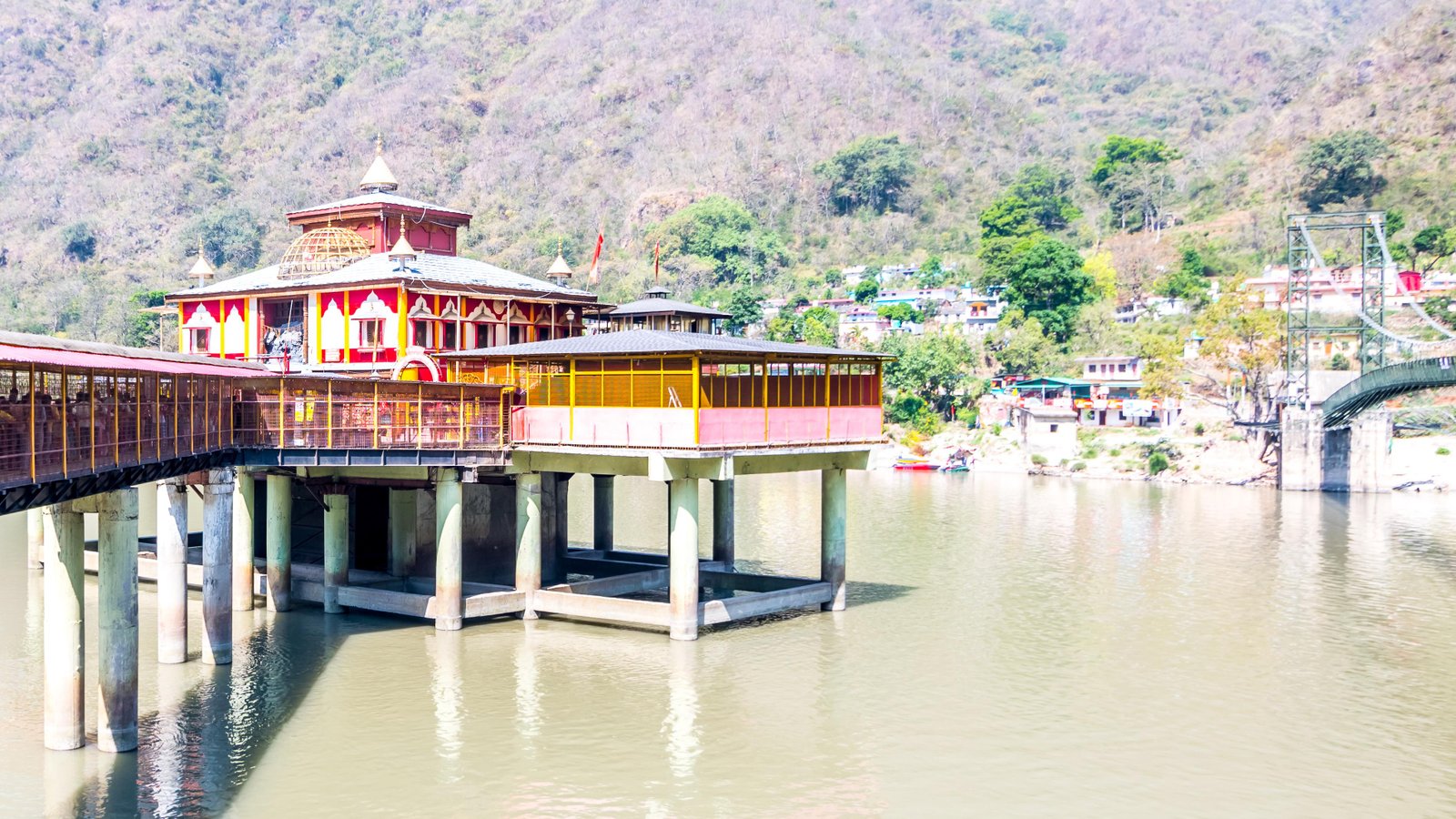
Dhari Devi Temple is one of the most revered Shakti shrines in Uttarakhand and an important spiritual destination on the route between Srinagar Garhwal and Rudraprayag. Dedicated to Maa Dhari Devi, a powerful manifestation of the Divine Mother, the temple stands on a raised platform above the sacred Alaknanda River and is surrounded by the dramatic mountain landscape of the Garhwal Himalayas.
The unique location of the temple immediately distinguishes it from other pilgrimage destinations in Uttarakhand. The shrine appears to rise directly from the flowing waters of the Alaknanda, connected to the riverbank by a long covered pathway. Mountains, river currents, temple bells, saffron flags and devotional chants come together to create one of the most memorable spiritual settings on the Char Dham pilgrimage route.
Maa Dhari Devi is widely revered as the guardian goddess of Uttarakhand and the divine protector of the Char Dham pilgrimage. Devotees believe that she watches over the sacred Himalayan region and protects pilgrims travelling towards Badrinath, Kedarnath, Gangotri and Yamunotri.
Many travellers stop at Dhari Devi Temple before continuing towards Rudraprayag, Kedarnath, Badrinath or other sacred destinations in Garhwal. For these pilgrims, darshan of Maa Dhari Devi is not merely an additional sightseeing activity. It is considered an important spiritual beginning to the difficult mountain journey ahead.
The temple is located near Kalyasaur, approximately 15 kilometres from Srinagar Garhwal. It lies along the principal road connecting Srinagar with Rudraprayag and the upper Himalayan pilgrimage routes. From the roadside area, visitors follow a constructed pathway towards the river and then cross the covered approach leading to the temple.
The journey from Srinagar Garhwal to Dhari Devi Temple passes through beautiful mountain scenery. The Alaknanda River flows beside the road in several places, while forested hills, rocky slopes, village settlements and terraced fields create a constantly changing landscape.
The temple’s position between Srinagar and Rudraprayag makes it easily accessible for pilgrims undertaking the Char Dham Yatra. It can also be visited as a dedicated spiritual excursion by travellers staying in Srinagar Garhwal, Rudraprayag, Khirsu or surrounding destinations.
## Spiritual Importance of Maa Dhari Devi
Maa Dhari Devi is worshipped as a powerful form of Goddess Kali and is regarded as one of the principal guardian deities of the Garhwal Himalayas. Her worship is closely connected with protection, courage, divine energy and the safety of the sacred mountain region.
The goddess is approached as a mother who protects her devotees from fear, danger, uncertainty and negative forces. Pilgrims seek her blessings before beginning demanding journeys through the Himalayas, particularly when travelling towards the Char Dham shrines.
Devotees visit Dhari Devi Temple to pray for family welfare, health, courage, marriage, children, prosperity, success and relief from personal difficulties. Travellers may also offer prayers for a safe journey through mountain roads and changing Himalayan weather.
The devotion surrounding Maa Dhari Devi is deeply rooted in the cultural identity of Garhwal. For local communities, she is not simply a deity worshipped inside a temple. She is believed to be the living protector of the river valley, surrounding villages and the larger sacred geography of Uttarakhand.
The shrine is regarded as one of the important Shakti Sthals of India. Shakti worship recognises the Divine Mother as the universal source of strength, creation, protection and spiritual transformation.
At Dhari Devi Temple, the presence of the goddess is closely connected with the Alaknanda River. The flowing water beneath the shrine adds a powerful natural dimension to the worship of Shakti.
The sound of the river, the movement of mountain air and the ringing of bells create an atmosphere in which nature itself appears to participate in the spiritual experience.
## Connection Between Dhari Devi and Kalimath
One of the most important beliefs associated with Dhari Devi Temple concerns the form of the goddess worshipped at the shrine.
According to regional religious tradition, the upper portion of the divine form is worshipped at Dhari Devi Temple, while the remaining form is worshipped at Kalimath as Goddess Kali.
Kalimath is another important Shakti pilgrimage destination in the Rudraprayag district. It is situated in the Himalayan region associated with the journey towards Kedarnath and is revered as a powerful centre of Goddess worship.
The spiritual connection between Dhari Devi and Kalimath creates a wider Shakti pilgrimage circuit across Garhwal. Devotees may visit both temples to experience different manifestations of the same divine feminine power.
At Dhari Devi, the goddess is worshipped as the guardian of the Alaknanda valley and protector of the Char Dham route. At Kalimath, she is worshipped in her powerful Kali form within a remote Himalayan setting.
Travellers undertaking a longer pilgrimage may combine Dhari Devi Temple with Kalimath, Ukhimath, Guptkashi, Triyuginarayan and Kedarnath. Such a journey brings together Shakti worship, Shiva pilgrimage and the sacred landscapes of Rudraprayag district.
## The Belief That the Goddess Changes Form
One of the best-known traditions associated with Dhari Devi Temple is the belief that the appearance of the goddess changes three times during the day.
Local devotees say that Maa Dhari Devi appears as a young girl in the morning, as a mature woman during the afternoon and as an elderly woman in the evening.
These three forms are understood as representations of the principal stages of human life. The belief symbolises the universal presence of the Divine Mother throughout childhood, adulthood and old age.
For devotees, this changing appearance expresses the timeless nature of Shakti. The goddess is believed to exist within every stage of creation and every phase of human experience.
Visitors should understand this account as a deeply respected local religious tradition rather than a scientifically established phenomenon. Its importance lies in the faith and meaning it carries for generations of worshippers.
Many pilgrims prefer to visit the temple during different periods of the day to experience the changing light, atmosphere and devotional character of the shrine.
Morning offers a quiet and fresh environment, afternoon brings brighter views of the river and surrounding mountains, while evening aarti creates a deeply spiritual atmosphere of lamps, bells and prayers.
## The Legend of the Sacred Idol
Dhari Devi Temple is associated with an important regional legend concerning the discovery of the goddess.
According to local tradition, a severe flood once carried away an earlier temple or sacred structure situated upstream. The divine idol was swept through the river and eventually became lodged against a rock near Dharo village.
Residents of the area are believed to have heard a divine voice or mysterious sound coming from the idol. The voice instructed the villagers to recover the sacred form and establish it at that location.
The people followed the divine instruction and began worshipping the goddess beside the Alaknanda River. Over time, the shrine became known as Dhari Devi Temple.
Different versions of the story may be narrated by priests, local residents and devotees. The central belief remains that Maa Dhari Devi selected the location herself and directed the community to establish her worship there.
The legend reinforces the relationship between the goddess and the river. The Alaknanda is not simply a geographical feature beside the temple; it forms an essential part of the sacred story of Dhari Devi.
Visitors should receive such stories respectfully as part of the temple’s living religious heritage. These legends have been preserved through oral traditions and continue to shape how pilgrims understand the spiritual power of the destination.
## Temple Above the Alaknanda River
The present temple stands on a raised structure supported above the Alaknanda River. A covered walkway connects the main approach with the shrine, allowing devotees to cross above the water and reach the temple safely.
The bright temple structure, supported by pillars above the river, creates a striking visual contrast with the surrounding mountains and flowing water.
During periods of lower river flow, the rocks and riverbanks around the structure may become more visible. During the monsoon and periods of heavy rainfall, the Alaknanda can rise significantly and flow with great force.
The river’s changing appearance gives the temple a different character in every season. In winter and spring, the water may appear comparatively calm and clear. During the monsoon, it can become powerful, fast-moving and muddy.
Visitors should always respect barriers and local safety instructions. The Alaknanda is a major Himalayan river, and its depth, speed and level can change quickly because of rainfall and upstream conditions.
Travellers should not attempt to enter the river, climb onto exposed rocks or move beyond authorised areas for photographs. Children should remain under continuous adult supervision near the riverbank and temple approach.
Nothing should be thrown into the river. Plastic packets, flowers, food waste, cloth and ritual materials can damage the river ecosystem and reduce the dignity of the sacred destination.
Religious offerings should be placed only in the locations identified by the temple authorities.
## Dhari Devi as Protector of the Char Dham
Maa Dhari Devi is widely regarded as the guardian of the Char Dham shrines of Uttarakhand. The Char Dham pilgrimage includes Yamunotri, Gangotri, Kedarnath and Badrinath, four of the most important sacred destinations in the Indian Himalayas.
Although Dhari Devi Temple is not one of the four principal Dhams, its location and religious importance give it a special position within the wider pilgrimage journey.
Travellers moving towards Kedarnath and Badrinath often pass through or near Srinagar and Rudraprayag. Dhari Devi Temple therefore serves as a spiritual gateway to the upper Garhwal Himalayas.
Pilgrims may stop to seek protection before travelling along narrow mountain roads, crossing high-altitude terrain or beginning a demanding temple trek.
The prayer is not limited to physical safety. Devotees may also ask the goddess for emotional strength, patience, discipline and spiritual clarity during the pilgrimage.
Char Dham travel can involve long road journeys, uncertain weather, crowded routes and physically demanding conditions. Receiving the blessings of Maa Dhari Devi gives many pilgrims a sense of confidence and reassurance before continuing.
Travellers returning from the Char Dham may also stop at the temple to express gratitude for the completion of their journey.
## Navratri at Dhari Devi Temple
Navratri is among the most important periods for visiting Dhari Devi Temple.
During Navratri, devotees worship different forms of the Divine Mother over nine sacred nights. Special prayers, religious ceremonies, offerings and devotional gatherings may be organised at the temple.
The shrine receives larger numbers of pilgrims during both Chaitra Navratri and Sharad Navratri. The temple atmosphere becomes more energetic as devotees arrive from nearby villages, towns and distant regions.
Flowers, red cloth, coconuts, incense and traditional puja materials are offered to Maa Dhari Devi. The sound of bells and devotional chants fills the covered temple structure and surrounding river valley.
Travellers planning to visit during Navratri should expect longer queues, greater traffic and increased demand for accommodation near Srinagar and Rudraprayag.
Hotels and homestays should be reserved in advance, particularly for families, senior citizens and pilgrimage groups requiring multiple rooms.
Visitors seeking a quieter experience may prefer an ordinary weekday outside the major festival dates. Those wishing to experience the temple’s strongest community celebrations may find Navratri especially meaningful.
Every visitor should remember that the festival is primarily a religious occasion. Photography and recording should not interfere with rituals, worshippers or movement through the temple.
## Morning and Evening Darshan
Morning is one of the best times to visit Dhari Devi Temple.
The mountain air is generally cooler, road traffic may be lighter and the temple surroundings can feel especially peaceful. Morning light across the Alaknanda River and surrounding hills adds to the beauty of the experience.
An early visit also allows travellers to continue towards Rudraprayag, Kedarnath, Badrinath or nearby attractions during the remaining daylight hours.
The belief that the goddess appears in a youthful form during the morning gives early darshan additional religious significance for many devotees.
Afternoon visits provide brighter views of the river and temple structure. However, the sun can be strong during warmer months, and visitors should carry water and suitable protection.
Evening aarti offers a different experience. Lamps, bells and devotional chants create a powerful spiritual atmosphere as daylight fades over the Alaknanda valley.
Travellers planning an evening visit should confirm the current temple schedule and arrange return transport in advance. Driving on unfamiliar mountain roads after dark can be challenging, particularly during rain, fog or winter.
Temple timings may change according to the season, religious events, river conditions or administrative instructions. Visitors should verify current information through their hotel, homestay host, local driver or temple management.
## Best Time to Visit Dhari Devi Temple
Dhari Devi Temple can be visited during much of the year, but every season offers a different experience.
### Spring
Spring generally provides pleasant weather, fresh vegetation and comfortable conditions for temple visits.
The surrounding hills become greener, while daytime temperatures remain suitable for road travel and short walks.
This season is appropriate for families, senior citizens and travellers combining the temple with Srinagar, Rudraprayag or Khirsu.
### Summer
Summer is an important pilgrimage season because the Char Dham routes generally receive large numbers of visitors during this period.
Days around Srinagar and the Alaknanda valley can become warm, although mornings and evenings may remain comparatively pleasant.
Visitors should carry drinking water, wear comfortable clothing and avoid excessive exposure to the afternoon sun.
Traffic and accommodation demand may increase considerably during the Char Dham season. Advance booking is strongly advisable.
### Monsoon
The monsoon transforms the Garhwal landscape into a lush green environment, but it also requires the greatest travel caution.
Heavy rainfall can increase the level and speed of the Alaknanda River. Mountain roads may experience landslides, falling stones, traffic restrictions or temporary closures.
Travellers should check official weather and road advisories before beginning the journey. Flexible itineraries are essential during periods of heavy rain.
Visitors must remain within authorised areas around the temple and should never approach the river during high-water conditions.
### Autumn
Autumn is one of the most suitable periods for visiting Dhari Devi Temple.
The post-monsoon landscape remains green, skies may become clearer and daytime temperatures are generally comfortable.
Sharad Navratri can make the temple considerably busier but also provides an opportunity to witness special Goddess worship.
### Winter
Winter offers a quieter pilgrimage experience. The lower Alaknanda valley generally remains accessible, although mornings and evenings can become cold.
Travellers should carry warm clothing and complete road journeys during daylight where possible.
Clear winter days may provide beautiful views of the surrounding mountains and river valley.
Fog, frost and changing road conditions should still be considered while planning the journey.
## Reaching Dhari Devi Temple
Dhari Devi Temple is located near the road connecting Srinagar Garhwal and Rudraprayag.
Srinagar Garhwal is the nearest major town and provides accommodation, restaurants, markets, medical facilities and transport services.
From Srinagar, travellers can hire a private taxi, use a personal vehicle or enquire about local transport towards Kalyasaur and Rudraprayag.
The road follows the Alaknanda valley and offers scenic views throughout the journey.
From the main approach area, visitors follow a constructed pathway towards the river. The final covered passage leads directly to the raised temple structure.
The walk is manageable for many visitors, but senior citizens and travellers with mobility limitations should confirm the distance, slope and current access conditions before travelling.
Families should keep additional time for the walk, temple queue and rest stops.
Parking availability may be limited during Navratri, weekends and the Char Dham pilgrimage season. Travellers should follow local traffic arrangements and avoid parking on narrow road sections.
Mountain driving requires patience. Distances that appear short on a map can take longer because of curves, traffic, road work and weather.
## Nearby Spiritual Destinations
Dhari Devi Temple can be combined with several important temples and pilgrimage destinations across Srinagar and Rudraprayag.
### Kamleshwar Mahadev Temple
Kamleshwar Mahadev Temple is an important Shiva shrine situated in Srinagar Garhwal.
The temple is associated with regional religious traditions and is visited by devotees seeking the blessings of Lord Shiva.
Travellers staying in Srinagar can combine morning or evening darshan at Kamleshwar Mahadev with a visit to Dhari Devi Temple.
### Rudraprayag
Rudraprayag is one of the sacred Panch Prayags of Uttarakhand and is located at the confluence of the Alaknanda and Mandakini rivers.
The town serves as an important junction for pilgrims travelling towards Kedarnath and Badrinath.
Visitors can experience the river confluence, local temples and mountain scenery while using Rudraprayag as a base for the wider pilgrimage region.
### Koteshwar Mahadev Temple
Koteshwar Mahadev Temple is a cave shrine dedicated to Lord Shiva near Rudraprayag.
The temple’s cave setting and location close to the Alaknanda River make it a suitable addition to a Dhari Devi and Rudraprayag spiritual itinerary.
### Devprayag
Devprayag is the sacred confluence where the Alaknanda and Bhagirathi rivers meet to form the Ganga.
Travellers approaching Dhari Devi from Rishikesh may stop at Devprayag and visit the Raghunath Temple before continuing towards Srinagar.
### Kalimath
Kalimath is an important Shakti pilgrimage destination connected with Maa Dhari Devi through regional religious tradition.
The route requires additional mountain travel and should be planned as part of a longer journey towards Ukhimath or Kedarnath.
### Kedarnath
Kedarnath is one of the twelve Jyotirlingas and a principal destination of the Char Dham Yatra.
Pilgrims travelling towards Kedarnath may seek the blessings of Maa Dhari Devi before continuing through Rudraprayag, Agastmuni, Guptkashi and Gaurikund.
### Badrinath
Badrinath Temple is dedicated to Lord Vishnu and forms another major destination of the Char Dham pilgrimage.
The route towards Badrinath passes through Rudraprayag, Karnaprayag, Nandprayag, Joshimath and other sacred mountain destinations.
Dhari Devi Temple can become an important spiritual stop for travellers beginning or completing the Badrinath journey.
## Suggested One-Day Pilgrimage
A one-day spiritual journey can begin with early darshan at Kamleshwar Mahadev Temple in Srinagar Garhwal.
Travellers can then proceed towards Dhari Devi Temple and spend sufficient time offering prayers and observing the Alaknanda River.
After darshan, visitors may continue towards Rudraprayag to experience the sacred confluence and local temples.
The journey can conclude with a return to Srinagar or an overnight stay in Rudraprayag.
Travellers should avoid adding too many distant destinations because mountain road travel can take longer than expected.
## Suggested Two-Day Itinerary
On the first day, visitors can arrive in Srinagar Garhwal, check into a hotel or homestay and explore Kamleshwar Mahadev Temple and the local market.
The second day can begin with an early journey to Dhari Devi Temple.
After darshan, travellers can continue to Rudraprayag, visit the confluence and explore Koteshwar Mahadev Temple if time and road conditions permit.
Guests may return to Srinagar or stay overnight in Rudraprayag depending on the direction of their onward journey.
## Suggested Three-Day Spiritual Circuit
The first day can include arrival in Srinagar Garhwal, Kamleshwar Mahadev Temple and local sightseeing.
The second day can cover Dhari Devi Temple, Rudraprayag Sangam and Koteshwar Mahadev Temple.
The third day can be used to continue towards Kalimath, Ukhimath, Guptkashi or another destination on the Kedarnath route.
Travellers heading towards Badrinath can instead continue towards Karnaprayag, Nandprayag and Joshimath.
This itinerary allows visitors to experience the pilgrimage at a comfortable pace while reducing the pressure of long same-day road journeys.
## Where to Stay Near Dhari Devi Temple
Accommodation for visiting Dhari Devi Temple is available in Srinagar Garhwal, Kalyasaur, Rudraprayag and surrounding mountain settlements.
The right location depends on the traveller’s route, budget, group size and onward destination.
### Hotels in Srinagar Garhwal
Srinagar offers one of the widest selections of hotels, guesthouses and budget accommodation near Dhari Devi Temple.
The town provides markets, restaurants, transport, medical services and other essential facilities.
Staying in Srinagar is suitable for families, senior citizens and travellers who want convenient access to the temple without staying in a remote location.
A Srinagar stay is also practical for visitors arriving from Rishikesh, Haridwar, Devprayag or Pauri.
### Stays Near Kalyasaur and Dhari Devi
Properties closer to Kalyasaur provide more convenient access to the temple.
These may include small hotels, roadside guesthouses, local homestays and independent mountain properties.
A nearby stay can help pilgrims attend early darshan and continue towards Rudraprayag before traffic increases.
Travellers should verify food availability, parking, mobile connectivity and the actual road distance to the temple before booking.
### Hotels and Homestays in Rudraprayag
Rudraprayag is suitable for travellers continuing towards Kedarnath, Badrinath, Kalimath or Ukhimath.
Accommodation includes budget hotels, guesthouses and mountain-view properties.
Staying in Rudraprayag allows visitors to combine Dhari Devi Temple with the sacred river confluence and Koteshwar Mahadev Temple.
### Peaceful Stays Around Khirsu
Khirsu is a scenic mountain destination known for forest surroundings and Himalayan views.
Travellers who prefer a quiet hill retreat may stay around Khirsu and undertake a road journey to Srinagar and Dhari Devi.
This option is better suited to visitors with additional time rather than pilgrims following a tightly scheduled Char Dham itinerary.
## Choosing Suitable Accommodation
Travellers should select accommodation according to their complete pilgrimage route rather than only the nearest district name.
A guest heading towards Kedarnath may find Rudraprayag more practical, while a visitor arriving from Rishikesh may prefer Srinagar Garhwal.
Families should check room size, meal availability, parking and road access.
Senior citizens should select properties offering minimal stairs, comfortable bathrooms and direct vehicle access.
Pilgrimage groups should look for multiple rooms, vegetarian meals, driver accommodation and parking for larger vehicles.
Guests visiting during summer, Navratri or the Char Dham season should book well in advance.
Monsoon travellers should confirm whether the property’s access road is operating normally and whether any local travel advisory is in effect.
Winter visitors should ask about hot water, warm bedding and room-heating arrangements.
Mobile-network and internet quality may vary according to the property’s location within the river valley.
Travellers should always consider actual driving time instead of relying only on straight-line distance.
## Book Stays Near Dhari Devi Temple with MudrasStays
MudrasStays helps pilgrims find hotels, homestays, guesthouses and comfortable mountain accommodation near Dhari Devi Temple, Srinagar Garhwal and Rudraprayag.
The platform is designed specifically for travellers seeking stays near temples and spiritual destinations across India.
Visitors can explore accommodation according to distance from Dhari Devi Temple, room requirements, group size, travel budget and onward pilgrimage route.
Booking a nearby stay makes it easier to attend morning darshan, avoid unnecessary road travel and continue comfortably towards the Char Dham destinations.
Families can search for spacious rooms, meal facilities and convenient parking.
Senior citizens can find properties offering accessible rooms and reduced climbing.
Solo pilgrims can explore budget hotels and local homestays.
Couples can select peaceful river-view or mountain-view accommodation.
Pilgrimage groups can identify hotels capable of providing multiple rooms, vegetarian food and vehicle parking.
Travellers heading towards Kedarnath can choose accommodation that supports onward travel to Rudraprayag, Guptkashi and Gaurikund.
Visitors travelling towards Badrinath can select stays convenient for the route through Karnaprayag and Joshimath.
MudrasStays allows travellers to plan not only an individual hotel booking but a complete temple journey connecting Dhari Devi with the sacred destinations of Garhwal.
## Responsible Pilgrimage at Dhari Devi
Visitors should remember that Dhari Devi Temple is an active place of worship and an environmentally sensitive riverside destination.
Modest clothing and respectful behaviour are appropriate.
Footwear should be removed wherever directed by temple authorities.
Photography of the principal deity, sanctum, priests or religious rituals should only be undertaken when permitted.
Visitors should avoid blocking the covered pathway for photographs, particularly during crowded periods.
Religious offerings must be placed only in designated areas.
Plastic packets, disposable containers, flowers, cloth and food should never be thrown into the Alaknanda River.
The river should be observed from authorised areas only.
Children must remain under adult supervision throughout the approach and temple visit.
Visitors should not lean excessively over railings or attempt risky photographs above the water.
During the monsoon, every local safety restriction should be followed immediately.
Travellers should avoid loud music and unnecessary disturbance around the temple.
Supporting local shops, drivers, homestays and food providers helps pilgrimage tourism benefit communities living around Srinagar and Kalyasaur.
## A Sacred Guardian Above the Alaknanda
Dhari Devi Temple represents a powerful meeting of faith, river and Himalayan landscape.
The temple stands above the Alaknanda as though the goddess continues to watch over the flowing water and every pilgrim travelling through the valley.
For devotees, Maa Dhari Devi is the protective mother of Uttarakhand.
For Char Dham pilgrims, she is the guardian whose blessings are sought before entering the higher Himalayas.
For families, the temple is a place to pray for welfare, safety and prosperity.
For spiritual travellers, the river setting offers an opportunity for reflection and inner stillness.
For cultural travellers, the shrine provides insight into the Shakti traditions and living religious heritage of Garhwal.
For photographers, the raised temple, covered pathway, river and mountain slopes form one of Uttarakhand’s most distinctive spiritual landscapes.
For pilgrims travelling towards Kedarnath or Badrinath, the temple provides a meaningful pause between long mountain journeys.
The destination should not be rushed as a brief roadside stop. Visitors should allow enough time to walk towards the river, attend darshan, observe the surroundings and understand the importance of Maa Dhari Devi within the spiritual geography of Uttarakhand.
Plan your pilgrimage to Dhari Devi Temple with MudrasStays and experience one of the most powerful Shakti shrines in the Garhwal Himalayas.
Seek the blessings of Maa Dhari Devi, walk across the sacred Alaknanda River and begin your Char Dham journey with faith and protection.
Combine your visit with Srinagar Garhwal, Rudraprayag Sangam, Koteshwar Mahadev Temple, Kalimath, Kedarnath and Badrinath.
Book hotels near Dhari Devi Temple, discover homestays around Srinagar Garhwal and explore comfortable pilgrimage accommodation in Rudraprayag through MudrasStays.
Stay closer to your spiritual destination, attend morning darshan comfortably and reduce unnecessary travel on winding Himalayan roads.
MudrasStays connects pilgrims with suitable accommodation near temples and sacred destinations across India.
Begin your Dhari Devi Temple journey with a comfortable stay and experience the devotion, river landscape, mountain culture and spiritual power of Garhwal at a relaxed and meaningful pace.