
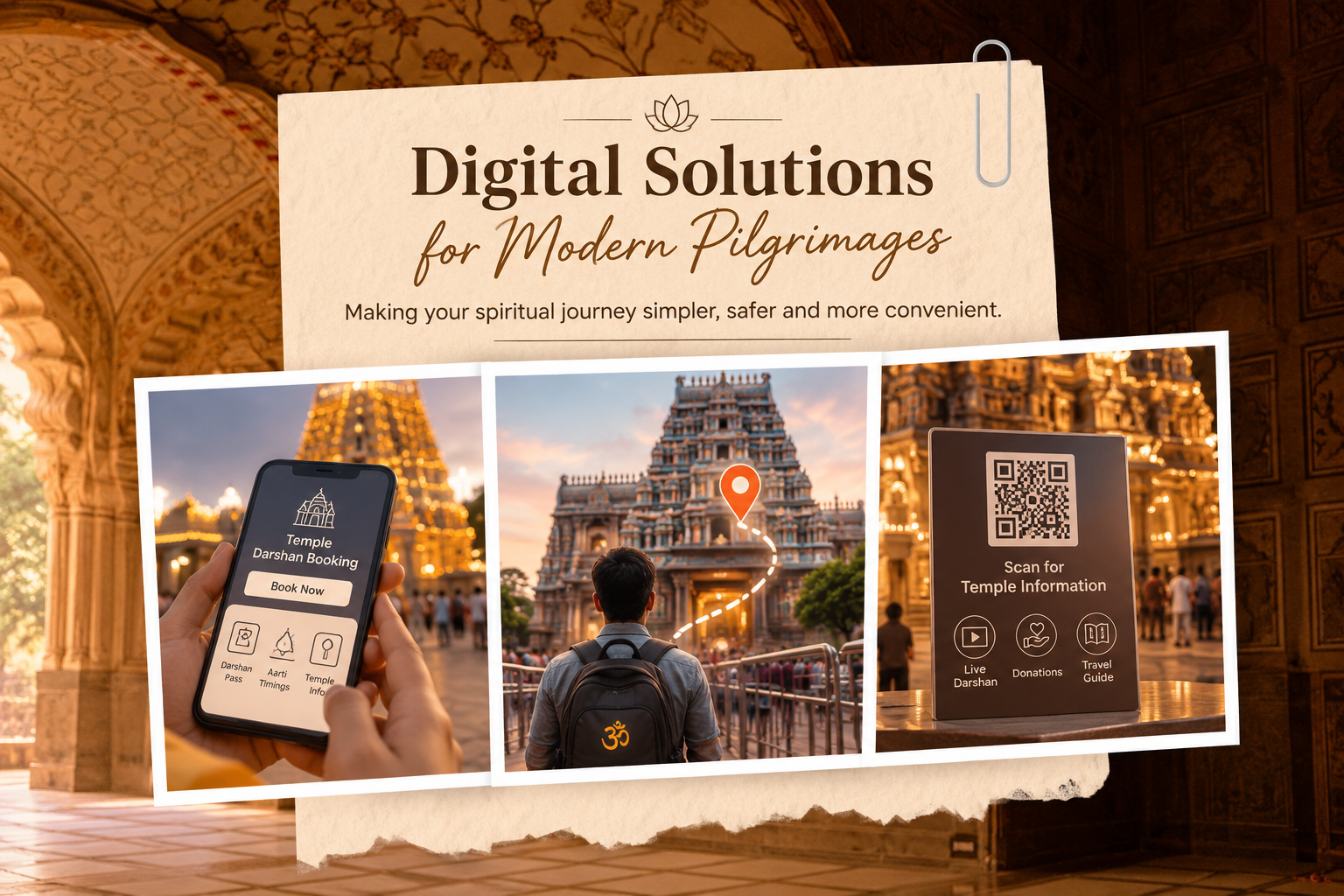
Pilgrimage travel in India is changing rapidly. The spiritual purpose of visiting sacred temples remains timeless, but the way devotees plan and experience these journeys is becoming increasingly digital. From booking hotels and checking temple timings to navigating unfamiliar cities and managing transportation, technology now plays an important role in helping pilgrims organize their journeys more efficiently.
For travelers visiting destinations such as Tirupati, Kedarnath, Badrinath, Vaishno Devi, Somnath, Dwarkadhish Temple, Kashi Vishwanath, Mahakaleshwar, Jagannath Puri, Rameswaram, Ayodhya, and other sacred centers, digital tools can reduce uncertainty and simplify decisions that once required extensive phone calls, local agents, or last-minute arrangements.
Modern pilgrimage planning is no longer limited to booking a train ticket and arriving at the destination. Devotees increasingly expect access to verified accommodation information, digital payments, online maps, travel alerts, temple schedules, local guidance, and reliable communication before they begin their journey.
Digital solutions do not replace the spiritual experience. Instead, they help remove unnecessary logistical stress so that travelers can focus more on devotion, family, rituals, and the meaning of the journey itself.
This guide explains how digital solutions are transforming modern pilgrimages and how platforms such as Mudras Stays can help devotees plan accommodation and travel more confidently.
Why Pilgrimage Travel Is Becoming More Digital
India's pilgrimage destinations attract an enormous and diverse population of travelers. Some are experienced devotees who visit the same temple every year, while others may be travelling to an unfamiliar region for the first time.
Digital tools are particularly valuable because they make important travel information available before arrival.
Travelers can now research:
- Temple locations.
- Hotel availability.
- Approximate travel routes.
- Weather conditions.
- Transportation options.
- Nearby attractions.
- Local dining areas.
- Destination information.
Having these details in advance reduces uncertainty and allows travelers to make more informed choices.
Online Hotel Booking Has Simplified Temple Travel
Accommodation used to be one of the most uncertain parts of pilgrimage travel. Many devotees would reach a temple town and search locally for a room, sometimes during busy periods when good accommodation was already unavailable.
Online booking has changed this process significantly.
Today, travelers can compare:
- Hotel location.
- Room categories.
- Facilities.
- Prices.
- Policies.
- Availability.
- Guest information.
This makes it possible to confirm accommodation before leaving home and reduces the risk of arriving without a suitable place to stay.
Temple-Focused Booking Platforms Make Search More Relevant
General hotel booking websites often display a large number of properties across an entire city. While this creates variety, it can also make the search more complicated for pilgrims who primarily care about temple access and practical convenience.
A temple-focused platform such as Mudras Stays can make the search more relevant by concentrating on accommodation around spiritual destinations.
Instead of evaluating hundreds of unrelated listings, travelers can focus on properties that better match pilgrimage requirements such as:
- Practical proximity to the temple.
- Family-friendly accommodation.
- Options for senior citizens.
- Budget and premium categories.
- Nearby transportation.
- Destination-focused information.
Digital Maps Make Navigation Easier
Temple towns can be difficult to navigate, especially for first-time visitors. Narrow roads, pedestrian zones, one-way streets, busy markets, and restricted vehicle access may make a hotel or temple harder to reach than expected.
Digital maps help travelers:
- Understand the general route.
- Estimate travel time.
- Find nearby restaurants.
- Locate medical facilities.
- Identify railway stations or bus stands.
- Plan local sightseeing.
However, travelers should remember that map distance is not always equal to practical travel convenience. Local road restrictions and walking routes should still be checked before booking accommodation.
Online Temple Information Helps Build Better Itineraries
Many devotees now research temple schedules before reaching the destination.
Digital access to information can help travelers understand:
- Temple opening and closing hours.
- Darshan schedules.
- Aarti timings.
- Special rituals.
- Festival dates.
- Dress requirements.
- Visitor guidelines.
Knowing this information beforehand helps families build realistic daily schedules and avoid unnecessary waiting.
Digital Payments Reduce the Need to Carry Large Amounts of Cash
Digital payments have become an important convenience for travelers across India.
Pilgrims can often use digital payment methods for:
- Hotel bookings.
- Restaurants.
- Local transportation.
- Shopping.
- Travel reservations.
This reduces the need to carry large amounts of cash throughout the journey.
However, travelers should still keep a small amount of cash because some local vendors, remote areas, or temporary stalls may not accept digital payments.
Digital Tickets Reduce Travel Uncertainty
Flights, trains, and buses can now be booked and stored digitally, making trip organization significantly easier.
Travelers should keep:
- Ticket confirmations.
- Booking references.
- Hotel confirmations.
- Government identification.
- Important travel details.
Keep screenshots or offline copies of important confirmations in case mobile connectivity becomes weak.
Online Weather Information Improves Safety
Weather is particularly important for pilgrimage destinations located in mountainous, coastal, or monsoon-prone regions.
Checking weather information before departure can help travelers prepare for:
- Rainfall.
- Cold temperatures.
- Heat.
- Snowfall.
- Changing road conditions.
Weather forecasts should be checked again during the journey, particularly before long road trips or visits to high-altitude temples.
Digital Travel Alerts Can Prevent Unnecessary Delays
Pilgrimage routes can occasionally be affected by heavy crowds, weather, road closures, festivals, or administrative restrictions.
Checking reliable travel updates can help devotees adjust their plans before problems arise.
Travelers should pay attention to:
- Transport notifications.
- Weather advisories.
- Road condition updates.
- Temple announcements.
- Local administration guidance.
Technology Makes Family Pilgrimage Planning Easier
Family temple travel usually involves coordinating multiple people, rooms, transport schedules, and individual requirements.
Digital planning can simplify:
- Shared itineraries.
- Hotel confirmations.
- Travel tickets.
- Family communication.
- Emergency contact sharing.
- Location sharing where appropriate.
When everyone has access to the same basic itinerary, confusion during the journey is reduced.
Senior Citizens Can Benefit from Better Pre-Travel Information
Technology is especially useful when families are travelling with elderly parents because many accessibility concerns can be investigated before arrival.
Families can research:
- Hotel lift availability.
- Approximate walking distance.
- Vehicle access.
- Nearby medical facilities.
- Local transportation.
- Room categories.
Confirming these practical details in advance helps avoid accommodation that may be inconvenient for senior travelers.
Online Reviews Help Travelers Compare Experiences
Guest reviews can provide useful context about a property or destination.
Temple travelers should look for reviews that mention:
- Actual location.
- Cleanliness.
- Staff behaviour.
- Family suitability.
- Noise levels.
- Temple access.
- Food availability.
Reading several recent reviews is generally more useful than relying on a single comment.
Digital Destination Guides Improve Local Planning
Modern pilgrimage travelers often want to experience more than the main temple. They may also be interested in nearby ghats, spiritual sites, heritage attractions, markets, local food, and cultural experiences.
Digital destination content helps travelers identify:
- Nearby temples.
- Local attractions.
- Markets.
- Food areas.
- Spiritual landmarks.
- Short sightseeing routes.
This allows families to create better itineraries without relying completely on last-minute local recommendations.
Technology Can Help Prevent Overplanning
One of the advantages of digital planning is the ability to estimate distances and travel times before departure.
This helps travelers avoid unrealistic schedules such as trying to cover several distant temples within a single day.
A better itinerary should include time for:
- Darshan.
- Meals.
- Transportation.
- Rest.
- Unexpected queues.
- Family needs.
Digital Tools Help Travelers Compare Total Travel Cost
A hotel with a low room rate may not always be the most economical option if it is located far from the temple.
Online research allows travelers to compare:
- Room price.
- Transport costs.
- Distance.
- Meal availability.
- Parking requirements.
- Additional travel time.
This helps pilgrims choose accommodation based on overall value rather than room price alone.
Online Booking Makes Festival Planning Easier
Major temple festivals create significant pressure on accommodation and transportation.
Digital booking allows travelers to secure rooms before demand peaks rather than arriving and searching locally.
For major festival travel, booking early can provide:
- More hotel choices.
- Better location options.
- Suitable room categories.
- Greater confidence before departure.
Digital Communication Improves Hotel Coordination
Before arriving, travelers may need to confirm practical details with the hotel.
These can include:
- Check-in time.
- Vehicle access.
- Parking.
- Room configuration.
- Meal availability.
- Special requirements.
Clear communication reduces misunderstandings and helps the property prepare for the guest's arrival.
Digital Planning Helps Travelers Find More Affordable Options
Online comparison allows pilgrims to review multiple accommodation categories before booking.
Depending on the destination, travelers may compare:
- Budget hotels.
- Guest houses.
- Homestays.
- Boutique hotels.
- Premium hotels.
- Resorts.
The best option is not necessarily the cheapest one. A slightly more expensive property close to the temple may provide better overall value by reducing daily transportation.
Technology Can Improve Safety During Pilgrimages
Digital tools can support safer travel when used sensibly.
They can help travelers:
- Share travel plans with family.
- Store emergency information.
- Find nearby medical facilities.
- Navigate unfamiliar areas.
- Keep booking details accessible.
- Check weather and transport updates.
Technology should support normal safety practices rather than replace personal awareness.
Offline Backups Are Still Important
Mobile connectivity may be unreliable in some remote or mountainous pilgrimage destinations.
Before departure, save offline copies of:
- Hotel address.
- Booking confirmation.
- Travel tickets.
- Emergency contacts.
- Basic route information.
- Medical details if required.
Keeping important information available without internet access prevents unnecessary stress.
Keep Your Phone Charged Throughout the Journey
A smartphone may be used for navigation, payments, tickets, communication, and hotel details.
Carry:
- A compatible charger.
- A charged power bank.
- Required charging cables.
Charge devices before leaving the hotel for long temple visits or road journeys.
Technology Should Reduce Stress, Not Create More of It
While digital tools are useful, constantly checking phones, reviews, maps, and notifications can become distracting during a spiritual journey.
Use technology mainly for:
- Practical planning.
- Communication.
- Safety.
- Bookings.
- Navigation.
Once the essential logistics are organized, allow yourself time away from screens so you can experience the temple and destination more fully.
How Mudras Stays Fits into the Digital Pilgrimage Experience
One of the main challenges of digital travel planning is information overload. General hotel platforms may show hundreds of properties, requiring pilgrims to conduct additional research to understand which hotels are actually suitable for temple travel.
Mudras Stays addresses this by focusing on spiritual and temple destinations. Its purpose is to make accommodation search more relevant to pilgrimage travelers.
Depending on the destination, travelers can explore:
- Hotels near important temples.
- Budget accommodation.
- Family-friendly stays.
- Options for senior travelers.
- Premium accommodation.
- Destination-focused travel information.
This specialized approach helps combine the convenience of digital booking with the practical realities of temple travel.
Digital Planning Can Support Multi-Temple Journeys
Travelers planning circuits such as Char Dham, Jyotirlinga routes, Shakti Peetha visits, or regional temple tours have more complex accommodation requirements.
Digital planning helps organize:
- Destination order.
- Hotel bookings.
- Travel times.
- Transport connections.
- Daily schedules.
- Rest periods.
This reduces the risk of booking impractical routes or trying to cover too much in too little time.
Better Information Creates Better Temple Travel Decisions
The greatest benefit of digital pilgrimage planning is not simply convenience. It is the ability to make better decisions before travelling.
Travelers can understand the destination, compare accommodation, estimate travel time, prepare for weather, and plan around the needs of their family rather than discovering important details only after arrival.
When technology is used thoughtfully, pilgrimage travel becomes more predictable, organized, and comfortable while preserving the spiritual purpose of the journey.
Frequently Asked Questions
How is technology changing pilgrimage travel?
Technology allows devotees to research temples, book accommodation and transportation, access maps, check weather, compare hotels, use digital payments, and organize important travel information before beginning their journey.
Why is online hotel booking useful for temple travelers?
Online booking allows pilgrims to compare location, facilities, availability, pricing, and accommodation categories before travelling instead of searching for rooms after reaching the destination.
How does Mudras Stays help with digital pilgrimage planning?
Mudras Stays focuses on accommodation around spiritual destinations, helping travelers search for stays based on pilgrimage-specific needs such as temple access, family suitability, budget, and convenience.
Can digital tools make pilgrimages safer?
Yes. Travelers can use digital tools for navigation, emergency information, weather updates, booking storage, family communication, and locating nearby facilities, while still following normal travel safety precautions.
Are online maps always accurate for temple travel?
Maps are useful for general planning, but they may not fully reflect pedestrian routes, local vehicle restrictions, crowded lanes, or seasonal access conditions. Practical local information should also be checked.
How can senior citizens benefit from digital travel planning?
Families can research hotel accessibility, walking distance, vehicle access, room facilities, nearby medical support, and transportation before travelling with elderly parents.
What digital information should I save offline?
Save your hotel address, booking confirmation, travel tickets, important phone numbers, basic route information, identification copies, and any essential medical details that may be needed without internet access.
Should I use digital payments exclusively during pilgrimage travel?
Digital payments are convenient, but travelers should still carry a reasonable amount of cash because some small vendors, remote locations, or local transport providers may not accept electronic payments.
How does technology help during temple festivals?
Digital tools make it easier to book hotels early, review travel schedules, monitor weather and transport updates, store reservations, and organize family itineraries during high-demand festival periods.
Can technology replace local knowledge during a pilgrimage?
No. Digital tools are valuable for planning and convenience, but local conditions, temple procedures, and access arrangements can change. Travelers should combine online information with official or reliable on-ground guidance when necessary.