
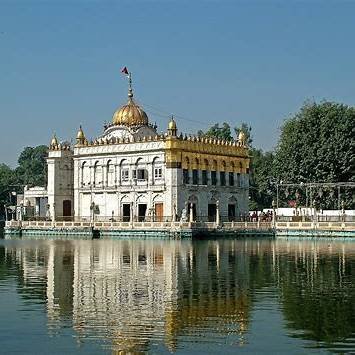
Durgiana Temple is one of the most important Hindu pilgrimage destinations in Amritsar and one of Punjab’s most recognisable sacred landmarks. Situated outside Hathi Gate in the Goal Bagh area, close to Amritsar Junction railway station, the temple rises from the middle of a large sacred sarovar and is reached through a ceremonial bridge.
The golden upper walls, gilded dome, white marble surfaces, engraved silver doors and reflection of the shrine in the surrounding water create one of the most memorable temple views in Amritsar.
The destination is known by several names, including:
Shri Durgiana Mandir
Durgiana Temple
Shri Durgiana Tirath
Lakshmi Narayan Temple
Laxmi Narain Mandir
Durga Tirath
Durgiana Silver Temple
Sitla Mandir or Sheetla Mata Temple complex
These names are connected but should be understood carefully.
Durgiana Temple is the name of the complete sacred complex and of the principal water-surrounded temple.
Lakshmi Narayan Temple refers to the central divine pair worshipped within the main sanctum.
The name Durgiana reflects the site’s association with Maa Durga and the older Devi worship connected with the sacred tank.
Sheetla Mata Mandir and Bada Hanuman Mandir are important shrines within the wider Durgiana pilgrimage landscape, but they possess their own traditions and worship practices.
Travellers booking a taxi, auto-rickshaw or hotel transfer should specify:
**Shri Durgiana Mandir, outside Hathi Gate, Goal Bagh, Amritsar.**
This prevents confusion with neighbourhood Durga temples and helps drivers use the correct entrance, parking zone and approach road.
Durgiana Temple is situated within central Amritsar and does not require a trek. Its proximity to the railway station, city hotels, markets and major attractions makes it suitable for families, senior citizens, children, solo pilgrims and cultural travellers.
The principal shrine is reached by walking across a bridge over the sarovar. Visitors should still expect marble flooring, thresholds, queues, busy corridors and possible restrictions during festival periods.
The complete Durgiana experience extends beyond one quick visit to the central sanctum.
A meaningful pilgrimage may include:
Darshan of Shri Lakshmi Narayan
Prayer before Ram Darbar
Darshan of Radha–Krishna and Giriraj Ji
Respectful viewing of the engraved silver doors
Parikrama around the sarovar
Visit to Shri Sheetla Mata Mandir
Visit to Bada Hanuman Mandir
Participation in aarti or sankirtan
Langar or community food service where available
A visit to the museum or cultural facilities when open
The temple’s setting is often compared with Sri Harmandir Sahib because both sacred complexes use a central water body, a bridge and a shining shrine rising within the sarovar.
However, Durgiana Temple and Sri Harmandir Sahib are separate religious institutions with different traditions, sanctums and codes of worship.
Durgiana is a Hindu temple centred on Lakshmi–Narayan, Durga, Rama, Krishna, Hanuman, Sheetla Mata and related Hindu sacred traditions.
Sri Harmandir Sahib is the central Sikh pilgrimage shrine and is governed by Sikh maryada.
Visitors should appreciate the architectural relationship without describing one sacred place as a copy, substitute or lesser version of the other.
Each should be approached with its own religious dignity.
Travellers searching for hotels near Durgiana Temple, homestays near Hathi Gate, pilgrimage accommodation near Amritsar Junction, family hotels near Durgiana Sarovar or places to stay near Hindu temples in Amritsar can use MudrasStays to plan a convenient and spiritually focused journey.
## Spiritual Importance of Durgiana Temple
Durgiana Temple brings several major Hindu devotional traditions together within one sacred complex.
The principal sanctum is associated with Shri Lakshmi Narayan.
Lakshmi represents prosperity, nourishment, auspiciousness and wellbeing.
Narayan, a form of Lord Vishnu, represents preservation, balance and the protection of dharma.
Together, Lakshmi and Narayan represent prosperity guided by wisdom and responsibility.
The temple’s name, however, is associated with Maa Durga.
Durga represents courage, protection and the disciplined divine power that confronts injustice.
Ram Darbar brings the traditions of Lord Rama, Mata Sita, Lakshmana and Hanuman into the central temple.
Radha–Krishna represents devotion, divine love, music and the soul’s longing for the sacred.
Giriraj Ji recalls Krishna’s lifting of Govardhan and the protection of communities and nature.
Sheetla Mata represents protection from disease within inherited folk and Goddess traditions.
Bada Hanuman represents strength, humility and service.
This combination makes Durgiana Temple especially suitable for family pilgrimage.
Different members of one family may feel connected with different divine forms while worshipping within one shared sacred environment.
The temple also demonstrates an important feature of Hindu sacred geography: one pilgrimage complex may contain several theological traditions without requiring them to compete.
A devotee can approach Lakshmi Narayan for balanced prosperity.
Another may pray to Maa Durga for courage.
Another may connect with Lord Rama through dharma and responsibility.
A child may be inspired by Hanuman’s strength and loyalty.
A Krishna devotee may participate in bhajan and Janmashtami worship.
The sacred tank unites these experiences within one landscape of water, reflection and ritual movement.
## Shri Lakshmi Narayan
The central sanctum contains the standing forms of Shri Lakshmi Narayan.
Lord Vishnu is worshipped as Narayan, the sustaining power of the universe.
He protects cosmic order and appears through different avatars whenever dharma requires restoration.
Goddess Lakshmi represents prosperity, abundance, nourishment and auspiciousness.
Her presence beside Narayan teaches that prosperity must remain connected with moral balance.
Financial success without honesty can produce fear and conflict.
Power without responsibility can become destructive.
Resources used generously and wisely support families, communities, education and service.
Devotees may pray for financial stability, family wellbeing and success.
Such prayers belong to personal faith.
Lakshmi Narayan worship should not be presented as a guarantee of wealth or business profit.
The deeper spiritual teaching is that prosperity should be earned responsibly, shared fairly and used in accordance with dharma.
## Maa Durga and the Meaning of Durgiana
The temple is named after Maa Durga, one of the principal forms of the Divine Mother.
Temple tradition associates the sacred place with warriors seeking Durga’s blessings before entering battle.
Whether understood literally or symbolically, this tradition reflects Durga’s identity as the source of courage and protection.
Durga’s best-known sacred narrative concerns Mahishasura.
According to Hindu mythology, Mahishasura obtained great power and used it to disturb the balance of the world.
The divine energies combined and manifested as Goddess Durga.
She confronted the demon and restored dharma.
The battle can also be interpreted as an inward spiritual struggle.
Mahishasura may represent arrogance, anger, greed, addiction, cruelty or the misuse of authority.
Durga represents the discipline required to confront these forces.
A pilgrim visiting Durgiana Temple can therefore pray not only for protection from external difficulty but also for the courage to correct harmful conduct within the self.
## Ram Darbar
Ram Darbar ordinarily depicts Lord Rama, Mata Sita, Lakshmana and Lord Hanuman.
The group represents the values of dharma, loyalty, courage, service and family responsibility.
Lord Rama is revered as Maryada Purushottam, one who attempts to uphold righteous conduct and social duty.
Mata Sita represents dignity, strength and endurance through hardship.
Lakshmana represents dedicated service and family loyalty.
Hanuman represents complete devotion, humility and strength used for the welfare of others.
Ram Darbar is particularly meaningful for families.
Its message should not be reduced to the expectation that one person must silently tolerate every difficulty.
Responsible family life requires communication, respect, fairness and the willingness to protect one another’s dignity.
## Radha and Krishna
The Radha–Krishna tradition represents divine love, devotion, music and spiritual longing.
Krishna is associated with wisdom, playfulness, protection and the teachings of the Bhagavad Gita.
Radha represents complete devotion and the soul’s longing for union with the Divine.
Their sacred relationship is not limited to ordinary romance.
Within Bhakti traditions, it expresses the intense love through which the individual soul seeks the divine presence.
Bhajan, kirtan, seasonal decoration and Janmashtami celebrations strengthen the Krishna tradition at Durgiana Temple.
## Giriraj Ji and Govardhan
Giriraj Ji refers to the sacred Govardhan Hill associated with Lord Krishna.
According to the Bhagavata tradition, Krishna lifted Govardhan to protect the residents of Braj from destructive rain.
The story teaches that leadership means protecting people, animals, land and local communities.
It also highlights the sacred relationship between spiritual life and nature.
Govardhan worship should encourage devotees to protect water, trees, animals and the environment rather than treating natural resources as disposable.
## The Durgiana Sarovar
The sacred tank is one of the defining elements of Durgiana Temple.
The temple committee records a large rectangular water body surrounding the principal shrine.
The bridge creates a ceremonial transition from the outer complex to the inner sanctum.
The sarovar reflects the temple’s golden and white surfaces, making water an active part of the architecture rather than a decorative background.
Water carries several meanings within Hindu pilgrimage.
It represents purification.
It represents life.
It receives reflection.
It changes with light, weather and movement.
The sarovar can also be understood as a symbol of the human mind.
When water is disturbed, the reflection becomes unclear.
When the surface becomes calm, the temple appears more clearly.
In the same way, a constantly distracted mind struggles to perceive truth, while a disciplined mind develops greater clarity.
Visitors should not assume that unrestricted bathing is permitted simply because steps or water access are visible.
Bathing rules, water quality, maintenance and festival arrangements can change.
Children and non-swimmers must remain supervised.
Soap, shampoo, detergent, plastic, flowers wrapped in synthetic material, food and ritual packaging must not be thrown into the sarovar.
Protecting the water is one of the most direct ways to honour the temple.
## Historical Development
The sacred landscape predates the present early-20th-century temple.
Historical references maintained by the temple committee point to an earlier Durgiana Sarovar and Devi Dwara visited by pilgrims before the current structure was built.
The present temple emerged through a major reconstruction movement in the early decades of the twentieth century.
Gurshai Mal Kapoor is remembered as the visionary behind the present design.
Pandit Madan Mohan Malaviya, the prominent educationist, reformer and founder associated with Banaras Hindu University, laid the foundation stone in 1924.
Some accounts refer to reconstruction activity beginning around 1921, while official descriptions place the temple’s principal foundation ceremony in 1924.
The most accurate approach is therefore to describe the current Durgiana Temple as an early-20th-century reconstruction built upon an older sacred tank and Devi pilgrimage tradition.
It should not be claimed that every visible marble wall, gold panel, bridge or silver door survives unchanged from the sixteenth century.
Living temples undergo renovation, repair and beautification.
The antiquity of the sacred place and the date of the present architecture are related but separate questions.
## Architecture of Durgiana Temple
The principal temple stands on a raised platform within the sarovar.
A bridge connects it with the outer courtyard and Darshani Deori.
The structure combines:
A gilded central dome
Smaller domed canopies
Golden upper wall panels
White marble and pale stone surfaces
Decorative arches
A water-surrounded platform
A ceremonial causeway
Engraved silver doors
Interior sanctum spaces
Parikrama pathways
The golden dome and upper surfaces catch changing light throughout the day.
Morning sunlight creates a softer appearance.
Strong afternoon sun makes the gilded panels shine intensely.
Evening illumination reflects across the water and gives the temple a ceremonial atmosphere.
The architectural relationship with Amritsar’s water-centred sacred traditions is visually clear, but the iconography and worship inside Durgiana remain distinctly Hindu.
## The Silver Doors
Durgiana Temple is sometimes called the Silver Temple because of its large engraved silver doors.
The main Darshani Deori and temple entrances contain extensive silver work depicting Hindu deities and sacred motifs.
Silver reflects light and carries associations with purity, sacred transition and ritual importance.
The doors are not merely decorative panels.
They mark the threshold between the outer world and the concentrated sacred environment of the shrine.
Visitors should not scratch, rub or repeatedly touch the engraved surfaces.
Photography should be completed without blocking the entrance or delaying the queue.
Flash photography may be restricted.
Commercial filming or the use of large equipment may require permission.
## Shri Sheetla Mata Mandir
Shri Sheetla Mata Mandir is an important shrine within the wider Durgiana complex.
Temple tradition describes it as significantly older than the present main temple.
Sheetla Mata is worshipped within North Indian folk and Shakta traditions as a protective Mother Goddess associated historically with epidemic illness, fever and the wellbeing of children.
Her worship reflects how communities responded spiritually to disease before modern vaccination and healthcare systems existed.
Devotees may still pray for health and protection.
However, Sheetla Mata worship must not be promoted as a substitute for vaccination, medical diagnosis or professional treatment.
Prayer and healthcare can coexist.
The deeper spiritual lesson of Sheetla worship includes cleanliness, community responsibility and care for vulnerable children.
Visitors should follow the separate customs of the Sheetla Mata shrine and avoid assigning an exact archaeological age without verified evidence.
## Bada Hanuman Mandir
Bada Hanuman Mandir stands in the northwestern part of the Durgiana pilgrimage complex and is associated with Ramayana traditions concerning Lord Rama, Mata Sita, Luv and Kush.
Local belief connects the area with the Ashwamedha Yajna and the episode in which Luv and Kush confronted the army connected with Lord Rama’s ceremonial horse.
The Hanuman tradition here is particularly famous because of the annual Langur Mela.
Lord Hanuman represents courage, loyalty, service and strength guided by humility.
His extraordinary abilities are never used for selfish pride.
He dedicates them to Lord Rama and the protection of others.
For children, Hanuman can be introduced not merely as a physically powerful figure but as an example of discipline, learning and devoted service.
## Langur Mela
Langur Mela is one of the most distinctive festival traditions associated with Durgiana Tirath.
It takes place during Sharad Navratri and continues through the period leading to Dussehra.
Families dress children in red or brightly coloured langur-style costumes and bring them to Bada Hanuman Mandir as part of a vow or thanksgiving tradition.
The children may wear caps, tails, decorated garments and carry symbolic maces.
After completing the observance, families traditionally conclude the vow according to the established ritual sequence.
The mela creates a visually memorable atmosphere, but visitors should approach it respectfully.
Children participating in the tradition are devotees, not performers arranged for tourist photography.
Permission should be obtained before photographing them closely.
Costumes should remain comfortable and safe.
Children should receive water, rest and protection from crowd pressure.
The ritual should never involve forcing a frightened or exhausted child to continue merely for photographs or social expectations.
Festival dates and the exact conclusion ritual should be confirmed for the relevant year.
## Navratri
Both Chaitra and Sharad Navratri are major periods of Goddess worship.
Navratri means nine nights and honours the different manifestations of the Divine Mother.
The nine forms are traditionally identified as Shailaputri, Brahmacharini, Chandraghanta, Kushmanda, Skandamata, Katyayani, Kalaratri, Mahagauri and Siddhidatri.
Each form represents a spiritual quality.
Shailaputri represents stability.
Brahmacharini represents discipline.
Chandraghanta represents courage.
Kushmanda represents creative energy.
Skandamata represents nurturing care.
Katyayani represents action against injustice.
Kalaratri represents the removal of fear.
Mahagauri represents purification and renewal.
Siddhidatri represents spiritual fulfilment.
During Navratri, Durgiana Temple receives larger crowds, additional decoration and special worship.
Sharad Navratri is particularly associated with the Langur Mela at Bada Hanuman Mandir.
Visitors should expect queue barriers, security checks and parking restrictions.
Families should select a meeting point before entering crowded areas.
Senior citizens and people unable to tolerate long queues may prefer a weekday morning outside Ashtami, Navami and Dussehra.
## Dussehra
Dussehra celebrates the victory of dharma over destructive forces.
It is associated with Lord Rama’s victory over Ravana and with the conclusion of Durga’s battle against Mahishasura in different regional traditions.
At Durgiana Tirath, Dussehra forms part of the larger Navratri and Langur Mela cycle.
The festival should encourage reflection upon the defeat of ego, injustice and harmful conduct rather than being reduced only to spectacle.
## Krishna Janmashtami
Krishna Janmashtami celebrates the birth of Lord Krishna.
The Radha–Krishna shrine receives special decoration and worship.
Bhajans, kirtan, jhanki displays and late-evening rituals may be organised.
Because the principal celebration can continue late into the night, travellers should arrange transport and confirm the temple schedule beforehand.
## Ram Navami
Ram Navami celebrates the birth of Lord Rama.
Ram Darbar becomes an important focus for prayer, recitation and devotional singing.
The festival generally falls during Chaitra Navratri, linking Rama worship with the spring cycle of Goddess devotion.
## Diwali and Annakoot
Diwali celebrates light, dharma, homecoming and auspicious renewal.
The Lakshmi Narayan tradition makes the festival particularly meaningful at Durgiana Temple.
Lamps and decorative illumination can create striking reflections across the sarovar.
Fire safety rules must be followed.
Visitors should not light lamps in unauthorised locations or release waste into the water.
Annakoot or Govardhan Puja may include offerings of prepared food connected with Krishna and Giriraj Ji traditions.
Food offerings should be handled hygienically and distributed without waste.
## Sawan Traditions
The holy month of Shravan or Sawan includes worship connected with Shiva, Krishna and seasonal devotion.
Durgiana Temple also preserves a Sawan tradition involving married couples and Radha–Krishna worship.
Annual practices can vary, so visitors should confirm the current programme rather than relying upon an old description.
## Daily Darshan and Aarti
The official temple schedule includes several distinct darshan intervals.
Darshan generally begins early in the morning, with closures for offerings, decoration, rest and evening rituals.
The temple currently publishes separate summer and winter aarti schedules.
Morning Mangla Aarti takes place shortly after opening.
Shingar Aarti follows after the deities have been dressed and decorated.
Sandhya Aarti takes place in the evening.
Shayan Aarti precedes the final night closure.
Visitors should not assume that the sanctum remains continuously open throughout the day.
A person arriving during Thakur Ji’s rest period or a bhog closure may need to wait.
The official timetable should be checked on the day of travel, particularly during festivals.
## Best Time to Visit Durgiana Temple
Durgiana Temple can be visited throughout the year.
### October to March
The cooler months provide the most comfortable weather for walking around the sarovar and exploring central Amritsar.
December and January mornings can be cold and foggy.
Train and road delays are possible.
### Chaitra Navratri
March or April brings major Goddess worship, Ram Navami and increased crowds.
Morning visits are generally more comfortable.
### April to June
Amritsar can become extremely hot.
Marble surfaces and open courtyards receive strong sunlight.
Early-morning or evening darshan is preferable.
Visitors should carry drinking water and protect children and senior citizens from heat.
### July to September
The monsoon brings humidity and rainfall.
Marble flooring, bridges and sarovar-side paths may become slippery.
Janmashtami and early autumn festivals may fall during this broader period.
### Sharad Navratri and Langur Mela
September or October offers one of the most distinctive festival experiences.
It also brings the greatest crowd pressure around Bada Hanuman Mandir.
Accommodation and transport should be planned well in advance.
### Diwali
The illuminated temple and its reflection can be visually impressive.
Visitors should expect crowd controls and should follow fire-safety instructions.
## Reaching Durgiana Temple
Durgiana Temple is located outside Hathi Gate in the Goal Bagh area of central Amritsar.
It can be reached by taxi, auto-rickshaw, e-rickshaw, private vehicle and local transport.
Traffic and parking conditions vary with festivals and city congestion.
## Reaching from Amritsar Junction
Amritsar Junction railway station is very close to the temple.
Depending upon the exit, luggage and traffic, visitors can use an auto-rickshaw, e-rickshaw or taxi.
Walking may be practical for some travellers, but busy roads, weather and luggage should be considered.
Travellers arriving by train should leave large bags at their hotel or use secure storage before entering the temple.
## Reaching from the Bus Stand
The principal bus terminal is a short urban road journey away.
Autos and local taxis are generally available.
Festival diversions may increase travel time.
## Reaching from the Golden Temple Area
Durgiana Temple and Sri Harmandir Sahib are situated in different parts of central Amritsar.
A local vehicle is usually the most convenient connection.
Traffic through the old city can be slow.
Visitors should allocate sufficient time and should not rush the customs of either sacred place.
## Reaching from Amritsar Airport
Sri Guru Ram Dass Jee International Airport is the nearest airport.
The temple requires an urban road transfer.
Travel time depends heavily upon traffic and the location of the visitor’s accommodation.
A temple visit should not be scheduled immediately before a flight without a generous buffer.
## Accessibility for Senior Citizens
Durgiana Temple is significantly more accessible than mountain and cave pilgrimages.
The main complex is road-connected and contains developed paths.
The bridge to the central shrine is generally manageable for visitors who can walk short distances.
Thresholds, queues, marble flooring and crowds may still create difficulty.
Senior citizens should visit during quieter hours and carry required medication.
Wheelchair users should confirm the currently accessible entrance and assistance arrangements before departure.
Festival days can require longer walking from parking zones.
## Visiting with Children
Children can learn about Durga, Lakshmi Narayan, Rama, Krishna and Hanuman within one complex.
They must remain supervised near the sarovar, bridge, lamps and crowded queues.
Children should not climb railings, run on marble flooring or throw food into the water.
Families attending Langur Mela should prioritise the child’s comfort and safety.
## Temple Etiquette
Visitors should dress respectfully and remove footwear where instructed.
Phones should remain silent near the sanctum.
Photography of the deities, silver doors, priests and private rituals should only be undertaken when permitted.
Visitors should not block the bridge, doorway or queue while recording videos.
Offerings should be presented through authorised arrangements.
Donations should be made through recognised counters or boxes.
Alcohol, tobacco and non-vegetarian food are inappropriate within the pilgrimage environment.
## Temple Facilities and Community Services
The Durgiana institution lists a range of pilgrim and community services, including:
Langar
Yatri Niwas
Dharamshala accommodation
Sant Niwas
Community halls
Parking
Museum
Dispensary and social services
Educational institutions
Religious discourse and cultural spaces
Availability, eligibility, room charges, identification requirements and timings should be confirmed directly.
A facility listed by the institution may not remain available at every hour or during every festival.
Pilgrim accommodation should not automatically be expected to provide hotel-style privacy, room service or luxury facilities.
## Durgiana Museum
The temple institution maintains a museum connected with Hindu heritage and the history of the complex.
Museum access can enrich the pilgrimage by explaining religious traditions, cultural objects and the development of Durgiana Tirath.
Opening hours may differ from temple darshan timings.
Visitors should confirm access and should not touch exhibits or use flash where prohibited.
## Nearby Attractions
### Sri Harmandir Sahib
Sri Harmandir Sahib, popularly known as the Golden Temple, is Amritsar’s central Sikh pilgrimage shrine.
Visitors must cover their heads, remove footwear, wash their feet and follow Sikh maryada.
The langar represents equality and service.
Durgiana Temple and Sri Harmandir Sahib can be visited within one spiritual itinerary while respecting their distinct identities.
### Jallianwala Bagh
Jallianwala Bagh is a national memorial associated with the massacre of 1919.
The site should be approached with seriousness and respect.
Memorial spaces should not be used merely as casual selfie backgrounds.
### Partition Museum
The Partition Museum preserves personal accounts, documents and objects connected with the Partition of 1947.
Its stories of displacement, loss and resilience provide essential context for understanding Amritsar and Punjab.
### Ram Tirath
Ram Tirath, or Bhagwan Valmiki Tirath Sthal, is associated through Hindu tradition with Maharishi Valmiki, Mata Sita and Luv–Kush.
It lies outside central Amritsar and requires a separate road journey.
### Gobindgarh Fort
Gobindgarh Fort presents aspects of Amritsar’s military, royal and cultural history.
Tickets, performances and opening hours should be checked before visiting.
### Mata Lal Devi Temple
Mata Lal Devi Temple is another colourful Hindu pilgrimage destination in Amritsar.
Its narrow passages, mirrored surfaces and symbolic cave-style route create a very different experience from Durgiana Temple.
Visitors with mobility limitations or claustrophobia should assess the route before entering.
### Attari Border
The Attari border ceremony lies outside Amritsar and requires sufficient travel time, identification and security screening.
It should not be compressed into a schedule immediately after a long temple visit.
## Suggested Half-Day Durgiana Itinerary
Begin with early-morning darshan at Durgiana Temple.
Attend Mangla or Shingar Aarti where practical.
Cross the bridge and receive darshan of Lakshmi Narayan, Ram Darbar and Radha–Krishna.
Walk respectfully around the sarovar.
Visit Sheetla Mata Mandir and Bada Hanuman Mandir.
Explore the museum if open.
Return to the hotel or continue to another central attraction.
## Suggested One-Day Amritsar Spiritual Itinerary
Begin at Durgiana Temple during the morning.
Continue to Sri Harmandir Sahib and participate respectfully in the langar.
Visit Jallianwala Bagh and the Partition Museum during the afternoon.
End the day with a quiet heritage walk or evening prayer.
The schedule should remain flexible because queues and city traffic can be substantial.
## Suggested Two-Day Pilgrimage
On the first day, visit Durgiana Temple, the Golden Temple and central Amritsar heritage.
On the second day, visit Ram Tirath, Mata Lal Devi Temple or another spiritual destination according to family interests.
Travellers planning Attari should reserve a separate afternoon and adequate travel time.
## Accommodation Near Durgiana Temple
Durgiana Temple’s central location gives visitors access to a large range of hotels, guesthouses, homestays, dharamshalas and pilgrim accommodation.
The right location depends upon the complete itinerary.
## Temple Yatri Niwas and Dharamshalas
The Durgiana institution lists Yatri Niwas and several dharamshala facilities.
These provide convenient access for pilgrims.
Availability, booking methods, identification rules, check-in restrictions and room facilities should be confirmed directly.
Festival periods may create heavy demand.
## Hotels Near Amritsar Junction
Hotels around Amritsar Junction provide the most convenient commercial accommodation for Durgiana Temple.
They are suitable for train travellers and short stays.
Guests should compare cleanliness, noise, parking, room size and family suitability before booking.
## Hotels Near Hathi Gate and Goal Bagh
Properties in the Hathi Gate and Goal Bagh area can offer convenient temple access.
The neighbourhood is busy and traffic can be dense.
Guests should confirm whether a car can reach the property and whether parking is available.
## Hotels Near the Golden Temple
Old-city hotels are best for travellers prioritising Sri Harmandir Sahib, Jallianwala Bagh and pedestrian heritage areas.
They are not necessarily the closest option for Durgiana Temple.
Vehicle access may be restricted in narrow lanes.
## Hotels in Ranjit Avenue
Ranjit Avenue offers modern hotels, restaurants, wider roads and easier parking.
It is suitable for families and travellers seeking more spacious accommodation.
A taxi or auto-rickshaw is required for Durgiana Temple.
## Homestays in Amritsar
Verified homestays can provide Punjabi meals, local guidance and a quieter residential experience.
Guests should confirm attached bathrooms, air-conditioning, heating, parking and transport.
## Choosing the Right Stay
Pilgrims focused mainly on Durgiana Temple should choose accommodation near Amritsar Junction, Hathi Gate or Goal Bagh.
Travellers combining several old-city attractions may prefer a central location balancing the Golden Temple and railway station.
Families should verify room size, breakfast and parking.
Senior citizens should prioritise lifts, ground-floor rooms and reliable transport.
Couples may prefer quieter hotels outside congested lanes.
Solo pilgrims should choose populated, well-reviewed accommodation.
Groups should confirm multiple rooms, early meals and bus parking.
Navratri, Diwali and Langur Mela visitors should book early.
## Book Hotels Near Durgiana Temple with MudrasStays
MudrasStays helps pilgrims, families and cultural travellers discover hotels, homestays, guesthouses and pilgrimage accommodation near Durgiana Temple and throughout Amritsar.
The platform is designed specifically for travellers searching for places to stay near temples, sacred tanks and pilgrimage destinations.
Visitors can compare accommodation according to practical road distance from Durgiana Temple, room category, budget, family size and required facilities.
Booking near Amritsar Junction or Goal Bagh can make early-morning darshan easier.
Families can select hotels offering comfortable rooms, meals and parking.
Senior citizens can prioritise accessible properties with lifts and dependable taxis.
Solo pilgrims can search for economical guesthouses in well-connected areas.
Couples can explore quieter homestays or comfortable city hotels.
Pilgrimage groups can identify accommodation providing multiple rooms, vegetarian meals and vehicle parking.
Visitors attending Navratri, Langur Mela, Janmashtami or Diwali can reserve rooms early and avoid uncertain last-minute availability.
Travellers combining Durgiana Temple with Sri Harmandir Sahib, Ram Tirath, Jallianwala Bagh, the Partition Museum, Gobindgarh Fort and Attari can select accommodation according to the actual sequence of the journey.
MudrasStays helps pilgrims avoid booking a property that appears nearby on a map but lies across congested old-city roads or restricted lanes.
## Responsible Pilgrimage
Durgiana Temple is an active place of worship and an important part of Amritsar’s spiritual heritage.
Visitors should dress respectfully and follow the designated queue.
The deities, priests, silver doors and private rituals should only be photographed when permission is clear.
The sarovar must not be polluted.
Children should remain supervised near water and lamps.
Offerings should be made through authorised arrangements.
Food and prasad should not be wasted.
Plastic must be placed in designated bins.
## Respecting Separate Sacred Traditions
Visitors often combine Durgiana Temple and Sri Harmandir Sahib.
The architectural comparison should never become a reason for competition or disrespect.
At Durgiana Temple, visitors follow Hindu temple customs.
At Sri Harmandir Sahib, visitors follow Sikh maryada.
Respectful travel recognises both the similarities of Amritsar’s sacred landscape and the distinct identity of each tradition.
## A Sacred Meeting of Durga, Lakshmi Narayan and the Sarovar
Durgiana Temple represents a powerful meeting of Maa Durga, Lakshmi Narayan worship, Ramayana traditions, Krishna devotion, sacred water and Amritsar’s shared architectural heritage.
Maa Durga represents courage.
Lakshmi represents responsible prosperity.
Narayan represents preservation and balance.
Ram Darbar represents dharma and family responsibility.
Radha–Krishna represents devotion and divine love.
Giriraj Ji represents protection of community and nature.
Hanuman represents strength guided by humility.
Sheetla Mata represents care for health and children within inherited Goddess traditions.
The silver doors represent sacred transition.
The gilded dome represents divine light.
The sarovar represents reflection and purification.
The bridge represents the movement from ordinary distraction towards concentrated worship.
The Langur Mela connects family vows, children and Hanuman devotion.
The temple’s community services transform prayer into food, shelter, education and care.
For Hindu pilgrims, Durgiana is one of Amritsar’s principal sacred destinations.
For families, it brings several devotional traditions together within one accessible complex.
For senior citizens, its central location makes pilgrimage manageable when crowds are avoided.
For children, the sarovar, bridge and multiple shrines create an educational spiritual experience.
For cultural travellers, the temple reveals the relationship between Hindu architecture and Amritsar’s wider water-centred sacred landscape.
For photographers, the golden shrine and its reflection provide memorable images when worship and privacy rules are respected.
For spiritual seekers, the sarovar communicates a simple teaching: inner clarity emerges when the mind becomes calm enough to receive a true reflection.
Durgiana Temple should not be treated merely as a quick alternative after visiting the Golden Temple.
Its complete identity deserves time.
Cross the bridge without rushing.
Receive darshan of Lakshmi Narayan.
Pay respect to Maa Durga.
Observe Ram Darbar and Radha–Krishna.
Visit Sheetla Mata and Bada Hanuman Mandir.
Learn about the Langur Mela without turning children into tourist spectacles.
Protect the sarovar.
Participate in langar without wasting food.
Respect the temple’s separate Hindu identity while honouring Amritsar’s diverse spiritual culture.
Plan your pilgrimage to Durgiana Temple with MudrasStays and experience one of Punjab’s most important Hindu sacred complexes.
Seek the blessings of Maa Durga and Shri Lakshmi Narayan, admire the engraved silver doors and experience the peaceful reflection of the gilded shrine in the Durgiana Sarovar.
Combine your journey with Sri Harmandir Sahib, Ram Tirath, Jallianwala Bagh, the Partition Museum, Gobindgarh Fort, Mata Lal Devi Temple and the wider spiritual heritage of Amritsar.
Book hotels near Durgiana Temple, discover homestays near Hathi Gate and explore suitable pilgrimage accommodation throughout Amritsar through MudrasStays.
Stay closer to the shrine, attend peaceful morning darshan and reduce unnecessary travel through crowded city roads.
MudrasStays connects pilgrims, families and cultural travellers with suitable accommodation near temples, sacred water bodies and pilgrimage destinations across India.
Begin your Durgiana Temple journey with a comfortable stay and experience a meaningful pilgrimage centred on Maa Durga, Lakshmi Narayan, the silver doors, the sacred sarovar and the living spiritual heritage of Amritsar.