
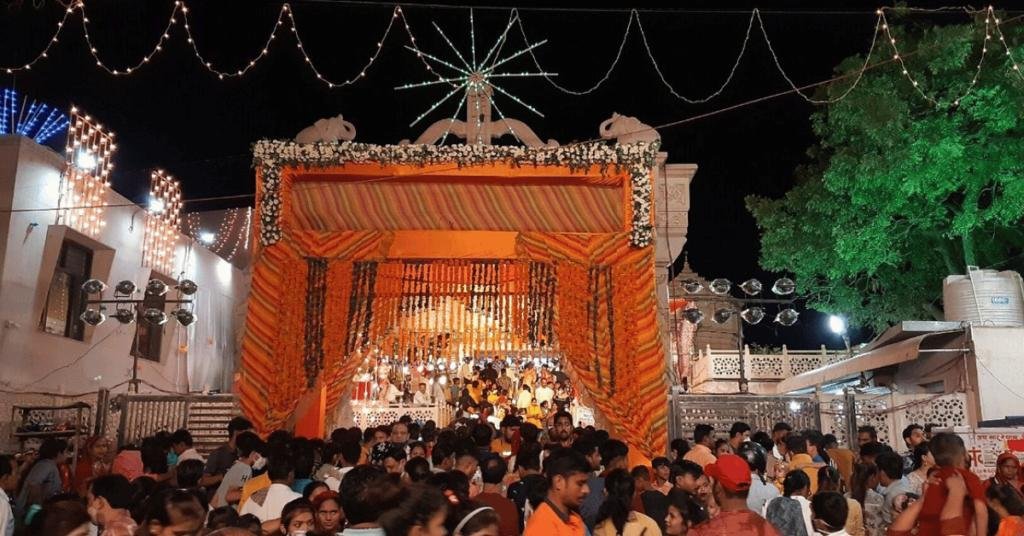
Khatu Shyam Ji Aarti: Worship of Baba Shyam in Rajasthan
Khatu Shyam Ji Aarti is performed five times each day at Shri Shyam Mandir in Khatu, a major pilgrimage town in Rajasthan’s Sikar district. The ceremonies accompany different stages of the deity’s daily worship, beginning with Mangala Aarti at dawn and concluding with Shayan Aarti before the temple closes.
Khatu Shyam Ji is worshipped as Baba Shyam and is traditionally identified with Barbarika, the heroic son of Ghatotkacha and grandson of Bhima. According to Hindu tradition, Lord Krishna blessed Barbarika to be worshipped under Krishna’s own name, Shyam, during Kaliyuga.
The five daily ceremonies are Mangala Aarti, Shringar Aarti, Bhog Aarti, Sandhya Aarti and Shayan Aarti. Each Aarti has a different devotional purpose, and the timings change between summer and winter.
The Shri Shyam Mandir Committee publishes a standard seasonal Aarti schedule. However, temporary closures, special Tilak and Shringar rituals, Ekadashi arrangements, festivals, crowd-control measures and seasonal transitions can change the practical timing. Visitors should therefore check the latest official notice before beginning their journey.
Who Is Khatu Shyam Ji?
Khatu Shyam Ji is traditionally associated with Barbarika, a warrior from the Mahabharata tradition. Barbarika is described as the son of Ghatotkacha and the grandson of Bhima.
According to the sacred account, Barbarika possessed extraordinary power and had promised to support whichever side appeared weaker during the Kurukshetra war. Because his intervention could repeatedly change the balance of the battle, Lord Krishna tested his wisdom, courage and commitment.
Krishna eventually requested Barbarika’s head as an offering. Barbarika accepted the request and made the sacrifice voluntarily. Pleased by his courage and devotion, Krishna granted him the blessing that he would be worshipped under the name Shyam in Kaliyuga.
Devotees commonly call Baba Shyam “Haare Ka Sahara”, meaning the support of those who feel defeated, helpless or without another source of strength. The title expresses faith in divine companionship during hardship. It should not be interpreted as a guarantee that every material request will be fulfilled exactly as demanded.
History of Khatu Shyam Ji Temple
Rajasthan Tourism records the traditional account that Barbarika’s sacred head remained concealed in the village of Khatu. A cow is said to have begun releasing milk naturally over the place where it was buried, attracting the attention of local residents.
When the location was excavated, the sacred object associated with Baba Shyam was discovered. Roopsingh Chauhan, the ruler of Khatu, is said to have received instructions through a dream to construct a temple and install the deity there.
This narrative forms part of the temple’s sacred history. The supernatural elements should be understood as matters of religious tradition rather than claims demonstrated through modern archaeology.
The present temple is recognised for its white-marble construction. Rajasthan Tourism describes a prayer hall called the Jagmohan, painted religious scenes, ornamental marble brackets and silver-covered shutters at the sanctum.
The temple’s daily worship, festivals and pilgrim arrangements are managed by the registered Shri Shyam Mandir Committee. The committee also publishes official notices, daily Shringar Darshan photographs and information relating to donations and major events.
Spiritual Significance of Khatu Shyam Ji Aarti
- Remembering sacrifice: Barbarika’s Sheesh Daan represents courage, selflessness and fulfilment of one’s word.
- Seeking strength during defeat: Baba Shyam is especially remembered by devotees facing uncertainty, disappointment or emotional hardship.
- Surrendering pride: The Aarti encourages worshippers to recognise that ability and success should be accompanied by humility.
- Offering gratitude: The flame is offered in thanks for life, family, food, health and opportunities.
- Developing faith: Daily worship helps devotees sustain hope without abandoning personal responsibility.
- Purifying intention: Prayer provides an opportunity to examine whether one’s desires are fair, compassionate and responsible.
- Experiencing community: Pilgrims from different regions participate together through chanting and shared devotion.
- Accepting changing circumstances: The five daily Aartis remind devotees that every stage of the day has its own purpose.
Aarti can support devotion, reflection and emotional calm. It cannot guarantee medical recovery, employment, examination results, financial profit, marriage or success in a legal dispute.
The Five Daily Aartis at Khatu Shyam Ji Temple
Mangala Aarti
Mangala Aarti is the first ceremony of the day and is performed when the temple opens in the early morning. It marks the beginning of Baba Shyam’s daily worship.
The atmosphere is associated with freshness, discipline and a spiritually focused start to the day. Devotees wishing to attend should reach Khatu the previous night or arrange reliable early-morning transport.
Shringar Aarti
Shringar Aarti follows the ceremonial decoration of Baba Shyam. Flowers, ornaments, garments and other approved materials are used to prepare the deity’s appearance for Darshan.
This is one of the most visually distinctive Aartis and is suitable for first-time visitors who want to understand the importance of Seva and sacred decoration. The official committee regularly publishes photographs of the day’s Shringar Darshan.
Bhog Aarti
Bhog Aarti is performed around midday when food is ceremonially offered to Baba Shyam. The offering expresses gratitude for nourishment and recognises food as a divine gift rather than something to be wasted.
Because this Aarti takes place close to the end of the morning Darshan period, visitors should not arrive at the published time itself. Queueing and security procedures can make late entry impossible.
Sandhya Aarti
Sandhya Aarti is performed in the evening around sunset. It marks the transition from the activities of the day towards rest, prayer and reflection.
The evening atmosphere, collective chanting and illuminated lamp make Sandhya Aarti a popular choice. It can consequently attract a larger congregation, particularly on weekends, Ekadashi and festival days.
Shayan Aarti
Shayan Aarti is the final ceremony before the temple closes for the night. It symbolically concludes Baba Shyam’s daily worship and prepares the deity for rest.
This Aarti can offer a quieter and more contemplative ending to the pilgrimage. Visitors should confirm the availability of return transport, especially when travelling onwards to Ringas, Sikar or Jaipur.
Khatu Shyam Ji Aarti Timings
| Aarti | Winter Timing | Summer Timing | Purpose |
|---|---|---|---|
| Mangala Aarti | 5:30 AM | 4:30 AM | Opening and first worship of the day |
| Shringar Aarti | 8:00 AM | 7:00 AM | Aarti following the deity’s sacred decoration |
| Bhog Aarti | 12:30 PM | 12:30 PM | Offering of food to Baba Shyam |
| Sandhya Aarti | 6:30 PM | 7:30 PM | Evening worship around sunset |
| Shayan Aarti | 9:00 PM | 10:00 PM | Final worship before the temple closes |
Important timing note: These are the standard seasonal timings displayed by the Shri Shyam Mandir Committee. Timings can be revised at the transition between seasons or because of special worship, Tilak, Shringar, Ekadashi, festivals, eclipses, maintenance or administrative directions.
Khatu Shyam Ji Temple Opening Timings
| Season | Morning Darshan | Evening Darshan |
|---|---|---|
| Winter | 5:30 AM to 1:00 PM | 5:00 PM to 9:00 PM |
| Summer | 4:30 AM to 12:30 PM | 4:00 PM to 10:00 PM |
The opening hours published by Rajasthan Tourism are general seasonal hours. The temple can remain closed temporarily for special rituals or operational requirements. Reaching the town does not guarantee immediate entry when a closure notice is in effect.
Which Khatu Shyam Ji Aarti Should You Attend?
Choose Mangala Aarti if you prefer an early and spiritually disciplined beginning. Arrange accommodation close to the temple because public transport may be limited before dawn.
Choose Shringar Aarti if seeing Baba Shyam’s floral and ornamental decoration is central to your visit. This is a suitable choice for families and first-time pilgrims, provided they reach well before the scheduled ceremony.
Choose Bhog Aarti if you are undertaking a daytime journey and cannot attend at dawn or after sunset. Remember that the morning Darshan period ends shortly afterwards.
Choose Sandhya Aarti if you want the collective atmosphere of evening worship. Allow additional time for queues and evening traffic.
Choose Shayan Aarti if you prefer to end the day with prayer. Confirm late-evening transport and avoid becoming dependent upon unverified private operators.
A weekday that is not an Ekadashi or major festival generally offers a more manageable experience. Devotees with elderly family members, small children or limited mobility should prioritise a less crowded day over a specific Aarti.
How Khatu Shyam Ji Aarti Is Performed
Arrival Through the Darshan Queue
Visitors enter through the route authorised for that day. Barricades and queue directions can change according to crowd levels, so older videos should not be treated as reliable maps of the current entry system.
Devotees should keep moving when directed and should not attempt to change queues, cross barriers or obtain unauthorised entry through an agent.
Preparation of the Deity
The form of preparation depends upon the Aarti. Shringar Aarti follows the decoration of Baba Shyam, while Bhog Aarti includes the ceremonial offering of food.
Visitors should not attempt to throw flowers, cloth or other objects towards the sanctum. All offerings should be presented only through the system approved by temple representatives.
Invocation and Lamp Lighting
The priests begin the worship with approved ritual preparations, mantras and the lighting of the Aarti flame. Bells or other traditional sounds may accompany the ceremony.
The flame symbolises divine awareness and the removal of ignorance. Devotees may fold their hands and focus upon the deity without needing to reproduce every priestly action.
Offering of the Aarti Lamp
The illuminated lamp is moved before Baba Shyam in a prescribed devotional manner. Visitors should remain within the queue or congregation area and must not reach towards a large lamp without invitation.
Shri Shyam Aarti and Shri Shyam Vinati
Rajasthan Tourism identifies Shri Shyam Aarti and Shri Shyam Vinati as two hymns associated with the temple’s Aarti ceremonies. Devotees familiar with the words may join respectfully.
Visitors who do not understand Hindi or the devotional verses can remain silent. Respectful attention is itself an appropriate form of participation.
Bhog and Prasad
During Bhog Aarti, food is offered ceremonially to Baba Shyam. Prasad may be distributed or obtained according to the arrangements operating at the temple.
Devotees should accept only a manageable quantity, avoid wasting food and use designated bins for packaging.
Final Prayer and Darshan
The ceremony concludes with prayer and blessings. During crowded periods, each devotee may receive only a brief Darshan, and stopping abruptly can obstruct the people behind.
The spiritual value of Darshan is not determined by the number of seconds spent directly before the sanctum.
Offerings for Khatu Shyam Ji Aarti
Suitable offerings can include:
- Fresh flowers or an approved garland
- Prasad obtained through a recognised counter
- A cloth or devotional offering accepted through the temple’s authorised system
- A properly prepared Nishan offered according to current rules
- A voluntary donation through the official committee channel
- Prayer, chanting or silent gratitude without purchasing anything
No devotee needs an expensive package to attend Aarti sincerely. Ask the price before accepting any privately offered Puja, transport or Prasad service.
The temple committee provides an official donation facility on its website. Visitors should verify the domain and recipient before scanning a QR code. Screenshots forwarded through unofficial groups can be altered and should not automatically be trusted.
Khatu Shyam Ji Nishan Yatra
The Nishan Yatra is a major devotional tradition associated with Khatu Shyam Ji. Pilgrims carry a sacred flag towards the temple while singing bhajans and repeating Baba Shyam’s name.
Many pilgrims begin the foot journey from Ringas, approximately 17 kilometres from Khatu. Participation becomes especially prominent during the Phalgun Mela.
The Nishan should be handled respectfully and carried without obstructing roads, emergency movement or other devotees. Pilgrims must use the authorised route and follow police and committee instructions.
Walking from Ringas is optional. Elderly devotees, children, people with health conditions and those unaccustomed to long-distance walking should not feel pressured to undertake the journey.
Shyam Kund Near Khatu Shyam Ji Temple
Shyam Kund is a sacred pond situated near the temple. Tradition associates it with the discovery of Baba Shyam’s sacred head.
Some devotees take a ritual bath, particularly during the Phalgun Mela. Rajasthan Tourism records a devotional belief that bathing in the Kund can support good health.
This is a religious belief and not medical evidence. Bathing should never replace professional diagnosis or treatment. Visitors should enter the water only where bathing is currently permitted and should consider hygiene, water depth, crowding and personal health.
Soap, shampoo, plastic, food, clothing and other waste must not be released into the Kund.
Khatu Shyam Ji Phalgun Mela
The Phalgun Mela, also called the Lakkhi Mela, is the principal annual gathering associated with Khatu Shyam Ji. Rajasthan Tourism describes a ten-day fair held during February or March according to the Hindu lunar calendar.
Large numbers of devotees undertake Nishan Yatras, participate in bhajans and seek Baba Shyam’s Darshan. The collective devotion can be powerful, but visitors should prepare for long queues, traffic restrictions, changed parking locations and substantial walking.
Entry routes, vehicle restrictions, medical facilities, parking and queue arrangements are announced for each year’s fair. Previous-year instructions should not be reused without checking the current administration plan.
Visitors seeking a calm introduction to the temple may find an ordinary weekday more suitable than the Phalgun Mela. Those attending the fair should reserve accommodation and transport well in advance.
Benefits of Attending Khatu Shyam Ji Aarti
- Finding courage: Barbarika’s story can inspire devotees to face difficulty without abandoning their principles.
- Developing humility: The tradition emphasises surrender even when a person possesses great ability.
- Creating emotional support: Prayer can help some visitors feel less isolated during hardship.
- Strengthening discipline: Attending a scheduled Aarti requires planning, punctuality and patience.
- Practising gratitude: Bhog and Aarti direct attention towards the sources of nourishment and support in life.
- Building concentration: The flame, hymns and decorated shrine provide a shared point of focus.
- Experiencing community: Pilgrims from different regions participate in one devotional tradition.
- Encouraging reflection: The ceremony creates an opportunity to reconsider personal choices and responsibilities.
- Understanding Rajasthan’s spiritual culture: The visit introduces devotees to Shringar, Nishan Yatra, Bhog and regional pilgrimage traditions.
Interesting Facts About Khatu Shyam Ji Aarti
- Five separate Aartis are performed every day.
- The timing schedule changes between summer and winter.
- Mangala Aarti is the first ceremony, while Shayan Aarti is the last.
- Shringar Aarti follows the floral and ornamental decoration of Baba Shyam.
- Bhog Aarti is connected with the ceremonial offering of food.
- Sandhya Aarti is performed around sunset.
- Shri Shyam Aarti and Shri Shyam Vinati are associated with the temple’s ceremonies.
- The temple is built primarily from white marble.
- Shyam Kund is traditionally associated with the discovery of the sacred form worshipped at Khatu.
- Ringas is an important starting point for the Nishan Yatra.
- The Phalgun Mela is the temple’s principal annual pilgrimage gathering.
- The temple committee publishes daily Shringar Darshan photographs.
Best Time to Attend Khatu Shyam Ji Aarti
October to March generally offers more comfortable daytime conditions for travelling in Rajasthan. Winter mornings and nights can still be cold, particularly when waiting outdoors before Mangala Aarti.
April to June can be extremely hot. Summer visitors should consider Mangala or Shringar Aarti, carry sufficient water and avoid unnecessary exposure during the hottest part of the afternoon.
Monsoon can bring relief from the heat but may also produce slippery surfaces, waterlogging and transport delays. Weather and local traffic conditions should be checked before travelling.
Ekadashi, weekends, public holidays and the Phalgun Mela attract larger crowds. A non-festival weekday is usually better for families, elderly visitors and anyone attending the temple for the first time.
Travellers using Mudras Stays can arrange accommodation near Khatu, Ringas or elsewhere in the Sikar region while retaining flexibility to respond to official timing or traffic changes.
How to Attend Khatu Shyam Ji Aarti Responsibly
- Check the latest temple notice before leaving for Khatu.
- Choose the applicable summer or winter Aarti schedule.
- Reach at least 45 to 60 minutes before the expected Aarti on an ordinary day.
- Allow substantially more time on Ekadashi, weekends and festivals.
- Use only the official queue and entry route.
- Keep mobile-phone use to a minimum while moving through the queue.
- Follow the current photography rules displayed at the temple.
- Do not throw flowers, cloth, coins or packets towards the sanctum.
- Do not pay an agent merely to bypass the general queue.
- Keep children, elderly relatives and companions together.
- Carry drinking water but dispose of all packaging responsibly.
- Follow committee, police, medical and local-administration instructions.
How to Reach Khatu Shyam Ji Temple
By Train
Ringas Junction is the nearest major railway station and is approximately 17 kilometres from the temple. Shared and private road transport is commonly available between Ringas and Khatu.
Train schedules should be checked directly with Indian Railways because the availability and timing of services change.
By Air
Jaipur International Airport is the nearest major airport, approximately 80 kilometres from Khatu. The remaining journey is completed by road.
By Road
Khatu is connected by road with Jaipur, Sikar, Ringas and other regional destinations. Government and private buses, taxis and shared vehicles operate on the route.
During major fairs, vehicles may be diverted to temporary parking areas outside the central pilgrimage zone. Visitors should follow the current traffic plan rather than relying entirely upon normal navigation directions.
Nearby Places to Combine With Khatu Shyam Ji Aarti
- Shyam Kund: The sacred pond traditionally associated with the discovery of Baba Shyam’s form.
- Gaurishankar Temple: A local shrine associated with Lord Shiva and Goddess Parvati.
- Jeen Mata Temple: An important hill temple and pilgrimage centre in the Sikar region.
- Harshnath Temple: A historic Shiva temple situated on the Aravalli hills near Sikar.
- Sikar and Shekhawati: The region is known for painted havelis, heritage streets and traditional architecture.
- Salasar Balaji Temple: A major Hanuman pilgrimage centre that can form part of a longer Rajasthan temple circuit.
Do not overcrowd the itinerary if attending a specific Aarti is the priority. Traffic and queues can make temple travel take considerably longer than the map distance suggests.
Key Details for Devotees
| Temple | Shri Shyam Mandir, Khatu Shyam Ji |
|---|---|
| Location | Khatu, Sikar district, Rajasthan |
| Principal Deity | Khatu Shyam Ji or Baba Shyam |
| Traditional Identity | Barbarika, son of Ghatotkacha and grandson of Bhima |
| Daily Aartis | Mangala, Shringar, Bhog, Sandhya and Shayan |
| Winter Temple Hours | 5:30 AM to 1:00 PM and 5:00 PM to 9:00 PM |
| Summer Temple Hours | 4:30 AM to 12:30 PM and 4:00 PM to 10:00 PM |
| Recommended Arrival | 45 to 60 minutes early on ordinary days; considerably earlier during peak periods |
| Main Festival | Phalgun Mela, generally held during February or March |
| Nearest Major Railway Station | Ringas Junction, approximately 17 kilometres away |
| Nearest Major Airport | Jaipur International Airport, approximately 80 kilometres away |
| Temple Management | Shri Shyam Mandir Committee (Registered) |
| Official Telephone | 01576-231182 and 01576-231482 |
| Official Email | info@shrishyammandir.com |
| Aarti Reservation | No separate compulsory public Aarti reservation is published on the official pages reviewed; special arrangements can apply during major events |
| Standard Entry Ticket | No mandatory ordinary-Darshan ticket is published on the official temple or Rajasthan Tourism pages reviewed |
Khatu Shyam Ji Temple Dress Code and Etiquette
- Wear clean and modest clothing suitable for a place of worship.
- Keep shoulders, midriff and upper legs covered.
- Avoid transparent clothing, beachwear and clothing with offensive text.
- Wear comfortable footwear because queues can involve substantial walking.
- Remove footwear only at the designated place.
- Carry warm layers when attending winter Mangala or Shayan Aarti.
- Use lightweight, breathable clothing during summer.
- Keep phones silent during Aarti.
- Do not assume that photography is permitted inside the sanctum.
- Avoid flash, selfies and prolonged recording that slows the queue.
- Do not cross barricades or enter priestly areas.
- Present offerings only through the authorised system.
- Do not push to obtain a longer Darshan.
- Supervise children in crowded areas and near Shyam Kund.
- Assist elderly companions without blocking the queue.
- Use official donation channels and verify every QR code.
- Do not leave flowers, bottles, packets or food waste on the route.
Frequently Asked Questions About Khatu Shyam Ji Aarti
1. How many Aartis are performed at Khatu Shyam Ji Temple?
Five Aartis are performed each day: Mangala, Shringar, Bhog, Sandhya and Shayan Aarti.
2. What are the winter Aarti timings?
The standard winter schedule is Mangala at 5:30 AM, Shringar at 8:00 AM, Bhog at 12:30 PM, Sandhya at 6:30 PM and Shayan at 9:00 PM.
3. What are the summer Aarti timings?
The standard summer schedule is Mangala at 4:30 AM, Shringar at 7:00 AM, Bhog at 12:30 PM, Sandhya at 7:30 PM and Shayan at 10:00 PM.
4. Can the timings change?
Yes. Seasonal transitions, special worship, Tilak, Shringar, maintenance, Ekadashi and festivals can change the schedule. Check the current committee notice before travelling.
5. Which Aarti is best for first-time visitors?
Shringar Aarti is a suitable choice because it follows Baba Shyam’s floral and ornamental decoration. Sandhya Aarti is another popular option but can be more crowded.
6. How early should visitors arrive?
Arrive at least 45 to 60 minutes early on an ordinary weekday. Ekadashi, weekends and festival days can require considerably more time.
7. Is Aarti booking required?
The official pages reviewed do not publish a separate compulsory booking process for ordinary Aarti attendance. Special crowd arrangements may apply during major gatherings.
8. Is there an entry fee?
No mandatory ordinary-Darshan ticket is published on the official temple committee or Rajasthan Tourism pages reviewed. Optional donations, Prasad and privately arranged services are separate.
9. What is Shringar Aarti?
It is the Aarti associated with Baba Shyam’s ceremonial decoration using flowers, garments, ornaments and other approved materials.
10. Can visitors bathe in Shyam Kund?
Ritual bathing may be practised when permitted, but visitors must follow current safety and hygiene instructions. Religious beliefs concerning health should not replace medical treatment.
11. Is photography allowed?
Photography rules can vary by area and crowd arrangement. Follow the signs and staff instructions, and do not photograph the sanctum when prohibited.
12. Which station is nearest to Khatu Shyam Ji?
Ringas Junction is the nearest major railway station, approximately 17 kilometres from the temple.
13. When is the Phalgun Mela held?
It is held annually during the Hindu month of Phalgun, generally falling in February or March. Exact dates change according to the lunar calendar.
14. Can elderly devotees attend Aarti?
Yes, but a weekday outside Ekadashi and festival periods is generally more manageable. Current accessibility and queue assistance should be confirmed with temple representatives.