
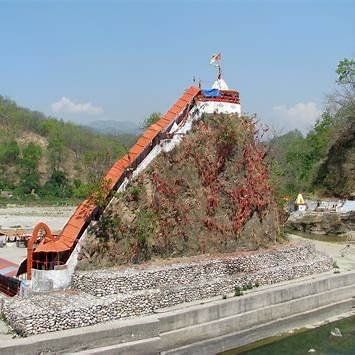
Garjiya Devi Temple, also written as Garjia Devi Temple, Girija Devi Temple or Garjiya Mata Mandir, is one of the most distinctive spiritual destinations near Ramnagar in the Nainital district of Uttarakhand. Dedicated to Goddess Garjiya, worshipped as a form of Goddess Parvati, the temple stands on top of a large natural rock rising from the Kosi River.
The extraordinary location of the temple immediately distinguishes it from other shrines in the Kumaon region. A steep covered staircase climbs the rocky formation, leading devotees from the riverbank to the small sacred shrine at the summit. Below the temple, the Kosi River flows through a landscape of stones, forested slopes and the Himalayan foothills.
Garjiya Devi Temple is located in Garjiya village on the road connecting Ramnagar with the forest and tourism areas surrounding Jim Corbett National Park. The temple is approximately 10 to 13 kilometres from Ramnagar, depending on the starting point and route used by the traveller.
Its location makes Garjiya Devi Temple an important stop for pilgrims, families, wildlife travellers and visitors staying in Ramnagar or around the Corbett landscape. Many travellers combine morning temple darshan with a nature holiday, forest safari or relaxed stay beside the Kosi River.
Although the temple is situated near one of India’s most famous wildlife destinations, it should not be viewed only as an additional sightseeing attraction. Garjiya Devi Temple is an active place of worship with deep importance for local communities and devotees from different parts of Uttarakhand.
People visit the shrine to seek the blessings of the goddess for protection, family welfare, prosperity, marriage, children, health, courage and the fulfilment of personal prayers. Many devotees return to the temple after their wishes are fulfilled to offer gratitude to Maa Garjiya.
The temple forms part of Uttarakhand’s wider tradition of Shakti worship. Across the Himalayan region, the Divine Mother is worshipped through several local and regional forms, each connected with a particular landscape, community or sacred story.
At Garjiya Devi Temple, the goddess is closely associated with the mountains and the Kosi River. The combination of rock, water, forest and elevated worship gives the shrine a powerful natural identity.
The temple is surrounded by the landscapes of the lower Kumaon Himalayas. Forested hills rise behind the river, while the rocky riverbed extends around the sacred formation. During clear weather, the white temple walls, red-orange stairway, saffron flags and natural stone create a memorable contrast against the green surroundings.
For pilgrims, the river and the rock are not merely scenic elements. They form part of the sacred environment in which the goddess is worshipped. The journey across the river and upward through the covered staircase gives devotees the feeling of gradually approaching a divine space.
## Spiritual Importance of Maa Garjiya
Maa Garjiya is generally worshipped as a manifestation of Goddess Parvati, the daughter of the Himalayas and divine consort of Lord Shiva. The name Garjiya or Girija is traditionally associated with the daughter of the mountain king.
In Hindu spiritual traditions, Goddess Parvati represents devotion, strength, motherhood, compassion, family welfare and divine feminine energy. Different forms of the goddess may appear gentle, protective or powerful according to the religious tradition and circumstances of worship.
At Garjiya Devi Temple, devotees approach the goddess as a protective mother who listens to sincere prayers and supports families during periods of difficulty or uncertainty.
Women may visit the temple to pray for family prosperity, a harmonious marriage, children and the welfare of loved ones. Families may seek blessings before beginning an important journey, marriage ceremony, new business, education or major life decision.
Some travellers visit the shrine after hearing accounts of fulfilled wishes from relatives or members of the local community. Such experiences form part of living religious belief and should be understood as expressions of personal faith rather than guaranteed outcomes.
The temple’s significance comes from generations of continued worship. Local residents, priests and devotees have maintained religious traditions around the shrine, allowing Garjiya Devi Temple to remain closely connected with the cultural life of Ramnagar and the Corbett region.
## The Temple on the Kosi River
The most recognisable feature of Garjiya Devi Temple is its position on top of a tall rock in the Kosi River.
The temple does not stand on a conventional hilltop surrounded by a large complex. Instead, the rock rises directly from the riverbed, creating the appearance of a small sacred island during periods when water flows around it.
A bridge or constructed approach connects the riverbank with the base of the temple. From there, visitors climb approximately 60 narrow steps through a covered stairway to reach the principal shrine.
The climb is relatively short but can feel steep, especially during crowded periods, warm weather or rain. Visitors should move patiently and use the available railings.
Senior citizens, travellers with knee difficulties, pregnant visitors and families with young children should assess the staircase before beginning the climb. Assistance may be useful for visitors who are uncomfortable with steep steps.
The covered staircase provides some protection from direct sunlight and weather, but the steps may still become wet or slippery during rain. Comfortable footwear with good grip is advisable.
During festivals and peak travel periods, visitors may need to wait as people move in both directions along the narrow approach. Travellers should avoid rushing, overtaking or blocking the stairs for photography.
At the summit, the temple provides views across the Kosi River, forested hills and surrounding valley. The elevated position allows devotees to appreciate the unusual natural setting while attending darshan.
The small size of the shrine creates an intimate atmosphere. During busy periods, temple staff may regulate the time visitors spend near the sanctum so that all devotees receive an opportunity for darshan.
## Local Religious Traditions
Garjiya Devi Temple is associated with several regional stories and local beliefs. Different priests, residents and families may preserve varying versions of the temple’s origin.
One widely shared tradition connects the goddess with Girija, another name for Goddess Parvati. The temple is therefore understood as a sacred place of the Himalayan daughter and Divine Mother.
Other local narratives connect the rock and river with spiritual events involving deities, sages or forces of nature. These stories form part of regional oral tradition rather than documented historical records.
Their importance lies in explaining how local communities understand the sacred identity of the temple and its relationship with the Kosi River.
Visitors may hear temple stories from priests, local guides, shopkeepers and residents. Listening respectfully can add cultural depth to the pilgrimage.
However, legends should be presented as matters of faith and tradition rather than as scientifically or historically established events.
The temple complex may also contain or be associated with shrines dedicated to other Hindu deities. Devotees should follow the traditional sequence of worship recommended by the priests.
Offerings may include flowers, sweets, coconuts, puffed rice, incense and red chunari. The exact practices and permitted materials can change, so visitors should ask temple authorities or authorised local sellers before making offerings.
Red cloth is traditionally associated with Goddess worship and may be tied in designated places as part of a prayer or religious vow.
Visitors should not attach cloth, threads or paper randomly to railings, trees or protected structures. Offerings should be made only where permitted.
## Kartik Purnima Fair
Kartik Purnima is one of the most important religious occasions at Garjiya Devi Temple.
The festival generally falls during October or November according to the Hindu lunar calendar. The exact Gregorian date changes every year.
During Kartik Purnima, the temple and surrounding area become the centre of a large religious gathering. Devotees arrive from Ramnagar, Nainital district and other parts of Uttarakhand to offer prayers and participate in the festival atmosphere.
Temporary stalls, religious offerings, local food and community activities may be visible around the temple area. The usually peaceful riverside destination becomes considerably busier.
Pilgrims planning to visit during Kartik Purnima should arrange accommodation and transport in advance. Hotels and resorts around Ramnagar and the Corbett road may experience increased demand.
Parking may be limited, and traffic arrangements can change during major gatherings. Visitors should follow instructions issued by local police, district authorities and temple management.
Families travelling with children or senior citizens should arrive early and avoid the most congested hours where possible.
The fair should be approached as a religious gathering rather than only as a tourism event. Visitors should respect ceremonies, queues and the privacy of devotees.
Photography and video recording should not interfere with worship or movement within crowded areas.
## Visiting the Kosi River
The Kosi River contributes greatly to the beauty and spiritual identity of Garjiya Devi Temple.
The river flows through a broad bed of stones and pebbles surrounded by forested hills. During lower-water periods, parts of the riverbank may appear open and accessible.
Devotees have traditionally associated river bathing with purification before or after temple worship. However, visitors should never assume that entering the Kosi River is safe.
Water depth, current speed and river channels can change unexpectedly. Flow conditions may vary according to rainfall, upstream weather and the season.
The monsoon can increase the river’s force considerably. Even when the surface appears calm, strong currents or sudden depth changes may be present.
Travellers should enter the water only when local authorities explicitly permit it and should remain within identified safe areas.
Children should never be left unsupervised near the river. Visitors should avoid climbing on wet rocks, moving into deeper channels or attempting risky photographs.
The river should also be protected from waste. Flowers, plastic packets, food items, religious materials and disposable containers should not be thrown into the water.
Respecting the Kosi River is essential because it is both an ecologically important water system and part of the temple’s sacred environment.
## Connection with Ramnagar
Ramnagar is the principal town and transport base for visiting Garjiya Devi Temple and the wider Corbett region.
The town offers railway connectivity, bus services, taxis, markets, restaurants, medical facilities and a broad range of accommodation.
Ramnagar Railway Station connects the destination with major cities through available rail services. Travellers should check current schedules before planning their journey.
Visitors arriving from Delhi, Uttar Pradesh or other parts of Uttarakhand commonly reach Ramnagar by road or rail before continuing towards Garjiya village.
Local taxis, auto-rickshaws and hired vehicles may be available for the temple visit. Availability and fares should be confirmed in advance.
Travellers staying in forest resorts or riverside properties along the Corbett road can often arrange transportation through their accommodation provider.
The road between Ramnagar and Garjiya passes through a landscape that gradually changes from town surroundings to forests, villages, resorts and the Kosi River.
Traffic can increase during weekends, school holidays, wildlife-safari seasons and religious festivals. Visitors should keep additional travel time and avoid making tightly connected plans.
## Garjiya Devi Temple and Jim Corbett National Park
Garjiya Devi Temple is located near the tourism landscape surrounding Jim Corbett National Park and Corbett Tiger Reserve.
This proximity allows travellers to combine a spiritual journey with forest experiences, wildlife safaris and nature-based accommodation.
Jim Corbett National Park is known for forests, grasslands, rivers and wildlife including elephants, deer, birds and the Bengal tiger. Wildlife sightings are never guaranteed and depend on natural conditions.
Safari access is regulated and generally requires valid permits, authorised vehicles and approved guides. A temple visit does not include entry into the national park.
Travellers planning a safari should make reservations only through authorised channels and confirm the correct zone, gate, reporting time and identification requirements.
Garjiya Devi Temple can be visited before or after a scheduled safari when timings permit. However, visitors should not risk missing a safari reporting time, as entry rules may be strict.
A comfortable itinerary usually keeps the temple visit and forest safari in separate parts of the day or on different days.
The combination of temple worship and nature tourism makes Ramnagar attractive to families and multi-generational travellers. Some members of a group may focus on pilgrimage, while others may be interested in wildlife, birdwatching or riverside relaxation.
## Nearby Attractions
### Jim Corbett National Park
Jim Corbett National Park is the best-known attraction near Ramnagar. Visitors can explore authorised tourism zones through regulated jeep or canter safaris according to seasonal availability.
The park should be visited responsibly. Travellers must remain inside authorised vehicles, follow guide instructions and avoid feeding or disturbing wildlife.
### Corbett Museum
The Corbett Museum at Kaladhungi is associated with the life and work of Jim Corbett. It can be included in a longer regional itinerary for travellers interested in natural history and conservation heritage.
The museum is located away from Garjiya, so sufficient road travel time should be planned.
### Corbett Waterfall
Corbett Waterfall is a forest attraction in the wider Ramnagar–Kaladhungi region. Access conditions, entry rules and water flow can vary by season.
Visitors should avoid slippery rocks and follow all local safety instructions.
### Sitabani Forest Landscape
The Sitabani area is associated with forest tourism, regional legends and nature experiences. Entry procedures may differ from the core Corbett zones.
Travellers should use authorised vehicles and confirm current access arrangements.
### Suspension Bridge and Riverside Areas
Different stretches of the Kosi River around Ramnagar and the Corbett road offer scenic views, forested surroundings and riverside accommodation.
Visitors should remain cautious near riverbanks and avoid entering restricted or unsafe areas.
### Hanuman Dham
Hanuman Dham near Ramnagar is a modern religious complex dedicated to Lord Hanuman. It can be included in a wider spiritual itinerary with Garjiya Devi Temple.
### Local Kumaoni Villages
The villages surrounding Ramnagar offer glimpses of Kumaoni and Terai culture, farming traditions and local food.
Visitors should explore villages respectfully and avoid entering private land without permission.
## Suggested One-Day Spiritual Itinerary
A one-day pilgrimage can begin with an early departure from Ramnagar.
Travellers can reach Garjiya Devi Temple during the quieter morning hours, cross the bridge and climb the steps for darshan.
After worship, visitors may spend a short period observing the Kosi River from a safe area.
The journey can then continue towards Hanuman Dham or other nearby religious attractions.
The afternoon can be used for relaxation at a riverside property, local sightseeing or a pre-booked forest activity.
Travellers should avoid combining too many distant attractions within one day because mountain and forest-road travel may take longer than expected.
## Suggested Two-Day Itinerary
On the first day, travellers can arrive in Ramnagar, check into a hotel, resort or homestay and spend the evening resting near the Kosi River.
The second morning can begin with darshan at Garjiya Devi Temple.
After returning from the temple, travellers may visit Hanuman Dham, explore Ramnagar or enjoy the facilities of their accommodation.
A wildlife safari can be scheduled separately according to permit availability and reporting time.
This itinerary is suitable for families and senior citizens because it avoids excessive same-day travel.
## Suggested Three-Day Pilgrimage and Nature Journey
The first day can include arrival, hotel check-in and a relaxed evening in Ramnagar or near Garjiya.
The second day can begin with Garjiya Devi Temple, followed by Hanuman Dham and local sightseeing.
The third day can be reserved for a pre-booked Corbett safari, birdwatching experience or nature excursion.
Travellers who are not interested in wildlife safaris may use the third day for riverside relaxation, village exploration or additional temple visits.
The itinerary should remain flexible because safari availability, weather and local traffic can affect plans.
## Best Time to Visit Garjiya Devi Temple
Garjiya Devi Temple can be visited during much of the year, but the experience changes considerably with the season.
### Spring
Spring generally offers pleasant temperatures and green surroundings. The weather is suitable for temple visits, forest tourism and outdoor travel.
Morning and evening temperatures can still be cooler than the plains, so light layers may be useful.
### Summer
Summer can be warm in Ramnagar because it lies in the Himalayan foothills rather than at a high mountain elevation.
Early morning is usually preferable for temple darshan. Visitors should carry drinking water, wear breathable clothing and protect themselves from direct sunlight.
Summer may also be a popular period for family holidays and Corbett tourism. Hotels and resorts can experience higher demand.
### Monsoon
The monsoon brings heavy greenery and stronger river flow. The landscape can appear beautiful, but rainfall may affect roads, river conditions and access arrangements.
Visitors must remain particularly cautious near the Kosi River during this period.
Temple or bridge access may be regulated when authorities consider river conditions unsafe. Travellers should confirm the latest situation before leaving their accommodation.
### Autumn
Autumn generally offers comfortable weather and an attractive post-monsoon landscape.
Kartik Purnima makes this season especially important for devotees. Visitors seeking a vibrant religious experience may attend the fair, while travellers seeking quiet darshan may choose another date.
### Winter
Winter is one of the most pleasant periods for exploring Ramnagar and the Corbett region during the daytime.
Mornings and evenings can be cold, particularly in forest and riverside areas. Warm layers should be carried.
Winter is also a popular wildlife-tourism season, so accommodation and safari permits may require advance booking.
## Where to Stay Near Garjiya Devi Temple
Travellers visiting Garjiya Devi Temple can choose accommodation in Garjiya village, along the Corbett road, near the Kosi River or in Ramnagar town.
The best location depends on the traveller’s purpose, budget and transport arrangements.
### Stays Close to Garjiya Devi Temple
Accommodation near Garjiya provides convenient access for early-morning darshan.
The area includes riverside resorts, forest-facing properties, independent cottages, guesthouses and homestays.
A nearby stay reduces travel time and allows visitors to experience the quieter atmosphere of the Kosi River after day visitors leave.
Travellers should confirm the actual road distance to the temple, as properties using “Garjiya” or “Corbett” in their location may be spread across a wide area.
### Riverside Resorts
Riverside resorts are popular among couples, families and leisure travellers.
These properties may offer river views, gardens, recreational activities and organised meals.
Guests should verify whether the property provides safe, authorised river access. A room described as riverside does not automatically mean that entering the river is permitted or safe.
### Forest Retreats and Nature Lodges
Forest-oriented properties are suitable for travellers interested in wildlife, birdwatching and peaceful surroundings.
Guests should follow property instructions regarding wildlife. Food should not be left outdoors, and animals should never be approached or fed.
### Hotels in Ramnagar
Ramnagar offers budget hotels, business-style accommodation, guesthouses and family hotels.
Staying in town can be convenient for railway access, markets, restaurants, medical facilities and transport.
Town accommodation may be more practical for pilgrims whose primary purpose is temple darshan rather than a resort holiday.
### Homestays
Homestays can provide a closer experience of local hospitality and regional food.
Guests should confirm meal plans, road access, parking, power backup and distance from the temple before booking.
### Accommodation for Pilgrimage Groups
Large groups should look for properties offering multiple rooms, vehicle parking, group meals and early breakfast.
The availability of lifts, ground-floor rooms and accessible bathrooms should be checked when travelling with senior citizens.
## Choosing the Right Property
Travellers should select accommodation according to their complete itinerary.
Guests planning an early safari may need a property closer to the relevant reporting gate, while pilgrims may prefer accommodation closer to Garjiya Devi Temple.
Families should check room size, meal availability, child-safety measures and parking.
Couples may prefer private cottages or quieter riverside resorts.
Solo travellers may select budget hotels or homestays with reliable transport access.
Senior citizens should choose properties with minimal stairs, direct vehicle access and comfortable bathroom facilities.
Guests visiting during winter should confirm hot-water and room-heating arrangements.
Monsoon travellers should check the condition of the approach road and whether the property lies within a flood-sensitive area.
Travellers requiring stable internet for work should verify connectivity directly with the property because mobile and broadband quality may vary.
Properties should be selected based on actual driving time rather than only straight-line distance.
## Book Stays Near Garjiya Devi Temple with MudrasStays
MudrasStays helps pilgrims discover hotels, riverside resorts, forest retreats, cottages, guesthouses and homestays near Garjiya Devi Temple and Ramnagar.
The platform is designed specifically to connect travellers with accommodation near temples, pilgrimage centres and sacred destinations across India.
Visitors can search for properties based on their distance from Garjiya Devi Temple, room requirements, group size, budget and preferred facilities.
Booking accommodation close to the temple makes it easier to attend early darshan, avoid peak-hour traffic and spend more time exploring the spiritual and natural attractions of the region.
Families can find spacious rooms, resorts with meals and properties offering convenient parking.
Couples can explore private cottages, riverside stays and peaceful forest resorts.
Solo pilgrims can search for budget hotels and homestays with local transport access.
Senior citizens can select properties offering ground-floor rooms, limited stairs and comfortable facilities.
Pilgrimage groups can identify accommodation suitable for multiple rooms, vegetarian meals and larger vehicles.
Travellers can also use MudrasStays to plan a broader spiritual journey covering Garjiya Devi Temple, Hanuman Dham and other religious destinations around Ramnagar and Kumaon.
By choosing accommodation through a temple-focused platform, visitors can compare stays according to their practical distance from the pilgrimage destination rather than relying only on general tourism labels.
## Responsible Temple and Nature Travel
Visitors should dress respectfully and follow temple instructions regarding footwear, offerings and photography.
The staircase should be kept clear. Travellers should avoid stopping in narrow sections to take photographs.
Photography inside the sanctum or of the principal deity should only be undertaken when permitted.
Devotees should use designated areas for flowers, chunari and other offerings.
Plastic packaging, bottles and food waste should not be left around the temple or riverbank.
Nothing should be thrown into the Kosi River.
Visitors should not attempt to feed monkeys, birds or other wildlife around the temple. Feeding animals can alter their behaviour and create safety risks.
Families must supervise children continuously near the river, bridge and staircase.
Travellers should avoid loud music and behaviour that disturbs worshippers.
Wildlife-tourism rules should be followed strictly in the surrounding Corbett landscape.
Visitors should never leave safari vehicles in unauthorised areas or attempt to attract animals for photographs.
Local taxi drivers, guides, shops, homestays and food providers can be supported as part of responsible community-based tourism.
## A Sacred Meeting of River, Rock and Forest
Garjiya Devi Temple offers a pilgrimage experience shaped by the natural landscape.
The goddess is worshipped above the Kosi River, on a rock surrounded by forested hills and the wildlife-rich environment of the Himalayan foothills.
The approach creates a gradual spiritual journey. Devotees cross from the riverbank, climb the covered steps and reach the small shrine above the valley.
From the temple, visitors can look across the river and recognise how closely the sacred place is connected with water, mountains and forests.
For devotees, the temple is a place to seek the blessings of Maa Garjiya and offer gratitude for protection and fulfilled prayers.
For families, it provides an accessible spiritual destination that can be combined with a comfortable holiday in Ramnagar.
For nature lovers, it offers views of the Kosi River and the forested Corbett landscape.
For photographers, the white temple, red-orange stairway and rocky island create one of the most recognisable visual scenes near Ramnagar.
For cultural travellers, the shrine provides an introduction to Kumaoni Shakti worship and local religious traditions.
For wildlife travellers, the temple adds a spiritual dimension to a journey otherwise focused on forests and safaris.
For senior citizens, a carefully planned visit can offer darshan without requiring a long mountain trek, although the steep stairs should be assessed in advance.
For couples and solo travellers, the riverside surroundings provide a peaceful environment for reflection and rest.
Garjiya Devi Temple should not be rushed as a brief photograph stop on the way to a safari.
The destination deserves sufficient time for prayer, safe exploration and appreciation of its unusual setting.
Travellers who stay nearby can visit during quieter morning hours and experience the temple before larger groups arrive.
A nearby stay also gives visitors the flexibility to respond to weather, traffic and seasonal river conditions.
Plan your pilgrimage to Garjiya Devi Temple with MudrasStays and experience one of the most beautiful riverside shrines in Uttarakhand.
Seek the blessings of Maa Garjiya, climb the sacred rock above the Kosi River and discover the spiritual traditions of Ramnagar and the Kumaon foothills.
Combine your journey with Hanuman Dham, Jim Corbett National Park, forest experiences and the peaceful riverside landscapes surrounding Ramnagar.
Book hotels near Garjiya Devi Temple, discover riverside resorts near the Kosi River and explore cottages, homestays and forest retreats through MudrasStays.
Stay closer to your place of worship, attend morning darshan comfortably and reduce unnecessary travel during busy weekends and religious festivals.
MudrasStays connects pilgrims and spiritual travellers with suitable accommodation near temples and pilgrimage destinations across India.
Begin your Garjiya Devi Temple journey with a comfortable stay and experience a meaningful combination of devotion, Kumaoni culture, river scenery and the natural beauty of the Corbett region.