
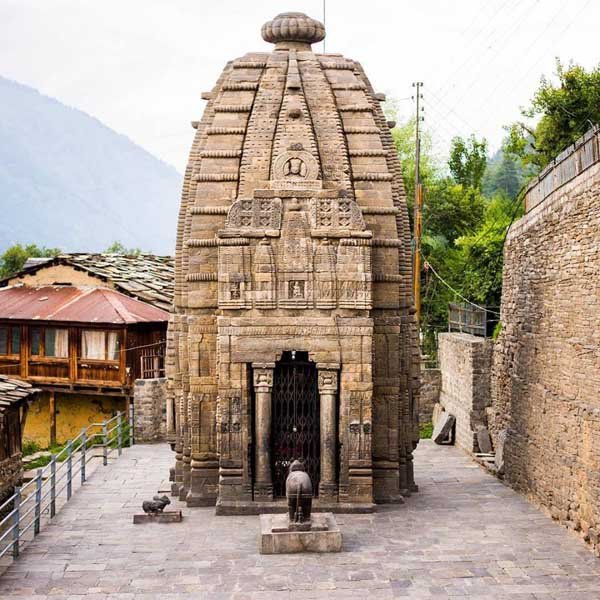
Gauri Shankar Temple is one of the most important ancient Shiva temples in Naggar, the former capital of the Kullu kingdom in Himachal Pradesh. Located below Naggar Castle near the small village bazaar, the temple is dedicated to Lord Shiva and Goddess Parvati, worshipped together as Gauri Shankar.
Built from carefully carved stone and crowned by a tall curving shikhara, the shrine is a remarkable example of the historic temple architecture preserved in the Kullu Valley. Its sculpted walls, sacred doorway, stone courtyard and image of Nandi create an atmosphere in which spirituality, architecture and the living traditions of Naggar come together.
The temple is protected as a monument of national importance by the Archaeological Survey of India. This recognition reflects the historic and artistic significance of both the temple structure and the sculptures associated with it.
Unlike large pilgrimage complexes surrounded by extensive markets, Gauri Shankar Temple stands within the intimate setting of an old Himalayan village. Traditional slate-roofed houses, narrow roads, orchards, stone walls and views across the Kullu Valley surround the shrine.
The peaceful setting allows visitors to experience the temple slowly. Pilgrims can offer prayers to Lord Shiva and Goddess Parvati, observe the sculptures and explore the wider heritage landscape of Naggar without the intensity of the larger tourist centres of Manali.
Gauri Shankar Temple is particularly suitable for Shiva devotees, couples, families, heritage travellers, photographers, architecture enthusiasts and visitors looking for spiritually significant places to visit near Manali and Kullu.
Its convenient location within Naggar makes it possible to combine temple darshan with Naggar Castle, the Nicholas Roerich Art Gallery, Tripura Sundari Temple, Krishna Temple, local orchards and village walks.
## Spiritual Importance of Gauri Shankar Temple
The name Gauri Shankar represents the sacred union of Goddess Gauri, another name for Goddess Parvati, and Lord Shankar, another name for Lord Shiva.
Their combined worship reflects the inseparable relationship between Shiva and Shakti.
Lord Shiva represents consciousness, meditation, transformation, detachment and the destruction of ignorance. Goddess Parvati represents energy, devotion, compassion, fertility, strength and family life.
Together, Gauri and Shankar represent balance between spiritual discipline and worldly responsibility.
Their relationship is central to many Hindu traditions. Shiva is often shown as the great ascetic seated in meditation, while Parvati represents the divine energy that connects ascetic wisdom with family, society and creation.
The worship of Gauri Shankar therefore carries special meaning for couples and families.
Married devotees may pray for harmony, patience, understanding and stability within their relationship. Unmarried visitors may seek blessings for a suitable life partner and a respectful future marriage.
Parents may pray for the health, education and welfare of their children. Other pilgrims visit for courage, spiritual clarity, protection and peace of mind.
These prayers belong to personal faith and should not be presented as guaranteed outcomes. The temple provides a sacred setting for reflection and devotion, while healthy relationships continue to depend upon communication, respect and responsible decisions.
For spiritual seekers, the combined presence of Shiva and Parvati represents the idea that inner awareness and active life do not need to remain separate. A person can pursue spiritual growth while fulfilling responsibilities towards family and society.
## The Sacred Image of Gauri and Shankar
The temple is associated with an important sculptural representation of Lord Shiva and Goddess Parvati.
Heritage descriptions frequently refer to an image in which Shiva and Parvati are shown together, seated in a unified divine composition associated with Nandi.
Such images are sometimes described through the Uma-Maheshvara tradition, in which Uma or Parvati appears beside Lord Shiva as his divine consort.
The image communicates affection, balance and the unity of masculine and feminine spiritual principles.
Visitors should ask the temple priest or authorised heritage personnel about the exact sacred images currently visible within the shrine and their religious significance.
The lighting inside an old stone temple may be limited, and some sculptural details may be difficult to observe without time and patience.
Visitors should not use strong flash photography or additional lighting without permission. Artificial light, tripods and repeated crowding near the entrance can disturb worshippers and may affect the visitor experience.
Touching sacred or ancient sculptures should be avoided unless the priest specifically permits a devotional practice.
Historic stone surfaces can gradually deteriorate through repeated handling, moisture, oil and chemical substances.
## Worship of Lord Shiva
Lord Shiva is worshipped at Gauri Shankar Temple as the principal divine presence of the shrine.
Devotees may offer water, flowers, bilva leaves, incense and prayers according to local temple customs.
The exact procedure for abhishek and offerings should be confirmed with the priest. Protected heritage rules may limit the manner in which water, milk, oil or other substances can be used around historic stone and sculptures.
Visitors should avoid carrying excessive puja materials. Simple and sincere worship is more appropriate than leaving large quantities of flowers, plastic packets or food within a protected temple.
The mantra “Om Namah Shivaya” is commonly recited by Shiva devotees. It represents surrender to Lord Shiva and contemplation of the divine consciousness within all life.
Visitors may sit quietly in the courtyard, listen to the bells or spend a few moments in personal prayer, provided they do not obstruct the movement of other devotees.
## Architecture of Gauri Shankar Temple
The architecture is one of the temple’s greatest attractions.
The shrine is constructed primarily from stone and follows the North Indian shikhara temple tradition adapted to the Himalayan environment.
The central tower rises vertically above the sanctum and gradually curves inward towards the top. Horizontal stone bands, projecting elements and sculptural panels divide the surface into a carefully organised architectural composition.
The shikhara creates a visual movement from the earth towards the sky. In temple symbolism, the rising tower represents the sacred mountain and the journey from ordinary awareness towards higher spiritual consciousness.
The temple stands on a raised stone base within a paved courtyard. Its compact plan gives the structure a strong vertical appearance.
The entrance is framed by carved stonework. Sculptural niches, floral motifs, divine figures and geometric details can be observed across different parts of the exterior.
The stone has weathered naturally through centuries of rain, cold, sunlight and seasonal change. This ageing gives the temple much of its character, but it also makes careful conservation necessary.
Visitors should not lean against carved walls, rub surfaces, place bags against the structure or use the temple as a background for physically staged photographs.
## Shikhara-Style Temple Architecture
Gauri Shankar Temple is an important example of shikhara-style architecture in the Kullu Valley.
The term shikhara refers to the rising tower above the sanctum of a North Indian Hindu temple.
In contrast with Himachal’s multi-tiered wooden pagoda temples, a shikhara shrine is usually dominated by a vertically rising stone tower.
Naggar provides an excellent opportunity to compare different Himalayan temple styles within a relatively small area.
Gauri Shankar Temple demonstrates the stone shikhara tradition, while Tripura Sundari Temple represents a layered wooden and pagoda-influenced architectural form.
This variety reflects the cultural exchanges that shaped the Kullu Valley. Builders worked with local wood and stone while adapting religious forms that travelled between the Himalayan region and the plains.
Architecture enthusiasts should spend time observing how the Gauri Shankar Temple fits into the surrounding village. The tall stone tower rises above traditional slate roofs, creating a distinctive relationship between sacred architecture and domestic buildings.
## Sculptures and Exterior Carvings
The carved exterior is one of the defining features of Gauri Shankar Temple.
Different parts of the tower and doorway contain sculptural panels representing divine figures, decorative forms and scenes connected with religious and cultural life.
Heritage accounts describe representations associated with Lord Ganesha, celestial or human figures, dancers and musicians among the temple’s carvings.
Visitors should understand that weathering, restoration and restricted viewing may make some figures clearer than others.
A knowledgeable guide can help identify architectural sections and sculptural themes without encouraging visitors to touch the stone.
The carvings are important not only because they are beautiful. They preserve evidence of the artistic vocabulary, clothing, music, dance and religious imagination of the period in which the temple developed.
Sculptures of musicians and dancers demonstrate that temple art could include aspects of celebration and everyday cultural life alongside images of deities.
Floral patterns and geometric bands create visual rhythm across the stone surface.
The carvings should be photographed from a respectful distance. Visitors should not apply water, oil or powder to make details more visible.
## Nandi at the Temple
A representation of Nandi, the sacred bull and vehicle of Lord Shiva, stands in relation to the temple entrance.
Nandi is traditionally positioned facing the Shiva shrine. Devotees may offer prayers to Nandi before entering the sanctum.
In Shaivite tradition, Nandi represents devotion, patience, strength and disciplined attention.
The bull waits calmly before Lord Shiva and symbolises the ideal devotee whose awareness remains directed towards the divine.
Some visitors traditionally express a prayer near Nandi before seeking Shiva darshan. Any such practice should be performed gently and according to the local priest’s instructions.
The historic image should not be climbed upon, sat on or treated as an ordinary decorative sculpture.
Children should be guided to understand that Nandi is both a sacred religious figure and part of a protected heritage setting.
## Heritage Status and Conservation
Gauri Shankar Temple is recognised as a centrally protected monument together with its sculptures.
This status makes responsible visitor behaviour especially important.
The temple is not only a place of worship for the present generation. It is also an irreplaceable record of historic architecture and sculpture that must remain available to future generations.
Visitors should follow every sign, railing and instruction established by the Archaeological Survey of India or local management.
Restricted architectural areas should not be entered. Stones, carvings and fragments should never be moved.
Names, initials and messages should not be written or scratched on the temple walls.
Oil lamps, incense and ritual materials should only be used in permitted locations. Fire and smoke can damage historic surfaces when used carelessly.
Professional photography, commercial filming, large tripods, lighting equipment and drone operation may require prior permission.
A mobile photograph taken from a permitted courtyard does not automatically mean that commercial production is allowed.
Visitors should also avoid posting misleading historical claims merely to make social-media content appear more dramatic. The temple’s genuine architectural and spiritual importance is sufficient without invented stories.
## History of the Temple
Gauri Shankar Temple is widely described as one of Naggar’s oldest surviving shrines.
Architectural and heritage literature commonly places it within the medieval period, often around the 11th or 12th century. However, precise dating varies between descriptions, and visitors should treat exact century claims with appropriate caution unless confirmed by current archaeological documentation.
The temple’s architectural form, carvings and sculptures indicate that it belonged to an important period of stone temple construction in the Kullu Valley.
Naggar served as the capital of the rulers of Kullu for several centuries before the royal centre shifted towards Sultanpur in present-day Kullu.
The presence of major temples around Naggar reflects the town’s earlier political and religious importance.
Rulers, priests, artisans, village communities and pilgrims would all have contributed to the continued use and preservation of these sacred places.
The temple survived through changing kingdoms, earthquakes, weather and transformations in the settlement around it.
Its continued existence demonstrates the skill of Himalayan builders and the strength of the worship traditions that kept the shrine active.
## Naggar as an Ancient Capital
Naggar is one of the most culturally significant settlements in the Kullu Valley.
Situated on the left bank side of the Beas River, the town served as the former capital of the Kullu kingdom.
Its elevated position offers views across the valley, orchards, forests and surrounding mountains.
The historic centre contains Naggar Castle, temples, traditional houses and narrow village lanes that preserve a different atmosphere from commercial Manali.
A visitor walking through Naggar encounters layers of religious, royal and artistic heritage within a relatively compact area.
Gauri Shankar Temple represents the Shaivite and sculptural heritage of the town.
Naggar Castle represents the region’s royal and architectural history.
The Nicholas Roerich Estate represents the international artistic connections that developed during the twentieth century.
Tripura Sundari Temple and other local shrines demonstrate the continuing deity traditions of the Kullu Valley.
This concentration of attractions makes Naggar ideal for a slow heritage stay rather than only a short roadside stop.
## Connection with Naggar Castle
Gauri Shankar Temple is situated below Naggar Castle, making the two sites easy to combine within one visit.
Naggar Castle is a historic stone-and-timber structure associated with the rulers of Kullu. It later became a heritage property managed by Himachal Pradesh Tourism.
The castle demonstrates the traditional kath-kuni or timber-bonded architectural technique of the western Himalayas.
Gauri Shankar Temple, by contrast, is dominated by a stone shikhara.
Visiting the two monuments together allows travellers to compare sacred and secular architecture within historic Naggar.
The route between the temple, village bazaar and castle may include sloping lanes, steps and uneven surfaces.
Senior citizens and visitors with mobility concerns should ask their driver or accommodation provider about the easiest drop-off points.
Vehicles may not be able to enter every narrow heritage lane.
## Tripura Sundari Temple
Tripura Sundari Temple is another major spiritual destination in Naggar.
Dedicated to the Divine Mother, it is recognised for its multi-tiered wooden architecture and local religious traditions.
A combined visit to Gauri Shankar and Tripura Sundari creates a balanced Shiva–Shakti pilgrimage.
Gauri Shankar represents the combined divine presence of Shiva and Parvati through stone shikhara architecture.
Tripura Sundari represents Goddess worship within a wooden Himalayan architectural form.
The temples should be visited respectfully as active sacred places rather than only as contrasting architectural examples.
Festival schedules, photography rules and access may differ between the two shrines.
## Jagatipatt Temple
Jagatipatt Temple is situated within the upper courtyard area of Naggar Castle.
The shrine contains a sacred stone slab connected with the meeting and traditions of local Kullu deities.
Regional belief preserves a distinctive story regarding how the stone reached Naggar.
The temple provides insight into Kullu’s devta culture, in which village deities participate in community, ceremonial and social life.
Visitors should confirm whether access is available during their visit because areas within a heritage hotel or active shrine may have specific timings and restrictions.
## Nicholas Roerich Art Gallery
The Nicholas Roerich Art Gallery and estate are among Naggar’s best-known cultural attractions.
Nicholas Roerich was a painter, explorer and thinker who made Naggar his home during the twentieth century.
His paintings frequently reflect the mountains, monasteries and spiritual atmosphere of the Himalayas.
Combining the art gallery with Gauri Shankar Temple allows visitors to experience two different forms of engagement with the mountains: ancient religious sculpture and modern Himalayan painting.
Opening days, entry times and photography rules for the museum should be checked before travelling.
The estate and temple should generally be given separate time rather than rushing through both only for photographs.
## Krishna Temple and Other Naggar Shrines
Naggar and its surrounding villages contain several additional temples associated with Shiva, Vishnu, Krishna, Devi and local deities.
Krishna Temple, Murlidhar Temple and nearby village shrines can be included according to available time and local guidance.
Visitors should avoid confusing the Gauri Shankar Temple at Naggar with other similarly named temples in nearby places such as Dashal or Jagatsukh.
The Kullu–Manali region contains several ancient Shiva shrines, and online photographs may occasionally be labelled incorrectly.
When booking accommodation or transport, travellers should clearly specify **Gauri Shankar Temple below Naggar Castle**.
## Best Time to Visit Gauri Shankar Temple
Gauri Shankar Temple can be visited during most of the year, although the atmosphere and travel conditions vary by season.
### Spring
Spring is one of the most pleasant periods for visiting Naggar.
Fruit trees begin to blossom, surrounding slopes display fresh vegetation and daytime conditions are generally comfortable.
Apple blossom timing varies each year according to elevation and weather, so flowering should not be guaranteed for specific travel dates.
Morning and evening temperatures may remain cool. Visitors should carry a light jacket.
Spring is suitable for temple walks, heritage exploration and photography.
### Summer
Summer provides pleasant conditions compared with the intense heat of the plains.
Naggar can become busier during school holidays and peak Manali tourism periods, but it usually retains a calmer atmosphere than central Manali.
Early morning is ideal for peaceful temple darshan and village walks.
Direct sunlight can become strong during the day, so visitors should carry water and sun protection.
Hotels and homestays should be reserved in advance for weekends and holiday periods.
### Monsoon
The monsoon creates a green and atmospheric landscape around Naggar.
Clouds move through the valley, orchards become lush and the old stone temple takes on a distinctive appearance during light rain.
However, heavy rainfall can affect roads through landslides, falling stones and traffic delays.
Stone courtyards, village pathways and steps may become slippery.
Visitors should wear footwear with dependable grip and carry proper rain protection.
Travel should be postponed during severe rainfall or active official warnings.
### Autumn
Autumn is among the best periods for visiting Gauri Shankar Temple.
Rain generally reduces, the landscape remains green and mountain visibility may improve.
Daytime weather is comfortable for exploring Naggar Castle, temples and the Roerich estate.
Kullu Dussehra occurs during the wider autumn period according to the Hindu calendar and brings increased cultural activity to the district.
Travellers combining Naggar with Kullu should reserve accommodation early around festival dates.
### Winter
Winter gives Naggar a quiet and peaceful atmosphere.
Temperatures can fall below freezing, and snowfall may occasionally affect the settlement and surrounding roads.
Snowfall cannot be guaranteed for a particular booking date.
Stone pathways may become slippery because of frost, ice or snow. Visitors should wear warm layers and suitable shoes.
Accommodation providers should be asked about room heating, hot water, power backup and vehicle access.
Driving should be avoided during active snowfall or unsafe road conditions.
## Morning and Evening Darshan
Morning is generally the most peaceful time to visit Gauri Shankar Temple.
The village is quieter, the courtyard receives softer light and visitors may have more time to observe the stone carvings.
Morning darshan can be followed by breakfast in Naggar and visits to the castle or Roerich estate.
Evening provides a different atmosphere as the village becomes quieter and lamps and bells become more prominent.
Travellers planning evening darshan should stay in Naggar or arrange their return transport in advance.
Temple access and worship timings may vary with season, festivals and priestly arrangements.
Visitors should confirm current timings through their accommodation provider, local residents or temple personnel rather than relying entirely on old online listings.
## Mahashivratri and Religious Occasions
Mahashivratri is the principal festival associated with Lord Shiva and may bring additional devotional activity to Gauri Shankar Temple.
Pilgrims offer prayers, flowers, water and bilva leaves according to temple customs.
The temple’s limited courtyard and village location mean that visitors should remain patient during busy periods.
The Hindu month of Shravan is also sacred to Shiva devotees. Mondays may attract additional worshippers.
Because Shravan frequently overlaps with the monsoon, travellers should check road and weather conditions before visiting.
Marriage-related prayers and Gauri worship may also hold significance for couples and women seeking family harmony.
The exact local festival calendar should be confirmed in Naggar because community observances can vary.
## Reaching Gauri Shankar Temple
Naggar is situated between Kullu and Manali on the left side of the Beas Valley.
It is approximately 21 kilometres from Manali and around 26 kilometres from Kullu by road.
Travellers can reach Naggar by taxi, private vehicle or available local bus services.
The nearest airport is Kullu–Manali Airport at Bhuntar, followed by a road journey through the Kullu Valley.
Flight schedules can be affected by weather, and travellers should maintain flexibility when using the mountain airport.
The nearest narrow-gauge railhead commonly used for the region is Joginder Nagar, followed by substantial road travel.
Most visitors arrive by road from Chandigarh, Delhi, Shimla, Mandi, Kullu or Manali.
The route between Kullu and Manali can experience traffic during peak tourism periods. Travel time should be calculated using current road conditions rather than distance alone.
Within Naggar, narrow lanes and sloping roads may require visitors to walk a short distance.
The temple lies below Naggar Castle near the small bazaar and can be included naturally within a heritage walking route.
## Accessibility for Families and Senior Citizens
Gauri Shankar Temple does not require a mountain trek.
Most of the journey can be completed by road, followed by a short walk through the village or heritage area.
However, Naggar has sloping lanes, uneven stone surfaces and occasional steps.
Senior citizens should wear stable footwear and take assistance where required.
Visitors using wheelchairs or with significant mobility limitations should ask a local driver about the closest suitable approach and current barriers.
Families should supervise children around old stone structures, village roads and courtyard edges.
The absence of a demanding trek makes the temple a suitable spiritual destination for travellers who cannot visit high-altitude Shiva shrines.
## Suggested One-Day Naggar Itinerary
Begin the morning with darshan at Gauri Shankar Temple.
Spend time observing the shikhara, sculptures, Nandi and stone courtyard without rushing.
Continue uphill towards Naggar Castle and explore its historic architecture and valley views.
After lunch, visit the Nicholas Roerich Art Gallery and estate, subject to current opening hours.
The evening can include Tripura Sundari Temple or a peaceful walk through the village.
This itinerary provides a balanced experience of Shiva worship, royal heritage, art and local culture.
## Suggested Two-Day Naggar Itinerary
On the first day, arrive in Naggar and check into a hotel, cottage or homestay.
Visit Gauri Shankar Temple during the quieter afternoon or evening period and explore the bazaar and village lanes.
On the second morning, return for peaceful darshan before visiting Naggar Castle, Tripura Sundari Temple and the Roerich estate.
Additional time can be used for an orchard walk or nearby village experience with permission from local residents.
Staying overnight provides a considerably richer experience than visiting Naggar as a hurried stop between Kullu and Manali.
## Suggested Three-Day Spiritual and Heritage Journey
The first day can focus on Gauri Shankar Temple and Naggar Castle.
The second day can include Tripura Sundari Temple, the Roerich Art Gallery and other local shrines.
The third day can include nearby temples around Jagatsukh, Dashal, Kullu or Manali according to the traveller’s onward route.
Visitors interested in Shiva pilgrimage may add Jagatsukh Shiva Temple, Basheshwar Mahadev Temple at Bajaura or Bijli Mahadev through separate journeys.
Every destination requires independent travel planning and should not be compressed into a single rushed day.
## Nearby Spiritual Destinations
### Tripura Sundari Temple
A major wooden Devi temple within Naggar and an ideal complement to Gauri Shankar darshan.
### Jagatsukh Shiva Temple
An ancient stone Shiva shrine in the former capital settlement of Jagatsukh, located closer to Manali.
Visitors should not confuse it with Gauri Shankar Temple at Naggar.
### Gauri Shankar Temple, Dashal
Another protected historic temple dedicated to Gauri Shankar exists at Dashal in Kullu district.
Travellers researching online should check the exact locality before booking transport.
### Basheshwar Mahadev Temple, Bajaura
An important historic stone Shiva temple near Bajaura, known for its architecture and sculpture.
### Bijli Mahadev Temple
A hilltop Shiva shrine above Kullu associated with a sacred lightning tradition and an uphill walking route.
It should be planned as a separate day journey.
### Raghunath Temple, Kullu
One of the principal religious centres of Kullu and closely connected with the district’s Dussehra and deity traditions.
### Hadimba Devi Temple, Manali
A historic wooden temple dedicated to Goddess Hadimba, surrounded by deodar forest.
### Manu Temple and Vashisht
Manali-area spiritual destinations associated with Sage Manu, Sage Vashisht, Lord Rama and sacred hot springs.
## Where to Stay Near Gauri Shankar Temple
Naggar offers a varied selection of heritage accommodation, hotels, cottages, homestays, guesthouses and orchard properties.
Staying within Naggar provides the easiest access to the temple and allows visitors to attend morning and evening darshan.
### Heritage Stays in Naggar
Heritage accommodation is suitable for travellers interested in Naggar’s royal architecture and historic atmosphere.
Rooms may be located within restored traditional structures and can provide distinctive valley views.
Historic properties may also contain stairs, uneven floors or limited modern accessibility. Guests should confirm these details before booking.
### Homestays Near Gauri Shankar Temple
Local homestays provide an opportunity to experience Himachali hospitality, regional food and village life.
Hosts may assist with temple directions, local taxis, orchard visits and updated information about attraction timings.
Visitors should confirm the actual walking distance from the property to Gauri Shankar Temple.
A listing described as being in Naggar may still lie outside the central heritage area or on a different slope.
### Cottages and Orchard Stays
Naggar and its surrounding villages contain cottages and orchard stays suitable for couples, families and slow travellers.
These properties may offer quieter surroundings than the village bazaar.
Guests should ask whether the approach road is suitable for their vehicle, especially during rain or snow.
Orchards are privately owned agricultural spaces. Visitors should enter or pick fruit only with permission.
### Hotels in Manali
Manali provides the widest selection of hotels, resorts, hostels and restaurants.
It can serve as a base for visiting Naggar, but the additional road journey should be considered during peak traffic periods.
Travellers whose main purpose is Gauri Shankar Temple and Naggar heritage may find a local stay more convenient.
### Hotels in Kullu and Bhuntar
Kullu and Bhuntar are suitable for visitors arriving through the airport or continuing towards other parts of the valley.
Kullu provides markets, medical facilities and transport connections.
Naggar remains the preferred location for visitors wanting to explore the temple during quiet hours.
## Choosing the Right Accommodation
Travellers should select accommodation according to their complete itinerary rather than only price.
Pilgrims prioritising Gauri Shankar Temple should stay within central Naggar or a short driving distance.
Couples may prefer heritage rooms, private cottages or orchard-view stays.
Families should check room size, food options, parking and safe access.
Senior citizens should ask about stairs, lifts, road approach and the walking route to the temple.
Winter travellers should confirm heating, hot water, warm bedding and road clearance.
Monsoon guests should ask whether the approach road is vulnerable to waterlogging, falling stones or landslide disruption.
Travellers working remotely should verify Wi-Fi and mobile connectivity directly with the property.
Pilgrimage groups should confirm room inventory, vegetarian meals and parking for their vehicle.
## Book Stays Near Gauri Shankar Temple with MudrasStays
MudrasStays helps pilgrims and heritage travellers discover hotels, homestays, cottages, guesthouses and spiritual accommodation near Gauri Shankar Temple in Naggar.
The platform is designed specifically for travellers searching for suitable places to stay near temples and sacred destinations across India.
Visitors can compare properties according to practical distance from the temple, room requirements, budget, group size and preferred facilities.
Booking a stay in Naggar allows devotees to attend peaceful morning or evening darshan and explore the village without repeated travel from Manali.
Solo pilgrims can search for affordable guesthouses and local homestays.
Couples can explore heritage rooms, private cottages and orchard stays.
Families can select hotels offering meals, parking and comfortable room capacity.
Senior citizens can prioritise accessible properties close to the temple approach.
Pilgrimage groups can identify accommodation offering multiple rooms and vegetarian food.
Cultural travellers can select stays convenient for Naggar Castle, the Roerich Art Gallery and Tripura Sundari Temple.
Travellers continuing towards Kullu, Manali, Bijli Mahadev or the Parvati Valley can choose accommodation according to the direction of their onward journey.
A temple-focused booking platform helps visitors understand the real location of their stay and avoid confusion between the different Gauri Shankar temples found across the Kullu–Manali region.
## Responsible Heritage and Temple Travel
Gauri Shankar Temple is both an active shrine and a protected monument.
Visitors should remove footwear wherever instructed and dress respectfully.
The inner sanctum, sacred image and private rituals should only be photographed when clearly permitted.
Historic stone carvings should not be touched, rubbed or marked.
Visitors should not sit on Nandi, climb onto the temple platform or place bags against sculpted walls.
Flowers, incense and other offerings should be used only in the manner permitted by the priest and heritage authorities.
Plastic packaging, bottles and food waste should be carried away from the temple.
Loud music and disruptive photography are inappropriate within the courtyard and old village lanes.
Drones and commercial filming may require specific permissions.
Traditional houses and local residents should not be photographed without consent.
Visitors should support local guides, homestays, shops, cafés and taxi drivers fairly.
Responsible spending helps heritage tourism benefit the community that lives around and protects Naggar’s temples.
## A Sacred Union of Shiva, Parvati and Himalayan Heritage
Gauri Shankar Temple represents a rare meeting of spirituality, sculpture, architecture and village history.
The worship of Shiva and Parvati expresses balance between meditation and family life.
The stone shikhara preserves an important chapter in the architectural history of the Kullu Valley.
The sculptural panels reflect the artistic imagination and cultural life of an earlier period.
Nandi represents devotion and unwavering attention towards Lord Shiva.
The protected status of the temple recognises its importance beyond the immediate locality.
Naggar Castle connects the temple with the former rulers of Kullu.
Tripura Sundari Temple connects it with the living Shakti traditions of the region.
The Roerich estate connects the village with the modern artistic interpretation of the Himalayas.
For Shiva devotees, Gauri Shankar Temple is a place to seek courage, peace and spiritual clarity.
For couples, it offers a sacred setting for prayers relating to harmony, respect and companionship.
For families, its road-accessible location provides an opportunity to introduce younger generations to temple heritage.
For senior citizens, it offers a meaningful Shiva pilgrimage without a difficult mountain trek.
For architecture enthusiasts, it is one of the most rewarding historic stone temples near Manali.
For photographers, its carved shikhara, Nandi, traditional houses and mountain background provide memorable visual opportunities when heritage rules are respected.
For cultural travellers, Naggar offers a concentrated experience of royal history, village life, temple architecture and Himalayan art.
Gauri Shankar Temple should not be treated merely as a quick photography stop below Naggar Castle.
Visitors should allow time for darshan, careful observation of the carvings and quiet reflection within the courtyard.
Staying overnight in Naggar allows travellers to experience the shrine before or after the principal sightseeing crowds arrive.
Plan your journey to Gauri Shankar Temple with MudrasStays and experience one of the most significant protected Shiva temples in the Kullu Valley.
Seek the blessings of Lord Shiva and Goddess Parvati, observe the ancient stone shikhara and explore the sacred sculptures preserved within the temple.
Combine your visit with Naggar Castle, Tripura Sundari Temple, Jagatipatt Temple, the Nicholas Roerich Art Gallery, local orchards and the other spiritual destinations of Kullu and Manali.
Book hotels near Gauri Shankar Temple, discover heritage stays in Naggar and explore cottages, guesthouses and homestays through MudrasStays.
Stay closer to the temple, attend peaceful morning darshan and experience Naggar’s spiritual and cultural heritage without unnecessary travel.
MudrasStays connects pilgrims, families and heritage travellers with suitable accommodation near temples and sacred destinations across India.
Begin your Gauri Shankar Temple journey with a comfortable stay and experience a meaningful pilgrimage centred on Lord Shiva, Goddess Parvati, ancient stone architecture and the timeless heritage of Naggar.