
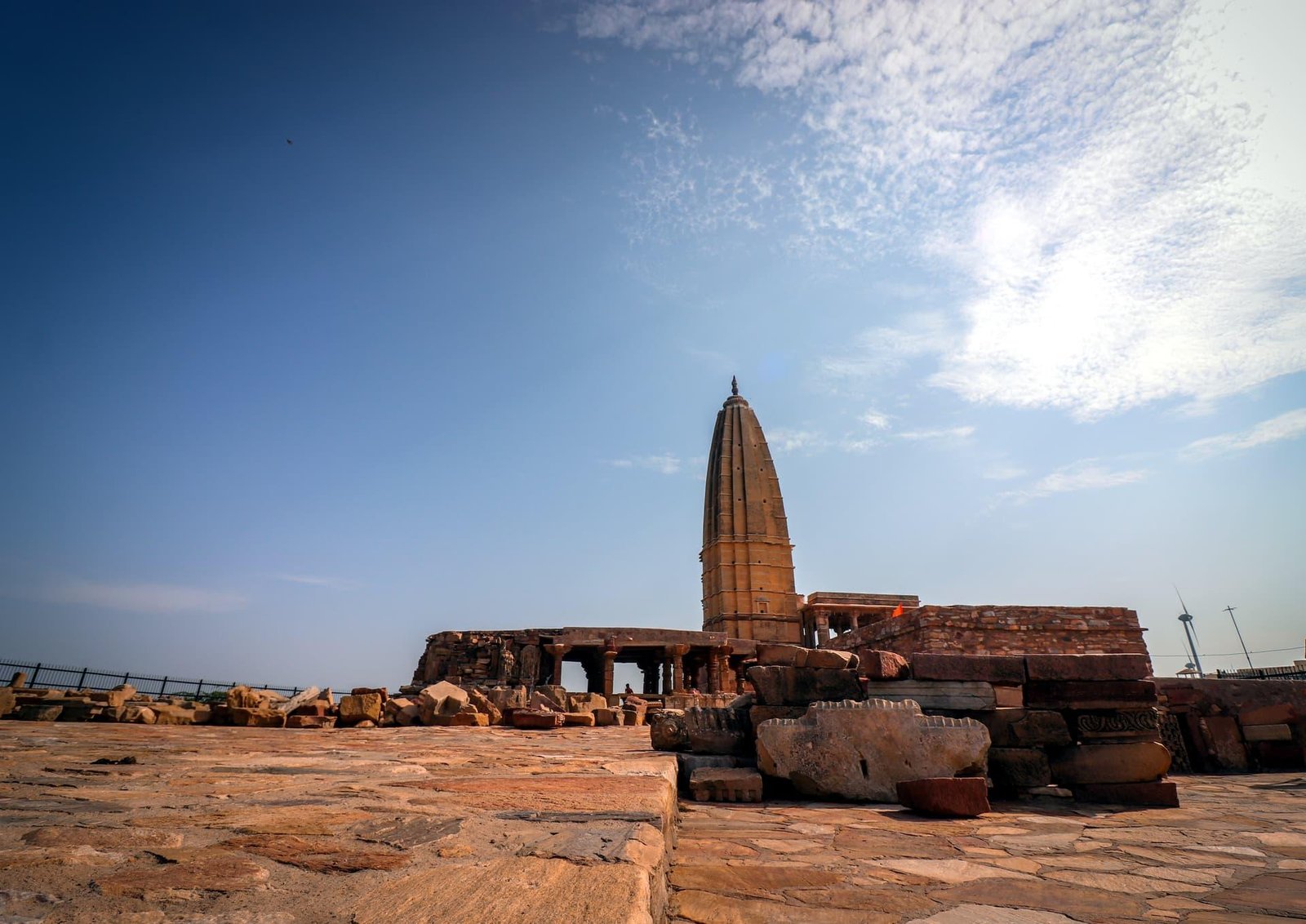
Harshnath Temple, Sikar – A 10th-Century Shiva Shrine on Harshagiri Hill
Harshnath Temple is an important ancient Shiva temple situated on **Harshagiri Hill**, commonly called Harsh Parvat, near Sikar in Rajasthan. Surrounded by the rugged landscape of the Aravalli hills, the temple combines pilgrimage, archaeology, sculpture, early medieval history and panoramic natural views.
The surviving temple complex belongs primarily to the tenth century and is associated with the **Chahamanas of Shakambhari**, commonly known as the Chauhan rulers. Lord Shiva was worshipped here as **Harshnath**, the joyful and protective deity of Harshagiri and an important guardian divinity of the ruling dynasty.
An inscription dated 973 CE provides valuable information about the temple, its Shaiva religious community and its patrons. The temple is attributed to the Shaiva ascetic **Bhavarakta**, also known as Allata, and developed under Chauhan royal patronage.
The historic temple now survives largely as an archaeological ruin. Broken pillars, carved stone panels, sculptural fragments, architectural blocks and the remains of subsidiary shrines are spread across the hilltop complex. Beside these ruins stands a later Shiva temple where worship continues.
Harshnath is therefore not merely one building. It is a layered sacred landscape comprising:
* The remains of the original tenth-century temple
* Numerous ruined subsidiary shrines
* A later functioning Shiva temple
* Sculptures associated with Shiva, Parvati and other deities
* A Nandi pavilion and ritual spaces
* A Bhairava shrine situated nearby
* Panoramic views across the Sikar and Shekhawati landscape
Pilgrims, architecture enthusiasts and heritage travellers can visit Harshnath as part of a wider spiritual journey through Sikar district. Travellers searching for hotels near Harshnath Temple, accommodation in Sikar or family stays for the Harshnath–Jeen Mata pilgrimage route can explore suitable options through **MudrasStays**.
## Who Is Lord Harshnath?
Harshnath is a local and historic manifestation of Lord Shiva.
The name may be understood through the Sanskrit word *harsha*, meaning joy, delight or spiritual happiness, and *natha*, meaning lord or protector. Harshnath can therefore be understood as the **Lord of Joy** or the divine guardian of Harshagiri.
The deity was not worshipped only as an isolated Shiva Lingam. In early medieval religious imagination, Lord Harshnath was regarded as the divine presence who occupied and protected the entire mountain.
The hill itself became sacred because it was believed to be inhabited by Shiva.
Devotees worship Lord Harshnath for:
* Spiritual peace
* Protection from adversity
* Courage during difficult periods
* Family welfare
* Health and recovery
* Removal of persistent obstacles
* Success in responsible work
* Relief from fear and uncertainty
* Strength to overcome harmful habits
* Blessings for marriage and family life
* Inner happiness and detachment
* Progress on the path of Shiva devotion
The worship of Shiva on an elevated mountain naturally recalls Mount Kailash, the celestial abode of Shiva and Goddess Parvati.
## Harshagiri as a Second Kailash
The Harshnath inscription presents Harshagiri as a sacred mountain transformed by the presence of Shiva.
The hill was imagined as an earthly reflection of **Mount Kailash**. Its elevated landscape, natural beauty, religious community and temples created a sacred environment distinct from the settlements below.
This idea is important for understanding why the temple was built at the top of a hill rather than within a major town.
The ascent represented a spiritual journey:
* Leaving ordinary life behind
* Climbing towards the realm of Shiva
* Moving from noise towards silence
* Passing from the inhabited plain to a sacred summit
* Seeking a wider spiritual perspective
* Approaching a symbolic earthly Kailash
Even today, the changing landscape during the journey to the summit contributes significantly to the pilgrimage experience.
## Historical Background of Harshnath Temple
Harshnath Temple developed during an important period in the political and religious history of Rajasthan.
During the early medieval period, the **Chahamanas of Shakambhari** emerged as a major ruling dynasty in the region. Their political territory included parts of present-day Rajasthan, and their history is closely associated with places such as Sambhar, Ajmer and the wider Shekhawati region.
The rulers supported several religious traditions, but Shiva in the form of Harshnath occupied an especially important place in their dynastic devotion.
Harshnath was regarded as a **kuladevata**, or lineage-protecting deity, of the Chauhan rulers.
This meant that the temple served several connected purposes:
* A centre of Shiva worship
* A royal religious institution
* A symbol of dynastic protection
* A place for donations and public religious activity
* A gathering point for ascetics and pilgrims
* A landmark on regional travel and trade routes
* A spiritual centre connected with the political identity of the Chauhans
The temple’s history is therefore significant not only for Sikar but also for understanding the rise of the Chauhan dynasty.
## The Harshnath Inscription of 973 CE
The most important historical source connected with the temple is an inscription dated **973 CE**.
The inscription is valuable because it preserves information concerning:
* The sacred identity of Harshagiri
* The temple of Lord Harshnath
* The Shaiva ascetics associated with the shrine
* Chauhan rulers and their genealogy
* Royal and non-royal donations
* Development of facilities around the temple
* The wider religious importance of the hill
The Archaeological Survey of India attributes the temple to the Shaiva ascetic **Bhavarakta**, also called Allata, during the reign of a Chauhan ruler named Vigraharaja.
Historical interpretations differ slightly regarding the precise relationship between the temple’s construction date and the later inscription. The safest conclusion is that the principal shrine was established during the middle decades of the tenth century and that the 973 CE inscription records its history, patrons and religious importance.
This inscription makes Harshnath one of Rajasthan’s especially valuable inscription-based temple sites.
## Bhavarakta, Also Known as Allata
Bhavarakta, also called Allata, was a Shaiva religious teacher closely associated with the development of Harshnath Temple.
He belonged to an organised tradition of Shiva worship and appears to have played an important role in gathering support for the construction and maintenance of the temple.
The shrine was not funded only by a single monarch. Donations came from different sections of society, including rulers, officials, merchants and ordinary devotees.
This reveals that Harshnath functioned as a regional pilgrimage institution supported by a broad religious community.
After Bhavarakta’s death, his disciple or successor continued developing facilities associated with the temple. These reportedly included spaces such as a courtyard, garden, well and water arrangements for people and animals.
The site was therefore designed not only for worship but also to support pilgrims, ascetics, travellers and livestock.
## Harshnath and the Pashupata Shaiva Tradition
Harshnath is associated with the broader **Pashupata tradition of Shaivism**, one of India’s early organised systems of Shiva worship.
The name Pashupata derives from Pashupati, meaning “Lord of all living beings,” an important title of Shiva.
Pashupata practitioners emphasised:
* Devotion to Shiva
* Spiritual discipline
* Renunciation
* Meditation
* Liberation from worldly bondage
* The relationship between teacher and disciple
* Ritual worship and sacred geography
Mountains, caves, cremation grounds and remote landscapes often held special significance within Shaiva traditions.
Harshagiri’s elevated and comparatively isolated setting was therefore well suited to the establishment of a major Shaiva centre.
## The Temple as a Chauhan Royal Shrine
The Chauhan rulers contributed to Harshnath Temple and regarded the deity as a protector of their lineage.
Royal patronage helped provide:
* Land and financial support
* Temple construction
* Ritual maintenance
* Facilities for priests and ascetics
* Recognition of the shrine as a regional religious centre
* Protection of pilgrimage routes
* Public prestige and political legitimacy
The relationship was reciprocal in sacred terms. The rulers honoured Lord Harshnath, while the deity was believed to protect the dynasty and its kingdom.
Temple inscriptions were also instruments of memory. They recorded rulers, teachers, donations and religious achievements so that future generations would remember them.
## Merchants, Travellers and Public Donations
The inscriptional history of Harshnath suggests that support also came from merchants and travellers.
The wider region was connected with the historic salt economy of Shakambhari or Sambhar. Trade routes carried salt, horses and other goods across Rajasthan and towards major cities of northern and central India.
Harshagiri’s visible hill position may have served as:
* A geographic landmark
* A resting or convergence point
* A pilgrimage destination for merchants
* A place for religious donations before onward journeys
* A link between sacred and commercial routes
This helps explain how a major hill temple could attract support beyond the immediate villages surrounding Sikar.
## Architecture of the Original Temple
The original Harshnath Temple is an important example of early medieval North Indian temple architecture.
The east-facing temple followed a carefully planned arrangement and included:
* A sanctum or garbhagriha
* A projecting multi-part exterior plan
* A rangamandapa or ceremonial hall
* Four principal pillars in the central hall
* Lateral transepts
* Stone seating or balustrade arrangements
* A separate Nandi pavilion
* A ceremonial gateway or torana aligned with the temple
* Numerous subsidiary shrines around the principal building
The original temple tower has not survived intact, but architectural evidence and official descriptions identify the shrine with a developed North Indian temple tradition.
The complex was constructed in stone and ornamented extensively with sculpture.
## Mahameru Architectural Concept
Government descriptions identify Harshnath Temple with the **Mahameru style**.
Mount Meru occupies a central position in Hindu, Buddhist and Jain cosmology. It is imagined as the cosmic mountain at the centre of the universe.
In temple architecture, the idea of Meru can be expressed through a central shrine surrounded by smaller architectural forms, creating the visual impression of a great sacred mountain with subsidiary peaks.
At Harshnath, this concept suited the hilltop setting exceptionally well:
* The temple stood on a real mountain.
* Its tower represented a cosmic mountain.
* Subsidiary shrines formed smaller symbolic peaks.
* Lord Shiva occupied the centre of the sacred landscape.
* The summit became an earthly reflection of Kailash and Meru.
Visitors should remember that the original composition can no longer be seen in complete form because much of the complex survives as scattered ruins.
## Sculptures and Carved Pillars
The surviving sculptures are among the most important features of Harshnath Temple.
Visitors can observe fragments depicting:
* Lord Shiva
* Goddess Parvati
* Nandi
* Divine attendants
* Musicians
* Dancers
* Human couples
* Decorative figures
* Floral patterns
* Mythological scenes
* Architectural guardians
* Celestial beings
The quality of the carving demonstrates the skill of the craftsmen who worked at the temple.
The figures are not rigid. Many appear graceful and animated, with flowing posture, musical instruments, elaborate jewellery and detailed clothing.
These carvings reveal aspects of early medieval life, including:
* Music
* Dance
* Personal ornamentation
* Religious ceremonies
* Courtly culture
* Ideas of beauty
* Temple performance traditions
Visitors should view the sculptures without touching, climbing upon or moving any fragments.
## The Image of Parvati Performing Panchagni Tapasya
One of the temple’s most significant sculptural compositions depicts Goddess Parvati performing **Panchagni Tapasya**, or penance amid five fires.
In the sacred narrative, Parvati undertook severe austerities to attain Lord Shiva as her husband. Her tapasya represents devotion, determination and spiritual concentration.
The five fires may be understood as four physical fires surrounding the practitioner, with the sun above forming the fifth.
The scene symbolises:
* Devotional determination
* Mastery over bodily discomfort
* Purification
* Single-minded spiritual purpose
* The union of Shiva and Shakti
* The power of disciplined prayer
The official archaeological description identifies a standing form of Parvati, labelled Vikata, accompanied by graceful female attendants.
This sculptural programme demonstrates that the temple honoured not only Shiva but also the wider theology of Shiva and Shakti.
## Music and Dance in the Temple Sculptures
Several sculptural fragments depict musicians carrying instruments such as stringed instruments, flutes and drums.
These images suggest the important role of music and performance within temple life.
Music could accompany:
* Daily worship
* Festival processions
* Ritual dance
* Royal ceremonies
* Religious storytelling
* Community celebrations
* Offerings to the deity
The musicians of Harshnath are valuable visual records of instruments and performance traditions from early medieval Rajasthan.
## Subsidiary Shrines and the Wider Temple Complex
The principal Harshnath shrine was once surrounded by numerous smaller temples.
These may have been dedicated to different manifestations of Shiva and to other deities associated with the wider Hindu pantheon.
Today, many of these shrines survive only as:
* Foundation outlines
* Broken walls
* Doorframe fragments
* Pillar sections
* Sculptural pieces
* Displaced architectural blocks
* Partially standing structures
The ruins should not be treated as loose stones available for sitting, climbing or rearranging. Each fragment may contain important archaeological information concerning the original layout.
## The Later Shiva Temple
A later Shiva temple stands beside the remains of the original monument.
This temple is commonly associated with an eighteenth-century restoration or rebuilding undertaken under **Rao Shiv Singh of Sikar**, with 1718 frequently cited as the date.
Materials from the ruined complex appear to have been reused in later construction.
The later temple has a prominent tower and remains an active place of worship. Because it is visually more complete, first-time visitors sometimes mistake it for the original tenth-century monument.
The site should therefore be understood as containing two related but historically distinct elements:
### The Original Harshnath Temple
A tenth-century Chauhan-period temple surviving largely as ruins and protected for its archaeological importance.
### The Later Functioning Temple
A post-medieval Shiva shrine associated with the restoration of worship at the sacred site.
Both are significant, but they should not be assigned the same construction date.
## How Was the Ancient Temple Damaged?
The original temple suffered extensive destruction and loss over several centuries.
Popular accounts frequently attribute its destruction to Mughal forces during the reign of Aurangzeb, sometimes giving the late seventeenth century as the period of damage. However, the precise sequence of destruction, abandonment, weathering and stone reuse is not fully explained by one universally accepted contemporary record.
The present ruined condition may reflect several factors:
* Deliberate damage during political conflict
* Decline of royal patronage
* Natural deterioration
* Earth movement and severe weather
* Reuse of stone in later buildings
* Neglect over long periods
* Removal or theft of sculptures
It is historically safer to say that the temple was severely damaged before the eighteenth-century restoration than to present every popular destruction story as conclusively documented.
## Harshnath as a Protected Monument
The ancient temple is recognised as a centrally protected monument under the Archaeological Survey of India.
Protection is important because the complex contains:
* Early medieval architecture
* Inscriptional evidence
* Rare sculptural remains
* Information concerning Chauhan history
* Evidence of Shaiva religious organisation
* Surviving temple-planning elements
Visitors must not:
* Carve names on stones
* Apply paint or vermilion to archaeological sculptures
* Move architectural fragments
* Climb unstable ruins
* Remove stones or souvenirs
* Light fires against protected masonry
* Attach cloth or thread to fragile carved surfaces
* Fly drones without permission
* Enter barricaded areas
Worship should be performed only in active designated sections.
## Religious Legends Associated with Harshnath
Local tradition connects Harshnath with the nearby **Jeen Mata Temple**.
Harsh is popularly remembered as the brother of Jeen Mata. In the regional narrative, the brother and sister are associated with separate hills and sacred sites within Sikar district.
Different versions of their story are told locally. They generally emphasise:
* A deep bond between brother and sister
* Separation after a family disagreement
* Jeen’s spiritual withdrawal and devotion
* Harsh’s search for or concern for his sister
* The establishment of sacred places associated with both figures
These narratives form an important part of regional faith but should be distinguished from the tenth-century inscriptional history of the temple.
Many pilgrims combine Harshnath with Jeen Mata Darshan as part of a shared local pilgrimage tradition.
## Worship at the Present Shrine
The functioning temple allows devotees to worship Lord Shiva through ordinary Shaiva offerings.
Depending on current temple rules, offerings may include:
* Water
* Milk
* Bilva leaves
* Flowers
* Fruit
* Incense
* Camphor
* Sweets
* Rudraksha
* White cloth
* Prayers and mantra recitation
Visitors should ask the priest before performing abhishekam.
Large quantities of milk, oil or other materials should not be poured without proper arrangements. Offerings must never be applied to protected archaeological sculptures.
## Maha Shivaratri at Harshnath
Maha Shivaratri is the most important annual occasion at a Shiva temple.
Devotees may visit for:
* Shiva Lingam abhishekam
* Bilva-leaf offerings
* Night worship
* Mantra chanting
* Fasting
* Bhajan and kirtan
* Special decoration
* Community prayer
The hill road and temple area can become significantly busier during the festival.
Families should plan:
* Early arrival
* A reliable vehicle
* Warm clothing for late-evening hill weather
* Drinking water
* Safe supervision of children
* Additional time for parking
* A confirmed return journey
* Accommodation in Sikar when travelling from outside the district
## Sawan and Monday Worship
The month of Sawan is especially important for Shiva worship.
Mondays during Sawan may attract pilgrims carrying water and devotional offerings.
The hill becomes greener during the monsoon, but rain can also create travel hazards.
Visitors should not undertake the ascent during severe weather, low visibility or official road restrictions simply to maintain a ritual schedule.
## Best Time to Visit Harshnath Temple
### October to March
The cooler months generally provide the most comfortable conditions for driving, walking through the complex and examining the sculptures.
### July to September
The monsoon can transform the Aravalli landscape and make the hill especially scenic. However, roads, stone surfaces and steps may become slippery.
Visitors should check weather and road conditions before departure.
### Maha Shivaratri
The festival offers the strongest devotional atmosphere but brings larger crowds.
### Sawan Mondays
These are important for Shiva worship but require additional caution during rain.
### April to June
Summer temperatures can become extremely high. Early-morning visits are preferable.
### Sunrise and Sunset
The elevated location offers impressive views, but visitors should not remain on isolated or poorly lit sections after dark. Sunset visitors should begin descending with sufficient daylight unless they have confirmed safe night access.
## Hill-Road and Weather Safety
The road to Harshagiri includes an uphill approach and may involve bends, exposed sections and changing surface conditions.
Visitors should:
* Use a roadworthy vehicle.
* Prefer an experienced local driver.
* Check fuel and brakes before ascending.
* Avoid speeding.
* Do not travel during intense rain or poor visibility.
* Follow local closure notices.
* Carry drinking water.
* Keep essential medicines.
* Wear footwear with a good grip.
* Supervise children near steep edges.
* Avoid standing close to wind turbines or restricted equipment.
* Return before conditions become unsafe.
The scenic drive should not be treated as an opportunity for risky photography or reckless driving.
## Wind Turbines and the Modern Hill Landscape
Harshagiri is also known for wind-energy installations visible around the hill.
The wind turbines create a striking contrast between:
* A tenth-century Shiva temple
* An ancient Aravalli landscape
* Modern renewable-energy infrastructure
Visitors must remain outside restricted technical areas and should not attempt to climb turbine structures or cross safety barriers.
Photography should be conducted only from safe public areas.
## Temple Etiquette and Heritage Conduct
Visitors should:
* Dress respectfully.
* Remove footwear where instructed.
* Keep mobile phones silent near active worship.
* Follow the priest’s guidance.
* Respect ASI barriers.
* Avoid touching carvings.
* Do not climb ruined walls.
* Never remove stones or sculptural fragments.
* Keep children supervised.
* Do not play loud music.
* Avoid alcohol and tobacco.
* Carry waste back from the hill.
* Do not throw plastic or food around the ruins.
* Avoid disturbing animals.
* Respect other devotees and researchers.
* Use drones only with the required permissions.
A responsible visit protects both the sacredness and archaeology of Harshnath.
## How Much Time to Keep
Visitors should keep approximately two to three hours for:
* Darshan at the functioning Shiva temple
* Exploration of the ancient temple ruins
* Observation of carved pillars and sculptures
* Nandi and subsidiary shrine remains
* Panoramic hill views
* Photography from safe areas
* Quiet prayer
Additional time is required for the road journey from Sikar.
Heritage enthusiasts may need longer to understand the layout and sculptures properly.
## Nearby Spiritual and Heritage Attractions
### Jeen Mata Temple
Jeen Mata is one of Sikar district’s most important Shakti shrines and is traditionally associated with Harshnath through the regional brother-and-sister legend.
A combined pilgrimage can include:
**Harshnath Temple – Jeen Mata Temple – Sikar Stay**
The road route and travel duration should be checked before departure.
### Sikar City Temples
Sikar contains several temples, local shrines and traditional markets that can be explored while staying in the city.
### Rani Mahal and Sikar Heritage
Historic buildings, gateways and havelis in the Sikar region reflect the artistic traditions of Shekhawati.
Access conditions may vary because some buildings are privately occupied or undergoing conservation.
### Fatehpur Shekhawati
Fatehpur is known for painted havelis and historic architecture. It is suitable for a separate heritage excursion.
### Nawalgarh
Nawalgarh is another important Shekhawati town recognised for frescoed havelis and merchant history.
### Khatu Shyam Ji
Khatu Shyam Ji is one of Rajasthan’s major pilgrimage destinations and can be added as a separate journey from Sikar.
Visitors should not attempt Harshnath, Jeen Mata and Khatu Shyam Ji within an unrealistically short schedule, especially when travelling with senior citizens.
## Suggested Pilgrimage Itineraries
### Short Harshnath Visit
**Sikar – Harshagiri Hill – Shiva Darshan – Ancient Temple Ruins – Return to Sikar**
### Shiva and Shakti Circuit
**Harshnath Temple – Jeen Mata Temple – Overnight Stay in Sikar**
### Sikar Pilgrimage Circuit
**Harshnath Temple – Sikar City Temples – Khatu Shyam Ji on the Following Day**
### Heritage and Spiritual Journey
**Harshnath Temple – Sikar Heritage – Nawalgarh or Fatehpur Shekhawati**
The journey should be divided comfortably rather than turning sacred destinations into hurried checklist stops.
## How to Reach Harshnath Temple
Harshnath Temple is situated on Harshagiri Hill near Harsh village in Sikar district.
The historic site is commonly described as being approximately 14 kilometres from Sikar, although the actual driving distance can vary according to the starting point and selected hill route.
Visitors may travel by:
* Private taxi
* Personal car
* Hotel-arranged vehicle
* Local hired jeep
* Pilgrimage vehicle
* Bus to a nearby settlement followed by local transport, subject to availability
A private or hotel-arranged vehicle is generally more practical because public transport may not operate directly to the hilltop on a predictable schedule.
### By Rail
Sikar Junction is the principal rail connection for visitors staying in Sikar. Travellers can continue towards Harshagiri by taxi or another hired vehicle.
### By Air
Jaipur International Airport is the principal major airport for the region, followed by onward road travel to Sikar.
Travel times depend on traffic, road conditions and weather.
## Food and Visitor Facilities
Facilities on the hill may be basic and should not be assumed to operate continuously.
Visitors should carry:
* Drinking water
* Light vegetarian snacks
* Prescribed medicines
* Sun protection
* A hat or scarf
* Rain protection during monsoon
* A charged mobile phone
* Basic first-aid items
Larger choices of restaurants, pharmacies and general stores are available in Sikar.
Do not leave food packets or plastic waste within the archaeological complex.
## Where to Stay Near Harshnath Temple
Accommodation is more readily available in Sikar than on Harshagiri Hill.
### Stay in Sikar For:
* A wider selection of hotels
* Restaurants and medical facilities
* Access to Sikar Junction
* Easier hired transport
* Family and group accommodation
* Multi-day Shekhawati travel
* Visits to Jeen Mata and Khatu Shyam Ji
* Secure evening return after the hill journey
### Choose a Rural or Highway Stay For:
* Quieter surroundings
* Group pilgrimage travel
* Private vehicle access
* Early departure towards nearby temples
Before booking, verify:
* Actual road distance to Harshnath Temple
* Availability of a local driver
* Parking
* Early breakfast
* Vegetarian meals
* Family-room configuration
* Ground-floor or lift access
* Secure luggage storage
* Late return arrangements
* Cancellation conditions
* Assistance during Maha Shivaratri or monsoon travel
A property described as being near Harshnath may still be far from the usable hill road.
## Book Stays Near Harshnath Temple with MudrasStays
**MudrasStays** helps pilgrims and heritage travellers discover suitable accommodation near temples, sacred hills and important religious routes.
Travellers visiting Sikar can use MudrasStays to explore:
* Hotels near Harshnath Temple
* Family stays in Sikar
* Accommodation for Maha Shivaratri pilgrims
* Rooms suitable for senior citizens
* Hotels serving vegetarian food
* Properties with secure parking
* Group accommodation for Shiva pilgrimages
* Stays for the Harshnath–Jeen Mata circuit
* Hotels near Sikar Junction
* Accommodation for Shekhawati heritage tours
Choosing a comfortable base in Sikar allows pilgrims to begin the hill journey early, explore the ancient temple carefully and return before difficult weather or darkness.
Harshnath Temple is more than a ruined monument. It is a sacred mountain landscape where Chauhan history, Shaiva philosophy, temple sculpture, royal patronage and living worship meet.
Its broken pillars and scattered carvings do not diminish its importance. Instead, they reveal the scale of a once-great Shiva centre that imagined Harshagiri as an earthly Kailash.
By worshipping Lord Harshnath, protecting the archaeological remains and booking a convenient nearby stay through **MudrasStays**, travellers can experience one of Rajasthan’s most historically significant and spiritually compelling hill temples.