
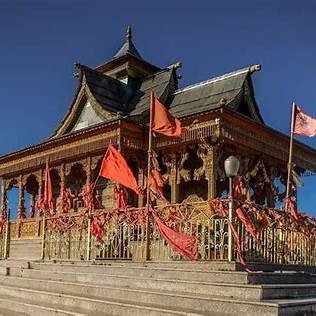
Hatu Mata Temple is one of the most beautiful and spiritually important hilltop temples in the Shimla district of Himachal Pradesh. Situated on the summit of Hatu Peak near Narkanda, the temple stands at an elevation of approximately 3,400 metres above sea level and is surrounded by dense Himalayan forests, apple-growing villages, deep valleys and expansive mountain views.
The temple is dedicated to Hatu Mata, a locally revered manifestation of the Divine Mother commonly associated with Goddess Kali or Goddess Durga. For communities living around Narkanda, Kumarsain, Thanedar, Kotgarh and the surrounding Sutlej valley, Hatu Mata is worshipped as a guardian goddess who protects the region, its villages, forests, orchards and families.
Devotees visit Hatu Mata Temple to seek blessings for courage, protection, prosperity, family welfare, children, health, education, employment and the successful beginning of important journeys. Many local families maintain a deep devotional connection with the goddess and visit the shrine during festivals, family ceremonies and moments of personal significance.
The extraordinary hilltop location makes Hatu Mata Temple much more than a conventional religious attraction. Reaching the temple involves travelling through Narkanda’s forests and ascending towards one of the highest peaks in the wider Shimla region. The journey gradually separates visitors from busy roads, markets and urban surroundings and brings them into a landscape of deodar, fir, spruce, cedar, pine and open mountain sky.
Hatu Peak rises above the Sutlej valley and offers panoramic views across the Himalayan landscape. During clear weather, visitors can see layers of mountain ridges, deep valleys, forests, cultivated slopes and distant snow-covered ranges. The visibility changes constantly according to the season, cloud cover, haze and time of day.
Early morning frequently provides the clearest conditions, although mountain views can never be guaranteed. Clouds may gather quickly around the summit, and the temple can become surrounded by mist even when the weather in Narkanda appears bright.
This changing atmosphere is part of the experience. On a clear day, Hatu Peak feels open and expansive. During mist or cloud, the wooden temple, prayer flags and forest can appear quiet, mysterious and deeply spiritual.
Hatu Mata Temple is known for its distinctive wooden architecture. The shrine reflects traditional Himalayan craftsmanship through carved timber, layered sloping roofs and ornamental detailing suited to the climate of the high mountains.
The sloping roof helps manage rain and snowfall, while the use of wood connects the building with the architectural traditions of Himachal Pradesh. Intricate carvings can be seen around the exterior, pillars, doors and roof edges.
The temple’s appearance differs considerably from the stone shrines of Uttarakhand or the marble temples of the plains. Its wooden structure, dark roof, bright sacred flags and elevated mountain setting create an identity strongly connected with the culture and environment of the upper Shimla hills.
Visitors should observe the carvings carefully without touching, scratching or leaning against the wood. Historic timber can be damaged by repeated handling, moisture and careless photography equipment.
The temple remains an active place of worship rather than only an architectural attraction. Devotees should receive priority near the sanctum and entrance.
Photography of the main deity, inner worship area, priests or ceremonies should only be undertaken when clearly permitted. Even where exterior photography is allowed, visitors should avoid blocking the temple steps or disturbing people engaged in prayer.
Red and saffron flags are commonly visible around the shrine. These colours are associated with Shakti, courage, devotion and divine protection.
Temple bells, sacred cloth and religious threads should not be removed, rearranged or used merely as photography props. Every offering may represent a devotee’s personal prayer or expression of gratitude.
The spiritual identity of Hatu Mata is closely connected with Goddess Kali and Goddess Durga. These forms of the Divine Mother represent courage, protection and the destruction of harmful forces.
Although the goddess may be represented through powerful imagery, devotees approach her as a compassionate mother who protects families and communities during hardship.
For local orchard owners and farming families, worship may also express gratitude for the land, harvest and natural resources supporting village life.
The importance of Hatu Mata therefore extends beyond the temple building. The goddess remains connected with the mountain, forest, weather, agriculture and social traditions of the region.
A pilgrimage to Hatu Mata Temple encourages visitors to recognise the close relationship between Himalayan spirituality and nature. The forest is not merely scenery around the shrine. It forms part of the sacred landscape through which pilgrims approach the goddess.
The traditional journey from Narkanda to Hatu Peak involves an uphill walk of approximately 7 kilometres each way. The route passes through dense forest and provides a rewarding combination of pilgrimage, trekking and nature travel.
The trail is generally regarded as manageable for regular walkers, but the total distance, altitude and gradient should not be underestimated. Visitors who are not accustomed to mountain walking may find the climb demanding.
The elevation difference between Narkanda and Hatu Peak can affect breathing and energy levels. Travellers should walk at a steady pace, rest when necessary and avoid turning the pilgrimage into a race.
Comfortable walking or trekking shoes with reliable grip are strongly recommended. Slippers, formal shoes and smooth-soled footwear may be unsuitable.
Visitors should carry drinking water, light food, essential medication, sun protection, a rain layer and a small first-aid kit.
The weather can change quickly, even during summer. A light jacket or windproof layer should remain in the daypack.
Heavy luggage should be avoided. A small backpack is easier to manage than hand-carried bags.
The forest route may become wet, muddy or slippery during rain. During winter, snow and ice can significantly change the difficulty of the journey.
Travellers should obtain current information from their hotel, homestay host, local driver or tourism authorities before beginning the trek.
Solo visitors should inform someone about their route and expected return time. Mobile connectivity may be inconsistent in forest sections.
Families should supervise children continuously and ensure that they remain on the recognised trail.
Senior citizens and people with heart, breathing, knee or mobility concerns should assess the trek carefully and seek appropriate medical guidance when required.
A motorable road also connects Narkanda with Hatu Peak. The road is narrow, steep and passes through dense forest.
Small cars or suitable mountain vehicles may be able to reach the upper area when road and weather conditions permit. However, vehicle access should never be assumed.
Rain, snow, ice, maintenance work and traffic restrictions can affect the road. During winter, sections may become inaccessible to ordinary vehicles.
Drivers unfamiliar with steep Himalayan roads should not attempt the journey casually. Local taxis and experienced mountain drivers are generally safer options.
Vehicles travelling in opposite directions may have limited space to pass. Visitors should remain patient and follow the guidance of local drivers.
Parking near the summit can become limited during weekends, holidays and festival periods. Travellers should avoid blocking the road or stopping at unsafe bends.
Walking remains the more immersive way to experience the forest, while the road provides improved access for families and travellers unable to complete the full trek.
Visitors can also combine road travel and walking by driving part of the route and continuing on foot when conditions allow.
The final summit area is exposed to wind and sudden weather changes. Temperatures may feel considerably lower than in Narkanda.
Loose scarves, hats and lightweight belongings should be secured. Visitors should avoid exposed edges and follow all safety barriers.
The peak should not be approached during thunderstorms, heavy snowfall, intense rain or conditions considered unsafe by local authorities.
Local religious tradition connects Hatu Peak with the Pandavas of the Mahabharata. According to the widely narrated belief, the Pandavas spent part of their period of incognito exile in this region.
A stove-like stone formation near the temple is traditionally identified as the place where the Pandavas cooked their food.
Visitors may hear the term “Bhim Chulha” or similar local descriptions associated with the formation. The precise name and story can vary between narrators.
These accounts belong to sacred mythology and oral tradition rather than archaeological proof. Their importance lies in the way communities have connected the landscape with the Mahabharata over generations.
The story adds another spiritual dimension to the Hatu Peak journey. Pilgrims can imagine the forest and summit as part of an ancient route associated with endurance, exile and faith.
Visitors should not climb upon, damage or alter stone formations connected with local belief. Even a natural feature can carry significant cultural and religious meaning.
Another local tradition associates Hatu Mata Temple with Mandodari, the wife of Ravana in the Ramayana.
Official tourism descriptions record a belief that Mandodari constructed or was closely connected with the temple. Some accounts even describe the shrine as dedicated to her.
Other sources identify Hatu Mata directly as an incarnation of Goddess Kali or Durga. These different versions reflect the layered nature of Himalayan oral traditions.
Rather than treating one interpretation as conclusively historical, visitors should understand that local temples often preserve multiple narratives developed across different communities and periods.
Mandodari is remembered in the Ramayana as an intelligent and dignified queen who attempted to advise Ravana against destructive choices.
Her traditional connection with Hatu Peak gives the shrine an unusual relationship with the wider Ramayana landscape.
The Pandava and Mandodari stories should be presented respectfully as local beliefs rather than verified historical events.
They add cultural meaning to the pilgrimage but should not overshadow the living worship of Hatu Mata and the importance of the shrine to present-day communities.
The forests surrounding Hatu Peak are among the most important attractions of the journey. Government tourism sources describe a mixed forest containing deodar, fir, spruce, cedar and blue pine.
The dense tree cover creates shade, supports wildlife and gives the trail its peaceful character.
Visitors may hear birds and observe different Himalayan plant species depending on the season. Wildlife sightings are never guaranteed and animals should not be approached, followed or fed.
Birdwatchers should use binoculars and remain quiet. Playing loud recorded calls can disturb natural behaviour.
Forest vegetation should not be cut or removed. Flowers, branches, pine cones and medicinal plants should remain within their natural environment.
Travellers should stay on the established route. Shortcuts can cause soil erosion, damage vegetation and create a risk of becoming lost.
Smoking and open flames present serious forest-fire hazards, especially during dry periods. Cigarette ends, incense and burning materials should never be discarded along the trail.
Every visitor should carry back all plastic bottles, food wrappers and disposable items.
The spiritual value of Hatu Peak depends on preserving the forest that surrounds the temple.
The summit views are another major reason travellers visit Hatu Mata Temple. From the upper area, the landscape opens across the Sutlej valley and surrounding mountain ranges.
The height gives visitors an impression of standing above multiple layers of ridges. Villages, forests and cultivated slopes appear far below.
Sunrise can provide soft mountain light and peaceful conditions, but reaching the peak before dawn requires careful planning, reliable transport or experienced local guidance.
Sunset can also be beautiful, although visitors must preserve enough daylight for the descent or return drive.
Walking through the forest after dark is not advisable for inexperienced visitors.
The summit should not be treated only as a viewpoint. It is first a sacred place, and photography should remain respectful.
Visitors should avoid climbing onto temple walls, railings or exposed rocks to obtain dramatic photographs.
Drones should not be operated without all necessary religious, local, environmental and aviation permissions. Drone noise can disturb worshippers and wildlife.
Hatu Mata Temple may receive larger numbers of devotees during Navratri and local religious occasions.
Navratri is dedicated to the worship of the Divine Mother and is observed twice prominently each year during Chaitra and Sharad Navratri.
Devotees may offer flowers, coconuts, incense, sweets, red cloth and prayers to Maa Hatu.
The usually quiet summit can become more active with temple bells, religious flags, community worship and pilgrimage groups.
Festival dates change according to the Hindu lunar calendar. Travellers should confirm the exact schedule with local sources.
Accommodation in Narkanda and nearby orchard regions may experience increased demand during festivals and holiday weekends.
Visitors should book rooms and transport early and remain prepared for parking limitations or slower movement on the peak road.
The temple is primarily a religious destination during festivals. Photography and sightseeing should not obstruct ceremonies or queues.
Spring is one of the most suitable periods for visiting Hatu Mata Temple. The forest begins to display fresh growth, temperatures become comfortable and walking conditions may improve after winter.
Snow may remain in shaded or higher sections during early spring, depending on the year. Visitors should confirm road and trail conditions locally.
Summer offers pleasant mountain weather and relief from the heat of the plains.
The forest provides shade during the trek, although strong sunlight can be experienced near the open summit.
Summer weekends and holidays may bring more visitors to Narkanda. Advance booking is advisable for popular dates.
The monsoon transforms Hatu Peak into a lush green and misty destination. Clouds move through the forest and the temple may appear surrounded by fog.
Although visually beautiful, the rainy season requires caution. The trail and road can become slippery, and landslides or falling stones may affect mountain travel.
Visitors should carry proper rain protection and avoid trekking during severe rainfall or thunderstorms.
Autumn is among the best seasons for clear views, comfortable walking and photography.
The post-monsoon forest remains green, rainfall usually decreases and distant mountain visibility may improve.
Early morning and evening temperatures become cooler, so layered clothing is useful.
Winter brings snow to Narkanda and Hatu Peak during suitable weather conditions. The landscape can become exceptionally beautiful, but travel is more difficult.
The road to the summit may be blocked, icy or unsuitable for ordinary vehicles. Trekking through snow requires appropriate footwear, clothing, navigation and physical preparation.
Snowfall cannot be guaranteed for any specific travel date.
Visitors seeking a winter pilgrimage should check current weather, road access and local advice before departure.
Thermals, waterproof footwear, gloves, woollen caps and insulated jackets may be necessary.
Daylight hours are shorter in winter, and the return journey should begin early.
Narkanda is the most convenient accommodation base for Hatu Mata Temple.
Situated at approximately 2,708 metres on the historic Hindustan–Tibet road, Narkanda is a small mountain town surrounded by fir forests, apple orchards and Himalayan scenery.
It lies approximately 60 kilometres from Shimla and is known for winter skiing, forest walks and access to Hatu Peak.
Staying in Narkanda allows visitors to begin the trek or road journey early in the morning.
Accommodation includes hotels, guesthouses, cottages, homestays, resorts and budget rooms.
Properties near the main market provide easier access to taxis, shops and restaurants.
Stays on the outskirts may offer quieter surroundings, forest views and greater privacy.
Travellers should check the actual distance from the property to the Hatu Peak route rather than relying only on the word “Narkanda” in the listing.
Mountain properties may be spread across different roads and villages.
Families should check room size, parking, meal availability and heating.
Senior citizens should prioritise direct vehicle access, limited stairs and comfortable bathrooms.
Winter guests should confirm room heating, hot water, power backup and the condition of the approach road.
Homestays around Narkanda can provide a closer experience of Himachali hospitality and local food.
Hosts may assist with information about the Hatu Peak road, trek conditions, taxis and weather.
A homestay can be especially useful for travellers visiting during winter or beginning the trek early.
Guests should maintain realistic expectations regarding facilities in smaller mountain properties.
Thanedar and Kotgarh are excellent alternatives for travellers who want to combine pilgrimage with an orchard-based holiday.
These areas are strongly associated with apple cultivation and offer homestays, cottages, orchard retreats and boutique properties.
Staying within an apple-growing village provides insight into farming traditions, seasonal work and rural life in Himachal Pradesh.
Visitors should enter orchards only with the owner’s permission and should not pick fruit without consent.
Apple blossoms generally appear during spring, while harvesting occurs later according to the variety, elevation and season.
The appearance of orchards changes throughout the year, making every visit different.
MudrasStays can help travellers compare temple-focused accommodation in Narkanda with quieter orchard stays in Thanedar and Kotgarh.
Tanni Jubbar Lake is another nearby attraction that can be combined with Hatu Mata Temple.
The small lake is surrounded by greenery and provides a peaceful location for a short walk, family visit or quiet rest.
Visitors should avoid littering, loud music and behaviour that disturbs the natural setting.
Mahamaya Temple near the wider Narkanda region is another spiritual destination that can be included in a local pilgrimage itinerary.
Travellers can seek blessings at Hatu Mata Temple and explore other regional goddess traditions during the same trip.
Jau Bagh is a meadow area near Hatu Peak associated with nature walks and mountain scenery.
Access conditions and the exact route should be confirmed locally. Visitors should avoid leaving established paths or damaging grasslands.
Narkanda’s ski slopes are popular during the winter season when sufficient snow is available.
Skiing should only be undertaken with suitable equipment and qualified instructors.
Snow conditions change each year, and skiing availability cannot be assumed for a particular date.
Travellers should separate the spiritual purpose of the temple visit from adventure activities and allocate sufficient time to both.
Shimla can be included before or after Narkanda. It offers railway connectivity, extensive accommodation, markets, temples and heritage attractions.
The road from Shimla to Narkanda follows mountain terrain and can take several hours depending on traffic and weather.
Visitors staying in Shimla may undertake a long day trip to Hatu Peak, but an overnight stay in Narkanda provides a more relaxed experience.
A day excursion from Shimla can become tiring when combined with the Hatu trek.
Staying closer allows visitors to begin early, avoid some traffic and experience the mountain town after day visitors leave.
A one-day Hatu Mata pilgrimage is practical for travellers already staying in Narkanda.
Visitors can begin early, walk or drive towards Hatu Peak and attend temple darshan.
Time should be kept for rest, summit views and the return journey.
After returning to Narkanda, travellers can explore the local market or relax at their accommodation.
A two-day itinerary offers a fuller experience.
On the first day, visitors can arrive in Narkanda, check into a hotel or homestay and explore the town or nearby orchards.
The second day can begin early with the Hatu Mata Temple trek or road journey.
After darshan, travellers can visit Tanni Jubbar Lake or another nearby attraction if time and weather permit.
A three-day itinerary can include Narkanda and Hatu Mata Temple on the first two days, followed by Thanedar, Kotgarh or an orchard experience on the third day.
Winter travellers may reserve additional time for skiing, snow conditions and possible road delays.
A longer Himachal pilgrimage can connect Hatu Mata Temple with Bhimakali Temple in Sarahan, Mahamaya Temple, Shimla’s Kali Bari Temple, Tara Devi Temple and other Devi shrines across the region.
Sarahan lies farther along the Sutlej valley and requires a separate road journey. Its Bhimakali Temple is known for traditional Himachali architecture and Shakti worship.
Travellers should avoid attempting Hatu Peak, Sarahan and Shimla within a single rushed day.
Accommodation should be selected according to the road sequence and the primary purpose of each stage.
MudrasStays helps pilgrims discover hotels, cottages, resorts, homestays and orchard retreats near Hatu Mata Temple and Narkanda.
The platform is designed specifically for travellers seeking accommodation close to temples, sacred destinations and pilgrimage routes across India.
Visitors can compare properties according to their practical distance from the Hatu Peak route, budget, room type, group size and preferred facilities.
Booking a stay in Narkanda makes it easier to begin the temple journey early and reduces unnecessary travel before the trek.
Solo pilgrims can search for affordable guesthouses and simple homestays.
Couples can explore private cottages, forest-view rooms and orchard retreats.
Families can select hotels offering meals, parking and larger rooms.
Senior citizens can prioritise properties with accessible entrances and support for arranging a local vehicle.
Pilgrimage groups can identify accommodation offering multiple rooms, vegetarian meals and parking for suitable vehicles.
Winter travellers can select properties based on heating, road access and snow preparedness.
Guests planning orchard experiences can compare stays in Narkanda, Thanedar and Kotgarh.
MudrasStays helps visitors plan a complete spiritual and mountain journey rather than booking a general hotel without understanding its relationship to the temple route.
Responsible travel is particularly important at Hatu Peak because it is both a sacred summit and a sensitive forest environment.
Visitors should carry back all plastic bottles, food wrappers, disposable cups and puja packaging.
Nothing should be thrown into the forest or down the mountain slope.
Religious offerings should be placed only in designated areas.
Synthetic cloth and plastic flags should not be tied randomly to trees.
Smoking and open flames should be avoided because forest fires can spread rapidly.
Travellers should not play loud music along the trail or near the temple.
Birds and wildlife should not be fed, chased or disturbed.
Vehicles should remain on authorised roads and parking areas. Driving off-road can damage vegetation and create erosion.
Visitors should respect local residents, priests, orchard owners and forest workers.
Private farms and orchards should not be entered without permission.
Water should be used responsibly because mountain communities can experience seasonal shortages.
Supporting local homestays, taxis, restaurants, guides and shops helps tourism income reach the communities that maintain the destination.
Hatu Mata Temple represents a powerful meeting of Devi worship, Himachali wooden architecture, forest pilgrimage and Himalayan scenery.
The temple reflects the regional tradition of worshipping the Divine Mother as protector of the mountains and local communities.
The forest journey creates space for patience and reflection.
The summit views remind visitors of the scale of the Himalayas and the dependence of mountain life on weather and nature.
The Pandava story connects the peak with the Mahabharata.
The Mandodari tradition connects it with the Ramayana.
The wooden architecture preserves the craftsmanship of Himachal Pradesh.
The apple orchards connect the pilgrimage with the agricultural identity of Narkanda, Thanedar and Kotgarh.
For devotees of Maa Kali and Maa Durga, Hatu Mata Temple is a place to seek strength, protection and spiritual confidence.
For local families, it remains a guardian shrine connected with regional identity.
For trekkers, the forest route provides a rewarding mountain walk ending at a living temple.
For families, the motorable road can provide improved access when conditions are suitable.
For senior citizens, a carefully arranged local vehicle can reduce the physical demands of the journey.
For nature lovers, the deodar, fir, spruce and pine forests create an immersive Himalayan environment.
For photographers, the wooden temple, flags, forests, valleys and mountain views provide memorable visual opportunities when safety and religious dignity are respected.
For couples, Narkanda’s cottages and orchard stays offer a peaceful mountain escape combined with temple darshan.
For cultural travellers, the shrine provides insight into Himachali architecture, oral traditions and local goddess worship.
Hatu Mata Temple should not be treated merely as a viewpoint or a brief stop during a road journey.
Visitors should allow enough time for darshan, quiet observation and appreciation of the forest and architecture.
Staying in Narkanda allows travellers to experience the temple at a comfortable pace and respond safely to changing mountain weather.
Plan your pilgrimage to Hatu Mata Temple with MudrasStays and experience one of the most beautiful hilltop Devi shrines in Himachal Pradesh.
Seek the blessings of Maa Hatu, walk through the dense forests of Narkanda and experience panoramic views from the summit of Hatu Peak.
Learn about the local traditions associated with the Pandavas, Mandodari and the spiritual heritage of the upper Shimla hills.
Combine your journey with Narkanda, Tanni Jubbar Lake, Jau Bagh, Mahamaya Temple, Thanedar, Kotgarh, Sarahan and Shimla.
Book hotels near Hatu Mata Temple, discover cottages and resorts in Narkanda, and explore orchard homestays in Thanedar and Kotgarh through MudrasStays.
Stay closer to the pilgrimage route, begin the temple journey early and reduce unnecessary travel on narrow mountain roads.
MudrasStays connects pilgrims, families and spiritual travellers with suitable accommodation near temples and sacred destinations across India.
Begin your Hatu Mata Temple journey with a comfortable stay and experience a meaningful pilgrimage centred on Goddess worship, Himachali culture, forest trekking, apple orchards and the natural beauty of the Himalayas.