
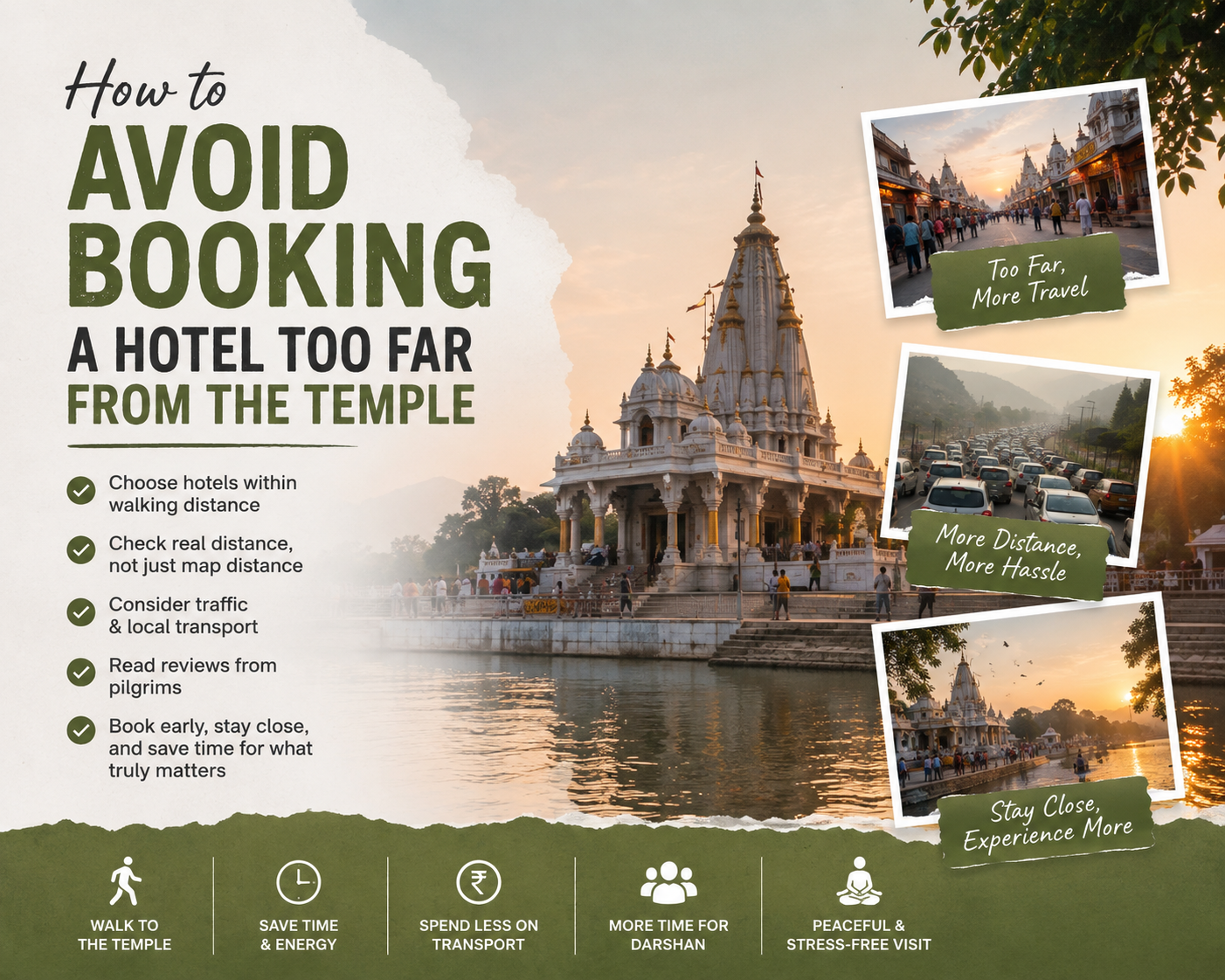
One of the easiest mistakes to make while planning a pilgrimage is booking a hotel that looks convenient online but turns out to be much farther from the temple than expected. A property may be located within the same city, appear close on a map, or even use words such as “near temple” in its description, yet the actual journey to darshan may involve long drives, crowded roads, vehicle restrictions, or considerable walking.
For ordinary sightseeing, staying a few kilometres away from a major attraction may not create much inconvenience. During a pilgrimage, however, hotel location can directly influence early morning darshan, evening aarti, senior citizen comfort, transportation expenses, family coordination, and the amount of time available for the spiritual experience itself.
Mudras Stays helps pilgrims focus on best and budget-friendly hotels near temples rather than simply accommodation somewhere within the destination. Understanding how to verify actual temple proximity before booking can prevent unnecessary travel, additional expenses, and avoidable stress during your journey.
WHY BOOKING TOO FAR FROM THE TEMPLE CAN BECOME A PROBLEM
A distant hotel may initially seem attractive because it offers a lower room rate, better photographs, larger rooms, or a higher star category. The problem often becomes visible only after arrival.
Travelers may discover that they need to:
- Arrange taxis or autos for every temple visit.
- Wake up much earlier for morning darshan.
- Spend additional time in traffic.
- Pay repeated local transportation charges.
- Walk from distant vehicle drop-off points.
- Coordinate several family members every time they leave the hotel.
- Skip evening aarti because returning to the temple feels inconvenient.
This is why temple distance should be treated as one of the most important parts of pilgrimage hotel booking.
WHAT DOES “TOO FAR FROM THE TEMPLE” ACTUALLY MEAN?
There is no single number of kilometres that automatically makes a hotel too far away. The practical distance depends on the destination and the traveler.
A hotel three kilometres away may be convenient if there is a direct road and reliable transportation. Another hotel only one kilometre away may be inconvenient if the route passes through congested lanes, restricted areas, steep roads, or difficult walking sections.
Instead of judging distance alone, pilgrims should consider:
- Actual travel time.
- Walking distance.
- Vehicle restrictions.
- Temple entry gate location.
- Traffic conditions.
- Availability of local transport.
- Mobility of the travelers.
The hotel becomes “too far” when reaching the temple repeatedly creates unnecessary effort, expense, or disruption to the pilgrimage.
START WITH THE TEMPLE, NOT THE HOTEL
A common hotel booking habit is to search the destination city first and then compare properties. For pilgrimage travel, it is often better to reverse this process.
Start by identifying:
- The exact temple you are visiting.
- The main visitor entrance.
- The area immediately surrounding the temple.
- Nearby accommodation zones.
- Road and walking access.
Only after understanding the temple area should you begin comparing hotels.
This approach reduces the risk of selecting a property that is technically located in the destination but practically inconvenient for darshan.
BEST AND BUDGET-FRIENDLY HOTELS NEAR TEMPLES WITH MUDRAS STAYS
Mudras Stays focuses specifically on spiritual destinations and pilgrimage accommodation, helping travelers evaluate hotels according to the needs of devotees.
Best and budget-friendly hotels by Mudras Stays can be compared according to:
- Actual temple proximity.
- Walking convenience.
- Vehicle accessibility.
- Accommodation price.
- Family room requirements.
- Senior citizen comfort.
- Nearby vegetarian food.
- Overall pilgrimage convenience.
The objective is not to find the closest property at any cost. It is to find accommodation close enough to support the pilgrimage while still meeting comfort and budget requirements.
CHECK THE ACTUAL TEMPLE ENTRANCE
One of the most overlooked hotel-booking details is the location of the temple entrance.
A hotel can appear extremely close to the temple complex on a map but be situated on the opposite side from the gate used by visitors. The traveler may then need to walk around the entire complex or take a longer road route.
Before booking, check:
- Which temple gate is used by general visitors.
- Whether different gates operate at different times.
- How far the hotel is from the relevant entrance.
- Whether the route is walkable.
- Whether vehicles can approach the gate.
For large temple complexes, the entrance location can matter almost as much as the hotel-to-temple distance.
DO NOT TRUST STRAIGHT-LINE MAP DISTANCE ALONE
Map applications can show that a hotel is only a short distance from a temple, but this does not automatically represent the actual route.
The practical journey may involve:
- One-way roads.
- Pedestrian-only lanes.
- Temple security zones.
- Narrow market streets.
- Traffic diversions.
- Restricted vehicle access.
Always use the actual walking or driving route rather than relying only on the distance displayed between two map points.
CHECK TRAVEL TIME, NOT JUST KILOMETRES
Two hotels may be located approximately the same distance from the temple but have very different travel times.
For example:
- One hotel may have direct road access.
- Another may require navigating crowded local streets.
- One may allow autos to stop nearby.
- Another may require a longer final walk.
When comparing hotels, check how many minutes the journey actually takes during the times you expect to visit the temple.
CHECK THE WALKING ROUTE BEFORE BOOKING
If a property advertises itself as being within walking distance of the temple, verify the route carefully.
Check whether the walk includes:
- Steep slopes.
- Stairs.
- Uneven roads.
- Heavy crowds.
- Narrow streets.
- Long stretches without seating.
A 700-metre walk on a comfortable road may be easy, while a shorter route through steep or crowded streets can be physically demanding.
WHY WALKING DISTANCE IS DIFFERENT FOR EVERY TRAVELER
A young solo pilgrim and a senior citizen family group may define walking distance very differently.
Before booking, consider:
- Age of travelers.
- Mobility.
- Children in the group.
- Weather.
- Amount of walking required inside the temple area.
- Whether the route must be completed several times.
The most important question is not whether the hotel is technically walkable. It is whether everyone travelling with you can comfortably manage the route.
CHECK THE HOTEL-TO-TEMPLE ROUTE AT THE TIME YOU PLAN TO VISIT
A route that takes ten minutes in the afternoon may take much longer during peak darshan periods.
Travel conditions may change during:
- Early morning darshan.
- Evening aarti.
- Weekends.
- Religious festivals.
- Public holidays.
- Major pilgrimage seasons.
When possible, evaluate hotel location according to the temple timing you actually plan to follow.
WHY DISTANCE MATTERS FOR EARLY MORNING DARSHAN
Early morning darshan can become considerably more complicated when the hotel is far away.
A distant property may require travelers to:
- Wake up much earlier.
- Arrange transportation before sunrise.
- Wait for taxis or autos.
- Allow additional time for traffic.
- Coordinate several family members very early.
Staying closer can simplify the morning and allow pilgrims to focus more on the spiritual experience.
WHY DISTANCE MATTERS FOR EVENING AARTI
Many devotees want to return to the temple in the evening after completing morning darshan.
A distant hotel can make this second visit feel inconvenient, especially after a full day of walking or sightseeing.
A nearby stay allows travelers to:
- Return to the hotel after morning darshan.
- Rest.
- Have a meal.
- Freshen up.
- Return for evening rituals.
This flexibility is one of the strongest reasons to choose accommodation reasonably close to the temple.
CALCULATE HOW MANY TIMES YOU WILL TRAVEL TO THE TEMPLE
The number of temple visits should influence how much distance is acceptable.
If you are planning only one temple visit, a slightly farther hotel may be manageable.
If you plan to visit the temple:
- Early in the morning.
- Again during the day.
- For evening aarti.
- On multiple days.
then staying closer can save substantial time and transportation costs.
CALCULATE THE TOTAL TRANSPORTATION COST BEFORE CHOOSING A CHEAPER HOTEL
One of the biggest reasons travelers book farther away is lower room pricing.
Before assuming the distant property is cheaper, calculate:
- Taxi fare to the temple.
- Auto-rickshaw fare.
- Number of daily trips.
- Parking charges.
- Fuel expenses.
- Number of nights.
A hotel that saves ₹300 per night may not actually be cheaper if the family spends several hundred rupees each day travelling to and from the temple.
THE CHEAPEST HOTEL IS NOT ALWAYS THE MOST BUDGET-FRIENDLY
Budget-friendly pilgrimage travel should be measured according to the total cost of the journey rather than simply the room rate.
A well-located hotel may:
- Reduce taxi expenses.
- Reduce fuel usage.
- Save parking charges.
- Reduce travel time.
- Allow travelers to walk where practical.
This is why Mudras Stays encourages devotees to compare affordable hotels near temples according to overall pilgrimage value.
WHY LOCATION CAN MATTER MORE THAN STAR RATING
A premium hotel located far from the temple may offer excellent amenities but still create daily inconvenience.
During pilgrimage travel, visitors often spend most of the day outside the hotel. The facilities that matter most may simply be:
- Clean room.
- Comfortable bed.
- Hygienic bathroom.
- Temple access.
- Nearby meals.
- Safe surroundings.
A comfortable budget or mid-range hotel close to the temple can therefore provide better pilgrimage value than a luxury hotel requiring a long commute.
DO NOT IGNORE VEHICLE RESTRICTIONS
Some major temple areas limit private vehicles or restrict traffic during certain hours.
A hotel may appear close by road, but your taxi may not actually be allowed to take you directly to the temple.
Before booking, check:
- Where vehicles are permitted.
- Where the final drop-off point is located.
- Whether autos can enter the temple area.
- How far you must walk after drop-off.
This is particularly important for families travelling with elderly parents.
CHECK WHETHER THE HOTEL ITSELF HAS EASY VEHICLE ACCESS
Some properties close to historic temples are located inside narrow lanes where vehicles cannot reach the entrance.
This may mean carrying luggage from a distant road or parking location.
Before booking, ask:
- Can a taxi reach the hotel entrance?
- Can a private car reach the property?
- Is luggage assistance available?
- How far is the nearest vehicle drop-off?
A hotel close to the temple but difficult to access can create problems during arrival and departure.
FAMILIES SHOULD CONSIDER THE COMPLETE GROUP
When travelling as a family, hotel location should be suitable for the least mobile person in the group rather than only the person making the booking.
Families should consider:
- Young children.
- Senior citizens.
- Travelers with mobility difficulties.
- Amount of luggage.
- Need for frequent rest.
A hotel that feels conveniently located for one traveler may be exhausting for another.
HOW FAR IS TOO FAR FOR SENIOR CITIZENS?
There is no universal distance because senior citizens have different mobility levels.
Instead of selecting a fixed number of metres, prioritize:
- Short walking requirements.
- Vehicle access.
- Minimal stairs.
- Easy hotel entrance.
- Nearby food.
- Comfortable room location.
A slightly farther hotel with a direct vehicle route can sometimes be better for elderly pilgrims than a closer hotel requiring difficult walking.
HOW FAR IS TOO FAR FOR FAMILIES WITH CHILDREN?
Young children may become tired after temple queues, walking, and sightseeing.
A nearby hotel makes it easier to return for:
- Naps.
- Meals.
- Changing clothes.
- Rest.
- Unexpected breaks.
For family pilgrimages, being able to return to the hotel easily can be more valuable than saving a small amount on the room price.
HOW FAR IS TOO FAR FOR A ONE-NIGHT TEMPLE TRIP?
If you are visiting a pilgrimage destination for only one night, staying far from the temple can consume a large portion of your limited time.
For short trips, convenient temple proximity generally becomes more important because travelers want to maximize time available for:
- Darshan.
- Aarti.
- Nearby spiritual attractions.
- Rest.
A hotel closer to the temple can often make a one-night pilgrimage much more efficient.
WHEN A FARTHER HOTEL CAN STILL MAKE SENSE
Not every property farther from the temple is a bad choice.
A slightly more distant hotel can make sense when it offers:
- Reliable direct transport to the temple.
- Large family rooms.
- Better accessibility.
- Secure parking.
- Quieter surroundings.
- Significantly better overall value.
The key is ensuring that the distance does not create excessive daily travel.
WHEN PARKING MAKES A FARTHER HOTEL MORE PRACTICAL
Travelers arriving by private car should carefully assess parking.
Hotels immediately around famous temples may have limited or no parking because of:
- Narrow roads.
- Pedestrian areas.
- Historic streets.
- Traffic restrictions.
In this situation, staying slightly farther away with proper parking can provide greater convenience, provided temple transport remains easy.
CHECK WHETHER LOCAL TRANSPORT IS AVAILABLE EARLY AND LATE
A hotel may be only a short drive from the temple, but that advantage disappears if transportation is difficult to find at the times you need it.
Check transport availability for:
- Early morning darshan.
- Late evening aarti.
- Festival periods.
- Weekends.
If reliable transportation is uncertain, choosing a closer hotel may be safer and more practical.
CHECK NEARBY FOOD BEFORE CHOOSING A DISTANT PROPERTY
A distant hotel may also be located away from restaurants and local services.
Families should check for convenient access to:
- Vegetarian restaurants.
- Breakfast.
- Tea and snacks.
- Simple family meals.
- Medical stores.
A property located close to both the temple and essential services can significantly simplify a pilgrimage.
WHY TEMPLE FESTIVALS MAKE DISTANCE EVEN MORE IMPORTANT
During major festivals, road congestion, pedestrian crowds, and traffic restrictions can dramatically increase travel times.
A hotel that normally takes fifteen minutes to reach may require much longer during a peak pilgrimage period.
Travelers visiting during festivals should check:
- Likely road closures.
- Vehicle restrictions.
- Expected crowd levels.
- Walking access.
- Temple-area transportation.
During particularly busy periods, a genuinely walkable hotel can become extremely valuable.
WHY LAST-MINUTE BOOKINGS OFTEN LEAD TO DISTANT HOTELS
Hotels closest to famous temples are often among the first properties to fill during weekends, holidays, festivals, and peak pilgrimage seasons.
Travelers booking late may find that only distant accommodation remains within their preferred budget.
Booking earlier can provide greater choice among:
- Hotels near temples.
- Budget-friendly stays.
- Family rooms.
- Senior citizen-friendly properties.
- Hotels with practical road access.
DO NOT ASSUME “CITY CENTRE” MEANS “NEAR THE TEMPLE”
Many hotel platforms classify properties according to city-center distance. This can be useful for general tourism but may not be useful for pilgrimage travel.
The city center and the temple area may be located in different parts of the destination.
Always search according to the specific temple rather than relying only on central-city location.
DO NOT ASSUME THE HOTEL NAME GUARANTEES TEMPLE PROXIMITY
Some hotel names may include the temple, pilgrimage area, or spiritual destination.
Never assume the property is within walking distance based only on its name.
Verify:
- Exact address.
- Map location.
- Temple entrance distance.
- Driving route.
- Walking route.
READ REVIEWS FOR LOCATION-SPECIFIC COMMENTS
Guest reviews can provide useful clues about whether a hotel is genuinely convenient for pilgrims.
Look specifically for comments about:
- Temple walking time.
- Availability of autos.
- Road access.
- Parking.
- Stairs and slopes.
- Senior citizen convenience.
- Actual distance versus advertised distance.
Location-related reviews can often reveal practical information that is not obvious from property photographs.
COMPARE WALKING DISTANCE AND DRIVING DISTANCE SEPARATELY
Some temples are located in areas where driving routes are much longer than walking routes.
A hotel might be:
- Ten minutes away on foot.
- Twenty-five minutes away by car because of one-way roads.
Another property may have the opposite situation.
Compare both routes before deciding which location works better for your travel group.
HOW TO COMPARE TWO HOTELS AT DIFFERENT DISTANCES
If one property is closer but more expensive and another is farther but cheaper, compare the complete value.
- Calculate the room price for the complete stay.
- Check actual temple travel time.
- Calculate transportation costs.
- Check walking requirements.
- Compare family room options.
- Review senior citizen accessibility.
- Check food availability.
- Consider early morning and evening temple visits.
- Compare parking and vehicle access.
- Select the option requiring the least unnecessary effort.
WHAT ABOUT MULTI-TEMPLE PILGRIMAGES?
If your destination includes several important temples, staying directly beside one temple may not always be ideal.
A more central hotel can sometimes reduce total travel between:
- Multiple temples.
- Ghats.
- Religious sites.
- Markets.
- Transport points.
The best location should reflect the complete pilgrimage itinerary rather than only one attraction.
WHAT ABOUT MOUNTAIN PILGRIMAGE DESTINATIONS?
Distance requires even more careful interpretation in hill and mountain pilgrimage destinations.
A location that appears geographically close may involve:
- Steep roads.
- Trekking.
- Changing altitude.
- Limited vehicle access.
- Weather-related delays.
For mountain pilgrimages, evaluate actual route difficulty rather than kilometres alone.
WHAT ABOUT TEMPLES INSIDE OLD CITY AREAS?
Many important temples are located inside historic neighborhoods where roads can be narrow and vehicle access limited.
In such destinations, a hotel close enough to walk may provide excellent access, but families should verify:
- Luggage movement.
- Hotel vehicle access.
- Crowd levels.
- Walking conditions.
- Senior citizen mobility.
Proximity should always be evaluated together with accessibility.
WHAT TO CHECK BEFORE CONFIRMING ANY HOTEL NEAR A TEMPLE
Before making payment, verify:
- Exact hotel address.
- Actual temple entrance distance.
- Walking route.
- Driving route.
- Expected travel time.
- Vehicle restrictions.
- Local transport availability.
- Parking.
- Family room capacity.
- Senior citizen accessibility.
- Nearby food.
- Check-in and check-out timings.
- Final payable amount.
A SIMPLE WAY TO AVOID BOOKING TOO FAR FROM THE TEMPLE
- Search for the exact temple on a map.
- Identify the visitor entrance.
- Study the surrounding accommodation area.
- Shortlist hotels within a practical radius.
- Check actual walking routes.
- Check actual driving routes.
- Calculate local transportation costs.
- Consider family and senior citizen mobility.
- Compare total hotel value.
- Book before the closest practical properties sell out.
HOW MUDRAS STAYS HELPS DEVOTEES FIND PRACTICAL TEMPLE LOCATIONS
Mudras Stays is focused on spiritual travel and temple accommodation, helping pilgrims search according to the sacred destination rather than only the city.
Travelers can explore:
- Hotels near temples
- Best hotels near temples
- Budget hotels near temples
- Family-friendly pilgrimage stays.
- Senior citizen-friendly accommodation.
- Practical temple locations.
- Affordable spiritual travel stays.
This temple-focused approach can reduce the risk of booking accommodation that is technically within the destination but unnecessarily far from the actual pilgrimage area.
WHY A PILGRIMAGE-FOCUSED HOTEL SEARCH MAKES SENSE
General hotel searches may prioritize city centers, popular tourist areas, airports, or business districts. Pilgrims have a different priority: the sacred destination.
A pilgrimage-focused search starts with questions such as:
- Which temple are you visiting?
- How close should you stay?
- Can everyone comfortably reach the temple?
- What will transportation cost?
- Does the hotel location support darshan timings?
These questions make hotel selection more relevant to the actual purpose of the journey.
THE RIGHT HOTEL SHOULD REDUCE TRAVEL, NOT ADD TO IT
Temple travel can already involve long journeys, queues, walking, rituals, and multiple spiritual attractions. The hotel should provide a place to rest and simplify the pilgrimage rather than adding another long commute every day.
The best location is usually one that provides a sensible balance of:
- Temple proximity.
- Accessibility.
- Comfort.
- Affordability.
- Food availability.
- Transportation.
FIND A BETTER-LOCATED TEMPLE STAY WITH MUDRAS STAYS
Avoiding a hotel that is too far from the temple begins with checking actual routes rather than trusting broad location descriptions. Compare walking time, transport availability, temple gates, family mobility, senior citizen needs, and total travel costs before confirming your stay.
Mudras Stays helps devotees explore best and budget-friendly hotels near temples with greater focus on practical pilgrimage locations, family comfort, accessibility, and affordable spiritual travel.
EXPLORE WELL-LOCATED TEMPLE HOTELS WITH MUDRAS STAYS
FREQUENTLY ASKED QUESTIONS
How do I know if a hotel is too far from the temple?
Check actual travel time, walking distance, transport costs, vehicle restrictions, and how often you plan to visit the temple. A hotel is too far when reaching the temple repeatedly becomes inconvenient or expensive.
How many kilometres from a temple is considered close?
There is no universal distance. A direct three-kilometre route may be easier than a one-kilometre route through congested lanes. Practical travel time matters more than kilometres alone.
Should I always choose the closest hotel?
No. The closest hotel may have difficult access, limited parking, small rooms, or unsuitable walking conditions. Compare proximity with comfort, accessibility, and budget.
How can I check the real distance to a temple?
Identify the actual temple entrance, then check both walking and driving routes. Review road restrictions, traffic conditions, and the final distance from vehicle drop-off to the temple.
Why is hotel distance especially important for senior citizens?
Long walking routes, repeated transport, stairs, and difficult vehicle access can increase fatigue. Senior travelers should prioritize the route requiring the least physical effort.
Is a cheaper hotel farther from the temple really cheaper?
Not always. Add daily taxi, auto-rickshaw, fuel, and parking costs before comparing the total price with a closer property.
What should families consider when checking temple distance?
Families should consider children, elderly relatives, walking conditions, food access, local transport, and whether they may need to return to the hotel during the day.
Does “near temple” in a hotel listing guarantee walking distance?
No. “Near” can be used broadly. Always verify the exact address, actual route, temple entrance, and travel time before booking.
How does Mudras Stays help pilgrims find better hotel locations?
Mudras Stays focuses on spiritual destinations and helps travelers explore best and budget-friendly hotels according to temple proximity, family requirements, accessibility, and pilgrimage convenience.
Where can I search for Hotels near temples?
Travelers can use Mudras Stays to explore pilgrimage-focused accommodation according to destination, temple location, budget, family size, and travel requirements.