
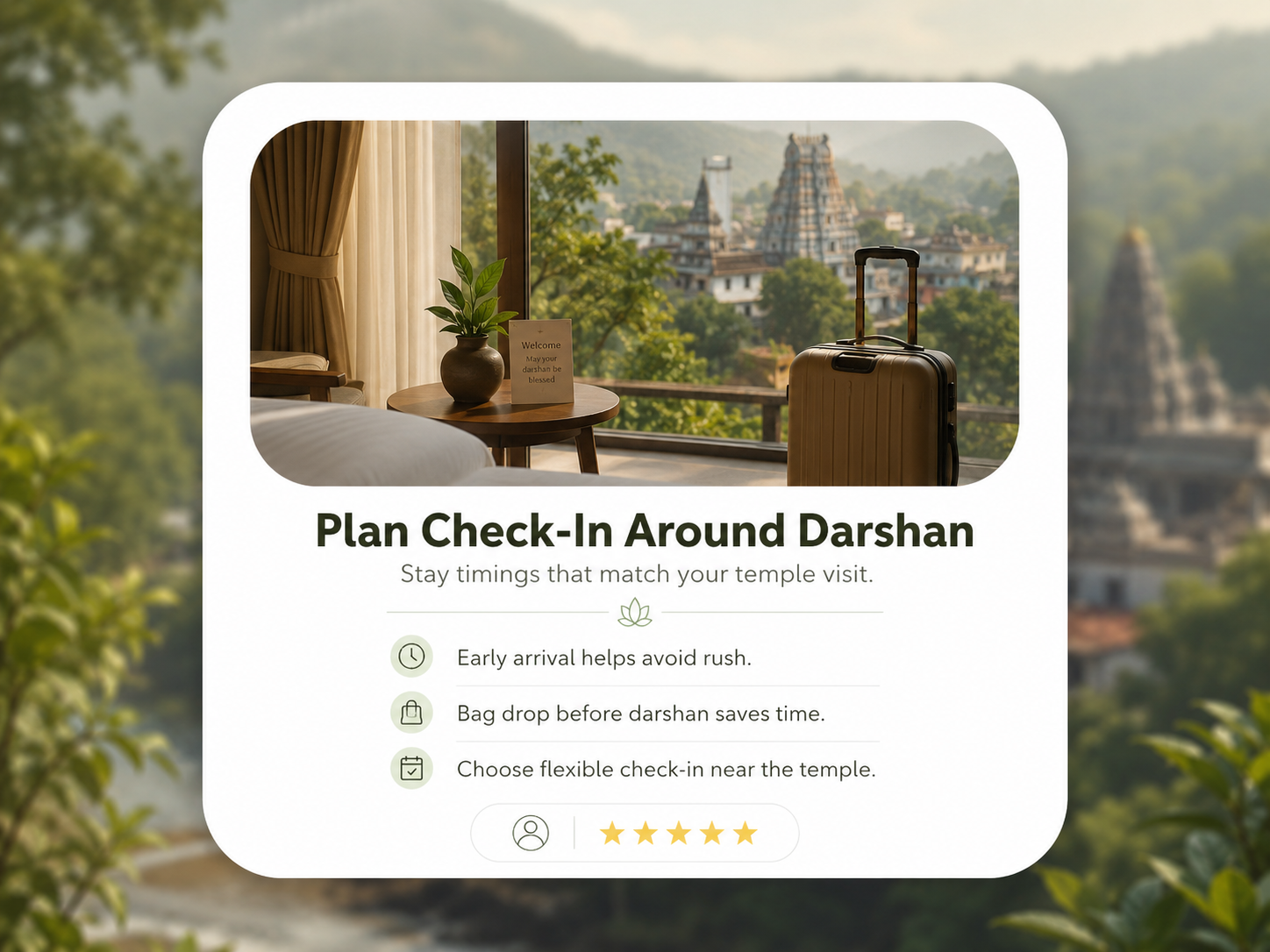
Hotel check-in may look like a small part of pilgrimage planning, but it can strongly influence how comfortable and organized your temple visit feels. A traveler who reaches a destination at 6:00 AM for morning darshan may face a problem if the hotel allows check-in only in the afternoon. Similarly, a family planning evening darshan may struggle if the room must be vacated several hours before their train or bus departure.
This is why pilgrims should plan hotel check-in and check-out around temple darshan timings rather than treating accommodation and temple visits as separate parts of the journey. A well-planned hotel schedule can help travelers rest after long journeys, freshen up before darshan, store luggage safely, and avoid unnecessary waiting.
Mudras Stays helps devotees explore best and budget-friendly hotels near temples while considering the practical needs of pilgrimage travel. When selecting accommodation, travelers should compare not only location and room price but also whether hotel timings actually support their darshan itinerary.
WHY HOTEL CHECK-IN TIMINGS MATTER DURING A PILGRIMAGE
Temple travel often operates on a different schedule from conventional leisure travel. Pilgrims may arrive before sunrise, attend early morning rituals, spend several hours in darshan queues, or plan temple visits late into the evening.
Standard hotel check-in times may not always align naturally with these schedules.
If accommodation timing is poorly planned, travelers may face:
- Several hours of waiting before receiving a room.
- Difficulty freshening up before temple darshan.
- Problems storing luggage.
- Extra charges for early check-in.
- Unnecessary fatigue for children and senior citizens.
- Pressure to rush temple visits before check-out.
For this reason, check-in and check-out should be treated as part of the pilgrimage itinerary from the beginning.
START WITH YOUR DARSHAN TIME, NOT YOUR HOTEL CHECK-IN TIME
A practical way to plan accommodation is to first determine the approximate temple schedule and then select hotel arrangements around it.
Ask yourself:
- What time do I expect to reach the destination?
- When do I want to visit the temple?
- Will I need to freshen up before darshan?
- Will children or senior citizens need rest after arrival?
- How long might the temple visit take?
- What time is my onward train, bus, or flight?
Once these questions are answered, hotel timing becomes much easier to plan.
ARRIVING EARLY MORNING: WHAT SHOULD PILGRIMS DO?
Early morning arrival is common during pilgrimage travel because overnight trains and buses often reach spiritual destinations before normal hotel check-in times.
If your train reaches the city at 5:00 AM or 6:00 AM and you plan darshan shortly afterward, waiting until afternoon for a room may be uncomfortable.
Travelers should check whether the hotel offers:
- Early check-in.
- Paid early check-in.
- Luggage storage.
- A common washroom or freshening-up facility.
- A reception area where guests can wait.
These details can be particularly important when booking hotels near temples for short pilgrimages.
WHEN EARLY CHECK-IN IS WORTH PAYING FOR
Paying an additional amount for early check-in can sometimes provide excellent value during a pilgrimage.
It may be worth considering when:
- You have travelled overnight.
- You are travelling with elderly parents.
- You have young children.
- Your darshan is scheduled later in the morning.
- You need to bathe and change clothes before visiting the temple.
- You expect a physically demanding temple visit.
The value of early check-in should be measured against comfort, not simply the additional room charge.
WHEN BOOKING THE PREVIOUS NIGHT MAY BE BETTER
If you expect to arrive very early and need guaranteed room access, booking the hotel from the previous night can sometimes be more reliable than depending on early check-in availability.
This may make sense when:
- You are arriving before sunrise.
- The hotel cannot guarantee early check-in.
- You are travelling during a festival or peak pilgrimage period.
- Senior citizens need immediate rest.
- The family needs time to prepare before darshan.
Although this adds the cost of another night, it can prevent uncertainty and make the first day of the pilgrimage much smoother.
BEST AND BUDGET-FRIENDLY HOTELS BY MUDRAS STAYS
Mudras Stays focuses on spiritual destinations and helps travelers compare accommodation according to actual pilgrimage requirements rather than generic hotel features alone.
Best and budget-friendly hotels by Mudras Stays can be considered according to:
- Temple proximity.
- Check-in timing.
- Check-out timing.
- Early check-in options.
- Luggage storage.
- Family room availability.
- Senior citizen accessibility.
- Room price.
- Overall pilgrimage convenience.
A budget-friendly hotel can provide excellent value if its policies and location work well with the traveler's darshan plan.
HOW TO PLAN CHECK-IN FOR EARLY MORNING DARSHAN
If your priority is early morning darshan, the hotel plan should support the previous evening or very early arrival.
Possible strategies include:
- Arriving the previous evening and checking in normally.
- Booking the previous night if arriving before standard check-in.
- Confirming guaranteed early check-in.
- Choosing accommodation within practical distance of the temple.
For many travelers, arriving the previous evening is the least stressful option because it provides enough time to rest, eat, prepare, and reach the temple early the following morning.
WHY ARRIVING THE PREVIOUS EVENING CAN IMPROVE DARSHAN
A same-day arrival followed immediately by temple darshan can create unnecessary pressure, particularly after a long journey.
Arriving the previous evening allows travelers to:
- Check into the hotel without rushing.
- Organize luggage.
- Have dinner.
- Rest properly.
- Prepare clothing and temple essentials.
- Wake up fresh for darshan.
This can be especially helpful for senior citizens and families with children.
HOW TO PLAN CHECK-IN FOR AFTERNOON DARSHAN
Afternoon darshan can often work well with standard hotel timings if travelers arrive around midday.
A practical sequence may be:
- Reach the destination.
- Complete hotel check-in.
- Freshen up.
- Have a light meal.
- Rest briefly.
- Proceed for temple darshan.
This can create a more comfortable first day because travelers avoid carrying luggage directly to the temple area.
HOW TO PLAN CHECK-IN FOR EVENING DARSHAN
If the main temple visit is planned for the evening, hotel check-in should ideally happen several hours earlier.
This gives travelers enough time to:
- Settle into the room.
- Rest after travel.
- Freshen up.
- Have a meal.
- Reach the temple before peak evening crowds where possible.
A rushed arrival shortly before evening darshan can create unnecessary pressure, particularly in busy spiritual destinations.
HOW HOTEL LOCATION AFFECTS CHECK-IN PLANNING
A hotel located close to the temple can reduce the amount of buffer time required between check-in and darshan.
For example, a property within practical walking distance may allow travelers to leave the hotel shortly before the planned temple visit. A hotel farther away may require more time for:
- Finding transportation.
- Traffic.
- Parking.
- Walking from the vehicle drop-off point.
Travelers should therefore combine hotel check-in timing with temple distance when planning the day.
WHY HOTELS NEAR TEMPLES CAN MAKE CHECK-IN EASIER
Hotels near temples can provide greater flexibility because travelers may be able to return to the room easily between different parts of the pilgrimage.
This can be useful when:
- Darshan queues are longer than expected.
- Children become tired.
- Senior citizens need rest.
- The family wants to return for evening rituals.
A practical location can therefore improve the value of the hotel beyond simply saving transportation time.
HOW TO PLAN CHECK-OUT AROUND MORNING DARSHAN
Morning darshan and hotel check-out can sometimes create scheduling conflicts.
If standard check-out is late morning, travelers need to estimate whether they can comfortably complete darshan and return before the room must be vacated.
Before leaving for the temple, consider:
- Expected queue time.
- Distance from hotel to temple.
- Return travel time.
- Breakfast requirements.
- Time required to pack.
If the schedule looks tight, it may be better to pack before leaving for the temple.
PACK BEFORE DARSHAN WHEN CHECK-OUT IS CLOSE
If your temple visit is scheduled close to hotel check-out time, preparing luggage beforehand can prevent unnecessary stress.
A simple routine can be:
- Pack most luggage the previous night.
- Keep only morning essentials outside.
- Complete morning darshan.
- Return to the hotel.
- Freshen up if time allows.
- Complete check-out.
This can be especially useful during short one-night pilgrimages.
WHAT IF DARSHAN TAKES LONGER THAN EXPECTED?
Temple queues can be unpredictable, particularly during weekends, holidays, religious festivals, and peak pilgrimage periods.
Travelers should avoid planning check-out with no buffer.
Possible solutions include:
- Requesting late check-out.
- Completing check-out before darshan.
- Leaving luggage at hotel reception.
- Booking an additional night if the itinerary requires substantial flexibility.
Always confirm whether luggage storage is available before relying on it.
WHY LUGGAGE STORAGE CAN BE VERY USEFUL FOR PILGRIMS
Luggage storage can solve several scheduling problems when temple timings and hotel timings do not align.
It can allow travelers to:
- Check out in the morning.
- Leave bags securely at the hotel.
- Visit the temple.
- Explore nearby spiritual attractions.
- Collect luggage before departure.
This can prevent the need to book an additional night purely for luggage convenience.
CHECK WHETHER LUGGAGE STORAGE IS FREE
Do not assume every hotel provides free luggage storage.
Before booking, ask:
- Whether luggage can be stored before check-in.
- Whether luggage can be stored after check-out.
- Whether there is any additional charge.
- How long luggage can remain at the property.
This small detail can make a major difference during short pilgrimages.
HOW FAMILIES SHOULD PLAN HOTEL CHECK-IN
Families generally need more time between arrival and temple visits than solo travelers.
They may need time to:
- Check into multiple rooms.
- Organize children's belongings.
- Help elderly parents settle.
- Freshen up.
- Have meals.
- Prepare for temple visits.
Families should therefore avoid scheduling important darshan immediately after their expected arrival time.
HOW SENIOR CITIZENS SHOULD PLAN CHECK-IN
Senior citizen pilgrims may require adequate rest after long road, rail, or air journeys.
A good senior-friendly itinerary should allow time for:
- Hotel check-in.
- Rest.
- Medication.
- Meals.
- Freshening up.
- Slow preparation for darshan.
Trying to move directly from a long journey into a crowded temple visit can make the pilgrimage unnecessarily exhausting.
WHY EARLY CHECK-IN IS MORE IMPORTANT FOR SENIOR CITIZENS
If elderly travelers arrive early in the morning, waiting several hours for the hotel room can be particularly uncomfortable.
Families should consider:
- Pre-booking the previous night.
- Requesting confirmed early check-in.
- Choosing a hotel with a comfortable waiting area.
- Checking whether washroom facilities are available before check-in.
These practical arrangements can significantly improve the travel experience.
HOW SOLO PILGRIMS CAN PLAN CHECK-IN MORE FLEXIBLY
Solo travelers often have greater flexibility because they can move quickly and may carry less luggage.
A solo pilgrim arriving before check-in might:
- Leave luggage at the hotel.
- Proceed directly for darshan.
- Return later for check-in.
However, this approach works best when the traveler is comfortable, the luggage storage arrangement is confirmed, and the temple is conveniently accessible.
HOW GROUP PILGRIMS SHOULD PLAN CHECK-IN
Large pilgrimage groups require significantly more time for hotel check-in because several rooms and travelers need to be coordinated.
Group organizers should consider:
- Room allocation.
- Guest identification requirements.
- Luggage distribution.
- Senior citizen assistance.
- Meal timing.
- Transport to the temple.
Groups should avoid planning temple departure immediately after the estimated hotel arrival time.
WHY GROUP CHECK-IN SHOULD BE PRE-COORDINATED
When several rooms are booked, the organizer should ideally confirm room allocation and property requirements before arrival.
This can reduce:
- Waiting at reception.
- Confusion over room categories.
- Delays before darshan.
- Unnecessary movement of elderly travelers.
HOW TRAIN ARRIVAL TIME SHOULD AFFECT YOUR HOTEL BOOKING
Rail travelers should compare train arrival time with hotel check-in before confirming accommodation.
If the train arrives very early, consider:
- Early check-in availability.
- Luggage storage.
- Booking the previous night.
- Planning darshan before formal check-in.
If the train arrives in the afternoon, standard hotel check-in may align naturally with the pilgrimage schedule.
HOW FLIGHT ARRIVAL TIME SHOULD AFFECT YOUR HOTEL BOOKING
Travelers arriving by air should also include airport-to-hotel travel time.
Remember to account for:
- Baggage collection.
- Airport transfer.
- Traffic.
- Hotel check-in.
- Freshening up before temple travel.
A flight landing at 3:00 PM does not necessarily mean the traveler can reach a temple comfortably by 4:00 PM.
HOW ROAD TRAVEL CAN MAKE ARRIVAL TIMES UNPREDICTABLE
Pilgrims travelling by car or bus should build extra flexibility into their itinerary because road journeys can be affected by traffic, weather, stops, and local conditions.
Do not schedule a highly time-sensitive darshan immediately after the expected arrival time unless there is sufficient buffer.
A more comfortable approach is to arrive, check in, rest briefly, and then proceed to the temple.
SHOULD YOU CHECK IN BEFORE DARSHAN OR AFTER DARSHAN?
Checking in before darshan is generally more comfortable if your room is available and time permits.
Advantages include:
- Secure luggage storage.
- Opportunity to freshen up.
- Time to change clothes.
- Rest after travel.
- Less worry during temple visits.
However, checking in after darshan can work when:
- You arrive very early.
- The room is not yet available.
- The hotel offers luggage storage.
- The temple visit is your immediate priority.
WHAT IF YOUR DARSHAN TICKET HAS A FIXED TIME?
If your pilgrimage includes a fixed or pre-planned darshan slot, work backward from that time.
Allow time for:
- Hotel arrival.
- Check-in formalities.
- Freshening up.
- Meals if necessary.
- Travel to the temple.
- Security procedures.
- Walking to the required entry area.
Never assume that reaching the destination city means you can immediately enter the temple.
WHY YOU SHOULD ALWAYS KEEP A BUFFER BEFORE DARSHAN
A buffer protects the itinerary from minor delays.
Possible delays include:
- Traffic.
- Hotel check-in queues.
- Room preparation.
- Local transport availability.
- Walking time.
- Security checks.
For an important temple visit, a generous buffer is usually better than a tightly packed schedule.
WHY HOTEL CHECK-IN MATTERS MORE DURING FESTIVAL SEASON
During major religious festivals and peak pilgrimage periods, hotels may operate at high occupancy and early check-in may become more difficult.
Travelers should expect:
- Less flexibility in room availability.
- Longer reception queues.
- Higher demand for early check-in.
- More traffic near temples.
- Longer darshan queues.
During these periods, confirming hotel arrangements well in advance becomes particularly important.
WHY LAST-MINUTE EARLY CHECK-IN REQUESTS MAY FAIL
Early check-in usually depends on whether the previous guest has checked out and whether the room has been cleaned.
During high occupancy periods, hotels may have little flexibility.
If early room access is essential, travelers should seek a confirmed arrangement rather than depending on availability after arrival.
HOW HOTEL CHECK-IN CAN AFFECT YOUR TEMPLE CLOTHING PLAN
Many pilgrims prefer to bathe and change into fresh clothes before entering an important temple.
If your room will not be available before darshan, decide in advance how you will prepare.
Possible solutions include:
- Book the previous night.
- Request early check-in.
- Ask about freshening-up facilities.
- Choose a later darshan schedule.
HOW CHECK-IN TIMING AFFECTS PILGRIMAGE MEALS
Travelers should also coordinate hotel and temple schedules with meal timings.
A poorly planned itinerary can result in families skipping meals because they move directly from travel to check-in to darshan.
Allow enough time for:
- Breakfast after overnight travel.
- Light meals before long temple queues.
- Dinner after evening darshan.
This is particularly important for children, senior citizens, and travelers taking regular medication.
WHY HOTELS WITH NEARBY FOOD CAN MAKE THE SCHEDULE EASIER
A hotel close to vegetarian restaurants or simple meal options can save valuable time between check-in and temple visits.
This can help travelers avoid additional journeys simply to find food.
HOW CHECK-IN PLANNING CHANGES FOR ONE-NIGHT PILGRIMAGES
Short stays require careful timing because travelers have limited room usage.
For a one-night pilgrimage, consider:
- Arrival time.
- Darshan schedule.
- Whether early check-in is needed.
- Next-day check-out.
- Return travel timing.
A conveniently located hotel can be especially valuable for short stays because less time is lost in local transportation.
HOW CHECK-IN PLANNING CHANGES FOR MULTI-NIGHT PILGRIMAGES
Longer stays provide greater flexibility. Travelers can use the arrival day mainly for rest and begin major temple visits the following morning.
This can be a good option for:
- Families.
- Senior citizens.
- Travelers visiting multiple temples.
- Pilgrims undertaking longer journeys.
HOW CHECK-IN SHOULD WORK ON A MULTI-TEMPLE JOURNEY
Multi-temple travelers may change hotels frequently, so each check-in should be coordinated with the next sacred destination.
Consider:
- Departure time from the previous city.
- Expected arrival.
- Hotel check-in.
- Temple opening hours.
- Next-day departure.
Repeated poor timing across several destinations can make a pilgrimage unnecessarily tiring.
DO NOT FORGET HOTEL DOCUMENT REQUIREMENTS
Hotel check-in itself may take longer if travelers do not have required identification ready.
Before arrival, keep necessary guest documents easily accessible according to the hotel's stated requirements.
For groups, collecting the required information beforehand can reduce check-in delays.
WHAT TO ASK THE HOTEL BEFORE BOOKING
Before confirming a pilgrimage stay, ask:
- What is the standard check-in time?
- What is the standard check-out time?
- Is early check-in possible?
- Does early check-in cost extra?
- Is late check-out available?
- Can luggage be stored before check-in?
- Can luggage be stored after check-out?
- Can senior citizens receive a ground-floor room?
- How far is the hotel from the temple?
Answers to these questions can reveal whether the hotel genuinely fits the pilgrimage itinerary.
WHAT TO CHECK BEFORE BOOKING HOTELS NEAR TEMPLES
Before confirming accommodation, review:
- Actual temple distance.
- Standard check-in time.
- Standard check-out time.
- Early check-in policy.
- Late check-out policy.
- Luggage storage.
- Family room capacity.
- Senior citizen accessibility.
- Nearby food.
- Final payable amount.
HOW MUDRAS STAYS HELPS PILGRIMS PLAN BETTER ACCOMMODATION
Mudras Stays focuses specifically on spiritual destinations and pilgrimage accommodation.
Travelers can explore options relevant to:
- Hotels near temples
- Best hotels near temples
- Budget hotels near temples
- Family-friendly pilgrimage stays.
- Senior citizen temple accommodation.
- Temple-focused hotel locations.
- Affordable spiritual travel.
This approach allows pilgrims to think about hotel timing, location, affordability, and comfort together instead of treating each factor separately.
A SIMPLE HOTEL CHECK-IN AND DARSHAN PLANNING CHECKLIST
- Confirm your expected arrival time.
- Check your planned darshan timing.
- Compare both with standard hotel check-in.
- Request early check-in if necessary.
- Confirm luggage storage.
- Allow enough time to freshen up.
- Calculate travel time to the temple.
- Keep a buffer for delays.
- Plan check-out around next-day darshan.
- Confirm luggage storage after check-out if needed.
THE MOST PRACTICAL WAY TO PLAN HOTEL CHECK-IN AROUND DARSHAN
If darshan is early in the morning, arriving the previous evening is often the most comfortable arrangement.
If darshan is in the afternoon or evening, arriving several hours earlier and checking into the hotel first usually provides enough time to rest and prepare.
If you arrive before the hotel room is available, confirm luggage storage or early check-in in advance rather than assuming the property will accommodate you immediately.
If temple timing extends beyond hotel check-out, pack beforehand and ask whether luggage can remain at reception.
The best plan is the one that gives enough time for arrival, rest, preparation, temple travel, darshan, meals, and departure without unnecessary rushing.
MAKE YOUR DARSHAN SCHEDULE EASIER WITH MUDRAS STAYS
The right hotel should work around your pilgrimage rather than forcing your pilgrimage to work around the hotel. By checking arrival time, early check-in, temple distance, luggage storage, and check-out policies before booking, travelers can avoid many common temple-trip problems.
Mudras Stays helps devotees explore best and budget-friendly hotels near temples according to location, family requirements, senior citizen needs, affordability, and practical pilgrimage convenience.
EXPLORE PILGRIM-FRIENDLY HOTELS WITH MUDRAS STAYS
FREQUENTLY ASKED QUESTIONS
Should I check into my hotel before temple darshan?
If time and room availability allow, checking in before darshan can be more comfortable because travelers can store luggage, rest, freshen up, and prepare before visiting the temple.
What should I do if my train arrives before hotel check-in?
Ask whether early check-in or luggage storage is available. If guaranteed room access is essential, booking the previous night may be more reliable.
Is early check-in usually guaranteed?
Early check-in can depend on room availability and individual hotel policies, so travelers should confirm arrangements directly rather than assuming access will be available.
Should I arrive the night before early morning darshan?
For many families and senior citizens, arriving the previous evening can provide a more comfortable schedule because travelers can rest properly and prepare without rushing.
What if temple darshan finishes after hotel check-out?
Ask whether the hotel offers late check-out or luggage storage. Another option is to check out before darshan and collect your luggage afterward.
Why is luggage storage important during pilgrimage travel?
Luggage storage can allow travelers to visit temples before check-in or after check-out without carrying bags through crowded pilgrimage areas.
How much time should I keep between check-in and darshan?
The required buffer depends on hotel location, family size, traffic, temple access, and preparation time. Families and senior citizens should generally allow more time than solo travelers.
Should families book early check-in?
Families arriving very early may benefit from confirmed early check-in, particularly when travelling with children or elderly parents who need rest after the journey.
How does Mudras Stays help with pilgrimage hotel planning?
Mudras Stays focuses on spiritual destinations and helps travelers explore best and budget-friendly accommodation according to temple proximity, family needs, accessibility, and pilgrimage convenience.
Where can I search for Hotels near temples with Mudras Stays?
Travelers can use Mudras Stays to explore pilgrimage-focused accommodation according to sacred destination, travel dates, family size, budget, and stay requirements.
```