Jagannath Temple, Hauz Khas – Delhi’s Sacred Centre of Jagannath Worship and Odia Culture
Jagannath Temple in Hauz Khas is one of Delhi’s most prominent temples dedicated to **Lord Jagannath**, worshipped together with his elder brother Lord Balabhadra, sister Goddess Subhadra and Sudarshan Chakra.
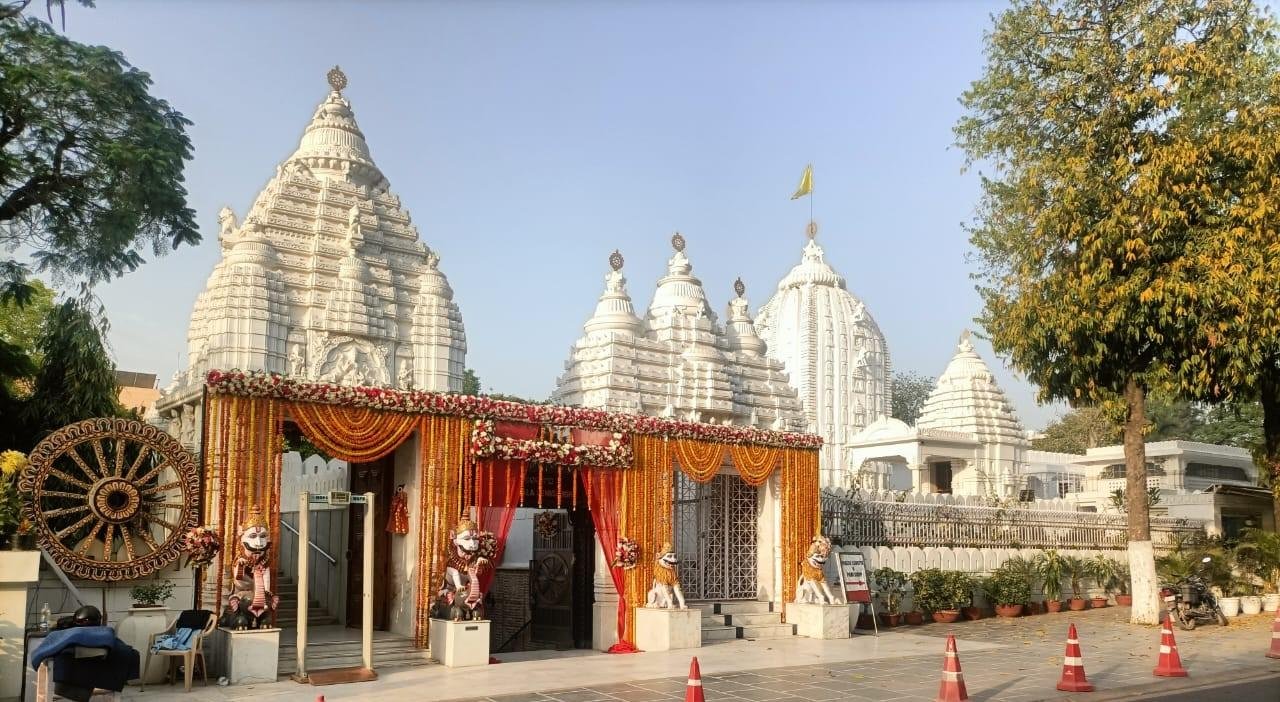
Situated at Bhagwan Jagannath Mandir Chowk near Hauz Khas Village, the white-marble temple serves as an important spiritual, religious and cultural centre for Delhi’s Odia community. It also welcomes devotees from every linguistic, regional and social background.
The temple is administered by **Sree Neelachala Seva Sangha**, an organisation established to preserve Jagannath worship, Odia traditions and the ritual practices associated with the sacred Jagannath Temple of Puri.
Its most important annual celebration is the **Rath Yatra**, during which Lord Jagannath, Balabhadra and Subhadra are ceremonially brought out of the temple and placed on decorated chariots. The procession carries the devotional atmosphere of Puri into the streets of South Delhi and attracts thousands of worshippers.
The Hauz Khas shrine is also known for its daily bhoga, Mahaprasad distribution, Patta Chitra-inspired decoration, Odia festivals and traditional rituals performed according to the Jagannath tradition.
Travellers searching for hotels near Jagannath Temple Hauz Khas, family accommodation near Green Park or convenient stays for Rath Yatra and other temple festivals can explore suitable options through **MudrasStays**.
## Who Is Lord Jagannath?
Lord Jagannath is worshipped as a universal form of the Supreme Divine and is closely identified with Lord Vishnu and Lord Krishna.
The name “Jagannath” comes from two Sanskrit words:
* **Jagat**, meaning the world or universe
* **Natha**, meaning lord, protector or master
Jagannath therefore means **Lord of the Universe**.
His worship is especially associated with Puri in Odisha, where the historic Shree Jagannath Temple is one of India’s most important pilgrimage destinations and one of the four traditional Char Dham sites.
Lord Jagannath’s distinctive form differs from the conventional human-shaped images found in many Vishnu and Krishna temples. His large circular eyes, broad face and simplified wooden body create an immediately recognisable sacred appearance.
Devotees worship Lord Jagannath for:
* Divine protection
* Family welfare
* Spiritual peace
* Freedom from fear
* Success in righteous efforts
* Health and recovery
* Marriage and family harmony
* Educational and professional progress
* Relief from repeated obstacles
* Devotion to Lord Krishna
* Liberation from ego and attachment
Jagannath worship emphasises that the Divine belongs to everyone and cannot be restricted by caste, language, geography or social status.
## Lord Jagannath, Balabhadra, Subhadra and Sudarshan
The principal sanctum contains the sacred forms of:
### Lord Jagannath
Lord Jagannath is generally understood as a manifestation of Vishnu or Krishna and is worshipped as the Lord of the Universe.
### Lord Balabhadra
Balabhadra is the elder brother of Lord Jagannath and is associated with strength, agriculture, protection and Lord Balarama.
### Goddess Subhadra
Subhadra is the divine sister of Jagannath and Balabhadra. She represents compassion, auspiciousness, protection and the power of the Divine Mother.
### Sudarshan Chakra
Sudarshan represents the divine discus of Lord Vishnu. It symbolises spiritual clarity, protection, righteous action and the destruction of ignorance.
The four are worshipped together according to the sacred tradition followed at Puri.
## The Sacred Tradition Behind the Wooden Deities
Jagannath tradition contains several religious narratives explaining the unusual wooden forms of the deities.
One widely known account is connected with King Indradyumna, who desired to establish a temple for the Supreme Lord. According to the sacred story, a divine log known as **Daru Brahma** appeared and was selected for the creation of the deities.
A mysterious craftsman—often identified with Vishwakarma—agreed to carve the sacred forms under the condition that he should not be disturbed until the work was complete.
When the closed room remained silent for an extended period, the king became anxious and opened the door before the agreed time. The craftsman disappeared, leaving the forms incomplete according to ordinary human standards.
The king was instructed to worship the deities in this distinctive form because their spiritual completeness did not depend upon conventional physical appearance.
The narrative teaches that:
* The Divine cannot be confined to human expectations.
* Spiritual completeness is different from physical perfection.
* God accepts every devotee.
* Sacred presence can exist in simple material.
* Faith requires humility and patience.
This is the theological tradition of Jagannath worship and should be distinguished from the documented twentieth-century history of the Hauz Khas temple.
## History of Jagannath Temple, Hauz Khas
The Jagannath Temple in Hauz Khas developed through the efforts of Odia residents who wanted to create a permanent centre of Jagannath worship in Delhi.
### The Idea Emerges Around 1960
The temple’s official history traces the idea to approximately **1960**.
Two members of the Odia community, Duryodhan Pradhan and his uncle Bhramarabar Pradhan, were living in the Hauz Khas area. They and other devotees felt that Delhi needed a temple where Lord Jagannath could be worshipped according to the traditions of Odisha.
The official temple narrative records an important incident that strengthened this vision.
A group of travellers from Banpur in Odisha arrived at the residence of Duryodhan Pradhan after losing their belongings at New Delhi Railway Station. They possessed an image of Lord Jagannath and initially offered it in exchange for financial assistance.
Duryodhan Pradhan declined to treat the sacred image as an object of barter but helped the travellers arrange their return journey. In gratitude, they left the Jagannath image with the family.
The image was first worshipped in the Pradhan household alongside the family deity. Its arrival became a powerful spiritual inspiration for the proposed temple.
### Formation of Sree Neelachala Seva Sangha
Community members formed **Sree Neelachala Seva Sangha** to support social, religious and cultural activities and to establish the temple.
The organisation’s roots are traced to 1960, while its formal registration took place in **1967 on Akshaya Tritiya**, an especially auspicious day in the Jagannath tradition.
Akshaya Tritiya is also traditionally associated with the ceremonial beginning of chariot construction for the Puri Rath Yatra.
### Selection of the Hauz Khas Site
The devotees sought a suitable site that could accommodate a temple inspired by the Puri tradition.
With support from public representatives and administrators, land was identified in the Hauz Khas area. Construction formally began in **1967**.
The chosen site became an important gathering point for Odia families who had migrated to Delhi for work, education and government service.
### Construction of the Two-Storey Temple
The temple was planned as a two-storey religious complex.
The ground floor was dedicated to **Mausi Maa**, while the upper level was created for Lord Jagannath, Balabhadra, Subhadra and Sudarshan.
The official historical account states that the first major floor was completed by **1971**, and further construction and development continued through the 1970s.
The Hauz Khas temple’s own administration describes it as Delhi’s first and oldest Jagannath temple. Because another Delhi Jagannath shrine also claims an early foundation, it is safest to describe the Hauz Khas temple as one of Delhi’s earliest and most established centres of Jagannath worship.
### Growth into a Cultural Institution
Over time, Jagannath Temple became more than a neighbourhood shrine.
It developed into a centre for:
* Odia religious festivals
* Rath Yatra
* Mahaprasad distribution
* Odissi dance
* Pala performances
* Daskathia
* Devotional music
* Religious discourses
* Community gatherings
* Odia language and cultural programmes
* Marriage, mundan and family rituals
For Odias living away from their home state, the temple became an important connection with the traditions of Puri and Odisha.
## Architecture of Jagannath Temple
The temple is immediately recognisable through its white-marble exterior, sculpted towers and Odisha-inspired design.
Although it is a modern temple, its architecture draws from the **Kalinga temple tradition** associated with Odisha.
Visitors may observe:
* A tall central shikhara
* Smaller subsidiary towers
* White-marble construction
* Carved entrances
* Lion guardians
* Religious relief sculptures
* Decorative wheels
* The sacred Neela Chakra
* Patta Chitra-style paintings
* A broad courtyard
* A two-storey arrangement
* A temple kitchen and flower garden
The structure should not be described as an exact architectural replica of the twelfth-century Puri temple. It is a modern Delhi shrine that adapts important visual and ritual elements of the Jagannath tradition.
## The Neela Chakra
A prominent sacred wheel crowns the main temple tower.
The **Neela Chakra** is strongly associated with Lord Jagannath and the Puri temple. It represents divine protection, cosmic authority and Lord Vishnu’s Sudarshan Chakra.
The flag above the temple reinforces the shrine’s identity as the abode of Lord Jagannath.
Visitors should view the chakra respectfully and avoid making exaggerated claims that the modern Delhi structure has every architectural or ritual feature of the Puri temple.
## Patta Chitra Art
The temple includes decorative paintings inspired by **Patta Chitra**, Odisha’s traditional narrative painting style.
Patta Chitra art commonly depicts:
* Lord Jagannath
* Krishna Leela
* Dashavatara
* Ramayana stories
* Temple rituals
* Floral borders
* Sacred symbols
* Mythological scenes
The paintings strengthen the temple’s connection with Odisha’s artistic heritage and give the religious complex an important cultural dimension.
Visitors should avoid touching painted walls or using flash photography where restrictions apply.
## The Two-Storey Temple Arrangement
The ground floor of the temple is associated with **Mausi Maa**, while the principal deities are worshipped on the upper floor.
The upper sanctum houses:
* Lord Jagannath
* Lord Balabhadra
* Goddess Subhadra
* Sudarshan
The climb towards the main sanctum has been compared by the temple administration with the sacred ascent found in the Puri temple tradition.
Visitors with mobility concerns should enquire about current access arrangements before travelling, particularly during festivals when normal movement routes may be altered.
## Who Is Mausi Maa?
Mausi Maa means the maternal aunt of Lord Jagannath.
In the Puri Rath Yatra tradition, the deities visit the Gundicha Temple, which is interpreted as the home of their aunt or a sacred garden residence. A separate Mausi Maa temple is connected with the return journey.
The presence of Mausi Maa on the ground floor of the Hauz Khas complex reflects this intimate family dimension of Jagannath worship.
The tradition makes the Divine accessible not only as a distant ruler but also as a beloved family member who travels, eats, rests, falls ill and returns home.
## Daily Rituals
The Hauz Khas temple follows a structured daily schedule inspired by the traditions of Puri.
### Temple Opening
The deities are awakened and prepared for the day according to the seasonal schedule.
### Mangala Arati
Mangala Arati is the first major worship of the morning. Lamps are offered while devotees sing prayers and receive the earliest darshan.
### Bala Dhupa
Bala Dhupa is a morning food offering made to the deities.
### Midday Prasad Offering
A substantial midday bhoga is offered before the temple enters its afternoon rest period.
### Pahad
Pahad refers to the period when the deities rest and the main darshan is suspended.
### Evening Arati
Lamps and prayers are offered after the temple reopens.
### Night Prasad Offering
The final food offering is made before the concluding rituals.
### Sayana or Night Rest
The deities are prepared for rest and the temple closes for the night.
The schedule can change during festivals, special ceremonies and seasonal transitions.
## Current Seasonal Temple Timings
The official temple schedule currently lists separate timings for March–September and October–February.
### March to September
* Temple opens: approximately 4:30 AM
* Mangala Arati: approximately 5:15 AM
* Bala Dhupa: approximately 8:30 AM
* Midday Prasad offering: approximately 12:30 PM
* Afternoon rest begins: approximately 1:30 PM
* Temple reopens: approximately 4:00 PM
* Evening Arati: approximately 7:30 PM
* Night Prasad offering: approximately 9:00 PM
* Temple closes after night rituals: approximately 10:00 PM
### October to February
* Temple opens: approximately 5:30 AM
* Mangala Arati: approximately 6:15 AM
* Bala Dhupa: approximately 9:00 AM
* Midday Prasad offering: approximately 12:30 PM
* Afternoon rest begins: approximately 1:30 PM
* Temple reopens: approximately 4:00 PM
* Evening Arati: approximately 6:00 PM
* Night Prasad offering: approximately 8:00 PM
* Temple closes after night rituals: approximately 9:00 PM
These timings may change during Rath Yatra, Snana Purnima, special festivals, maintenance or crowd-management arrangements. Visitors should confirm the schedule before travelling.
## Rath Yatra at Hauz Khas
Rath Yatra is the temple’s largest and most important public celebration.
During the festival, Lord Jagannath, Lord Balabhadra and Goddess Subhadra leave the sanctum and travel in decorated chariots through the surrounding streets.
The festival represents the Divine coming out of the temple to meet everyone, including those who may not ordinarily enter the sanctum.
Important elements may include:
* Pahandi procession
* Carrying the deities towards the chariots
* Conch shells and temple bells
* Mridanga and devotional singing
* Decorated chariots
* Chhera Pahanra or ceremonial sweeping
* Public pulling of the chariots
* Distribution of water and food
* Odia cultural performances
* Community participation
* Return celebrations
The temple management follows the ritual framework of the Puri Rath Yatra as closely as practicable in Delhi.
The Hauz Khas Rath Yatra has become one of the capital’s most important Odia cultural gatherings. Recent celebrations have continued a tradition of more than four decades.
## Spiritual Meaning of Rath Yatra
Rath Yatra teaches that the Divine does not remain confined within temple walls.
Lord Jagannath comes among the people, allowing everyone to receive darshan without distinction.
The festival represents:
* Equality before God
* Accessibility of divine grace
* Movement from separation towards union
* Community participation
* Humility
* Seva
* Universal brotherhood
* The journey of the soul towards the Divine
Pulling the chariot is regarded by devotees as an act of great merit, but participants should follow crowd-control instructions and never push into restricted areas.
## Snana Purnima and Anavasara
Before Rath Yatra, the deities are ceremonially bathed during **Snana Purnima**.
In Jagannath tradition, the elaborate bath is followed by a period during which the deities are believed to become unwell. They withdraw from ordinary public darshan during **Anavasara**.
The tradition expresses Jagannath’s deeply human and intimate relationship with devotees. The Lord is treated as a living member of the household who bathes, eats, rests and recovers.
Visitors travelling near Rath Yatra should check whether ordinary darshan is available, as parts of the festival cycle may temporarily change access to the deities.
## Bahuda Yatra and Niladri Bije
The return journey of the deities is called **Bahuda Yatra**.
After the return procession, the festival concludes through ceremonies that include **Niladri Bije**, when Lord Jagannath returns to the main sanctum.
A popular devotional tradition describes Goddess Lakshmi as displeased because Jagannath travelled without her. Lord Jagannath offers her a sweet preparation to regain entry.
The episode expresses divine relationships through affection, humour and family emotion.
## Mahaprasad and Temple Food
Food occupies a central place in Jagannath worship.
Bhoga is offered to the deities and then distributed as sacred prasad. The temple operates a kitchen and provides day and night prasad according to an organised booking system.
Meals may include traditional Odia preparations such as:
* Anna or rice
* Dali
* Dalma
* Ghanta
* Saga
* Besar
* Khata
* Khiri
* Vegetable preparations
The exact menu varies by day.
The temple also offers Odia sweets and preparations such as:
* Ladu
* Chhena Gaja
* Chhena Poda
* Rasagolla
* Gaja
* Labang Lata
Prasad should be received respectfully and not wasted.
The official system currently requires advance booking for day and night prasad. Booking deadlines, distribution hours, prices and menus can change, so devotees should verify them directly.
## Family and Religious Ceremonies
The temple’s official services include several rituals and family ceremonies, subject to booking and current rules.
These may include:
* Mundan
* Annaprasana
* Shraddha Puja
* Vehicle Puja
* Akhanda Deepa
* Flag offering
* Pali Bhog
* Bada Bhog
* Narayan Seva
* Permanent or one-time bhog arrangements
Families should use official booking channels rather than unauthorised intermediaries.
Charges and available dates may change.
## Important Festivals
In addition to Rath Yatra, the temple celebrates several religious and cultural occasions, which may include:
* Snana Purnima
* Anavasara
* Bahuda Yatra
* Suna Besha
* Niladri Bije
* Janmashtami
* Ganesh Chaturthi
* Durga Puja
* Kumar Purnima
* Kartik Purnima
* Makar Sankranti
* Dol Purnima
* Ram Navami
* Akshaya Tritiya
* Sabitri Brata
* Raja festival
* Odia New Year
The annual calendar follows religious dates that change each year.
## Temple Etiquette
Visitors should:
* Dress modestly.
* Remove footwear at the designated place.
* Keep mobile phones silent.
* Follow the queue system.
* Respect restrictions on photography.
* Avoid touching sacred images or ritual objects.
* Do not enter restricted kitchen or priestly areas.
* Carry only essential belongings.
* Use official donation and puja counters.
* Supervise children.
* Avoid wasting Mahaprasad.
* Keep the temple courtyard clean.
* Follow instructions during Rath Yatra.
* Respect Odia rituals even when they differ from local temple customs.
The temple welcomes devotees from every region, but visitors should remember that it is an active place of worship rather than only an architectural attraction.
## Best Time to Visit
### October to March
Cooler Delhi weather is generally comfortable for temple visits and nearby sightseeing.
### Rath Yatra Period
This is the most vibrant and spiritually powerful time, but visitors should expect very large crowds and road diversions.
### Early Morning
Mangala Arati provides a peaceful devotional experience and fewer visitors than evening hours.
### Ordinary Weekdays
Weekday mornings outside festivals are suitable for quiet darshan.
### April to June
Delhi can become extremely hot. Early-morning visits are preferable.
### July to September
Monsoon rain may affect the courtyard, roads and Rath Yatra movement. Carry rain protection and follow festival advisories.
## Nearby Attractions
### Hauz Khas Complex
The historic Hauz Khas complex includes a medieval reservoir, madrasa, tombs and architectural remains dating largely to the Delhi Sultanate period.
### Deer Park
The nearby Deer Park provides greenery and walking paths. Visitors should respect wildlife and avoid feeding animals.
### Hauz Khas Village
The village area contains cafés, boutiques, restaurants and independent shops. Its modern leisure atmosphere differs from the temple’s devotional environment.
### Green Park Market
Green Park offers restaurants, pharmacies, shops and transport facilities.
### Dilli Haat, INA
Dilli Haat features handicrafts and regional food from different Indian states.
### Safdarjung’s Tomb
This eighteenth-century monument can be included in a wider South Delhi heritage itinerary.
### Lodhi Garden
The landscaped garden contains historic tombs and is suitable for a separate morning or evening visit.
## Suggested Itineraries
### Short Temple Visit
**Jagannath Darshan – Mausi Maa Shrine – Prasad – Temple Courtyard**
### Spiritual and Cultural Visit
**Jagannath Temple – Mahaprasad – Hauz Khas Complex – Deer Park**
### South Delhi Family Day
**Morning Temple Darshan – Hauz Khas Complex – Dilli Haat – Evening Meal**
### Rath Yatra Visit
**Early Arrival – Temple Rituals – Pahandi – Chariot Procession – Community Prasad**
During Rath Yatra, avoid adding unrelated sightseeing because crowds and road controls can make movement difficult.
## How to Reach Jagannath Temple
The temple is located at:
**Block C, SDA, Bhagwan Jagannath Mandir Chowk, Hauz Khas Village Road, New Delhi**
Visitors can reach it by:
* Delhi Metro
* Auto-rickshaw
* App-based cab
* Private taxi
* Local bus
* Personal vehicle
* Hotel-arranged transport
Hauz Khas and Green Park are among the convenient metro stations serving the wider area, followed by a short auto-rickshaw or cab journey.
The final approach near Hauz Khas Village can become congested during evenings, weekends and festivals.
Parking is limited during Rath Yatra and other major events. Public transport is generally more practical on festival days.
## Food and Local Facilities
The temple provides traditional prasad according to advance-booking arrangements.
The surrounding Hauz Khas, SDA and Green Park areas offer:
* Odia food
* South Indian food
* North Indian vegetarian meals
* Cafés
* Bakeries
* Pharmacies
* ATMs
* General stores
* Public transport
Pilgrims seeking temple Mahaprasad should not assume walk-in availability. Advance confirmation is advisable.
## Where to Stay Near Jagannath Temple
Travellers can choose accommodation in Hauz Khas, Green Park, Safdarjung, Greater Kailash or other South Delhi neighbourhoods.
### Stay in Hauz Khas or SDA For:
* Convenient temple access
* Early Mangala Arati
* Rath Yatra participation
* Access to Hauz Khas Complex
* Restaurants and local markets
### Stay in Green Park For:
* Metro connectivity
* More hotels and guesthouses
* Medical facilities
* Easier family accommodation
* Access to central and south Delhi
### Stay in Safdarjung or Greater Kailash For:
* Wider hotel choice
* Restaurants and shopping
* Road connectivity
* Access to other South Delhi temples and attractions
Before booking, verify:
* Actual distance from the temple
* Final vehicle access
* Parking availability
* Lift or ground-floor rooms
* Family-room configuration
* Vegetarian meal options
* Secure luggage storage
* Metro connectivity
* Early check-in
* Rath Yatra road restrictions
* Festival cancellation policies
A property that appears close on a map may take longer to reach during weekend traffic or Rath Yatra diversions.
## Book Stays Near Jagannath Temple with MudrasStays
**MudrasStays** helps pilgrims find suitable accommodation near temples, sacred cultural centres and important religious routes.
Travellers visiting Jagannath Temple can use MudrasStays to explore:
* Hotels near Jagannath Temple Hauz Khas
* Family stays near Green Park
* Accommodation for Rath Yatra pilgrims
* Rooms suitable for senior citizens
* Hotels near vegetarian restaurants
* Group accommodation for Odia festivals
* Properties with secure luggage storage
* Hotels with Delhi Metro connectivity
* Stays near Hauz Khas Village
* Accommodation for South Delhi temple circuits
Choosing accommodation close to Hauz Khas allows devotees to attend early rituals, receive Mahaprasad and participate in Rath Yatra without repeatedly travelling across Delhi.
Jagannath Temple, Hauz Khas is more than a modern city shrine. It represents the journey of Odisha’s devotional traditions into the national capital and the determination of a migrant community to preserve its faith, food, festivals, music and art.
By seeking the blessings of Lord Jagannath, respecting the temple’s Odia rituals and booking a comfortable nearby stay through **MudrasStays**, pilgrims can experience a meaningful spiritual journey centred on equality, service, devotion and universal divine grace.