
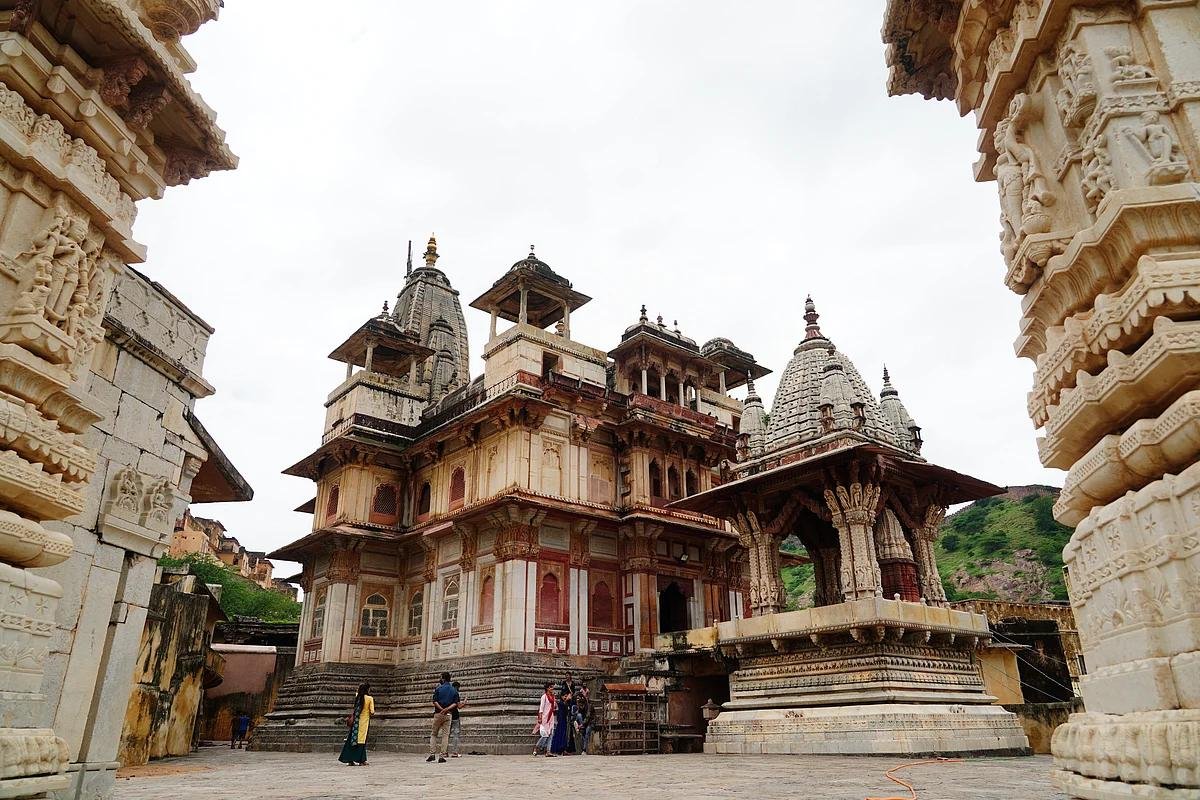
Jagat Shiromani Temple, Amer – A Royal Krishna Shrine Connected with Meera Bai
Jagat Shiromani Temple is one of the most beautiful and historically important Hindu temples in **Amer**, the former capital of the Kachwaha rulers near Jaipur, Rajasthan. Standing below the famous Amer Fort, the temple combines royal memory, Krishna devotion, the spiritual legacy of Meera Bai and some of the finest temple architecture created in Rajasthan around the beginning of the seventeenth century.
The shrine is primarily associated with **Lord Vishnu and Lord Krishna**, while Meera Bai—the celebrated Rajput poet-saint whose life was devoted to Krishna—is also represented and honoured within the temple.
Its name, **Jagat Shiromani**, is generally interpreted as “the crown jewel of the world” or “the supreme jewel of Lord Vishnu.” The name also preserves the memory of **Prince Jagat Singh**, in whose honour the temple was commissioned.
The temple was constructed between approximately **1599 and 1608 CE** by **Queen Kanakwati**, a wife of Raja Man Singh I of Amer. She commissioned the shrine following the death of her son Jagat Singh, transforming personal grief into an enduring work of devotion, architecture and public worship.
Unlike Amer Fort, which receives large numbers of sightseeing visitors, Jagat Shiromani Temple often offers a quieter experience. Its stone courtyard, soaring shikhara, carved marble entrance, Garuda pavilion and richly decorated mandapa make it an essential stop for pilgrims, heritage travellers, architecture enthusiasts and devotees of Lord Krishna and Meera Bai.
Travellers searching for hotels near Jagat Shiromani Temple, family accommodation in Amer or convenient stays for a Jaipur–Amer pilgrimage can explore suitable options through **MudrasStays**.
## Who Is Worshipped at Jagat Shiromani Temple?
The temple’s religious identity includes three closely connected forms of devotion.
### Lord Vishnu
Lord Vishnu is worshipped as the preserver of the universe and the protector of dharma. The temple’s formal identity and architectural programme are strongly Vaishnava.
Devotees pray to Lord Vishnu for:
* Protection and stability
* Family welfare
* Peace within the household
* Success in righteous responsibilities
* Relief from repeated difficulties
* Spiritual balance
* Preservation of health and prosperity
* Progress on the path of devotion
### Lord Krishna
Lord Krishna, an incarnation of Vishnu, occupies a central place in the temple’s living worship.
He is revered as:
* The beloved of devotees
* The teacher of the Bhagavad Gita
* The protector of dharma
* The playful child of Vrindavan
* The divine friend
* The supreme object of bhakti
* The Lord worshipped by Meera Bai
Devotees seek Krishna’s blessings for love, wisdom, courage, family harmony, emotional peace and freedom from attachment.
### Meera Bai
Meera Bai was a sixteenth-century Rajput princess, mystic poet and one of India’s most celebrated saints of the Bhakti movement.
She regarded Krishna as her true Lord and expressed her devotion through bhajans, poetry, singing and complete surrender. Her songs continue to be performed across India centuries after her lifetime.
At Jagat Shiromani Temple, Meera is remembered not merely as a historical poet but as an ideal devotee whose love for Krishna overcame royal pressure, social convention and personal suffering.
The presence of her image near Krishna makes this temple especially important to followers of the Bhakti tradition.
## The Meaning of “Jagat Shiromani”
The Sanskrit-derived expression can be understood through:
* **Jagat** – the world or universe
* **Shiromani** – the highest jewel, crown jewel or most excellent among all
Jagat Shiromani may therefore mean:
* The crown jewel of the universe
* The supreme jewel of the world
* A title honouring Lord Vishnu
* A memorial reference to Prince Jagat Singh
The name creates a meaningful connection between the temple’s deity, its royal patronage and the memory of the prince for whom it was built.
## History of Jagat Shiromani Temple
The history of Jagat Shiromani Temple belongs to the period when Amer was the political centre of the Kachwaha kingdom.
### Amer Before Jaipur
Before Maharaja Sawai Jai Singh II founded Jaipur in the eighteenth century, Amer served as the capital of the Kachwaha rulers.
The settlement developed around:
* Amer Fort and palace
* Maota Lake
* Royal temples
* Residential neighbourhoods
* Stepwells
* Markets
* Gardens
* Military routes
* Religious institutions supported by the court
Jagat Shiromani Temple was constructed within this active royal town rather than as an isolated shrine.
### Raja Man Singh I
Raja Man Singh I was one of the most powerful Kachwaha rulers of Amer. He also held an important position within the Mughal administration during the reign of Emperor Akbar.
His political and military career brought the Amer court into close contact with different regions, artistic traditions and architectural influences.
The architecture created under the Kachwahas consequently combined Rajput temple design with decorative ideas shaped by wider courtly contact.
### Queen Kanakwati
Queen Kanakwati commissioned Jagat Shiromani Temple following the death of her son, Prince Jagat Singh.
The project began around 1599 and required approximately nine years to complete, reaching its finished form around 1608.
The temple was therefore:
* A memorial created by a grieving mother
* A royal act of religious merit
* A major Vaishnava shrine
* A permanent public institution
* A statement of Kachwaha artistic ambition
* A sacred monument preserving Prince Jagat Singh’s name
Although personal loss inspired its construction, the result was not a private funerary monument. It became a living temple where generations of devotees continued to worship.
## Prince Jagat Singh
Jagat Singh was a son of Raja Man Singh I and Queen Kanakwati.
He died relatively young, before he could play a longer role in the political life of Amer. His death deeply affected the royal family, particularly his mother.
Rather than allowing his memory to disappear, Queen Kanakwati associated it with the worship of Vishnu and Krishna.
The temple’s name thus transformed the prince’s memory into a sacred and enduring presence within Amer.
Visitors should not confuse this Prince Jagat Singh with later Rajput rulers of the same or similar name. Royal names were frequently repeated across dynasties and generations.
## Construction Between 1599 and 1608
The nine-year construction period indicates the scale and complexity of the project.
The temple required:
* Skilled stone carvers
* Marble workers
* Sculptors
* Architects
* Painters
* Masons
* Metalworkers
* Ritual specialists
* Royal financing
* Transportation of different building materials
The result was a temple that combined religious symbolism with the artistic refinement expected of a royal foundation.
Its completion around 1608 places it at an important transition between the sixteenth and seventeenth centuries, when Rajput and Mughal courtly architecture were influencing one another while maintaining distinct religious functions.
## The Meera Bai and Krishna Idol Tradition
The most famous religious tradition associated with Jagat Shiromani Temple concerns its Krishna image.
Local belief maintains that the Krishna idol worshipped at the temple is the same sacred form once worshipped by **Meera Bai in Mewar**.
According to the tradition, the image was brought from Mewar or Chittorgarh to Amer for protection during a period of conflict and was later installed in Jagat Shiromani Temple.
This story is central to the temple’s devotional identity and explains why the shrine is also called:
* Meera Mandir
* Meera Bai Temple
* Meera-Krishna Temple
However, the precise historical journey of the image is not established through a widely available contemporary document that verifies every part of the story.
The most responsible description is that the temple preserves a deeply respected tradition identifying its Krishna image with the deity worshipped by Meera Bai.
Pilgrims may honour this belief while recognising that it belongs primarily to sacred memory and temple tradition.
## Why Is Meera Bai Honoured Beside Krishna?
Meera Bai’s life represents the principle of **bhakti**, or loving surrender to God.
She refused to regard Krishna as a distant deity. To her, he was:
* Her Lord
* Her companion
* Her true husband
* Her protector
* The centre of her emotional and spiritual life
Her devotion challenged social expectations placed upon a royal Rajput woman.
Through her poetry, she expressed:
* Longing for Krishna
* Separation from the Divine
* Joy in devotional singing
* Rejection of status and pride
* Complete surrender
* Freedom from fear
* Spiritual equality
* The belief that love is greater than social position
Honouring Meera within the temple emphasises that a devotee can become spiritually inseparable from the deity through complete surrender.
## Architecture of Jagat Shiromani Temple
Jagat Shiromani Temple is one of Amer’s finest architectural monuments.
Rajasthan Tourism describes it as an amalgamation of:
* Hindu temple architecture
* Jain decorative traditions
* Rajput design
* Mughal-influenced ornamentation
* South Indian elements
Rather than fitting perfectly into one style, the temple reflects the cosmopolitan character of the Amer royal court.
## Construction Materials
The temple uses a combination of:
* White marble
* Local sandstone
* Dark or black stone
* Lime plaster
* Painted architectural surfaces
The contrast between light marble, darker stone and reddish decorative details gives the structure a distinctive appearance.
Different materials were selected for different functions:
* Marble for the ceremonial entrance and detailed carving
* Sandstone for structural walls and architectural mass
* Dark stone for contrast and selected sculptural elements
* Painted surfaces for decorative emphasis
## The Raised Temple Platform
The principal temple stands on an elevated platform approached by steps.
The raised level serves several purposes:
* It separates sacred space from the street.
* It increases the monument’s visual prominence.
* It protects the temple from ordinary surface movement and water.
* It prepares visitors mentally for entry.
* It creates a processional approach towards the sanctum.
The climb from the courtyard to the main temple symbolises movement from the ordinary world towards the divine presence.
Visitors with limited mobility should assess the steps before proceeding and seek local assistance where available.
## The Marble Torana
The temple’s most celebrated architectural feature is its magnificent **marble torana**, or ornamental gateway.
The torana stands in the courtyard before the main shrine and immediately commands attention.
It includes:
* Tall carved supports
* Elephant figures at the base
* Decorative arches
* Floral and geometric carving
* Sculptural panels
* A projecting canopy
* Fine marble workmanship
Rajasthan Tourism describes the ornamental entrance as being carved from a single piece of marble, although visitors should treat highly specific construction claims cautiously unless confirmed by an architectural survey.
Regardless of whether every element is monolithic, the torana is an outstanding work of ceremonial stone carving.
Its function is both practical and symbolic. It marks the transition from the outer courtyard into the formal sacred approach.
## Elephant Sculptures
Carved elephants appear around the entrance architecture.
In Indian religious and royal symbolism, elephants represent:
* Strength
* Stability
* Royal authority
* Prosperity
* Protection
* Auspiciousness
Their placement near the gateway suggests that the deity is approached through a space protected and honoured by royal strength.
Visitors should not climb onto the elephant sculptures or use them as casual seating.
## Garuda Pavilion
A separate pavilion associated with **Garuda**, the divine vehicle of Lord Vishnu, stands within the temple complex.
Garuda represents:
* Devotion
* Speed
* Courage
* Protection
* Victory over harmful forces
* Service to Lord Vishnu
In Vaishnava temples, Garuda is commonly positioned facing the main deity.
The pavilion’s carved pillars, canopy and elevated position make it one of the most visually impressive elements of the courtyard.
## Mandapa or Assembly Hall
The mandapa forms the transitional space between the courtyard and sanctum.
It contains:
* Carved pillars
* Decorative brackets
* Arched openings
* Sculptural reliefs
* Ornamented ceilings
* Spaces for devotional gathering
The mandapa may be used for:
* Bhajan
* Aarti
* Religious recitation
* Festival worship
* Waiting before darshan
* Community prayer
Architecturally, the mandapa gradually reduces the brightness and activity of the external courtyard, preparing the visitor for the more intimate sanctum.
## Shikhara Above the Sanctum
A tall shikhara rises above the garbhagriha.
The shikhara marks the location of the principal deity and represents the sacred mountain at the centre of the temple.
Its vertical form symbolises:
* The cosmic mountain
* Spiritual ascent
* Connection between earth and heaven
* The rising energy of prayer
* The divine centre of the complex
Smaller towers and pavilions create a layered skyline around the main structure.
## Carvings on the Walls and Ceilings
The temple contains richly carved representations of:
* Elephants
* Horses
* Birds
* Musicians
* Dancers
* Floral designs
* Divine figures
* Vaishnava imagery
* Episodes associated with Hindu sacred literature
* Processional and courtly scenes
These carvings reflect both religious and royal culture.
Musicians and dancers remind visitors that temple worship historically included performance, music and celebration rather than only silent prayer.
Floral and geometric patterns reveal the influence of broader courtly decoration, while figurative sculpture anchors the building within Hindu sacred storytelling.
## Jali Work, Arches and Balconies
Certain parts of the temple display:
* Perforated stone screens
* Projecting balconies
* Chhatris
* Cusped or ornamental arches
* Bracketed supports
These elements reflect the interaction between Rajput temple building and the wider architectural language of the Mughal-period courts.
The temple remains fundamentally Hindu in plan and function, but its decorative vocabulary demonstrates the artistic exchanges of its time.
## Darshan Experience
Jagat Shiromani is both a protected historic monument and an active temple.
A typical visit may include:
**Footwear Removal – Marble Torana – Garuda Pavilion – Mandapa – Krishna and Vishnu Darshan – Meera Bai Darshan – Quiet Prayer – Prasad**
Devotees may pray for:
* Krishna bhakti
* Family harmony
* Emotional peace
* Protection
* Wisdom
* Courage
* Relief from grief
* Strength during separation
* Success in responsible work
* Spiritual surrender
The temple’s origin as a memorial makes it particularly meaningful for visitors processing grief or remembering a departed family member.
Queen Kanakwati’s response to loss demonstrates how sorrow can be transformed into devotion, creativity and service.
## Offerings
Depending on current temple rules, devotees may offer:
* Flowers
* Garlands
* Tulsi leaves
* Fruit
* Sweets
* Butter or mishri
* Yellow cloth
* Incense
* Camphor
* Personal prayers
* Krishna bhajans
Visitors should confirm accepted offerings before purchasing a large puja basket.
Offerings should never be applied directly to protected carvings, walls or historic architectural surfaces.
## Janmashtami
**Krishna Janmashtami** is one of the most important festivals at Jagat Shiromani Temple.
The occasion commemorates the birth of Lord Krishna.
Celebrations may include:
* Special shringar
* Bhajan and kirtan
* Krishna katha
* Aarti
* Floral decorations
* Prasad distribution
* Night worship
* Devotional singing associated with Meera Bai
* Larger darshan queues
Visitors travelling specifically for Janmashtami should confirm the current programme and access arrangements.
The narrow roads and lanes of Amer may become congested during important festivals.
## Radhashtami and Vaishnava Festivals
Radhashtami may also be observed through prayer, decoration and bhajan, depending on the annual temple programme.
Other important occasions can include:
* Holi
* Govardhan Puja
* Diwali
* Annakut
* Ekadashi
* Sharad Purnima
* Meera-related devotional programmes
* Special Vishnu worship days
The temple’s annual calendar can change, so festival schedules should be verified locally.
## Meera Bai Bhajans
The temple is an especially meaningful place to remember Meera’s devotional poetry.
Her bhajans focus on:
* Love for Krishna
* Spiritual longing
* Rejection of ego
* The pain of separation
* Complete surrender
* Joy in the divine name
* Courage in the face of opposition
Visitors should avoid loudly playing recorded music on mobile phones. Bhajans should be performed only where permitted and without disturbing regular worship.
## Temple Timings
Several visitor references commonly report daily access from approximately **6:00 AM to 8:00 PM**.
However, opening hours may include breaks for bhog, private rituals, cleaning or afternoon rest.
Timings can also change during:
* Janmashtami
* Special Vaishnava festivals
* Conservation work
* Maintenance
* Security arrangements
* Major events at Amer Fort
* Seasonal conditions
Pilgrims should confirm the same-day opening, aarti and sanctum schedule before travelling from outside Jaipur.
## Conservation and Heritage Protection
Jagat Shiromani Temple is a protected historic monument, and conservation work may periodically affect visitor movement.
The structure requires careful maintenance because of:
* Weathering
* Water penetration
* Ageing plaster
* Stone deterioration
* Biological growth
* Visitor pressure
* Structural movement
* Earlier repairs using incompatible material
Visitors may encounter scaffolding, temporary barriers or closed sections.
They should not:
* Touch fragile carvings
* Climb architectural elements
* Write on walls
* Apply oil or vermilion to historic stonework
* Move sculptural fragments
* Enter barricaded areas
* Fly drones without permission
* Conduct commercial photography without approval
Protecting the temple is an important form of respect towards both the deity and Rajasthan’s heritage.
## Temple Etiquette
Visitors should:
* Dress modestly.
* Remove footwear where instructed.
* Keep mobile phones silent.
* Follow the darshan queue.
* Respect sanctum photography restrictions.
* Avoid flash photography near paintings and carvings.
* Do not obstruct devotees while taking pictures.
* Use official donation facilities.
* Keep children supervised.
* Avoid touching the torana and sculptures.
* Maintain silence during aarti.
* Do not carry tobacco or alcohol.
* Keep the courtyard clean.
* Follow conservation barriers.
* Respect priests, caretakers and other pilgrims.
The temple should not be treated merely as a photography backdrop.
## Best Time to Visit
### October to March
The cooler months provide the most comfortable conditions for temple darshan and exploration of Amer Fort and the old town.
### Janmashtami
The temple becomes especially devotional and colourful, but larger crowds should be expected.
### Early Morning
Morning visits generally provide quieter darshan and softer light on the marble and sandstone architecture.
### Late Afternoon
The temple is visually beautiful in the softer evening light, but visitors should confirm the final darshan time.
### April to June
Jaipur can become extremely hot. Early-morning visits are preferable.
### July to September
Monsoon clouds make the surrounding hills attractive, but stone steps and courtyards may become slippery.
## Suggested Duration
Keep approximately one to two hours for:
* The marble torana
* Garuda pavilion
* Exterior carvings
* Mandapa
* Krishna and Vishnu darshan
* Meera Bai shrine
* Quiet prayer
* Architectural photography from permitted areas
Visitors combining the temple with Amer Fort should avoid reducing the temple to a five-minute stop.
Architecture and history enthusiasts may need additional time.
## Visit Amer Fort
Amer Fort is the principal nearby attraction and lies within easy reach of the temple.
The palace-fort complex includes:
* Jaleb Chowk
* Ganesh Pol
* Diwan-i-Aam
* Diwan-i-Khas
* Sheesh Mahal
* Sukh Niwas
* Palace courtyards
* Defensive gateways
* Views of Maota Lake
The fort requires a separate ticket and several hours for a meaningful visit.
A suitable sequence is:
**Early Jagat Shiromani Darshan – Amer Fort – Lunch – Amer Old Town**
## Shila Devi Temple
Shila Devi Temple is situated within Amer Fort and is one of the Kachwaha royal family’s important Goddess shrines.
Pilgrims can combine:
**Jagat Shiromani Temple – Shila Devi Temple – Amer Fort**
The two temples represent different aspects of royal devotion:
* Jagat Shiromani reflects Vishnu, Krishna and Meera bhakti.
* Shila Devi represents the protective power of the Divine Mother.
Entry to Shila Devi Temple may depend on Amer Fort’s access arrangements.
## Ambikeshwar Mahadev Temple
Ambikeshwar Mahadev is an old Shiva shrine associated with the sacred identity of Amer.
A broader Amer pilgrimage may include:
**Ambikeshwar Mahadev – Jagat Shiromani – Shila Devi**
Visitors should confirm the safest walking route through the old town.
## Panna Meena Ka Kund
Panna Meena Ka Kund is a historic stepwell in Amer known for its geometric stairways.
It can be included in an old-town heritage walk with Jagat Shiromani Temple.
Visitors must obey access restrictions and should never descend into prohibited areas for photographs.
## Maota Lake and Kesar Kyari
Maota Lake lies below Amer Fort and historically supplied water to the palace complex.
Kesar Kyari, the formal garden within the lake, forms one of Amer’s most recognisable views.
The lake is best observed from designated public viewpoints.
## Jaigarh Fort
Jaigarh Fort stands above Amer and historically protected the palace and surrounding routes.
It can be added as a separate visit for travellers interested in military architecture, fortifications and panoramic views.
## Nahargarh Fort
Nahargarh overlooks Jaipur from the Aravalli hills and is best planned as a separate excursion because of the road journey and time required.
## Suggested Itineraries
### Short Spiritual Visit
**Jagat Shiromani Darshan – Meera Bai Prayer – Garuda Pavilion – Prasad**
### Amer Temple Circuit
**Ambikeshwar Mahadev – Jagat Shiromani – Shila Devi Temple**
### Temple and Heritage Day
**Morning Jagat Shiromani – Amer Fort – Panna Meena Ka Kund – Old Amer Market**
### Jaipur Pilgrimage Circuit
**Jagat Shiromani – Govind Dev Ji Temple – Galtaji on a Separate Half-Day**
Do not overload a single day when travelling with children or senior citizens.
## How to Reach Jagat Shiromani Temple
The temple is located in Amer town below the fort complex, approximately 11–15 kilometres from central Jaipur depending on the starting point.
Visitors may travel by:
* Private taxi
* App-based cab
* Auto-rickshaw
* Local bus to Amer
* Personal vehicle
* Hotel-arranged cab
* Guided heritage vehicle
The final approach may involve narrow roads, local traffic and walking.
During weekends and peak tourist periods, congestion increases around Amer Fort.
Visitors should ask specifically for:
**Jagat Shiromani Temple, Amer**, rather than only requesting Amer Fort.
## Parking and Walking Access
Parking near the immediate temple entrance can be limited.
Visitors may need to:
* Use authorised Amer parking
* Walk through part of the old town
* Arrange a fixed drop-off and pickup point
* Avoid blocking residential lanes
* Follow police diversions
* Use comfortable footwear
Families with elderly devotees should confirm the closest practical vehicle access because the temple includes steps.
## Food and Local Facilities
Amer town has:
* Tea stalls
* Vegetarian restaurants
* Local dhabas
* Sweet shops
* Snack counters
* Puja shops
* Handicraft stores
* Pharmacies
* Basic visitor facilities
Visitors may find:
* Dal baati churma
* Rajasthani thali
* Kachori
* Samosa
* Poori sabzi
* Dal and roti
* Lassi
* Tea
* Sweets
* Seasonal vegetarian food
Those following a strict satvik diet should confirm whether onion and garlic are used.
## Where to Stay Near Jagat Shiromani Temple
Travellers can stay in Amer, Kukas, Jal Mahal Road or central Jaipur.
### Stay in Amer For:
* Early temple darshan
* Easy access to Amer Fort
* Quiet heritage surroundings
* Temple and stepwell walks
* Reduced morning travel
* Photography and architecture visits
### Stay in Kukas For:
* Resorts and larger hotels
* Group accommodation
* Parking
* Access from the Delhi–Jaipur highway
* Family leisure stays
### Stay Near Jal Mahal Road For:
* Access to Amer and Jaipur city
* More restaurants
* Mid-range hotel options
* Convenient taxi availability
* Views towards Man Sagar Lake
### Stay in Central Jaipur For:
* The widest hotel selection
* Railway and bus connectivity
* City Palace and Govind Dev Ji access
* Restaurants and shopping
* Multi-day Jaipur itineraries
Before booking, verify:
* Actual driving distance to Amer
* Early-morning transport
* Parking availability
* Lift or ground-floor rooms
* Family-room configuration
* Vegetarian meals
* Secure luggage storage
* Road noise
* Festival traffic restrictions
* Cancellation conditions
A property marketed as being near Amer may still be several kilometres from the temple entrance.
## Book Stays Near Jagat Shiromani Temple with MudrasStays
**MudrasStays** helps pilgrims and heritage travellers discover suitable accommodation near temples, forts, sacred towns and important spiritual routes.
Travellers visiting Amer can use MudrasStays to explore:
* Hotels near Jagat Shiromani Temple
* Family stays near Amer Fort
* Accommodation near Shila Devi Temple
* Heritage stays in Amer
* Hotels near Jal Mahal
* Rooms suitable for senior citizens
* Properties serving vegetarian food
* Hotels with secure parking
* Group accommodation for Jaipur pilgrimages
* Stays for temple and heritage tours
Choosing accommodation near Amer allows devotees to attend peaceful morning darshan, explore the temple’s carvings without rushing and combine the visit with other sacred and historic places comfortably.
Jagat Shiromani Temple is more than an architectural monument beneath Amer Fort. It is a memorial created from a mother’s grief, a royal shrine dedicated to Vishnu and Krishna, and a rare place where the devotion of Meera Bai is given a visible and honoured presence.
Its marble torana, Garuda pavilion, carved mandapa and sacred images preserve the artistic brilliance of the Kachwaha court, while its continuing worship keeps the temple spiritually alive.
By seeking the blessings of Lord Krishna, remembering Meera Bai’s complete surrender and booking a comfortable nearby stay through **MudrasStays**, pilgrims can experience one of Rajasthan’s most moving combinations of devotion, royal history and temple architecture.