
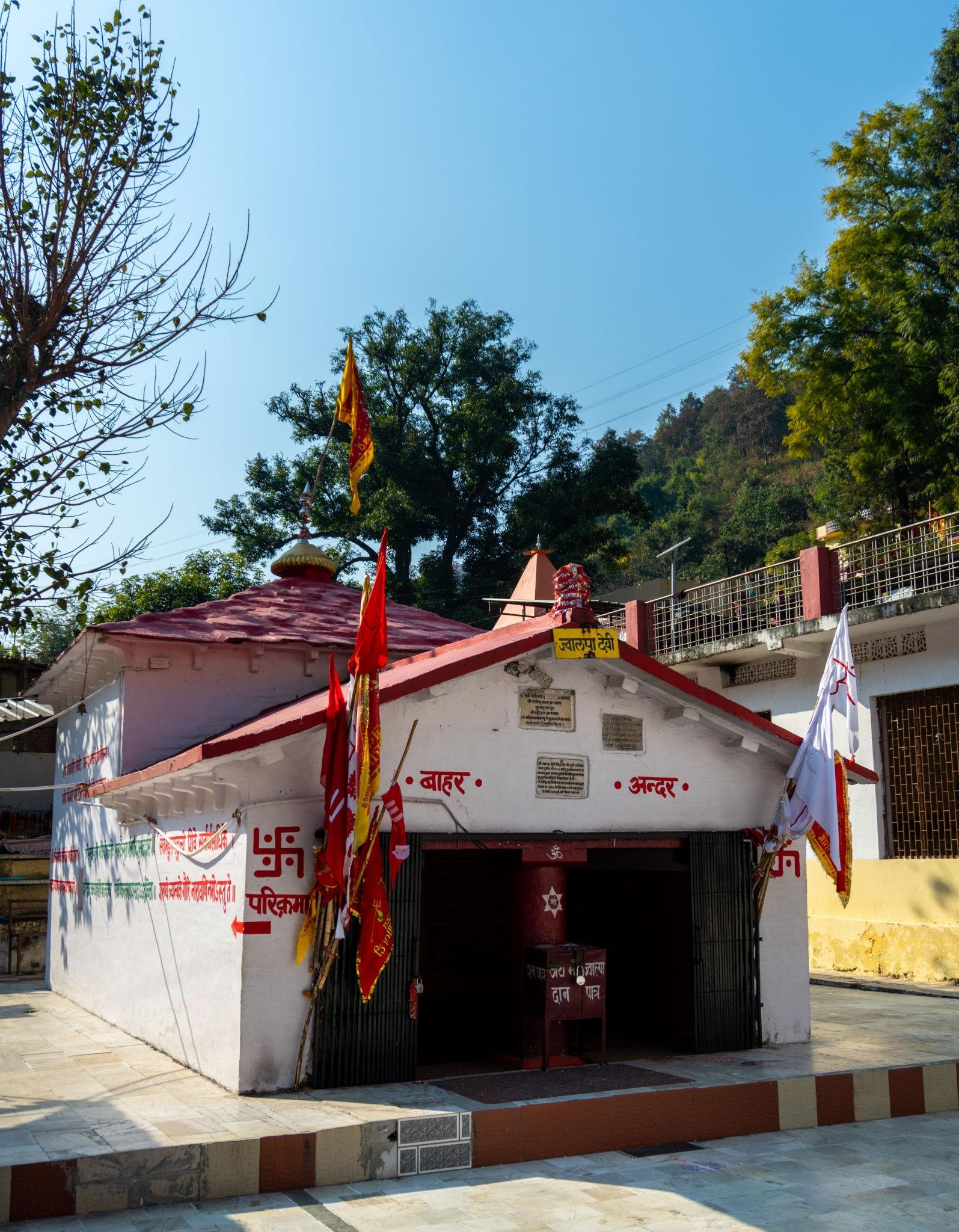
Jwalpa Devi Temple is one of the most revered Shakti shrines in the Pauri Garhwal district of Uttarakhand. Dedicated to Maa Jwalpa, worshipped as a powerful manifestation of Goddess Durga, the temple is situated beside the Nayar River on the scenic road connecting Pauri with Satpuli and Kotdwar. Surrounded by forested hills, flowing water and the peaceful landscape of Garhwal, the temple attracts devotees seeking the blessings of the Divine Mother for protection, family welfare, courage, prosperity, marriage and fulfilment of sincere prayers.
The temple is located approximately 33 to 34 kilometres from Pauri town and about 17 kilometres from Satpuli. Its roadside location makes it comparatively accessible for families, senior citizens, couples and pilgrimage groups travelling through Pauri Garhwal. Unlike many remote Himalayan temples requiring long treks, Jwalpa Devi Temple can generally be reached by road, followed by a short approach through the temple premises.
The combination of spiritual importance, river scenery and convenient road access makes Jwalpa Devi Temple suitable for both dedicated pilgrimage and a wider Garhwal holiday. Visitors can seek the blessings of Maa Jwalpa, spend time beside the river, explore nearby mountain towns and stay in Pauri, Satpuli or accommodation close to the temple.
Maa Jwalpa is worshipped as a form of Goddess Durga, the Divine Mother associated with strength, protection, courage and the defeat of harmful forces. The name Jwalpa carries an association with divine radiance, flame and illuminating energy. Devotees approach the goddess as a compassionate mother whose power removes fear and provides strength during difficult periods.
For local communities across Pauri Garhwal, Jwalpa Devi Temple is not simply a tourist attraction. It is a living centre of faith connected with family traditions, personal vows, festivals, marriages, mundan ceremonies and other important events.
Generations of families visit the shrine to offer prayers before beginning a new phase of life. Couples may seek blessings before or after marriage, parents may pray for the well-being of their children, and travellers may request protection before undertaking a mountain journey.
Some devotees visit the temple when facing uncertainty relating to education, employment, family matters or personal decisions. Others return after experiencing a favourable outcome to express gratitude through prayer, offerings or religious ceremonies.
Such experiences belong to personal faith and should not be presented as guaranteed results. The spiritual importance of the temple lies in the hope, courage and emotional strength that devotees receive through worship.
Jwalpa Devi Temple is traditionally regarded as a Siddha Peeth or spiritually accomplished Shakti shrine within the region. The term Siddha Peeth is used for a sacred destination associated with sustained worship, spiritual practice and the belief that sincere prayers are heard.
Different religious traditions may classify Shakti Peethas and Siddha Peethas in different ways. The importance of Jwalpa Devi Temple is rooted primarily in the continuing devotion of the Garhwali community and the large number of pilgrims who visit the shrine throughout the year.
The temple’s official and district descriptions identify it as an important regional Shakti centre where devotees arrive from distant places, particularly during Navratri.
A well-known local religious tradition connects the shrine with Sachi, also known as Shachi or Indrani, who is remembered in Hindu mythology as the consort of Lord Indra.
According to the tradition narrated around Jwalpa Devi Temple, Sachi performed penance and worshipped the Divine Mother with the wish of marrying Indra. Pleased by her devotion, the goddess is believed to have appeared in a radiant form and granted her prayer.
The luminous manifestation is described in regional narratives as Jwaleshwari or a radiant form of Shakti. Over time, the sacred name is believed to have become popularly known as Jwalpa Devi.
This story explains why the temple is often associated with prayers relating to marriage and suitable life partners. Unmarried devotees may visit to seek blessings for a harmonious future relationship, while married couples pray for stability, understanding and family welfare.
The account should be understood as sacred religious tradition rather than conventional documented history. Its importance lies in the values of devotion, patience and trust represented by Sachi’s worship.
The temple should not be described as guaranteeing marriage or resolving relationship difficulties. Visitors may seek spiritual reassurance, but personal relationships also require communication, compatibility and responsible decision-making.
The natural setting is an essential part of the Jwalpa Devi Temple experience. The shrine stands on the northern bank of the Nayar River, which is also locally associated with the name Nawalika or Nawalika Ganga around the temple.
The sound of flowing water, the surrounding greenery and the quieter valley atmosphere create a peaceful setting for Goddess worship. During ordinary weekdays, visitors may have sufficient time to sit within the complex, listen to the bells and experience the river landscape without feeling hurried.
The river changes considerably with the seasons. During lower-flow periods, stones and parts of the riverbank may become more visible. During the monsoon, the water can rise, become faster and carry significant force.
Visitors should never assume that entering the river is safe simply because the water appears shallow. River depth, current and underwater surfaces can change unexpectedly.
Children should remain under continuous adult supervision near the river. Travellers should not climb onto wet rocks, cross unauthorised sections or enter fast-moving water for photographs.
Local safety barriers and instructions must always be respected, particularly during periods of heavy rainfall.
The river is both an ecological resource and part of the sacred landscape. Flowers, plastic packaging, cloth, food waste and ritual materials should not be thrown into the water.
Offerings should be deposited only in the areas designated by the temple management. Protecting the river is an important form of respect towards the goddess and the community that maintains the shrine.
The temple architecture is simple and closely integrated with its Garhwali surroundings. White walls, red roof sections, saffron flags, bells and sacred symbols create the appearance of a traditional regional Devi shrine.
The principal temple is comparatively intimate rather than monumental. Its spiritual importance comes from the presence attributed to Maa Jwalpa, the rituals performed by devotees and the continuity of worship across generations.
The surrounding complex includes pathways, courtyards and facilities supporting prayer and religious ceremonies. Devotees may perform circumambulation according to the directions marked around the shrine and the guidance of temple priests.
Red and saffron flags are strongly associated with Shakti worship and can be seen around the temple. Visitors should not remove, rearrange or use sacred flags and threads merely as photography props.
The sanctum is the principal place of worship. Devotees may offer flowers, coconuts, sweets, incense, chunari and other permitted puja materials.
The exact method of worship should be confirmed with authorised priests or temple staff. During crowded periods, movement near the sanctum may be regulated so that every devotee receives an opportunity for darshan.
Photography of the principal deity or inner worship area should only be undertaken when explicitly permitted. Even where photography is allowed outside, visitors should avoid blocking entrances, queues or spaces used for prayer.
Navratri is the most important festival period at Jwalpa Devi Temple. Both Chaitra Navratri and Sharad Navratri are associated with special worship of the Divine Mother.
During Navratri, the usually peaceful shrine becomes a vibrant centre of prayer and community activity. Devotees arrive from Pauri, Satpuli, Kotdwar and other parts of Uttarakhand to offer flowers, red cloth, coconuts, lamps and traditional puja materials.
The sound of bells, devotional singing and mantras fills the temple complex. Religious ceremonies may continue for extended periods according to the annual arrangements.
Travellers planning a Navratri visit should expect larger crowds, increased road traffic and greater demand for accommodation.
Families, senior citizens and groups should reserve rooms in advance and arrive during the earlier hours of the day where possible.
Parking arrangements may change during major religious gatherings. Visitors should follow instructions issued by local authorities and temple organisers rather than leaving vehicles along narrow road sections.
Navratri is primarily a sacred occasion. Photography and video recording should not disturb rituals, priests or devotees participating in private prayer.
Visitors seeking a quieter experience may prefer an ordinary weekday outside the main festival dates. Those wishing to experience the temple’s strongest devotional atmosphere may find Navratri especially meaningful.
The temple is also associated with traditional wedding ceremonies. Couples may choose Jwalpa Devi Temple because of the shrine’s connection with Goddess worship and the religious tradition relating to Sachi’s prayer for marriage.
A temple wedding can provide a simple and spiritually focused alternative to a large commercial celebration. The presence of Maa Jwalpa, the riverside setting and Garhwali rituals create a meaningful environment for beginning married life.
However, families should not assume that a wedding can be organised without prior arrangements. Permission, priest services, ceremony timings, guest capacity, meals, transport and accommodation should be confirmed with temple management.
The temple’s official platform also identifies facilities or arrangements connected with weddings, mundan ceremonies, hawan and puja services. Visitors should contact the authorised temple organisation directly for current procedures and charges.
A religious ceremony does not automatically replace the civil registration requirements applicable to a marriage. Couples should complete all necessary legal documentation independently.
Wedding groups should avoid excessive decoration, loud sound systems, plastic flowers and materials that create waste around the temple and river.
Simple, respectful arrangements are more appropriate for the spiritual and environmental character of Jwalpa Devi Temple.
Guest numbers should be planned according to the accommodation and parking capacity available nearby. Larger groups may need to stay across different properties in Pauri, Satpuli or along the Pauri–Kotdwar road.
MudrasStays can help couples and families search for hotels, guesthouses and homestays near Jwalpa Devi Temple according to room requirements, group size and travel route.
Mundan ceremonies, in which a child’s first hair is removed according to family tradition, are also associated with the temple.
Families may bring children to seek the blessings of Maa Jwalpa and perform the ritual under priestly guidance.
The ceremony should be arranged only through authorised persons, and cleanliness must be maintained. Hair, plastic, blades and ritual waste should not be left around the temple or river.
Parents should carry suitable clothing, food and essential items for children, especially when travelling during winter, summer heat or crowded festival periods.
Hawan and special pujas may also be organised according to temple customs. Visitors should clarify what materials are required and whether advance booking is necessary.
Open flames and sacred fire rituals must be handled only within authorised areas. The surrounding hills and vegetation can be vulnerable to fire, particularly during dry weather.
Morning is generally one of the best times to visit Jwalpa Devi Temple. Road traffic may be lighter, temperatures are often comfortable and the riverside surroundings can feel especially peaceful.
An early visit allows devotees to attend darshan before larger groups arrive and continue towards Pauri, Satpuli, Khirsu or another nearby destination during daylight.
Afternoon visits may be convenient for travellers arriving from Kotdwar or Lansdowne, although temperatures can become warm during summer.
Evening worship can offer a beautiful atmosphere of lamps, bells and devotional chants beside the river.
Travellers planning an evening visit should confirm the current temple closing time and arrange their onward transport or accommodation in advance.
Driving on unfamiliar mountain roads after dark can be difficult because of curves, limited lighting, fog and changing weather.
Temple timings may vary according to the season, Navratri celebrations, ceremonies and management decisions. Visitors should verify the current schedule through their hotel, homestay, driver or authorised temple contact.
Jwalpa Devi Temple remains accessible during much of the year, but the character of the journey changes with every season.
Spring generally offers pleasant temperatures, fresh vegetation and comfortable road conditions. The surrounding valley begins to become greener, making the period suitable for families and nature travellers.
Chaitra Navratri may bring increased numbers of pilgrims during spring. Visitors should check festival dates because they change each year according to the Hindu lunar calendar.
Summer can be warm around the lower river valley, although the surrounding hills remain greener and cooler than many cities in the plains.
Early morning and late afternoon are generally more comfortable than the strongest midday heat. Visitors should carry drinking water, sun protection and light clothing suitable for temple worship.
Summer is also a popular family-travel period. Hotels in Pauri, Khirsu and other nearby destinations may receive additional demand during school holidays.
The monsoon transforms the valley into a lush green landscape. Clouds, rain and stronger river flow create a dramatic atmosphere around the temple.
However, heavy rainfall may affect road conditions and increase the risk of landslides, falling stones and traffic delays.
Travellers should check official weather and road advisories before beginning the journey. Fixed schedules should remain flexible during periods of intense rain.
The temple courtyard, steps and approach may become wet or slippery. Footwear with dependable grip and proper rain protection are advisable.
Visitors must remain away from the river during high-water conditions and follow every instruction issued by the administration or temple authorities.
Autumn is one of the most favourable seasons for visiting Jwalpa Devi Temple. The post-monsoon landscape remains green, rainfall generally reduces and temperatures become comfortable.
Sharad Navratri gives the season additional religious importance. Travellers wanting a lively pilgrimage may plan around the festival, while those seeking peaceful darshan may choose dates before or after it.
Winter offers a comparatively calm temple experience. Daytime conditions can be pleasant under clear sunlight, but mornings and evenings may become cold.
Travellers should carry layered clothing and confirm hot-water and heating arrangements when staying in Pauri or higher mountain locations.
Fog can affect driving visibility in some areas, so journeys should preferably be completed during daylight.
Jwalpa Devi Temple can be reached by road through the Pauri–Kotdwar route. It lies between the broader Pauri and Satpuli travel region.
Travellers beginning from Pauri can hire a taxi or use available local transport towards the temple. The road descends through the Garhwal hills towards the river valley.
Visitors arriving from Kotdwar travel upward through Dugadda and Satpuli towards the temple region.
Satpuli is the nearest significant town and road station, approximately 17 kilometres from the shrine. It offers markets, transport, basic accommodation and essential services.
Private taxis are generally the most convenient choice for families, senior citizens and groups because they provide control over departure time and rest stops.
Shared vehicles and buses may operate along the route, but schedules can vary. Return transport should be confirmed before beginning the temple visit.
Mountain distances should always be considered together with practical driving time. Curves, traffic, road maintenance and weather can make a journey longer than it appears on a map.
Visitors should not arrange tightly timed railway or flight connections immediately after the temple visit.
Kotdwar is an important railway and road gateway for travellers approaching Pauri Garhwal from Delhi, Uttar Pradesh and other parts of northern India.
From Kotdwar, visitors continue by road through the foothills and mountain valleys towards Satpuli, Jwalpa Devi Temple and Pauri.
Rishikesh and Dehradun can also serve as gateways, depending on the traveller’s complete itinerary.
Jolly Grant Airport near Dehradun is the principal commercial airport used for reaching this part of Uttarakhand, followed by a substantial road journey.
Travellers arriving by air should avoid planning a late-night mountain drive immediately after landing.
An overnight stay in Dehradun, Rishikesh, Kotdwar or another convenient location may make the journey more comfortable.
Pauri is the district headquarters and one of the most suitable accommodation bases for visiting Jwalpa Devi Temple.
The hill town offers hotels, guesthouses, homestays, restaurants, markets, medical facilities and transport services.
Staying in Pauri allows travellers to combine Jwalpa Devi Temple with several other religious and scenic attractions.
Kandolia Temple is a respected local shrine situated amid forested surroundings near Pauri. The wider Kandolia area also offers views, walking opportunities and open spaces.
Kyunkaleshwar Temple is an ancient Shiva shrine near Pauri associated with Lord Shiva, Goddess Parvati, Lord Ganesha and Lord Kartikeya.
Nagdev Temple is located within a pine and rhododendron forest and is reached through a short walk. The surrounding area offers views towards the Himalayan ranges during favourable weather.
A Pauri stay is suitable for travellers who want developed facilities, cooler hill weather and a wider spiritual itinerary.
However, guests should account for the road journey between Pauri and Jwalpa Devi Temple when planning morning darshan.
Satpuli is another practical base, particularly for travellers arriving from Kotdwar or continuing through the lower Garhwal region.
The town lies closer to Jwalpa Devi Temple than Pauri and can reduce travel time on the day of worship.
Accommodation in Satpuli may include budget hotels, guesthouses and locally operated properties.
Travellers should confirm room condition, parking, hot water, meals and actual road distance before booking.
A stay near the temple can be especially convenient for families participating in weddings, mundan ceremonies or extended pujas.
The district administration records the presence of a small tourist rest house and a dharamshala around the temple area. Availability, current condition and booking procedures should be verified before arrival because local inventory may be limited.
Pilgrims should not arrive during Navratri or a major ceremony assuming that rooms will be available without advance confirmation.
Khirsu can be included for travellers wanting a quieter hill-station experience. The destination is known for forest scenery, village surroundings and views of the Himalayan peaks during clear conditions.
A journey combining Jwalpa Devi Temple, Pauri and Khirsu offers a balanced combination of pilgrimage, mountain scenery and slow travel.
Visitors can seek the blessings of Maa Jwalpa and then spend additional time within the quieter landscapes of Pauri Garhwal.
Devalgarh is another significant heritage and pilgrimage destination in the region. It contains ancient temples, including shrines associated with Goddess Raj Rajeshwari and Gauri Devi.
Travellers interested in Shakti worship can combine Jwalpa Devi Temple with the Devi traditions of Devalgarh as part of a multi-day itinerary.
The drive should be planned carefully because mountain routes may take longer than expected.
Satpuli and the Nayar valley provide opportunities to experience local markets, riverside scenery and Garhwali settlements.
Visitors should not enter private agricultural land or village homes without permission.
Kotdwar can be included at the beginning or end of the journey. The town serves as a gateway between the plains and the Garhwal hills and provides railway connectivity, hotels and larger markets.
Sidhbali Temple in Kotdwar is a popular shrine dedicated to Lord Hanuman and can be added to a longer spiritual route.
Travellers can create a pilgrimage itinerary beginning with Sidhbali Temple in Kotdwar, continuing towards Jwalpa Devi Temple and then proceeding to Pauri’s Shiva and local deity shrines.
Lansdowne may also be included by travellers seeking a peaceful hill holiday, although it lies on a separate mountain route and requires additional travel planning.
Tarkeshwar Mahadev Temple, surrounded by deodar forests, is another important religious destination in Pauri Garhwal that can be combined within a longer itinerary.
A one-day Jwalpa Devi pilgrimage can begin with an early departure from Pauri or Satpuli.
Visitors can attend morning darshan, offer prayers and spend some time within the riverside temple environment.
After the temple visit, travellers staying in Pauri can return to explore Kandolia Temple, the local market or nearby viewpoints.
Visitors travelling towards Kotdwar can continue through Satpuli and the lower Garhwal route.
The schedule should remain relaxed because mountain driving can be tiring, particularly for children and senior citizens.
A two-day itinerary allows a more complete experience.
On the first day, travellers can arrive in Pauri, check into a hotel or homestay and visit Kyunkaleshwar Temple or Kandolia Temple.
The second day can begin with an early journey to Jwalpa Devi Temple. After darshan, visitors can stop in Satpuli or continue according to their onward route.
Alternatively, travellers can stay in Satpuli on the first night, visit Jwalpa Devi Temple early and proceed towards Pauri for the second night.
A three-day spiritual itinerary can begin with Jwalpa Devi Temple and Satpuli, continue with the temples of Pauri and conclude with Khirsu or Devalgarh.
Travellers approaching from Kotdwar can add Sidhbali Temple at the beginning of the route.
Those with additional time can extend the journey towards Lansdowne, Tarkeshwar Mahadev Temple, Srinagar Garhwal or Dhari Devi Temple.
Every destination should be given sufficient time rather than attempting to cover the entire district through rushed daily travel.
Accommodation near Jwalpa Devi Temple includes basic pilgrimage facilities close to the shrine and a broader selection of hotels and homestays in Satpuli and Pauri.
Travellers whose primary purpose is temple darshan or a ceremony may prefer staying as close as possible to the shrine.
Visitors seeking better restaurants, markets, medical facilities and a wider choice of rooms may prefer Pauri or Satpuli.
Couples planning a wedding should assess the total number of rooms available before confirming the guest list.
Families should check whether a property provides larger rooms, vegetarian meals, parking and facilities for children.
Senior citizens should select accommodation with direct vehicle access, minimal stairs and comfortable bathrooms.
Winter travellers should confirm warm bedding and hot water.
Monsoon travellers should ask about the condition of the property’s approach road and parking area.
Pilgrimage groups should look for properties offering multiple rooms, group meals and space for buses or larger vehicles.
Guests requiring internet access should verify mobile and Wi-Fi connectivity directly with the property because network quality can vary across valleys and hills.
MudrasStays helps pilgrims discover hotels, homestays, guesthouses, dharamshalas and comfortable accommodation near Jwalpa Devi Temple, Satpuli and Pauri.
The platform is designed specifically for travellers searching for places to stay near temples and spiritual destinations across India.
Visitors can compare accommodation according to practical distance from Jwalpa Devi Temple, room type, budget, group size and required facilities.
Booking a nearby stay makes it easier to attend morning darshan, participate in puja and avoid unnecessary travel on mountain roads.
Solo pilgrims can search for simple rooms and budget guesthouses.
Couples can explore peaceful homestays and properties suitable for a spiritual getaway.
Families can select hotels offering meals, parking and larger rooms.
Senior citizens can prioritise accommodation with easy access and reduced climbing.
Wedding groups can identify properties capable of providing multiple rooms and support for transport and meals.
Travellers continuing towards Pauri, Khirsu, Devalgarh, Lansdowne or Kotdwar can select their stay according to the direction of their onward route.
MudrasStays can help create a connected Pauri Garhwal pilgrimage covering Jwalpa Devi Temple, Kyunkaleshwar Temple, Kandolia Temple, Nagdev Temple, Devalgarh and other sacred destinations.
Choosing accommodation through a temple-focused platform helps pilgrims prioritise actual proximity and accessibility rather than relying only on general destination names.
Responsible pilgrimage is especially important at Jwalpa Devi Temple because of its riverside location.
Visitors should carry reusable water bottles where practical and avoid purchasing unnecessary single-use plastic.
Puja materials should be purchased in reasonable quantities. Excess flowers, food and packaging should not be left within the temple.
Nothing should be thrown into the Nayar River.
The temple courtyard, pathways and roadside areas should remain free from food wrappers, bottles and disposable plates.
Visitors should use designated waste containers or carry their waste back until an appropriate disposal point is available.
Modest clothing and respectful behaviour are suitable for the shrine.
Footwear should be removed wherever directed.
Photography of the sanctum, principal deity, priests or private rituals should only be undertaken with permission.
Couples conducting weddings and families participating in mundan ceremonies should not be photographed without consent.
Loud music and disruptive behaviour should be avoided, even during private celebrations.
Wedding decoration and catering teams should remove every item after the ceremony and ensure that waste does not enter the river.
Visitors should not feed monkeys or other animals around the temple. Feeding wildlife can alter behaviour and create safety problems.
Children should be supervised around steps, railings, parking areas and the river.
Local shops, drivers, priests, homestays and food providers should be supported fairly so that pilgrimage tourism contributes to the surrounding community.
Jwalpa Devi Temple represents a sacred meeting of Shakti worship, river landscape and Garhwali tradition.
The goddess is worshipped beside flowing water, surrounded by hills that have supported local communities and pilgrimage routes for generations.
For devotees of Maa Durga, the temple is a place to seek strength and protection.
For unmarried devotees, the tradition of Sachi provides a spiritual connection with prayers for a suitable and harmonious marriage.
For married couples, the shrine offers an environment in which to seek blessings for trust, stability and family welfare.
For families, it is a place connected with worship, weddings, mundan ceremonies and shared religious traditions.
For senior citizens, its road accessibility provides a comparatively convenient opportunity to visit an important Shakti shrine.
For spiritual travellers, the river and peaceful surroundings provide space for prayer and reflection.
For cultural travellers, the temple offers insight into the living Devi traditions of Pauri Garhwal.
For photographers, the white-and-red shrine, saffron flags, forested valley and riverside setting create memorable visual opportunities when approached respectfully.
For travellers exploring Uttarakhand, Jwalpa Devi Temple provides a meaningful destination between the foothills of Kotdwar and the higher landscapes of Pauri.
The temple should not be treated only as a brief roadside stop. Visitors should allow sufficient time for darshan, prayer and quiet observation of the surrounding environment.
An overnight stay in Pauri, Satpuli or close to the temple allows pilgrims to travel without rushing and attend worship during the quieter morning hours.
Plan your pilgrimage to Jwalpa Devi Temple with MudrasStays and experience one of the most revered Shakti destinations in Pauri Garhwal.
Seek the blessings of Maa Jwalpa, experience the peaceful Nayar River valley and discover the devotional traditions preserved by local communities.
Combine your journey with Pauri, Satpuli, Khirsu, Devalgarh, Kandolia Temple, Kyunkaleshwar Temple, Nagdev Temple, Kotdwar and other sacred destinations across Garhwal.
Book hotels near Jwalpa Devi Temple, discover homestays near Satpuli and explore comfortable pilgrimage accommodation in Pauri through MudrasStays.
Stay closer to your place of worship, attend morning darshan comfortably and reduce unnecessary travel on winding mountain roads.
MudrasStays connects pilgrims, couples and families with suitable accommodation near temples and sacred destinations across India.
Begin your Jwalpa Devi Temple journey with a comfortable stay and experience a meaningful pilgrimage centred on Goddess worship, Garhwali culture, riverside serenity and the natural beauty of Uttarakhand.