
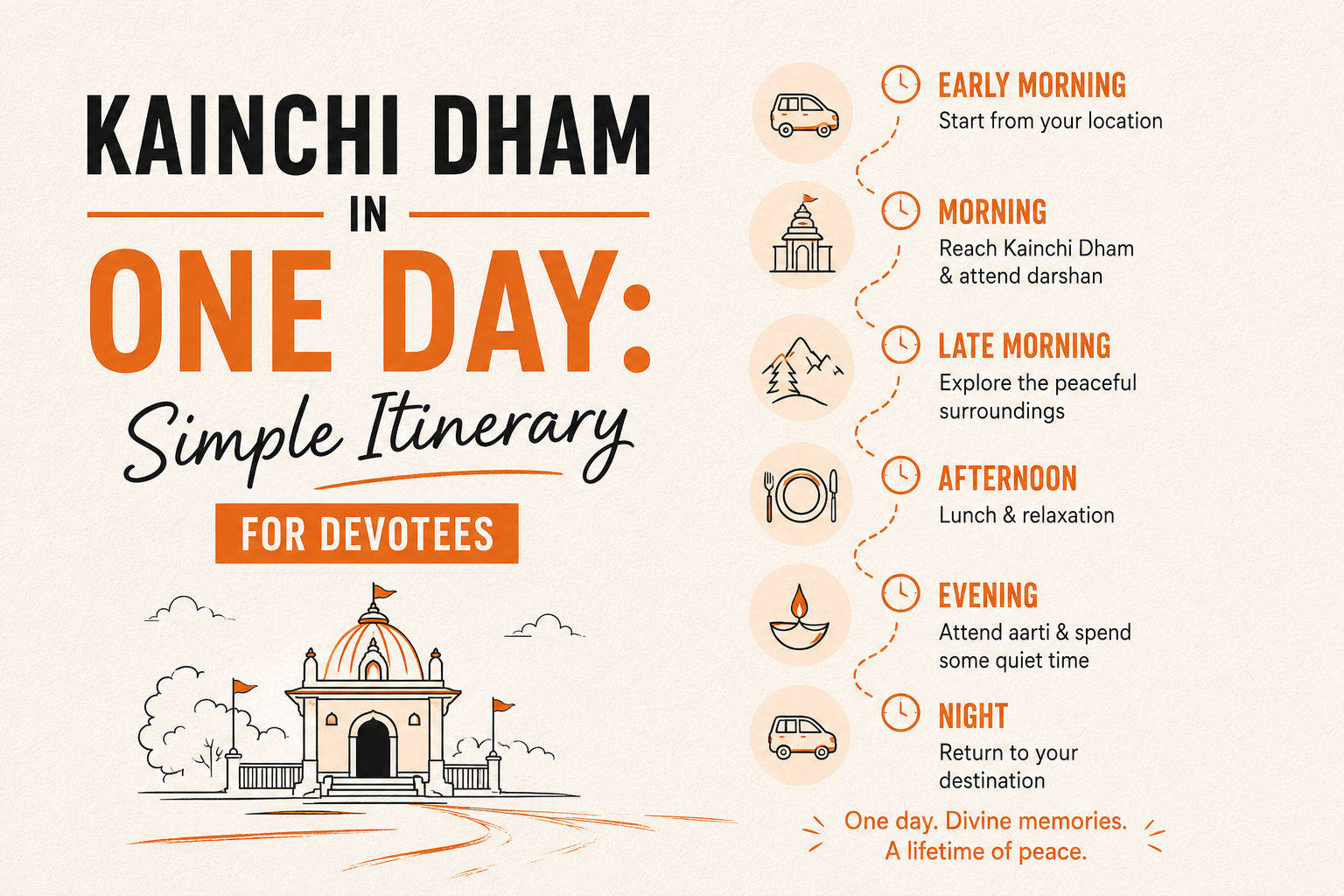
Kainchi Dham in One Day: Simple Itinerary for Devotees
A one-day Kainchi Dham trip works best when the itinerary stays simple: arrive early, give darshan enough time, eat after the visit and add only one nearby stop if the group still has energy. The day becomes stressful only when travellers try to combine too many lakes, viewpoints and shopping stops with fixed train timings.
Travel note: Mountain routes, traffic rules, temple systems and seasonal services can change because of weather or administration. Verify same-day local conditions before starting.
Kainchi Dham at a Glance
Kainchi Dham is a spiritual ashram and temple complex in the Kumaon hills of Uttarakhand, on the Nainital–Almora road. It is closely associated with Neem Karoli Baba, affectionately called Maharajji by devotees. Uttarakhand Tourism places it about 17 km from Nainital and around 9 km from Bhowali, at roughly 1,400 metres above sea level. The setting is compact and scenic: wooded slopes rise on both sides of the road, and the ashram sits beside a mountain stream. For many first-time visitors, the appeal is not a long sightseeing list but the quiet rhythm of darshan, prayer and a few unhurried hours in the hills.
The ashram was established in the early 1960s under Neem Karoli Baba. Over time it became known well beyond Uttarakhand because of Maharajji’s teachings on devotion, service and remembrance of God. International visitors also brought attention to the place, but the atmosphere inside remains that of a functioning sacred space rather than a conventional tourist attraction. Visitors should dress modestly, speak softly, follow signs regarding photography or mobile-phone use, and avoid treating the temple complex as a backdrop for social-media content.
A visit can be completed in a few hours, yet the journey feels better when it is not rushed. Early morning is usually the most comfortable time because the roads are quieter, parking is easier and the temple area feels calmer. Weekends, public holidays and important devotional dates can be very busy. The annual bhandara around 15 June is especially significant and can draw exceptionally large crowds, so transport and stay arrangements should be made well in advance if you deliberately plan to visit at that time.
Quick planning facts
- Nearest convenient railhead: Kathgodam, roughly 38–44 km away depending on the road point used for measurement.
- Nearest major hill town: Nainital, about 17 km away.
- Road approach: via Bhowali on the Nainital–Almora road.
- Typical visit duration: half a day for darshan alone; one full day if adding Bhowali or nearby viewpoints; two days if pairing Kainchi Dham with Nainital.
- Best crowd strategy: arrive early, especially on weekends and in May–June.
- Most important etiquette: respect silence, queue discipline, temple instructions and restrictions on photography.
Because mountain traffic changes quickly, do not build the day around a single exact arrival time. Landslides, road maintenance, tourist congestion in Bhowali and Nainital, and weather can all alter journey time. A practical itinerary always keeps a buffer before evening, particularly if you need to return to Kathgodam for a train.
Nainital and Kainchi Dham Together
Nainital and Kainchi Dham are close enough to combine without turning the day into a road marathon. Kainchi Dham is about 17 km from Nainital, and the usual drive takes roughly 40–60 minutes in light traffic. During peak tourism weeks, however, the approach to Bhowali and Nainital can become congested, so time is better measured with a buffer than by distance alone.
If darshan is your main purpose, visit Kainchi Dham first. Leaving Nainital early helps you reach the ashram before the midday crowd. After darshan, return toward Nainital and spend the afternoon around Naini Lake, Mall Road, Naina Devi Temple or a viewpoint depending on weather and mobility. This order also protects the spiritual part of the trip from being squeezed by sightseeing delays.
One-day combination
- Early morning: leave Nainital for Kainchi Dham.
- Morning: darshan, quiet prayer and time around the temple complex.
- Late morning: return via Bhowali; stop for tea or breakfast if needed.
- Afternoon: Naini Lake, Naina Devi Temple and a relaxed walk in the central town area.
- Evening: sunset by the lake, followed by dinner and rest.
Families with seniors should avoid overloading the day with too many viewpoints. Hill-town parking, slopes and queues can be more tiring than the road distance suggests. A two-day plan is better if you want Bhimtal, Sattal or other lake-area excursions in addition to Nainital and Kainchi Dham.
Practical Tips for a First Visit
What to wear
Choose modest, comfortable clothing suitable for a religious site and hill weather. Even in warmer months, a light layer is useful in the morning. In monsoon, carry a compact rain jacket rather than a large umbrella that becomes awkward in queues. Wear footwear that is easy to remove and put on, with a sole that grips well on wet surfaces.
Food, water and medicines
Carry water, but avoid overpacking. Keep essential prescription medicines with you, especially if travelling with senior citizens. Eat a light breakfast before a long drive. Mountain bends can cause nausea, and heavy oily food immediately before the climb from Kathgodam is a common mistake.
Phones, photography and silence
Treat posted rules as the final authority. Photography and mobile use can be restricted in parts of the complex, and rules may be tightened during crowded periods. Keep the phone on silent, avoid filming other devotees and do not block pathways for photographs.
Cash and connectivity
Digital payments are common in the region, but network reliability can vary. Carry a modest amount of cash for local transport, parking, snacks and emergencies. Download tickets, addresses and your stay confirmation before entering the hills.
Travelling with seniors
The temple visit itself is not a long mountain trek, but traffic diversions may require extra walking on busy days. Keep the schedule light, carry regular medicines and identify a warm place to rest after darshan. If the road is highly congested, do not pressure elderly travellers to cover additional sightseeing simply because it was written into the plan.
Places to Visit Near Kainchi Dham After Darshan
The best nearby stops are those that fit naturally into your onward route. Trying to cover every lake and temple in one day often leaves little time for the reason you came to Kainchi Dham in the first place. Choose one or two additions based on whether you are returning toward Kathgodam, staying in Nainital or travelling onward toward Almora.
Bhowali
Bhowali is the nearest practical junction and a good place for breakfast, tea, basic shopping or a transport change. It is only a short drive from Kainchi Dham. Because several roads meet here, traffic can be slow during busy holiday periods.
Nainital
About 17 km from Kainchi Dham, Nainital is the easiest major sightseeing add-on. Naini Lake, Naina Devi Temple and the central Mall Road area can comfortably fill an afternoon. If you are returning to Delhi the same day, do not let a late Nainital departure jeopardise your train or turn the drive into a night journey.
Bhimtal
Bhimtal is convenient for travellers heading toward Kathgodam and offers a calmer lake-town atmosphere than central Nainital on many days. It works well as a lunch or early-evening stop after morning darshan.
Sattal
Sattal is known for its cluster of lakes and wooded surroundings. It is better for travellers with a private cab and enough daylight, because the aim here is to slow down and enjoy nature rather than rush through a photo stop.
Ghorakhal and the surrounding ridge
The Ghorakhal side is known for hill views and religious sites, and it can be combined with Bhowali if your route and time permit. Road conditions and parking vary, so keep the plan flexible rather than trying to follow a minute-by-minute schedule.
If you have only half a day, choose Bhowali plus one lake town. If you have a full extra day, Nainital and Bhimtal can be combined at an easy pace. Travellers continuing toward Almora should avoid backtracking toward Nainital unless it is a priority.
Where to Stay Near Kainchi Dham
For a pilgrimage-focused trip, staying close to the ashram or along the Bhowali–Kainchi corridor reduces morning driving and makes an early darshan easier. Travellers searching for a best hotel near Kainchi Dham can consider Viom Regency. Booking in advance is particularly useful for weekends, the May–June holiday period and the annual June gathering.
When comparing any hotel near Kainchi Dham, look beyond room photos. Check approach-road access, parking, heating or hot-water arrangements in colder months, meal timing, and how early a cab can be arranged for darshan. A stay that saves an hour of morning traffic can be more valuable than a more elaborate property farther away.
Detailed Planning Checklist
Seven days before travel
Confirm your train or road plan, stay, cab and expected arrival time. If the trip falls on a weekend or in peak summer, call the driver/property again rather than assuming an old confirmation is enough. Check the weather forecast for both the plains and Nainital district because conditions can differ sharply.
The evening before
Charge phones and power banks, download tickets and maps, keep a small amount of cash ready, and pack one day bag with water, medicines and a light layer. If you are driving from Delhi, sleep early; fatigue is a more serious hill-road risk than saving thirty minutes with an aggressive start.
On the morning of darshan
Eat lightly, carry only what you need and leave earlier than your map app suggests. Temple-area movement can be regulated at short notice. If parking is shifted, accept the extra walk and follow local instructions rather than arguing for a closer drop.
After darshan
Decide whether the group still has enough energy for sightseeing. A pilgrimage day is successful even if you skip an optional lake or viewpoint. If someone is tired, return to the stay and rest. This is especially important with children and seniors.
Before leaving the hills
Check fuel, train status and road conditions. If you are heading to Kathgodam, keep a conservative buffer for traffic around Bhowali and Haldwani. If driving to Delhi, take a proper break in the plains before the final highway stretch.
The most reliable Kainchi Dham itinerary is therefore not the one with the largest number of attractions; it is the one that protects early darshan, keeps road buffers and leaves the group calm enough to appreciate the place.
Frequently Asked Questions About Kainchi Dham
How much time is needed at Kainchi Dham?
For darshan and a quiet visit, allow roughly two to three hours once you reach the area. On busy days, queues and traffic may extend this substantially.
Can Kainchi Dham be visited as a day trip from Nainital?
Yes. It is about 17 km from Nainital and is one of the easiest spiritual day trips from the town. Leave early to avoid traffic and return after darshan for afternoon sightseeing.
Is Kathgodam the best railway station?
Kathgodam is the most convenient railhead for most visitors. From there, a reserved cab is the simplest onward option, especially for families.
Is one day enough from Delhi?
A very long same-day road trip is technically possible but tiring. Train plus taxi or one overnight stay is usually a better pilgrimage experience.
When should I avoid crowds?
Avoid weekends, long holiday periods and the major June bhandara if your priority is silence. Weekday mornings in spring or autumn are generally calmer.
Can I combine Kainchi Dham with Nainital?
Yes. A two-day plan is ideal: one day for Nainital and one early morning for Kainchi Dham, with optional Bhimtal or Bhowali afterward.
Planning by Traveller Type
Families with children
Keep the temple morning short on logistics and long on patience. Children handle the drive better when they have eaten lightly, have water available and are not forced through too many sightseeing stops afterward. A quiet lake stop or early return to the accommodation is usually better than a packed checklist.
Senior citizens
Choose train plus taxi or a comfortable private cab, reduce walking from distant parking where possible, and travel on a weekday. Keep regular medicines in hand luggage and avoid a same-day Delhi return unless the senior traveller is used to long road journeys.
Solo pilgrims
Solo travel is straightforward, especially via Kathgodam. Share your cab details with family, arrive in daylight, keep cash and phone power available, and avoid depending on the last possible shared vehicle of the evening.
Photographers and content creators
The temple is a sacred space first. Follow photography restrictions without negotiation and focus visual work on permitted road, forest and landscape areas. Never photograph private prayer or people receiving prasad without permission.
Budget travellers
Public transport to Haldwani/Kathgodam or Nainital followed by shared local transport can reduce cost. The trade-off is time and uncertainty, so build a longer day and avoid a tight return ticket.
Common Mistakes to Avoid
- Leaving Delhi late and reaching the mountain section after dark.
- Assuming 17 km from Nainital means a guaranteed 30-minute drive.
- Visiting on 15 June without planning for extraordinary crowds.
- Packing the day with Kainchi Dham, Nainital, Bhimtal, Sattal and a same-night train.
- Speaking loudly or filming inside areas where the atmosphere calls for silence.
- Booking a return cab or train with no traffic buffer.
- Treating monsoon road conditions as predictable.
Final Takeaway
Kainchi Dham is easiest to enjoy when the journey is built around an early, respectful darshan and generous road buffers. Keep the itinerary light, choose transport that matches the group’s energy and let nearby sightseeing remain optional.
Extended Kainchi Dham Travel Notes
The Kumaon region is forgiving compared with higher Himalayan pilgrimage routes, but the two variables that most often disrupt a plan are road congestion and rain. This is why experienced hill travellers think in windows instead of exact times. If navigation predicts a 45-minute drive, allow an hour or more. If a train departs at 6 pm, plan to reach Kathgodam well before the final hour rather than aiming for a tight connection.
Another useful principle is to separate pilgrimage time from tourism time. Kainchi Dham can be emotionally meaningful precisely because the visit is not rushed. Arrive, complete darshan, sit quietly if permitted, receive prasad where available and leave without feeling that the next attraction is already late. Once you are back on the road, decide how much sightseeing the group actually wants.
For meals, prefer simple food before a winding drive. People prone to motion sickness often do better with a light breakfast, ginger or doctor-approved medication and a front-facing seat. Keep plastic waste in the vehicle until you find a proper bin. Mountain roads and streams are not places to discard bottles or snack wrappers.
If you are visiting as part of a larger Kumaon trip, build the route geographically. Nainital and Bhowali fit naturally with Kainchi Dham. Bhimtal and Sattal fit well when returning toward Kathgodam. Almora lies in the opposite onward direction. Good routing reduces backtracking and gives you more time at each place.
Finally, remember that temple instructions can be stricter than what an older online article describes. Crowd-control barriers, parking zones, mobile rules and opening periods may be adjusted by local authorities or management. The correct information is the instruction you receive on the day, not an outdated screenshot.
Decision Guide: Build the Trip Around Your Priority
If your priority is spiritual quiet, choose a weekday morning and stay near the Bhowali–Kainchi corridor. If your priority is a family holiday, stay in or near Nainital and use Kainchi Dham as the first activity of the day. If your priority is low cost, use rail or bus to Kathgodam/Haldwani and accept that local shared transport will add time. If your priority is a same-day return, remove optional sightseeing and protect your transport connection.
These priorities should not be mixed blindly. A budget trip with five sightseeing stops, a fixed evening train and a late start is fragile because every choice consumes the same limited time buffer. Pick the two things that matter most and let the rest remain optional.
The same logic applies to crowd planning. Peak days can still be rewarding if you deliberately want the shared devotional atmosphere. They are poor choices if your expectation is silence and effortless parking. Matching the date to the experience you actually want is more useful than searching for a universally ‘best’ day.
Deep Planning Notes for a Smoother Kainchi Dham Trip
How to choose your arrival point
For most outstation pilgrims, Kathgodam is the cleanest arrival point because it creates a simple final road leg. Haldwani also works, especially for buses, while Nainital is better treated as a stay and sightseeing base than as a transport gateway. If you are coming from Delhi with elderly family members, reducing transfers is usually more valuable than saving a small amount of money. A reserved cab from the railway station keeps luggage together, avoids waiting for shared seats and lets you pause if someone feels motion sick on the climb.
Travellers arriving by road should decide in advance whether the first objective is darshan or check-in. If you reach the hills early in the morning and the group is fresh, going directly to Kainchi Dham can work well. If you reach after a long overnight drive, check in, rest and visit the next morning. Fatigue changes the character of a pilgrimage; a place intended for quiet reflection can feel like another task when everyone is hungry and sleep-deprived.
How to use Bhowali intelligently
Bhowali is more than a name on the map. It is the practical junction around which many Kainchi Dham itineraries turn. It is close enough for breakfast or a short supply stop, and roads branch from the area toward Nainital, Bhimtal and Almora. On a crowded day, however, the same junction can become a bottleneck. This is why a good itinerary does not repeatedly cross Bhowali just to collect attractions. Choose an onward direction and keep moving logically.
For example, a traveller returning to Kathgodam can pair darshan with Bhimtal or Sattal more naturally than with a long detour deeper into the hills. A traveller staying in Nainital can return there for the afternoon. A traveller continuing to Almora should keep moving east rather than backtracking toward Nainital merely because it is famous. Geographic discipline saves more time than a rushed driving style.
How early is early enough?
There is no single departure time that works in every month, but the principle is consistent: reach before the main leisure-tourism traffic builds. During school holidays and long weekends, vehicles begin stacking up earlier than expected. If the group is staying within a short drive, leaving soon after daybreak is usually a strong strategy. If coming from Nainital, ask the driver about the previous day’s traffic pattern and adjust. Local knowledge is often more useful than an app that only sees current speed.
An early visit also improves the rest of the day. You can have breakfast after darshan, return to the stay before afternoon congestion or continue to one nearby place without watching the clock constantly. People who leave late often try to compensate by cutting darshan short, skipping meals and driving faster—exactly the wrong trade-offs on a hill trip.
What to do when traffic is unexpectedly heavy
Accept that the plan has changed. Follow police diversions, use designated parking and keep the group together if walking from a remote drop point. Do not ask a driver to stop in a live lane simply because the temple looks close. If a senior traveller cannot manage the extra walk, speak with local officials or volunteers about the currently permitted drop arrangements rather than improvising.
Heavy traffic is also a reason to simplify the return. Cancel an optional sightseeing stop before sacrificing the buffer for a train. If you have a flexible evening, have a meal and let traffic thin. If you have a fixed rail connection, leave the hills earlier than planned. The best itinerary is the one that adapts without creating a new safety problem.
A realistic budget framework
Costs vary by season and booking date, so exact figures age quickly. Think in categories instead: intercity travel, local cab, stay, meals, parking and a contingency amount. Train plus private cab generally sits between a full shared-transport journey and an all-the-way private vehicle from Delhi. Families often find the per-person cost of a cab reasonable once divided among three or four travellers.
Keep a separate emergency reserve that is not counted as spending money. It can cover an extra night, a replacement cab or a changed train if weather disrupts the return. Mountain travel becomes far less stressful when a delay is inconvenient rather than financially destabilising.
Spiritual etiquette beyond the obvious
Respect means more than modest clothing. Avoid pushing in queues, speaking on calls near prayer spaces, photographing people without consent or asking volunteers to bend rules for a faster visit. If prasad is distributed, receive it respectfully and avoid waste. If you sit quietly after darshan, choose a place that does not obstruct circulation.
Kainchi Dham’s popularity means visitors arrive with many different expectations—devotion, curiosity, personal reflection or interest in Neem Karoli Baba’s global influence. All can coexist when behaviour remains considerate. A quiet, orderly visitor contributes to the atmosphere rather than merely consuming it.
How to know whether to stay one night or two
One night is enough when you arrive early, want primarily darshan and have simple onward plans. Two nights are better when you are coming from a long distance, travelling with seniors, combining Nainital at an easy pace or visiting during a crowded period. The second night removes the pressure to complete sightseeing and a long road return on the same day.
If this is your first hill journey, choose the more generous schedule. The Kumaon region rewards slow mornings, short drives and unplanned pauses. Compressing everything into the fewest possible hours saves calendar time but often loses the quality that made the trip worthwhile.