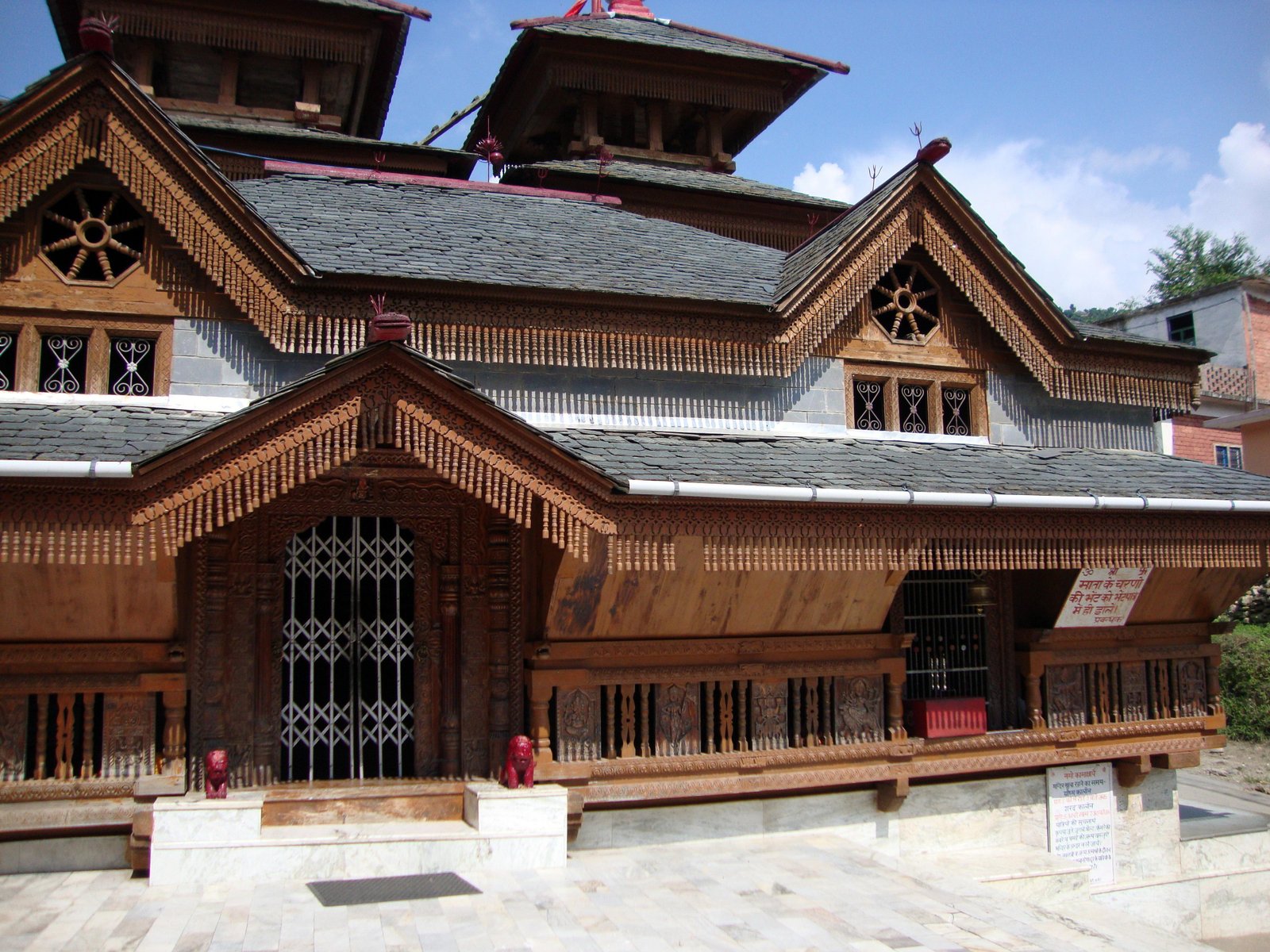
Kamaksha Devi Temple is one of the most important centres of Goddess worship in Karsog Valley, Himachal Pradesh. Located in Kau village, also written as Kao, approximately 7 kilometres from Karsog Bazaar, the temple is dedicated to Maa Kamaksha, worshipped here in the powerful form of Mahishasuramardini—the Divine Mother who defeats the buffalo demon Mahisha.
Surrounded by terraced fields, traditional villages, orchards, forested slopes and the peaceful mountain landscape of Mandi district, Kamaksha Devi Temple offers a deeply local pilgrimage experience. It is not a heavily commercialised shrine or a large urban temple complex. Its spiritual importance comes from the continuing faith of the people of Karsog, the distinctive image of the goddess, traditional Himachali architecture and religious customs preserved across generations.
The temple stands at an elevation of approximately 1,400 metres and can generally be approached by road from Karsog, followed by a short village walk depending on the current parking arrangement. This comparatively accessible location makes it suitable for families, senior citizens, couples, solo pilgrims and spiritual travellers who may not be able to undertake a difficult Himalayan trek.
Kamaksha Devi Temple is also an important destination for architecture enthusiasts. The shrine combines timber, stone and tiered slate roofs with finely worked wooden surfaces. Its design reflects the practical intelligence and artistic traditions of mountain builders who created religious structures capable of responding to rain, cold, seismic activity and changing weather.
A visit to the temple can be combined with Mamleshwar Mahadev Temple, Chindi, Mahunag Temple, Pangna, Shikari Devi Temple, Kamrunag and other sacred destinations in the wider Karsog region.
Travellers searching for hotels near Kamaksha Devi Temple, homestays in Karsog, cottages around Chindi or peaceful pilgrimage accommodation in Mandi district can use MudrasStays to plan a comfortable and geographically practical spiritual journey.
## Spiritual Importance of Maa Kamaksha
Maa Kamaksha is worshipped as a manifestation of the Divine Mother and a powerful form of Goddess Durga.
The name Kamaksha is often interpreted through the ideas of divine compassion, desire, fulfilment and the all-seeing presence of the goddess. In different Shakta traditions, similar names and forms of the goddess may be understood differently.
At Karsog, the identity of Maa Kamaksha is rooted in the local worship traditions of Kau village. Her importance should therefore be understood through the customs practised by the temple community rather than by automatically transferring rituals or stories from Kamakhya Temple in Assam, Kamakshi Temple in Kanchipuram or other similarly named shrines.
Maa Kamaksha is approached as a protector of families, villages, agriculture and the wider valley. Devotees pray for courage, health, prosperity, children, education, employment, family harmony and relief from difficult circumstances.
Some worshippers visit before beginning a marriage, new business, journey or important stage of life. Others return to express gratitude after experiencing what they regard as the fulfilment of a prayer.
Such experiences belong to personal religious faith and should not be presented as guaranteed outcomes. The temple offers devotees spiritual reassurance, emotional strength and a sacred environment for prayer, while responsible decisions and practical action remain essential in everyday life.
For local residents, the goddess is more than an image inside a temple. She is part of the cultural identity, collective memory and seasonal life of the community.
Her worship is connected with festivals, sacred music, ceremonial objects, agricultural cycles and relationships with other regional deities.
## Maa Kamaksha as Mahishasuramardini
The principal image at Kamaksha Devi Temple represents the goddess as Mahishasuramardini.
The Sanskrit term Mahishasuramardini means “the slayer of the demon Mahishasura.” This form of the Divine Mother is among the most powerful expressions of Goddess Durga.
According to Hindu sacred tradition, Mahishasura was a destructive being capable of assuming the form of a buffalo. After receiving powers that made him difficult to defeat, he disturbed the balance of the world and challenged the divine order.
The energies of the gods combined to manifest Goddess Durga. Armed with divine weapons and riding a lion or tiger according to different artistic traditions, she confronted Mahishasura and defeated him.
The story is preserved prominently in the Devi Mahatmya and is celebrated during Navratri and Durga Puja.
The victory of the goddess is not only a narrative about physical combat. It symbolises the triumph of courage over fear, clarity over confusion, discipline over uncontrolled desire and divine order over destructive power.
For devotees at Kamaksha Devi Temple, the Mahishasuramardini form represents protection and the strength required to overcome adversity.
The principal image is traditionally described as being made from ashtadhatu, a sacred alloy composed through a combination of metals.
Official tourism descriptions draw particular attention to the intensity and expression of the goddess’s eyes. Devotees may experience the gaze as powerful, compassionate or protective according to their personal faith.
Visitors should approach the image respectfully and avoid turning the darshan into a close-up photography session.
Photography of the principal deity, inner sanctum or private worship should only be undertaken when clearly permitted by the priest.
## The Ashtadhatu Image
Ashtadhatu images hold an important place in Hindu temple traditions.
The term generally refers to an alloy created from eight metals, although the exact composition may vary according to regional and ritual traditions.
Such images require significant metallurgical knowledge and artistic skill. The sculptor must create a form that is both structurally stable and suitable for ritual consecration.
At Kamaksha Devi Temple, the principal metal image is especially important because it represents the publicly worshipped form of Maa Kamaksha.
Devotees may offer flowers, red cloth, coconuts, sweets, incense and other materials permitted by the temple priest.
Visitors should not touch the image, remove ornaments or attempt to inspect it closely without authorisation.
Strong flash photography should be avoided. Apart from disturbing worshippers, repeated flash and crowding can reduce the dignity of the darshan experience.
Metal images can also be affected by moisture, oils, chemicals and uncontrolled handling. Religious devotion and conservation therefore need to work together.
## Underground Sanctum Tradition
Local temple tradition refers to an underground chamber regarded as the deeper or original sanctum of the goddess.
The original stone form of Maa Kamaksha is believed to remain within this lower sacred space. Ordinary visitors are generally not permitted to enter it.
This restricted chamber contributes to the temple’s spiritual mystery, but it should not be treated as an adventure attraction or secret tunnel to be explored.
Sacred underground spaces may be restricted because of religious custom, structural safety, limited ventilation and the need to preserve old objects.
Visitors should never attempt to enter a closed chamber, remove a covering or request unauthorised access for photography.
The publicly visible image enables devotees to receive darshan while the deeper sanctum remains protected according to local practice.
The idea of an inaccessible sacred centre also carries symbolic meaning. It reminds visitors that not every aspect of a spiritual tradition is intended for public display or casual examination.
Some spaces are preserved through silence, restraint and limited ritual access.
## Lord Parashurama Tradition
Kamaksha Devi Temple is traditionally associated with Lord Parashurama.
According to regional belief, the goddess manifested at this location as a result of Parashurama’s meditation, austerities and spiritual sacrifices.
Parashurama is recognised in Hindu traditions as an incarnation of Lord Vishnu. He is associated with discipline, justice, martial strength, penance and the restoration of moral order.
Several temples in Karsog Valley preserve stories relating to Parashurama, reflecting the region’s wider identification with sages, divine warriors and secluded places of meditation.
The precise historical details of his presence cannot be independently verified. The narrative belongs to sacred geography and the oral religious traditions of the valley.
Its importance lies in the spiritual message it communicates: divine grace is approached through discipline, perseverance and sincere devotion.
Visitors should present the Parashurama association as a respected local belief rather than as a documented archaeological conclusion.
## Other Sacred Images Within the Temple
The temple is not limited to the principal image of Maa Kamaksha.
Traditional descriptions refer to smaller chambers and sacred forms associated with Lord Vishnu, Bhairav, Nag Pundari and Lord Shiva.
Their presence reflects the interconnected character of Himalayan temple worship.
Maa Kamaksha is the central deity, but she exists within a wider sacred universe that includes protective, Shaivite, Vaishnava and serpent-related traditions.
Lord Vishnu represents preservation, balance and cosmic order.
Bhairav is commonly associated with protection, guardianship and a powerful form of Lord Shiva.
Nag Pundari belongs to the important serpent-deity traditions found across Himachal Pradesh. Nag worship is frequently associated with water sources, fertility, agricultural welfare, rainfall and protection of the land.
The Shiva lingam represents the formless and universal presence of Lord Shiva.
Visitors should not assume that the worship sequence followed at another temple will apply here. Guidance should be taken from the priest regarding the order of darshan and permitted offerings.
## The Bedchamber of the Goddess
Kamaksha Devi Temple also contains a space traditionally described as the bedchamber of the goddess.
The concept reflects the living-deity traditions of Himachal Pradesh, in which the divine presence may be served through daily routines comparable to those offered to a respected royal or family member.
A deity may be awakened, dressed, offered food, placed to rest and represented through ceremonial journeys.
These practices express intimacy between the community and its presiding goddess.
The bedchamber should not be treated as a decorative display or ordinary room. Access and photography may be restricted according to local custom.
Visitors should respect closed doors, curtains and instructions issued by the priest.
The existence of such a space demonstrates that the goddess is understood as an active presence participating in the rhythm of temple and village life.
## Traditional Himachali Architecture
Kamaksha Devi Temple is an outstanding example of local woodworking and traditional Himalayan temple design.
The building combines a substantial stone base with timber walls, carved wooden elements and layered slate roofs.
Its broad roof surfaces help protect the structure from rain and winter weather.
The projecting eaves direct water away from the walls and provide partial shelter around the outer walkway.
Timber provides flexibility, while stone supplies weight and stability. This combination is well suited to a mountain region where buildings must respond to both climate and seismic conditions.
The temple has been rebuilt or restored while retaining its traditional architectural character.
A living wooden shrine requires regular maintenance. Roof slates can become damaged, timber can weather and carved sections may require conservation.
Visitors should therefore understand that some elements may be newer than others even though the temple institution and worship tradition are much older.
Restoration carried out in the original architectural genre allows the shrine to remain functional without abandoning its regional identity.
## Tiered Slate Roofs
The roof is among the most recognisable features of Kamaksha Devi Temple.
Multiple sloping levels rise above the main structure and create a pagoda-influenced Himalayan profile.
Dark slate surfaces contrast with the warm tones of carved wood, painted sections and sacred flags.
Slate is a practical mountain material because it is durable and capable of shedding rain and snow when installed on a suitable slope.
The layered arrangement creates visual depth and helps protect different sections of the building.
Visitors should never climb onto a roof, boundary wall or adjoining structure for photography.
Slate can be extremely slippery, particularly during rain, frost or snow.
Loose pieces may also be damaged when subjected to unnecessary weight.
Observing the roof from the courtyard provides a better understanding of its design without placing either the visitor or temple at risk.
## Wooden Carvings
The temple’s carved timber is one of its most valuable artistic features.
Door frames, eaves, panels, railings and supporting elements display floral patterns, geometric designs and forms created by local craftspeople.
Carved wood transforms the structure from a practical mountain building into a sacred work of art.
The patterns may symbolise fertility, continuity, protection, nature and the cosmic order surrounding the goddess.
Visitors should observe the details patiently and from a respectful distance.
Historic wood can be damaged through repeated touching, scratching, oil, water and pressure.
Names, initials and messages should never be carved into the temple.
Bags, tripods and cameras should not be rested against decorated surfaces.
Professional photography, large lighting equipment or commercial filming may require prior permission.
The temple remains first an active place of worship. Architectural appreciation should not obstruct devotees entering the sanctum.
## The Large Ceremonial Drum
A large traditional drum is preserved within the temple complex and is regarded as one of its noteworthy cultural objects.
It is comparable in scale and significance to the drum associated with Mamleshwar Mahadev Temple in nearby Mamel village.
Drums play a central role in Himachal Pradesh’s deity traditions.
They may accompany religious processions, village fairs, sacred announcements and the ceremonial movement of a deity.
Their sound is not simply musical entertainment. It can signal the presence of the goddess and mark an important transition within a ritual.
Visitors should not strike, touch or move the drum without explicit permission.
Its exact age, materials and legendary associations should be described cautiously unless supported by formal conservation records.
The drum’s true importance lies in its continuing place within regional religious and musical culture.
## Kamaksha Devi and Kullu–Mandi Devta Culture
The worship of Kamaksha Devi belongs to the wider devta traditions of Himachal Pradesh.
Across Mandi and Kullu, local gods and goddesses are understood as active guardians of particular villages, valleys and communities.
A deity may be represented through a sacred image, mask, emblem or decorated palanquin.
Priests, musicians, attendants and traditional representatives maintain responsibilities relating to ceremonies and processions.
Local deities may visit one another during fairs or participate in wider community gatherings.
For outside travellers, these processions can be visually impressive, but they should never be treated as performances staged only for tourists.
Visitors must give palanquins, musicians and worshippers sufficient space.
Sacred masks and ceremonial objects should not be touched.
Photography should not block the movement of the deity or interfere with private acts of devotion.
Understanding this living religious system helps visitors appreciate Kamaksha Devi Temple as part of a network of sacred relationships rather than as an isolated building.
## Dussehra Celebrations
Dussehra is one of the principal religious celebrations at Kamaksha Devi Temple.
The festival symbolises the victory of righteousness over destructive power and occurs after the nine nights of Navratri.
For a temple dedicated to Mahishasuramardini, the season has special significance because it celebrates the triumph of the Divine Mother over harmful forces.
Local observances may include special worship, offerings, music, gatherings and ceremonial activity according to the traditions of Kau village.
The exact programme may change from year to year.
Travellers should confirm festival dates, temple timings and transport arrangements before arrival.
The temple approach and village lanes may become crowded during major celebrations.
Families should supervise children and establish a meeting point in case members become separated.
Senior citizens may prefer less crowded hours.
Photography should remain secondary to worship. Visitors should not obstruct the sanctum, procession routes or musicians while recording videos.
## Annual June–July Fair
A local fair is traditionally held during June or July and commemorates an important story preserved by the people of the area.
According to regional oral tradition, the ruler of the former princely state of Suket pressured residents to join British military forces during the Second World War.
The people were reluctant, and local faith attributes the end of the conflict and the protection of the community to the intervention of Maa Kamaksha.
The annual fair remembers this event through the community’s religious perspective.
This account belongs to local oral history and devotional belief. The wider dates and documented causes of the Second World War are matters of established global history, while the goddess’s intervention is an expression of regional faith.
The story demonstrates how communities understand major external events through their relationship with a guardian deity.
The fair may include worship, deity ceremonies, music, cultural gatherings and village participation.
Exact dates should be verified locally because the programme can vary according to the traditional calendar and organisational decisions.
Visitors planning to attend should reserve hotels or homestays near Karsog and Chindi in advance.
## Navratri and Durga Worship
Both Chaitra Navratri and Sharad Navratri are meaningful periods for worshipping Maa Kamaksha.
Devotees honour different forms of the Divine Mother through prayer, fasting, lamps and devotional recitation.
The temple may receive additional visitors during the Navratri period, particularly around Ashtami and Navami.
Offerings may include flowers, coconuts, sweets, incense and red cloth according to local customs.
Visitors should avoid bringing excessive offerings that create plastic waste or obstruct temple management.
Special rituals should only be arranged through authorised priests.
Practices found online or followed at unrelated Shakti temples should not automatically be repeated at Kamaksha Devi Temple.
A simple and respectful darshan remains appropriate for every visitor.
## Best Time to Visit Kamaksha Devi Temple
The temple can generally be visited throughout the year, although each season creates a different travel experience.
### Spring
Spring is one of the best periods for visiting Karsog Valley.
Fields become active, trees develop fresh leaves and daytime weather is generally comfortable.
Fruit blossoms may appear in surrounding orchard areas according to elevation and yearly weather, but flowering cannot be guaranteed for specific dates.
Morning and evening remain cool, making layered clothing useful.
Spring is suitable for families, couples and visitors combining several temples in the valley.
### Summer
Summer offers pleasant mountain conditions compared with the intense heat of the plains.
Karsog lies at a moderate elevation, so midday can still feel warm under direct sunlight.
Morning is ideal for darshan and architectural observation.
Visitors should carry drinking water, sunscreen and a light head covering.
The annual fair may occur during the broader June–July period, increasing local activity and accommodation demand.
### Monsoon
The monsoon transforms Karsog Valley into a lush green landscape.
Terraced fields, forested slopes and village surroundings become especially attractive.
Clouds and light rain can create a peaceful atmosphere around the wooden temple.
Heavy rainfall, however, may cause landslides, falling stones, blocked roads and slippery pathways.
Visitors should check current district weather and road advisories before departure.
Shoes with dependable grip and proper rain protection are recommended.
Travel should be postponed during severe rain or official warnings.
### Autumn
Autumn is among the most favourable periods for visiting Kamaksha Devi Temple.
Rain generally reduces, fields and orchards remain attractive and road conditions may improve.
Sharad Navratri and Dussehra give the season additional religious importance.
Travellers seeking a quieter experience should choose an ordinary weekday outside the main festival dates.
### Winter
Winter provides a calm and less crowded pilgrimage.
Morning and evening temperatures can become very cold, while frost may affect shaded village roads and temple steps.
Snowfall at the immediate temple location should not be guaranteed.
Higher surrounding hills may receive snow while Kau village remains accessible.
Travellers should carry warm jackets, thermals, gloves and suitable footwear.
Accommodation providers should be asked about hot water, room heating, warm bedding and power backup.
## Reaching Kamaksha Devi Temple
Kamaksha Devi Temple is situated in Kau village, approximately 7 kilometres from Karsog Bazaar and around 17 kilometres from Chindi.
The most practical approach is generally by local taxi or private vehicle.
Road conditions and the closest parking point should be confirmed through the accommodation host or driver.
Mountain roads may be narrow, and journey times should not be calculated from distance alone.
Weather, road repairs, agricultural traffic and village activity can slow movement.
The final approach may involve a short walk through the settlement or temple lane.
Vehicles should not block residential entrances, agricultural access or narrow turning points.
Travellers relying on buses or shared vehicles should confirm both the onward and return schedule, as frequency may be limited.
## Reaching Karsog
Karsog can be approached by road from Shimla, Mandi, Sundernagar, Tattapani, Chindi and other parts of Himachal Pradesh.
The preferred route depends on the traveller’s starting point and current road condition.
Visitors travelling from Shimla often approach through the Tattapani and Chindi side.
Travellers coming from Mandi or Sundernagar may use regional roads passing through different mountain settlements.
Mountain journey times can increase significantly because of curves, rain, fog, construction or landslides.
Visitors should begin early and avoid unfamiliar mountain roads after dark.
Private taxis offer the greatest flexibility for families and senior citizens.
Public buses may be economical but require careful timetable planning.
## Karsog as the Main Stay Base
Karsog is the most practical accommodation base for visitors whose main purpose is Kamaksha Devi darshan.
The town offers markets, restaurants, pharmacies, basic medical facilities, taxis and local transport.
Accommodation includes hotels, guesthouses, lodges and homestays.
Staying in Karsog allows travellers to reach Kau village early and return without completing a long journey on the same day.
Properties in the main town offer easier access to shops and vehicles.
Village homestays outside the bazaar may provide quieter surroundings and closer interaction with local families.
Guests should confirm actual driving time to the temple rather than relying only on the property’s Karsog address.
## Chindi as a Peaceful Accommodation Base
Chindi is approximately 17 kilometres from Kamaksha Devi Temple and offers a quieter hill-station setting.
The destination is surrounded by forests, orchards, small villages and broad mountain views.
Accommodation includes tourism properties, small hotels, cottages and homestays.
Chindi is suitable for couples, families and travellers seeking relaxation in addition to pilgrimage.
A stay here can be combined with Chindi Mata Temple, Karsog Valley, Mamleshwar Mahadev and other regional attractions.
The practical driving time to Kau should be confirmed before scheduling morning darshan.
## Homestays Near Kau Village
A homestay close to Kau can provide the most locally connected pilgrimage experience.
Guests may receive home-cooked meals, information about temple timings and assistance arranging transport.
A nearby stay can make morning or evening darshan easier.
Facilities may be simpler than those available in established hotels.
Travellers should confirm attached bathrooms, hot water, electricity, meals, parking and mobile connectivity before booking.
Guests should respect household schedules, village quiet hours and local customs.
Supporting community-run homestays enables pilgrimage tourism to benefit families living near the shrine.
## Mamleshwar Mahadev Temple
Mamleshwar Mahadev Temple in Mamel village is one of the most important nearby pilgrimage destinations.
Dedicated to Lord Shiva, it is known for traditional wood-and-slate architecture, a sacred fire and local traditions associated with the Pandavas, Lord Rama and Himalayan sages.
The temple lies close to Karsog Bazaar and can be combined easily with Kamaksha Devi Temple.
Visiting both shrines creates a meaningful Shiva–Shakti pilgrimage.
A morning visit to Mamleshwar Mahadev can be followed by afternoon darshan at Kamaksha Devi, or the sequence can be reversed according to temple timings and accommodation location.
## Mahunag Temple
Mahunag Temple is another important sacred destination in the wider Karsog region.
The deity is traditionally associated with Karna of the Mahabharata.
Local devotees worship Mahunag as a guardian and powerful regional deity.
A visit provides insight into the living devta traditions of Mandi district.
The road and travel time should be confirmed locally because the temple lies away from the immediate Karsog–Kau route.
It is better included in a separate day or a carefully planned regional circuit.
## Shikari Devi Temple
Shikari Devi Temple is a roofless hilltop shrine standing at high altitude on Shikari Peak.
It is approached from Janjehli or the Karsog side according to current road conditions.
The temple requires a full-day excursion, an experienced local driver and careful attention to weather.
Dense forest, fog, remote roads and altitude make it significantly more demanding than Kamaksha Devi Temple.
The two shrines should generally be visited on separate days.
Travellers should not attempt to add Shikari Devi late in the afternoon after completing other temple visits.
## Kamrunag Lake and Temple
Kamrunag is a high-altitude lake and temple destination associated with a powerful regional deity and traditions concerning rainfall and the Mahabharata.
It requires a separate trekking plan from an appropriate route village.
Visitors need suitable footwear, food, water, weather protection and sufficient daylight.
The lake is sacred and should not be entered or polluted.
Offerings and rituals must follow local regulations.
Kamrunag should not be treated as a casual addition to a Kamaksha Devi day trip.
## Pangna and Suket Heritage
Pangna is associated with the historic princely state of Suket and contains traditional buildings, temples and village heritage.
The regional story connecting Kamaksha Devi with the former Suket rulers gives Pangna additional relevance to interested cultural travellers.
A visit can be incorporated according to the traveller’s route towards Mandi or Sundernagar.
Old buildings, private homes and restricted areas should be treated respectfully.
## Suggested One-Day Itinerary
A one-day Kamaksha Devi pilgrimage is most practical for travellers already staying in Karsog or Chindi.
Begin with an early journey to Kau village.
Attend darshan before the arrival of larger groups and spend time observing the wooden architecture.
Return towards Karsog for breakfast or lunch.
The afternoon can include Mamleshwar Mahadev Temple in Mamel village.
Conclude the day at a nearby hotel or homestay rather than attempting a long mountain drive after dark.
## Suggested Two-Day Itinerary
On the first day, arrive in Karsog or Chindi and check into accommodation.
Visit Mamleshwar Mahadev Temple and explore Karsog Bazaar or the surrounding fields.
On the second morning, travel to Kamaksha Devi Temple for peaceful darshan.
Spend time in Kau village before returning to Karsog.
The afternoon can include Chindi Mata Temple or a relaxed orchard and village drive.
## Suggested Three-Day Spiritual Itinerary
The first day can include arrival in Chindi, local sightseeing and Chindi Mata Temple.
The second day can focus on Kamaksha Devi Temple, Mamleshwar Mahadev Temple and Karsog.
The third day can include Mahunag Temple, Pangna or another road-accessible regional shrine.
Shikari Devi and Kamrunag require additional planning and should be assigned separate days.
## Choosing Accommodation Near Kamaksha Devi Temple
Pilgrims prioritising early darshan should choose Kau, Karsog or another nearby village.
Travellers seeking developed services should stay in Karsog.
Couples and families looking for forests, orchards and a peaceful hill atmosphere may prefer Chindi.
Senior citizens should choose properties with direct vehicle access, minimal stairs and dependable hot water.
Families should confirm room size, meals, parking and bathroom facilities.
Couples may prefer private cottages, orchard stays or mountain-view rooms.
Solo pilgrims can select simple guesthouses and homestays.
Pilgrimage groups should verify multiple-room availability, vegetarian meals, driver accommodation and vehicle parking.
Winter visitors should confirm heating and warm bedding.
Monsoon travellers should ask about the condition of the property’s approach road.
Guests requiring internet access should verify Wi-Fi and mobile connectivity directly with the property.
## Book Stays Near Kamaksha Devi Temple with MudrasStays
MudrasStays helps pilgrims discover hotels, cottages, guesthouses and homestays near Kamaksha Devi Temple, Kau village, Karsog and Chindi.
The platform is designed specifically for travellers searching for suitable places to stay near temples and spiritual destinations across India.
Visitors can compare accommodation according to practical distance from the temple, room type, budget, group size and required facilities.
Booking a stay near Karsog makes it easier to attend morning darshan and combine Kamaksha Devi Temple with Mamleshwar Mahadev and other regional shrines.
Solo pilgrims can find affordable rooms and locally operated guesthouses.
Couples can explore peaceful cottages, orchard stays and village homestays.
Families can choose properties offering meals, parking and comfortable room capacity.
Senior citizens can prioritise accessible accommodation and shorter vehicle approaches.
Pilgrimage groups can identify properties offering several rooms, vegetarian meals and parking for their transport.
Travellers attending Dussehra or the annual fair can reserve accommodation early and avoid last-minute travel difficulties.
Visitors continuing towards Shikari Devi, Kamrunag, Pangna or Mandi can select separate bases according to the actual road sequence.
MudrasStays helps travellers build a temple-focused itinerary instead of booking a general property located far from the pilgrimage route.
## Responsible Temple and Village Travel
Kamaksha Devi Temple is a sacred wooden shrine within a living village environment.
Visitors should remove footwear wherever instructed and dress respectfully.
Photography of the principal image, underground sanctum, bedchamber, ceremonial drum, priests or private rituals should only be undertaken with permission.
Wooden carvings, doors and railings should not be scratched, rubbed or used to support luggage.
Incense, lamps and ritual fire should only be used in designated areas because timber structures are vulnerable to fire.
Plastic bottles, food wrappers and puja packaging must be carried away.
Synthetic cloth and plastic decorations should not be tied randomly to trees or temple structures.
Visitors should avoid loud music and disruptive video recording.
Sacred palanquins, masks, instruments and ceremonial objects should never be touched without authorisation.
Private homes, fields and residents should not be photographed without consent.
Crops, flowers and fruit should not be taken from private land.
Vehicles must not block village lanes, homes or agricultural access.
Supporting local homestays, taxi drivers, priests, shops and food providers allows pilgrimage tourism to benefit the community preserving the shrine.
## A Living Shakti Tradition in Karsog Valley
Kamaksha Devi Temple represents a powerful meeting of Goddess worship, Himachali craftsmanship, agricultural life and community faith.
The Mahishasuramardini image symbolises courage and the victory of divine order over destructive power.
The ashtadhatu form preserves the skill of traditional sacred metalwork.
The underground sanctum expresses the protected and hidden dimension of the goddess.
The Parashurama tradition connects the temple with meditation and disciplined devotion.
The images of Vishnu, Bhairav, Nag Pundari and Shiva demonstrate the interconnected nature of Himalayan worship.
The bedchamber reflects the belief that the goddess is a living presence within the community.
The wooden walls and slate roofs preserve regional architectural knowledge.
The ceremonial drum connects worship with Himachali music and deity processions.
Dussehra and the annual fair connect the temple with collective memory and village identity.
For devotees of Maa Durga, Kamaksha Devi Temple is a place to seek courage, protection and spiritual strength.
For families, it offers an accessible pilgrimage within the peaceful Karsog Valley.
For senior citizens, the road-based approach makes darshan more manageable than at remote hilltop shrines.
For couples, the surrounding homestays and cottages provide a calm spiritual retreat.
For architecture enthusiasts, the temple offers an outstanding example of wood-and-slate Himalayan craftsmanship.
For cultural travellers, the shrine provides insight into local deity traditions, oral history and village festivals.
For photographers, the carved timber, layered roofs and agricultural landscape provide memorable visual opportunities when religious privacy is respected.
For slow travellers, staying in Karsog, Kau or Chindi allows time to experience the shrine as part of a living community.
Kamaksha Devi Temple should not be treated only as a brief sightseeing stop or confused with other similarly named Goddess temples.
It is an independent sacred destination with its own Mahishasuramardini image, architectural identity, ceremonies and relationship with the people of Karsog.
Plan your pilgrimage to Kamaksha Devi Temple with MudrasStays and discover one of the most important Shakti shrines in Himachal Pradesh’s Karsog Valley.
Seek the blessings of Maa Kamaksha, observe the traditional wooden architecture and experience the sacred customs preserved in Kau village.
Combine your journey with Mamleshwar Mahadev Temple, Chindi, Mahunag Temple, Pangna, Shikari Devi and Kamrunag.
Book hotels near Kamaksha Devi Temple, discover homestays in Karsog and Kau, and explore peaceful cottages and pilgrimage stays around Chindi through MudrasStays.
Stay closer to your place of worship, attend peaceful morning darshan and reduce unnecessary travel on winding mountain roads.
MudrasStays connects pilgrims, families and spiritual travellers with suitable accommodation near temples and sacred destinations across India.
Begin your Kamaksha Devi Temple journey with a comfortable stay and experience a meaningful pilgrimage centred on Maa Shakti, Mahishasuramardini worship, Himachali craftsmanship and the natural beauty of Karsog Valley.