
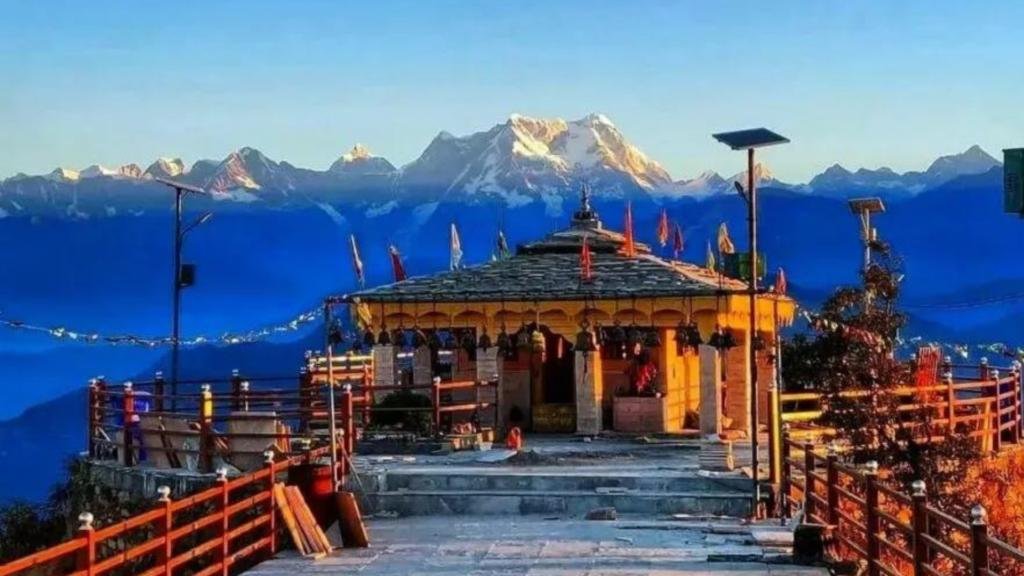
Kartik Swami Temple is one of the most beautiful and spiritually rewarding hilltop temples in Uttarakhand. Located above Kanakchauri village in the Rudraprayag district, the temple is dedicated to Lord Kartikeya, the son of Lord Shiva and Goddess Parvati. Lord Kartikeya is also known across India by names such as Kartik, Skanda, Murugan, Subramanya and Kartikeya.
The temple stands on a narrow mountain ridge at an elevation of approximately 3,048 metres above sea level. Its dramatic location on Kronch Parvat, surrounded by deep valleys and snow-covered Himalayan ranges, makes it an exceptional destination for pilgrims, trekkers, photographers, birdwatchers and travellers seeking a peaceful spiritual retreat.
Reaching Kartik Swami Temple requires an approximately 3-kilometre uphill trek from Kanakchauri village, followed by a final climb of around 380 steps. The journey passes through peaceful mountain forests and gradually opens towards wide views of the Garhwal Himalayas. For many visitors, the trek is not simply a route to the temple—it is an essential part of the pilgrimage.
The forest trail, changing mountain light, ringing temple bells and panoramic views create a spiritual experience very different from temples located in crowded cities. Kartik Swami Temple offers visitors an opportunity to combine devotion with walking, nature, silence and Himalayan village life.
## Spiritual Importance of Kartik Swami Temple
Kartik Swami Temple is dedicated to Lord Kartikeya, traditionally worshipped as the deity of courage, discipline, leadership, knowledge and victory over negative forces.
In Hindu religious traditions, Kartikeya is the son of Lord Shiva and Goddess Parvati and the brother of Lord Ganesha. He is especially prominent in South India, where he is widely worshipped as Lord Murugan or Subramanya. His hill temples are associated with spiritual discipline, bravery and the overcoming of internal and external obstacles.
At Kartik Swami Temple, devotees approach Lord Kartikeya for courage, clarity, strength, success, protection and fulfilment of sincere prayers. Students may seek blessings for concentration and achievement, while families pray for welfare and prosperity. Travellers may also seek divine protection before undertaking journeys through the mountains.
The remote ridge-top location reflects many of the qualities associated with Lord Kartikeya. Reaching the shrine requires effort, patience and discipline. The gradual ascent through the forest encourages pilgrims to leave behind distractions and prepare themselves mentally before darshan.
Unlike a roadside temple where visitors may arrive and leave within a few minutes, Kartik Swami Temple demands time and participation. Every step towards the shrine becomes part of the spiritual journey.
## The Legend of Lord Kartikeya
Kartik Swami Temple is connected with a popular religious story involving Lord Kartikeya, Lord Ganesha, Lord Shiva and Goddess Parvati.
According to the tradition, Shiva and Parvati once asked their sons to travel around the universe. The son who completed the journey first would receive a special honour.
Lord Kartikeya immediately began travelling across the universe on his vehicle, the peacock. Lord Ganesha, however, walked around Shiva and Parvati and explained that his parents represented the entire universe.
When Kartikeya returned and learned what had happened, he was deeply affected. Regional tradition associates the mountain with his devotion, sacrifice and separation from worldly recognition.
Some versions of the legend say that Lord Kartikeya offered his physical form or bones to his parents as a symbol of complete devotion. The temple is therefore regarded as a sacred place representing sacrifice, duty and unconditional love for one’s parents.
These stories belong to Hindu religious tradition and may be narrated differently by priests and local communities. Their significance lies in the spiritual values they communicate rather than in their treatment as conventional documented history.
The legend encourages devotees to reflect on devotion, humility, parental respect and the difference between external achievement and inner wisdom.
## Kronch Parvat and the Sacred Ridge
Kartik Swami Temple stands on the summit ridge of Kronch Parvat. The narrow elevated position creates an extraordinary sense of openness, with steep valleys descending on different sides of the temple.
As visitors complete the forest trek and climb the final steps, the landscape changes dramatically. Dense trees give way to open skies, mountain winds and expansive views of the Himalayan ranges.
The shrine appears to stand between earth and sky. On clear days, snow-covered peaks rise across the horizon, while layers of forested ridges extend into the valleys below.
The ridge-top setting is particularly powerful during sunrise and sunset. Early morning sunlight gradually illuminates the peaks, while clouds and mist move across the valleys beneath the temple.
The natural environment forms an essential part of the spiritual identity of Kartik Swami Temple. The temple cannot be separated from its mountain, forest, weather and views. Together, these elements create the complete pilgrimage experience.
Visitors should remember that an exposed mountain ridge can experience sudden wind, fog, rain and temperature changes. Weather conditions at the temple may be significantly colder and windier than in Kanakchauri village.
## Trek from Kanakchauri to Kartik Swami Temple
The trek to Kartik Swami Temple begins from Kanakchauri, a small mountain village located on the Rudraprayag–Pokhari road.
The distance from Kanakchauri to the temple is approximately 3 kilometres. The trail passes through dense Himalayan forest and includes gradual as well as moderately steep uphill sections.
For travellers accustomed to walking, the trek is generally manageable. However, the altitude, slope and final flight of steps can make it tiring for visitors with limited fitness or mountain-walking experience.
The route passes through forests containing oak, rhododendron and other Himalayan vegetation. During spring, flowering rhododendrons can add bright colour to sections of the landscape.
Bird calls, wind moving through the trees and occasional openings towards the valley make the trek peaceful and engaging. The absence of vehicle traffic after Kanakchauri allows travellers to experience the natural sounds of the mountains.
Visitors should begin at a comfortable pace rather than trying to complete the route quickly. Short rests can be taken along the way, particularly when travelling with children, senior citizens or first-time trekkers.
The final approach includes approximately 380 steps leading towards the exposed ridge and temple courtyard. These steps can feel demanding after the forest trek, but the expanding Himalayan views provide a strong sense of arrival.
## Trekking Preparation
Comfortable walking or trekking shoes with reliable grip are strongly recommended. Ordinary slippers or smooth-soled footwear may be unsuitable, particularly during rain, frost or snow.
Visitors should carry drinking water, light snacks, sun protection and a small first-aid kit. Luggage should be kept light because every unnecessary item must be carried uphill.
Weather-appropriate clothing is essential. Even during relatively warm months, the ridge can become cold because of wind, clouds or evening temperatures.
A light waterproof layer is useful during periods of uncertain weather. Winter visitors may require thermals, gloves, woollen caps and insulated jackets.
Travellers should begin the trek during daylight and avoid starting late in the afternoon. Mountain weather can change quickly, and walking through the forest after dark may be difficult for first-time visitors.
Senior citizens and people with heart, breathing, knee or mobility concerns should assess the trek carefully and seek appropriate medical advice where necessary.
The destination should not be treated as a casual walk without preparation. Although the route is not a technical mountaineering trek, it involves altitude, forest terrain, climbing and changing weather.
## Sunrise at Kartik Swami Temple
Sunrise is one of the most memorable experiences at Kartik Swami Temple.
Visitors staying in Kanakchauri may begin the trek before dawn with suitable local guidance, torches and weather preparation. The dark forest gradually becomes lighter as the trail approaches the ridge.
From the temple, the first sunlight can be seen moving across the Himalayan peaks. Snow-covered mountains change from grey and blue to shades of gold, orange and white.
The surrounding valleys may remain filled with mist or low clouds, creating the impression that the temple is standing above a sea of clouds.
The sunrise experience attracts photographers, nature lovers and spiritual travellers. However, it requires careful planning because the trek begins in darkness and temperatures can be very low.
Travellers should not attempt a pre-dawn trek alone when unfamiliar with the route. A local guide or knowledgeable accommodation host can assist with timing, trail conditions and safety.
Cloud cover may occasionally hide the mountains, and no visitor should expect guaranteed views. The Himalayan landscape changes continuously, and mist itself can create a peaceful and dramatic atmosphere.
## Himalayan Views from the Temple
Kartik Swami Temple offers panoramic views of several prominent Himalayan ranges and peaks during favourable weather.
The surrounding landscape may include views towards Chaukhamba, Kedarnath Dome, Bandarpoonch and other peaks of the Garhwal Himalayas.
Visibility depends on clouds, haze, season and the time of day. Early mornings and clear post-monsoon or winter days often provide better opportunities for distant views.
The wide mountain panorama is one of the reasons travellers choose to stay overnight in Kanakchauri rather than visiting the temple through a rushed same-day journey from a distant town.
An overnight stay allows visitors to attempt sunrise, rest after the trek and experience village life without the pressure of returning immediately to Rudraprayag.
Photographers should carry lightweight equipment because heavy camera bags can become difficult during the climb. Tripods should be positioned without blocking the temple pathway or disturbing devotees.
Drone photography should never be assumed to be permitted. Visitors must obtain all required permissions and respect religious, environmental and aviation restrictions.
## Temple Bells and Prayer Offerings
Numerous bells can be seen around Kartik Swami Temple. Their sound becomes especially powerful when mountain winds pass across the ridge.
Temple bells are traditionally rung to focus the mind and announce the devotee’s arrival before the deity. At Kartik Swami Temple, the sound carries across the open mountain environment and becomes part of the spiritual atmosphere.
Visitors may also see sacred threads, flags and other devotional offerings around the temple. These should be treated respectfully and should not be removed, rearranged or used merely as photography props.
Devotees should make offerings only in the areas permitted by the priests or temple management.
Plastic packaging, synthetic cloth and other waste should not be left around the shrine or forest trail.
The temple is comparatively small, so visitors should remain patient during crowded periods and allow everyone an opportunity for darshan.
## Morning and Evening Aarti
Morning prayers at Kartik Swami Temple are especially peaceful. The combination of bells, mantras, cold mountain air and sunrise creates a deeply spiritual beginning to the day.
Evening aarti offers another memorable experience. As daylight fades, lamps and devotional chants transform the temple’s exposed ridge into a quiet place of worship above the surrounding valleys.
Travellers wishing to attend evening aarti should plan to stay in Kanakchauri or another nearby settlement. Returning through the forest after dark requires preparation, reliable lighting and local guidance.
Temple rituals and timings may change according to season, weather, festivals and priestly arrangements. Visitors should confirm current information with local accommodation providers or temple authorities.
A sunrise visit and evening aarti should ideally be planned on separate occasions unless appropriate arrangements have been made for staying close to the temple.
## Birdwatching and Nature
The forests surrounding Kartik Swami Temple support a variety of Himalayan birdlife.
Visitors may have opportunities to observe eagles, including golden eagles, as well as the Himalayan monal and other mountain species. Wildlife sightings depend on season, weather, silence and chance.
Birdwatchers should carry binoculars and avoid using loud recorded calls that may disturb natural behaviour.
The forest should be explored quietly. Visitors should not leave the main trail, chase birds or damage vegetation for photographs.
The destination is also suitable for nature observation, forest walks and mountain photography. Every season changes the colour and character of the landscape.
Spring brings flowers and fresh foliage. Summer offers greener forests and relatively comfortable daytime temperatures. The monsoon creates mist and dense vegetation, while autumn and winter may provide clearer mountain views.
## Kanakchauri Village
Kanakchauri is the base village for the Kartik Swami Temple trek.
The village offers visitors an opportunity to experience a quieter form of Himalayan travel based on local hospitality, mountain agriculture and community life.
Instead of treating Kanakchauri only as a parking point, travellers should consider spending time in the village, interacting respectfully with residents and supporting locally operated accommodation and businesses.
Village homestays may provide home-cooked meals, information about the trek and guidance regarding temple customs and weather.
Local hosts can help travellers identify the best starting time, arrange a guide and understand current trail conditions.
Staying in Kanakchauri also reduces the need for early morning driving from Rudraprayag and makes sunrise visits more practical.
The slow rhythm of village life complements the spiritual character of Kartik Swami Temple. Guests can experience quiet evenings, simple local food and clear night skies when weather conditions permit.
## Best Time to Visit Kartik Swami Temple
Kartik Swami Temple can be visited across several seasons, but weather and trail conditions should always be checked before departure.
### Spring
Spring is one of the most attractive periods for the trek. Temperatures are generally comfortable, forests become colourful and rhododendrons may bloom along the route.
The season is suitable for families, photographers and nature lovers.
### Summer
Summer offers relatively pleasant mountain weather compared with the plains. The destination may receive more visitors during school holidays and weekends.
Sunlight can be strong on the exposed ridge, while the weather may become cool quickly when clouds arrive.
Advance booking is advisable for the limited accommodation available in and around Kanakchauri.
### Monsoon
The monsoon brings dense greenery, mist and dramatic cloud formations. However, rain can make the forest path and steps wet or slippery.
Mountain roads may also experience landslides, falling stones or temporary disruptions.
Visitors should check official weather and road advisories before travelling and avoid trekking during severe rainfall or thunderstorms.
### Autumn
Autumn is among the best seasons for clear views and comfortable trekking conditions.
The post-monsoon landscape remains fresh, while visibility towards the Himalayan peaks may improve.
Early mornings can become cold, so warm layers should still be carried.
### Winter
Winter offers clear skies, quiet surroundings and the possibility of beautiful snow-covered landscapes.
However, snowfall, frost and ice can make the trail difficult or unsafe. Temperatures may drop significantly, particularly before sunrise and after sunset.
Visitors must confirm trail accessibility and road conditions locally before attempting a winter trek.
Snowfall should never be treated as guaranteed on a specific travel date.
## Important Festivals
Kartik Swami Temple becomes particularly significant during festivals associated with Lord Kartikeya.
The Kartik Swami Mahayagya is an important religious event involving Vedic rituals, prayers, religious discourses and community meals.
The event may continue for several days and attract devotees from surrounding villages and other parts of Uttarakhand.
Kartik Purnima is another meaningful period for devotees. The exact date changes each year according to the Hindu lunar calendar.
During important celebrations, accommodation in Kanakchauri may become limited. Travellers should reserve rooms in advance and expect greater activity along the trek.
Festival visitors should remember that religious ceremonies take priority over sightseeing and content creation. Photography and recording should not interfere with rituals or devotees.
## Nearby Spiritual Destinations
Kartik Swami Temple can be included within a wider pilgrimage circuit covering several important destinations in Rudraprayag district.
### Rudraprayag Sangam
Rudraprayag is one of the sacred Panch Prayags of Uttarakhand. It stands at the confluence of the Alaknanda and Mandakini rivers.
Travellers can visit the river confluence and nearby temples before continuing towards Kanakchauri.
Rudraprayag also serves as the main transport and accommodation centre for the region.
### Koteshwar Mahadev Temple
Koteshwar Mahadev Temple is a sacred cave shrine near Rudraprayag.
Dedicated to Lord Shiva, the cave temple stands near the Alaknanda River and can be combined with Rudraprayag Sangam during a one-day spiritual tour.
### Dhari Devi Temple
Dhari Devi Temple stands above the Alaknanda River between Srinagar Garhwal and Rudraprayag.
The temple is dedicated to Maa Dhari Devi, widely revered as a guardian goddess of Uttarakhand.
Travellers arriving from Srinagar or Rishikesh can visit Dhari Devi before continuing towards Rudraprayag and Kanakchauri.
### Ukhimath
Ukhimath is an important pilgrimage town associated with the winter worship of deities from the Kedarnath region.
It can be included in a longer Rudraprayag spiritual itinerary, although additional mountain travel is required.
### Chopta and Tungnath
Chopta is known for forests, meadows and access to the Tungnath Temple trek.
Tungnath is one of the Panch Kedar temples and is dedicated to Lord Shiva.
The route towards Chopta should be planned separately from Kartik Swami unless travellers have sufficient time for a multi-day journey.
### Kedarnath
Kedarnath is one of the twelve Jyotirlingas and a major destination of the Char Dham pilgrimage.
Travellers can combine Kartik Swami Temple with Kedarnath as part of an extended Rudraprayag district pilgrimage, but both destinations require separate planning and sufficient time.
## Suggested One-Day Visit
A one-day Kartik Swami pilgrimage is possible for travellers beginning early from Rudraprayag.
Visitors can drive towards Kanakchauri, begin the 3-kilometre trek and attend temple darshan before returning during daylight.
This itinerary can feel tiring because it combines mountain driving and trekking on the same day.
Travellers should carry sufficient water and avoid adding several distant destinations to the schedule.
A same-day journey is better suited to physically active visitors who are comfortable with mountain roads and walking.
## Suggested Two-Day Itinerary
A two-day itinerary provides a more relaxed experience.
On the first day, travellers can arrive in Kanakchauri, check into a homestay or guesthouse and explore the village.
The second day can begin before sunrise or during the early morning for the trek to Kartik Swami Temple.
After darshan and sufficient rest, visitors can return to Kanakchauri for breakfast or lunch before continuing towards Rudraprayag.
This plan is suitable for families, photographers and travellers who want to experience the temple without rushing.
## Suggested Three-Day Spiritual Journey
On the first day, visitors can arrive in Rudraprayag and explore the river confluence and Koteshwar Mahadev Temple.
The second day can include travel to Kanakchauri, village exploration and an overnight stay.
The third day can begin with the Kartik Swami Temple trek and darshan, followed by departure towards Srinagar, Chopta or another destination.
Travellers with more time can add Dhari Devi Temple, Ukhimath or Tungnath to create a broader Garhwal pilgrimage circuit.
## Where to Stay Near Kartik Swami Temple
Accommodation near Kartik Swami Temple is available mainly in Kanakchauri, nearby villages and Rudraprayag.
### Homestays in Kanakchauri
Kanakchauri is the most convenient base for the temple trek.
Local homestays and small guesthouses allow visitors to begin early without travelling from a distant town.
These properties may offer simple rooms, home-cooked meals and guidance regarding the route.
Travellers should expect facilities to be more basic than those available in major tourist towns.
Before booking, visitors should confirm hot water, meal timings, parking, power backup and mobile connectivity.
### Mountain Cottages and Guesthouses
A limited number of cottages or independent mountain properties may be available around the wider Kanakchauri area.
These stays are suitable for couples, families, trekkers and spiritual travellers seeking quiet surroundings.
Actual road access should be confirmed, particularly during the monsoon and winter.
### Hotels in Rudraprayag
Rudraprayag offers a broader range of hotels, budget guesthouses and pilgrimage accommodation.
Staying in Rudraprayag provides access to markets, medical facilities, transport and restaurants.
However, visitors must drive approximately 38–40 kilometres to Kanakchauri before beginning the trek.
This option is suitable for travellers who prefer urban facilities or are continuing towards Kedarnath and Badrinath.
### Accommodation for Groups
Pilgrimage groups should check whether a property can provide multiple rooms, vegetarian meals, driver accommodation and parking.
Because Kanakchauri has limited inventory, large groups should make reservations well in advance.
Senior citizens should choose rooms with minimal stairs and confirm whether the temple trek is physically suitable.
## Book Stays Near Kartik Swami Temple with MudrasStays
MudrasStays helps pilgrims discover homestays, guesthouses, cottages and hotels near Kartik Swami Temple, Kanakchauri and Rudraprayag.
The platform is designed specifically for travellers seeking accommodation close to temples and pilgrimage destinations across India.
Visitors can search for stays according to distance from the temple’s trekking point, room requirements, group size, budget and preferred facilities.
Booking a stay in Kanakchauri allows travellers to begin the trek early, experience sunrise and avoid a long drive before walking.
Families can search for homestays providing meals, parking and comfortable rooms.
Couples can explore quiet cottages and mountain-view stays.
Solo pilgrims and trekkers can select simple budget rooms near the trail.
Senior citizens can choose accommodation with accessible rooms while assessing whether the trek suits their physical condition.
Pilgrimage groups can identify properties offering several rooms, group meals and support with local transport.
MudrasStays can also help travellers plan a wider Rudraprayag pilgrimage covering Kartik Swami Temple, Dhari Devi Temple, Rudraprayag Sangam, Koteshwar Mahadev, Ukhimath, Tungnath and Kedarnath.
## Responsible Pilgrimage and Trekking
Kartik Swami Temple lies within a sensitive Himalayan environment. Visitors must carry all waste back from the trail and temple.
Plastic bottles, food wrappers, disposable plates and puja packaging should never be left in the forest.
Religious offerings should be placed only in designated areas.
Travellers should not write on rocks, damage trees or tie synthetic materials randomly along the trail.
Loud music should be avoided because it disturbs wildlife, pilgrims and the peaceful environment.
Visitors should remain on the established route and avoid creating shortcuts that contribute to soil erosion.
Smoking and open flames can create serious forest-fire risks. All local safety instructions must be followed.
Birds and wildlife should not be fed, chased or approached for photographs.
At the temple, visitors should dress respectfully, remove footwear where required and follow instructions from priests.
Photography inside the sanctum should only be undertaken when permitted.
The narrow ridge and final steps require caution. Travellers should avoid exposed edges and dangerous photography.
Children must remain under adult supervision throughout the trek and temple visit.
## A Journey of Devotion, Discipline and Himalayan Beauty
Kartik Swami Temple offers far more than a conventional temple visit.
The journey begins in Kanakchauri village, continues through a quiet forest and ends on a narrow ridge surrounded by the Garhwal Himalayas.
The physical effort of the trek prepares devotees for the spiritual experience at the summit.
For worshippers of Lord Kartikeya, the temple represents courage, devotion, sacrifice and respect for one’s parents.
For trekkers, it offers an accessible Himalayan trail with an extraordinary destination.
For photographers, the sunrise, clouds, bells and snow-covered peaks provide memorable visual opportunities.
For birdwatchers, the surrounding forests offer the possibility of observing Himalayan species.
For families, the journey can become an educational experience combining mythology, nature and pilgrimage.
For solo travellers, the forest trail and quiet ridge provide valuable space for reflection.
For couples, Kanakchauri offers a peaceful mountain escape away from crowded tourist centres.
For spiritual groups, the temple provides an environment suited to prayer, silence and mindful walking.
The destination should not be rushed merely to collect photographs. Visitors should allow enough time to sit near the temple, listen to the bells and observe the mountains.
The most meaningful experience often comes from staying overnight, walking slowly and accepting the changing weather of the Himalayas.
Plan your pilgrimage to Kartik Swami Temple with MudrasStays and experience one of Uttarakhand’s most beautiful ridge-top shrines.
Walk through the forests of Kanakchauri, climb the sacred steps and seek the blessings of Lord Kartikeya above the valleys of Rudraprayag.
Witness Himalayan sunrise views, hear temple bells moving in the mountain wind and experience the peaceful village culture of Garhwal.
Book homestays near Kartik Swami Temple, discover mountain cottages in Kanakchauri and explore comfortable hotels in Rudraprayag through MudrasStays.
Stay closer to the trekking point, begin your pilgrimage early and reduce unnecessary road travel before the climb.
MudrasStays connects pilgrims and spiritual travellers with suitable accommodation near temples and sacred destinations across India.
Begin your Kartik Swami Temple journey with a comfortable stay and create a meaningful pilgrimage combining devotion, trekking, mountain culture and the natural beauty of the Garhwal Himalayas.