Kathgarh Mahadev Temple is one of the most distinctive Shiva pilgrimage destinations in the Kangra district of Himachal Pradesh. Located in Kathgarh village within the Indora subdivision, close to the Himachal Pradesh–Punjab border, the temple is famous for a remarkable sacred formation consisting of two adjoining stone sections worshipped as Lord Shiva and Goddess Parvati.
The shrine is commonly known as Kathgarh Mahadev Temple, Kathgarh Shiv Mandir, Pracheen Shiv Mandir Kathgarh and Ardhanarishwar Temple Kathgarh. It attracts devotees from Himachal Pradesh, Punjab, Jammu, Haryana and other parts of North India, particularly during Mahashivratri and the holy month of Shravan.
Unlike many Himalayan temples situated on remote mountaintops, Kathgarh Mahadev Temple is located in the lower hills and plains surrounding Indora. It can generally be reached by road without a long trek, making it suitable for families, children, senior citizens, pilgrimage groups and travellers with limited mobility.
The temple’s primary spiritual identity comes from its divided Shivling. The larger section is worshipped as Lord Shiva, while the smaller adjoining section is regarded as Goddess Parvati. Together they express Ardhanarishwar—the inseparable unity of Shiva and Shakti.
Local tradition maintains that the distance between the two sections changes during different seasons. Devotees believe that the gap becomes more visible during summer and decreases during winter, with the two sacred forms appearing closest around Mahashivratri.
This belief is central to the temple’s religious identity and should be respected as part of local faith. It should not, however, be presented as a scientifically verified astronomical or geological phenomenon unless supported by formal long-term measurements.
Kathgarh Mahadev Temple offers visitors a combination of Shiva worship, Ardhanarishwar philosophy, regional history, sacred legend and the cultural traditions of lower Kangra.
The temple can be combined with Indora, Nurpur, Pathankot, Mukteshwar Mahadev Temple, Nurpur Fort, Damtal, Pong Dam and other religious and heritage destinations in the wider Kangra–Pathankot region.
Travellers searching for hotels near Kathgarh Mahadev Temple, homestays near Indora, pilgrimage accommodation near Pathankot or places to stay near Kathgarh can use MudrasStays to plan a comfortable and geographically practical spiritual journey.
## Spiritual Importance of Kathgarh Mahadev Temple
Kathgarh Mahadev Temple is primarily a shrine of Lord Shiva and Goddess Parvati in their unified Ardhanarishwar principle.
The temple communicates one of the deepest philosophical ideas within Hinduism: consciousness and energy cannot exist separately.
Lord Shiva represents pure awareness, meditation, stillness and the unchanging divine reality.
Goddess Parvati represents Shakti—the energy of creation, movement, compassion, fertility and active life.
The divided yet adjoining stone forms at Kathgarh express distinction without separation.
Shiva and Parvati may appear as two, yet their existence remains interdependent.
This teaching extends beyond religious symbolism.
It expresses balance between stillness and activity, reason and emotion, strength and compassion, discipline and creativity.
Devotees visit the temple to seek blessings for family harmony, marriage, children, health, prosperity, spiritual progress and the ability to overcome difficult circumstances.
Married couples may pray for mutual understanding and stability.
Unmarried devotees may seek blessings for a suitable and respectful life partner.
Parents may pray for the wellbeing and education of their children.
Students and professionals may seek concentration, confidence and wise decision-making.
Such prayers are expressions of faith and should not be represented as guaranteed outcomes.
The temple provides a sacred environment for devotion, reflection and emotional reassurance, while personal, medical, financial and legal concerns should continue to receive suitable practical attention.
## Meaning of Ardhanarishwar
Ardhanarishwar is a composite divine form combining Lord Shiva and Goddess Parvati within one body.
The name is formed from three Sanskrit elements: ardha, meaning half; nari, meaning woman; and Ishwara, meaning Lord.
The form should not be interpreted merely as one physical body divided into male and female halves.
It represents the spiritual principle that creation depends upon the unity of consciousness and energy.
Shiva without Shakti is inactive awareness.
Shakti without Shiva lacks a stable centre of consciousness.
Together, they form the complete divine reality.
Kathgarh Mahadev Temple presents this principle through two adjoining natural or ancient stone formations rather than a conventional sculpted human figure.
The larger formation is associated with Shiva.
The smaller formation is associated with Parvati.
Their closeness expresses unity, while the visible division allows devotees to recognise both divine identities.
For couples and families, Ardhanarishwar symbolises mutual dignity rather than domination.
Neither side is incomplete or inferior.
The form represents spiritual equality and complementary responsibility.
For individual devotees, it encourages balance between assertiveness and empathy, action and reflection, worldly duty and spiritual awareness.
## The Divided Shivling
The divided Shivling is the defining sacred feature of Kathgarh Mahadev Temple.
The two upright stone sections stand close together within the sanctum.
Temple tradition identifies the larger and taller section with Lord Shiva and the comparatively smaller section with Goddess Parvati.
Descriptions of the exact dimensions differ between sources and may also depend upon where the stone is measured. Visitors should therefore avoid insisting upon one exact height unless confirmed by temple management.
The formations are dark or greyish stone and may be decorated with flowers, cloth, sacred markings and ritual ornaments according to the day and festival.
A trident, garlands and other Shaivite symbols may be placed nearby.
Visitors should approach the sacred forms respectfully and follow the darshan arrangement established by the priests.
The Shivling should not be touched, measured or photographed closely without permission.
During major festivals, devotees should complete darshan efficiently so that others can enter the comparatively limited inner space.
The sacred formation is traditionally regarded as swayambhu, meaning self-manifested rather than created as an ordinary sculpture.
This is a matter of religious faith rather than an independently verified archaeological conclusion.
## Seasonal Change in the Gap
The best-known belief associated with Kathgarh concerns the changing distance between the Shiva and Parvati sections.
Local devotees and the temple’s official tradition maintain that the gap between the two formations increases during the warmer months and decreases during winter.
Mahashivratri is often described as the period when the two sacred sections appear closest or spiritually united.
Some popular descriptions attribute this variation to planetary movements or constellations.
These explanations belong to religious tradition and should not be treated as established astronomy or geology.
Natural stone can respond to temperature, moisture, surrounding material and other environmental conditions, but no unsupported scientific explanation should be invented for the temple.
The spiritual interpretation is more important.
Summer separation can be understood as the visible expression of two divine forms.
Winter closeness represents their eternal unity.
Mahashivratri celebrates the union of Shiva and Parvati, consciousness and energy, stillness and creation.
Visitors should appreciate this tradition respectfully without attempting to insert instruments, coins or objects into the space between the formations.
## Jyotirlinga Tradition and the Pillar of Light
Temple tradition connects Kathgarh Mahadev with the famous Shiva Purana narrative concerning Lord Brahma and Lord Vishnu.
According to the sacred story, Brahma and Vishnu entered into a dispute over supremacy.
Their disagreement intensified, and Lord Shiva appeared between them as an immeasurable pillar of light.
Brahma attempted to find its upper limit, while Vishnu travelled downward in search of its base.
Neither could reach the end.
The infinite pillar demonstrated that the ultimate divine reality cannot be measured or controlled by pride.
The story became associated with the idea of the Jyotirlinga—the radiant, limitless presence of Shiva.
Local belief identifies Kathgarh as a location connected with this manifestation.
This temple-specific connection should be understood as sacred tradition rather than a conclusively documented geographical event.
Its philosophical message remains universal.
Human knowledge has limits.
Pride creates conflict.
True wisdom begins when a person accepts that ultimate reality is greater than individual status or argument.
At Kathgarh, the two stone formations are sometimes interpreted through the relationship between the infinite Shiva principle and the creative power of Parvati.
## Gujjar Pastoral Tradition
Another local story concerns Gujjar pastoral communities who lived or travelled through the surrounding region.
According to temple tradition, herders placed containers of milk near or upon a stone formation while tending their cattle or buffaloes.
The stone reportedly continued to emerge or grow despite attempts to reduce its size.
When local authority became aware of the unusual formation, excavation and worship revealed the adjoining Shiva and Parvati forms.
Versions of the story differ considerably.
Some refer to cutting or shaping the stone.
Others focus on milk offerings, repeated emergence and the recognition of a divine presence.
The narrative should be treated as oral tradition rather than geological or archaeological history.
Its cultural importance lies in its connection with pastoral life.
Lower Kangra and the adjoining Punjab region have long supported agricultural and livestock communities.
Milk, cattle and seasonal movement formed important parts of everyday life.
The discovery legend therefore connects the sacred formation with ordinary rural work rather than only with royal courts or religious scholars.
## Bharat of the Ramayana Tradition
Kathgarh Mahadev Temple is also associated with Bharat, the younger brother of Lord Rama.
According to regional tradition, Bharat travelled through the area while journeying towards the land of his maternal relatives.
After crossing or approaching the ancient Vipasha—the river now known as the Beas—he is believed to have bathed, worshipped Lord Shiva and rested at the site.
This account belongs to Ramayana-related oral tradition and should not be presented as independently verified history.
The story nevertheless carries meaningful spiritual themes.
Bharat is remembered for loyalty, humility and refusal to misuse power.
Although he had the opportunity to rule Ayodhya, he honoured Lord Rama’s rightful position and governed as a caretaker rather than claiming the kingdom for himself.
His association with Kathgarh therefore connects the shrine with ethical leadership, service and self-restraint.
Devotees may reflect upon Bharat’s example when praying for wisdom in positions of responsibility.
## Alexander and the Beas Tradition
Kangra district’s heritage description preserves a local story connecting Kathgarh with Alexander of Macedon.
Historically, Alexander’s army reached the Hyphasis, generally identified with the Beas River, in 326 BCE.
His soldiers refused to continue farther east after years of campaigning, leading to the end of the advance into India.
Local tradition states that Alexander encountered a spiritually absorbed ascetic near the Kathgarh area.
The ruler reportedly offered wealth and invited the ascetic to accompany him, but the ascetic rejected worldly temptation and asked only that Alexander move aside so sunlight could reach him.
The story resembles traditions associated with Alexander’s encounter with independent philosophers or ascetics.
Specific claims that Alexander constructed the present temple or its surviving walls at Kathgarh cannot be established securely from the available archaeological evidence.
The account should therefore be presented as regional oral tradition rather than confirmed architectural history.
Its moral meaning is clear.
Political power and wealth have limited importance before a person who has conquered desire and fear.
The ascetic required nothing from the world conqueror except freedom and sunlight.
## Maharaja Ranjit Singh Tradition
Temple management and district heritage accounts also connect Kathgarh Mahadev with Maharaja Ranjit Singh.
According to local tradition, the Sikh ruler visited the shrine during a tour of religious sites within his kingdom.
Deeply impressed by the sacred Shivling, he is believed to have supported the construction or improvement of the temple over the previously open formation.
Some accounts also state that he valued the water of a nearby well and arranged for it to be carried for his personal use.
These details should be treated as regional tradition unless supported by specific inscriptions or contemporary state records.
The association remains culturally plausible within the broader religious landscape of the Sikh Empire, where rulers and patrons supported Hindu, Sikh and other sacred institutions.
The story reflects Kathgarh’s position close to historic routes linking Punjab with the Himalayan foothills.
The current complex has experienced subsequent rebuilding, painting, expansion and management works, particularly through modern temple committees.
Visitors should therefore distinguish between the antiquity of worship, royal traditions and the visible architecture of the present complex.
## Temple Architecture
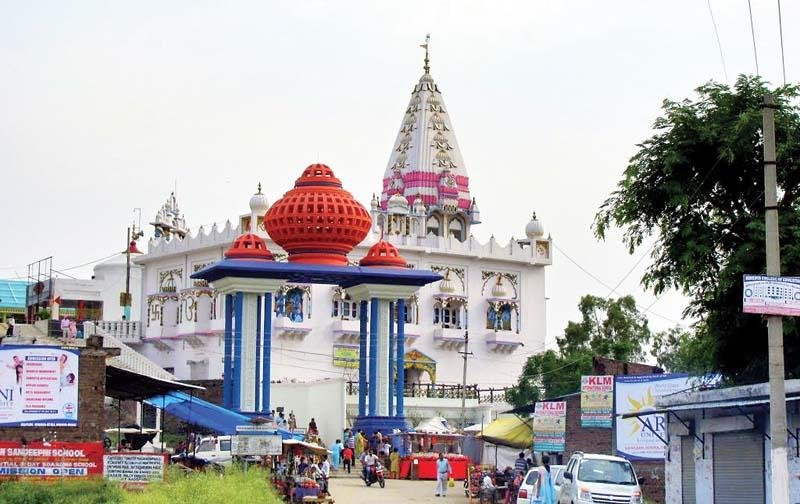
The present Kathgarh Mahadev Temple is a large, white-painted complex incorporating a prominent shikhara, domed gateways, decorative arches, colourful murals, pillared spaces and a broad courtyard.
The structure reflects several phases of construction and renovation rather than one untouched historical period.
The central shikhara rises above the principal sanctum and marks the location of the Shiva–Parvati formation.
Its vertical shape follows the broad North Indian temple tradition in which the tower symbolises a sacred mountain.
The main entrance may include large red or terracotta-coloured lattice domes supported by painted pillars.
Murals and divine figures decorate portions of the exterior.
Images of Lord Shiva, Goddess Parvati, Lord Hanuman and other sacred beings may be visible around gateways and walls.
The colourful temple architecture differs from the unpainted stone shrines of higher Kangra, yet it reflects the living devotional culture of the lower region.
The complex has been developed to accommodate large numbers of visitors during fairs and festivals.
Railings, tiled floors, covered areas, stairways and crowd-control arrangements may have been added over time.
Visitors should not assume that every decorative section is ancient.
The true heritage of Kathgarh lies principally in the sacred formation, long-standing worship traditions and collective memory of the community.
## The Temple Courtyard
The temple courtyard provides space for devotees to gather, queue for darshan, perform circumambulation and rest after travel.
During quieter periods, the courtyard offers a peaceful environment for prayer and observation.
During Mahashivratri, it becomes a major gathering space filled with devotees, decorations, religious announcements and fair activity.
Visitors should keep the main pathways clear.
Food, shoes and personal belongings should be placed only in designated areas.
Children should not climb on railings, gateways, decorative domes or temple walls.
Loud entertainment, staged dances and disruptive social-media filming are inappropriate close to the sanctum.
Photography of the outer complex may generally be easier than photography inside, but current temple rules should always be followed.
## Mahashivratri Fair
Mahashivratri is the most important annual celebration at Kathgarh Mahadev Temple.
Kangra district recognises Kathgarh Shivratri as a district-level fair.
The celebration may extend across several days and attract thousands of devotees from Himachal Pradesh, Punjab, Jammu and neighbouring regions.
A shobha yatra, religious ceremonies, cultural activities, community participation and formal inauguration may form part of the event according to annual arrangements.
Devotees visit the divided Shivling because Mahashivratri symbolises the union of Shiva and Parvati.
The seasonal belief that the sacred sections appear closest during this period adds special importance to darshan.
Visitors should expect road congestion, parking restrictions, long queues and crowded temple approaches.
Families should keep children and senior citizens close.
A fixed meeting point should be selected in case group members become separated.
Accommodation in Indora, Damtal, Pathankot and nearby areas should be reserved in advance.
The precise fair schedule changes each year and should be confirmed through the temple committee or district administration.
## Shravan Month and Monday Worship
Shravan is another important period for Kathgarh Mahadev Temple.
Mondays during Shravan may bring large numbers of Shiva devotees carrying water, flowers, bilva leaves and other offerings.
Special puja, abhishek and devotional recitation may take place.
Shravan normally overlaps with the monsoon season.
Travellers should therefore monitor rain, local roads and river conditions.
The lower Kangra region can experience waterlogging, strong rainfall, rising streams and disruption on rural roads.
Visitors should not travel during severe warnings merely because a particular Monday is religiously important.
A safe visit on another day remains spiritually meaningful.
## Somvati Amavasya and Other Sacred Dates
Somvati Amavasya occurs when the new-moon day falls on a Monday and is considered important by many Shiva devotees.
The temple may receive additional visitors on this and other Shaivite dates.
Pradosh Vrat, monthly Shivratri and certain Sankranti occasions may also bring special worship.
The actual scale of observance should be confirmed locally.
Visitors arranging a specific ritual should speak only with an authorised temple priest or recognised management representative.
Fear-based promises, guaranteed remedies and pressure to purchase expensive rituals should be avoided.
## Daily Darshan and Aarti
Temple opening and closing times may vary according to season, festival arrangements and priestly duties.
Visitors planning early-morning or late-evening darshan should verify current timings before travel.
Morning is generally suitable for quieter worship, cooler weather and easier parking.
Evening aarti can offer a devotional atmosphere with lamps, bells and collective prayer.
Travellers attending late should ensure they have dependable transport and accommodation nearby.
Rural roads around the temple should not be navigated carelessly after dark by visitors unfamiliar with the area.
## Best Time to Visit Kathgarh Mahadev Temple
Kathgarh can generally be visited throughout the year.
Its lower elevation creates a different climate from Dharamshala, Palampur and other higher Kangra destinations.
### Spring
Spring is one of the best periods for visiting the temple.
The weather is generally pleasant, surrounding fields become greener and road travel remains comfortable.
Mahashivratri may fall in late winter or early spring according to the Hindu calendar.
Visitors attending the fair should book accommodation early.
Those seeking quiet darshan should choose an ordinary weekday after the festival.
### Summer
Summer can become hot in Indora and the lower Kangra–Pathankot region.
Visitors should not expect the cool climate associated with high-altitude Himachal Pradesh.
Morning and evening visits are preferable.
Travellers should carry drinking water, sunscreen, sunglasses and light cotton clothing.
The temple’s covered areas provide some protection, but the courtyard and road may become warm during midday.
Senior citizens and children should avoid prolonged exposure to intense afternoon heat.
### Monsoon
The monsoon brings green fields and a fresh rural landscape.
It can also create heavy rainfall, waterlogging, slippery temple surfaces and disruption on roads approaching Indora.
The nearby Beas and local streams may carry significantly more water.
Visitors should follow district weather advisories and avoid unsafe riverbanks.
Shoes with dependable grip are useful.
Travel should be postponed during severe rain or flooding warnings.
### Autumn
Autumn is among the most comfortable periods for visiting Kathgarh.
Rain generally reduces, roads improve and the rural landscape remains attractive.
The weather is suitable for combining the temple with Nurpur, Pathankot, Pong Dam or other regional destinations.
### Winter
Winter is cool and generally pleasant during the day.
Morning and evening can become cold or foggy.
The sacred forms are traditionally believed to appear closer during the colder season.
Snowfall should not be expected at Kathgarh because the temple lies in the lower foothill region.
Visitors should carry warm layers for early-morning or evening worship.
Fog may affect road and railway travel, so additional journey time should be allowed.
## Reaching Kathgarh Mahadev Temple from Indora
Indora is the principal local town and administrative centre associated with the temple.
Kathgarh Mahadev is commonly described as approximately 6–8 kilometres from Indora, depending on the selected starting point and route.
Local taxis, private vehicles, auto-rickshaws or other regional transport may be available.
The exact service and fare should be confirmed locally.
During Mahashivratri, traffic diversions and special parking arrangements may be introduced.
Visitors should follow police and temple-management instructions rather than attempting to drive directly to a crowded entrance.
## Reaching from Pathankot
Pathankot is the largest transport and accommodation hub near Kathgarh.
It provides major railway stations, hotels, restaurants, markets, hospitals and road connections.
Depending upon the selected route and starting neighbourhood, the temple is commonly reached through a road journey of roughly 20–30 kilometres.
Actual travel time can vary because of border roads, railway crossings, rural traffic and festival congestion.
Pathankot is a practical base for travellers arriving from Delhi, Punjab, Jammu or other distant locations.
A local taxi can be booked for Kathgarh, Indora, Nurpur and nearby temples.
Travellers should specify that Kathgarh Temple lies in Himachal Pradesh’s Kangra district even though it is frequently listed informally as a Pathankot attraction.
## Reaching from Damtal
Damtal is another practical road and accommodation base near the Punjab–Himachal border.
The temple is generally described as approximately 15 kilometres from the broader Damtal area, although distance varies by route.
Damtal provides access to highways, markets, fuel stations and transport.
It may be convenient for travellers continuing towards Dharamshala, Nurpur or Jammu.
Visitors should confirm whether their hotel lies on the correct side of the highway for the Kathgarh road.
## Reaching by Train
Mirthal and Kandrori are among the smaller railway stations used for approaching the area, subject to the trains currently stopping there.
Pathankot Junction and Pathankot Cantonment provide broader rail connectivity.
A small station being geographically closer does not necessarily mean it offers a convenient train for the visitor’s journey.
Travellers should check current railway schedules before selecting their accommodation.
Onward taxis or local vehicles should be arranged, especially for early-morning and late-evening arrivals.
## Reaching by Air
Pathankot has an airport with limited or variable commercial connectivity.
Kangra Airport at Gaggal is farther away but may offer additional scheduled flights depending on the season.
Flight availability and routes can change.
Travellers arriving by air should verify current operations and keep sufficient time between temple travel and departure.
Pathankot generally remains the more practical road and rail gateway for Kathgarh.
## Accessibility for Senior Citizens
Kathgarh Mahadev Temple is comparatively accessible because it does not require a mountain trek.
Vehicles can generally approach the temple area, followed by a short walk or manageable steps according to current parking arrangements.
The inner sanctum may become crowded and contain narrow movement space.
Senior citizens should visit during quieter hours and use railings or family assistance where necessary.
Visitors with severe mobility limitations should confirm the latest drop-off point and wheelchair practicality before travelling.
Darshan from an appropriate outer position may be preferable during intense crowding.
## Visiting with Children
Families can comfortably include Kathgarh Mahadev Temple in a pilgrimage itinerary.
Children should remain supervised around stairs, railings, lamps and crowded gateways.
Parents can explain the meaning of Ardhanarishwar as balance and equality rather than presenting the visit only as a mysterious phenomenon.
Children should not touch the Shivling, insert objects into the gap, climb decorative structures or ring bells continuously.
Water, snacks and weather-appropriate clothing should be carried, particularly during summer.
## Nurpur Fort and Brij Raj Swami Temple
Nurpur Fort is one of the most important nearby heritage destinations.
The historic fort contains the Brij Raj Swami Temple, dedicated to Lord Krishna and Meera Bai.
Its ruined walls, gateways and temple create a powerful historical experience.
The fort was affected significantly by the 1905 Kangra earthquake.
Visitors should stay within permitted areas and avoid climbing unstable walls.
A combined Kathgarh and Nurpur itinerary offers both Shiva pilgrimage and regional heritage.
## Mukteshwar Mahadev Temple near Pathankot
Mukteshwar Mahadev Temple, also known as Mukesaran Mandir, is situated near the Ravi River in the Pathankot region.
It contains cave-like sacred spaces and traditions associated with the Pandavas.
Kathgarh and Mukteshwar are separate Shiva temples connected with different rivers and legends.
They can be combined within a longer Pathankot-based pilgrimage itinerary, but the route should be planned carefully.
## Shahpurkandi and Ranjit Sagar Dam
Shahpurkandi and the Ranjit Sagar Dam region offer reservoir and river-valley scenery.
Access, security and photography restrictions may apply around dam infrastructure.
Visitors should use recognised viewpoints and obey all barriers.
Water levels, road access and permitted areas can change.
## Pong Dam and Maharana Pratap Sagar
Pong Dam forms Maharana Pratap Sagar, an important reservoir and wetland within the wider Kangra region.
It is known for migratory birds during winter.
The reservoir requires a separate journey from Kathgarh and should not be compressed into a short temple visit.
Visitors should use authorised boating and birdwatching services.
Wildlife must not be fed, chased or disturbed.
## Dharamshala and Kangra Temple Circuit
Kathgarh lies considerably southwest of Dharamshala and the major upper-Kangra pilgrimage circuit.
Travellers can combine the regions within a multi-day itinerary, but Kathgarh should not be treated as a short excursion from McLeod Ganj without accounting for road time.
A practical route may include Pathankot or Nurpur, Kathgarh, Kangra town, Dharamshala and Palampur across several days.
## Suggested One-Day Itinerary
A one-day Kathgarh pilgrimage is most practical from Indora, Damtal, Pathankot or Nurpur.
Begin with morning darshan at Kathgarh Mahadev Temple.
Spend time observing the Shiva and Parvati sections respectfully and learning about the Ardhanarishwar tradition.
After darshan, continue towards Indora or return to Pathankot for breakfast or lunch.
The afternoon can include Nurpur Fort or another nearby road-accessible destination.
Return to accommodation before dark.
## Suggested Two-Day Itinerary
On the first day, arrive in Pathankot, Damtal or Nurpur and check into accommodation.
Visit Nurpur Fort, the local market or another nearby attraction.
On the second morning, travel to Kathgarh Mahadev Temple for darshan.
After the visit, continue towards Mukteshwar Mahadev, Pathankot or the next destination according to the onward route.
This itinerary is suitable for families and senior citizens.
## Suggested Three-Day Shiva and Heritage Circuit
The first day can include Pathankot and Mukteshwar Mahadev Temple.
The second day can focus on Kathgarh Mahadev and Indora.
The third day can include Nurpur Fort, Brij Raj Swami Temple or onward travel towards Kangra and Dharamshala.
A slower itinerary provides sufficient time for darshan and reduces road fatigue.
## Accommodation Near Kathgarh Mahadev Temple
Accommodation immediately beside the temple may be limited compared with larger towns.
The main practical bases include Indora, Damtal, Pathankot and Nurpur.
### Hotels and Guesthouses in Indora
Indora provides the shortest practical access for early darshan.
Accommodation may include small hotels, lodges, guesthouses and local homestays.
Facilities can be simpler than in Pathankot.
Guests should confirm attached bathrooms, hot water, parking, meals and the actual road distance to the temple.
### Hotels in Pathankot
Pathankot offers the widest range of hotels, restaurants, hospitals, transport and shopping.
It is suitable for families, groups and travellers arriving by long-distance train.
Visitors should account for the morning road journey to Kathgarh.
A hotel near the correct exit road may be more convenient than one on the opposite side of the city.
### Stays in Damtal
Damtal is useful for highway travellers and those continuing towards Himachal Pradesh or Jammu.
Properties may include highway hotels, budget rooms and guesthouses.
Noise, parking and road access should be checked before booking.
### Hotels in Nurpur
Nurpur is suitable for travellers combining Kathgarh with the fort and nearby heritage sites.
It offers hotels, guesthouses and local food options.
The actual driving distance to Kathgarh should be confirmed before planning early darshan.
### Rural Homestays
Homestays around Indora and neighbouring villages can offer home-cooked meals, quieter surroundings and local guidance.
Facilities vary considerably.
Travellers should verify bathrooms, cooling in summer, heating in winter, electricity, meals, mobile connectivity and parking.
## Choosing the Right Property
Pilgrims whose principal purpose is early Kathgarh darshan should select Indora or another verified nearby stay.
Travellers prioritising developed services and rail connectivity may prefer Pathankot.
Highway travellers may choose Damtal.
Heritage travellers combining the temple with Nurpur Fort may stay in Nurpur.
Families should confirm room size, meals and safe parking.
Senior citizens should prioritise ground-floor rooms, lifts or minimal stairs.
Couples may prefer peaceful homestays outside busy highway areas.
Solo pilgrims can select affordable guesthouses capable of arranging local transport.
Groups should confirm multiple rooms, vegetarian meals, driver accommodation and vehicle parking.
Mahashivratri visitors should reserve accommodation well in advance.
Summer travellers should confirm air-conditioning or effective cooling because the lower region can become hot.
## Book Stays Near Kathgarh Mahadev Temple with MudrasStays
MudrasStays helps pilgrims, families and spiritual travellers discover hotels, homestays, guesthouses and pilgrimage accommodation near Kathgarh Mahadev Temple, Indora, Damtal, Pathankot and Nurpur.
The platform is designed specifically for travellers searching for suitable places to stay near temples and sacred destinations across India.
Visitors can compare accommodation according to practical driving distance from Kathgarh Mahadev, budget, room type, group size and required facilities.
Booking closer to Indora allows devotees to attend peaceful morning darshan and avoid unnecessary travel before worship.
Solo pilgrims can search for simple and affordable local rooms.
Couples can explore quiet rural homestays.
Families can choose properties offering meals, parking and comfortable room capacity.
Senior citizens can prioritise accessible accommodation and dependable taxi arrangements.
Pilgrimage groups can identify stays providing multiple rooms, vegetarian food and parking for buses or larger vehicles.
Travellers attending the Kathgarh Shivratri fair can reserve accommodation early and avoid uncertain last-minute availability.
Visitors combining Kathgarh with Nurpur Fort, Mukteshwar Mahadev, Pathankot, Pong Dam or Dharamshala can select separate bases according to the actual road sequence.
MudrasStays helps travellers avoid booking a property that appears close in straight-line distance but requires unnecessary backtracking through highways, railway crossings or rural roads.
## Responsible Temple Travel
Kathgarh Mahadev Temple is an active place of worship and an important centre of regional faith.
Visitors should dress respectfully and remove footwear wherever instructed.
Photography of the divided Shivling, inner sanctum, priests and private rituals should only be undertaken with permission.
Objects should never be placed between the two sacred sections.
The stones should not be measured, scratched, rubbed or tested.
Flowers, water and other offerings should be made according to the priest’s guidance.
Oil, colour and chemical substances should not be applied without authorisation.
Visitors should keep queues and gateways clear.
Plastic bottles, food wrappers and puja packaging must be carried away.
Children should not climb decorative domes, railings or walls.
Loud music and disruptive video creation are inappropriate near the sanctum.
During festivals, police, temple committee and crowd-management instructions should be followed patiently.
Local priests, drivers, shops, food providers and accommodation hosts should be treated fairly.
## A Sacred Expression of Shiva and Shakti
Kathgarh Mahadev Temple represents a rare and deeply meaningful expression of the unity between Lord Shiva and Goddess Parvati.
The two sacred stone sections preserve the Ardhanarishwar principle through a distinctive physical form.
The larger Shiva section represents consciousness, meditation and stability.
The Parvati section represents energy, compassion and creation.
Their closeness represents the eternal relationship between awareness and action.
The belief in their seasonal separation and reunion adds a powerful devotional dimension to Mahashivratri.
The pillar-of-light tradition connects the shrine with Shiva as infinite reality beyond human pride.
The Gujjar legend connects the sacred discovery with rural pastoral life.
The Bharat tradition introduces the values of humility, duty and responsible leadership.
The Alexander story contrasts worldly conquest with spiritual independence.
The Maharaja Ranjit Singh tradition connects the temple with the political and religious history of the Punjab–Himalayan border region.
The district-level Shivratri fair keeps the temple connected with the living cultural traditions of Kangra.
For Shiva devotees, Kathgarh is a place to seek discipline, courage and spiritual clarity.
For Shakti worshippers, the Parvati form represents strength, compassion and creative energy.
For couples, the Ardhanarishwar symbolism provides a model of dignity, balance and shared responsibility.
For families, the road-accessible location creates a manageable pilgrimage without a mountain trek.
For senior citizens, nearby vehicle access makes darshan possible when the sanctum is approached carefully.
For heritage travellers, the temple’s traditions connect ancient mythology, regional rulers, pastoral communities and modern religious life.
For photographers, the white shikhara, colourful gateways and devotional atmosphere offer memorable visual opportunities when sanctum rules and visitor privacy are respected.
For spiritual travellers, the temple encourages reflection on the apparent differences that exist within a deeper unity.
Kathgarh Mahadev Temple should not be treated only as a mysterious stone formation or a quick roadside stop near Pathankot.
Its true significance lies in the living worship of Shiva and Parvati, the philosophical depth of Ardhanarishwar and the devotion maintained by generations of local communities.
Plan your pilgrimage to Kathgarh Mahadev Temple with MudrasStays and experience one of the most distinctive Shiva–Shakti shrines in Himachal Pradesh.
Seek the blessings of Lord Kathgarh Mahadev and Maa Parvati, observe the divided sacred formation respectfully and experience the spiritual message of unity within difference.
Combine your journey with Indora, Nurpur Fort, Brij Raj Swami Temple, Mukteshwar Mahadev Temple, Pathankot, Ranjit Sagar Dam, Pong Dam and the wider pilgrimage destinations of Kangra.
Book hotels near Kathgarh Mahadev Temple, discover homestays near Indora and explore suitable pilgrimage accommodation around Damtal, Pathankot and Nurpur through MudrasStays.
Stay closer to your spiritual destination, attend peaceful morning darshan and reduce unnecessary travel through border highways and rural roads.
MudrasStays connects pilgrims, families and cultural travellers with suitable accommodation near temples and sacred destinations across India.
Begin your Kathgarh Mahadev Temple journey with a comfortable stay and experience a meaningful pilgrimage centred on Lord Shiva, Maa Parvati, Ardhanarishwar philosophy and the sacred heritage of Indora.