
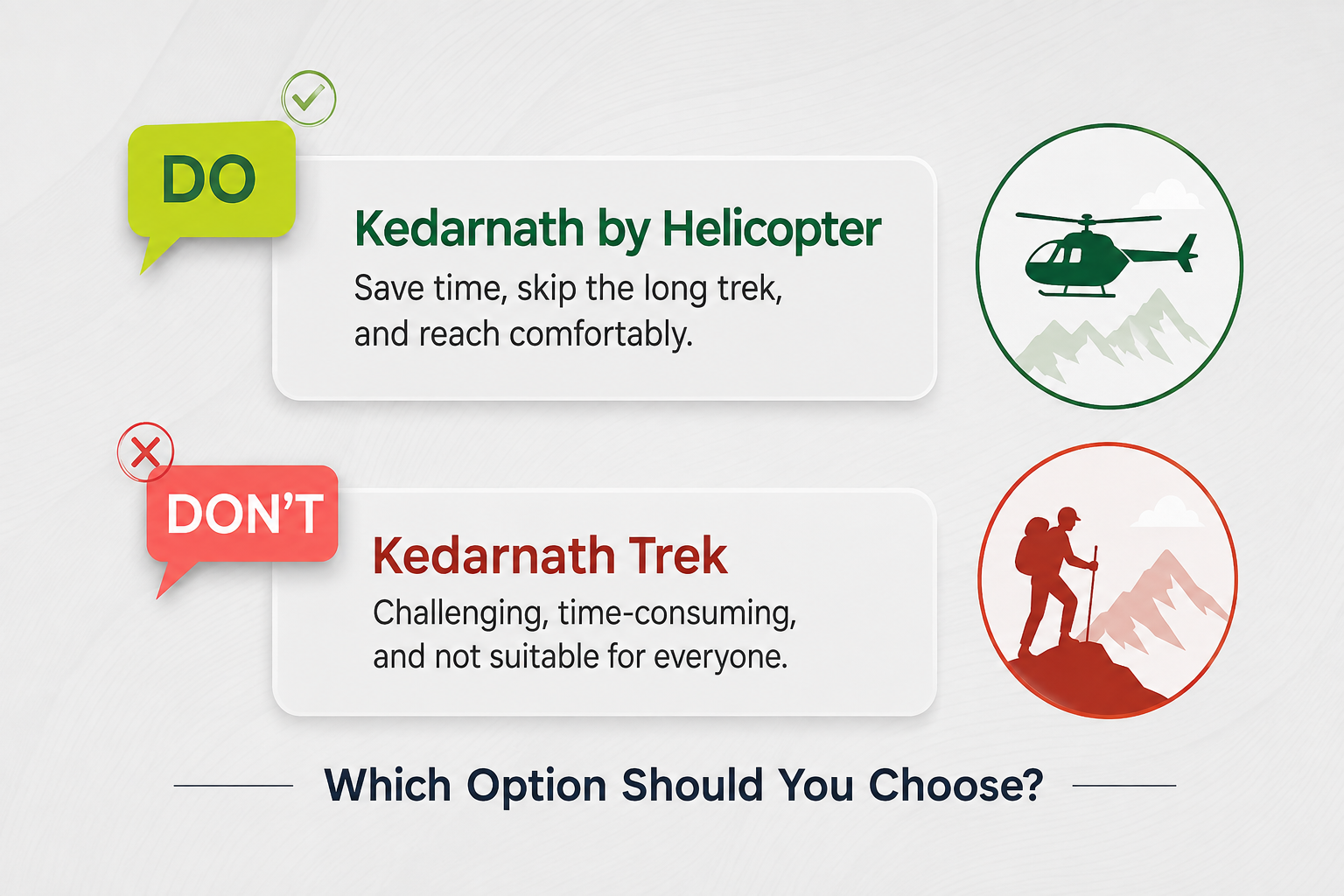
Kedarnath by Helicopter vs Trek: Which Option Should You Choose?
Helicopter and trek are both legitimate ways to complete the Kedarnath yatra, but they solve different problems. Trekking offers the full physical pilgrimage and greater independence from flight schedules; helicopter travel reduces walking but introduces slot, baggage and weather uncertainty. The right choice depends on health, time and the type of experience you want.
Travel note: Mountain routes, traffic rules, temple systems and seasonal services can change because of weather or administration. Verify same-day local conditions before starting.
Kedarnath by Helicopter vs Trek
Helicopter: best for time and limited mobility
Helicopter services usually operate from designated helipads such as Phata, Sersi and Guptkashi during the yatra season, subject to government allocation, weather and operational approvals. Book only through the official IRCTC HeliYatra portal or the officially announced channel for the season. Avoid agents promising guaranteed seats outside the authorised system.
The main advantage is time: the flight itself is short and removes the long uphill walk. The main disadvantage is uncertainty. Mountain weather can ground flights with little notice, reporting times can change and same-day plans may be delayed. Passengers also face strict baggage and weight rules, so read the current ticket conditions carefully.
Trek: best for the full pilgrimage experience
Walking from Gaurikund gives a gradual transition into the sacred landscape. You see the Mandakini valley change with altitude, share the route with other pilgrims and reach the temple through sustained physical effort. For many devotees, that effort is part of the yatra’s meaning. The trade-off is obvious: it requires fitness, time, strong knees and tolerance for changing weather.
Who should choose which?
- Healthy first-time trekkers: walk if you have trained and can spare two days for ascent/descent.
- Seniors or people with mobility limitations: consider helicopter or palanquin after medical advice.
- Very tight schedules: helicopter can help, but do not assume weather will cooperate.
- Families with mixed fitness: different members can use different modes and reunite near the shrine, provided logistics are planned carefully.
- Monsoon travellers: keep extra buffer regardless of mode.
The right choice is not about proving endurance. It is about reaching safely, preserving the spiritual purpose of the trip and respecting your actual health, age and available time.
Kedarnath Yatra at a Glance
Kedarnath is one of the most revered Shiva shrines in the Himalayas and a major stop on Uttarakhand’s Char Dham pilgrimage. The temple stands at roughly 3,584 metres in Rudraprayag district, surrounded by high peaks and a landscape that can change from bright sun to cold rain within minutes. Unlike Badrinath, the shrine is not reached directly by road. Pilgrims travel to Sonprayag, take regulated local transport toward Gaurikund and then continue on foot, pony or palanquin; helicopter services also operate during the yatra season subject to weather and official schedules.
For first-time pilgrims, the central planning principle is simple: reach the base region rested, start early and keep one buffer day if your wider travel schedule allows. The mountain environment is the main variable. Road delays, rain, crowd control and helicopter cancellations are not unusual, and a plan that looks efficient on paper can become exhausting if every connection is tight.
Essential facts
- Road base: Sonprayag is the principal vehicle-control point for the Kedarnath route.
- Trek start: Gaurikund, reached from Sonprayag by local regulated/shared transport when operating.
- Trek distance: commonly quoted at roughly 16–19 km depending on the current alignment and measurement method.
- Temple altitude: about 3,584 m.
- Typical uphill walking time: around 7–10 hours for many first-time pilgrims; faster walkers may take less, while seniors and crowded-day travellers may need more.
- Registration: complete the required yatra registration through the official Uttarakhand Char Dham registration portal and carry the QR/registration details.
- Weather rule: treat rain gear and warm layers as essential even if the forecast looks clear.
Gaurikund to Kedarnath Trek: Route, Distance and Rest Points
The current Kedarnath approach is a long uphill mountain walk rather than a technical trek. The path is largely constructed and used by thousands of pilgrims, ponies and service workers, but the sustained climb and altitude make it demanding. Official and tourism sources quote different totals—from about 16 km to around 19 km—because the route has been realigned over time and different points are used for measurement. For planning, think of it as a full-day ascent, not a short 16-km walk on level ground.
Stage 1: Gaurikund to Jungle Chatti
The first section leaves the busy Gaurikund bazaar and climbs steadily. This is where many first-time pilgrims realise that the gradient matters more than the distance. Start at an intentionally slow pace. If you walk too fast in the first hour, fatigue builds before the steeper upper sections. Jungle Chatti is a useful early break point for tea, water and a quick physical check.
Stage 2: Jungle Chatti to Bheembali
The trail continues through the Mandakini valley with a mix of paved inclines, steps and exposed sections. Bheembali is commonly used as a major rest stop and has seasonal food, basic facilities and medical support in the yatra period. Take a proper break here, but avoid sitting so long that your legs become stiff.
Stage 3: Bheembali to Linchauli
For many walkers, this is where the trek becomes mentally harder. The air feels cooler, the vegetation changes and altitude begins to have a stronger effect. Keep eating small snacks, sip water regularly and maintain a pace at which you can speak in short sentences without gasping. Linchauli is another important rest and support point.
Stage 4: Linchauli to Kedarnath base area and temple
The final approach is spectacular but tiring. The valley opens and the sense of height becomes more obvious. Do not sprint simply because the destination feels close. If you develop persistent headache, unusual breathlessness at rest, confusion, chest discomfort or severe dizziness, seek medical help rather than forcing yourself onward.
A practical waypoint table
Approximate sequence: Gaurikund → Jungle Chatti → Bheembali → Linchauli → Kedarnath base area → Kedarnath Temple. Distances between individual points are best treated as approximate because route markings and active alignments can change after maintenance or weather events.
Food stalls, water points, toilets, shelters and medical posts operate at key locations during the yatra season, but availability can vary. Carry enough water and snacks to remain independent for several hours without turning your backpack into a heavy load.
Health and Safety on the Kedarnath Route
Kedarnath’s altitude is high enough for some travellers to experience headache, nausea, unusual fatigue or breathlessness. Good fitness does not guarantee immunity from altitude illness. Climb at a steady pace, hydrate normally, avoid alcohol, sleep well before the trek and seek medical help if symptoms become severe or keep worsening.
People with heart, lung or major mobility conditions should discuss the trip with a qualified clinician before travelling. Senior citizens should not be pressured into walking simply because other group members can. Pony, palanquin and helicopter options exist for a reason, although each has its own physical and logistical demands.
Emergency mindset
- Carry identification and emergency contacts.
- Keep regular medicines in the day bag.
- Know that Uttarakhand’s general emergency number is 112 and medical emergency support can be reached through 108.
- Follow police, district administration and yatra-management instructions during bad weather.
- Never cross barricades or continue on a closed trail.
- If helicopter flights stop, do not pay unofficial middlemen claiming they can bypass the system.
Sonprayag vs Guptkashi: Which Base Is Better?
Choose Sonprayag for the earliest possible trek start
Sonprayag is closer to the Gaurikund transfer point, so it is the practical choice for pilgrims who want to minimise pre-trek driving. The trade-off is crowding: during peak yatra weeks, the town can feel intensely busy, vehicle movement is regulated and accommodation choices are more limited than in the broader Guptkashi region.
Choose Guptkashi for more comfort and services
Guptkashi is farther from the trek start but has a larger market, more accommodation, restaurants, medical shops and transport options. It is often better for families, seniors and groups arriving after a long drive from Rishikesh. The next morning, however, you must leave very early to reach Sonprayag, transfer onward and still start the trek at a good hour.
What about Phata or Sersi?
These areas are strategically useful for pilgrims holding confirmed helicopter bookings because helipads operate in the region during the yatra season. They can also work as road bases, but the choice should depend on your exact booking and transport plan rather than a generic recommendation.
Simple decision rule
- Fit trekkers: Sonprayag if an early walking start is the priority.
- Families: Guptkashi for broader services and a calmer evening.
- Helicopter pilgrims: stay near the helipad named on the confirmed ticket.
- Late arrivals: do not force a night drive to Sonprayag merely to save an hour the next morning.
- Monsoon travel: favour flexibility over the closest possible base.
Where to Stay for the Kedarnath Yatra
Your stay should support the route rather than complicate it. Pilgrims looking for a best hotel option for a Kedarnath yatra can consider Mudras Kedarnath. The best location for you depends on whether you are trekking, using a helicopter and how early you want to begin the next day.
When comparing a hotel for a Kedarnath yatra, ask about early breakfast, road access, luggage storage, hot water, transport to Sonprayag or the relevant helipad, and what happens if weather delays your itinerary. Flexible support can matter more than luxury on a pilgrimage where timing changes quickly.
Detailed Kedarnath Planning Checklist
Four to six weeks before
Begin regular walking, stair climbing and basic leg-strength work if you plan to trek. You do not need mountaineering training, but arriving with no preparation makes the climb unnecessarily hard. Break in your shoes before the trip.
One week before
Verify yatra registration through the official Uttarakhand Char Dham registration portal, confirm your lower-valley stay and transport, and recheck weather trends. If using a helicopter, verify the ticket on the official channel and read baggage/reporting rules.
Night before the ascent
Pack only the trek essentials, leave heavy luggage below where possible, eat a normal but not heavy dinner and sleep early. Set out clothing in layers so you do not waste time repacking at dawn.
During the ascent
Walk steadily, drink small amounts frequently and eat light snacks. Use major rest points for short breaks and medical checks if needed. Do not compete with faster pilgrims. Your target is to arrive with enough energy to remain comfortable at altitude.
At Kedarnath
Change into dry layers quickly if you arrive wet. Eat something warm, hydrate, and keep movement gentle. Nights are cold and sleep can be lighter at altitude. Follow the current queue and darshan system rather than assuming a timing found in an old blog is still valid.
During descent
Protect knees and toes by using small controlled steps. Start early enough to reach Gaurikund and Sonprayag before the road becomes difficult. If the descent takes longer than expected, stay in the lower valley instead of forcing a late-night drive.
After the yatra
Give the body recovery time before another long trek or strenuous sightseeing day. Soreness is common, but persistent severe breathlessness, chest pain, fainting or unusual weakness requires medical attention.
Frequently Asked Questions About Kedarnath
How difficult is the Kedarnath trek for a first-timer?
It is physically demanding because of the sustained climb and altitude, but it is not a technical mountaineering route. Regular walking and stair training for several weeks makes a major difference.
What is the actual trek distance?
Different official and tourism sources quote roughly 16–19 km because route alignments and measurement points differ. Plan for a full-day uphill effort.
Can I do Kedarnath without trekking?
Yes, subject to availability and weather, helicopter services operate during the yatra season. Pony and palanquin services are also used on the trail.
Is registration required?
Yes. Char Dham yatra registration is mandatory. Use the official Uttarakhand Char Dham registration portal and follow current verification instructions.
Can I trek up and down on the same day?
Very fit walkers sometimes do, but it is not the ideal first-time plan. The combined distance, altitude and crowd conditions make an overnight or two-day trekking plan safer and more meaningful.
What if it rains?
Continue only if the trail remains open and authorities permit movement. Wear proper rain protection, keep electronics dry and do not take shortcuts around blocked sections.
Training and Pace: A Simple Preparation Plan
Four weeks of basic preparation can transform the trek. On three or four days each week, walk briskly for 30–60 minutes. Add stair climbing or a gentle incline twice a week and simple strength work such as body-weight squats, calf raises and step-ups. The aim is not athletic performance; it is to prepare legs and lungs for several hours of climbing.
During the actual trek, use a pace you can sustain. A practical rhythm is 40–50 minutes of walking followed by a short rest, adjusted to how you feel. Long stops can make muscles cold, while continuous hard effort can trigger exhaustion. Eat small portions rather than one large meal on the route.
Crowd Management and Trail Etiquette
The Kedarnath trail carries walkers, ponies, palanquins and workers in both directions. Stay on the designated side as instructed, listen for animal handlers, avoid sudden movements near ponies and do not block narrow points for selfies. If you stop, move fully out of the moving line.
Keep children close and do not let a group spread across the full width of the path. On wet days, stone surfaces and animal traffic can make sections slippery. Trekking poles are useful, but keep the tips controlled so they do not trip other pilgrims.
Common Mistakes to Avoid
- Starting the trek after a sleepless overnight drive.
- Carrying a heavy backpack because the distance looks short on a map.
- Wearing brand-new shoes.
- Skipping rain protection because the morning sky is clear.
- Treating severe altitude symptoms as something to ‘push through’.
- Assuming a helicopter booking guarantees flying weather.
- Planning a same-night long road journey after the descent.
- Buying helicopter seats from unofficial agents or social-media accounts.
Final Takeaway
A successful Kedarnath yatra is not measured by speed. Start rested, respect the altitude, carry the right layers, use only official booking channels and keep enough time for weather to change your plan.
Extended Kedarnath Yatra Notes
The Kedarnath route is a system of connected decisions. A late road arrival leads to a late sleep; a late sleep leads to a late trek; a late trek increases exposure to afternoon weather and crowds. The easiest way to improve the entire journey is therefore to protect the night before the ascent. Reach the base region with daylight remaining, eat early and resist the temptation to add sightseeing.
Foot care deserves special attention. Trim nails before the trip, use socks that do not bunch, and stop immediately if you feel a hot spot developing into a blister. On descent, lace shoes so the foot does not slide forward repeatedly. A small footwear problem at kilometre three can become a major problem by the end of the day.
Hydration should be steady rather than excessive. Drink to thirst and use electrolytes sensibly, especially if sweating heavily. Do not assume that forcing litres of water prevents altitude sickness; it does not. The more important protections are a conservative pace, rest and quick response to concerning symptoms.
Weather protection should be reachable without unpacking the bag. Keep the rain shell in an outer pocket and protect the phone, documents and dry layer inside waterproof pouches. When clouds arrive, changing layers early is better than waiting until your clothes are soaked.
If travelling with a group, agree on a regrouping system. Strong walkers should not disappear far ahead with all the money, medicines or tickets. Keep one emergency contact sheet with each person, and decide in advance that anyone who becomes unwell can turn back or seek assistance without feeling that they have disappointed the group.
At the temple, the emotional high of arrival can hide physical fatigue. Eat, change wet clothes and stay warm before spending a long time outdoors. If you plan sunrise or very early darshan, prepare clothing the night before because the cold is strongest when the body is still recovering from the climb.
Decision Guide: Trek, Assistance or Helicopter
Choose the trek when your health is suitable, you have trained and you want the full walking pilgrimage. Choose pony or palanquin assistance when the route is spiritually important but walking the full distance is not realistic. Choose helicopter when time or mobility is the main constraint and you can tolerate weather-related schedule uncertainty.
Do not choose based on social pressure. A person with knee disease may be safer not walking; another with motion sensitivity may find a pony difficult; a traveller with a fixed same-day connection may discover that a grounded helicopter is more disruptive than a slow trek. Each mode transfers risk rather than eliminating it.
The most robust plan keeps alternatives visible. Know your lower-valley stay, keep one buffer day where possible and carry enough cash/documentation to change plans through official channels. Flexibility is part of Himalayan travel, not evidence that the plan failed.
Deep Planning Notes for the Kedarnath Yatra
Think in effort hours, not kilometres
The most misleading number in Kedarnath planning is the trek distance by itself. Sixteen or seventeen kilometres on level ground can sound routine to a reasonably active person, but the pilgrimage adds sustained ascent, altitude, crowds, rain, cold and a mixed-use trail with ponies and palanquins. A better planning unit is effort hours. If you expect to be moving for most of the day, you naturally start earlier, pack food more intelligently and stop trying to combine the ascent with a long road journey.
The same idea applies to descent. It may be faster, but the muscles work differently and the knees absorb repeated impact. A pilgrim who reaches Kedarnath completely exhausted may struggle the next morning. Conserving a little energy on the ascent is therefore not wasted time; it is preparation for the return.
How to train without overcomplicating it
You do not need a gym programme. Walk briskly on most days, add stairs or an incline, and practise one longer walk each week. If you live in a flat city, stairwells are excellent preparation. Use the shoes and socks you intend to take, and carry a light day pack during some training sessions. The goal is to make several hours on your feet feel normal before the trip begins.
Strength work can be simple: controlled squats, step-ups, calf raises and basic core exercises two or three times a week. Increase gradually. Starting an intense routine just before travel creates soreness or injury and defeats the purpose. People with significant medical conditions should seek personalised medical guidance rather than using generic fitness advice as clearance for a high-altitude pilgrimage.
Managing altitude sensibly
Altitude illness is not a test of toughness. Symptoms such as headache, nausea and unusual fatigue can occur even in fit people. The warning signs that deserve urgent attention include severe or worsening breathlessness, confusion, inability to walk normally, fainting, chest symptoms or marked deterioration. Use available medical posts and follow professional advice. Descending can be the correct decision.
Do not take random altitude medication because another traveller recommends it. Some medicines require medical screening and can have side effects or contraindications. The universal strategies are slower ascent, appropriate hydration, warmth, rest and honest symptom monitoring.
Food strategy on trek day
Eat a familiar breakfast with carbohydrates and some protein, but avoid a very heavy or greasy meal. Carry small snacks you know your stomach tolerates: nuts, chikki, bananas where practical, biscuits or energy bars. Buy warm food at established stops when needed, but do not wait until you are shaky with hunger.
At altitude, appetite can decrease. Small frequent portions are easier than a huge lunch. Keep drinking water in small amounts rather than going hours without it. In cold weather people often forget to drink because they are not visibly sweating, even though the body is still losing fluid through exertion and breathing.
Rain changes more than comfort
Rain makes stone surfaces slippery, reduces visibility and increases cold stress when clothing becomes wet. It can also slow pony traffic and create crowding at shelters. A proper waterproof shell and bag protection are therefore safety items, not just comfort items. Cheap disposable ponchos can help in an emergency but are less reliable in wind and can tear.
If authorities halt movement, wait. Do not follow people onto unofficial shortcuts or cross barriers because the temple is visible in the distance. Himalayan trail closures are based on conditions you may not be able to see from where you stand.
Group management
Before leaving Gaurikund, decide who carries documents, medicines and money. Do not place every essential item in the backpack of the fastest walker. Set a rule that nobody passes a major rest point without confirming the group’s status. If the party includes children or seniors, pair each with a responsible adult rather than assuming the whole group will naturally stay together in a crowded trail.
It is also useful to agree in advance that changing mode is acceptable. A member who becomes exhausted can choose an approved assistance option if available. A pilgrim who feels unwell can stop for medical evaluation. Making these decisions before the trek reduces the emotional pressure to continue unsafely.
How to plan darshan after a long ascent
On reaching the upper valley, first address warmth, hydration and food. Change wet socks and base layers. Check into your accommodation or designated resting place and understand the current darshan system. Queue arrangements can change with crowd levels, so an old timetable from social media should never override instructions on site.
If you are staying overnight, you may be able to choose between evening and early-morning darshan according to current arrangements and your energy. The spiritually richer choice is the one you can experience attentively, not the one that leaves you shivering, dehydrated or too exhausted to be present.
The return to Sonprayag
Descending to Gaurikund is not the end of the day. You still need to move through the local transport system to Sonprayag and then reach your stay. This last transfer is why ambitious plans to drive deep into the night after the trek often fail. Keep the lower-valley stay flexible and decide the onward road only after you know your actual descent time.
When the trip is designed around recovery instead of maximum distance, Kedarnath becomes more manageable for first-time pilgrims. The mountains still control the schedule, but your plan is strong enough to absorb that reality.