Kol Kandoli Temple is one of the most spiritually significant yet frequently overlooked destinations associated with the pilgrimage of Shri Mata Vaishno Devi. Located at Nagrota in Jammu district, the temple stands along the wider Jammu–Katra travel corridor and is traditionally revered as **Mata Vaishno Devi Ka Pehla Darshan**—the first sacred glimpse or first devotional stop in the ancient pilgrimage journey towards the Trikuta Hills.
The shrine is also written as Kaul Kandoli Temple, Kol Kandholi Temple, Kol Khandoli Temple, Kaul Kandoli Mata Mandir and Shri Vaishno Mata Kol Kandoli Mandir. These spelling variations generally refer to the same temple complex in Nagrota.
Travellers arranging a taxi or searching for accommodation should use the complete destination name:
**Kol Kandoli Mata Temple, Nagrota, Jammu.**
This helps distinguish the shrine from similarly named temples in other regions and from the main Shri Mata Vaishno Devi Bhawan above Katra.
The temple is dedicated to Mata Vaishno Devi, worshipped here through a sacred pindi and through the traditions of her divine childhood. Local belief maintains that the Goddess appeared in this area as a young girl, performed spiritual discipline, played with village children and revealed sacred water for them through a bowl.
These stories give Kol Kandoli a distinctive identity.
At the Holy Cave in the Trikuta Hills, Mata Vaishno Devi is worshipped through the supreme energies of Mahakali, Mahalakshmi and Mahasaraswati.
At Kol Kandoli, devotees encounter the Goddess in the approachable and affectionate form of a divine girl.
She is remembered as a child who played, laughed, used a swing and responded compassionately when her companions became thirsty.
The temple therefore combines the majesty of Shakti with the innocence of childhood.
For pilgrims following the traditional sequence of the Vaishno Devi journey, Kol Kandoli represents the spiritual beginning.
For families, it is a peaceful place where children can connect with the Goddess through stories of play, kindness and courage.
For heritage travellers, it preserves memories of the older pilgrimage route between Jammu and the Trikuta Hills.
For visitors staying in Jammu, Nagrota or Katra, it offers a meaningful road-accessible spiritual destination without a long trek.
Travellers searching for hotels near Kol Kandoli Temple, homestays near Nagrota, pilgrimage accommodation near Jammu, family hotels on the Jammu–Katra route or places to stay before beginning the Vaishno Devi yatra can use MudrasStays to plan a comfortable and geographically practical journey.
## Location of Kol Kandoli Temple
Kol Kandoli Temple is situated in Nagrota, approximately 13–15 kilometres from central Jammu depending upon the visitor’s starting point and selected road.
The shrine lies near the broader Jammu–Katra route, although travellers may need to leave the principal highway and continue along a local approach road towards the temple.
Nagrota occupies an important geographical position between Jammu city and the routes leading towards Udhampur, Reasi and Katra.
The town is associated with the Tawi Valley and the lower Shivalik landscape.
Unlike Shri Mata Vaishno Devi Bhawan, Kol Kandoli does not require a long uphill pilgrimage.
Vehicles can generally approach the temple area, followed by a short walk through the entrance and courtyard.
This makes Kol Kandoli suitable for families, senior citizens, young children and pilgrims who are unable to undertake a demanding mountain journey.
Parking, vehicle movement and the closest drop-off point may change during Navratri, weekends and special processions.
Visitors should follow local traffic instructions and avoid blocking residential lanes or temple access.
## Kol Kandoli as the First Darshan of Mata Vaishno Devi
The phrase **Pehla Darshan** or **Pratham Darshan** is central to the religious identity of Kol Kandoli Temple.
According to inherited pilgrimage tradition, devotees once began the sacred journey to Mata Vaishno Devi through a sequence of temples, resting places and village routes rather than travelling directly to modern Katra by road or railway.
Kol Kandoli was regarded as the first major place where pilgrims sought the blessings of the Goddess.
From Nagrota, the traditional journey continued through other sacred points associated with Mata’s movement towards the Trikuta Hills.
Modern highways, railways and accommodation have changed the practical starting point of the pilgrimage.
Most travellers now arrive in Katra, obtain the required registration and begin the climb from Ban Ganga.
However, many devotees continue to believe that visiting Kol Kandoli before proceeding to Katra restores the spiritual completeness of the older route.
The temple should not be described as a compulsory administrative requirement for the Vaishno Devi yatra.
Official yatra registration is managed separately through the Shri Mata Vaishno Devi Shrine Board.
Kol Kandoli’s importance is devotional and traditional rather than regulatory.
A pilgrim who cannot visit the temple has not committed a legal or procedural error.
Those who can include Kol Kandoli may experience a deeper connection with the complete sacred geography of Mata Vaishno Devi.
## Presiding Deity: Mata Vaishno Devi
Mata Vaishno Devi represents the combined spiritual power of the Divine Mother.
At the Holy Cave, she is worshipped through three sacred pindis associated with Mahakali, Mahalakshmi and Mahasaraswati.
Mahakali represents strength, transformation and the destruction of harmful forces.
Mahalakshmi represents nourishment, prosperity, balance and wellbeing.
Mahasaraswati represents wisdom, learning, expression and spiritual understanding.
Together, these powers form one supreme Shakti.
At Kol Kandoli, the Goddess is remembered especially through her childhood presence and a sacred pindi.
The pindi does not attempt to reproduce the Goddess through an ordinary human image.
It represents a concentrated divine presence beyond one physical form.
Devotees may offer flowers, chunri, coconuts and other approved items according to current temple practice.
The pindi should not be touched, measured or photographed closely without permission.
During busy periods, visitors should complete darshan without remaining in front of the sanctum for an extended period.
## The Divine-Child Tradition
The most beloved Kol Kandoli tradition describes Mata Vaishno Devi appearing in Nagrota as a young girl.
Many retellings describe her as approximately five years old when she reached the area.
She is believed to have remained there for several years, often described as twelve years, while undertaking spiritual discipline and interacting with local children.
The story belongs to Hindu religious tradition rather than documented biography.
Its spiritual meaning is more important than establishing a literal age or calendar.
The child form represents innocence without weakness.
A child may appear physically small, yet the divine girl carries unlimited spiritual power.
She participates in ordinary play while remaining fully aware of her sacred purpose.
The story teaches that divine presence need not always appear through grandeur, royal clothing or dramatic miracles.
It may be encountered through kindness, friendship, water shared with a thirsty child and simple village life.
## Mata’s Childhood at Nagrota
According to local tradition, the young Goddess lived among the hills and woods surrounding the present temple.
She joined village girls in their games and used a swing beneath the trees.
The children did not initially understand that their companion was the Divine Mother.
They experienced her as a friendly and extraordinary girl.
This narrative creates a different emotional connection from the powerful warrior forms of Durga.
At Kol Kandoli, Mata is affectionate, playful and approachable.
Parents visiting with children can use the story to teach that spirituality includes friendship, generosity and care for others.
Children should not be told only that the Goddess grants wishes.
They can also learn that divine qualities must appear through their own behaviour.
Sharing water, including others in play, speaking honestly and helping a frightened friend are practical expressions of devotion.
## The Meaning of the Name Kol Kandoli
The name Kol Kandoli is explained through several related oral traditions.
The word **Kol**, **Kaul** or **Kaulā** is commonly interpreted as a bowl or vessel.
The second part, **Kandoli**, is variously connected with shaking the bowl, playing with small objects, marbles, shells, cowries or the movement of a swing.
The precise linguistic origin is not universally established.
Local explanations connect the name with the divine child’s games and the bowl from which water appeared.
Some accounts say the girls played with marbles or cowrie shells.
Other versions emphasise the act of shaking or moving the bowl.
Another tradition focuses on the swing used by Mata and her companions.
These variations should not be forced into one rigid interpretation.
They preserve different memories of the same central idea: Mata lived here in a child form, played with village girls and responded compassionately when they needed water.
## The Bowl and Sacred-Water Legend
One day, according to local tradition, the girls playing with Mata became thirsty.
There was no easily accessible water source nearby.
The divine child moved, shook or touched a bowl, and water appeared.
Some versions say that water flowed directly from the bowl.
Others state that the action revealed a spring or sacred well.
The place became associated with the bowli or water source preserved within the temple tradition.
The legend explains the name Kol Kandoli and expresses one of the most important qualities of the Goddess: she responds to a genuine need.
The girls did not ask for jewellery, status or power.
They needed water.
The Goddess provided what sustained life.
The story therefore teaches that compassion is practical.
True service addresses immediate human needs.
Providing clean water, protecting springs and preventing pollution can be understood as modern forms of honouring Mata’s action at Kol Kandoli.
## The Sacred Bowli or Well
A sacred water source is associated with the temple complex.
It may be described as a well, bowli, spring or kund depending upon the local account and the particular structure being discussed.
Devotees regard the water with reverence and may touch or receive it according to temple arrangements.
The water is often described in popular tradition as remaining cool and pleasant throughout the year.
Claims that it cures specific diseases or possesses guaranteed medicinal properties should not be presented as scientific fact.
Sacred water can have deep spiritual importance while still requiring ordinary health precautions.
Visitors should not enter the water structure, wash clothes in it or use soap and chemicals.
Plastic, flowers, coins and food should not be thrown into the source.
Children must remain supervised.
A clean sacred well preserves both religious dignity and public health.
## The Swing Tradition
A swing is associated with the childhood stories of Mata Vaishno Devi at Kol Kandoli.
Devotees remember the Goddess playing and swinging with girls from the surrounding settlement.
Some visitors offer swings or participate symbolically in the tradition after the fulfilment of a family vow.
The current form, location and ritual use of the swing should be confirmed within the temple complex.
Visitors should not assume that every swing-shaped object is an unrestricted recreational facility.
Children should use any permitted swing under adult supervision and according to temple instructions.
The deeper meaning of the swing lies in the joyful relationship between the Goddess and her young companions.
The movement of a swing goes forward and backward but remains connected to a stable support.
Spiritually, this can be understood as the changing movement of life held by an unchanging divine foundation.
## Mata’s Penance at Kol Kandoli
Temple tradition maintains that the Goddess performed tapasya or penance at Kol Kandoli for twelve years.
Tapasya does not simply mean physical suffering.
It represents disciplined concentration, purification and complete dedication to a spiritual purpose.
The child form of Mata therefore combines playfulness with extraordinary discipline.
She joined children in ordinary life but remained committed to her divine mission.
This balance offers an important teaching.
Spiritual life need not eliminate joy.
Joy and discipline can exist together.
A student can play while remaining committed to learning.
A family can celebrate while maintaining responsibility.
A pilgrim can experience happiness without losing respect for the sacred environment.
The twelve-year period belongs to religious tradition rather than a securely documented historical timeline.
Its symbolic importance lies in sustained dedication.
## Connection with the Shri Mata Vaishno Devi Journey
The wider Vaishno Devi narrative describes the Goddess moving gradually towards the Trikuta Hills.
She is associated with several locations across Jammu and Reasi districts.
Kol Kandoli represents an early stage of this sacred journey.
Later traditions connect her with Deva Mai, Aghar Jitto, Banganga, Charan Paduka, Adhkuwari and Bhawan.
The exact sequence and interpretation can vary across oral accounts.
Modern pilgrims may visit only some of these places.
Understanding the wider route reveals that Vaishno Devi is not confined to one cave.
Her sacred geography stretches through towns, villages, rivers, hills and traditional resting places.
Kol Kandoli connects Jammu with Katra and the Trikuta pilgrimage through this extended spiritual landscape.
## The Ancient Vaishno Devi Route
Before the development of modern transport, pilgrims often walked for long distances from Jammu towards the Trikuta Hills.
The journey required rest, food, water and guidance.
Temples and village shrines marked the route.
Kol Kandoli served as a place for darshan, prayer and preparation.
The traditional route is remembered through religious processions and the Pavitra Chhari or sacred-staff journey.
A chhari symbolises spiritual authority, protection and the continuity of pilgrimage.
When carried through an ancient route, it reconnects present-day devotees with earlier generations who walked before roads and railways existed.
Sections of historic routes can pass through villages, forest land or roads that are no longer used regularly.
Travellers should not attempt to recreate the complete ancient walk independently without current local guidance, permissions and safety planning.
## The Pavitra Chhari Tradition
A sacred-staff procession associated with the ancient Vaishno Devi route has been revived or commemorated through ceremonial journeys beginning from Kol Kandoli.
The procession reinforces the temple’s status as the first darshan.
Participants may include priests, devotees, local organisations and administrative representatives.
Dates and routes can change each year.
Road diversions, security arrangements and access restrictions may be introduced.
Visitors wishing to witness or join a Chhari procession should obtain current information from recognised organisers.
The event should be treated as a religious journey rather than a performance created for social-media content.
## Pandava Tradition
The Shri Mata Vaishno Devi tradition preserves the belief that the Pandavas built temples at Kol Kandoli and at Bhawan in gratitude and reverence for the Goddess.
According to Mahabharata-related oral tradition, the Pandavas worshipped the Divine Mother while facing conflict, exile and uncertainty.
Some versions connect their stay in the region with the construction of the old shrine at Kol Kandoli.
The story belongs to epic tradition.
It does not establish that every stone, wall, roof or courtyard visible today dates directly from the Mahabharata era.
Living temples are rebuilt and repaired repeatedly.
The sacred location may preserve an old memory while the present architecture includes much later construction.
The Pandava association remains important because it connects Kol Kandoli with courage, endurance, family unity and the search for divine guidance during hardship.
## Temple Age and Historical Caution
Kol Kandoli is frequently described as ancient, and some popular accounts assign it an age of hundreds or thousands of years.
A precise construction date is not securely established through widely available archaeological documentation.
The temple’s historical development should therefore be described cautiously.
The sacred site and its traditions may be old.
The pindi worship may predate portions of the current complex.
The compact stone shrine may represent an earlier architectural phase.
Courtyards, shelters, railings, tiled surfaces and additional shrines may have been added later.
Navratri decoration and periodic renovations continue to change the visual appearance.
It is more accurate to speak of a historic and traditionally ancient shrine than to claim one exact age for the complete complex.
## Architecture of Kol Kandoli Temple
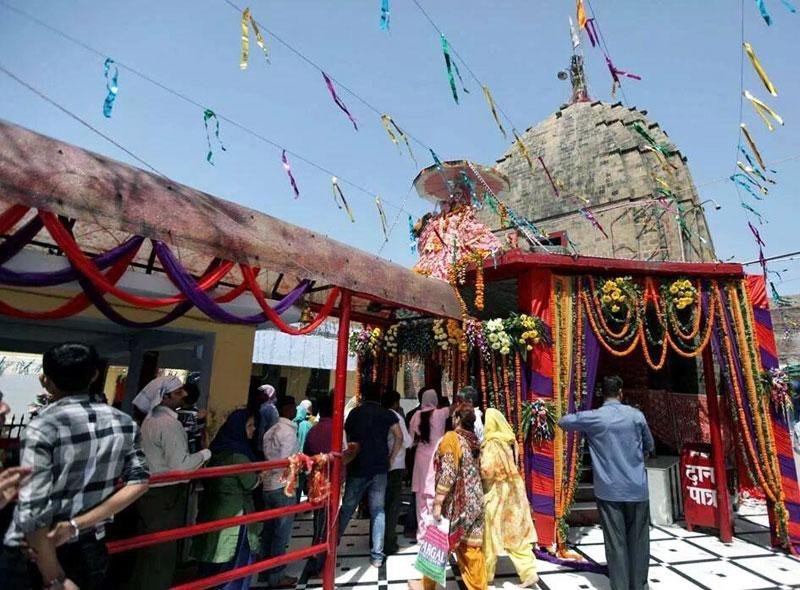
Kol Kandoli Temple contains a compact stone shrine standing within a developed courtyard.
The older-looking central structure is built in grey stone and possesses a vertically rising roof or tower crowned by a finial.
Its restrained form differs from the brightly painted and heavily ornamented appearance of many modern North Indian temples.
The stone surface gives the shrine a strong, grounded character.
During festivals, the structure may be covered with marigold garlands, flags, cloth and lights.
The surrounding complex contains queue corridors, covered passages, railings, tiled floors and additional prayer areas designed to support visitors.
Pink, red and white surfaces may appear around the courtyard and auxiliary buildings.
Mature trees create shade and reinforce the connection with Mata’s childhood stories.
Visitors should distinguish between the historic core and later infrastructure.
Both are important, but they represent different phases of the temple’s development.
## The Sacred Pindi Shrine
The pindi shrine is the principal focus of darshan.
A pindi represents divine presence through a sacred stone form rather than a conventional full-body statue.
Pindi worship has special importance in the Vaishno Devi tradition.
The natural or aniconic form encourages devotees to look beyond ordinary physical representation.
The Goddess is not limited by one face, dress or posture.
She is the underlying Shakti present throughout creation.
Visitors should follow the established queue.
Photography may be restricted near the pindi.
Offerings should be made through authorised priests or counters.
Coins, plastic and personal objects should not be placed directly on the sacred form.
## Associated Shiva Shrine
The Kol Kandoli complex is also associated with a Shiva shrine, often described through names such as Ghanteshwari or Gandeshwari Mahadev in popular accounts.
The presence of Shiva within a Shakti temple expresses the inseparable relationship between Shiva and the Goddess.
Shiva represents consciousness and meditative stillness.
Shakti represents active divine energy.
One cannot function fully without the other.
The precise name and historical date of the associated shrine should be confirmed from local temple information.
Visitors should not confuse it with an independently established Jyotirlinga.
The term Jyotirlinga has a specific religious meaning associated with twelve principal Shiva shrines across India.
A local Shiva lingam can be deeply sacred without being one of the twelve classical Jyotirlingas.
## Other Deities in the Complex
Like many living temple complexes, Kol Kandoli may include images or shrines associated with Hanuman, Bhairava, Kali, Ganesha, Shani, Navagraha or other deities.
The exact arrangement can change through renovation and ritual development.
These divine forms create a complete sacred environment around Mata.
Hanuman represents devotion, service and courage.
Bhairava represents protection and the disciplined power associated with Shiva.
Ganesha represents wisdom and auspicious beginnings.
The Navagraha represent the traditional planetary powers connected with time and human life.
Visitors should follow local signs rather than assuming the identity of a weathered or covered image.
## Sacred Trees and the Courtyard
Trees within the temple premises are associated with shade, childhood play and devotional memory.
A mature tree may be regarded as a witness to the sacred traditions of the site.
Visitors should not drive nails into trunks, cut bark or tie excessive synthetic cloth around branches.
Threads and offerings should only be used where temple management permits them.
The courtyard provides space for gathering, prayer and queue movement.
During quiet periods, visitors can sit respectfully and reflect.
During festivals, the same area becomes part of the organised circulation system.
Pathways and emergency access should remain clear.
## Navratri at Kol Kandoli Temple
Navratri is the most important festival period at Kol Kandoli Temple.
The word Navratri means nine nights and honours the different powers of the Divine Mother.
Two principal Navratri periods are widely observed.
Chaitra Navratri generally falls during March or April.
Sharad Navratri generally falls during September or October.
The temple is decorated with flowers, flags, lights and devotional cloth.
Special prayers, bhajans, satsang, havan and community meals may be organised according to annual arrangements.
The temple receives local families as well as travellers beginning or completing the Vaishno Devi pilgrimage.
Queue time and parking pressure increase.
Visitors should arrive early and follow police or management instructions.
The exact programme and traffic plan should be confirmed for the relevant year.
## Chaitra Navratri
Chaitra Navratri marks the spring cycle of Goddess worship.
The weather is often comfortable, although warm afternoons and occasional rain are possible.
The first day is particularly important because devotees begin nine days of fasting, prayer and Durga worship.
Kol Kandoli’s status as the first darshan gives the opening of Navratri special significance.
Pilgrims may seek Mata’s blessings before continuing to Katra.
## Sharad Navratri
Sharad Navratri takes place after the principal monsoon and summer period.
The weather generally becomes more comfortable.
Katra and the entire Vaishno Devi region can receive heavy pilgrimage traffic.
Ashtami and Navami may bring the largest crowds.
Families with senior citizens or young children should choose quieter morning hours whenever possible.
## Kanya Pujan and the Divine-Child Tradition
Kanya Pujan, the worship of young girls as manifestations of the Goddess, is widely observed during Navratri.
The practice has particular emotional meaning at Kol Kandoli because Mata herself is remembered here through the form of a young girl.
Families may offer food, gifts and respect to girls according to their tradition.
The ritual should never become performative or disrespectful.
Children must be treated with dignity, consent and appropriate care.
The purpose is to recognise divine worth within every child, not merely to complete a ritual checklist.
## Bhajans, Jagran and Community Worship
Bhajans and satsang may be organised at the temple during festivals.
A jagran is an extended devotional gathering involving songs and sacred narratives of the Goddess.
Sound levels and timings should remain under authorised control.
Independent loudspeakers should not be installed without permission.
Devotion should not create distress for residents, senior citizens or children.
Community worship is most meaningful when discipline and consideration remain present.
## Langar and Bhandara
Community meals may be served during Navratri and other important occasions.
Langar and bhandara express equality, generosity and service.
Visitors should accept only the amount of food they can eat.
Disposable waste must be placed in appropriate bins.
Serving food while leaving plastic throughout the temple approach contradicts the spiritual purpose of the offering.
## Daily Darshan and Aarti
Kol Kandoli Temple is generally visited from early morning until evening, but current opening and closing times should be confirmed locally.
Timing can change according to season, festival activity, maintenance and priestly arrangements.
Morning darshan provides cooler weather, lighter traffic and a quieter courtyard.
It is ideal for pilgrims continuing to Katra.
Evening aarti can create a devotional atmosphere of lamps, bells and collective prayer.
Travellers attending evening worship should arrange dependable return transport.
## Best Time to Visit Kol Kandoli Temple
The shrine can generally be visited throughout the year.
### Spring
Spring is one of the best periods for visiting Nagrota.
Temperatures are usually comfortable, trees become greener and Chaitra Navratri creates a vibrant devotional atmosphere.
Festival visitors should expect crowds.
Ordinary weekdays offer a quieter experience.
### Summer
Summer in Jammu and Nagrota can become very hot.
Kol Kandoli is not a high-altitude hill station.
Morning darshan is strongly recommended.
Visitors should carry drinking water, light clothing and sun protection.
Children and senior citizens should avoid prolonged exposure to the midday heat.
### Monsoon
The rainy season brings greener surroundings but can create slippery temple approaches, waterlogging and road delays.
Nagrota and the Jammu–Katra corridor may experience intense rain.
Travellers should monitor weather and road conditions.
The sacred water source should be protected from runoff pollution and discarded offerings.
### Autumn
Autumn is among the most comfortable periods for pilgrimage.
Sharad Navratri creates major religious activity.
Visitors seeking peaceful darshan may travel after the festival or choose an ordinary weekday.
### Winter
Winter mornings and evenings can become cold, while daytime weather may remain pleasant.
Fog can affect the Jammu region and road visibility.
Regular snowfall should not be expected at Kol Kandoli because Nagrota lies in the lower Shivalik zone.
Warm layers remain useful for early-morning darshan.
## Reaching Kol Kandoli Temple from Jammu
Jammu is the most practical urban and transport base for Kol Kandoli.
The temple lies roughly 13–15 kilometres from central Jammu, while distance from the railway station or airport can vary according to the selected route.
A taxi, private vehicle or locally arranged cab provides the easiest access.
Travellers proceeding to Katra can include the shrine during the road journey when luggage and timing permit.
The driver should be informed in advance because the temple may require a diversion from the fastest through-route.
Visitors should allow sufficient time for darshan rather than treating the stop as a five-minute photograph.
## Reaching from Jammu Tawi Railway Station
Jammu Tawi is the principal long-distance railway gateway for travellers arriving from Delhi, Punjab, Rajasthan, Uttar Pradesh and other parts of India.
Kol Kandoli can be visited after leaving luggage at a hotel or through a prearranged taxi transfer.
Large suitcases should not be carried into the temple.
Visitors arriving late at night should check into accommodation and visit during daylight or confirmed temple hours.
## Reaching from Jammu Airport
Jammu Airport is the nearest commercial airport.
A road transfer is required to Nagrota.
Traffic conditions vary according to the time of day and the route through Jammu.
Travellers should not schedule temple darshan immediately before a tightly timed flight.
Additional buffer time is essential.
## Reaching from Katra
Nagrota lies on the broader route between Jammu and Katra.
The road distance from Katra is commonly around 30–35 kilometres depending upon the exact starting point and route.
A private taxi provides the easiest connection.
Pilgrims staying in Katra can visit Kol Kandoli as a half-day excursion or stop there while travelling back towards Jammu.
Those who wish to follow the traditional “first darshan” sequence should ideally visit before beginning the Vaishno Devi climb.
However, the temple remains spiritually meaningful when visited after Bhawan darshan.
## Public Transport
Buses and shared vehicles operate along the Jammu–Katra and Jammu–Udhampur corridors, but they may not stop directly at the temple entrance.
A local connection could be required from Nagrota.
Schedules and last-return timings should be checked locally.
Families and senior citizens are generally more comfortable with a prearranged taxi.
## Accessibility for Senior Citizens
Kol Kandoli is one of the more accessible Vaishno Devi-associated temples because it does not require a mountain trek.
The courtyard and developed pathways make the principal darshan manageable for many senior citizens.
Some thresholds, steps or queue sections may still require assistance.
Visitors with substantial mobility limitations should confirm the nearest permitted drop-off and wheelchair practicality.
Navratri crowds can make movement more difficult.
A quiet weekday morning is usually preferable.
## Visiting with Children
Kol Kandoli is especially meaningful for children because Mata is remembered here in her childhood form.
Parents can explain the stories of the bowl, water and swing through lessons about kindness and sharing.
Children should remain supervised around the sacred well, railings, lamps and queue corridors.
They should not climb the stone shrine, pull garlands or ring bells continuously.
Any permitted swing should be used carefully.
## Temple Etiquette
Visitors should wear respectful clothing and remove footwear wherever instructed.
Phones should remain silent.
Photography of the sacred pindi, inner sanctum, priests and private rituals should only be undertaken with permission.
The queue should move steadily.
Offerings should be made through recognised arrangements.
Visitors should not pressure priests for guaranteed results or special treatment.
Donations should be placed in authorised boxes or made through recognised channels.
## Responsible Use of the Sacred Water
The bowli or well must be protected from pollution.
Visitors should not throw coins, plastic, flowers wrapped in packaging or food into the water.
Soap and chemicals must never be used.
Claims of guaranteed healing should be avoided.
The water may be received respectfully according to current temple practice, while ordinary hygiene precautions remain appropriate.
## Responsible Heritage Behaviour
The compact stone shrine may preserve older architectural fabric.
Visitors should not scratch the walls, apply paint or rub stone surfaces.
Vermilion, oil and adhesive material should be placed only where authorised.
Children should not climb the shrine.
Professional filming, tripods or drones may require permission.
Protecting the building is an important expression of devotion.
## Shri Mata Vaishno Devi Bhawan
The Holy Cave of Shri Mata Vaishno Devi is the principal pilgrimage destination associated with Kol Kandoli.
Bhawan stands in the Trikuta Hills above Katra and is reached through a substantial uphill journey.
Pilgrims must follow the current registration and access system of the Shrine Board.
Kol Kandoli darshan does not replace this process.
The two temples are connected spiritually but managed separately.
## Deva Mai Temple
Deva Mai is traditionally remembered as another sacred stop on the older Vaishno Devi route.
It lies closer to the Katra side and is associated with the Goddess’s journey towards the Trikuta Hills.
Access, local roads and temple arrangements should be confirmed before visiting.
A specialised ancient-route itinerary can include Kol Kandoli and Deva Mai across one day.
## Raghunath Temple
Raghunath Temple in central Jammu is one of the region’s major Hindu temple complexes.
It is primarily dedicated to Lord Rama and contains numerous associated shrines.
A Jammu spiritual itinerary can combine Raghunath Temple, Ranbireshwar Temple, Bahu Fort and Kol Kandoli.
## Ranbireshwar Temple
Ranbireshwar Temple is one of Jammu’s principal Shiva shrines.
Its large central lingam and numerous smaller lingams give it a distinctive identity.
A visit provides a Shaivite complement to the Shakti traditions of Kol Kandoli.
## Bahu Fort and Bawe Wali Mata
Bahu Fort overlooks the Tawi River and contains the revered temple of Bawe Wali Mata.
The Goddess is deeply connected with Jammu’s identity.
Kol Kandoli and Bawe Wali Mata can be combined within a two-day Shakti circuit.
Visitors should account for traffic across Jammu city.
## Peer Kho Cave Temple
Peer Kho is an important cave shrine dedicated to Lord Shiva.
It is associated with the wider sacred landscape of Jammu and the Tawi River.
The cave environment requires careful movement and respect for current temple rules.
## Aghar Jitto
Aghar Jitto near Katra preserves the memory of Baba Jitto, a farmer-saint associated with dignity, sacrifice and justice.
It offers a valuable cultural dimension to a Vaishno Devi itinerary.
## Nau Devi Cave Temple
Nau Devi Cave Temple lies on the Katra–Reasi side and contains nine sacred pindis representing forms of the Goddess.
Kol Kandoli and Nau Devi are separate shrines.
A multi-day itinerary can include both without confusing their traditions.
## Baba Dhansar Temple
Baba Dhansar is known for its Shiva cave, forested ravine, waterfalls and sacred pool.
It requires a separate journey from Katra or Reasi.
Water and pathway safety are essential.
## Suggested Half-Day Kol Kandoli Itinerary
Begin from Jammu during the morning.
Travel to Nagrota and visit Kol Kandoli Temple.
Receive darshan of the sacred pindi.
Observe the stone shrine, courtyard and sacred-water tradition respectfully.
Spend time understanding Mata’s childhood stories.
Return to Jammu for lunch or continue towards Katra.
## Suggested One-Day Jammu–Nagrota Spiritual Itinerary
Begin with early darshan at Kol Kandoli.
Return towards Jammu and visit Raghunath Temple and Ranbireshwar Temple.
Continue to Bahu Fort and Bawe Wali Mata during the afternoon if traffic and group mobility permit.
Stay overnight in Jammu.
## Suggested Vaishno Devi Pilgrimage Sequence
Stay in Jammu on the arrival day.
Visit Kol Kandoli Temple during the morning as the traditional first darshan.
Continue to Katra and check into accommodation.
Complete current yatra registration and prepare for the climb according to Shrine Board requirements.
Begin the Bhawan journey after adequate rest.
This sequence is particularly suitable for families and senior citizens because it avoids rushing directly from a train or flight into the mountain pilgrimage.
## Suggested Three-Day Shakti Circuit
The first day can include Kol Kandoli and the major Jammu temples.
The second day can focus on Shri Mata Vaishno Devi.
The third day can include Nau Devi Cave Temple, Baba Dhansar or Aghar Jitto according to group energy and road conditions.
Shiv Khori requires a separate longer journey and should not be compressed into an already crowded schedule.
## Accommodation Near Kol Kandoli Temple
Accommodation directly around the temple and within Nagrota is more limited than in Jammu or Katra.
Options may include small hotels, local guesthouses and verified homestays.
The best accommodation base depends upon the complete pilgrimage route.
## Hotels in Nagrota
A stay in Nagrota provides the closest access to Kol Kandoli and can reduce travel before morning darshan.
The selection is smaller than in Jammu.
Guests should confirm attached bathrooms, meals, parking, air-conditioning, heating and the actual distance to the temple.
## Hotels in Jammu
Jammu offers the widest selection of hotels near Kol Kandoli Temple.
Options range from budget guesthouses to family hotels and premium properties.
Jammu is ideal for travellers arriving by train or air and planning Kol Kandoli before continuing to Katra.
Properties near the Nagrota-facing side of the city may reduce travel time.
Guests should still consider access to the railway station, airport and city temples.
## Hotels Near Jammu Tawi Railway Station
Railway-station hotels are practical for short stays and early departures.
Visitors should confirm parking, luggage storage and taxi arrangements to Nagrota.
The station area may be busy and less peaceful than residential parts of Jammu.
## Hotels in Katra
Katra offers extensive accommodation for Vaishno Devi pilgrims.
Options include budget hotels, family rooms, premium properties, resorts, guesthouses, dharamshalas and Shrine Board accommodation.
Travellers visiting Kol Kandoli from Katra should account for the return road journey towards Nagrota.
Katra is best for pilgrims whose main focus is Bhawan, while Jammu or Nagrota is better for those prioritising the first-darshan sequence.
## Homestays Near Nagrota and Jammu
Verified homestays may provide local meals, quieter surroundings and personalised assistance with transport.
Facilities vary considerably.
Guests should confirm bathrooms, cooling, heating, Wi-Fi, parking and meal arrangements.
A local host may also provide current information about temple timings and festival traffic.
## Choosing the Right Place to Stay
Pilgrims arriving in Jammu and wishing to begin with Kol Kandoli should stay in Jammu or Nagrota.
Travellers already based in Katra can visit during a road excursion or on the return journey.
Families should prioritise room size, meals and parking.
Senior citizens should choose properties with lifts or ground-floor rooms.
Couples may prefer quieter stays away from congested transport areas.
Solo pilgrims should select populated and well-connected accommodation.
Groups should confirm several rooms, vegetarian meals and parking for larger vehicles.
Navratri visitors should reserve accommodation early.
Summer guests should verify air-conditioning or effective cooling.
Winter travellers should confirm hot water and room heating.
## Book Hotels Near Kol Kandoli Temple with MudrasStays
MudrasStays helps pilgrims, families and spiritual travellers discover hotels, homestays, guesthouses and pilgrimage accommodation near Kol Kandoli Temple, Nagrota, Jammu and Katra.
The platform is designed specifically for travellers searching for places to stay near temples, ancient pilgrimage routes and sacred destinations.
Visitors can compare accommodation according to practical driving distance from Kol Kandoli Temple, room category, budget, family size and required facilities.
Booking in Nagrota or on the appropriate side of Jammu makes it easier to attend peaceful morning darshan and continue towards Katra without unnecessary backtracking.
Solo pilgrims can search for affordable guesthouses and simple rooms.
Couples can explore quieter hotels and local homestays.
Families can choose properties offering meals, parking and comfortable room capacity.
Senior citizens can prioritise accessible hotels with lifts and dependable taxi services.
Vaishno Devi pilgrims can select stays offering luggage storage, early meals and onward transport.
Pilgrimage groups can identify accommodation providing multiple rooms, vegetarian food and suitable parking for large vehicles.
Travellers combining Kol Kandoli with Raghunath Temple, Ranbireshwar Temple, Bawe Wali Mata, Deva Mai, Nau Devi Cave Temple or Shri Mata Vaishno Devi can choose accommodation according to the actual sequence of their journey.
MudrasStays helps pilgrims avoid booking a property that appears close on a map but lies on an inconvenient side of Jammu or requires repeated movement through city traffic.
## Responsible Pilgrimage
Kol Kandoli Temple is an active place of worship and an important part of the Vaishno Devi pilgrimage tradition.
Visitors should dress respectfully and follow the designated queue.
The sacred pindi, priests and private rituals should only be photographed when permission is clear.
The stone shrine should not be climbed, scratched or covered with unauthorised substances.
The sacred water source must not be polluted.
Plastic bottles, flower packaging and food wrappers should be placed in appropriate bins.
Sacred trees should not be damaged with nails or excessive synthetic cloth.
Children should remain supervised.
Langar food should not be wasted.
Donations should be made through recognised arrangements.
## Respecting Nagrota’s Community
Nagrota is a living town rather than only a pilgrimage stop.
Residents use the same roads, lanes, water resources and market areas as visitors.
Vehicles must not block private homes, shops or emergency access.
Residents should not be photographed without consent.
Local drivers, priests, shopkeepers, food providers and accommodation hosts should be treated fairly.
Purchasing local goods and staying in locally managed properties can allow pilgrimage tourism to support the community.
## A Sacred Beginning to the Vaishno Devi Journey
Kol Kandoli Temple represents a deeply meaningful combination of Shakti worship, divine childhood, sacred water and ancient pilgrimage memory.
The pindi expresses Mata beyond an ordinary physical form.
The child tradition makes the Divine Mother approachable to families and children.
The bowl represents compassion and the fulfilment of a genuine need.
The sacred water reminds pilgrims that natural resources must be protected.
The swing represents joy and the innocence of Mata’s childhood companions.
The twelve-year tapasya tradition represents discipline and spiritual purpose.
The Pandava narrative connects the temple with endurance, faith and Mahabharata memory.
The ancient route connects modern pilgrims with generations who walked towards the Trikuta Hills before highways and railways existed.
The Chhari tradition keeps that sacred journey alive.
Navratri brings the temple into the wider celebration of the Divine Mother.
For Vaishno Devi pilgrims, Kol Kandoli provides a spiritually rich beginning before travelling to Katra.
For families, it offers a road-accessible shrine connected with stories children can understand.
For senior citizens, it provides meaningful Mata darshan without a demanding mountain climb.
For cultural travellers, it reveals the wider pilgrimage landscape beyond Bhawan.
For photographers, the compact stone shrine, marigold decoration, courtyard and flags offer memorable visual opportunities when sanctum rules are respected.
For spiritual seekers, Kol Kandoli teaches that the divine can appear through childhood simplicity, friendship and the sharing of water.
Kol Kandoli Temple should not be treated merely as a short roadside stop between Jammu and Katra.
Its significance lies in beginning the pilgrimage with the correct inner attitude.
Arrive without rushing.
Receive darshan of Mata’s pindi.
Listen to the stories of her childhood with respect.
Protect the sacred water source.
Allow children to learn that devotion includes kindness.
Continue towards Katra with patience, discipline and gratitude.
Plan your pilgrimage to Kol Kandoli Temple with MudrasStays and experience the traditional first darshan of Mata Vaishno Devi.
Seek the blessings of Maa Kol Kandoli, explore the sacred pindi shrine and understand the childhood traditions of the Divine Mother at Nagrota.
Combine your journey with Shri Mata Vaishno Devi, Deva Mai, Raghunath Temple, Ranbireshwar Temple, Bawe Wali Mata, Nau Devi Cave Temple, Baba Dhansar and Aghar Jitto.
Book hotels near Kol Kandoli Temple, discover homestays near Nagrota and explore suitable pilgrimage accommodation throughout Jammu and Katra through MudrasStays.
Stay closer to the shrine, attend peaceful morning darshan and continue towards the Trikuta Hills without unnecessary travel through congested routes.
MudrasStays connects pilgrims, families and spiritual travellers with suitable accommodation near temples, ancient yatra routes and sacred destinations across India.
Begin your Vaishno Devi pilgrimage with a comfortable stay and a meaningful first darshan at Kol Kandoli Temple—the sacred Nagrota shrine of Mata’s childhood, compassion and divine play.