
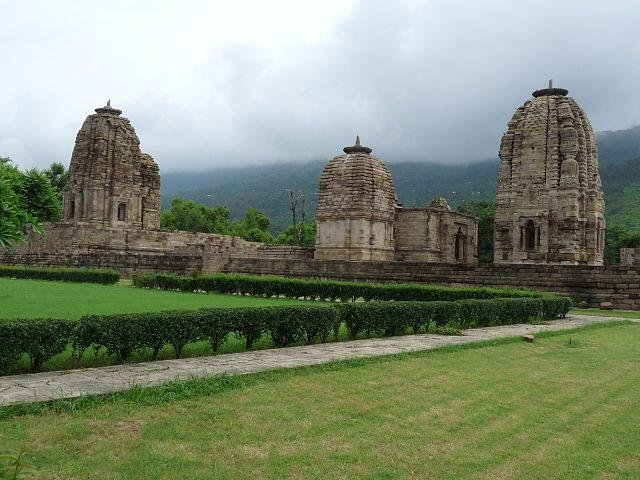
Krimchi Temple Complex is one of the most important surviving groups of early-medieval Hindu temples in the Jammu region of Jammu and Kashmir. Located in the peaceful village of Krimchi, approximately 12 kilometres north of Udhampur, the complex contains a remarkable collection of stone temples, raised platforms, sanctums, entrance halls, carved architectural fragments and curving shikhara towers surrounded by lawns, agricultural land, streams and low mountain slopes.
The site is also known as Krimachi Temple Complex, Kiramchi Group of Temples, Kirmachi Temples, Krimchi Pandava Temples, Pandav Mandir Krimchi and the Group of Temples at Kiramchi.
These spelling variations generally refer to the same protected archaeological complex near Udhampur.
Travellers arranging a taxi should specify:
Krimchi or Kiramchi ancient temple complex on the Udhampur–Lander road.
This helps prevent confusion with modern temples or similarly named villages elsewhere in the region.
Krimchi Temple Complex is traditionally associated with Lord Shiva and is locally called the Pandava Temples because of legends connecting the site with the Pandavas and Raja Kichak of the Mahabharata.
Architectural and archaeological evidence, however, places the surviving stone temples within the early-medieval period rather than the age traditionally assigned to the Mahabharata.
Different official and heritage descriptions propose dates ranging from the eighth and ninth centuries to the eleventh and twelfth centuries.
The most responsible description is therefore that Krimchi represents an early-medieval Hindu temple complex constructed and modified through more than one phase.
The complex is protected as an archaeological monument and should be approached primarily as an irreplaceable heritage site.
It is not simply one functioning temple with a single daily darshan arrangement.
Some visitors offer quiet prayers, but conservation rules governing ancient masonry, sculptures and archaeological remains must always be followed.
Krimchi is suitable for heritage travellers, Hindu pilgrims, families, senior citizens, photographers, architecture students, historians and visitors travelling through Udhampur towards Patnitop, Chenani, Jammu, Katra or the wider mountain regions of Jammu and Kashmir.
The site does not require a high-altitude trek.
Most travellers can reach the village by road and complete a short walk through the maintained archaeological grounds.
Visitors searching for hotels near Krimchi Temple Complex, homestays near Krimchi village, accommodation in Udhampur, heritage stays near the Pandava Temples or places to stay near Udhampur’s spiritual attractions can use MudrasStays to plan a practical and culturally meaningful journey.
## Location of Krimchi Temple Complex
Krimchi is a small village in Udhampur district, situated in a green valley approximately 12 kilometres north of Udhampur town.
The official district description places the village along the Udhampur–Lander road and approximately 67 kilometres from Jammu, although practical road distance varies according to the traveller’s starting location and the current route.
The complex stands at an elevation of roughly 730 metres above sea level.
This relatively moderate altitude gives Krimchi a climate different from the higher destinations of Patnitop, Nathatop or the upper Chenani region.
Summers can become warm.
Winters are cool but regular snowfall should not be expected.
The valley is drained by the Birunala and Krimchi rivulets.
Water, agricultural land and surrounding hills contribute to the secluded atmosphere of the site.
The temple complex occupies an elevated stone terrace near the Birunala stream.
The raised position protects the shrines from ordinary surface water while creating a visually prominent sacred platform within the valley.
## A Group of Seven Sacred Structures
Krimchi is commonly described as a group of seven surviving structures.
Official district information identifies five temples and two smaller shrines.
Other architectural descriptions classify the group as four large temples and three smaller temples.
The difference arises largely from the way damaged or subsidiary structures are categorised.
The essential point is that Krimchi was not designed as one isolated shrine.
It developed as a coordinated sacred complex containing principal temples and smaller associated shrines.
Some structures stand on shared platforms.
Others occupy separate raised bases.
Several retain substantial shikhara towers.
Others survive primarily through walls, foundations, sanctums or collapsed architectural components.
The temples are conventionally numbered by archaeologists and heritage authorities for documentation.
Numbering makes it easier to describe individual structures without assigning an uncertain original name to every shrine.
Visitors may therefore encounter signboards referring to Temple No. 1, Temple No. 2 and subsequent structures.
These modern numbers are archaeological labels, not the ancient ritual names of the temples.
## Early-Medieval History
The precise date of Krimchi Temple Complex remains debated.
Archaeological Survey of India descriptions generally place the Kiramchi temples in the eighth–ninth centuries CE.
Other official local heritage material describes them as belonging approximately to the eleventh–twelfth centuries.
Differences in dating may reflect multiple construction phases.
One temple may be older than another.
An earlier shrine may have been repaired or enlarged.
A damaged mandapa could have been reconstructed during a later period.
Sculptures may also have been moved between shrines during restoration or conservation.
It is therefore misleading to assign every standing temple, platform and carving to one exact year.
The complex is best understood as an early-medieval sacred centre developed gradually by local rulers, religious communities, stoneworkers and patrons.
The scale of the buildings indicates organised resources.
Large stone blocks had to be quarried, transported, shaped and raised into position.
Architects needed knowledge of geometry, structural load and water drainage.
Sculptors created doorframes, divine figures, mouldings and architectural ornament.
Priests and communities maintained worship after construction.
Krimchi was therefore part of a larger political, religious and economic landscape rather than an isolated collection of village structures.
## Uncertain Royal Patronage
The specific dynasty responsible for every phase of Krimchi has not been established conclusively in the information commonly available to visitors.
Different accounts connect the temples with regional rulers, a local kingdom centred at Krimchi or broader architectural developments across the western Himalayas.
Some older interpretations proposed construction during the Kushan period.
Others favour a later early-medieval date based upon the temple plans, sculptural style and shikhara forms.
Without a decisive inscription securely assigning the complete group to one ruler, royal attribution should remain cautious.
What can be stated confidently is that the builders belonged to a sophisticated architectural tradition and had access to skilled stone craftsmen.
## The Pandava Temples Name
Local communities commonly refer to Krimchi as the Pandava Temples.
According to regional tradition, the five Pandava brothers spent time in the area during their exile.
Some versions say that they constructed or worshipped at the temples.
Other stories connect them with the water sources, routes and settlements surrounding Krimchi.
Pandava traditions appear at numerous temples, caves, forts, lakes and mountain passes across Jammu, Kashmir and Himachal Pradesh.
Ancient ruins of impressive size were often associated with epic heroes whose strength was believed capable of moving enormous stones.
The Pandava connection should be presented as living Mahabharata tradition rather than archaeological proof that the surviving structures were built during the epic period.
The visible temples belong to a much later architectural era.
This distinction does not make the local story unimportant.
The legend shows how generations of people understood the ruins, protected their sacred identity and connected the landscape of Jammu with the Mahabharata.
For pilgrims, the Pandavas represent endurance, family duty, exile, moral struggle and the search for divine guidance.
## Raja Kichak Tradition
Another local narrative associates Krimchi with Raja Kichak.
Kichak is known in the Mahabharata as a powerful figure in the kingdom of Virata during the Pandavas’ period of concealment.
Regional stories sometimes identify Raja Kichak as the founder of Krimchi town or an early ruler of the surrounding kingdom.
The similarity between the names Kichak and Krimchi may have contributed to the tradition, although the linguistic and historical relationship is not conclusively established.
The current archaeological complex should not be attributed directly to the Mahabharata character as verified history.
The Kichak narrative belongs to oral tradition and the way local communities integrated the valley into India’s epic geography.
Visitors can respect the story while recognising the early-medieval dating of the surviving temples.
## Religious Identity of the Complex
Krimchi is generally described as a Shaivite temple group, meaning that Lord Shiva occupied a central position within its religious life.
Evidence from the site also includes imagery associated with Lord Vishnu, Goddess forms, Lord Ganesha and other members of the Hindu sacred universe.
This is not unusual.
A large Hindu temple complex may contain a principal Shiva shrine accompanied by temples or images dedicated to Vishnu, Parvati, Ganesha, attendant deities, guardians and directional powers.
Shaiva, Vaishnava and Shakta imagery often appeared within one broader sacred environment.
The complex should therefore not be described as seven identical Shiva temples.
Its religious programme was likely more diverse.
The surviving sanctums, sculptures and architectural niches suggest that different shrines may have housed different divine forms.
Some original images have been damaged, displaced, preserved separately or lost.
Visitors should not assign a deity to every empty sanctum without reliable archaeological or priestly evidence.
## Lord Shiva at Krimchi
Lord Shiva is traditionally regarded as the principal divine presence of Krimchi.
Shiva represents meditation, consciousness, transformation, time and liberation.
He is associated with mountains, rivers, forests and the quiet spaces chosen by ascetics.
The setting of Krimchi reflects this spiritual identity.
Stone temples stand beside flowing water and beneath wooded foothills.
The complex feels separated from the movement of Udhampur town even though it is reached through a relatively short road journey.
For Shiva devotees, the site can inspire quiet prayer and reflection.
However, Krimchi is a protected archaeological complex rather than an ordinary modern Shiva temple.
Visitors should not pour water, milk, oil or colour onto ancient walls, empty pedestals or unidentified stone objects.
Any active ritual arrangement should be followed only where clearly authorised.
## Vishnu Imagery
Architectural and heritage descriptions of Krimchi refer to imagery associated with Lord Vishnu.
A representation identified as Vaikuntha Vishnu has been discussed in relation to the complex.
Vaikuntha Vishnu is an important form within the religious history of Kashmir and the western Himalayas.
The form can present Vishnu through multiple aspects symbolising his universal power and protective functions.
The presence of Vishnu imagery demonstrates that Krimchi’s sacred world was not restricted to one narrow sectarian identity.
Devotees could honour Shiva while also recognising Vishnu and other deities as expressions of the wider Hindu divine order.
Visitors should avoid assuming that every image remains in its original shrine or position.
Archaeological recovery, damage and conservation can change the relationship between sculpture and architecture.
## Goddess and Saptamatrika Traditions
Some architectural descriptions identify niches intended for female deities, guardian figures or the Saptamatrikas.
The Saptamatrikas are a group of seven mother goddesses connected with protection, cosmic power and the energies of major male deities.
They appear in many early-medieval temples across India.
Their presence within a Shaiva complex is religiously appropriate because the Matrikas are often connected with Shiva, Skanda and the Goddess tradition.
Weathering can make individual figures difficult to identify.
Visitors should not label every damaged female sculpture as a particular goddess without expert guidance.
The broader significance is that Shakti—the active divine energy—formed part of Krimchi’s sacred programme.
## Lord Ganesha
Lord Ganesha is also represented within discussions of Krimchi’s sculptural heritage.
Ganesha is worshipped as the remover of obstacles, lord of beginnings and patron of wisdom.
His image commonly appears near entrances, subsidiary shrines or within larger Shiva temple complexes because he is the son of Shiva and Parvati.
For travellers, Ganesha’s symbolism is especially appropriate at the beginning of a heritage journey.
He represents careful thought, patience and the ability to overcome difficulty without unnecessary force.
Any surviving or displayed Ganesha sculpture should be treated as both a sacred image and an archaeological object.
It must not be touched, garlanded or covered with substances unless an authorised worship arrangement exists.
## Architecture of Krimchi Temple Complex
Krimchi is one of the best surviving examples of early-medieval Nagara temple architecture in the Jammu region.
Nagara is the broad term used for several traditions of temple building that developed across northern India.
The most recognisable Nagara feature is the rising shikhara above the sanctum.
At Krimchi, the larger temples possess tall curvilinear towers divided through vertical projections and repeated architectural bands.
The towers rise from square sanctums and visually direct attention upward.
The architectural composition generally includes:
A raised platform or jagati.
A square garbhagriha or inner sanctum.
An entrance vestibule or antarala in some structures.
A mandapa or hall.
A curving shikhara over the sanctum.
An amalaka or ribbed crowning element.
Doorframes with architectural mouldings.
External niches for sacred figures.
These features appear in different states of survival across the complex.
Some mandapas have lost their roofs or substantial portions of their walls.
Several sanctum towers survive more completely.
## The Garbhagriha
The garbhagriha is the innermost sanctuary of a Hindu temple.
Its name means the womb chamber.
It represents the concentrated centre of divine presence from which the symbolic universe of the temple develops.
At Krimchi, the sanctums are generally square and relatively compact.
The original sacred images or lingams would have occupied the centre or rear of these chambers.
The interior was not designed as a large public hall.
Devotees approached the doorway and entered in limited numbers.
Today, some sanctums may appear empty or contain only architectural remains.
Visitors should not treat an empty chamber as an ordinary room.
Its original ritual purpose and archaeological value remain important.
Entering restricted sanctums, touching walls or placing modern religious items inside can damage the historical integrity of the monument.
## The Mandapa
The mandapa is the hall positioned before the sanctum.
It provided space for worshippers, ritual preparation, music, recitation and ceremonial activity.
At Krimchi, several temples originally possessed square or rectangular entrance halls connected with the sanctum.
Many mandapa sections are more heavily damaged than the shikhara towers.
Open halls and projecting roofs are especially vulnerable when upper stone blocks shift or supporting elements collapse.
The surviving bases and walls allow visitors to understand how the devotee moved from open courtyard to hall and finally towards the sacred chamber.
No fallen pillar or base should be moved to create seating.
## The Shikhara
The shikhara is the dominant vertical tower rising above the garbhagriha.
In religious symbolism, it represents a sacred mountain connecting the earthly and divine worlds.
Krimchi’s shikharas use the curving form often called latina within Nagara architecture.
Strong vertical bands divide the tower and draw the eye upward.
Smaller subsidiary forms may appear along its projections.
The tower eventually narrows towards the crowning element.
The tallest surviving temple is commonly described as rising approximately 50 feet.
Measurements may vary according to whether the platform and surviving upper elements are included.
Visitors should appreciate the visual scale without attempting to climb the towers or platforms.
## The Amalaka
The amalaka is a ribbed circular stone element placed near the top of a Nagara temple shikhara.
Its name is associated with the amla fruit because of its segmented appearance.
The architectural element marks the transition between the curved tower and the upper finial.
Several interpretations have been proposed for its symbolism, including the Sun, a lotus, a celestial disc or the stabilising crown of the sacred mountain.
At Krimchi, surviving or restored crowning elements help visitors recognise the complete Nagara composition.
Loose circular stones near the complex should never be assumed to be ordinary decorative objects.
They may belong to an original architectural system.
## Phamsana Forms
Some smaller structures at Krimchi are described through phamsana-style superstructures.
A phamsana roof rises in gradually receding horizontal tiers rather than through the strong continuous curve of a latina shikhara.
The presence of more than one roof form demonstrates architectural diversity within the complex.
Larger sanctums may receive curvilinear towers, while smaller shrines or halls use tiered pyramidal forms.
This variation strengthens the interpretation that the complex developed through multiple phases or accommodated different ritual functions.
## Raised Platforms
Several Krimchi temples stand upon substantial stone platforms.
The platform creates a clear boundary between ordinary ground and sacred architecture.
It elevates the shrine visually and protects walls from surface moisture.
The platform may also support ritual circumambulation around the temple.
Some temples share a common terrace, suggesting that they were conceived as a related group.
Others stand independently.
Visitors should use recognised steps and pathways rather than climbing retaining walls.
Old platform edges may be worn, loose or unexpectedly high.
## Orientation of the Temples
Architectural descriptions indicate that several Krimchi temples face east, while others face west.
East-facing temples receive the rising Sun at their entrances and are common across Hindu architecture.
West-facing shrines may respond to the layout of the complex, the position of water, local topography or a specific ritual relationship with another temple.
The differing orientations support the view that Krimchi was a carefully planned sacred group rather than seven structures arranged randomly.
Unsupported claims about precise astronomical alignments should be avoided unless demonstrated by professional surveys.
## Stone Construction
Krimchi’s temples are built from carefully cut stone blocks, often described as sandstone or locally available sedimentary stone.
The material appears golden, brown, grey or reddish according to light, moisture and weathering.
Stoneworkers shaped the blocks into walls, mouldings, towers, pillars, doorframes and sculptural panels.
The temples rely upon accurate placement and the controlled transfer of weight.
Moving and lifting large blocks in the early-medieval period required organised labour, ramps, tools and practical engineering knowledge.
The surviving towers demonstrate the quality of the original construction.
At the same time, cracks, missing blocks and collapsed halls reveal the cumulative effect of earthquakes, rain, vegetation, neglect and human disturbance.
## Doorframes and Sacred Thresholds
The doorway of a Hindu temple is more than an entrance.
It marks the transition from the ordinary world into sacred space.
Krimchi’s temples contain framed doorways composed through vertical bands, projecting mouldings and carved architectural members.
Divine guardians, river goddesses, floral motifs or auspicious symbols may originally have appeared around such entrances.
Many details are weathered or damaged.
Visitors should not lean luggage against doorway mouldings or use the threshold as seating.
Repeated pressure can weaken already fragile stone.
Crossing an ancient threshold should be done slowly and respectfully where entry is allowed.
## Sculptural Niches
External niches were designed to hold divine figures and directional deities.
The placement of sculptures around a temple creates a sacred universe surrounding the principal deity within the sanctum.
Niches may have contained forms of Shiva, Vishnu, Goddess figures, Ganesha, guardians or attendant beings.
Many niches are now empty.
An empty niche should not be interpreted as evidence that it never contained a sculpture.
Images may have been damaged, removed, stolen or preserved separately for safety.
Visitors should not insert modern statues or offerings into empty niches.
Doing so can damage the stone and create an inaccurate appearance.
## Greek or Hellenistic Influence Claims
Popular descriptions frequently state that Krimchi’s architecture displays Greek or Hellenistic influence.
Comparisons are sometimes made between certain pillars, mouldings or proportions and classical Mediterranean forms.
The Jammu and Kashmir region historically stood near routes connecting the Indian subcontinent with Central Asia and territories once influenced by Hellenistic culture.
Artistic ideas could travel through trade, political contact and mobile craftsmen.
However, Krimchi should not be described simplistically as a Greek temple or as architecture created by foreign builders.
Its fundamental planning, sanctums, mandapas, shikharas and iconography belong to the North Indian Hindu temple tradition.
Any classical comparison should be treated as a discussion of possible artistic contact, not as proof of direct Greek construction.
The strongest architectural identification remains early-medieval Nagara temple design adapted within the Jammu Himalayan region.
## Relationship with Kashmiri Architecture
Krimchi also displays features that invite comparison with ancient temples of Kashmir.
The use of strong stone platforms, carefully framed openings and monumental proportions reflects a broader northwestern Himalayan architectural environment.
At the same time, Krimchi’s curvilinear Nagara shikharas differ from the steep pyramidal roofing and trefoil-dominated compositions commonly associated with major Kashmiri Valley temple sites.
The complex therefore occupies an important geographical and artistic position.
It stands between the architectural worlds of the Jammu hills, northern Indian plains and Kashmir Valley.
Its builders participated in regional exchange while creating a distinctly local sacred ensemble.
## Birunala Stream
The Birunala stream is an important part of Krimchi’s setting.
The temple terrace stands near the watercourse, connecting sacred architecture with the natural movement of water.
Streams provided drinking water, supported agriculture and served ritual purposes.
In Hindu thought, flowing water represents purification, continuity and the movement of life.
The Birunala can change dramatically according to season.
During dry periods it may appear small or carry limited water.
After heavy rain it can become stronger and potentially dangerous.
Visitors should not enter the stream during high flow, stand on slippery stones or allow children to wander unsupervised.
Plastic, food and ritual material must not be thrown into the water.
## Krimchi Valley Landscape
The valley surrounding the temples includes fields, village homes, low mountains, trees and rivulets.
The greenery is especially strong during and after the rainy season.
Winter and dry summer periods create a different landscape of muted grass and visible stone.
The relationship between architecture and landscape is central to Krimchi’s appeal.
The temples rise clearly above the open ground rather than being enclosed within dense urban construction.
Visitors can observe the shikhara silhouettes from several viewpoints.
The peaceful environment allows time for careful architectural study.
The site should nevertheless not be treated as a picnic ground.
Food, music and recreational activity should remain away from sacred and protected structures.
## Archaeological Protection
Krimchi Temple Complex is protected as a monument of national importance under the Archaeological Survey of India.
Protection applies to the complete archaeological area, including the standing temples, platforms, foundations, sculptures, architectural fragments and surrounding regulated land.
Visitors must follow ASI signs and staff instructions.
A structure that appears strong may contain unstable joints or concealed cracks.
Restricted areas should not be entered.
Conservation work may occasionally close a temple or pathway.
Such restrictions are necessary for safety and preservation.
Visitors should not expect unrestricted access merely because the complex is located within an open rural landscape.
## Conservation of the Temples
Krimchi has survived for centuries, but survival does not mean that the structures are indestructible.
The temples face pressure from rain, temperature changes, vegetation growth, earthquakes, wind and surface drainage.
Water entering cracks can weaken masonry.
Plant roots can separate blocks.
Earth movement can destabilise shikharas.
Uncontrolled touching and climbing add unnecessary pressure.
Conservation may involve resetting displaced stones, stabilising masonry, improving drainage and maintaining protective boundaries.
Modern repair should be evaluated carefully by specialists.
Visitors should not move a stone or attempt an informal repair, even when they believe they are helping.
## Worship at an Archaeological Complex
Krimchi retains religious meaning, but visitor behaviour must reflect its protected status.
Quiet personal prayer is appropriate.
Large unauthorised rituals, fire ceremonies, mass gatherings and the application of substances to ancient stone may not be permitted.
Oil, milk, water, vermilion, paint and adhesive religious material can permanently stain or weaken masonry.
Incense and lamps create fire and soot risks.
Worship should take place only through clearly authorised arrangements.
Protecting the temple is itself an act of devotion.
## Best Time to Visit Krimchi Temple Complex
Krimchi can generally be visited throughout the year, subject to local weather, road access and monument timings.
### Spring
Spring is one of the most comfortable periods for visiting.
Temperatures are moderate, vegetation becomes fresh and the surrounding hills appear attractive.
The archaeological grounds may remain damp after rain.
Visitors should wear shoes with dependable grip.
Morning and afternoon light reveal different details in the carvings and towers.
### Summer
Krimchi lies at a moderate elevation and can become hot during summer.
Visitors should not expect Patnitop-style temperatures.
Early morning and late afternoon are preferable for walking across the open complex.
Drinking water, sunscreen, sunglasses and a cap are useful.
The stone terraces can become hot under strong midday sunlight.
### Monsoon
The rainy season turns the valley green and creates dramatic clouds around the hills.
It also brings slippery stone, mud, stronger stream flow and possible road disruption.
Visitors should avoid climbing any platform not reached through an authorised step.
The Birunala should not be approached during high water.
Travel should be postponed during severe rain or local weather warnings.
### Autumn
Autumn is among the best seasons for heritage tourism.
Rain generally decreases, temperatures become comfortable and the surrounding landscape may remain green.
Clearer skies can improve architectural photography.
Morning and evening become cooler later in the season.
### Winter
Winter is generally cool and quiet.
Frost, fog or cold rain may occasionally affect travel.
Regular snowfall at Krimchi should not be expected because the village lies at a much lower altitude than Patnitop.
Visitors should carry warm layers for morning and evening.
Snow or ice on higher routes should still be considered when combining Krimchi with mountain destinations.
## Morning Visit
Morning is the best time for travellers seeking quiet observation.
The air is cooler, visitor numbers may be lower and sunlight gradually illuminates the east-facing temple walls.
A morning visit leaves enough time to explore Udhampur’s Devika area or continue towards another destination.
Visitors should confirm opening arrangements before planning arrival at sunrise.
Entry is permitted only according to monument timings.
## Late-Afternoon Visit
Late-afternoon light can give the stone temples warm golden tones.
Longer shadows reveal the projections and mouldings of the shikharas.
Visitors should monitor closing time and begin the return journey before darkness.
The rural road and village turns may be less convenient after sunset for travellers unfamiliar with the area.
## Reaching Krimchi from Udhampur
Udhampur is the most practical accommodation and transport base.
The village lies approximately 12 kilometres north of the town.
A taxi, private vehicle or locally arranged car is generally the easiest way to reach the complex.
Public transport may serve nearby settlements, but frequency and return timing should be confirmed.
Road conditions can change after rain or construction work.
Visitors should ask for the Udhampur–Lander road and the ancient Kiramchi group of temples.
## Reaching from Jammu
Krimchi is approximately 67–75 kilometres from Jammu depending upon the starting location and road used.
A day trip is possible by private vehicle.
The journey generally proceeds towards Udhampur before continuing to the village.
Traffic, highway work and weather can affect travel time.
A stay in Udhampur provides a more relaxed experience and makes it possible to visit the temples during quieter morning hours.
## Reaching from Katra
Katra is a major pilgrimage base for Shri Mata Vaishno Devi.
Krimchi can be included in a broader Jammu-region itinerary, but it is not located directly on the Vaishno Devi walking route.
The road journey should be planned through the appropriate Udhampur connection.
Visitors should avoid combining a tiring Vaishno Devi trek and detailed Krimchi exploration without sufficient rest.
An overnight stay in Katra or Udhampur should be selected according to the following day’s route.
## Reaching from Patnitop
Patnitop lies beyond Udhampur towards the higher Chenani region.
Visitors staying in Patnitop can travel downhill towards Udhampur and continue to Krimchi.
The journey should be planned with a local driver because road sequence and traffic can make map distances misleading.
A day combining Krimchi, Udhampur and Patnitop is possible, but travellers should avoid adding Sudh Mahadev and Mantalai to the same rushed itinerary.
## Reaching by Train
Udhampur Railway Station is the nearest major rail gateway.
It provides connections along the Jammu–Kashmir rail corridor.
A local taxi is required from the station to Krimchi.
Train schedules and operational arrangements should be checked before travel.
Visitors arriving with luggage should check into accommodation before visiting the archaeological complex.
Large suitcases should not be carried through the heritage site.
## Reaching by Air
Jammu Airport is the principal airport serving the region.
The onward journey requires road travel through or towards Udhampur.
Traffic and weather can affect the travel time.
Visitors should not schedule Krimchi immediately before a tightly timed flight.
## Accessibility for Senior Citizens
Krimchi does not require a mountain trek, making it comparatively accessible.
The archaeological grounds nevertheless contain steps, stone platforms, grass and uneven surfaces.
Senior citizens should wear stable footwear and use assistance where necessary.
A walking stick may improve balance.
Visitors with significant mobility limitations should confirm the nearest practical vehicle drop-off.
Wheelchair movement may be possible in some open areas but difficult around raised platforms and temple thresholds.
There is no need to climb every platform to appreciate the site.
The temples can be observed meaningfully from the maintained ground-level paths.
## Visiting with Children
Krimchi is an excellent educational destination for children when they are supervised carefully.
Parents can explain the difference between mythology and archaeology.
The Pandava story can introduce the Mahabharata tradition.
The stone towers can demonstrate how temples were built before modern machinery.
The site also teaches why heritage protection matters.
Children must not run across temple platforms, climb shikharas, enter restricted structures or move loose stones.
Water, sun protection and simple snacks should be carried, but all packaging must be removed.
## Photography at Krimchi
The temple towers, lawns, hills and changing sunlight make Krimchi highly attractive for photography.
Ordinary visitor photography should follow current monument rules.
Commercial shoots, professional lighting, drones, large tripods and staged productions may require permission.
Visitors should not stand on fragile platforms to obtain a higher angle.
Models should not lean against ancient doorways or carvings.
Religious dignity and archaeological safety should remain more important than a photograph.
## Responsible Heritage Travel
Krimchi is both a sacred landscape and a nationally important archaeological complex.
Visitors should:
Enter through authorised access points.
Follow ASI signs and barriers.
Avoid climbing walls, towers and platforms.
Never scratch names or dates into stone.
Avoid touching carvings unnecessarily.
Never apply oil, milk, paint or vermilion to protected surfaces.
Avoid lighting lamps or incense against ancient masonry.
Do not move loose architectural fragments.
Keep food and picnics away from the temples.
Carry all plastic and waste back.
Avoid loud music.
Respect local residents and agricultural land.
Obtain permission before commercial filming or drone use.
Each act of responsible behaviour helps the temples survive for future generations.
## Devika River and Udhampur Temples
The Devika River and its ghats form one of Udhampur’s most important sacred landscapes.
Local Hindu tradition regards Devika as a manifestation associated with the Ganga.
The riverfront contains temples, cremation areas and places used for ancestral rites.
A combined Krimchi and Devika itinerary allows visitors to experience archaeological heritage and active worship within one day.
Visitors must protect the river from plastic, food waste and ritual pollution.
Funeral ceremonies should never be photographed.
## Sudh Mahadev Temple
Sudh Mahadev is a major Shiva pilgrimage destination in Chenani tehsil.
It is known for its Shivling, sacred trident, Pap Nashni Bowli and traditions involving Goddess Parvati.
The temple lies significantly farther into the mountains than Krimchi.
The two sites are best divided across separate days.
Krimchi represents early-medieval archaeological architecture.
Sudh Mahadev represents active Shiva pilgrimage and living ritual tradition.
## Mantalai and Gauri Kund
Mantalai and Gauri Kund form part of the Sudh Mahadev Shiva–Shakti circuit.
They require additional mountain-road travel.
Visitors staying in Patnitop or Chenani can plan them separately after exploring Krimchi and Udhampur.
Current road and access conditions should be confirmed.
## Patnitop
Patnitop is the best-known hill destination near Udhampur.
It offers forest scenery, hotels, viewpoints and seasonal recreation.
A journey can combine Krimchi’s heritage with an overnight stay in Patnitop.
Travellers should remember that Patnitop lies at a much higher altitude and experiences different weather.
Winter road conditions should be checked before departure.
## Ramnagar Fort
Ramnagar Fort is an important heritage destination associated with the Dogra rulers.
The fort complex and surrounding historic structures require a separate road journey from Udhampur.
A two-day heritage itinerary can include Krimchi on one day and Ramnagar on the next.
Visitors should remain within permitted sections because old fort walls may be unstable.
## Mansar Lake
Mansar Lake is a sacred and natural destination within the wider Jammu region.
It is associated with temples, local legends and seasonal cultural activity.
The lake lies on a separate route and should not be treated as immediately adjacent to Krimchi.
A longer Jammu heritage itinerary can include both.
Visitors should avoid feeding wildlife or throwing waste into the water.
## Suggested One-Day Krimchi Itinerary
Begin with an early departure from Udhampur.
Reach Krimchi Temple Complex during the cooler morning hours.
Walk slowly through the archaeological grounds and study the seven surviving structures.
Observe the difference between the larger shikhara temples and smaller shrines.
Examine the raised platforms, mandapa remains and framed entrances without touching the stone.
Spend time near the permitted viewpoints overlooking the valley and Birunala.
Return to Udhampur for lunch.
During the afternoon, visit the Devika ghats or another road-accessible attraction within the town.
Return to accommodation before evening.
## Suggested Two-Day Heritage Itinerary
On the first day, arrive in Udhampur and visit the Devika area and local temples.
Stay overnight in Udhampur.
On the second morning, visit Krimchi Temple Complex.
After the heritage visit, continue towards Patnitop, Chenani, Jammu or Katra according to the onward route.
This itinerary is suitable for families and senior citizens.
## Suggested Three-Day Udhampur Journey
The first day can focus on Udhampur town and the Devika sacred landscape.
The second day can be dedicated to Krimchi Temple Complex and nearby rural heritage.
The third day can include Sudh Mahadev and Mantalai or Patnitop and Kud.
Ramnagar Fort can replace the mountain circuit for travellers more interested in history than pilgrimage.
## Accommodation Near Krimchi Temple Complex
Accommodation immediately beside the archaeological complex is limited.
Krimchi is a village rather than a developed hotel centre.
The most practical base is Udhampur town.
Travellers may also consider local homestays where verified, or stay in Patnitop, Katra or Jammu according to the broader itinerary.
## Hotels in Udhampur
Udhampur offers the best combination of hotels, restaurants, markets, hospitals, railway access and local taxis.
It is the preferred base for families, senior citizens and heritage travellers.
Properties range from budget guesthouses to comfortable hotels.
Guests should confirm parking, room heating or cooling, hot water, meals and the availability of an early taxi to Krimchi.
A property on the correct side of Udhampur can reduce unnecessary traffic crossing.
## Homestays Near Krimchi
Verified village homestays may provide local food, rural hospitality and a quieter experience.
Facilities can be simple.
Guests should confirm attached bathrooms, hot water, electricity, mobile network, meals and vehicle access.
A local stay can make morning exploration easier and allow tourism income to reach the community.
Travellers should not arrive without a confirmed reservation because accommodation supply may be extremely limited.
## Hotels in Patnitop
Patnitop offers a wider selection of resorts, cottages and mountain hotels.
It is suitable for couples and families combining heritage with a hill holiday.
The repeated downhill and uphill road journey to Krimchi should be considered.
Patnitop is not the closest accommodation base even when it appears nearby within the same district.
## Hotels in Katra
Katra is useful for travellers combining Krimchi with Shri Mata Vaishno Devi.
It offers a large range of hotels, restaurants and pilgrimage services.
A separate taxi journey is required to reach Krimchi.
Visitors should plan adequate rest between the Vaishno Devi pilgrimage and the heritage excursion.
## Hotels in Jammu
Jammu provides the largest accommodation selection, airport access and major transport services.
It is suitable as an arrival or departure base.
A day trip to Krimchi is possible, but staying in Udhampur reduces road time and enables a quieter morning visit.
## Choosing the Right Stay
Travellers focused on Krimchi should stay in Udhampur or a verified nearby homestay.
Families should check room capacity, meals and parking.
Senior citizens should prioritise lifts, ground-floor rooms and dependable taxi arrangements.
Couples may combine a Krimchi visit with a Patnitop stay.
Solo travellers should choose accommodation close to transport and populated areas.
Heritage groups should confirm multiple rooms, early breakfast and vehicle parking.
Summer travellers should verify air-conditioning or effective cooling because Udhampur and Krimchi can become warm.
Winter travellers should confirm heating and hot water.
Monsoon guests should ask about the village approach road and current drainage conditions.
## Book Hotels Near Krimchi Temple Complex with MudrasStays
MudrasStays helps pilgrims, families, heritage travellers and architecture enthusiasts discover hotels, homestays, guesthouses and comfortable accommodation near Krimchi Temple Complex, Udhampur, Patnitop, Katra and Jammu.
The platform is designed for travellers searching specifically for places to stay near temples, protected monuments and spiritual destinations.
Visitors can compare accommodation according to practical road distance from Krimchi, room category, budget, group size and required facilities.
Booking in Udhampur allows travellers to reach the temple complex during quieter morning hours and reduces unnecessary highway travel.
Solo travellers can search for affordable guesthouses near transport services.
Couples can explore peaceful rural homestays or combine Krimchi with a Patnitop resort.
Families can select hotels offering meals, parking and comfortable rooms.
Senior citizens can prioritise accessible properties with dependable taxis.
Student and heritage groups can identify stays offering multiple rooms, early meals and parking for larger vehicles.
Travellers combining Krimchi with Sudh Mahadev, Patnitop, Devika Ghats, Ramnagar Fort or Vaishno Devi can choose accommodation according to the actual sequence of the journey.
MudrasStays helps travellers avoid selecting a hotel that appears close in straight-line distance but requires inconvenient backtracking through highways or mountain roads.
## Respecting Krimchi Village
Krimchi is a living rural community as well as an archaeological destination.
Local residents use the surrounding roads, streams, fields and grazing areas.
Visitors should not enter private homes, farms or animal enclosures without permission.
Crops and fruit should not be picked.
Residents should not be photographed casually.
Vehicles must not block village lanes or house entrances.
Local drivers, guides, food providers and homestay hosts should be treated fairly.
Responsible tourism allows the protection of the monument to support the community around it.
## A Stone Legacy of Early-Medieval Jammu
Krimchi Temple Complex represents an exceptional meeting of early-medieval architecture, Hindu sacred traditions, Mahabharata folklore and the rural landscape of Udhampur.
The seven surviving structures reveal that Krimchi was once a substantial religious centre.
The principal shikharas demonstrate the strength of Nagara architecture.
The raised platforms organise sacred space and protect the temples from ground moisture.
The compact garbhagrihas preserve the form of ancient worship.
The mandapa remains show how devotees once gathered before approaching the sanctums.
The amalaka stones complete the symbolic image of the temple as a sacred mountain.
The niches indicate a rich sculptural programme.
The Shiva tradition gives the complex its principal religious identity.
The Vishnu, Goddess and Ganesha imagery reveals a broader sacred universe.
The Birunala stream connects the temple with water, agriculture and valley life.
The Pandava name preserves local Mahabharata memory.
The Raja Kichak legend links Krimchi with regional oral tradition.
The debated dating reminds visitors that archaeology continues to develop as evidence is studied.
The protected status recognises Krimchi as an irreplaceable part of India’s heritage.
For Shiva devotees, the complex offers a quiet landscape for reflection.
For families, it provides a road-accessible cultural excursion near Udhampur.
For senior citizens, the absence of a mountain trek makes the main grounds manageable with appropriate assistance.
For historians, Krimchi raises important questions about patronage, regional kingdoms and early-medieval Jammu.
For architecture students, the complex offers multiple shrine plans, towers and construction phases within one site.
For photographers, the warm stone, green lawns, shikhara silhouettes and surrounding hills provide memorable compositions when conservation rules are respected.
For children, it offers an opportunity to understand the difference between archaeology and sacred legend.
For cultural travellers, it reveals a side of Jammu and Kashmir beyond major pilgrimage centres and hill resorts.
Krimchi Temple Complex should not be treated merely as a brief roadside stop or a backdrop for photographs.
Its architecture deserves patient observation.
Walk slowly around the maintained paths.
Compare the size and orientation of the temples.
Notice how the shikharas rise from square sanctums.
Study the empty niches without inserting modern objects.
Observe the relationship between the temple terrace and Birunala.
Consider the labour required to transport and shape every block.
Remember the generations who worshipped, repaired and protected the complex.
Respect the archaeologists and conservators working to preserve what remains.
Plan your journey to Krimchi Temple Complex with MudrasStays and experience one of the most important early-medieval heritage destinations in the Jammu region.
Explore the Nagara shikharas, raised platforms, ancient sanctums and sculptural remains of the seven-temple group.
Learn about the local Pandava and Raja Kichak traditions while recognising the complex’s early-medieval archaeological history.
Combine your journey with Udhampur’s Devika Ghats, Sudh Mahadev Temple, Mantalai, Patnitop, Kud, Ramnagar Fort, Katra and the wider cultural attractions of Jammu and Kashmir.
Book hotels near Krimchi Temple Complex, discover homestays near Krimchi village and explore comfortable heritage and pilgrimage accommodation in Udhampur through MudrasStays.
Stay closer to the monument, arrive during peaceful morning hours and reduce unnecessary travel through regional roads.
MudrasStays connects pilgrims, families, students and heritage travellers with suitable accommodation near temples and sacred destinations across India.
Begin your Krimchi Temple Complex journey with a comfortable stay and experience a meaningful encounter with ancient stone architecture, Hindu sacred traditions, Mahabharata folklore and the timeless valley landscape of Udhampur.