
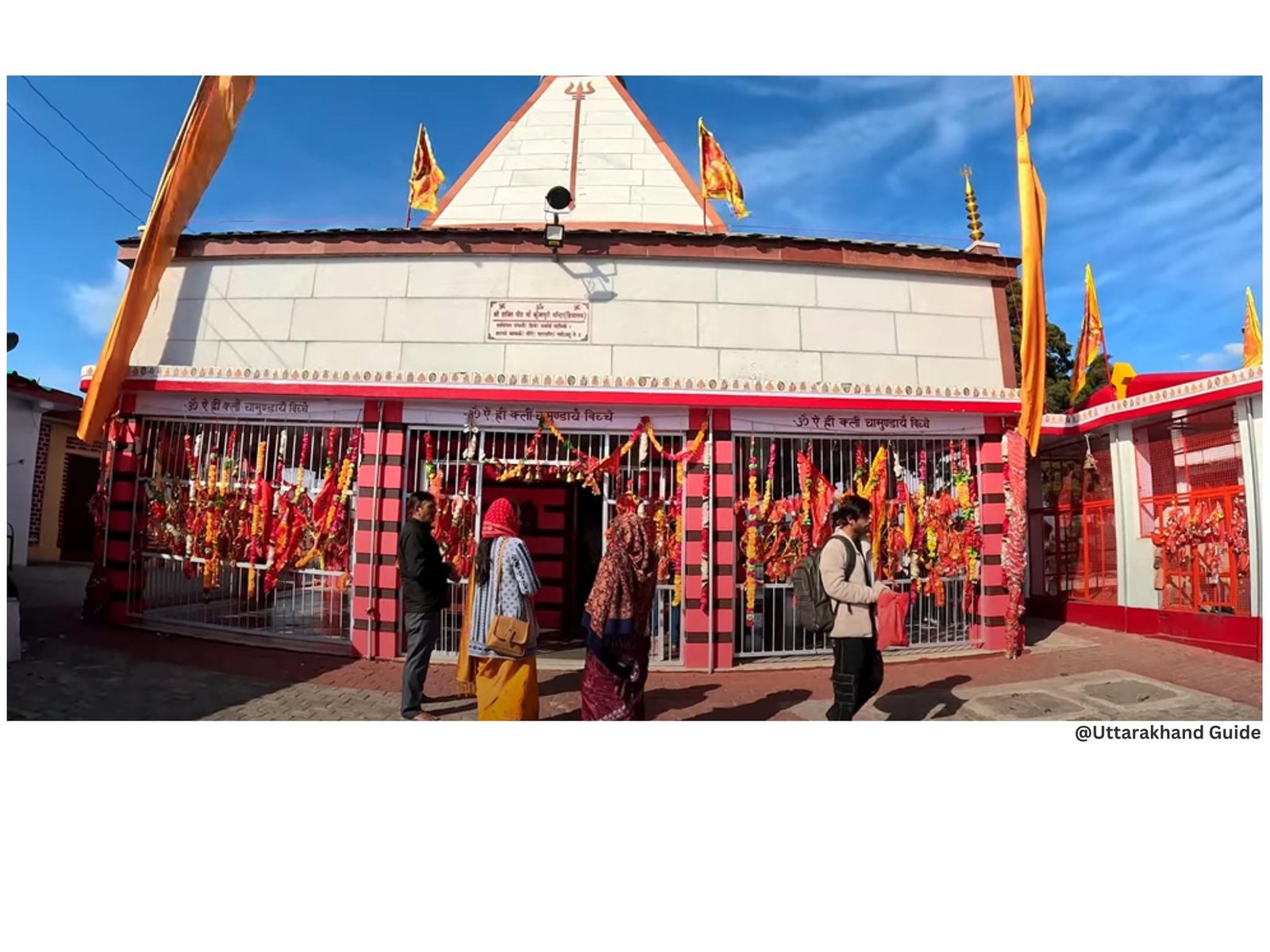
Kunjapuri Devi Temple is one of the most revered hilltop Shakti shrines in Tehri Garhwal and a popular spiritual destination near Narendra Nagar and Rishikesh in Uttarakhand. Dedicated to Goddess Durga, the temple stands on Kunjapuri Peak at an elevation of approximately 1,676 metres above sea level.
The temple combines spiritual importance with one of the most expansive viewpoints in the lower Garhwal Himalayas. Devotees visit to seek the blessings of Maa Kunjapuri, while nature lovers and photographers arrive before sunrise to experience changing light across the Himalayan peaks, river valleys and distant towns.
From the summit, clear weather may reveal snow-covered ranges including Swargarohini, Gangotri, Bandarpoonch and Chaukhamba. Looking towards the lower valleys, visitors may also see Rishikesh, Haridwar, the Doon Valley and sections of the Bhagirathi landscape.
The destination is especially popular among pilgrims staying in Rishikesh because it offers a meaningful combination of Goddess worship, a short mountain journey and a sunrise experience. It can be visited as a half-day pilgrimage from Rishikesh or as part of a longer Tehri Garhwal spiritual journey.
Kunjapuri Devi Temple is approximately 7 kilometres from Narendra Nagar. The practical distance from different parts of Rishikesh varies according to the starting point and selected road, so travellers should confirm current navigation and road conditions before departure.
A motorable mountain road leads towards the temple’s principal approach. Visitors then climb a series of steps to reach the upper courtyard and shrine. The number and condition of steps may be experienced differently according to the parking point and current access arrangements.
The climb is relatively short compared with a full Himalayan trek, but the altitude and slope can make it tiring for senior citizens, small children and travellers with knee, heart, breathing or mobility concerns.
Visitors should proceed slowly, use available railings and take breaks whenever needed. Comfortable walking footwear is preferable to slippers or smooth-soled shoes, especially during rain, frost or winter weather.
The physical ascent contributes to the pilgrimage experience. As visitors leave the road and move towards the summit, traffic noise gradually fades and is replaced by mountain wind, bells, birds and the quieter atmosphere of the temple.
The summit location creates a feeling of separation from ordinary routine. Open skies and distant mountains provide a natural environment for prayer, meditation and reflection.
Maa Kunjapuri is worshipped as a manifestation of Goddess Durga and the universal divine feminine power known as Shakti. In Hindu spiritual traditions, Durga represents strength, protection, courage, compassion and victory over negative forces.
Devotees visit the temple to pray for family welfare, prosperity, children, education, employment, marriage, safety and relief from difficult circumstances.
Some visitors arrive before beginning a major journey or important phase of life. Others return to offer gratitude after experiencing what they regard as the fulfilment of a sincere prayer.
These experiences are matters of personal faith and should not be presented as guaranteed outcomes. The temple’s importance lies in the spiritual reassurance, courage and sense of connection that worshippers receive through prayer.
Kunjapuri is traditionally recognised as a Shakti Peeth or Siddha Peeth within the Shivalik and Tehri Garhwal religious landscape. It is one of three prominent Shakti shrines in Tehri district, together with Surkanda Devi Temple and Chandrabadni Temple.
These three temples form what is popularly known as the sacred Shakti triangle of Tehri Garhwal.
Each shrine occupies a prominent mountain location and is associated with the wider sacred tradition of Goddess Sati.
According to Hindu religious belief, Goddess Sati was the daughter of King Daksha and the first consort of Lord Shiva. Daksha organised a major yajna but did not invite Shiva. Sati attended the ceremony and became deeply distressed when her father insulted her husband.
Unable to bear the humiliation, Sati entered the sacrificial fire. Lord Shiva, overwhelmed by grief, carried her body across the mountains and performed the Tandava, the powerful cosmic dance associated with destruction and transformation.
To restore cosmic balance, Lord Vishnu used his Sudarshan Chakra, and different parts of Sati’s body are believed to have fallen at sacred locations. These places became centres of Shakti worship known as Shakti Peethas.
Regional tradition associates Kunjapuri with a sacred portion of Goddess Sati’s body. Different accounts may describe the specific body part differently, and such details should be understood within the diversity of local religious traditions rather than treated as modern documentary history.
The spiritual significance of Kunjapuri comes from the continuing worship of Maa Durga, the faith of local communities and the temple’s place within the wider sacred geography of Tehri Garhwal.
The temple is also traditionally associated with the influence of Adi Shankaracharya, the philosopher and spiritual teacher connected with the revival and organisation of pilgrimage and temple traditions across India.
District information recognises Kunjapuri, Surkanda Devi and Chandrabadni as three Shakti shrines established within this sacred regional tradition.
Visitors should approach these historical and religious associations respectfully while recognising that ancient Himalayan temple histories often combine oral tradition, devotional belief and later institutional accounts.
The temple architecture is simple, colourful and suited to its exposed mountain setting. Its red, pink and white exterior, central shikhara, sacred flags and open courtyard create a recognisable Himalayan Devi temple appearance.
The structure does not depend on monumental size for its spiritual importance. Its atmosphere is created by the deity, the hilltop location, bells, prayer offerings and panoramic landscape.
Saffron and red flags can be seen around the temple, reflecting the symbolism of courage, devotion and Shakti worship.
Devotees may offer flowers, coconuts, sweets, incense, chunari and other traditional materials permitted by the temple authorities.
Visitors should purchase only the quantity of puja material they need. Excess offerings and plastic packaging can create waste in the sensitive mountain environment.
The principal sanctum is the spiritual centre of the shrine. During busy periods, movement may be regulated to ensure that every devotee receives an opportunity for darshan.
Visitors should follow instructions issued by priests and temple volunteers regarding entry, offerings and photography.
Photography of the deity or inner sanctum should only be undertaken when clearly permitted. Even where exterior photography is allowed, visitors should avoid blocking the temple entrance, prayer areas or queue.
Bells, sacred threads, flags and religious objects should not be removed, rearranged or treated as decorative accessories.
Sunrise is one of the most celebrated experiences at Kunjapuri Devi Temple.
Visitors commonly begin from Rishikesh or Narendra Nagar before dawn and travel towards the temple while the surrounding hills remain dark.
As daylight begins to appear, the Himalayan horizon may gradually change from deep blue and grey to shades of orange, gold and white.
When weather conditions are favourable, the first sunlight illuminates distant snow-covered peaks while the valleys below remain in shadow or mist.
The contrast between temple bells, early prayers, cold mountain air and changing light can create a deeply memorable spiritual experience.
Sunrise visibility is never guaranteed. Clouds, fog, rain, dust and seasonal haze may hide the Himalayan peaks or the sun itself.
Visitors should not consider a cloudy morning a failed pilgrimage. Mist moving through the hills can create an equally peaceful and atmospheric setting.
Travellers planning a sunrise visit should arrange a reliable vehicle in advance. Public transport may not operate during the required early hours.
A local driver familiar with the Narendra Nagar and Kunjapuri road is usually preferable, particularly during winter, rain or fog.
Visitors should carry a torch or use safe lighting while walking through the temple approach before sunrise. Mobile-phone flashlights may be useful, but a proper torch provides more reliable illumination.
Warm layers are important because early-morning temperatures on the summit can feel considerably colder than in Rishikesh.
A wind-resistant jacket, shawl, cap and suitable footwear may be required even when the daytime weather in the valley is comfortable.
Sunrise visitors should avoid standing near unprotected edges or climbing onto walls for photographs. Low light, wind and crowd movement increase the risk of accidents.
The summit is also known for sunset, although evening travel requires additional planning.
Sunset may illuminate the valleys, surrounding hills and distant settlements with changing colours. Temple bells and evening prayers add to the atmosphere.
Travellers planning a sunset visit should confirm the current temple schedule and ensure that their vehicle and return route are arranged.
Mountain roads become more difficult after dark, particularly for visitors unfamiliar with sharp curves, limited lighting and sudden fog.
Morning is generally more practical for first-time visitors because it provides sufficient daylight for the return journey and additional sightseeing.
Kunjapuri is also associated with walking and trekking routes. One recognised route begins around Hindolakhal and continues for approximately 5 kilometres through green forest towards the temple.
Other trekking itineraries promoted from the Rishikesh side may pass through villages, agricultural fields, forests and waterfalls before returning towards Tapovan or nearby areas.
The exact length, direction and difficulty depend on the route selected. Travellers should not begin an unfamiliar trail based only on a brief online description.
A reliable local guide is advisable for visitors undertaking a longer forest route or a descent towards villages and the Rishikesh side.
The road-based temple visit and the full trekking experience should be treated as different activities. Reaching the upper parking area and climbing the final steps requires far less time and physical effort than completing a longer village trail.
Trekkers should carry water, light food, sun protection, a rain layer, first-aid supplies and essential medication.
The route should be completed during daylight unless it is part of an organised sunrise trek with experienced local guidance.
Visitors should remain on recognised trails and avoid creating shortcuts. Unplanned routes can damage vegetation, increase erosion and lead into private land or unsafe terrain.
During the monsoon, paths may become muddy and slippery. Leeches, active streams and reduced visibility may also affect forest sections.
Winter frost can make shaded paths slippery even when the main road appears dry.
Solo travellers should inform their accommodation provider or another responsible person about their route and expected return time.
Families should assess whether the selected trek is suitable for children. Senior citizens and travellers with medical concerns should choose the road-based approach unless advised otherwise by an appropriate professional.
Kunjapuri Devi Temple is also valued as a place for meditation and yoga because of its open setting and proximity to Rishikesh, one of India’s best-known yoga destinations.
Some organised retreats and tour operators bring visitors to the summit for sunrise meditation, breathing exercises or quiet reflection.
Visitors participating in yoga should select a safe, level area and avoid obstructing temple movement or religious rituals.
The temple courtyard is first a sacred place of worship. Commercial classes, loud instruction, large equipment setups or extended occupation of prayer areas may be inappropriate without permission.
The summit can support a peaceful personal practice when approached respectfully. Sitting quietly, observing the mountains or reciting a prayer may be more suitable than turning the temple into a staged wellness venue.
Meditation and yoga may support relaxation and personal well-being, but the temple should not be advertised as providing guaranteed medical or mental-health treatment.
Visitors experiencing health concerns should continue seeking appropriate professional care while using the pilgrimage for spiritual reflection and rest.
Navratri is the most important festival period at Kunjapuri Devi Temple.
Both Chaitra Navratri and Sharad Navratri are dedicated to the worship of different forms of the Divine Mother.
During Navratri, devotees arrive from Narendra Nagar, Rishikesh, Tehri and surrounding villages to offer prayers, flowers, coconuts, lamps and red cloth.
The temple becomes more vibrant with religious ceremonies, bells, devotional singing and larger queues for darshan.
Travellers planning to visit during Navratri should expect increased traffic and limited parking near the temple approach.
Accommodation in Narendra Nagar and Rishikesh may experience stronger demand, particularly during weekends and important festival dates.
Families, senior citizens and larger groups should book their rooms and transport in advance.
Early arrival can reduce waiting time, although the temple may remain active throughout the day according to festival arrangements.
Visitors should remain patient and follow all crowd-control instructions. Attempting to bypass queues or blocking narrow areas for photography can create difficulties for other pilgrims.
Navratri is primarily a religious celebration rather than a tourism event. Content creation should never interfere with private prayer, rituals or the dignity of the shrine.
Outside festival periods, weekday mornings generally provide a quieter temple experience.
Spring is one of the most pleasant seasons for visiting Kunjapuri Devi Temple. The surrounding vegetation becomes fresh, temperatures are generally comfortable and clear mornings may provide attractive mountain views.
Chaitra Navratri can increase the number of visitors during spring, while ordinary weekdays remain comparatively peaceful.
Summer can be warm in Rishikesh but noticeably cooler at the temple summit. The difference in elevation makes Kunjapuri a refreshing early-morning excursion from the valley.
Direct sunlight can still become strong after sunrise. Visitors should carry drinking water, sunscreen, sunglasses and a cap while retaining a light jacket for the early hours.
The monsoon brings deep greenery, clouds and dramatic views across the hills. The temple may appear surrounded by mist, creating a distinctive spiritual atmosphere.
However, heavy rain can affect mountain roads, visibility, steps and trekking trails.
Travellers should check official weather and road advisories before beginning the journey. The temple should not be visited during severe thunderstorms, landslide warnings or conditions considered unsafe by local authorities.
A waterproof jacket or poncho is generally more practical than an umbrella on a windy hilltop.
Shoes with dependable grip are essential because steps and courtyard surfaces may become wet.
Autumn is one of the best periods for sunrise views and comfortable travel. The post-monsoon air may provide clearer visibility towards the Himalayan peaks.
Sharad Navratri gives the season additional religious importance and may bring significant crowds.
Winter provides a peaceful atmosphere and often clear air. Sunrise can be especially beautiful, but temperatures before dawn may be very low.
Visitors should carry thermals, warm jackets, gloves, caps and appropriate footwear.
Fog or frost may affect the road. Drivers should proceed carefully, and travellers should avoid pressuring the driver to reach the summit before sunrise at the cost of safety.
Snowfall at the temple should never be guaranteed for a specific date. Higher Himalayan peaks may appear snow-covered while the immediate Kunjapuri area remains free of snow.
Kunjapuri can be reached through Narendra Nagar, an important hill town overlooking the Ganga valley and Rishikesh region.
Narendra Nagar is the closest established town and provides road access, accommodation and basic services.
The town is associated with the former rulers of Tehri Garhwal and contains heritage architecture and viewpoints across the valley.
Staying in Narendra Nagar can be convenient for travellers whose principal purpose is an early sunrise visit to Kunjapuri Temple.
A nearby stay reduces the pre-dawn drive compared with accommodation in central Rishikesh.
Narendra Nagar offers hotels, wellness properties, guesthouses and local homestays. Accommodation ranges from simple rooms to premium retreats.
Travellers should confirm the actual driving route from the property to Kunjapuri because hotels under the Narendra Nagar destination may be situated across different roads and slopes.
Rishikesh remains the most popular base for visiting Kunjapuri Devi Temple.
The city offers a very large selection of hotels, hostels, guesthouses, ashrams, resorts and homestays.
Travellers can choose accommodation around Tapovan, Lakshman Jhula, Ram Jhula, Swarg Ashram, Muni Ki Reti, Triveni Ghat or quieter outskirts.
Tapovan is particularly convenient for travellers interested in yoga centres, cafés and organised sunrise excursions.
Muni Ki Reti and the Narendra Nagar road side may reduce part of the travel required from central Rishikesh.
A Rishikesh stay also allows visitors to combine Kunjapuri with Ganga Aarti, riverbank temples, ashrams and nearby waterfalls.
Guests should consider traffic while selecting accommodation. A property that appears close in distance may require additional time because of bridges, narrow lanes and busy tourism areas.
Visitors planning a pre-dawn departure should confirm whether their property permits early vehicle access and whether the driver can reach the entrance.
Rishikesh accommodation should be selected according to the traveller’s complete itinerary rather than only room price.
Families may prefer hotels offering parking, meals, lifts and larger rooms.
Couples may choose Ganga-view properties, peaceful resorts or private cottages.
Solo travellers can explore hostels, ashrams and budget guesthouses.
Senior citizens should prioritise properties with direct road access and minimal stairs, particularly because several riverbank areas involve steep lanes or walking bridges.
Pilgrimage groups should look for accommodation offering multiple rooms, vegetarian meals and parking for larger vehicles.
Travellers seeking a quieter spiritual stay may choose homestays or retreats around Narendra Nagar rather than the busier tourist neighbourhoods of Rishikesh.
Kunjapuri Devi Temple can be combined with several important spiritual destinations around Rishikesh.
Triveni Ghat is a major riverfront worship site known for evening Ganga Aarti. Visitors can attend Kunjapuri sunrise in the morning and experience the Ganga ceremony later the same day.
Bharat Mandir is one of the significant historic temples of Rishikesh and is dedicated to Lord Vishnu.
Neelkanth Mahadev Temple is dedicated to Lord Shiva and is reached through a separate mountain road. It should generally be planned as an independent excursion rather than added immediately after an early Kunjapuri journey.
Virbhadra Temple, nearby ashrams and the temples around Swarg Ashram can also be incorporated into a wider spiritual itinerary.
Travellers should avoid covering too many locations in one day merely because they appear close on a map. Traffic, mountain roads and walking can make the schedule tiring.
Kunjapuri also forms part of Tehri Garhwal’s sacred Shakti triangle.
Surkanda Devi Temple is a hilltop shrine near Kaddukhal, Dhanaulti and Kanatal. It is approached through a steep traditional climb or ropeway, subject to operation.
Chandrabadni Temple stands on Chandrakoot Mountain near the Devprayag region and is associated with a sacred Sri Yantra and broad Himalayan views.
A complete journey covering Kunjapuri, Surkanda Devi and Chandrabadni should be planned across several days.
A practical route may begin with Kunjapuri while staying in Narendra Nagar or Rishikesh.
The journey can continue towards Chamba, Kanatal or Dhanaulti for Surkanda Devi Temple.
Travellers can later proceed towards New Tehri, Devprayag or Jamnikhal for Chandrabadni Temple.
The order can be reversed according to the visitor’s starting point and onward route.
Separate accommodation near each section of the circuit reduces repeated mountain driving and allows pilgrims to attend early darshan.
MudrasStays can help travellers compare hotels, homestays and pilgrimage stays close to each temple in the Shakti triangle.
A one-day Kunjapuri itinerary can begin with a pre-dawn departure from Rishikesh or Narendra Nagar.
Visitors can reach the temple before sunrise, climb the final steps, attend darshan and observe the morning view.
After returning, travellers can have breakfast in Narendra Nagar or Rishikesh and spend the remainder of the day resting or exploring local temples.
The evening can conclude with Ganga Aarti at Triveni Ghat or another authorised riverfront ceremony.
A two-day itinerary allows a more relaxed experience.
On the first day, travellers can arrive in Rishikesh, check into their accommodation and explore a riverfront temple or evening Ganga Aarti.
The second day can begin with Kunjapuri sunrise and darshan. After returning, guests can rest before visiting Bharat Mandir, an ashram or a quieter riverside location.
A three-day spiritual and nature itinerary can include Rishikesh on the first day, Kunjapuri and Narendra Nagar on the second day, and a guided village or waterfall excursion on the third day.
A longer Tehri pilgrimage can continue from Kunjapuri towards Chamba, Kanatal, Surkanda Devi, New Tehri and Chandrabadni Temple.
Travellers interested in trekking may arrange a guided descent or forest route after the temple visit, but the route should be selected according to fitness, weather and available daylight.
Accommodation near Kunjapuri Devi Temple is available mainly in Narendra Nagar, Rishikesh and surrounding villages.
The closest local properties may include small homestays, guesthouses and mountain retreats.
Such accommodation can be ideal for sunrise pilgrims because it reduces the length of the early-morning drive.
Facilities in village properties may be simpler than those in established Rishikesh hotels. Guests should confirm attached bathrooms, meals, hot water, parking, power backup and mobile connectivity before booking.
Narendra Nagar provides a balance between proximity and developed services.
Luxury wellness resorts may offer panoramic settings and extensive facilities, while local hotels and homestays provide more affordable options.
Travellers should not select a property only because it uses the word “Kunjapuri” or “Narendra Nagar” in its listing. The actual road distance and travel time to the temple must be checked.
Rishikesh offers the broadest selection and is suitable for travellers combining Kunjapuri with yoga, temples, Ganga Aarti and other spiritual experiences.
Properties near the highway or Narendra Nagar road may be more practical for early departures than those deep inside pedestrian or riverbank lanes.
Before confirming accommodation, visitors should check whether the property can arrange an early taxi, packed breakfast or wake-up support.
Families should confirm room size, parking and meal options.
Senior citizens should ask about lifts, stairs and vehicle access.
Winter visitors should confirm room heating and hot water.
Monsoon travellers should check whether the final property approach remains accessible during heavy rain.
Guests requiring reliable internet should verify the connection directly with the property because mountain and riverside connectivity can vary.
MudrasStays helps pilgrims discover hotels, resorts, guesthouses, cottages and homestays near Kunjapuri Devi Temple, Narendra Nagar and Rishikesh.
The platform is designed specifically for travellers searching for suitable accommodation close to temples and spiritual destinations across India.
Visitors can compare properties according to practical distance from Kunjapuri Temple, room type, budget, group size and required facilities.
Booking a nearby stay makes it easier to leave before dawn, reach the summit safely and experience sunrise without beginning an excessively long journey.
Solo pilgrims can search for budget guesthouses and peaceful homestays.
Couples can explore mountain-view properties, private cottages and wellness retreats.
Families can choose hotels offering meals, parking and comfortable room capacity.
Senior citizens can prioritise accessible accommodation close to the driving route.
Pilgrimage groups can identify properties offering multiple rooms, vegetarian meals and suitable vehicle parking.
Travellers planning the Tehri Shakti triangle can use MudrasStays to organise stays near Kunjapuri, Surkanda Devi and Chandrabadni Temple.
Visitors combining the pilgrimage with Rishikesh can select properties convenient for both the temple road and the city’s spiritual attractions.
Choosing accommodation through a temple-focused platform helps visitors prioritise real access and travel time rather than booking a general property located far from the pilgrimage route.
Responsible travel is essential at Kunjapuri because the temple stands on a sensitive mountain summit.
Visitors should carry back plastic bottles, food wrappers, disposable cups and every other item they bring to the temple.
Waste should not be thrown down the mountain slope, hidden behind walls or left along the steps.
Flowers, cloth and other religious offerings should be placed only in designated areas.
Synthetic threads, plastic ribbons and flags should not be tied randomly to trees or railings.
Smoking and open flames can create forest-fire risks. Incense and lamps should be used only where permitted.
Visitors should avoid loud music, shouting and disruptive photography. The temple’s silence and sacred atmosphere should be preserved.
Trekkers should remain on established routes and avoid damaging crops, village land or forest vegetation.
Wildlife and birds should not be fed, chased or disturbed.
Drone photography should never be assumed to be allowed. It may require aviation, local and religious permissions and can disturb both worshippers and wildlife.
Individual devotees, priests and residents should not be photographed without consent.
Visitors should support local drivers, homestays, shops and guides fairly. Responsible spending allows pilgrimage tourism to benefit the communities maintaining the temple and surrounding roads.
Kunjapuri Devi Temple represents a powerful meeting of Goddess worship, sunrise, mountains and the spiritual landscape of Rishikesh and Tehri Garhwal.
The Shakti tradition connects the shrine with the sacred story of Goddess Sati.
The summit creates a natural space for prayer and contemplation.
The Himalayan panorama reminds visitors of the scale and beauty of the mountain region.
The view towards Rishikesh and Haridwar connects the hilltop temple with the sacred Ganga valley below.
The relationship with Surkanda Devi and Chandrabadni places Kunjapuri within a wider network of Devi worship.
Navratri connects the shrine with active community traditions and generations of pilgrims.
For devotees of Maa Durga, the temple is a place to seek courage, protection and family welfare.
For Shakti pilgrims, it is an important destination within Tehri Garhwal’s sacred triangle.
For sunrise travellers, it offers one of the most memorable early-morning viewpoints near Rishikesh.
For families, the road approach makes the shrine comparatively accessible with careful planning.
For senior citizens, a vehicle can cover most of the journey, although the final steps should be assessed in advance.
For trekkers, the Hindolakhal and village routes provide an opportunity to combine pilgrimage with walking through the Garhwal landscape.
For yoga and meditation travellers, the summit offers a quiet environment when religious space and local customs are respected.
For photographers, the temple flags, sunrise, valleys and Himalayan peaks provide outstanding visual opportunities without compromising safety or worship.
For cultural travellers, Navratri and the Shakti-triangle tradition offer insight into the religious heritage of Tehri Garhwal.
Kunjapuri Devi Temple should not be treated only as a sunrise photo location.
Its spiritual meaning, local traditions and place within the sacred geography of Uttarakhand deserve equal attention.
Visitors should allow time for darshan, prayer and quiet observation rather than leaving immediately after taking photographs.
Staying near Narendra Nagar or on the appropriate side of Rishikesh allows travellers to begin early, reduce travel fatigue and experience the temple at a relaxed pace.
Plan your pilgrimage to Kunjapuri Devi Temple with MudrasStays and experience one of the most revered hilltop Shakti shrines near Rishikesh.
Seek the blessings of Maa Kunjapuri, witness the Himalayan sunrise and observe panoramic views across the snow-covered peaks, river valleys and Doon landscape.
Combine your journey with Rishikesh, Narendra Nagar, Surkanda Devi Temple, Chandrabadni Temple, Chamba, Kanatal, Dhanaulti and Tehri Lake.
Book hotels near Kunjapuri Devi Temple, discover homestays in Narendra Nagar and explore spiritual resorts and comfortable accommodation in Rishikesh through MudrasStays.
Stay closer to your place of worship, begin the sunrise journey comfortably and reduce unnecessary travel on winding mountain roads.
MudrasStays connects pilgrims, families and spiritual travellers with suitable accommodation near temples and sacred destinations across India.
Begin your Kunjapuri Devi Temple journey with a comfortable stay and experience a meaningful pilgrimage centred on Maa Durga, Shakti worship, Himalayan sunrise and the spiritual beauty of Tehri Garhwal.