
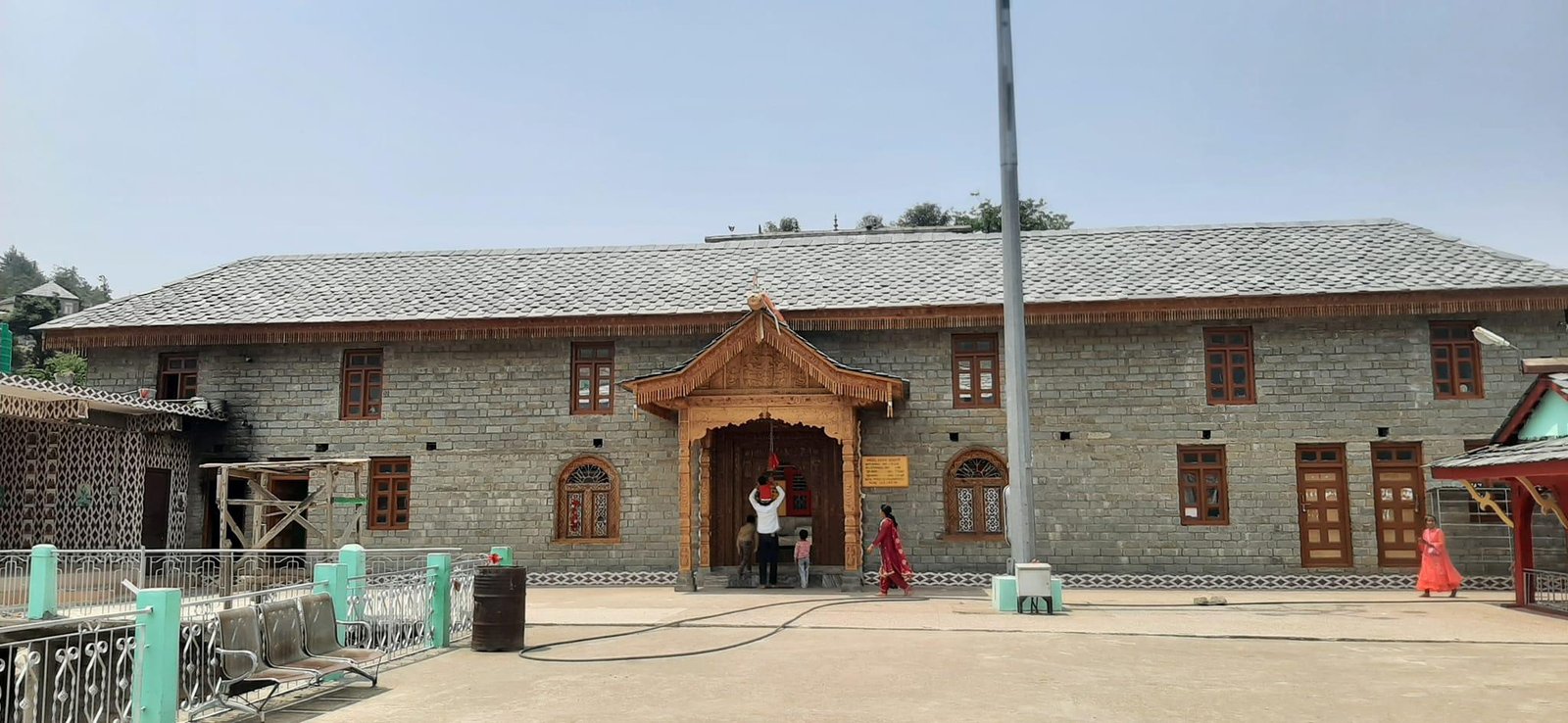
Mahunag Temple is one of the most revered and culturally distinctive pilgrimage destinations in the Karsog Valley of Himachal Pradesh. Commonly known as Mool Mahunag Temple, the principal shrine is situated around Bakhari Kothi in the wider Karsog region of Mandi district and is dedicated to Dev Mahunag, a powerful local deity traditionally identified with Suryaputra Karna of the Mahabharata.
Surrounded by pine and deodar forests, apple orchards, terraced fields, mountain villages and sweeping views of the Karsog landscape, Mahunag Temple offers a spiritual experience deeply connected with Himachal Pradesh’s living devta culture. The temple is not only a place where devotees offer individual prayers. It is also the sacred centre of a community tradition involving festivals, ceremonial processions, local musicians, hereditary temple responsibilities and the continuing relationship between the deity and surrounding villages.
The shrine is generally described as being approximately 25 kilometres from Karsog Bazaar, although the precise road distance and journey time may vary according to the traveller’s starting point and selected route. Mountain roads, weather, maintenance activity and village traffic can make short distances take considerably longer than expected.
The temple is also accessible from the Chindi side and can be included in a wider pilgrimage through Karsog Valley. Travellers commonly combine Mahunag Temple with Mamleshwar Mahadev Temple, Kamaksha Devi Temple, Chindi Mata Temple, Pangna, Shikari Devi Temple and other sacred destinations in Mandi district.
Unlike a high-altitude shrine requiring a long trek, Mool Mahunag Temple can ordinarily be approached by road, followed by a short local walk depending on the current parking arrangement. The road may still be narrow, winding and forested, so visitors should use an experienced driver and complete the journey during daylight.
The temple is especially meaningful for devotees interested in Karna, one of the most complex and admired figures of the Mahabharata. Karna is remembered for courage, loyalty, generosity, martial skill and his lifelong struggle for dignity and recognition. At Mahunag Temple, these qualities are transformed into a living local tradition in which Karna is not merely remembered as an epic hero but worshipped as a protective deity.
## Mool Mahunag: The Principal Shrine of Dev Mahunag
The word “Mool” generally conveys the idea of an origin, root or principal source. Mool Mahunag Temple is therefore regarded as the central or original shrine of Dev Mahunag within a wider network of Mahunag traditions and temples.
Several places in Himachal Pradesh contain shrines carrying the Mahunag name. Travellers should therefore clearly specify **Mool Mahunag Temple near Bakhari Kothi in the Karsog region** when booking accommodation, taxis or local transport.
Confusion can arise because Mahunag shrines or related local deity traditions are also found around Naldehra and other parts of the Shimla–Mandi region. The Karsog temple has its own location, architecture, religious customs and annual fair.
The identity of Mool Mahunag as the principal shrine reflects the importance of origin temples within Himachal Pradesh’s devta culture. A local deity may have several associated shrines, ceremonial representatives or areas of influence, while one temple is regarded as the deity’s primary seat.
For the surrounding communities, Mool Mahunag is not an archaeological curiosity or a symbolic memorial. Dev Mahunag is worshipped as an active guardian who remains involved in the welfare, justice and collective life of his people.
## Dev Mahunag as Suryaputra Karna
The defining religious tradition of Mahunag Temple identifies Dev Mahunag with Karna, the son of Kunti and Surya, the Sun God.
In the Mahabharata, Kunti received a sacred mantra through which she could invoke a deity. Before her marriage, she invoked Surya, and Karna was born with divine armour and earrings.
Because of social fear and difficult circumstances, the infant Karna was placed in a basket and sent upon a river. He was found and raised by the charioteer Adhiratha and his wife Radha.
Although born with royal and divine qualities, Karna spent much of his life facing questions about status, identity and belonging.
He became one of the greatest warriors of the epic and was renowned for extraordinary generosity. The title “Daanveer Karna” remembers his willingness to give even when the act involved significant personal loss.
Karna’s life also involved difficult moral choices. His loyalty to Duryodhana placed him on the Kaurava side of the Kurukshetra war, despite his own noble qualities and eventual knowledge of his relationship with the Pandavas.
The Mahunag tradition does not require visitors to simplify Karna into either a perfect hero or a villain. His story is powerful precisely because it contains courage, suffering, loyalty, pride, generosity, injustice and tragic consequence.
Devotees may see Mahunag as a deity who understands hardship, social exclusion and difficult circumstances because Karna himself experienced them.
People visit the temple to pray for justice, strength, courage, protection and the ability to continue through adversity.
The identification of Mahunag with Karna belongs to regional religious tradition rather than modern historical verification. Its importance comes from the faith of generations who have worshipped the Mahabharata warrior as a living divine protector.
## Karna as the Son of Surya
Karna’s connection with Surya gives Mahunag worship an additional symbolic dimension.
Surya represents light, energy, truth, vitality and the ability to see clearly. As Suryaputra, Karna is associated with strength, radiance and unwavering determination.
Some devotees may offer prayers during the morning, when sunlight begins illuminating the Karsog hills and temple surroundings.
The relationship with the Sun can be understood as a reminder to act openly, honour commitments and retain dignity during difficult circumstances.
Visitors should not invent or perform specialised Surya rituals at the temple without local guidance. The correct worship practices should be confirmed with the authorised priest.
Simple darshan, respectful prayer and participation in permitted temple customs remain appropriate for every visitor.
## The Meaning of the Name Mahunag
The exact origin of the name Mahunag is preserved through several local explanations.
One widely narrated belief says that when devotees call upon Karna during danger, he assumes the form of a “mahu,” commonly explained as a bee, and immediately comes to their assistance.
The name Mahunag is therefore associated with a deity capable of responding swiftly to sincere prayer.
This story belongs to regional faith and should not be interpreted as a literal or scientifically verifiable promise that a bee sighting represents divine intervention.
Its symbolic meaning is more important. A small creature can move rapidly, reach difficult places and remain unexpectedly powerful. The story communicates the belief that divine help may appear in forms people do not initially recognise.
The word “Nag” is also widely associated with serpent deities throughout Himachal Pradesh. Nag traditions are connected with water, rain, fertility, land and village protection.
However, Mool Mahunag at Karsog is principally identified by regional tradition with Karna. It should not be described simply as an ordinary serpent temple without acknowledging this distinctive epic association.
Himalayan deity identities can combine several layers of meaning, and local worship may not fit neatly within a single theological category.
Visitors should listen respectfully to the explanations offered by temple priests and residents rather than imposing an outside interpretation.
## Mahunag as a Guardian and Deity of Justice
Dev Mahunag is widely approached as a guardian deity who protects devotees during difficulty.
People may come to the temple with concerns relating to family disputes, agricultural welfare, personal safety, employment, financial hardship or other serious matters.
Some local deity traditions in Himachal Pradesh include consultation, collective decisions and the interpretation of divine guidance through established ceremonial representatives.
Outside visitors should not treat these practices as entertainment or imitate them casually.
The relationship between a village deity and the community can involve hereditary roles, customary law, social responsibility and religious discipline.
Visitors should respect private consultations and avoid recording individuals who have come to seek guidance during sensitive personal circumstances.
Devotees may believe that Mahunag supports truth and justice. Such belief can provide emotional courage, but the temple should not be presented as a substitute for legal proceedings, medical care or professional advice.
Spiritual faith and responsible practical action can exist together.
## Tradition of Raja Shyam Sen
Regional accounts attribute the present form of Mahunag Temple to Raja Shyam Sen of the former princely state of Suket in the seventeenth century, commonly giving the year 1664.
According to local tradition, the ruler became a devoted follower of Dev Mahunag after receiving divine assistance during a period of danger or political difficulty.
Versions of the story may connect the king with imprisonment, warfare or a seemingly impossible situation from which the deity helped him emerge.
In gratitude, the ruler is believed to have supported the construction or enlargement of the shrine.
The exact details vary across oral and regional narratives. Visitors should therefore distinguish between the documented existence of the former Suket state and the devotional stories describing the deity’s intervention.
The attribution to Raja Shyam Sen is important because it connects Mahunag Temple with the political history of the wider Suket region.
Rulers in the western Himalayas frequently maintained close relationships with local deities. A deity could be regarded as protector of the kingdom, witness to royal decisions and guardian of the people.
Temple patronage allowed rulers to express devotion while also strengthening relationships with villages and religious institutions.
Even where parts of the temple have been repaired or reconstructed, the continuing association with Raja Shyam Sen remains part of its cultural identity.
## Architecture of Mahunag Temple
Mahunag Temple reflects the traditional Pahari architecture of Himachal Pradesh.
Regional descriptions identify stone as the principal wall material, while doors, windows, roof supports and decorative sections use deodar wood.
The combination of stone and timber is particularly suited to Himalayan conditions. Stone provides weight and durability, while wood adds flexibility and allows detailed carving.
The temple has an outer and inner architectural arrangement with space for circumambulation between sections.
Its compact plan creates a gradual transition from the open courtyard into the more sacred interior.
The outer structure appears strong and restrained, while carved wooden elements introduce warmth and artistic detail.
Depending on the angle and period of restoration, visitors may observe slate roofing, wooden porticos, projecting roof sections, carved doors and small windows.
The building should be understood as a living temple that has experienced repair, maintenance and architectural change.
Wooden temples require regular care because timber is exposed to rain, sunlight, insects, snow, temperature variation and fire risk.
A section appearing newer than another does not mean that the temple tradition is recent. It may reflect necessary conservation or reconstruction.
## Stone Construction
The stone walls give Mahunag Temple a strong relationship with the surrounding mountain environment.
Stone has historically been available within Himalayan settlements and provides protection against cold, wind and weather.
Carefully arranged masonry also creates a stable base for wooden upper elements and roof structures.
Visitors should not touch or remove loose-looking stones, even when they appear separate from the main structure.
A small stone may form part of an older foundation, boundary or ritual arrangement.
Names, initials or religious symbols should never be scratched onto walls.
The temple is a sacred structure, and physical damage caused by visitors cannot be justified as devotion.
## Deodar Wood and Carving
Deodar cedar has been used extensively in the architecture of Himachal Pradesh because of its durability, availability and cultural importance.
At Mahunag Temple, deodar is associated with doors, window frames, carved panels and other structural details.
Wood allows craftspeople to create floral patterns, geometric designs, borders and symbolic forms that would be more difficult to execute in rough masonry.
Visitors should observe the carvings without rubbing or repeatedly touching them.
Oil from hands, moisture, scratching and pressure can gradually damage old timber.
Bags, tripods and camera equipment should not be leaned against carved doors or wooden walls.
Flash photography inside dark wooden interiors should only be used when clearly permitted.
## Inner Sanctum and Sacred Images
The inner section of the temple contains the principal sacred presence of Dev Mahunag.
Regional descriptions refer to anthropomorphic representations created through metalwork, including silver or brass elements associated with the deity.
In Himachal Pradesh’s devta tradition, a deity may be represented in several forms. These can include a permanent image within the sanctum, sacred masks, emblems, ceremonial staffs or a palanquin used during processions.
Visitors should not assume that every sacred object will be publicly visible during an ordinary visit.
Certain images may be displayed only on festival days, Sankranti or other occasions determined by the temple calendar.
Access to the innermost sanctum may be restricted according to local custom.
Travellers should accept these limits respectfully. Darshan does not require unauthorised entry into every sacred area.
Photography of the deity, metal masks, ornaments or private rituals should only be undertaken with direct permission.
Sacred objects should never be touched, moved or inspected closely without authorisation.
## Circumambulation
The architectural arrangement is described as including a circular path between the outer and inner sections.
Circumambulation, or pradakshina, is a common Hindu practice in which devotees move clockwise around a sacred centre.
The action symbolises placing the divine at the centre of one’s life.
At Mahunag Temple, visitors should observe whether circumambulation is permitted and follow the direction indicated by local devotees or priests.
The path may be narrow, dark or uneven. Children and senior citizens should proceed carefully.
Visitors should not obstruct the route while taking photographs.
During crowded festivals, temple organisers may regulate movement to maintain safety.
## Ceremonial Palanquin and Devta Procession
One of the most significant aspects of Mahunag worship is the ceremonial movement of the deity.
During important fairs and religious occasions, Dev Mahunag may come out of the temple through a decorated palanquin accompanied by priests, attendants, musicians and devotees.
The palanquin is not a decorative object or parade float. It is treated as the active ceremonial presence of the deity.
Local belief may attribute the movement, direction and rhythm of the palanquin to the will of Dev Mahunag.
Visitors should keep a respectful distance and never stand directly in the procession route.
The carriers require space to move safely, particularly when the palanquin changes direction suddenly.
Sacred cloth, ornaments, poles and masks should not be touched.
Visitors must not request attendants to stop the procession for photographs.
The emotional reactions of devotees should be treated as private acts of faith.
## Traditional Music
Drums, horns and other traditional instruments may accompany Mahunag processions and festivals.
The sound announces the presence of the deity and creates a ceremonial connection between the temple, village and gathering place.
Musicians may hold hereditary responsibilities and follow established rhythms associated with specific rituals.
Visitors should not interrupt musicians for staged recordings or attempt to play sacred instruments without permission.
Traditional music at the temple should not be described merely as entertainment. It forms part of the religious ceremony.
Recording may be permitted in public areas, but consent should be sought where musicians or devotees are shown closely.
## The Annual Mahunag Fair
The annual fair is one of the most important occasions in the religious calendar of Mool Mahunag Temple.
Regional accounts commonly place the celebration around the middle of July, with earlier reports identifying two important days associated with the deity’s public appearance and ceremonial birthday.
The exact dates, duration and programme should always be confirmed for the current year because local calendars and administrative arrangements can change.
The fair may take place partly at a traditional gathering ground away from the temple, often described in regional accounts as Bagra Dhar or a nearby open area surrounded by forest.
During the celebration, Dev Mahunag travels ceremonially from the temple to meet devotees.
Music, worship, community gathering and cultural activity create a vibrant atmosphere.
Residents from Karsog and surrounding villages may travel considerable distances to participate.
Accommodation demand in Karsog, Chindi and nearby settlements can rise during the fair.
Visitors should book rooms and local transport in advance.
Roads may become congested, and parking close to the temple or fairground may be limited.
Families should keep children close and identify a meeting point in case group members become separated.
Senior citizens may prefer attending during less crowded periods.
The annual fair should be approached as a sacred community occasion rather than only as a colourful event for photography.
## Karna’s Birthday Tradition
Some regional accounts describe the second day of the annual fair as the ceremonial birthday of Dev Mahunag or Karna.
The celebration reflects the belief that Karna continues to live through the local deity tradition.
Devotees may offer prayers, participate in processions and gather for community activities.
The precise religious interpretation and current programme should be obtained from temple organisers.
Visitors should avoid presenting the date as an archaeologically proven birth anniversary of the Mahabharata figure.
It is a living ceremonial tradition maintained by the community.
## Sankranti and Temple Access
Like many Himachali temples, Mahunag Temple may observe special worship on Sankranti and other calendar dates.
The visibility of particular sacred objects or access to certain interior areas may depend on these occasions.
Visitors should not assume that every chamber will remain open throughout the day or every day of the year.
Temple schedules may depend upon priests, agricultural seasons, festivals, weather and local custom.
Travellers making a dedicated visit should contact their host, driver or a local temple representative beforehand.
## Best Time to Visit Mahunag Temple
Mahunag Temple can generally be visited across much of the year, although each season creates a different experience.
### Spring
Spring is one of the most pleasant times to explore Karsog Valley.
Fields become green, trees develop new leaves and orchard blossoms may appear according to elevation and annual weather.
The road journey is usually comfortable compared with the intense monsoon or coldest winter periods.
Morning and evening remain cool, so layered clothing is useful.
Spring is suitable for families, senior citizens, cultural travellers and photographers.
### Summer
Summer offers relief from the heat of the plains.
The temple’s elevation and surrounding forests create pleasant conditions, although exposed sections can feel warm during midday.
Visitors should carry drinking water, sun protection and a light jacket for changing weather.
The broader summer period may also include increased pilgrimage and holiday travel.
The annual fair is commonly associated with July, though its timing can overlap with monsoon conditions.
### Monsoon
The monsoon transforms the landscape into a lush green environment of forests, fields and clouds.
The route to Mahunag Temple can look especially beautiful during light rain and mist.
Heavy rain, however, may cause landslides, falling stones, road damage, poor visibility and slippery temple approaches.
Travellers should check current weather and road advisories before departure.
The journey should be postponed during severe rainfall or official warnings.
A waterproof jacket or poncho is generally more practical than an umbrella on windy roads.
Shoes with dependable grip are essential.
Visitors attending the annual fair during the rainy period should carry proper protection and remain prepared for delays.
### Autumn
Autumn is among the best seasons for visiting Mahunag Temple.
Rain usually reduces, the landscape remains green and road conditions become more stable.
Clearer skies may reveal wide views of surrounding mountain ranges and valleys.
The season is suitable for temple circuits covering Karsog, Chindi, Mamleshwar Mahadev and Kamaksha Devi.
### Winter
Winter offers a quiet and peaceful pilgrimage experience.
Mornings and evenings can become very cold, while frost may affect shaded roads and temple pathways.
Snowfall at the immediate shrine should not be guaranteed for any particular date.
Higher surrounding ridges may receive snow while the temple remains accessible.
Visitors should carry thermals, warm jackets, gloves and suitable footwear.
Accommodation providers should be asked about heating, hot water, warm bedding and power backup.
Road conditions should be confirmed after rain, snowfall or freezing nights.
## Morning and Evening Darshan
Morning is generally the best time to visit Mahunag Temple.
The village and temple surroundings are quieter, the air is fresh and travellers have enough daylight for the return journey.
Morning sunlight can reveal architectural details in the stone and wooden exterior.
An early visit also allows travellers to continue towards Chindi, Karsog or another nearby shrine without rushing.
Evening darshan can create a deeply peaceful atmosphere as bells, lamps and mountain silence become more prominent.
Travellers planning an evening visit should stay nearby or arrange a reliable return vehicle.
Driving through unfamiliar forested mountain roads after dark is not advisable.
Temple timings should be confirmed locally because they may change with season and religious occasions.
## Reaching Mahunag Temple from Karsog
Karsog Bazaar is the principal service and accommodation centre for the region.
Mool Mahunag Temple is commonly described as being approximately 25 kilometres from Karsog, but the exact distance depends on the selected road and starting location.
The journey passes through village and forest landscapes and should preferably be completed by taxi or private vehicle.
A local driver familiar with the turn-offs and road conditions is useful.
Public buses or shared vehicles may serve some sections of the route, but frequency and return timing can be limited.
Travellers relying on public transport should confirm the last service before leaving Karsog.
The final approach may involve a short walk, steps or a village lane.
Vehicles should not block homes, agricultural access or narrow turning spaces.
## Reaching Mahunag Temple from Chindi
Chindi is another convenient base for Mahunag Temple.
The small hill destination is surrounded by apple orchards, forests and mountain views.
Travellers can use Chindi as part of a circuit connecting Mahunag Temple with Karsog and Kamaksha Devi Temple.
The route and travel time should be confirmed through the accommodation provider because different properties in Chindi may be located on different sections of the road.
Staying in Chindi is especially suitable for couples, families and travellers seeking quiet mountain accommodation in addition to pilgrimage.
## Reaching Karsog Valley
Karsog can be approached by road from Shimla, Tattapani, Chindi, Mandi, Sundernagar and other parts of Himachal Pradesh.
The best route depends on the starting point and current road conditions.
Travellers from Shimla commonly approach through the Tattapani–Chindi side.
Visitors from Mandi or Sundernagar may enter through regional roads connecting Chail Chowk, Pangna or nearby settlements.
Mountain distances should never be judged only by kilometres.
Curves, construction, rain, fog and local traffic can extend travel time considerably.
Visitors should begin early and avoid unfamiliar roads after dark.
## Accommodation in Karsog
Karsog is the most practical base for visitors planning a broader temple circuit.
The town offers guesthouses, hotels, homestays, restaurants, pharmacies, markets and local transport.
Staying in Karsog makes it easy to combine Mahunag Temple with Mamleshwar Mahadev and Kamaksha Devi.
Travellers should confirm the actual driving distance from their property to Mool Mahunag Temple.
A listing located within Karsog subdivision may still be far from the main bazaar or on a different mountain road.
Families should choose properties offering meals, parking, comfortable bathrooms and sufficient room capacity.
Senior citizens should prioritise direct vehicle access and minimal stairs.
## Accommodation in Chindi
Chindi offers a quieter alternative with forests, orchards and broad valley views.
Properties may include tourism hotels, local guesthouses, homestays and cottages.
Chindi is suitable for travellers who want to combine temple visits with relaxation and nature.
Winter visitors should confirm heating and road access.
Monsoon travellers should ask whether the final property approach is vulnerable to landslides or falling stones.
Guests requiring internet access should verify mobile and Wi-Fi connectivity directly.
## Homestays Near the Temple
A village homestay closer to Mahunag Temple provides an opportunity to experience local food, hospitality and religious culture.
Hosts may help visitors understand temple timings, fair arrangements and the correct road approach.
Facilities can be simpler than those available in Karsog or larger towns.
Guests should confirm attached bathrooms, hot water, meals, parking, electricity and mobile connectivity.
Visitors should respect household schedules, food customs and village quiet hours.
Supporting local homestays allows pilgrimage tourism income to reach families living near the shrine.
## Mamleshwar Mahadev Temple
Mamleshwar Mahadev Temple in Mamel village is one of the most important nearby Shiva shrines.
It is known for traditional wood-and-stone architecture, a sacred fire and local stories associated with the Pandavas, Bhima, Lord Rama and Himalayan sages.
A combined journey to Mamleshwar Mahadev and Mahunag Temple creates a strong Mahabharata-focused pilgrimage.
Mamleshwar Mahadev is located close to Karsog Bazaar, while Mahunag requires a longer road journey.
The temples should be visited with enough time rather than rushed into a single short morning.
## Kamaksha Devi Temple
Kamaksha Devi Temple in Kau village is an important Shakti shrine dedicated to the goddess in the form of Mahishasuramardini.
Its wooden architecture, ashtadhatu image and local festivals make it one of the principal temples of Karsog Valley.
Combining Kamaksha Devi with Mahunag creates a pilgrimage centred on divine courage, protection and the defeat of destructive forces.
Travellers can visit the two temples on the same day only when beginning early and using a reliable local vehicle.
A slower two-day itinerary is more comfortable for families and senior citizens.
## Chindi Mata Temple
Chindi Mata Temple is associated with the identity of Chindi village and can be included by travellers staying in the area.
The shrine reflects the regional relationship between village communities and guardian goddesses.
Visitors should confirm current timings and local photography customs.
## Pangna and Suket Heritage
Pangna is associated with the former princely state of Suket, whose history is also relevant to traditions concerning Mahunag Temple and Raja Shyam Sen.
The settlement contains historic temples and examples of traditional Himalayan architecture.
Cultural travellers can combine Pangna with Mahunag according to the direction of their journey.
Older structures and private areas should be approached respectfully.
## Shikari Devi Temple
Shikari Devi Temple is a roofless high-altitude Devi shrine situated on Shikari Peak.
It requires a separate full-day journey, appropriate transport and careful weather planning.
The remote forest road, altitude and changing conditions make it significantly more demanding than Mahunag Temple.
Visitors should not attempt Shikari Devi late in the day after completing several Karsog temples.
## Kamrunag Lake and Temple
Kamrunag is a high-altitude lake and temple destination associated with the Yaksha king of the Mahabharata and the rain traditions of Mandi district.
It requires a dedicated trek from an appropriate route village.
The lake is sacred, and visitors must not enter the water or attempt to retrieve offerings.
Mahunag and Kamrunag are separate deities and destinations despite the similarity of their names.
Travellers should not confuse the road-accessible Mool Mahunag Temple near Karsog with the trekking destination of Kamrunag Lake.
## Suggested One-Day Itinerary
A one-day Mahunag pilgrimage is best undertaken from Karsog or Chindi.
Begin early after confirming temple access and road conditions.
Travel by local taxi towards Mool Mahunag Temple and attend morning darshan.
Spend time observing the architecture and surrounding landscape.
Any inner sacred objects should only be viewed when permitted by the priest.
Return towards Chindi or Karsog before evening.
A nearby local temple can be added only when enough daylight remains.
## Suggested Two-Day Itinerary
On the first day, arrive in Karsog, check into accommodation and visit Mamleshwar Mahadev Temple and the local market.
On the second morning, travel to Mool Mahunag Temple.
After darshan, return through the scenic valley and stay in Chindi or Karsog.
This itinerary is suitable for families, senior citizens and travellers seeking an unhurried pilgrimage.
## Suggested Three-Day Karsog Temple Circuit
The first day can include Mamleshwar Mahadev Temple and Karsog Bazaar.
The second day can focus on Kamaksha Devi Temple and the villages around Kau.
The third day can be dedicated to Mool Mahunag Temple and Chindi.
This arrangement gives each major shrine sufficient time and reduces long daily drives.
## Longer Mandi Pilgrimage
A longer journey can include Mamleshwar Mahadev, Kamaksha Devi, Mahunag, Pangna, Mahunag-associated Suket heritage, Shikari Devi and Kamrunag.
Shikari Devi and Kamrunag require independent weather, trekking and accommodation plans.
MudrasStays can help travellers select different properties according to the real road sequence rather than using one distant hotel for every destination.
## Choosing Accommodation Near Mahunag Temple
The correct accommodation depends on the traveller’s complete itinerary.
Karsog is best for developed services and access to several temples.
Chindi is suitable for forests, orchards and a quieter hill stay.
A village homestay closer to Mahunag provides early access and local guidance.
Families should confirm meals, parking and room size.
Senior citizens should ask about stairs, bathroom accessibility and the final temple approach.
Couples may prefer cottages, orchard stays and peaceful homestays.
Solo pilgrims can select affordable guesthouses or community-run rooms.
Pilgrimage groups should verify multiple-room inventory, vegetarian meals, driver accommodation and parking.
Visitors attending the annual fair should book well in advance.
## Book Stays Near Mahunag Temple with MudrasStays
MudrasStays helps pilgrims discover hotels, homestays, cottages, guesthouses and spiritual accommodation near Mahunag Temple, Karsog and Chindi.
The platform is designed specifically for travellers searching for places to stay near temples and pilgrimage destinations across India.
Visitors can compare properties according to practical distance from Mool Mahunag Temple, room type, budget, group size and required facilities.
Booking a nearby stay allows devotees to begin early, reach the temple comfortably and avoid a long return journey after darshan.
Solo pilgrims can find affordable guesthouses and local rooms.
Couples can explore peaceful cottages and orchard homestays.
Families can choose properties offering meals, parking and larger rooms.
Senior citizens can prioritise accessible accommodation and local taxi support.
Pilgrimage groups can identify stays providing several rooms, vegetarian food and suitable vehicle parking.
Travellers combining Mahunag Temple with Mamleshwar Mahadev, Kamaksha Devi and Chindi Mata can select accommodation according to the geographical sequence of the route.
Visitors planning Shikari Devi or Kamrunag can arrange separate bases suited to those more demanding journeys.
MudrasStays helps spiritual travellers avoid booking accommodation that appears close on a map but is separated from the temple by a long mountain road.
## Responsible Pilgrimage
Mahunag Temple is a living religious institution within a sensitive village and forest environment.
Visitors should remove footwear wherever directed and dress respectfully.
Photography of the deity, inner sanctum, masks, palanquin, priest or private ceremony should only be undertaken with permission.
Sacred metal objects, wooden carvings and ceremonial instruments should never be touched without authorisation.
Temple walls, doors and windows must not be scratched or marked.
Incense, lamps and ritual fire should only be used in designated locations because wooden architecture is vulnerable to fire.
Plastic bottles, wrappers and puja packaging must be carried away.
Synthetic cloth and plastic flags should not be tied randomly to trees or buildings.
Visitors should not play loud music along the temple road or within the village.
Private homes, farms and residents should not be photographed without consent.
Fruit, flowers and crops should not be taken from private land.
Vehicles should not block narrow lanes, homes or agricultural access.
During processions, visitors must keep the route clear and follow the directions of temple organisers.
Supporting local homestays, taxis, shops, food providers, priests and musicians enables pilgrimage tourism to benefit the community maintaining the shrine.
## A Living Temple of Karna in the Himalayas
Mahunag Temple represents a rare and powerful meeting of Mahabharata tradition, local deity worship, Himalayan architecture and village faith.
The worship of Karna gives the shrine a distinctive place among the temples of Himachal Pradesh.
His divine birth connects the tradition with Surya.
His generosity gives devotees an example of giving without expectation.
His courage represents determination during adversity.
His struggle for dignity gives emotional meaning to people who have experienced exclusion or unfair judgement.
His loyalty invites reflection on the complexity of duty and friendship.
The name Mahunag preserves the belief that the deity responds rapidly when devotees call for help.
The association with Raja Shyam Sen connects the shrine with the history of the former Suket state.
The stone and deodar architecture preserves regional craftsmanship.
The ceremonial palanquin and traditional musicians connect the deity with the living devta culture of Himachal Pradesh.
The annual fair brings dispersed communities together in shared devotion.
For devotees of Karna, Mahunag Temple is one of India’s most meaningful pilgrimage destinations.
For families, it offers an accessible spiritual journey through the scenic Karsog Valley.
For senior citizens, the road approach makes the shrine more manageable than remote trekking temples.
For cultural travellers, it provides insight into how an epic hero can become a living regional deity.
For architecture enthusiasts, the stone walls, deodar wood and traditional Pahari design create a rewarding temple experience.
For photographers, the village, temple entrance, forests and festival processions offer memorable visual opportunities when religious privacy is respected.
For slow travellers, staying in Karsog, Chindi or a nearby village allows time to understand the temple’s relationship with the surrounding community.
Mahunag Temple should not be treated only as a brief roadside attraction or reduced to a single mysterious legend.
Its real importance lies in the continuing faith of the people, the worship of Dev Mahunag and the preservation of Karna’s memory within the living spiritual traditions of Himachal Pradesh.
Plan your pilgrimage to Mahunag Temple with MudrasStays and discover one of the most distinctive sacred destinations in Karsog Valley.
Seek the blessings of Dev Mool Mahunag, learn about the regional tradition of Suryaputra Karna and experience the peaceful forests, orchards and villages of Mandi district.
Combine your journey with Mamleshwar Mahadev Temple, Kamaksha Devi Temple, Chindi Mata Temple, Pangna, Shikari Devi and Kamrunag.
Book hotels near Mahunag Temple, discover homestays in Karsog and explore cottages and peaceful pilgrimage stays around Chindi through MudrasStays.
Stay closer to your place of worship, reach the shrine during quieter morning hours and reduce unnecessary travel on winding mountain roads.
MudrasStays connects pilgrims, families and cultural travellers with suitable accommodation near temples and sacred destinations across India.
Begin your Mahunag Temple journey with a comfortable stay and experience a meaningful pilgrimage centred on Dev Karna, Himachali devta traditions, mountain craftsmanship and the natural beauty of Karsog Valley.