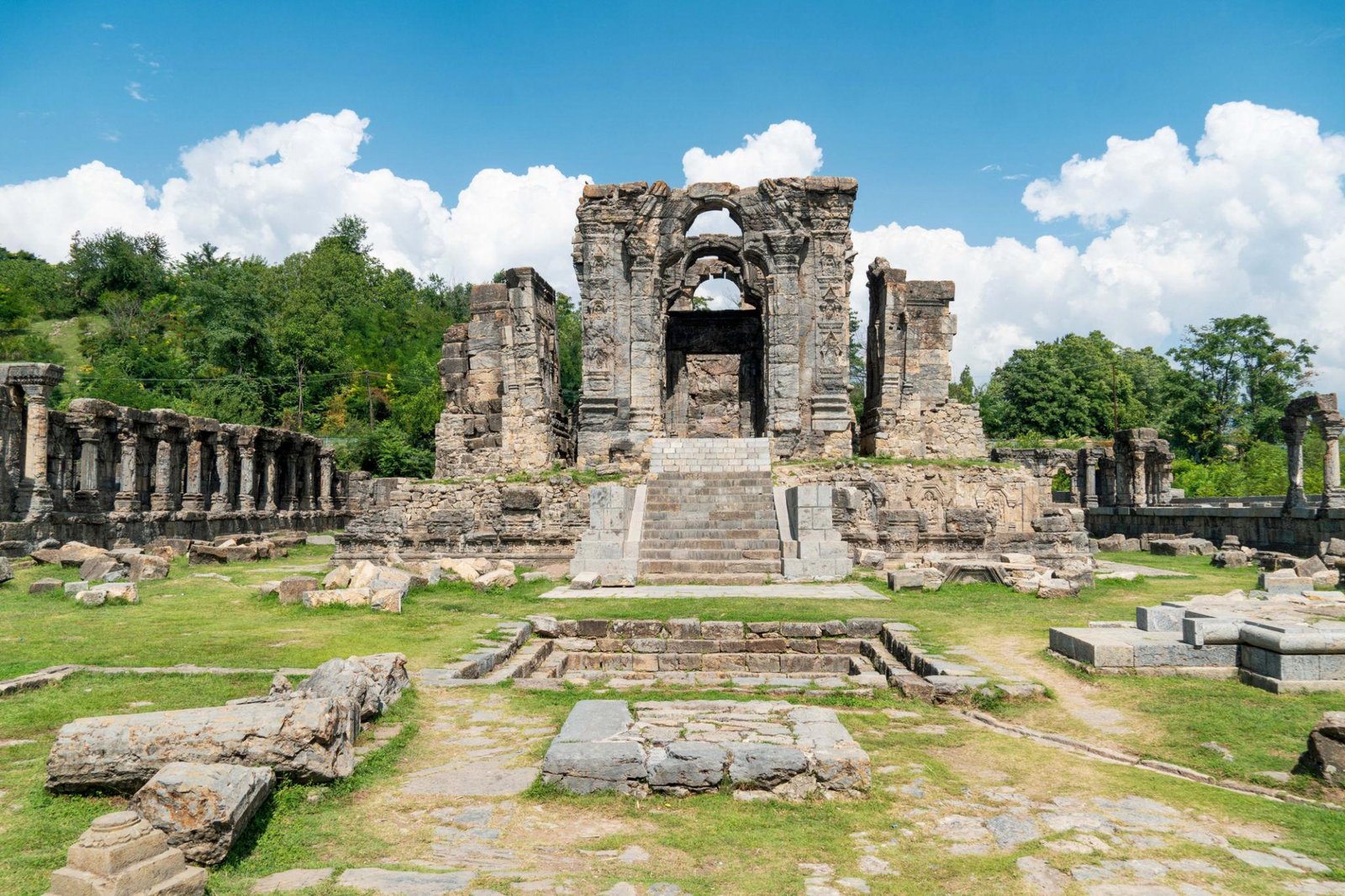
Martand Sun Temple is one of the most important surviving monuments of ancient Kashmir and one of India’s most remarkable temples dedicated to Surya, the Sun God. Standing on an elevated plateau near Mattan in the Anantnag district of Jammu and Kashmir, the ruined temple overlooks fields, villages, mountain ranges and the broad landscape of the Kashmir Valley.
The temple is also known as Martand Surya Temple, Martand Temple, Ancient Martand Temple and Martand Sun Temple Anantnag. Local and historical accounts have also referred to the ruins through names connected with the Pandavas, although the monumental complex visible today belongs primarily to the early medieval history of Kashmir.
The surviving structure is generally associated with the eighth century and the reign of Lalitaditya Muktapida, one of the most powerful rulers of the Karkota dynasty.
Lalitaditya’s period is remembered for political expansion, temple patronage, artistic achievement and the development of Kashmir as an influential centre connecting the Indian subcontinent with Central Asia and other cultural regions.
Martand Sun Temple reflects that wider world.
Its massive stone walls, monumental entrance, trefoil arches, colonnaded courtyard, sculptural remains and elevated setting combine local Kashmiri architecture with artistic ideas that developed through centuries of contact between different regions.
The temple is now a protected archaeological monument rather than a continuously functioning place of daily worship.
Visitors come to appreciate its history, architecture, Surya tradition, landscape and cultural importance.
Those wishing to attend active Hindu worship in the immediate area can also visit Mattan Temple, commonly known as Bawan Temple, which stands beside a sacred spring and remains an important pilgrimage destination.
Martand Sun Temple and Mattan Temple are related geographically and spiritually but should not be confused.
The Martand ruins represent a monumental early medieval Surya complex under archaeological protection.
Mattan Temple represents a living sacred destination where devotees continue to offer prayers.
A carefully planned journey can include both.
Martand Sun Temple is suitable for heritage travellers, Hindu pilgrims, architecture students, historians, photographers, families, senior citizens and visitors travelling between Srinagar, Anantnag and Pahalgam.
The site does not require a long mountain trek.
It is generally approached by road, followed by a short walk through the protected archaeological area.
Travellers searching for hotels near Martand Sun Temple, homestays near Mattan, accommodation in Anantnag, places to stay on the Pahalgam route or heritage stays near Kashmir’s ancient temples can use MudrasStays to plan a comfortable and geographically practical journey.
## Spiritual Importance of Martand Surya Temple
Martand Sun Temple was dedicated to Surya, the divine Sun within Hindu tradition.
Surya represents light, life, clarity, discipline, health, time and the visible energy sustaining the natural world.
The Sun rises each day without discrimination.
Its light reaches fields, forests, rivers, homes, temples and travellers.
It supports agriculture, regulates seasons and enables life to continue.
For this reason, Surya worship has held an important place within Hindu thought since the Vedic period.
Devotees honour Surya as the visible form of divine brilliance.
The Sun can be seen directly, yet its complete power cannot be approached physically.
This makes Surya a natural symbol of divine reality—visible through its effects but greater than ordinary human understanding.
At Martand, the worship of Surya was expressed through architecture on an extraordinary scale.
The temple stood in a location where sunlight, open sky, stone and mountain scenery formed part of the sacred experience.
The elevated plateau allowed light to move across the walls and courtyard during different parts of the day.
Morning sunlight would have illuminated the temple differently from the afternoon sun.
Seasonal changes would have altered the angle, colour and length of shadows across the colonnades.
The visitor therefore encountered Surya not only through a sacred image but through the complete environment.
## Meaning of the Name Martand
Martand is an ancient Sanskrit name associated with Surya.
The name appears in Vedic and later Hindu traditions as one of the forms or names of the solar deity.
A well-known Vedic narrative refers to the Adityas, the divine sons of Aditi.
Martand is identified among these solar beings and is connected with the Sun that rises, sets and participates in the visible cycle of life and mortality.
Different philosophical and Puranic traditions interpret the name in different ways.
Some connect it with the idea of the Sun emerging from an apparently lifeless cosmic egg.
Others understand Martand more generally as the solar divinity whose light sustains the world.
Visitors do not need to adopt one literal interpretation to appreciate the temple.
The essential meaning is that Martand represents Surya as a powerful cosmic presence governing light, time and the rhythms of life.
The name also became associated with the wider locality around Mattan and the plateau on which the temple stands.
## Surya in Hindu Tradition
Surya is among the most ancient deities worshipped in the Indian religious world.
The Rigveda contains hymns addressed to the Sun and related solar powers.
Surya is praised as the witness of human actions, the source of illumination and the divine presence travelling across the sky.
In later iconography, Surya is commonly shown standing upright and holding lotuses.
He may be depicted riding a chariot drawn by seven horses and guided by the charioteer Aruna.
The seven horses are interpreted in several ways.
They may represent the seven days of the week, seven colours of visible light, seven metres of Vedic poetry or the ordered movement of time.
Such explanations are symbolic rather than scientific descriptions of the physical Sun.
The lotus held by Surya represents purity and spiritual awakening.
A lotus grows from mud yet opens towards light.
It therefore symbolises the ability to rise above confusion and develop clarity.
Surya’s chariot represents continuous movement.
Time does not stop because a person is unprepared.
The solar journey encourages punctuality, discipline and the responsible use of every day.
## Surya Namaskar and Daily Discipline
Many modern visitors associate Surya worship with Surya Namaskar, the sequence of yoga postures traditionally performed while facing the rising Sun.
Surya Namaskar expresses gratitude for light, energy and a new day.
It combines physical movement, breathing and mental attention.
Martand Sun Temple provides a historical reminder that solar reverence existed within Indian civilisation many centuries before modern wellness culture.
Visitors should not perform organised yoga sessions, religious rituals or commercial shoots inside the protected monument without appropriate permission.
The archaeological site must remain protected from activities that place pressure on stone platforms, obstruct visitor movement or violate conservation rules.
A traveller can still experience the spirit of Surya worship through quiet reflection, respectful observation and gratitude for the landscape.
## The Karkota Dynasty
The Karkota dynasty ruled Kashmir during an important period of political and cultural development.
Its rulers supported religious institutions, monumental architecture, scholarship and artistic production.
The dynasty’s influence extended beyond the immediate valley through diplomacy, warfare and regional contact.
Lalitaditya Muktapida is the most widely remembered Karkota ruler.
His reign is traditionally placed in the eighth century.
Historical chronicles describe him as a powerful and ambitious monarch whose influence reached across a wide geographical area.
As with many early medieval rulers, later chronicles combine historical memory with royal praise and legendary expansion.
Individual military claims should therefore be evaluated carefully.
His role as a major patron of architecture and religious institutions is nevertheless central to the history of Martand.
The size and ambition of the temple suggest access to organised labour, skilled architects, stoneworkers, sculptors, transport systems and substantial royal resources.
Martand was not created as a small village shrine.
It represented state-supported sacred architecture on a monumental scale.
## Lalitaditya Muktapida and Martand
Martand Sun Temple is most commonly attributed to Lalitaditya Muktapida.
The ruler is believed to have expanded or constructed the great temple complex during the eighth century, possibly incorporating an earlier sacred structure within the later architectural plan.
This possibility helps explain why some historical and archaeological discussions propose that worship at the location may have begun before the complete monumental complex was created.
Visitors should distinguish between the date of the sacred site, the date of an earlier shrine and the date of the surviving large-scale temple.
They may not be identical.
A sacred location can exist for generations before a ruler commissions a monumental building.
Similarly, an older sanctuary may be incorporated into a later and larger complex.
The most reliable summary is that the surviving architectural ensemble is fundamentally associated with the eighth-century Karkota period and Lalitaditya’s patronage, while the precise sequence of construction continues to be studied.
## Architecture of Martand Sun Temple
The architecture of Martand Sun Temple is among the strongest reasons to visit.
The complex consists of a monumental central sanctuary standing within a large rectangular courtyard.
The courtyard is enclosed by a colonnaded perimeter containing numerous smaller cells or shrines.
Official tourism descriptions commonly identify 84 subsidiary shrines or compartments surrounding the central temple.
The entire composition creates a carefully ordered sacred environment.
The central sanctuary dominates the space.
The surrounding shrines create repetition and rhythm.
The entrance controls movement into the courtyard.
The open sky allows sunlight to remain constantly present.
The elevated plateau connects the architecture with the wider Kashmir Valley.
Even in ruins, the structure communicates scale, planning and ceremonial importance.
Visitors should enter slowly and allow time to understand the overall arrangement before concentrating on individual carvings.
From a distance, the temple appears as a powerful group of broken stone walls and arches.
From inside the courtyard, the relationship between the central shrine and surrounding colonnade becomes clearer.
## The Monumental Central Sanctuary
The central sanctuary was the spiritual focus of the temple.
It would originally have contained the principal sacred representation of Surya and supported a much more complete architectural superstructure than survives today.
The remaining walls rise above the courtyard and preserve large openings, carved mouldings and structural projections.
A staircase leads towards the elevated sacred chamber.
The height of the sanctuary separates it from the surrounding subsidiary shrines and establishes a clear hierarchy.
The devotee would have moved from the outer world through the entrance, crossed the courtyard and ascended towards the principal deity.
This movement represented more than physical travel.
It marked a gradual approach towards concentrated divine light.
The surviving interior is now open and damaged.
Visitors should not assume that the original temple was intended to appear roofless.
Collapsed stone and architectural fragments indicate that substantial upper and roofing elements once existed.
The exact form of the original roof has been reconstructed differently by historians and architects.
It is better to recognise the uncertainty than to present one visual reconstruction as proven fact.
## The Great Courtyard
The courtyard is commonly described as measuring approximately 220 feet by 142 feet.
These figures provide a sense of the temple’s scale, although visitors should understand that different surveys may define architectural boundaries differently.
The courtyard allowed large numbers of priests, pilgrims, attendants and royal visitors to move around the central sanctuary.
It also created ceremonial distance.
A monumental temple needs open space to be experienced fully.
The central shrine becomes more impressive when approached across a broad courtyard rather than being hidden within dense construction.
The open area would also have allowed sunlight to reach the surrounding structures.
At a temple dedicated to Surya, light was not merely practical illumination.
It formed part of the sacred design.
Today, the courtyard contains grass, pathways, fallen stones and protected architectural remains.
Visitors should use designated walking areas and avoid stepping onto loose masonry.
## The 84 Surrounding Shrines
One of the most frequently discussed features of Martand is the presence of 84 surrounding shrines, cells or colonnaded compartments.
The exact use of every space is not completely known.
Some may have contained sacred images, while others may have supported ritual, storage or associated religious activity.
The number 84 carries symbolic importance in several Indian traditions.
It appears in associations with yogic siddhas, cycles of existence and sacred groupings.
Some historical descriptions have also connected the number with combinations of seven and twelve—the seven days of the week and twelve divisions of the zodiac.
Such symbolic interpretations are interesting but should not be presented as a conclusively documented explanation for the Martand plan.
Architecturally, the repeated compartments create rhythm around the courtyard.
The central Surya sanctuary stands at the centre of a much larger sacred universe.
The visitor is surrounded by an ordered sequence of arches, pillars and recesses.
## The Colonnade
The courtyard was enclosed by a long colonnade consisting of stone pillars and intervening recesses.
The repetition of pillars created a sheltered perimeter around the open central space.
Colonnades can serve both practical and symbolic purposes.
They provide shade and circulation.
They create a visual frame.
They establish separation between the sacred enclosure and the outside world.
At Martand, the colonnade also demonstrates the skill of Kashmiri stone construction.
Large stone elements were cut, transported and assembled with remarkable precision.
Although many sections have collapsed, enough survives to communicate the original rhythm.
Visitors should not climb onto the surviving columns or sit on fragile architectural blocks.
The colonnade is not a collection of ordinary ruins.
Every surviving piece contributes to understanding the complete temple.
## Trefoil Arches
The trefoil arch is among the most recognisable features of ancient Kashmiri temple architecture.
Its upper outline is divided into three rounded or pointed lobes.
At Martand, trefoil-headed openings and recesses appear across the central temple and surrounding structures.
The form creates a distinctive transition between pillars and upper masonry.
Trefoil arches are also found at other early temple sites in Kashmir, including structures at Avantipura, Pandrethan and elsewhere.
Their presence helps identify a regional architectural language.
Visitors may notice that the arches appear both monumental and carefully proportioned.
They create strong frames for sky, mountain and surrounding landscape.
Through a ruined arch, the modern visitor sees the same changing light that has crossed the site for centuries.
## Kashmiri Temple Architecture
Ancient Kashmiri temple architecture developed its own recognisable character.
It commonly used large dressed stone blocks, high platforms, monumental doorways, trefoil arches, columned enclosures and steep or pyramidal roofing forms.
The environment influenced construction.
Kashmir experiences rain, snow, frost and earthquakes.
Buildings needed strong walls, controlled drainage and roofs capable of responding to seasonal weather.
Wooden architecture also influenced stone design.
Some stone forms may imitate elements originally developed through timber construction.
Martand is therefore not merely a copy of architecture from another region.
It represents a Kashmiri response to religious symbolism, climate, material and artistic contact.
## Architectural Influences and Cultural Contact
Martand’s architecture is often described as combining Kashmiri, Gandharan, Gupta and wider classical influences.
Some tourism descriptions also compare individual forms with Greek, Roman, Central Asian or West Asian architecture.
These comparisons should be used carefully.
They do not mean that the temple was simply designed by foreign builders or copied directly from one overseas monument.
Kashmir occupied a strategic position between the Indian subcontinent, Central Asia and trans-Himalayan routes.
Artistic ideas could travel through merchants, pilgrims, diplomats, craftsmen and political contact.
Local architects then adapted those ideas to Kashmiri materials, beliefs and construction practices.
The temple should therefore be appreciated as a distinctive Kashmiri creation formed within a connected historical world.
## Stone Construction
The temple was created from large dressed stone blocks.
The colour of the stone changes according to light, moisture and weathering, appearing grey, brown, dark or golden in different conditions.
Some popular descriptions refer to black stone, while other architectural discussions identify locally available limestone.
Visitors should focus on the quality of cutting and assembly rather than reducing the monument to one colour description.
Large blocks were shaped into walls, pillars, mouldings, arches and sculptural panels.
Moving these stones to the plateau and lifting them into position required organised labour and technical knowledge.
The surviving structure demonstrates careful understanding of weight and balance.
However, earthquakes, deliberate dismantling, weathering and centuries without a complete protective roof weakened the monument.
Loose fragments should never be moved or rearranged.
## Sculptural Programme
The surviving temple contains carved figures and decorative architectural panels.
Weathering and destruction have removed many original details, but remaining forms provide evidence of a rich sculptural programme.
Surya temples can include images connected with the solar deity, attendants, divine figures, river goddesses, guardians, celestial beings and other members of the Hindu sacred universe.
At Martand, figures associated with Vishnu and other deities have also been identified in architectural discussions.
This does not weaken the temple’s identity as a Surya shrine.
Early Hindu temples often incorporated multiple divine forms within one sacred programme.
Visitors should avoid confidently identifying every damaged figure without expert guidance.
A weathered image may have lost the symbols that once made its identity clear.
A knowledgeable heritage guide or archaeological publication can assist with interpretation.
## Orientation and Sunlight
The relationship between the temple and sunlight is fundamental.
Many Surya temples are oriented to receive significant light during particular parts of the day or year.
Martand’s exact astronomical planning continues to attract interpretation, but unsupported claims about perfect solstice alignments or hidden scientific mechanisms should be avoided unless demonstrated through reliable surveys.
The temple’s broad open courtyard and elevated setting clearly ensured a powerful relationship with the Sun.
Morning light enters the complex differently from evening light.
Winter sun creates long shadows across the courtyard.
Summer light reaches deeper and produces stronger contrast.
Cloud, snow and mist transform the experience completely.
Visitors interested in photography may prefer morning or late-afternoon light, but the monument remains impressive throughout the day.
## The Elevated Karewa Setting
Martand stands on a karewa or elevated plateau above the surrounding landscape.
Karewas are distinctive geological formations found within the Kashmir Valley.
They form broad elevated terraces composed of older deposits.
These plateaus have supported agriculture, settlements and important viewpoints.
The temple’s placement on high ground was both practical and symbolic.
It made the monument visible from the surrounding area.
It provided commanding views across the valley.
It brought the temple closer to open sky and sunlight.
It separated the sacred complex from ordinary settlement activity.
From the plateau, visitors may see cultivated land, orchards, villages and mountain ranges according to visibility.
Cloud, haze, rain or snow can conceal the wider panorama.
No particular view should be guaranteed.
## The View Across Kashmir Valley
Historical visitors repeatedly praised Martand’s setting.
The elevated site provides one of the most expansive heritage landscapes in South Kashmir.
The ruins appear to command the valley without feeling separated from it.
Fields stretch beneath the plateau.
Mountains frame the horizon.
Seasonal colour transforms the surroundings.
Spring brings blossoms and new growth.
Summer produces green fields and long daylight.
Autumn creates warmer colours across trees and agriculture.
Winter may cover the ruins and surrounding land with snow.
The view is an essential part of the monument but should not turn the site into only a scenic viewpoint.
The architecture and sacred history deserve equal attention.
## History Before the Monumental Temple
The possibility of an earlier sacred establishment at Martand has been discussed because the site may have contained a smaller shrine before the great Karkota complex was completed.
Official tourism descriptions also refer to the incorporation of an earlier temple.
This suggests a layered development.
An existing place of Surya worship may have been expanded by Lalitaditya into a royal ceremonial complex.
Such expansion was common in sacred architecture.
A respected local shrine could gain political importance and receive monumental construction under a powerful ruler.
Visitors should therefore avoid imagining Martand as a structure created in one uninterrupted building campaign without any earlier history.
The site’s complete chronology may contain phases that are no longer fully visible.
## Destruction and Abandonment
The temple survives in a ruined condition.
Later chronicles and regional historical traditions attribute major destruction to Sultan Sikandar Shah Miri during the late fourteenth or early fifteenth century.
The ruler is remembered in several accounts for policies affecting non-Islamic religious institutions.
The precise sequence, duration and physical method of Martand’s dismantling remain subjects of historical discussion.
The temple’s condition should not be explained through one simplified sentence alone.
Deliberate destruction may have caused major structural loss.
Earthquakes repeatedly affected Kashmir.
Weathering weakened exposed stone.
Roof collapse accelerated deterioration.
Building material may have been reused.
Vegetation and centuries of abandonment caused further damage.
The surviving ruins therefore reflect several processes across a long period.
This history should be discussed factually and without using the monument to encourage hostility against present-day communities.
Martand belongs to the shared cultural history of Kashmir and requires careful conservation, honest interpretation and respectful remembrance.
## Earthquakes and Environmental Damage
Kashmir lies in a seismically active region.
Historic earthquakes have damaged temples, mosques, houses, forts and other structures across the valley.
A tall stone monument with weakened connections and missing roof sections is especially vulnerable.
Freeze-and-thaw cycles also affect stone.
Water enters cracks, freezes during cold weather and expands.
Repeated cycles gradually enlarge fractures.
Rain, snow, plant growth and temperature changes create additional pressure.
Visitors should remain outside restricted areas even when a wall appears stable.
Conservation teams may introduce scaffolding, temporary supports or closed zones.
Such restrictions protect both the monument and the visitor.
## Archaeological Survey of India Protection
The ancient temple of Martand and its adjoining land are listed as a centrally protected monument under the Archaeological Survey of India.
This protection recognises the site as a monument of national importance.
It also establishes rules governing visitor activity, construction, excavation, filming and religious use.
Martand is generally treated as a non-living archaeological monument rather than a temple with uninterrupted daily worship.
Visitors should not organise rituals, fires, large prayer gatherings or ceremonies inside the protected complex without formal permission.
Personal silent prayer and respectful reflection differ from conducting an unauthorised public event.
The distinction protects the monument and ensures that conservation rules are applied consistently.
Visitors should obey all ASI signage and instructions.
Entry arrangements, opening hours, ticketing, photography rules and access areas may change.
## Responsible Behaviour at the Ruins
Visitors must not climb walls, columns, sanctum structures or fallen stone blocks.
Names should never be scratched into the monument.
Paint, vermilion, oil, water, incense, adhesive material and cloth should not be applied to archaeological surfaces.
Loose stones must not be collected as souvenirs.
Architectural fragments should not be rearranged for photographs.
Food should not be consumed against the ancient walls.
Professional photography, drones, tripods, lighting equipment and commercial filming may require permission.
Visitors should not attempt to recreate religious ceremonies or film dramatic scenes without authorisation.
A monument that has survived more than a thousand years can still be damaged by one careless visitor.
## Martand Sun Temple and Mattan Temple
The Martand ruins should be distinguished carefully from Mattan Temple, also called Bawan Temple.
Mattan Temple is an active Hindu pilgrimage site situated near a sacred spring containing fish.
It is commonly visited by local devotees and pilgrims travelling through Anantnag, including some travellers proceeding towards Amarnath.
The word Bawan is associated locally with the spring and the wider sacred area.
The active temple allows visitors to experience continuing worship, while Martand allows them to study the monumental history of ancient Surya architecture.
A combined visit can be spiritually and culturally meaningful.
Visitors should follow temple etiquette at Mattan and archaeological rules at Martand.
The two sites require different behaviour.
At Mattan, footwear, offerings, darshan queues and sacred-water customs apply.
At Martand, conservation boundaries and protected-monument rules take priority.
## Martand and the Pandava Tradition
The ruins have sometimes been called Pandu-Koru or associated with the Pandavas and Kauravas.
Across Kashmir and the wider Himalayas, many ancient stone monuments are connected through oral tradition with the Pandavas.
The impressive scale of old ruins often led communities to attribute them to heroic figures believed capable of extraordinary construction.
Such narratives should be understood as regional religious folklore rather than archaeological evidence that the surviving temple was built during the Mahabharata era.
The historically visible complex belongs to early medieval Kashmir.
The Pandava association remains culturally important because it shows how local communities interpreted ancient architecture before modern archaeological dating.
## Surya Worship in Kashmir
Martand demonstrates that Surya worship once held major institutional importance in Kashmir.
The valley’s religious landscape included Shaivism, Vaishnavism, Shakta traditions, Buddhism, Nag worship and solar devotion.
These traditions interacted rather than existing within completely isolated communities.
Kashmir became an important centre of philosophy, Sanskrit scholarship, tantra, art and temple architecture.
The scale of Martand indicates that Surya worship received royal support and attracted significant ritual activity.
Priests, attendants, artisans, pilgrims and agricultural communities may all have participated in maintaining the temple.
The complex likely formed part of a wider sacred and economic landscape rather than standing as an isolated monument.
## Kashmir Shaivism and the Wider Sacred World
Martand was a Surya temple, but visitors may understand it within the broader intellectual environment of Kashmir.
Kashmir later became famous for sophisticated Shaiva philosophy emphasising consciousness, recognition and the unity of divine reality.
Shakta and tantric traditions also developed strongly.
Solar worship can fit within this interconnected world.
Light becomes a symbol of consciousness.
The rising Sun becomes a daily expression of revelation.
The illumination of the outer world can represent the awakening of inner awareness.
Visitors should not label Martand a Kashmir Shaivism temple unless specific historical evidence supports that designation.
The broader philosophical connection is interpretive rather than a statement about the temple’s formal sectarian institution.
## Best Time to Visit Martand Sun Temple
Martand can be visited during much of the year when roads and the protected site remain accessible.
Each season creates a different experience.
### Spring
Spring is one of the most attractive periods for visiting Anantnag.
The landscape becomes green, orchards begin flowering and surrounding mountains may retain snow.
Daytime weather can be pleasant, while mornings and evenings remain cold.
Rain is possible.
Visitors should carry a light waterproof layer and footwear suitable for damp grass and stone.
Spring provides good conditions for combining Martand with Mattan, Achabal and Pahalgam.
### Summer
Summer offers longer daylight and generally easier road travel.
The plateau can become warm and exposed during the middle of the day.
There is limited shade within parts of the archaeological complex.
Visitors should carry drinking water, sun protection and a cap.
Morning or late-afternoon visits provide softer light and more comfortable temperatures.
Summer can also coincide with the Amarnath Yatra period, affecting traffic, security arrangements and accommodation demand across Anantnag and Pahalgam.
### Monsoon and Rainy Periods
Kashmir’s rainfall pattern differs from many parts of India, but summer and seasonal weather can still bring heavy showers.
Wet stone, grass and steps can become slippery.
Clouds may hide mountain views.
Local roads can experience temporary disruption.
Visitors should not shelter beneath unstable ancient walls during thunderstorms or strong wind.
Official weather and road information should be checked before travel.
### Autumn
Autumn is among the best times for heritage travel in Kashmir.
The air may become clearer, temperatures remain comfortable and trees gradually develop golden and red tones.
The quality of sunlight can be especially attractive for architecture photography.
Nights become colder as the season progresses.
Visitors should carry warm layers, particularly in October and November.
### Winter
Winter can transform Martand into a dramatic snow-covered monument.
The combination of dark stone, white snow and open sky creates a powerful visual experience.
Winter travel requires greater preparation.
Snow, ice, fog and freezing temperatures may affect roads and walking surfaces.
The monument may not always be accessible after heavy snowfall.
Visitors should never assume that a photograph taken during a previous winter represents current conditions.
Local authorities, accommodation providers and drivers should confirm access.
Warm waterproof footwear, gloves and layered clothing are essential.
## Morning Visit
Morning is generally the best time for visitors seeking quiet observation and softer light.
The rising Sun creates an especially meaningful atmosphere at a temple dedicated to Surya.
Shadows move gradually across pillars and arches.
The surrounding valley may remain covered by mist or appear sharply visible according to weather.
An early visit also leaves enough time to explore Mattan, Achabal or Pahalgam later in the day.
Opening times and security access should be confirmed before planning a very early arrival.
The monument should only be entered through authorised gates.
## Evening Visit
Late-afternoon light can warm the colour of the stone and create strong contrasts across the ruined walls.
The mountain backdrop may become clearer as the angle of sunlight changes.
Visitors should monitor closing time carefully.
The site should not be explored after authorised hours.
Those staying in Pahalgam, Anantnag or Srinagar should begin the return journey with sufficient daylight, particularly during winter.
## How to Reach Martand Sun Temple
Martand Sun Temple lies near Mattan in Anantnag district.
Official district information places the ruins approximately 8–10 kilometres from Anantnag town.
The road distance from a particular hotel depends upon its exact location and selected route.
Private taxis and hired vehicles provide the easiest access.
Shared transport may operate towards Mattan or nearby settlements, but the final connection and return schedule should be confirmed locally.
Visitors should clearly ask for the ancient Martand Sun Temple ruins rather than only saying “Mattan Temple.”
The two destinations are near each other but are not the same entrance.
## Reaching from Anantnag
Anantnag is the most practical urban base for Martand Sun Temple.
The town provides hotels, guesthouses, restaurants, markets, hospitals, pharmacies, railway access and local taxis.
A morning taxi can include Martand ruins and Mattan Temple within one half-day journey.
Visitors can then continue towards Achabal, Aishmuqam or Pahalgam according to time and road conditions.
Staying in Anantnag reduces unnecessary travel compared with beginning from central Srinagar.
## Reaching from Pahalgam
Pahalgam is a popular accommodation base for visitors combining natural scenery with South Kashmir heritage.
Martand lies along the broader Anantnag–Pahalgam region and can be visited while travelling towards or returning from Pahalgam.
The exact road sequence should be planned with the driver.
Visitors should avoid carrying all luggage through the monument.
A check-in or transfer stop should be arranged appropriately.
During the Amarnath Yatra, traffic regulation may affect travel time.
## Reaching from Srinagar
Srinagar is approximately 55–60 kilometres from Anantnag, depending upon the starting location and road.
A Martand day trip is possible by private vehicle.
The journey can include Anantnag, Mattan and Achabal or continue towards Pahalgam.
Traffic on NH44 and local roads can make journey time longer than map estimates.
Visitors should begin early and avoid compressing too many distant destinations into one day.
A night in Anantnag or Pahalgam provides a more relaxed experience.
## Reaching by Train
Anantnag Railway Station is part of the Kashmir rail network connecting South Kashmir with Srinagar and the Banihal side.
Rail schedules, operational arrangements and onward national connectivity can change.
Visitors arriving by train require a taxi, local vehicle or arranged transfer to reach Martand.
Luggage storage and return transport should be organised before visiting the site.
## Reaching by Air
Sheikh ul-Alam International Airport in Srinagar is the principal airport for the region.
The airport lies approximately 60 kilometres from Anantnag town, although actual travel distance and time depend upon traffic and route.
Flight operations can be affected by weather.
Visitors should not schedule Martand immediately before a tightly timed departure.
A delayed road journey could create unnecessary stress.
## Accessibility for Senior Citizens
Martand does not require a mountain trek, but the archaeological site contains stone steps, uneven ground and open surfaces.
Senior citizens who can walk moderate distances may visit comfortably with assistance.
A walking stick can provide support.
The central sanctuary involves steps and should be approached only according to permitted access.
Visitors with significant mobility limitations should ask their driver or accommodation provider about the nearest authorised drop-off point.
Wheelchair movement may be difficult across grass, thresholds and uneven archaeological pathways.
Darshan-like reflection from the courtyard may be more appropriate than attempting every elevated section.
## Visiting with Children
Martand can provide an excellent educational experience for children.
Parents can explain Surya worship, ancient architecture, stone construction and the importance of conservation.
Children should remain supervised at all times.
They must not climb walls, run across loose stones or collect architectural fragments.
The open plateau can become hot, cold or windy according to season.
Water, suitable clothing and sun protection should be carried.
The visit should be presented as exploration of an irreplaceable monument rather than a playground.
## Mattan or Bawan Temple
Mattan Temple is one of the most important nearby pilgrimage destinations.
The active temple stands beside a sacred spring traditionally filled with fish.
Pilgrims visit for worship and may include the shrine while travelling towards Pahalgam or Amarnath.
Visitors should dress respectfully and follow current rules concerning footwear, offerings, photography and sacred water.
Fish should only be fed according to local guidance.
Plastic packets and food waste must not be thrown into the spring.
A combined Martand and Mattan visit allows travellers to experience both archaeological heritage and living Hindu worship.
## Achabal Mughal Garden
Achabal lies a short road journey from Anantnag and is known for its powerful spring and historic Mughal garden.
Water flows through channels, terraces and fountains beneath mature trees.
The garden is associated with the Mughal period and the appreciation of Kashmir’s natural springs.
Martand and Achabal provide two contrasting historical experiences.
Martand represents early medieval temple architecture.
Achabal represents landscape design and water architecture from the Mughal period.
The two destinations can be combined within a comfortable day.
## Pahalgam
Pahalgam is one of the most famous mountain destinations in Anantnag district.
It lies beside the Lidder River and is surrounded by forested hills.
The town also serves as an important route centre for the traditional Pahalgam side of the Amarnath Yatra.
Pahalgam offers the widest selection of resorts, hotels, guesthouses and tourist services within the district.
It is a suitable accommodation base for travellers combining Martand with nature, leisure and pilgrimage.
However, Pahalgam properties can be significantly more expensive than accommodation in Anantnag or Mattan.
## Aishmuqam
Aishmuqam contains the respected shrine of Hazrat Zain-ud-Din Wali.
The shrine is situated within a hill setting and is important within the spiritual traditions of Kashmir.
A journey combining Hindu, Muslim and archaeological heritage should be undertaken respectfully.
Visitors should follow the dress and behaviour customs appropriate to each site.
Religious spaces should not be reduced to visual attractions alone.
## Bumzu Cave Temple
The Bumzu or Bhumju cave and temple site is another important protected heritage destination in Anantnag district.
It contains rock-cut and structural remains associated with Kashmir’s early religious history.
Access and conservation conditions should be confirmed before travel.
Martand and Bumzu can form part of a specialised heritage itinerary for travellers interested in ancient Kashmir.
## Avantipura Temple Ruins
The temple ruins at Avantipura lie on the route between Srinagar and Anantnag.
They are associated with King Avantivarman and the Utpala dynasty.
The principal remains include the Avantiswami and Avantisvara temple complexes.
A journey combining Avantipura and Martand allows visitors to compare different phases of Kashmiri temple architecture.
Both are protected archaeological monuments and require responsible behaviour.
## Verinag
Verinag is known for its deep spring, octagonal stone basin and Mughal garden.
It is traditionally associated with the source region of the Jhelum River.
The destination lies approximately 26 kilometres from Anantnag.
Martand, Achabal and Verinag can be combined within a multi-day South Kashmir heritage and spring circuit.
Attempting all three along with Pahalgam in one day would create excessive driving.
## Kokernag
Kokernag is known for its spring, botanical garden and forested surroundings.
It lies farther southeast of Anantnag.
The destination is suitable for travellers extending their stay beyond the principal Pahalgam route.
Accommodation and road conditions should be checked according to season.
## Suggested One-Day Martand Itinerary
Begin with morning departure from Anantnag or Mattan.
Visit Martand Sun Temple during the cooler and quieter part of the day.
Spend sufficient time observing the central sanctuary, colonnade, 84 surrounding shrines and mountain setting.
Continue to Mattan Temple for active darshan and respectful observation of the sacred spring.
After lunch, visit Achabal Mughal Garden.
Return to Anantnag before evening.
Travellers staying in Pahalgam can continue onward according to daylight and road conditions.
## Suggested Two-Day Heritage and Spiritual Itinerary
On the first day, arrive in Anantnag and visit Martand Sun Temple and Mattan Temple.
Stay overnight in Anantnag, Mattan or Achabal.
On the second day, explore Achabal and Aishmuqam before continuing towards Pahalgam.
This itinerary is suitable for families and senior citizens because it avoids excessive daily driving.
## Suggested Three-Day South Kashmir Itinerary
The first day can focus on Martand Sun Temple, Mattan Temple and Anantnag.
The second day can include Achabal, Kokernag or Verinag according to the selected route.
The third day can be dedicated to Pahalgam and nearby road-accessible attractions.
Travellers interested in archaeology can replace one nature destination with Bumzu or Avantipura.
## Accommodation Near Martand Sun Temple
Accommodation immediately beside the archaeological site may be limited.
The most practical bases include Anantnag, Mattan, Achabal and Pahalgam.
The correct choice depends upon the complete itinerary.
### Hotels in Anantnag
Anantnag provides the most convenient combination of transport, markets, restaurants, hospitals and local taxis.
It is the best base for travellers focused on Martand, Mattan and South Kashmir heritage.
Hotels range from budget guesthouses to more developed properties.
Guests should confirm parking, room heating, hot water, Wi-Fi and meal availability.
### Homestays Near Mattan
Homestays and smaller guesthouses around Mattan can provide quieter surroundings and early access to both Martand and Bawan Temple.
Facilities vary.
Guests should confirm attached bathrooms, heating, meals, parking and current road access.
A stay described as being near Martand should be checked for actual driving distance to the archaeological entrance.
### Accommodation Near Achabal
Achabal can serve as a peaceful base for travellers combining the temple with the Mughal garden and spring destinations.
Government or private accommodation availability should be checked before travel.
The area may offer fewer dining and transport options than Anantnag.
### Hotels and Resorts in Pahalgam
Pahalgam offers the widest range of tourism accommodation.
Options include resorts, hotels, cottages, homestays and guesthouses.
It is suitable for travellers combining Martand with several days of mountain tourism.
The distance and cost of repeated travel to Anantnag-area sites should be considered.
### Hotels in Srinagar
Srinagar offers the largest selection of hotels, houseboats and transport services.
It is suitable for travellers including Martand within a wider Kashmir holiday.
However, a same-day return adds road time and reduces the opportunity to explore South Kashmir slowly.
## Choosing the Right Property
Heritage travellers focused on Martand should stay in Anantnag or Mattan.
Families should confirm room capacity, meals, heating and parking.
Senior citizens should prioritise lifts, ground-floor rooms and dependable taxi access.
Couples may prefer quiet homestays near Mattan or comfortable resorts towards Pahalgam.
Solo travellers can choose affordable guesthouses near Anantnag’s transport connections.
Pilgrimage groups should confirm multiple rooms, vegetarian meals and parking for larger vehicles.
Winter travellers must verify heating, hot water and road access.
Visitors travelling during the Amarnath Yatra should reserve accommodation early and confirm traffic arrangements.
Guests requiring dependable internet should verify Wi-Fi and mobile connectivity directly with the property.
## Book Stays Near Martand Sun Temple with MudrasStays
MudrasStays helps pilgrims, families and heritage travellers discover hotels, homestays, guesthouses and comfortable accommodation near Martand Sun Temple, Mattan, Anantnag, Achabal and Pahalgam.
The platform is designed specifically for travellers searching for places to stay near temples, pilgrimage routes and sacred heritage destinations.
Visitors can compare properties according to practical driving distance from Martand Sun Temple, room type, budget, group size and required facilities.
Booking in Anantnag or Mattan makes it easier to reach the monument during peaceful morning hours and explore the archaeological complex without rushing.
Solo travellers can search for affordable guesthouses near transport services.
Couples can explore quiet homestays and heritage-oriented stays in South Kashmir.
Families can select hotels offering meals, parking, heating and comfortable room capacity.
Senior citizens can prioritise accessible properties with dependable local taxis.
Pilgrimage groups can identify accommodation providing multiple rooms, vegetarian food and suitable vehicle parking.
Visitors combining Martand with Pahalgam can choose separate stays according to the actual sequence of their journey.
MudrasStays helps travellers avoid selecting a property that appears nearby on a map but requires unnecessary backtracking through Anantnag traffic or mountain roads.
## Responsible Heritage Tourism
Martand Sun Temple is a nationally protected archaeological monument.
Visitors should enter only through authorised access points.
Walls, pillars, arches, sculptures and fallen stones must not be touched unnecessarily.
No one should climb the central sanctuary or surrounding colonnade.
Names, dates and messages must never be scratched into the stone.
Religious substances should not be applied to archaeological surfaces.
Flowers, cloth, lamps and incense should not be placed within the ruins without permission.
Tripods, drones, professional lights, commercial filming and organised events may require approval.
Food wrappers, bottles and tissues must be carried away.
Visitors should not move fallen stones to create seats or photography arrangements.
Local residents, staff and other visitors should not be photographed without consent.
Responsible behaviour ensures that the monument remains available for future generations.
## Respecting Kashmir’s Living Communities
Martand is surrounded by living villages, farms and communities.
Visitors should not enter agricultural fields without permission.
Fruit should never be picked from orchards.
Private homes and residents should not be photographed casually.
Drivers, guides, shopkeepers and accommodation providers should be treated respectfully.
Travellers should recognise the religious and cultural diversity of Anantnag district.
A heritage journey can include Hindu temples, Muslim shrines, Mughal gardens and archaeological sites without treating one tradition as a threat to another.
Respectful tourism supports preservation, local livelihood and cultural understanding.
## Martand as a Symbol of Ancient Kashmir
Martand Sun Temple represents a period when Kashmir was a major centre of architecture, royal power, learning and religious creativity.
The temple’s scale demonstrates the ambition of the Karkota rulers.
Its Surya dedication reflects an ancient spiritual tradition centred on light and disciplined time.
Its central sanctuary expresses concentrated divine presence.
The great courtyard creates ceremonial space.
The 84 surrounding shrines establish architectural rhythm and sacred order.
The colonnade frames the temple and separates the inner world from the outer landscape.
The trefoil arches preserve a distinctive feature of Kashmiri temple architecture.
The elevated plateau connects stone construction with sky, sunlight, valley and mountain.
The surviving sculptures record the skill of early craftsmen.
The ruins preserve the consequences of destruction, earthquake, weather and long abandonment.
ASI protection recognises the monument as an irreplaceable part of India’s heritage.
## A Temple of Light in the Kashmir Valley
Martand Sun Temple is far more than a collection of ruined stone walls.
It is a monument to Surya, the visible source of light and life.
It is a record of Karkota royal ambition.
It is an achievement of Kashmiri architects, stoneworkers and sculptors.
It is evidence of Kashmir’s historic connections with several cultural regions.
It is a reminder that sacred architecture can survive even after its rituals, roofs and images have disappeared.
The monument changes with every hour of sunlight.
Morning reveals one set of details.
Afternoon produces stronger shadows.
Evening softens the stone.
Cloud and snow create entirely different experiences.
The temple dedicated to the Sun therefore continues to be interpreted through light, even in ruin.
For Hindu pilgrims, Martand preserves the memory of one of Kashmir’s greatest Surya shrines.
For families, it provides an accessible heritage experience near Anantnag.
For senior citizens, road-based access makes the site easier to visit than remote mountain temples.
For architecture students, it offers an exceptional example of early medieval Kashmiri design.
For historians, it raises important questions about the Karkota dynasty, temple patronage, cultural exchange and destruction.
For photographers, the monumental arches, colonnades and mountain background create powerful compositions when conservation rules are respected.
For spiritual travellers, the site encourages reflection upon light, time, impermanence and cultural memory.
For slow travellers, a stay near Anantnag or Mattan provides time to combine the ancient ruins with active temples, springs, gardens and the natural landscapes of South Kashmir.
Martand Sun Temple should not be treated merely as a quick roadside ruin or a backdrop for photographs.
Its scale, symbolism, history and protected status deserve time and careful attention.
Walk through the courtyard slowly.
Observe how the central shrine dominates the enclosure.
Study the repeated arches around the perimeter.
Notice the changing light on the stone.
Look beyond the walls towards fields and mountains.
Consider the people who quarried, transported, shaped and assembled the massive blocks.
Remember the generations who worshipped Surya within the complex.
Acknowledge the periods of destruction and abandonment.
Respect the conservation work that now protects what remains.
Plan your journey to Martand Sun Temple with MudrasStays and experience one of the greatest sacred heritage monuments of Kashmir.
Explore the monumental Surya sanctuary, the colonnaded courtyard and the 84 surrounding shrines.
Learn about Lalitaditya Muktapida, the Karkota dynasty and the evolution of Kashmiri temple architecture.
Combine your visit with Mattan Temple, Achabal Mughal Garden, Pahalgam, Aishmuqam, Bumzu Cave Temple, Avantipura and Verinag.
Book hotels near Martand Sun Temple, discover homestays near Mattan and explore comfortable heritage and pilgrimage accommodation in Anantnag and Pahalgam through MudrasStays.
Stay closer to the monument, arrive during peaceful morning hours and reduce unnecessary travel across South Kashmir.
MudrasStays connects pilgrims, families, photographers and cultural travellers with suitable accommodation near temples and sacred heritage destinations across India.
Begin your Martand Sun Temple journey with a comfortable stay and experience a meaningful encounter with Surya worship, Karkota history, ancient Kashmiri architecture and the timeless landscape of the Kashmir Valley.