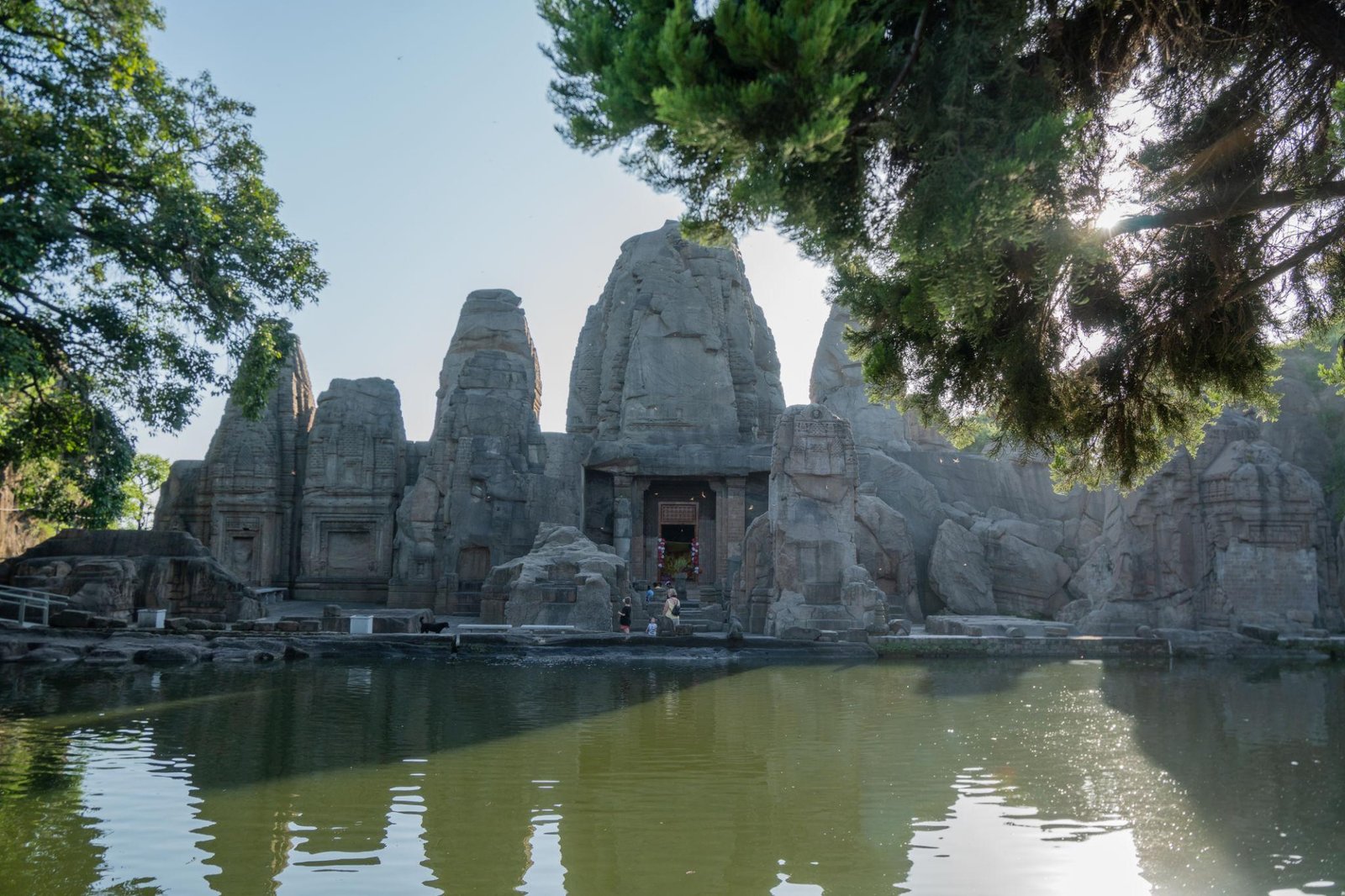
Masroor Rock-Cut Temples are among the most extraordinary ancient temple complexes in North India. Located in Masroor village in the Kangra district of Himachal Pradesh, the temples were carved directly from a natural sandstone ridge rather than assembled from separate blocks of stone.
The complex is also known as Masrur Temple, Masroor Temple, Masroor Rock-Cut Temple, Masrur Rock Temples, the Himalayan Pyramids and, in local usage, Thakurwada. It combines Hindu pilgrimage, rock-cut architecture, archaeology, sacred sculpture and the natural beauty of the Kangra Valley.
Official heritage descriptions generally place the complex in the early eighth century. Its architectural form belongs primarily to the North Indian Nagara tradition, yet the technique used to create it is exceptionally unusual for the Himalayan region.
Instead of constructing towers, walls and sanctums by stacking dressed stone, the builders began with a massive rock formation. They removed material gradually to reveal interconnected temple towers, chambers, doorways, platforms, sculptures and architectural details within the original stone.
This process required extraordinary planning. When a temple is built from individual blocks, mistakes can sometimes be corrected by replacing or repositioning a piece. In a monolithic monument, every major error is permanent because the temple and the mountain remain part of the same physical mass.
The surviving complex therefore represents not only religious devotion but also remarkable knowledge of design, geometry, stone behaviour and sacred architecture.
Masroor is especially important because large monolithic Hindu temple complexes are far more commonly associated with western and southern India. The rock-cut monuments of Ajanta, Ellora, Elephanta, Badami and other regions are well known, while comparable examples in the sub-Himalayan north are extremely rare.
For this reason, Masroor is sometimes promoted through descriptive names such as the “Ellora of the Himalayas.” Such comparisons help communicate its importance, although Masroor should ultimately be appreciated on its own terms.
Its setting, orientation, Nagara towers, sandstone material and relationship with the Dhauladhar mountains give the monument an independent architectural identity.
Visitors searching for historical places in Kangra, ancient temples near Dharamshala, heritage sites in Himachal Pradesh, rock-cut temples in India or spiritual attractions near Kangra should consider Masroor one of the district’s most significant destinations.
The temple is suitable for devotees, families, senior citizens, architecture students, photographers, historians, cultural travellers and visitors exploring the pilgrimage landscape of Kangra Valley.
Unlike high-altitude Himalayan shrines, Masroor does not require a difficult trek. Most of the journey can be completed by road, followed by a comparatively short walk through the protected monument area.
The road-based access makes it possible to combine the site with Kangra Fort, Bajreshwari Devi Temple, Jwala Ji, Baglamukhi Temple, Dharamshala, McLeod Ganj, Pong Dam, Bathu Ki Ladi and other destinations across Kangra district.
## A Rare Monolithic Temple Complex
The word monolithic means that a structure has been made from one continuous mass of rock.
At Masroor, the temples were not simply built beside a hill. They were carved out of the hill itself.
The artisans removed the surrounding sandstone to create towers resembling constructed temples. They cut chambers into the rock, shaped façades and doorways, produced sculptural panels and created the visual impression of a complete architectural complex.
The central temple is surrounded by smaller towers and shrines arranged in a carefully ordered pattern.
Official district information describes the overall composition as a symmetrical square grid in which the principal temple occupies the centre and smaller shrines surround it in a mandala-like formation.
The square is one of the most important geometrical forms in Hindu temple architecture. It represents stability, order and the organised sacred universe.
A mandala-based arrangement places the divine centre within a larger cosmic pattern. The visitor moves from the outer world towards the principal sanctum, symbolically progressing from ordinary experience towards concentrated sacred presence.
At Masroor, this philosophical concept was translated directly into the natural rock.
The builders were therefore not merely decorating a cliff. They were transforming a mountain ridge into a sacred architectural diagram.
## Fifteen Interconnected Temples
The complex is commonly described as containing fifteen major rock-cut temples or temple towers.
Visitors should understand that these do not appear as fifteen completely independent buildings separated by open ground. They form an interconnected monolithic composition created from the same rock formation.
The principal tower dominates the arrangement, while smaller towers rise around it.
Some sections are more complete and finely carved than others. Several areas appear unfinished, damaged or only partially shaped.
The unfinished sections are extremely important because they reveal how ambitious the original plan may have been.
They allow visitors to see the difference between raw rock, roughly cut architectural mass and more refined carved surfaces.
Rather than interpreting unfinished work as evidence that the site lacks value, travellers should recognise it as part of the archaeological record.
The complex allows viewers to imagine the stages through which an ancient rock formation was gradually transformed into a temple mountain.
## North Indian Nagara Architecture
Masroor is closely associated with the Nagara style of Hindu temple architecture.
Nagara temples are generally characterised by a rising tower or shikhara above the principal sanctum.
In conventional stone temples, the shikhara is constructed from carefully placed blocks. At Masroor, the appearance of such towers was carved directly from the rock.
The vertical towers create a rhythm across the skyline of the monument. Their rising forms draw the eye upwards and resemble a group of sacred mountain peaks.
This relationship between temple tower and mountain is central to the meaning of the complex.
In Hindu sacred architecture, the temple can symbolise Mount Meru, the cosmic mountain at the centre of the universe.
The sanctum represents the most concentrated sacred point, while the tower above it marks the connection between earth and the divine realm.
At Masroor, the temple does not merely imitate a mountain through architecture. The original mountain has itself been shaped into the temple.
This makes the monument a particularly powerful example of temple-mountain symbolism.
## Orientation Towards the Dhauladhar Mountains
The Masroor complex faces northeast towards the Dhauladhar range.
This orientation is unusual because many Hindu temples are commonly described as east-facing.
The direction creates a strong visual and symbolic relationship between the monument and the mountains.
During clear weather, the distant Dhauladhar peaks form a dramatic backdrop to the temple landscape.
The view depends upon season, atmospheric haze, cloud cover and time of day. The mountains may appear sharply defined on a clear winter or post-monsoon morning, while summer haze or monsoon clouds may hide them entirely.
Visitors should not treat limited visibility as a failed experience. The rock-cut complex remains architecturally and spiritually significant even when the mountain range is hidden.
Early morning generally offers softer light and a better possibility of open views.
Photographers should avoid climbing onto protected surfaces or crossing barriers to improve the angle. Safe and permitted viewpoints provide more than enough opportunity to capture the relationship between the temple, pool and mountain landscape.
## The Sacred Water Pool
A rectangular water pool stands in front of the temple complex.
The pool is not merely a modern decorative addition. Official descriptions recognise it as part of the sacred architectural plan and note that water bodies are recommended within Hindu temple design traditions.
Water has several meanings in a sacred setting.
It represents purification, life, renewal and the transition from the ordinary world into the temple environment.
The pool also creates one of Masroor’s most memorable visual experiences. When the water remains calm and the light is favourable, the temple towers appear reflected across its surface.
The reflection makes the complex seem larger and creates the impression of a temple mountain rising both above and below the viewer.
Visitors should not enter, swim in or pollute the pool.
Coins, plastic, flowers, food, cloth and religious packaging should not be thrown into the water.
Children should remain supervised near the edge, particularly when surfaces are wet.
Photography should be undertaken from safe areas without leaning dangerously over the pool.
Protecting the water is part of protecting the complete architectural composition of Masroor.
## Principal Sanctum and Living Worship
Masroor is both an archaeological monument and a living religious destination.
The complex is currently associated strongly with the worship of Lord Rama, Goddess Sita and Lord Lakshmana. This Vaishnava identity is reflected in the local name Thakurwada.
The word Thakur is commonly used in North India as a respectful name for a deity, particularly Lord Vishnu or his incarnations.
Visitors may find images of Rama, Sita and Lakshmana within the central worship area according to current temple arrangements.
The continued presence of worship distinguishes Masroor from a purely abandoned archaeological ruin.
Devotees visit to offer prayers, seek blessings and experience a sacred place connected with Hindu traditions.
The Archaeological Survey of India protects the monument, while local worship keeps its religious identity active.
Visitors should therefore follow both heritage rules and temple etiquette.
Footwear should be removed wherever directed.
Photography inside the sanctum or of the principal deities should only be undertaken when clearly permitted.
People engaged in prayer should not be interrupted or photographed without consent.
Offerings should be simple and should not create waste or damage ancient stone.
## Shiva, Vishnu, Devi and Surya Traditions
The surviving sculptures and architectural programme indicate that Masroor was not conceived exclusively around one narrow form of worship.
Official district information associates the complex with Shiva, Vishnu, Devi and Saura traditions.
Saura refers to the worship of Surya, the Sun God.
The presence of multiple traditions reflects the interconnected character of Hindu sacred architecture.
Lord Shiva represents consciousness, transformation, meditation and liberation.
Lord Vishnu represents preservation, order and divine protection.
Devi represents Shakti, the creative and protective energy of the Divine Mother.
Surya represents light, vitality, clarity and the visible source of energy sustaining life.
Their combined presence suggests a broad sacred vision in which different divine forms occupy places within one ordered cosmos.
Visitors should avoid assuming that every surviving sculpture can be identified easily. Weathering, earthquake damage and incomplete work have affected many images.
Where the identity of a figure is uncertain, it is better to describe it cautiously than to attach a dramatic but unsupported story.
A trained heritage guide or reliable archaeological publication can help visitors understand specific iconographic details.
## Ramayana Connection
The current worship of Rama, Sita and Lakshmana gives Masroor a strong connection with the Ramayana.
Lord Rama represents dharma, responsibility, courage and commitment to righteous conduct.
Goddess Sita represents strength, dignity, devotion and endurance.
Lakshmana represents loyalty, service and unwavering companionship.
Families may pray for harmony, protection and the strength to face hardship with dignity.
Pilgrims should understand that the present Vaishnava worship forms one important layer in the long religious life of the complex.
The broader sculptural programme demonstrates that Masroor historically included several Hindu traditions.
This layered identity should be preserved rather than reducing the site to a single story.
## Pandava Legend
Local tradition connects the Masroor Rock-Cut Temples with the Pandavas of the Mahabharata.
One widely repeated account says that the Pandavas stayed in the area during their exile and attempted to construct the temples within a single night.
According to some versions, the work had to be abandoned before sunrise, explaining why parts of the complex remain unfinished.
Similar one-night construction traditions are found at several ancient temples across the Himalayas.
Such stories express the community’s belief in the extraordinary strength, devotion and architectural ability of the Pandavas.
The narrative should be understood as local mythology and oral tradition rather than documented archaeological history.
Art historians and official tourism authorities generally date the surviving complex to the early medieval period, many centuries after the era in which the Mahabharata is traditionally placed.
The archaeological dating and the Pandava legend can be presented together when their different roles are made clear.
Archaeology studies when and how the monument was likely created.
Religious tradition explains how generations of local communities have understood its sacred origin.
The legend remains culturally meaningful even when it is not presented as a verified construction record.
## Incomplete Entrances and Unfinished Design
Official district information records three entrances on the northeast, southeast and northwest sides of the complex.
Two are described as incomplete, while evidence suggests that a fourth entrance was planned and begun but remained largely unfinished.
These incomplete sections demonstrate that the original architectural vision was probably even more ambitious than the surviving monument.
Visitors can observe changes in the degree of completion across doorways, surfaces and towers.
Some areas contain refined carving and organised architectural detail.
Other sections remain rough or appear only partially separated from the natural rock.
This variation allows visitors to understand the monument as a construction process rather than only as a completed object.
It is possible that the work stopped because of political change, shortage of resources, structural difficulty, instability of the rock or another unknown reason.
Unless supported by clear evidence, no single explanation should be presented as certain.
The unfinished character is one of the site’s most important historical questions.
## Sculptures and Relief Carvings
Masroor once contained a rich programme of sculpture and relief carving.
Surviving figures represent major Hindu deities and themes from Vedic and Puranic traditions.
Decorative bands, doorway elements, architectural frames and partially preserved figures remain visible across the sandstone.
Some details have been lost because sandstone is vulnerable to weathering.
Rainwater, temperature changes, biological growth, wind and seismic movement can gradually weaken carved surfaces.
Earthquakes have also caused major damage to the complex.
Visitors should not touch carvings, apply water to make them more visible or rub stone surfaces.
Vermilion, oil, colour and religious substances should not be placed on protected sculptures unless the particular object remains part of an authorised worship practice.
Historic reliefs should never be climbed upon, used as seating or treated as props for photographs.
A small act repeated by thousands of visitors can permanently damage a carving that survived for more than a millennium.
## Earthquake Damage
Kangra is a seismically active region, and earthquakes have played a major role in the condition of the Masroor complex.
Official district information notes that much of the sculpture and relief work has been lost and that the temples suffered substantial earthquake damage.
The monument is frequently associated with the destructive Kangra earthquake of 1905, although the surviving structure may also reflect damage from more than one seismic event across its long history.
Broken towers, displaced sections and fractured rock should not be interpreted as poor original craftsmanship.
A monolithic structure responds differently to seismic force than a conventional block-built temple.
Cracks and weaknesses within the natural rock can transmit force across large sections.
The surviving towers demonstrate both the vulnerability and durability of the monument.
Visitors should remain outside restricted areas because apparently stable rock may still require monitoring and conservation.
Loose fragments must never be moved.
## Discovery by Modern Archaeological Scholarship
The temple was known to local communities long before it entered formal archaeological literature.
Official district information records that Henry Shuttleworth reported the complex in 1913, bringing it to wider archaeological attention.
Harold Hargreaves of the Archaeological Survey of India surveyed it independently in 1915.
These early studies documented the plan, carvings, condition and incomplete architectural features of the site.
Modern scholarship has continued to examine Masroor’s chronology, orientation, design and relationship with other Indian temple traditions.
Visitors should remember that the phrase “discovered” can be misleading when used for heritage sites already known and worshipped locally.
Colonial-era documentation did not create the monument’s significance. It introduced the site into a particular archaeological and academic system.
The religious memory and local knowledge of Masroor existed independently of that documentation.
## Centrally Protected Monument
The Archaeological Survey of India lists the monolithic temples at Masroor, together with sculptures lying inside and outside them, as a centrally protected monument.
This status confirms the site’s national heritage importance.
Protected-monument rules apply even when a visitor does not see a guard beside every surface.
Stone fragments, sculptures and architectural remains cannot be touched, moved or taken away.
Visitors must not write names, carve initials or attach religious objects to protected walls.
Professional photography, filming, drones, lighting equipment and commercial activity may require specific permission.
Food should not be consumed against the temple walls or beside sculptures.
Children should be supervised carefully.
Conservation work, scaffolding or temporary access restrictions may be introduced according to the condition of the monument. Visitors should cooperate without complaint because preservation must take priority over obtaining a particular photograph.
## Masroor as a Temple Mountain
Art-historical interpretation often describes Masroor as a temple-mountain composition.
The monument does not merely contain individual shrines. Its multiple towers collectively resemble a sacred range rising from the earth.
The principal tower functions like the highest peak, while surrounding towers form a sequence of smaller summits.
The Dhauladhar range beyond the site reinforces this symbolism.
The visitor encounters a carved mountain in front and a natural mountain range in the distance.
This relationship between nature and architecture is one of Masroor’s deepest qualities.
The artisans did not attempt to erase the original rock completely. Portions of the ridge remain visibly natural, unfinished or roughly shaped.
The boundary between human construction and mountain geology therefore remains intentionally or practically incomplete.
The site invites reflection on whether the temple was created from the mountain or whether the builders believed the temple already existed within the rock and needed only to be revealed.
## Best Time to Visit Masroor Rock-Cut Temples
Masroor can generally be visited throughout the year, but the experience changes by season.
### Spring
Spring is one of the most comfortable periods for visiting the temples.
Daytime temperatures are generally pleasant, surrounding vegetation becomes fresh and the Dhauladhar mountains may remain snow-covered in the distance.
Morning and evening can still be cool.
Spring is suitable for families, senior citizens, photographers and travellers combining Masroor with Dharamshala or Kangra.
### Summer
Summer can become warm at Masroor because the site lies at a lower elevation than McLeod Ganj and the high Dhauladhar region.
The exposed stone absorbs heat, making the middle of the day less comfortable.
Visitors should arrive early, carry drinking water and use sun protection.
A cap, sunglasses and lightweight clothing are useful.
The temple complex may be quieter than the major summer attractions of Dharamshala, although weekends can still bring visitors.
### Monsoon
The monsoon turns Kangra Valley green and atmospheric.
Clouds may cover the Dhauladhar range, while moisture deepens the colour of the sandstone.
Heavy rain can create slippery surfaces, poor road visibility, falling stones and local drainage problems.
Visitors should wear shoes with dependable grip and avoid standing beneath unstable rock sections.
Travel should be postponed during severe weather warnings.
The monument’s protected surfaces should not be touched when wet.
### Autumn
Autumn is among the best periods for visiting Masroor.
Rain usually reduces, the valley remains green and visibility towards the mountains may improve.
The weather is comfortable for combining heritage and temple travel.
Navratri and other festivals can increase activity at major Kangra temples, so accommodation should be reserved early when planning a wider pilgrimage.
### Winter
Winter offers clear air, softer sunlight and attractive views of the snow-covered Dhauladhar range.
Morning and evening temperatures can become cold, although daytime conditions may remain comfortable under sunlight.
Fog and frost are possible.
Snowfall at Masroor itself should not be guaranteed because the site is much lower than the principal mountain peaks.
Visitors seeking snow should not assume that photographs of the Dhauladhar range reflect conditions at the temple.
## Morning and Evening Visit
Morning is generally the best time to explore Masroor.
The stone receives softer light, the water pool may be calmer and the Dhauladhar mountains may be more visible.
Early arrival also gives visitors enough time to study the architecture without rushing.
Evening light can create warm tones across the sandstone and attractive reflections in the pool.
Visitors planning an evening visit should confirm the monument’s current closing time and return before unfamiliar village roads become dark.
Entry timings, ticketing rules and photography regulations can change. Current information should be confirmed through official or local sources before travelling.
## How to Reach Masroor Rock-Cut Temples
Masroor village lies in Kangra district within the wider Beas Valley landscape.
Official district information places it approximately 41 kilometres from Dharamshala and around 35–40 kilometres from the Gaggal and Kangra side, depending on the specific starting point and road selected.
The route passes through villages, agricultural land and rolling foothill terrain.
A private taxi or hired vehicle provides the greatest flexibility.
Local buses or shared transport may operate on parts of the route, but visitors should confirm the last return service before departure.
Mountain and rural road travel should be planned according to time rather than distance alone.
Road construction, village traffic and weather can extend the journey.
The monument itself does not require a long trek, but visitors should wear comfortable footwear for walking through the archaeological area.
## Reaching from Dharamshala and McLeod Ganj
Dharamshala is the most popular tourism base for visiting Masroor.
The journey can be completed as a half-day or full-day excursion, although a full day allows a more relaxed visit and possible inclusion of another nearby attraction.
Travellers staying in McLeod Ganj should account for additional driving through Dharamshala and the lower valley.
Morning departure is preferable.
Traffic around Dharamshala, Gaggal and village junctions can affect travel time.
Visitors whose main interest is Kangra heritage may find a stay in lower Dharamshala, Kangra, Gaggal or a rural homestay more convenient than central McLeod Ganj.
## Reaching from Kangra Town
Kangra town provides practical access to Masroor and offers markets, hotels, medical facilities and transport.
Travellers can combine the rock-cut temples with Kangra Fort and Bajreshwari Devi Temple.
A local taxi is the most convenient option for a combined circuit.
The sequence should be planned according to current opening hours and road conditions.
Kangra Fort requires walking across uneven historic surfaces, while Bajreshwari Temple may experience queues during festivals.
Attempting all sites within a tightly compressed schedule can reduce the quality of the visit.
## Reaching by Air
Gaggal Airport, also known as Kangra Airport, is the nearest airport commonly used for the region.
The road distance to Masroor is approximately 35 kilometres according to district information.
Flights can be affected by mountain weather.
Visitors should not schedule the temple immediately before a tightly timed departure.
A delayed road journey or flight change could create unnecessary stress.
Travellers arriving late in the day should stay in Gaggal, Kangra or Dharamshala and visit Masroor the following morning.
## Reaching by Train
Kangra district is served by the Pathankot–Jogindernagar narrow-gauge railway, with several local stations across the valley.
Services, timing and operational status can change.
Pathankot is the major broad-gauge rail gateway used by many travellers arriving from Delhi, Punjab and other regions.
The onward road journey from Pathankot is substantial.
Visitors should stay in Nurpur, Kangra, Dharamshala or another suitable base rather than attempting a rushed monument visit after a late arrival.
## Kangra Fort
Kangra Fort is one of the most important nearby heritage attractions.
Situated above the confluence area of the Banganga and Manjhi rivers, the fort is associated with the long history of the Katoch dynasty.
A combined Masroor and Kangra Fort itinerary offers two distinct forms of heritage.
Masroor represents sacred monolithic architecture carved from rock.
Kangra Fort represents defensive, royal and political architecture built across a strategic hill.
Both sites require sufficient time and respectful behaviour.
Visitors should avoid climbing restricted walls or unstable sections of the fort.
## Bajreshwari Devi Temple
Bajreshwari Devi Temple in Kangra town is one of the district’s most important Shakti shrines.
It is associated with the wider Shakti Peeth tradition and attracts large numbers of devotees during Navratri and other festivals.
A journey combining Masroor and Bajreshwari Temple brings together archaeological heritage and living Goddess worship.
Religious legends concerning Goddess Sati should be understood as matters of sacred tradition.
Festival crowds, parking and security procedures should be considered when planning the combined route.
## Jwala Ji Temple
Jwala Ji is one of the most revered pilgrimage destinations in Kangra district.
The shrine is known for natural flames worshipped as manifestations of the Divine Mother.
Masroor and Jwala Ji can be combined within a longer itinerary, but the road sequence and temple crowds require careful planning.
Visitors should not rush through the rock-cut complex merely to reach another temple.
A two-day heritage and Shakti itinerary is more comfortable than attempting several distant destinations in one day.
## Baglamukhi Temple
Baglamukhi Temple at Bankhandi is another significant Goddess shrine in the wider Kangra region.
Devotees visit Maa Baglamukhi for courage, protection and spiritual strength.
Claims relating to guaranteed victory, legal outcomes or control over other people should not be treated as assured results.
The temple can be combined with Masroor according to the selected road route.
Current worship arrangements, dress customs and crowd conditions should be confirmed locally.
## Bathu Ki Ladi Temples
Bathu Ki Ladi is a group of temples situated within the Pong reservoir region.
Their visibility and accessibility vary significantly with the water level.
The temples should only be visited when current local information confirms safe access.
Visitors must not walk onto exposed reservoir ground or approach water without understanding changing conditions.
Masroor and Bathu Ki Ladi can form part of a wider Kangra heritage journey, but they require separate safety assessments.
## Pong Dam and Maharana Pratap Sagar
Pong reservoir offers birdwatching, wetland landscapes and seasonal water views.
Recognised birding areas should be visited with appropriate local guidance.
Wildlife should not be chased, fed or disturbed.
Water activities should only be undertaken through authorised operators and with approved safety equipment.
Masroor visitors can include the reservoir in a two- or three-day rural Kangra itinerary.
## Dharamshala and McLeod Ganj
Dharamshala and McLeod Ganj provide the widest selection of hotels, cafés, monasteries and visitor facilities in the region.
They are suitable bases for travellers combining Masroor with Tibetan cultural attractions, Bhagsunag, Naddi and other places.
However, central McLeod Ganj lies farther from Masroor than Kangra or Gaggal.
Visitors primarily interested in heritage and temple travel may prefer splitting their stay between Dharamshala and the lower Kangra Valley.
## Suggested One-Day Itinerary
A one-day Masroor itinerary can begin with an early departure from Kangra, Gaggal or Dharamshala.
Reach the monument during the morning and spend adequate time observing the central temple, surrounding towers, incomplete entrances, carvings and sacred pool.
Attend darshan respectfully if the worship area is open.
After the visit, continue towards Kangra town for lunch.
The afternoon can include Kangra Fort or Bajreshwari Devi Temple, depending on available time and current opening arrangements.
Return to accommodation before dark.
## Suggested Two-Day Heritage and Pilgrimage Itinerary
On the first day, arrive in Kangra or Dharamshala and visit Bajreshwari Devi Temple and Kangra Fort.
Stay overnight in Kangra, Gaggal or a nearby homestay.
On the second morning, travel to Masroor Rock-Cut Temples.
Explore the site slowly and continue towards another appropriate destination such as Baglamukhi Temple or the Pong reservoir region.
This itinerary is suitable for families and senior citizens because it avoids excessive daily driving.
## Suggested Three-Day Kangra Temple Circuit
The first day can include Kangra Fort and Bajreshwari Devi Temple.
The second day can focus on Masroor Rock-Cut Temples and the surrounding rural landscape.
The third day can include Jwala Ji and Baglamukhi Temple or a carefully planned Pong Dam excursion.
Travellers continuing to Dharamshala can add another night for monasteries, Bhagsunag and the upper valley.
## Accommodation Near Masroor Rock-Cut Temples
Accommodation immediately around Masroor may consist mainly of local homestays, guesthouses and small village properties.
These stays can provide a peaceful rural experience and convenient access to the monument.
Facilities may be simpler than those in Kangra or Dharamshala.
Guests should confirm attached bathrooms, hot water, meals, parking, electricity, mobile connectivity and the actual road distance to the temple.
A village stay is suitable for photographers, slow travellers and visitors who want to reach the monument during quiet morning hours.
## Homestays in Rural Kangra
Rural homestays allow visitors to experience Kangra hospitality, local food, agricultural landscapes and village life.
Hosts may help arrange transport and provide current information about monument timings and nearby attractions.
Travellers should respect household routines, food arrangements and private property.
Fields and village homes should not be photographed without permission.
Staying locally helps tourism income reach communities outside the major commercial centres.
## Hotels in Kangra
Kangra town is one of the most practical bases for Masroor.
It offers hotels, guesthouses, markets, restaurants, hospitals, pharmacies and local taxis.
Staying in Kangra also provides convenient access to Bajreshwari Devi Temple and Kangra Fort.
Families and senior citizens may prefer the developed facilities available in the town.
Guests should confirm parking and room accessibility before booking.
## Hotels Near Gaggal
Gaggal is useful for air travellers because of its proximity to Kangra Airport.
Accommodation includes hotels, guesthouses and roadside properties.
A Gaggal stay can reduce the journey to Masroor compared with central McLeod Ganj.
Travellers should choose a property according to actual road access rather than airport proximity alone.
Flight noise, highway traffic and transport availability should also be considered.
## Hotels in Dharamshala and McLeod Ganj
Dharamshala offers the widest variety of hotels, resorts, hostels, homestays and restaurants.
Travellers combining Masroor with a longer Kangra holiday may choose lower Dharamshala, Sidhpur, Gaggal or another road-accessible neighbourhood.
McLeod Ganj is suitable for Tibetan cultural tourism but requires additional travel for Masroor.
Visitors should leave early to avoid traffic and preserve enough time at the monument.
## Choosing the Right Stay
Pilgrims and heritage travellers should select accommodation according to the complete itinerary.
A rural Masroor homestay is best for early access and a quiet environment.
Kangra is suitable for a temple-and-fort circuit.
Gaggal is practical for airport arrivals.
Dharamshala is suitable for travellers combining several tourism experiences.
Families should check meals, room size, parking and bathroom facilities.
Senior citizens should prioritise lifts, ground-floor rooms and minimal stairs.
Couples may prefer rural cottages, heritage-style homestays or peaceful valley properties.
Solo travellers can choose affordable guesthouses with dependable transport support.
Groups should confirm multiple rooms, vegetarian meal options and vehicle parking.
Monsoon guests should ask about the condition of the final approach road.
Travellers requiring internet access should verify Wi-Fi and mobile connectivity directly with the property.
## Book Stays Near Masroor with MudrasStays
MudrasStays helps pilgrims, families and heritage travellers discover hotels, homestays, guesthouses and rural accommodation near the Masroor Rock-Cut Temples, Kangra, Gaggal and Dharamshala.
The platform is designed specifically for travellers looking for places to stay near temples, pilgrimage routes and sacred heritage destinations across India.
Visitors can compare properties according to practical distance from Masroor, room type, budget, group size and required facilities.
Booking a nearby stay makes it easier to arrive during peaceful morning hours and explore the monument without rushing.
Solo travellers can search for affordable guesthouses and village homestays.
Couples can explore quiet rural stays surrounded by Kangra Valley scenery.
Families can choose hotels offering meals, parking and comfortable rooms.
Senior citizens can prioritise accessible properties with road-based temple access.
Pilgrimage groups can identify accommodation offering multiple rooms, vegetarian meals and suitable vehicle parking.
Air travellers can select hotels around Gaggal according to flight schedules.
Visitors combining Masroor with Bajreshwari Devi Temple, Kangra Fort, Jwala Ji, Baglamukhi or Dharamshala can select different bases according to the geographical sequence of their journey.
MudrasStays helps travellers avoid booking a property that appears nearby on a map but requires unnecessary backtracking across rural and mountain roads.
## Responsible Heritage Travel
Masroor is a protected archaeological monument and a living sacred destination.
Visitors should follow every barrier, sign and instruction issued by the Archaeological Survey of India or local management.
No sculpture, stone fragment or architectural element should be touched, moved or removed.
Names and messages must never be scratched into the sandstone.
Visitors should not climb onto temple towers, walls or unfinished sections.
The sacred pool should remain free from plastic, food, coins and ritual waste.
Photography inside the worship area should only be undertaken with permission.
Tripods, drones, commercial filming and professional equipment may require approval.
Food and drinks should be consumed away from protected surfaces.
Smoking and open flames are inappropriate within the monument.
Visitors should not pressure staff to open restricted chambers or allow unsafe access.
Private village homes and residents should not be photographed without consent.
Local guides, taxis, homestays, shops and food providers should be treated fairly.
Responsible tourism protects both the monument and the community living around it.
## A Monument Carved from a Himalayan Mountain
Masroor Rock-Cut Temples represent a rare union of mountain, architecture, spirituality and human imagination.
The sandstone ridge provided the original material.
Ancient builders transformed it into towers, sanctums, doorways, sculptures and a sacred architectural plan.
The Nagara shikharas reproduce the form of a temple city while remaining physically united with the mountain.
The square grid expresses sacred order.
The surrounding shrines create a mandala around the central sanctuary.
The pool adds water, reflection and purification to the landscape.
The northeast orientation connects the complex with the Dhauladhar range.
The carvings preserve the presence of Shiva, Vishnu, Devi, Surya and other Hindu traditions.
The present worship of Rama, Sita and Lakshmana keeps the religious life of the monument active.
The Pandava legend connects the site with the oral memory of the Mahabharata.
The unfinished sections reveal the ambition and working process of the ancient builders.
Earthquake damage records the vulnerability of heritage within a changing mountain environment.
The protected status recognises Masroor as an irreplaceable part of India’s cultural inheritance.
For pilgrims, Masroor offers darshan within one of North India’s rarest sacred architectural environments.
For families, it provides an accessible heritage experience without a long trek.
For senior citizens, the road approach makes the monument more manageable than remote hilltop shrines.
For architecture students, it offers an exceptional example of Nagara design executed through monolithic rock cutting.
For history enthusiasts, it raises important questions about patronage, chronology, construction and unfinished plans.
For photographers, the towers, water reflection and Dhauladhar backdrop provide memorable compositions when heritage boundaries are respected.
For spiritual travellers, the temple mountain encourages reflection on the relationship between nature and divine space.
For slow travellers, a stay in rural Kangra creates time to explore the monument, villages and surrounding pilgrimage circuit without rushing.
Masroor should not be treated merely as a hidden photo location or a quick roadside ruin.
It deserves time for darshan, architectural observation, historical understanding and quiet reflection.
Plan your journey to the Masroor Rock-Cut Temples with MudrasStays and experience one of the most extraordinary sacred heritage sites in Himachal Pradesh.
Explore the early medieval monolithic temple complex, observe its Nagara towers and experience the reflection of the ancient rock-cut shrines in the sacred water pool.
Learn about its architecture, sculptures, Ramayana worship, Pandava traditions, unfinished entrances and earthquake-damaged heritage.
Combine your journey with Kangra Fort, Bajreshwari Devi Temple, Jwala Ji, Baglamukhi Temple, Pong Dam, Bathu Ki Ladi, Dharamshala and McLeod Ganj.
Book hotels near Masroor Rock-Cut Temples, discover rural homestays in Kangra Valley and explore suitable pilgrimage and heritage accommodation around Kangra, Gaggal and Dharamshala through MudrasStays.
Stay closer to the monument, arrive during peaceful morning hours and reduce unnecessary travel across winding rural roads.
MudrasStays connects pilgrims, families and cultural travellers with suitable accommodation near temples and sacred heritage destinations across India.
Begin your Masroor Rock-Cut Temples journey with a comfortable stay and experience a meaningful visit centred on ancient architecture, Hindu spirituality, Kangra heritage and the timeless beauty of the Dhauladhar landscape.