
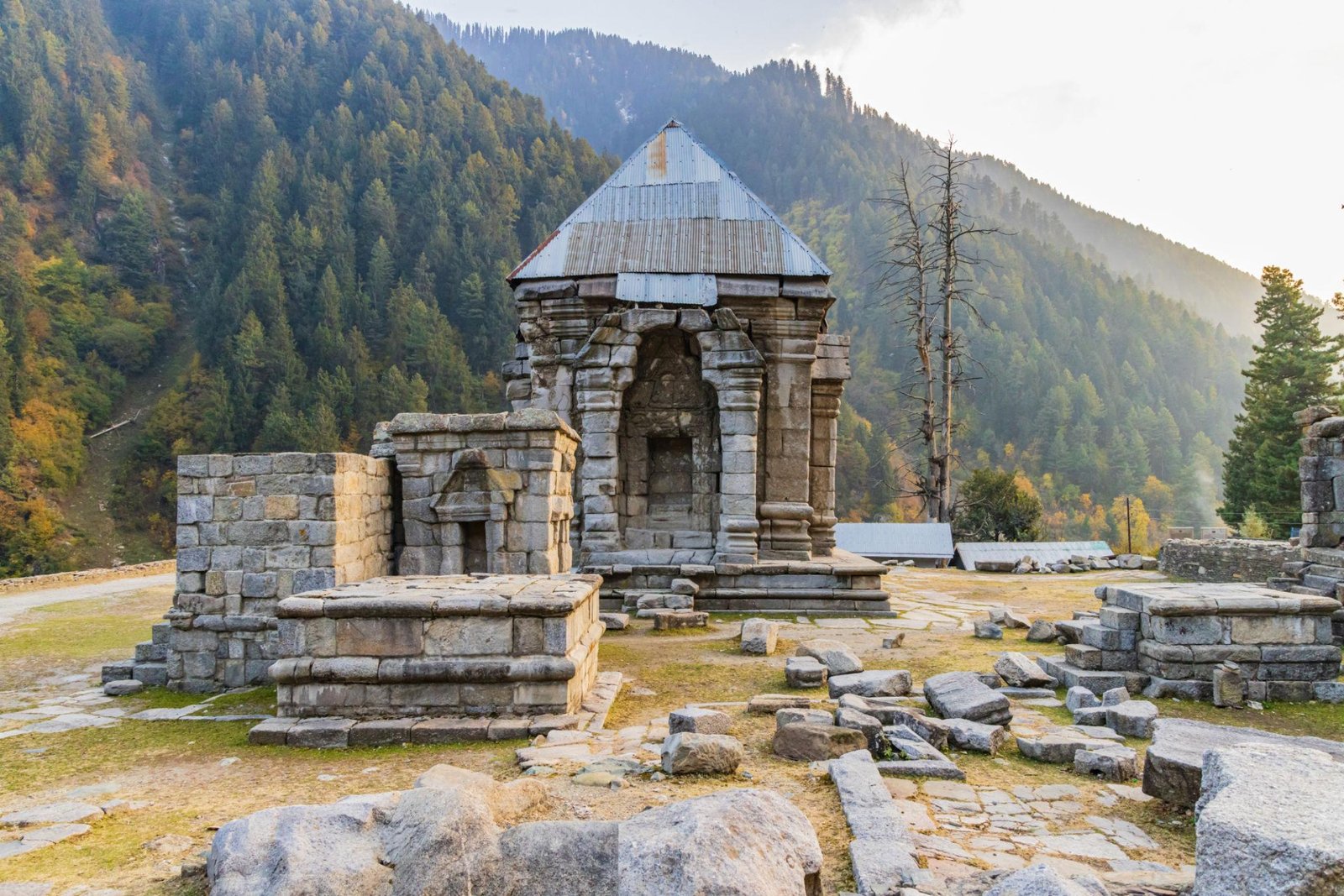
Naranag Temple Complex is one of the most atmospheric ancient Hindu heritage sites in the Kashmir Valley. Located in Naranag village within the Wangath Valley of Ganderbal district, the complex stands among forested mountain slopes, streams, meadows and the high Himalayan landscape leading towards Mount Harmukh and Gangabal Lake.
The site is also known as the Wangath Temple Complex, Naranag Shiva Temple, Naranag Ancient Temples, Nara Nag Temple, Group of Ancient Temples at Naranag and, in historical discussions, the temples of Bhuteshwara and Jyeshthesha.
The surviving temples are primarily associated with Lord Shiva and the Shaivite traditions of ancient Kashmir.
Rather than consisting of one isolated shrine, Naranag contains several temples, platforms, gateways, enclosure walls, stone foundations, water-related structures and the remains of buildings traditionally interpreted as mathas or religious establishments.
Archaeological descriptions generally identify two principal groups of temples—an upper or western group and a lower or eastern group—with additional structural remains between them.
Around seventeen temple structures or substantial foundations have been identified across the broader site, although their condition, visibility and interpretation vary.
Some shrines retain large portions of their walls and doorways.
Others survive only as platforms, bases or groups of displaced granite blocks.
One of the principal temples has received a protective sloping roof to reduce further exposure to rain and snow. This modern covering should not be confused with the precise form of every original temple roof.
The ruins demonstrate that Naranag was once a major sacred institution rather than a small village shrine.
Its builders created strong enclosures, monumental gateways, elevated platforms and carefully proportioned sanctums using massive blocks of local grey granite.
The location was chosen beside sacred water and beneath mountains regarded as spiritually connected with Lord Shiva.
Naranag is therefore important for several interconnected reasons.
It is an archaeological monument.
It is an ancient Shaivite pilgrimage centre.
It is a significant example of early Kashmiri stone architecture.
It is associated with traditions recorded in Kashmir’s historical chronicles.
It remains connected with the Harmukh–Gangabal pilgrimage undertaken by Kashmiri Hindus.
It is also the starting point for demanding mountain treks through forests, meadows and high-altitude lake country.
Visitors searching for ancient temples in Kashmir, Shiva temples near Srinagar, heritage places in Ganderbal, temples near Kangan, places to visit around Sonamarg or spiritual destinations in Jammu and Kashmir should consider Naranag Temple Complex one of the region’s most meaningful cultural sites.
Travellers can plan hotels near Naranag Temple Complex, homestays in Naranag, accommodation in Kangan, pilgrimage stays in Ganderbal or comfortable hotels in Srinagar through MudrasStays.
## Location of Naranag Temple Complex
Naranag lies in the Wangath Valley within the Kangan area of Ganderbal district.
The village is reached by taking a mountain road away from the principal Srinagar–Leh highway corridor near Kangan.
The road follows the Wangath landscape towards a quieter valley surrounded by forested slopes.
Naranag is commonly placed around 16 kilometres from Kangan and approximately 50 kilometres from Srinagar, although road distance varies according to the starting neighbourhood, traffic and exact route.
The temple complex lies close to the village and ordinarily does not require a long trek.
Visitors arriving by vehicle can reach the broader settlement and complete a short walk through uneven village and archaeological ground.
The site should not be confused with Gangabal Lake.
Naranag Temple Complex is road-accessible within the valley.
Gangabal is a high-altitude lake reached through a demanding trek from the Naranag side or through alternative mountain routes.
The distinction is essential for families and senior citizens.
A visitor can explore the ancient temples without undertaking the Gangabal trek.
## Meaning of the Name Naranag
The name Naranag is closely connected with water.
In Kashmiri geographical and sacred terminology, the word “nag” commonly refers to a spring, water source or serpent-associated sacred place.
Springs occupied an important position within the religious landscape of Kashmir.
They supplied drinking water, supported agriculture and were often connected with Nagas—serpent beings associated with water, fertility and guardianship.
Naranag is therefore more than a modern village name.
It reflects the sacred spring around which the ancient pilgrimage centre developed.
Historical and religious discussions also connect the site with names such as Nara Nag, Sodara Nag or Sodaratirtha.
Spellings vary because Sanskrit, Kashmiri, Persian and English records transliterate names differently.
Travellers should not assume that every variation refers to a separate monument.
The present archaeological complex is commonly identified as the Naranag or Wangath group of temples.
## Naranag and Wangath
The temples are frequently called the Wangath Temple Complex because they stand within the wider Wangath Valley and near the Wangath stream system.
The names Naranag and Wangath are often used together in archaeological and travel descriptions.
Naranag refers to the present village and sacred spring area.
Wangath refers to the valley, watercourse and wider geographical setting.
Visitors may therefore encounter signs, articles and maps using either name.
When arranging a taxi or accommodation, the clearest description is:
Naranag Ancient Temple Complex, near Kangan, Ganderbal district.
This reduces the possibility of confusion with similarly named villages or modern neighbourhood temples.
## Presiding Deity and Shaivite Identity
The temple complex is primarily associated with Lord Shiva.
Historical interpretations identify important shrines connected with Shiva Bhuteshwara or Bhutesha and Shiva Jyeshthesha or Jyeshtharudra.
These names represent different sacred aspects of Mahadev.
Bhuteshwara means Lord of beings, spirits or created existence.
The term reminds devotees that Shiva is not limited to one class of living being. He is the consciousness underlying every form of existence.
Jyeshthesha can be understood as the supreme or senior lord.
Jyeshtharudra connects the site with Rudra, the powerful Vedic and Shaivite form associated with storms, healing, wilderness and transformation.
The temple landscape may historically have accommodated more than one form of worship.
Large sacred complexes often contained principal shrines, subsidiary deities, ritual spaces and accommodation for priests or ascetics.
Visitors should therefore avoid reducing Naranag to one single building or one simplified deity label.
Its identity developed through several shrines and several centuries of patronage.
## Lord Shiva in the Kashmiri Landscape
The natural setting of Naranag strengthens its Shaivite character.
Lord Shiva is traditionally associated with mountains, caves, rivers, meditation and wilderness.
He is worshipped as the ascetic who remains beyond material luxury, yet he is also the compassionate householder united with Goddess Parvati.
He represents stillness within movement, consciousness within nature and freedom from fear.
At Naranag, the devotee encounters stone temples beside flowing water and beneath forested Himalayan slopes.
The mountains rise beyond the village towards Harmukh.
Gangabal Lake lies within the upper sacred landscape.
The environment itself reflects qualities traditionally associated with Shiva—silence, remoteness, power and simplicity.
For this reason, Naranag should not be experienced only as a collection of ruined walls.
The relationship between temple, spring, forest, stream and mountain is fundamental to the site’s meaning.
## Mount Harmukh and the Shiva Tradition
Mount Harmukh is one of the defining peaks of the Ganderbal region.
Kashmiri Hindu tradition associates Harmukh with Lord Shiva and treats the mountain landscape around Gangabal as a sacred counterpart to other Himalayan Shiva regions.
Gangabal Lake, situated below the mountain, is regarded as spiritually significant and is sometimes described through the devotional expression Harmukh Ganga.
The mountain is visible only from particular points and under suitable weather conditions.
Cloud, forest, valley shape and seasonal conditions may hide the higher peaks.
Travellers should not expect a guaranteed mountain view directly from every part of the temple complex.
The deeper spiritual relationship does not depend upon uninterrupted visibility.
Naranag functions as the lower gateway to the sacred Harmukh–Gangabal landscape.
The ancient temples mark the transition from inhabited valley to high mountain pilgrimage.
## Traditions Recorded in the Rajatarangini
Much of the historical memory associated with Naranag comes through the Rajatarangini, the celebrated Sanskrit chronicle of Kashmir composed by Kalhana in the twelfth century.
The Rajatarangini combines dynastic history, political memory, sacred geography, court narratives and inherited tradition.
It is an essential source for understanding premodern Kashmir, but individual dates and stories should still be assessed critically.
According to traditions preserved through the chronicle, early royal figures such as Jaluka were associated with the establishment of Shaivite shrines in the Wangath Valley.
Later rulers patronised, visited, endowed or repaired the sacred complex.
The surviving temples should not all be assigned automatically to the earliest ruler mentioned in the chronicle.
The visible architecture represents several periods.
The principal surviving structures are commonly placed within the early medieval period, especially around the Karkota and later dynastic eras.
Earlier worship at the sacred spring may have preceded the monumental stone architecture.
## Jaluka Tradition
Regional historical tradition connects Naranag with Jaluka, described in the Rajatarangini as a son of Emperor Ashoka.
Jaluka is associated with Shaivite worship and the establishment of temples dedicated to forms such as Bhuteshwara and Jyeshtharudra in the Wangath region.
The exact chronology and historical identity of Jaluka remain subjects of scholarly discussion.
Visitors should therefore avoid stating that every surviving granite wall was unquestionably constructed during the Mauryan period.
A more careful interpretation is that the sacred importance of the Naranag spring and the tradition of Shiva worship may be very old, while much of the visible architecture belongs to later monumental phases.
The Jaluka narrative remains culturally important because it places Naranag within the earliest layers of Kashmir’s recorded sacred history.
## Lalitaditya Muktapida and the Karkota Period
The surviving temple complex is strongly associated with the architectural world of Lalitaditya Muktapida and the Karkota dynasty.
Lalitaditya ruled Kashmir during the eighth century and is remembered as one of the valley’s most powerful royal patrons.
His period is associated with major temple building, political expansion and cultural contact across several regions.
Martand Sun Temple near Anantnag is the most famous monument traditionally connected with his patronage.
Naranag reflects the same broader age of ambitious stone architecture.
Historical traditions state that Lalitaditya supported or enriched the Wangath shrine after military success.
Whether he constructed every temple from the foundation, enlarged an older sacred centre or patronised one phase of development, his name remains central to the site’s early-medieval history.
The size and technical quality of the complex indicate substantial resources.
Quarrying, transporting and positioning massive granite blocks in a mountain valley required skilled labour and organised patronage.
## Avantivarman and Later Patronage
King Avantivarman, founder of the Utpala dynasty in the ninth century, is also connected with Naranag through historical tradition.
He is said to have provided a stone pedestal and a silver conduit associated with the ritual bathing of sacred images.
Such a system would have supported abhishek, the ceremonial pouring of water or other approved offerings over a deity.
The tradition indicates that Naranag remained an important pilgrimage centre after the Karkota period.
The complex was not created and immediately abandoned.
It continued to receive royal attention, priestly activity and pilgrim visits across generations.
Other rulers and officials are also mentioned in relation to donations, visits, treasury disputes or damage.
These accounts demonstrate that Naranag occupied an important position within the religious economy of medieval Kashmir.
## Architecture of Naranag Temple Complex
Naranag is an outstanding example of ancient Kashmiri temple architecture.
The temples were built primarily from large blocks of locally available grey granite.
The builders shaped the stone into platforms, walls, pilasters, doorway frames, mouldings, niches and roof-supporting elements.
The architectural forms are strong, compact and carefully proportioned.
Several characteristic features of Kashmiri temples are visible or reconstructable at Naranag:
Raised stone platforms.
Square sanctums.
Monumental framed doorways.
Trefoil or arched recesses.
Strong corner projections.
Pyramidal roof traditions.
Large dressed-stone blocks.
Enclosure walls.
Water-related ritual structures.
Separate groups arranged within a broader sacred landscape.
The architecture responds both to religious symbolism and the climate of Kashmir.
Pyramidal or steeply sloping roof forms were practical in a region exposed to snow and rain.
Heavy stone construction provided permanence and resistance to weather.
Raised platforms separated sacred buildings from damp ground and surface water.
## Grey Granite Construction
The extensive use of grey granite gives Naranag its distinctive visual character.
The stone appears pale silver, deep grey, brown or greenish according to moisture, moss, lichen and changing light.
Granite is hard and difficult to carve.
Its use demonstrates considerable technical skill.
Builders needed to quarry large blocks, shape them accurately and move them across difficult terrain.
The joints between stones had to be planned carefully.
The scale of many blocks makes the surviving structures appear powerful even in ruin.
Visitors should never attempt to move loose stones.
A displaced block may appear ordinary, but it can contain mouldings, tool marks or evidence necessary for archaeological reconstruction.
Every stone belongs to the protected monument.
## The Western or Upper Temple Group
The western temple group stands on comparatively higher ground.
Archaeological descriptions associate its principal shrine with Shiva Jyeshthesha or Jyeshtharudra.
The group traditionally contains a main temple surrounded by smaller shrines and structural remains within an enclosure.
The principal building follows a square plan.
Its doorway, wall projections and elevated platform demonstrate the disciplined geometry of Kashmiri architecture.
The inner sanctum would once have contained a sacred image, lingam or ritual pedestal.
The original roof form has not survived fully.
A later protective covering may be visible over one of the better-preserved structures.
Visitors should not mistake this metal or modern roof for an unchanged eighth-century element.
The protective structure helps reduce water and snow damage to the ancient stonework.
## The Eastern or Lower Temple Group
The eastern group lies within another substantial enclosure.
A monumental gateway and the remains of several shrines demonstrate that this was also a major architectural unit.
The group is traditionally associated with Shiva Bhuteshwara.
Several structures are more fragmentary or partly buried.
Walls, platforms and shrine foundations reveal the former layout even where the upper architecture has disappeared.
The relationship between the eastern and western groups suggests that Naranag accommodated multiple sacred functions.
One group may have served a particular form of Shiva worship, while another supported associated ritual or pilgrimage activity.
Visitors should move carefully because grass and soil can hide uneven stones and foundation edges.
## The Central Matha or Pavilion Remains
Between the principal temple groups are the remains of additional structures sometimes interpreted as mathas, pavilions or institutional buildings.
A matha is a religious establishment associated with teachers, monks, ascetics, students or temple administration.
A major pilgrimage centre required more than sanctums.
It needed spaces for priests, ritual preparation, accommodation, storage, teaching and the management of offerings.
Rows of monolithic bases or pier foundations suggest that a substantial pillared structure once stood in the central area.
The exact function of each building remains open to archaeological interpretation.
Visitors should therefore avoid presenting every foundation as a specific palace, monastery or dining hall without evidence.
The surviving layout nevertheless confirms that Naranag was a complex religious institution.
## Sacred Water and the Stone Cistern
Water is central to the origin and ritual identity of Naranag.
The sacred spring gave the location its name and attracted worship long before modern road access.
Archaeological descriptions mention a large rectangular stone cistern or bathing structure carved from a substantial rock mass.
Water systems may have supported ritual bathing, the purification of pilgrims and the ceremonial washing of sacred images.
In Hindu temple traditions, water marks the transition from ordinary life into sacred space.
A pilgrim cleanses the body and prepares the mind before approaching the deity.
At Naranag, the spring also connects the temple with the Nag traditions of Kashmir.
Visitors should not enter, wash clothes in or contaminate any historic water structure.
Soap, shampoo, food, flowers, plastic and ritual packaging must not be placed in the spring or cistern.
Current local guidance should be followed before touching or drinking natural water.
A source can be spiritually sacred while still requiring ordinary health precautions.
## Nagas and Sacred Springs of Kashmir
The Kashmir Valley contains numerous places whose names end in “nag.”
These locations are often associated with springs and the ancient reverence of Nagas.
In Hindu and regional traditions, Nagas are serpent beings linked with underground water, rainfall, fertility and the guardianship of lakes and springs.
They should not be understood simply as ordinary snakes.
They occupy a mythological and sacred role connecting the visible landscape with hidden water sources.
The religious history of Kashmir developed through the interaction of Naga traditions, Shaivism, Vaishnavism, Shaktism and Buddhism.
Naranag represents this layered sacred world.
Its Shiva temples arose beside a spring already regarded as spiritually powerful.
The site therefore communicates continuity rather than the complete replacement of one belief by another.
## Pyramidal Roof Tradition
Ancient Kashmiri temples are known for steep, pyramidal roof forms.
The shape may have been influenced by the climate and by regional traditions of wooden construction.
A steep roof helps shed rain and snow.
Stone architects translated the visual logic of timber roofs into monumental masonry.
At Naranag, much of the original roofing has disappeared.
The surviving cornices, wall tops and comparisons with other Kashmiri temples help historians understand the probable original forms.
Visitors should avoid describing the present protective metal roof as the ancient design.
It serves a conservation function.
The original temple likely possessed a more complex stone or stone-imitation pyramidal superstructure.
## Trefoil Arches and Doorway Frames
Trefoil arches are among the most recognisable features of early Kashmiri temple architecture.
The opening is shaped through three connected lobes or curves.
At Naranag, arched niches and elaborately framed entrances create depth around the doorway.
The doorway has both practical and symbolic meaning.
It marks the boundary between the outer world and the sanctum.
The visitor passes from open landscape into a concentrated sacred chamber.
Multiple mouldings and projecting pillars increase the visual importance of this transition.
Even where the deity no longer survives, the doorway continues to communicate that the inner space was once treated as sacred.
Visitors should not sit in ancient doorways, lean bags against carved pillars or climb through restricted openings.
## Unity of Kashmiri Temple Design
Ancient Kashmiri temples often display a strong unity of design.
The building was conceived as one complete composition rather than a structure intended for endless additions.
Platform, sanctum, doorway, roof and external projections were planned in relation to each other.
At Naranag, this unity remains visible despite collapse.
The surviving walls feel balanced and geometrically controlled.
The architecture does not rely upon dense surface sculpture alone.
Its power comes from mass, proportion, doorway depth and the relationship between solid stone and open mountain space.
This simplicity should not be mistaken for a lack of artistic skill.
Working with massive granite while maintaining precise geometry required advanced knowledge.
## Living Worship and Archaeological Heritage
Naranag Temple Complex is both a protected archaeological site and a place connected with continuing religious memory.
The absence of uninterrupted daily worship in every ancient sanctum does not make the location spiritually irrelevant.
Kashmiri Hindu pilgrims continue to associate Naranag with Shiva, Harmukh and Gangabal.
Prayers and rituals may be conducted during organised pilgrimage arrangements.
At the same time, the monument is protected heritage.
Visitors must not establish fires, apply paint, construct temporary altars or place permanent religious objects on ancient stone without authorisation.
Personal prayer can be offered quietly and respectfully.
Organised ceremonies, large gatherings, filming or ritual installations may require permission from the relevant authorities.
Protection of the monument is itself a form of respect.
## Harmukh–Gangabal Yatra
Naranag serves as the traditional starting point for the Harmukh–Gangabal Yatra.
The pilgrimage leads towards Gangabal Lake in the high mountains below Harmukh.
Kashmiri Hindu devotees regard the area as deeply connected with Lord Shiva.
The yatra may include worship at Naranag before pilgrims proceed into the mountains.
Gangabal also holds importance in traditions relating to the immersion of ashes and remembrance of departed family members.
The organised pilgrimage is subject to annual arrangements.
Dates, registration, security, medical checks, group size, route permissions and camping arrangements can change.
Pilgrims must rely on current official instructions rather than an old itinerary.
The spiritual importance of the destination does not reduce the physical dangers of high-altitude trekking.
## Gangabal Lake
Gangabal is a high-altitude alpine lake located beneath Mount Harmukh.
The lake is commonly described as lying at an elevation of approximately 3,570 metres.
It is reached through a strenuous mountain route from Naranag or through alternative multi-day trekking circuits.
Some descriptions mention a distance of around 15 kilometres from Naranag, but the effort cannot be judged by distance alone.
The route involves major elevation gain, forest ascent, meadows, exposed mountain terrain and variable weather.
A traveller should not plan Gangabal as an easy extension of the temple visit.
Naranag Temple Complex can be visited as a road-based heritage excursion.
Gangabal requires proper trekking preparation.
## Difficulty of the Gangabal Trek
The Gangabal route is suitable for physically prepared trekkers and organised pilgrims.
The initial ascent from Naranag can be steep and tiring.
Trekkers may need to cross forest sections, mountain ridges and open meadows before reaching the lake region.
Walking times vary according to fitness, route, weather and camp location.
A local guide is strongly advisable.
Visitors should not begin by following only a downloaded map or social-media video.
Mountain paths can divide, become hidden by snow or change after rain.
High-altitude symptoms can affect visitors who are otherwise fit.
Essential preparation includes warm layers, waterproof clothing, dependable trekking shoes, sufficient food, safe water, first aid, a headlamp, personal medication and an appropriate sleeping system when camping is authorised.
## Trekking Permits, Guides and Camping
Rules governing trekking, camping, environmental access and security can change.
Travellers should confirm current requirements through the district administration, tourism authorities, local police, recognised trekking operators or authorised guides.
Camping should not be assumed to be permitted at every meadow or beside every lake.
Some areas may be environmentally sensitive, forest-controlled or subject to security regulation.
Open fires can damage alpine vegetation and create forest-fire risk.
Waste must be carried back.
Human waste should be managed according to responsible trekking practices and local instructions.
Hiring local guides, cooks, pony operators and support staff can strengthen safety while contributing to the local economy.
## Naranag as a Trekking Base
Naranag is recognised as a base for several trekking routes in the Harmukh and Kashmir Great Lakes region.
Treks may connect Naranag with Gangabal, Nundkol, Trunkhol, Marchoi and other alpine landscapes.
Longer routes can link towards lake systems approached from the Sonamarg side.
These journeys should be planned independently from a simple temple visit.
A heritage traveller may spend two or three hours at Naranag and return to Kangan or Srinagar.
A trekker may need several days, specialised equipment and prior arrangements.
The difference should remain clear in MudrasStays accommodation planning.
## Best Time to Visit Naranag Temple Complex
The best time depends upon road access, weather and whether the visitor intends only to explore the temples or continue trekking.
### Spring
Spring brings gradual reopening after winter.
Snow may remain on surrounding slopes, while the lower valley begins turning green.
Early spring road conditions should be confirmed because snow, mud or repair work can affect access.
Days may be pleasant under sunlight, but mornings and evenings remain cold.
The archaeological ground can be wet and slippery.
Spring is suitable for quiet heritage travel once local conditions are stable.
### Summer
Summer is generally the most practical season for visiting the temple complex.
Days are longer, village access improves and surrounding forests and meadows become green.
The valley remains cooler than Srinagar during many periods, although direct sunlight can still be strong.
Visitors should carry drinking water, sunscreen, a cap and a warm layer.
Summer is also the primary season for high-altitude trekking, subject to snow clearance and permissions.
### Rainy and Monsoon Periods
Kashmir does not experience monsoon conditions in exactly the same way as many parts of India, but heavy summer rain can still affect the valley.
Temple stones, grassy platforms and village paths become slippery.
Streams can rise, and falling rocks or road damage may affect mountain access.
Visitors should not shelter directly beneath unstable ancient walls during thunderstorms.
Trekking should be postponed during severe weather.
### Autumn
Autumn is one of the most visually attractive seasons at Naranag.
Forests begin changing colour, skies may become clearer and the light across the granite temples becomes warmer.
Morning and evening temperatures fall rapidly.
Later autumn can bring frost or early snow at higher elevations.
Heritage visitors should carry warm layers even when Srinagar feels comfortable.
### Winter
Winter transforms Naranag into a snow-covered mountain settlement.
Road access can become difficult or temporarily unavailable.
The temple platforms, steps and loose stones may be hidden beneath snow or ice.
Ordinary vehicles may not be suitable after heavy snowfall.
Winter visits should only be undertaken after local confirmation of road, weather and transport conditions.
Visitors should not climb onto snow-covered ruins because the underlying surface may be unstable or invisible.
The Gangabal trek should not be attempted as an ordinary winter excursion.
## Morning and Evening Experience
Morning is the best time for most visitors.
The temple complex is quieter, the light is soft and the mountain air is clear.
An early departure from Kangan or Ganderbal provides enough time for careful exploration without rushing.
Morning visits also allow travellers to return before afternoon weather changes.
Late-afternoon light can produce warm tones across the granite and forest.
However, visitors should not remain after authorised access hours or begin an unfamiliar return journey too late.
Mountain roads become darker quickly because surrounding slopes block sunlight.
## Reaching Naranag from Srinagar
Srinagar is the main arrival and accommodation hub for most travellers.
The journey generally follows the road through Ganderbal and Kangan before turning towards the Wangath Valley.
The distance is commonly around 50 kilometres, though travel time depends upon the starting point within Srinagar, traffic, security checks and mountain-road conditions.
A private taxi provides the easiest option for a day visit.
Travellers should begin early and agree upon waiting time with the driver because immediate return transport from Naranag may not always be available.
A Srinagar day trip can include Naranag Temple Complex and limited stops around Kangan or Ganderbal.
Attempting to include distant Sonamarg, Manasbal Lake, Kheer Bhawani and Naranag in one day can create excessive driving.
## Reaching from Ganderbal
Ganderbal town is a practical intermediate base.
It provides markets, hospitals, local transport and road connections.
Travellers staying in Ganderbal can reach Naranag more easily than those beginning in central Srinagar.
The route proceeds towards Kangan and then enters the Wangath side valley.
Accommodation options in Ganderbal may be more limited than in Srinagar but can reduce travel time for temple and trekking itineraries.
## Reaching from Kangan
Kangan is the most practical developed town near Naranag.
The temple village is approximately 16 kilometres away, subject to the chosen road.
Kangan provides shops, pharmacies, local taxis, food and transport connections along the Srinagar–Sonamarg corridor.
Visitors staying in Kangan can leave early, spend several hours at Naranag and return comfortably.
Trekkers may also purchase last-minute basic supplies in Kangan, although specialised equipment should be arranged before arrival.
## Reaching from Sonamarg
Sonamarg lies farther east along the principal highway and is not directly beside Naranag.
Travellers must return towards the Kangan area and take the separate road into Wangath Valley.
A map may make the mountain destinations appear close, but valley roads create longer driving sequences.
Visitors combining Sonamarg and Naranag should consider a two-day itinerary.
A night in Kangan, Ganderbal or Srinagar may be more practical than repeatedly crossing the same road.
## Public Transport
Local buses or shared vehicles may operate between Srinagar, Ganderbal and Kangan.
Transport from Kangan towards Naranag can be less frequent and may depend on time, season and local demand.
The last return service should be confirmed before departure.
A visitor should not rely upon finding a shared taxi late in the evening.
Families, senior citizens and groups are generally better served by a prearranged vehicle.
## Accessibility for Senior Citizens
Naranag Temple Complex does not require a long trek, but it is not fully barrier-free.
The archaeological ground includes uneven stones, grass, platforms, steps and scattered ruins.
Senior citizens who can walk moderate distances with support may explore the principal areas.
A walking stick can improve stability.
Visitors with serious mobility limitations should ask their accommodation provider or driver about the closest practical drop-off point.
Wheelchair movement may be difficult because the site has no uniformly paved modern circulation route through every temple group.
Darshan-like reflection from a safe outer viewpoint may be more appropriate than attempting every platform.
## Visiting with Children
Children can learn significantly from a visit to Naranag.
The complex introduces them to ancient history, archaeology, architecture, sacred springs and responsible tourism.
Parents should supervise children continuously.
They should not climb walls, jump between platforms or move loose stones.
The stream and water structures require caution.
Warm clothing, water, snacks and sun protection should be carried according to season.
Children should understand that the ruins are not an adventure playground.
Every stone belongs to an irreplaceable monument.
## Temple Etiquette and Heritage Rules
Visitors should dress respectfully even though much of the site survives as archaeological ruins.
Quiet personal prayer is appropriate.
Photography should not obstruct worshippers, staff or other visitors.
Ancient stone surfaces should not be touched repeatedly.
Vermilion, oil, paint, milk, water or other substances should not be applied to protected architectural elements unless a clearly authorised active-worship arrangement exists.
Incense and lamps should not be lit against ancient walls.
Loose flowers, cloth and plastic should not be left on the ruins.
Visitors should not construct temporary cairns or rearrange stone blocks.
Drones, professional lights, commercial filming and organised events may require permission.
## Archaeological Survey of India Protection
The Group of Ancient Temples at Naranag is recognised as a protected monument.
This status confirms its national historical and architectural importance.
Protected status applies to the complete archaeological area, not only to the best-preserved shrine.
Enclosure walls, platforms, foundations, cisterns and loose carved fragments all form part of the monument.
Visitors must follow signs and barriers even when no guard is standing immediately beside a structure.
Temporary closures may be introduced for conservation, drainage work or safety.
Such restrictions should be accepted without argument.
The purpose is to ensure that the temples survive for future generations.
## Conservation Challenges
Naranag faces several conservation pressures.
Snow and rain enter cracks within the granite masonry.
Freeze-and-thaw cycles can enlarge fractures.
Plant roots disturb foundations.
Lichen and moss retain moisture.
Earthquakes affect already weakened walls.
Uncontrolled visitor movement can loosen stones.
Water drainage across ancient platforms creates erosion.
Past neglect and removal of material may also have damaged the complex.
Protective roofing, boundary management and conservation work must balance structural safety with the visual character of the monument.
Visitors should not criticise every modern support or protective element without understanding its conservation purpose.
## Responsible Environmental Travel
The temple complex stands within a sensitive forest and mountain environment.
Visitors must carry back plastic bottles, snack wrappers and tissues.
Waste should not be burned or buried.
Streams should not be contaminated with food, soap or religious material.
Open fires are inappropriate near forest and archaeological areas.
Flowers, medicinal plants and branches should not be collected.
Wildlife should not be chased or fed.
Music should remain quiet.
The sound of water, forest and wind forms part of the experience.
Responsible travel protects both the monument and the landscape that gives it meaning.
## Respecting Naranag Village
Naranag is a living village rather than an uninhabited archaeological park.
Residents use local roads, fields, water sources and grazing land.
Visitors should not enter homes, fields or animal enclosures without permission.
People should not be photographed casually.
Livestock should not be disturbed.
Local guides, pony operators, drivers, cooks, shopkeepers and homestay hosts should be treated fairly.
Visitors should seek permission before camping on community land.
Supporting locally operated accommodation and services helps heritage tourism benefit the village.
## Accommodation Near Naranag Temple Complex
Accommodation directly in Naranag is limited compared with Srinagar or Sonamarg.
Options may include simple guesthouses, homestays, tourist accommodation and seasonal trekking arrangements.
Availability, electricity, hot water, meals, network connectivity and room standards should be confirmed before travel.
Visitors should not arrive late while assuming that a hotel room will automatically be available.
During trekking season or organised pilgrimage dates, the small number of rooms may fill quickly.
## Homestays in Naranag
A local homestay can provide the closest access to the temple complex and trekking trail.
Hosts may assist with meals, local guides, ponies, route information and early departure.
Facilities can be basic.
Guests should ask about attached bathrooms, heating, blankets, hot water, electricity and charging.
Mobile connectivity and internet access may be limited or inconsistent.
A homestay is most suitable for travellers comfortable with rural mountain conditions.
## Tourist Huts and Government Accommodation
Government tourism information has historically identified limited tourist accommodation at Naranag.
Current operational status, booking procedure and room availability should be verified before relying upon it.
Government huts may provide simple lodging rather than full-service hotel facilities.
Guests should confirm meals, bedding, bathrooms, heating and access.
Old online references should not be treated as proof that a particular room remains bookable today.
## Camping Near Naranag
Naranag is known as a trekking base and camping location, but camping should only occur with landowner consent and all required permissions.
Visitors should not pitch tents inside the protected temple enclosure.
Campfires should be avoided.
Waste must be removed completely.
Commercial groups should use recognised campsites and trained local staff.
The absence of a visible fence does not mean that every meadow is open for camping.
## Hotels in Kangan
Kangan provides a practical accommodation base with better access to shops, transport and basic services.
It is suitable for families, senior citizens and visitors who want to explore Naranag without staying in a remote village.
A Kangan hotel or guesthouse can also serve travellers moving towards Sonamarg.
Guests should confirm parking, meals, heating, hot water and the availability of an early taxi to Naranag.
## Hotels and Homestays in Ganderbal
Ganderbal provides accommodation closer to Naranag than central Srinagar while retaining access to markets and medical services.
It is suitable for travellers combining Naranag with Kheer Bhawani Temple or Manasbal Lake.
Properties should be selected according to the actual road route rather than district name alone.
Ganderbal district covers a large geographical area.
A hotel in one part of the district may not be convenient for the Wangath road.
## Hotels in Srinagar
Srinagar offers the widest range of accommodation.
Travellers can choose hotels, guesthouses, houseboats, homestays and premium properties.
Srinagar is suitable for visitors including Naranag within a larger Kashmir itinerary.
A day trip requires an early departure and a dependable private vehicle.
Travellers focused on trekking or peaceful morning access may prefer spending one night in Kangan or Naranag.
## Hotels in Sonamarg
Sonamarg provides a broad selection of seasonal hotels and tourism services.
It is suitable for travellers continuing towards the eastern side of Ganderbal district.
However, Sonamarg is not the closest base for Naranag Temple Complex.
The traveller must return towards Kangan before entering Wangath Valley.
The geographical sequence should be considered before booking.
## Choosing the Right Stay
Heritage travellers focused on the temple complex may choose Naranag, Kangan or Ganderbal.
Trekkers should prioritise accommodation that can arrange guides, meals, equipment support and early trail access.
Families should check room size, bathrooms, food and safe vehicle access.
Senior citizens should prioritise ground-floor rooms, reliable heating and dependable taxis.
Couples may prefer peaceful village homestays when comfortable with basic facilities.
Solo travellers should confirm transport and avoid arriving without a return plan.
Groups require multiple rooms, meals, driver accommodation and parking.
Winter guests must verify road access and heating.
Visitors travelling during the Gangabal Yatra should book early and follow official arrangements.
## Book Stays Near Naranag Temple Complex with MudrasStays
MudrasStays helps pilgrims, families, trekkers and heritage travellers discover hotels, homestays, guesthouses and pilgrimage accommodation near Naranag Temple Complex, Kangan, Ganderbal and Srinagar.
The platform is designed for travellers seeking places to stay near temples, sacred landscapes and pilgrimage routes.
Visitors can compare accommodation according to practical road distance from Naranag, budget, room type, group size and required facilities.
Booking closer to Naranag allows travellers to reach the temple during peaceful morning hours.
It also reduces unnecessary driving before the Gangabal trek.
Solo travellers can search for simple local guesthouses and verified homestays.
Couples can explore quiet village accommodation surrounded by forested mountain scenery.
Families can choose hotels in Kangan or Ganderbal offering meals, parking and comfortable rooms.
Senior citizens can prioritise developed accommodation with dependable local taxis.
Trekkers can identify stays capable of arranging guides, packed meals, ponies and luggage support where permitted.
Pilgrimage groups can search for multiple rooms, vegetarian food and suitable vehicle parking.
Visitors combining Naranag with Kheer Bhawani, Manasbal Lake, Sonamarg or Srinagar can select different accommodation bases according to the actual route.
MudrasStays helps travellers avoid choosing a property that appears close in straight-line distance but lies across a different valley or mountain road.
## Kheer Bhawani Temple
Kheer Bhawani Temple at Tulmulla is one of the most important nearby pilgrimage destinations in Ganderbal district.
The shrine is dedicated to Goddess Ragnya Devi and stands within a sacred spring surrounded by chinar trees.
Devotees traditionally offer kheer and milk according to temple customs.
Beliefs concerning changes in the spring’s colour should be presented as religious tradition rather than guaranteed predictions of future events.
A combined Naranag and Kheer Bhawani itinerary brings together ancient Shaivite ruins and active Shakti worship.
The two sites require separate road travel and should not be rushed.
## Manasbal Lake
Manasbal Lake is an important natural attraction within Ganderbal district.
The lake is known for clear water, lotus growth, birds and surrounding villages.
Recognised viewpoints and authorised boating arrangements should be used.
Visitors should not throw plastic or food into the water.
Naranag and Manasbal can be included within a two-day Ganderbal heritage and nature itinerary.
## Sindh River and Kangan
The Sindh River flows through the wider Ganderbal landscape and passes near Kangan.
It is one of the defining natural features of the district.
The river supports agriculture, settlements and hydropower.
Visitors should remain cautious near fast water.
Current, depth and water level can change quickly.
Kangan provides a practical stop for food, transport and basic supplies before turning towards Naranag.
## Sonamarg
Sonamarg is one of the best-known mountain destinations in Ganderbal district.
It offers meadows, high peaks, glaciers and access to several trekking routes.
Naranag and Sonamarg lie in different side valleys despite sharing the Kangan road corridor.
Visitors should not attempt to treat both as short stops within an overloaded day.
A two-day itinerary provides a more meaningful experience.
## Suggested One-Day Naranag Itinerary
Begin with an early departure from Kangan, Ganderbal or Srinagar.
Reach Naranag Temple Complex during the morning.
Explore the western and eastern temple groups slowly.
Observe the granite platforms, framed doorways, enclosure walls and water structures without climbing on them.
Spend time understanding the relationship between the temples, stream and surrounding mountains.
Have lunch or a simple meal through a prearranged local provider.
Return towards Kangan during the afternoon.
Visitors staying in Ganderbal may include a brief stop along the Sindh Valley, subject to available daylight.
## Suggested Two-Day Heritage Itinerary
On the first day, arrive in Kangan or Naranag and check into accommodation.
Visit the temple complex during late afternoon when authorised access and weather permit.
Stay overnight locally.
Return to the ruins during the quieter morning hours.
After breakfast, travel towards Kheer Bhawani Temple or Ganderbal.
This itinerary is suitable for photographers, families and heritage travellers who want to avoid a rushed Srinagar day trip.
## Suggested Three-Day Ganderbal Itinerary
The first day can include arrival in Ganderbal and a visit to Kheer Bhawani Temple.
The second day can focus on Naranag Temple Complex and Wangath Valley.
The third day can include Manasbal Lake or onward travel towards Sonamarg.
Travellers beginning the Gangabal trek need a separate itinerary based on route, guide, acclimatisation and official permissions.
## Suggested Gangabal Pilgrimage Plan
Pilgrims should arrive near Naranag at least one day before the mountain journey.
The first day can be used for registration, guide coordination, equipment checks and prayer at the temple complex.
The ascent should begin according to the official schedule or the advice of a qualified local guide.
Camp locations, daily distances and emergency planning must be confirmed in advance.
The itinerary should include sufficient time for descent and weather delays.
A tight transport connection should never be scheduled immediately after the trek.
## Safety in the Wangath Valley
Weather can change rapidly.
Visitors should carry a warm layer even during summer.
Rain protection is useful.
Winter snow and spring melt affect road and walking conditions.
Forest and mountain areas may contain wildlife.
Travellers should not walk alone after dark or leave recognised routes.
Mobile connectivity can be unreliable.
A driver, host or family member should know the planned return time.
Trekkers must carry emergency contacts, first aid and appropriate navigation support.
## Cultural Sensitivity
Naranag’s value extends beyond one religious community.
The ruins belong to the ancient heritage of Kashmir, while the surrounding village is home to present-day communities whose daily lives continue around the monument.
Visitors should avoid inflammatory historical claims, communal language or attempts to use the site for political confrontation.
The temples can be honoured through accurate history, conservation and respectful pilgrimage.
Local residents who guide visitors or share stories should be treated as partners in heritage protection.
Cultural respect strengthens the possibility that the site will remain safe and accessible.
## A Sacred Stone Landscape Beneath Harmukh
Naranag Temple Complex represents a rare meeting of archaeology, Shaivism, sacred water, mountain pilgrimage and ancient Kashmiri architecture.
The spring explains the sacred origin of the place.
The name Nag reflects Kashmir’s relationship with water and serpent guardians.
The Shiva traditions connect Naranag with Bhuteshwara and Jyeshthesha.
The Rajatarangini preserves memories of royal patronage.
The Jaluka tradition suggests an ancient layer of worship.
The Karkota period explains much of the monumental architectural character.
Lalitaditya represents the age of powerful royal temple patronage.
Avantivarman demonstrates the continuation of ritual activity in a later dynasty.
The eastern and western temple groups reveal a complex sacred institution.
The central structural remains suggest accommodation, teaching or ceremonial functions.
The massive granite blocks display exceptional construction skill.
The pyramidal roof tradition reflects Kashmir’s mountain climate.
The framed doorways mark the transition into sacred space.
The stone cistern and spring connect ritual with water.
Mount Harmukh links the valley temple with the higher abode of Shiva.
Gangabal Lake extends the pilgrimage from architecture into alpine nature.
The annual yatra keeps ancient religious memory alive.
For Shiva devotees, Naranag is a place to reflect upon Mahadev within a powerful mountain landscape.
For Kashmiri Hindu pilgrims, it forms an important gateway to Harmukh and Gangabal.
For families, it provides an accessible heritage visit without requiring the high-altitude trek.
For senior citizens, vehicle access to the village makes the principal temple ruins more manageable than remote lake pilgrimages.
For historians, the site preserves evidence of Kashmir’s dynasties, sacred institutions and architectural traditions.
For architecture students, Naranag offers granite platforms, gateways, sanctums and regional roof forms within one complex.
For photographers, the ruins, forest, mountain slopes and changing light provide exceptional compositions when monument rules are respected.
For trekkers, Naranag marks the beginning of demanding journeys towards high meadows and alpine lakes.
For cultural travellers, it reveals a layer of Kashmir beyond gardens, houseboats and conventional sightseeing.
Naranag should not be treated merely as a brief photo stop before a trek.
The temple complex deserves its own time.
Walk slowly between the eastern and western groups.
Observe the size of the granite blocks.
Study the depth of the doorways.
Notice the relationship between the ruins and the water.
Look towards the forests and the route rising towards Harmukh.
Consider the priests, builders, pilgrims, rulers and ascetics once connected with the complex.
Recognise the centuries of weathering and abandonment.
Respect the conservation work protecting what remains.
Plan your visit to Naranag Temple Complex with MudrasStays and experience one of the most important ancient Shaivite heritage landscapes in Kashmir.
Explore the protected granite temples, sacred spring, archaeological platforms and mountain setting of Wangath Valley.
Learn about Bhuteshwara, Jyeshthesha, the Karkota period, Lalitaditya Muktapida and the architectural traditions of early Kashmir.
Combine your journey with Kheer Bhawani Temple, Manasbal Lake, Kangan, Sonamarg, Gangabal Lake and the wider sacred destinations of Ganderbal district.
Book hotels near Naranag Temple Complex, discover homestays in Naranag and explore comfortable pilgrimage accommodation around Kangan, Ganderbal and Srinagar through MudrasStays.
Stay closer to the ancient temples, arrive during peaceful morning hours and reduce unnecessary travel through mountain roads.
MudrasStays connects pilgrims, families, trekkers and heritage travellers with suitable accommodation near temples, pilgrimage routes and sacred destinations across India.
Begin your Naranag Temple Complex journey with a comfortable stay and experience a meaningful encounter with Lord Shiva, ancient Kashmiri architecture, the sacred waters of Naranag and the mountain landscape of Harmukh and Gangabal.