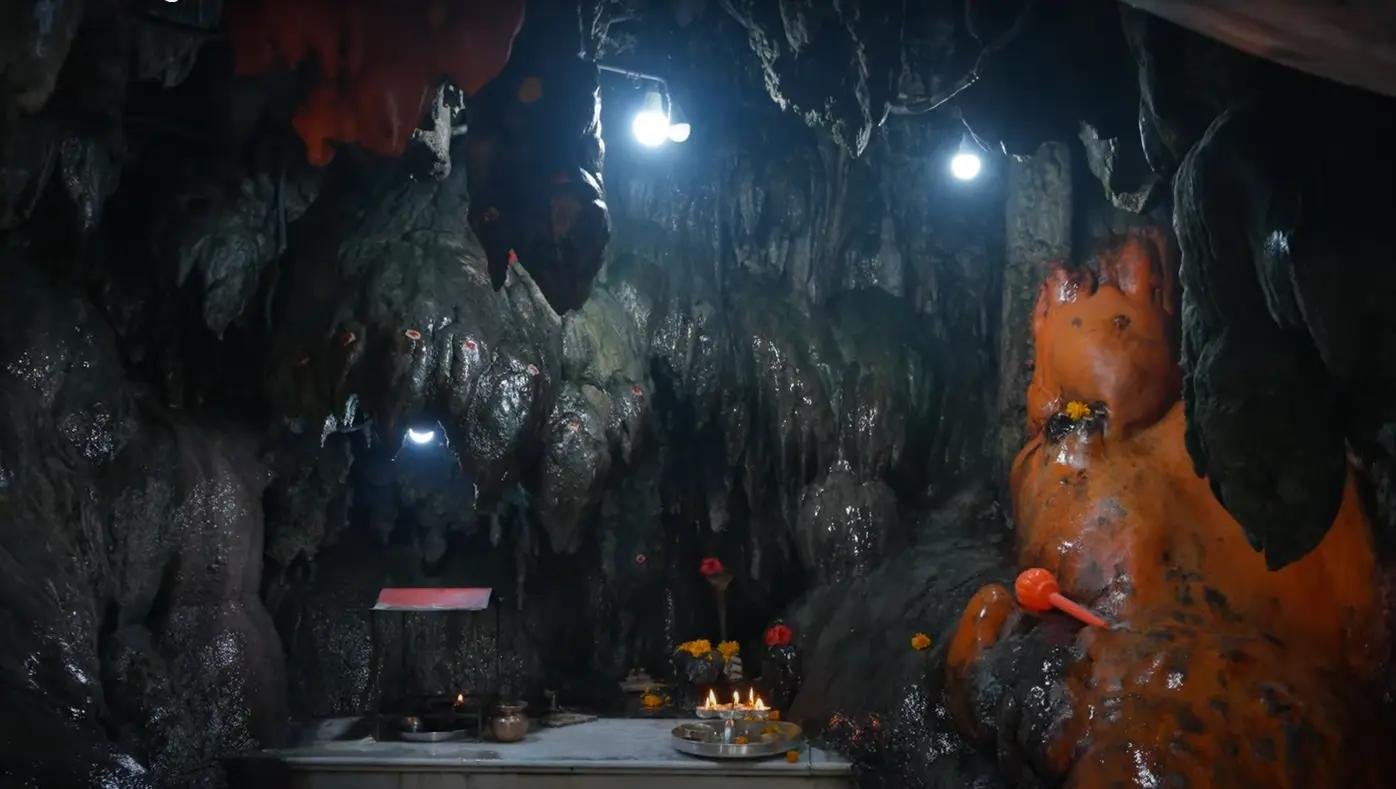
Nau Devi Cave Temple is one of the most distinctive Shakti pilgrimage destinations near Katra in the Reasi district of Jammu and Kashmir. Situated approximately 9 kilometres from Katra along the Katra–Reasi road, the shrine is centred around a natural cave where nine sacred pindis are worshipped as manifestations of the nine forms of Goddess Durga.
The temple is also known as Nau Devi Mata Mandir, Nav Devi Mandir, Nau Durga Cave Temple, Nav Durga Mandir, Nau Devi Cave Shrine and Nine Goddesses Temple near Katra.
Travellers arranging local transport should clearly specify:
Nau Devi Cave Temple on the Katra–Reasi road.
This helps distinguish the shrine from other Nav Durga temples, nine-goddess shrines and local Mata temples found across Jammu and northern India.
Nau Devi Temple offers a spiritual experience different from the large Shri Mata Vaishno Devi pilgrimage complex in the Trikuta Hills.
The Vaishno Devi journey involves a substantial uphill pilgrimage from Katra to Bhawan.
Nau Devi Cave Temple is reached primarily by road, followed by several flights of steps leading towards the cave area.
The shrine can therefore be included within a half-day or full-day spiritual itinerary from Katra without undertaking another long mountain trek.
The cave environment, natural rock formations, sacred pindis and nearby Shiv Gufa give the temple a powerful combination of Shakti and Shiva traditions.
Visitors pass from the open road and temple approach into a comparatively enclosed rock chamber.
The transition creates a symbolic movement from the visible outer world towards the hidden spiritual presence of the Divine Mother.
The nine pindis form the central focus of worship.
Rather than presenting the Goddess only through one sculpted human image, the shrine honours her through sacred natural or stone forms.
For devotees, these pindis represent the living presence of nine manifestations of Shakti.
The temple is particularly suitable for families who want to explore another important spiritual destination after visiting Shri Mata Vaishno Devi.
It is also visited by couples, children, senior citizens with manageable mobility, solo pilgrims, Shakti devotees and travellers exploring the sacred caves and temples of Reasi district.
The final steps and cave passage require care.
Rock surfaces may be damp or uneven.
The cave may feel confined during busy periods.
Visitors with severe mobility limitations, balance concerns or claustrophobia should understand the physical approach before entering.
Travellers searching for hotels near Nau Devi Cave Temple, accommodation near Nav Devi Mandir, homestays near the Katra–Reasi road, pilgrimage stays in Katra or family hotels near spiritual destinations in Reasi can use MudrasStays to plan a convenient and geographically practical journey.
## Spiritual Importance of Nau Devi Cave Temple
Nau Devi Cave Temple is dedicated to Shakti, the universal divine energy represented through the Goddess.
Within Hindu philosophy, Shakti is the active power through which consciousness becomes creation, movement, wisdom, protection and transformation.
She is present as maternal compassion, disciplined courage, learning, nourishment, justice and the ability to overcome destructive forces.
The nine sacred pindis at Nau Devi Temple express the belief that one supreme Divine Mother can reveal herself through several distinct forms.
Each form represents a different spiritual quality.
One form may represent protection.
Another may express discipline.
Another represents learning, courage, purity, nourishment or spiritual fulfilment.
The nine forms do not compete with one another.
Together, they create a complete spiritual journey.
The devotee begins with strength and purification, passes through courage and inner discipline, and eventually approaches wisdom, peace and fulfilment.
The cave setting gives this theology a physical form.
The pilgrim leaves the open surroundings, descends or moves through the temple approach and enters the enclosed sacred chamber.
This inward movement symbolises the journey from distraction towards spiritual concentration.
For many devotees, receiving darshan of all nine pindis within one cave is considered especially meaningful.
Families may pray for collective welfare rather than one individual request.
Parents may seek courage and wisdom for their children.
Students may pray for concentration and learning.
Couples may seek harmony and responsible family life.
Travellers may ask for protection during the remainder of their pilgrimage.
People facing difficulty may pray for emotional strength and clarity.
Such prayers belong to personal faith.
Nau Devi Cave Temple should not be promoted as guaranteeing fertility, marriage, employment, wealth, healing or the fulfilment of every wish.
The spiritual value of the temple lies in devotion, reflection, discipline and the confidence that pilgrims may carry back into daily life.
## Meaning of the Name Nau Devi
“Nau” means nine, while “Devi” means goddess or divine feminine presence.
Nau Devi therefore means the Nine Goddesses.
The alternate expression Nav Devi has the same basic meaning.
“Nav” is the Sanskrit-derived form commonly used in words such as Navratri and Navadurga.
Regional pronunciation and everyday speech often produce the form Nau Devi.
Both names are used for the shrine.
The name should not be misunderstood as suggesting nine unrelated supreme deities.
The nine forms are expressions of one Shakti.
A single flame can light several lamps without becoming divided.
In the same way, the Divine Mother can appear through several forms while remaining one ultimate spiritual power.
## The Nine Sacred Pindis
The principal darshan at Nau Devi Cave Temple is performed through nine pindis.
A pindi is a sacred stone or natural form through which divine presence is worshipped.
Pindi worship is deeply connected with several Shakti traditions across Jammu and Kashmir.
The most famous regional example is Shri Mata Vaishno Devi, where the supreme energies are worshipped through sacred pindis inside the Holy Cave.
At Nau Devi Temple, nine pindis are honoured collectively as nine manifestations of the Goddess.
Visitors should not treat them as ordinary stones or geological specimens.
They should not be touched, measured, moved or examined closely unless the temple’s current worship arrangements specifically permit contact.
Flowers, cloth, vermilion and other offerings should be presented only according to priestly guidance.
The temple may decorate the pindis differently during Navratri, special pujas or important religious dates.
Garlands and cloth can temporarily hide part of the natural form.
Visitors should avoid delaying the queue while attempting close-up photography.
Darshan is an act of spiritual attention rather than a demand for an unobstructed photograph.
## Navadurga: The Nine Forms of Goddess Durga
The nine forms of Durga are traditionally worshipped across the nine days of Navratri.
They are commonly known as Shailaputri, Brahmacharini, Chandraghanta, Kushmanda, Skandamata, Katyayani, Kalaratri, Mahagauri and Siddhidatri.
The nine pindis at Nau Devi Temple are worshipped collectively as nine divine forms.
The exact individual naming or arrangement of each pindi should follow the explanation provided by the temple priest or authorised local tradition rather than assumptions made by visitors.
The Navadurga framework nevertheless helps pilgrims understand the larger spiritual meaning of ninefold Goddess worship.
## Maa Shailaputri
Shailaputri means Daughter of the Mountain.
She is associated with the Himalayas and represents stability, purity and the beginning of spiritual discipline.
The mountain remains firm through changing weather.
It therefore symbolises the steady foundation required for any meaningful journey.
For pilgrims arriving in the Trikuta and Reasi hill region, Shailaputri carries a particularly appropriate symbolism.
She reminds visitors that spiritual progress begins with grounded conduct, patience and respect for nature.
## Maa Brahmacharini
Brahmacharini represents discipline, devotion and the pursuit of spiritual knowledge.
She is traditionally associated with Goddess Parvati’s intense penance to attain Shiva.
Her form teaches that lasting achievement requires patience rather than instant reward.
Students may connect her with focused learning.
Pilgrims may understand her as the strength required to continue prayer despite difficulty.
Her message is not withdrawal from all responsibility.
It is the ability to direct energy towards a meaningful purpose.
## Maa Chandraghanta
Chandraghanta represents courage, alertness and the protection of dharma.
Her name refers to a crescent moon resembling a bell.
The bell symbolises awakening.
Its sound interrupts distraction and calls the mind towards sacred awareness.
Chandraghanta reminds devotees that compassion does not mean weakness.
Protecting the vulnerable may require courage and decisive action.
## Maa Kushmanda
Kushmanda is associated with creative energy, light and the cosmic source of life.
She is sometimes described in sacred tradition as bringing light into darkness through her divine smile.
The teaching can be understood symbolically.
A small act of wisdom can change a situation dominated by confusion.
A kind action can transform an atmosphere of fear.
Kushmanda represents constructive energy rather than uncontrolled activity.
## Maa Skandamata
Skandamata is the mother of Skanda or Kartikeya.
She represents motherhood, protection and the responsibility of nurturing courage and wisdom in the next generation.
Her form is especially meaningful for families visiting Nau Devi Temple with children.
Motherhood here is not limited to biological parenthood.
It includes every form of care, guidance and responsibility through which another life is supported.
## Maa Katyayani
Katyayani is a powerful warrior form of the Goddess.
She represents the courage to confront injustice, arrogance and harmful conduct.
Her strength is disciplined rather than impulsive.
Devotees may pray for the confidence to make difficult but ethical decisions.
Katyayani worship is also connected in some traditions with prayers concerning marriage.
Such prayers should be understood as expressions of faith, not as guaranteed outcomes.
## Maa Kalaratri
Kalaratri is one of the fiercest forms of the Goddess.
Her dark appearance represents the power that enters fear itself and destroys it.
She teaches that spirituality does not require ignoring darkness.
It requires developing the courage to face uncertainty, grief, injustice and inner weakness.
A cave shrine provides an appropriate setting for understanding this symbolism.
Darkness inside the cave is not necessarily negative.
It can represent the unknown inner space where fear is recognised and transformed.
## Maa Mahagauri
Mahagauri represents purity, peace, forgiveness and renewal.
Purity should not be reduced to external appearance.
It refers to clarity of intention, honesty and freedom from destructive attachment.
Her form reminds devotees that transformation is possible after difficulty.
A person is not permanently defined by one mistake when genuine responsibility, correction and growth follow.
## Maa Siddhidatri
Siddhidatri is the form associated with spiritual fulfilment and accomplishment.
She represents the completion of the Navadurga journey.
True accomplishment is not the ability to impress others through supernatural claims.
It is the development of wisdom, humility and responsible conduct.
The end of a pilgrimage should therefore become the beginning of better action in everyday life.
## One Goddess Expressed Through Nine Qualities
The sequence of Navadurga can be understood as a complete map of spiritual growth.
Shailaputri provides stability.
Brahmacharini provides discipline.
Chandraghanta awakens courage.
Kushmanda expresses creative energy.
Skandamata teaches care.
Katyayani provides the strength to confront injustice.
Kalaratri removes fear.
Mahagauri brings purification and peace.
Siddhidatri represents fulfilment.
A pilgrim visiting Nau Devi Cave Temple can reflect upon all nine qualities rather than approaching the shrine with only one material demand.
The deepest blessing may be the ability to live with greater courage, responsibility and compassion.
## The Natural Cave
The cave is the defining physical feature of Nau Devi Temple.
Natural caves hold a special position within the spiritual geography of Jammu and Kashmir.
They represent the hidden interior of the earth and create an environment of silence, enclosure and concentration.
Several important regional shrines, including Vaishno Devi, Shiv Khori and Baba Dhansar, are connected with caves or natural rock formations.
The cave at Nau Devi Temple differs in size, route and religious identity from these larger pilgrimage sites.
Visitors should not assume that all cave shrines require the same physical effort or follow identical customs.
The Nau Devi cave contains naturally irregular rock surfaces.
Its ceiling and walls may remain damp.
Lighting has been introduced to help pilgrims move safely and observe the sacred area.
Railings, flooring or steps may also be present according to current management arrangements.
These additions support safe access but do not turn the natural cave into an ordinary indoor hall.
Visitors should remain attentive to low rock, wet surfaces and confined passages.
## Spiritual Symbolism of Entering a Cave
Entering a cave can be understood as a movement towards the inner self.
The external world is filled with sound, movement and social identity.
Inside a cave, the visitor encounters rock, darkness, limited space and the sound of water or devotional prayer.
Ordinary distractions become less important.
The experience can symbolise entering the spiritual heart.
The nine pindis within the cave suggest that several divine qualities already exist within the hidden depth of consciousness.
The pilgrimage is therefore not only a journey to an external location.
It is an invitation to discover courage, wisdom and discipline within oneself.
## Cave Safety
The cave requires careful movement.
Visitors should wear footwear with dependable grip until reaching the point where shoes must be removed.
Smooth sandals can become unsafe on damp steps.
Senior citizens should use railings and family assistance.
Young children should remain beside an adult.
Large backpacks and luggage should not be carried into confined spaces.
People with severe claustrophobia, breathing difficulty or balance problems should assess the cave before entering.
The queue should move steadily.
Visitors should not reverse direction against the flow unless guided by temple staff.
Selfies, flash photography and prolonged video recording can obstruct movement.
Religious enthusiasm should never replace basic physical caution.
## The Temple Steps
Official tourism imagery documents a stair approach to Nau Devi Mandir.
Several flights of steps lead towards the cave and associated shrine areas.
The total effort depends upon the current parking point, entrance route and any changes introduced for crowd management.
Visitors should not depend upon one exact step count quoted in an old review.
A person beginning from a different parking position may encounter a different number of steps.
The route is manageable for many families but requires a return climb.
Senior citizens should descend slowly because downhill movement can place pressure on the knees.
The return ascent may feel more tiring, especially during summer heat.
Resting should occur only where it does not block other pilgrims.
## Shiv Gufa within the Complex
The temple complex also includes a Shiv Gufa or Shiva cave area documented in official district tourism material.
Its presence reflects the deep relationship between Shakti and Shiva.
The Goddess is active divine energy.
Shiva is pure consciousness.
Shakti without consciousness lacks stable direction, while consciousness without Shakti remains unmanifest.
A pilgrimage containing both Nau Devi darshan and a Shiva cave therefore expresses spiritual completeness.
The exact sacred objects, accessibility and worship arrangements within the Shiv Gufa should be understood through current local guidance.
Visitors should not assume that every natural rock form is a Shivling.
Only the forms recognised and worshipped through established temple tradition should be treated as sacred icons.
## Lord Ganesha and the Beginning of Worship
Some local descriptions of the cave complex refer to a sacred Ganesha form within or near the cave.
Lord Ganesha is traditionally worshipped before major undertakings.
He represents wisdom, clear beginnings and the removal of obstacles.
The relationship is appropriate within a Goddess shrine because Ganesha is the son of Shiva and Parvati.
Visitors should follow current priestly guidance regarding the location and identity of any Ganesha image or natural formation.
No rock should be labelled or decorated independently by visitors.
## Nau Devi and Shri Mata Vaishno Devi
Nau Devi Cave Temple and Shri Mata Vaishno Devi Shrine are separate pilgrimage destinations.
Both are situated in Reasi district and are associated with Goddess worship through sacred pindis, but they have different religious identities, locations and management arrangements.
Shri Mata Vaishno Devi Bhawan stands high in the Trikuta Hills and is reached through a substantial pilgrimage route from Katra.
The Holy Cave is associated with the three supreme energies worshipped as Mahakali, Mahalakshmi and Mahasaraswati.
Nau Devi Temple lies approximately 9 kilometres from Katra along the Katra–Reasi road.
It is associated with nine Devi pindis inside a separate cave complex.
A pilgrim does not require a Vaishno Devi yatra registration merely to visit Nau Devi unless a future local rule specifically introduces another requirement.
Similarly, visiting Nau Devi should not be presented as a substitute for Shri Mata Vaishno Devi darshan.
Each shrine possesses its own identity.
Many travellers respectfully include both within one broader Shakti pilgrimage.
## A Complementary Shakti Journey
A combined Vaishno Devi and Nau Devi journey can be understood as an exploration of different expressions of the Divine Mother.
At Vaishno Devi, pilgrims encounter the three supreme energies.
At Nau Devi, worship is offered through nine sacred forms.
The number three expresses fundamental divine powers.
The number nine expands these powers into a complete cycle of spiritual qualities.
Pilgrims should avoid comparing the shrines competitively.
The value of one temple does not reduce the value of another.
A respectful itinerary allows each place sufficient time and attention.
## Navratri at Nau Devi Temple
Navratri is naturally one of the most important periods for a temple dedicated to nine forms of the Goddess.
The festival is observed over nine nights and ten days.
Chaitra Navratri generally falls in March or April.
Sharad Navratri generally falls in September or October.
Each day is associated with one form of Navadurga.
Devotees may observe fasting, recite Durga Saptashati, offer flowers, participate in bhajans and attend special prayers.
The temple can receive larger crowds during both Navratri periods because many visitors travelling to Katra seek darshan at several Goddess shrines.
The road, parking area, stairs and cave passage may become congested.
Families should keep children and senior citizens close.
Groups should decide upon a meeting point before entering the cave.
Visitors should carry minimal luggage.
The exact daily puja programme, opening hours, queue system and festival decoration should be confirmed locally.
## Chaitra Navratri
Chaitra Navratri marks the spring cycle of Goddess worship.
The surrounding lower hills become greener, and the weather is often comfortable.
Rain can still occur.
The steps and cave surfaces may become slippery.
Festival visitors should arrive early and avoid depending on an immediate return taxi unless transport has been arranged.
## Sharad Navratri
Sharad Navratri is celebrated after the principal summer and rainy period.
The weather can be pleasant, while pilgrim traffic throughout Katra may remain high.
The final days around Ashtami, Navami and Vijayadashami can attract particularly large numbers of devotees.
Visitors wanting a quieter experience should choose an early weekday morning or travel outside the principal festival dates.
## Durga Ashtami and Navami
Durga Ashtami and Navami are among the most significant days of Navratri.
Families may organise Kanya Pujan, havan or community meals according to tradition.
Such ceremonies should be conducted only through authorised temple arrangements when performed within the complex.
Fire ceremonies, large gatherings and food distribution require careful management.
Visitors should reduce disposable plastic and avoid wasting prasad or meals.
## Tuesdays and Other Shakti Worship Days
Tuesday is widely associated with Goddess worship in northern India.
The shrine may receive more local devotees on Tuesdays, Sundays, public holidays and school-vacation periods.
The exact weekly crowd pattern can vary.
Travellers with flexible schedules may prefer an ordinary weekday morning.
## Daily Darshan
Current opening and closing times should be confirmed locally.
Temple hours may change because of season, cave maintenance, festivals, priestly duties or crowd management.
Morning is generally the most comfortable time for darshan.
The weather is cooler, the road is quieter and visitors have sufficient daylight for the return journey.
Late-afternoon visits can also be peaceful, but the cave and stair approach should be completed before darkness unless proper lighting and transport arrangements are confirmed.
## Best Time to Visit Nau Devi Cave Temple
The temple can generally be visited throughout the year, subject to weather, access and local arrangements.
### Spring
Spring is one of the best seasons.
The weather is usually comfortable, the surrounding hills become greener and Chaitra Navratri creates a vibrant spiritual atmosphere.
A light rain jacket and shoes with reliable grip are useful.
### Summer
Summer in Katra and the lower Reasi hills can become hot.
The cave may feel cooler than the road, but the return stair climb can be tiring.
Visitors should arrive during the morning, carry drinking water and avoid the hottest afternoon hours.
Senior citizens and children require adequate rest.
### Monsoon
The monsoon brings green vegetation and cooler periods but creates important safety concerns.
Heavy rain can make roads, steps and cave surfaces slippery.
Water may enter drainage channels or flow across parts of the approach.
Falling stones and local road disruption are possible in hill terrain.
Visitors should check weather conditions and obey every closure.
Unauthorised shortcuts should not be used.
### Autumn
Autumn is among the most comfortable seasons for pilgrimage.
Rain generally decreases, temperatures become pleasant and Sharad Navratri brings major religious activity.
Visitors seeking quiet darshan should travel after the festival or during an ordinary weekday.
### Winter
Winter is cool and generally manageable.
Morning and evening temperatures can fall significantly.
The cave may feel colder and damper than the open road.
Regular snowfall should not be expected at Nau Devi Temple because it lies in the lower hill region, though weather can still affect roads.
Warm layers and stable footwear are recommended.
## Reaching Nau Devi Cave Temple from Katra
Official Reasi district information places Nau Devi Mata Mandir approximately 9 kilometres from Katra.
The temple lies directly along the Katra–Reasi road corridor.
A local taxi, private vehicle or prearranged cab is generally the easiest method of travel.
Visitors should agree upon waiting time or return arrangements with the driver.
Immediate public transport may not always be available at the exact moment the visit ends.
The road journey is relatively short, but travel time can increase because of traffic, pilgrimage-season restrictions, rain or road work.
## Reaching from Shri Mata Vaishno Devi Katra Railway Station
The temple is approximately 9 kilometres from Shri Mata Vaishno Devi Katra Railway Station according to official district information.
Travellers arriving by train can hire a taxi after checking into accommodation or storing their luggage securely.
Large suitcases should not be carried to the cave.
Visitors arriving very early or late should confirm whether the temple is open before leaving the station.
## Reaching from Jammu
Jammu is the principal air and long-distance rail gateway for Katra.
Nau Devi Temple is approximately 59 kilometres from Jammu Airport according to official district information.
Actual road time depends upon traffic, the starting neighbourhood and highway conditions.
Travellers can visit the temple while travelling between Jammu and Katra only when the vehicle route and available daylight make the diversion practical.
A stay in Katra provides a more relaxed experience.
## Reaching from Reasi
Nau Devi lies on the road connecting Katra and Reasi.
Travellers staying in Reasi can visit the temple while proceeding towards Katra.
The exact journey time depends upon the Reasi starting point and current road condition.
A Reasi-based itinerary can combine Nau Devi with Baba Dhansar, Bhimgarh Fort or Dera Baba Banda Bahadur across one or two days.
## Parking and Final Approach
Parking or vehicle drop-off arrangements may change during festivals and peak periods.
Visitors should use authorised parking and should not stop vehicles on narrow turning points.
The final approach contains stairs and pedestrian pathways.
Shops selling prasad, flowers and refreshments may operate near the entrance.
Pilgrims should avoid excessive plastic packaging and should carry all waste to designated bins.
## Accessibility for Senior Citizens
Nau Devi Temple does not require the long trek associated with Vaishno Devi Bhawan, but the stairs and cave environment still require physical effort.
Senior citizens should visit during cooler and quieter hours.
Railings should be used.
People with significant knee, heart, breathing or balance concerns should understand the approach before descending.
The current availability of assisted access should be confirmed rather than assumed.
Visitors who cannot enter the cave safely may offer prayers from an appropriate outer area according to local guidance.
A spiritually meaningful visit does not require ignoring physical limitations.
## Visiting with Children
Children can learn about the nine forms of Durga, cave worship and responsible pilgrimage.
They should remain beside an adult on the stairs and inside the cave.
Running, pushing, climbing on rocks and touching sacred pindis should not be permitted.
Parents should prepare children for the possibility of a dark, damp or confined chamber.
A frightened child should not be forced into the cave.
Water, simple snacks and necessary medicine should be carried, while all packaging must be removed responsibly.
## Visitors with Claustrophobia
A natural cave can feel uncomfortable for people who experience claustrophobia.
Crowds can increase the sense of confinement.
Visitors should observe the entrance and ask about the passage before entering.
They should travel during a quiet period and avoid carrying large bags.
If discomfort begins, staff or accompanying family should be informed.
There is no spiritual failure in choosing not to enter a confined area that creates a genuine health concern.
## Temple Etiquette
Visitors should dress respectfully and remove footwear wherever directed.
Phones should remain silent.
Photography of the nine pindis, inner cave, priests and private rituals should only be undertaken with permission.
Flash photography can disturb worshippers and create difficulty in a dark cave.
Visitors should not touch cave formations or collect stone.
Oil, paint, milk and vermilion should not be applied to natural rock unless clearly authorised.
Incense and lamps should remain within designated areas.
Queue barriers should not be crossed.
## Responsible Cave Tourism
Natural cave environments are sensitive.
Rock formations develop over long periods.
Repeated touching can alter their surface.
Smoke can darken walls.
Waste can block drainage.
Visitors should never carve names or religious symbols into the rock.
Coins, food and plastic should not be inserted into cracks.
Natural water should not be polluted with soap or packaged offerings.
Protecting the cave is an important expression of respect for the Goddess.
## Shri Mata Vaishno Devi Shrine
Shri Mata Vaishno Devi is the principal pilgrimage destination of Katra and one of India’s most visited sacred sites.
The Holy Cave stands in the Trikuta Hills and is reached through a substantial uphill pilgrimage.
The journey requires current yatra registration and compliance with Shrine Board arrangements.
Visitors should use only the official Shrine Board system for registrations and reserved services.
Nau Devi Temple can be visited before or after Vaishno Devi, but adequate rest should be allowed.
Pilgrims returning after a night journey to Bhawan may be too tired to negotiate additional stairs and cave passages safely.
## Baba Dhansar Temple
Baba Dhansar is another important cave and water pilgrimage destination on the Katra–Reasi side.
It contains a Shiva cave, forest waterfalls and the sacred Karua Jheel.
Nau Devi and Baba Dhansar can be combined within a carefully planned day.
Both involve steps and damp natural surroundings.
Families and senior citizens should avoid rushing.
Karua Jheel should not be entered for swimming.
## Aghar Jitto
Aghar Jitto is associated with Baba Jitto, a respected farmer-saint remembered for sacrifice, dignity and resistance to exploitation.
The site provides a cultural and social dimension beyond conventional temple tourism.
A journey combining Nau Devi and Aghar Jitto introduces travellers to both Goddess worship and Dogra rural heritage.
## Dera Baba Banda Bahadur
Dera Baba Banda Bahadur near Reasi is important to Sikh and Hindu devotees.
It preserves the memory of Banda Singh Bahadur and stands within a scenic Chenab-side setting.
The site requires a separate road journey and should be included according to available time.
## Bhimgarh Fort
Bhimgarh Fort overlooks Reasi town and reflects the region’s military and Dogra history.
Its structures have experienced several periods of rebuilding and restoration.
Visitors should follow current access restrictions and avoid unstable walls.
## Shiv Khori
Shiv Khori is a major Shiva cave shrine at Ransoo in Reasi district.
It requires a considerably longer journey from Katra than Nau Devi.
A separate full-day itinerary is preferable.
The cave environment and walking approach require their own preparation.
Nau Devi and Shiv Khori should not be treated as neighbouring half-hour stops merely because both are within Reasi district.
## Siar Baba
Siar Baba is a waterfall and pilgrimage attraction near Reasi.
Waterfall access and safety conditions should be checked before travel.
Visitors should remain within authorised areas and avoid wet rock or strong current.
## Suggested Half-Day Nau Devi Itinerary
Begin with an early departure from Katra.
Travel along the Katra–Reasi road to Nau Devi Cave Temple.
Use the authorised parking or drop-off point.
Descend the temple steps slowly.
Receive darshan of the nine pindis and visit the Shiv Gufa according to current access.
Spend quiet time within the complex without blocking the cave passage.
Return to Katra before midday or continue to one nearby road-accessible destination.
## Suggested One-Day Shakti and Shiva Circuit
Begin with morning darshan at Nau Devi Cave Temple.
Continue towards Baba Dhansar Temple.
Allow time for the forested descent and Shiva cave darshan.
Observe Karua Jheel without entering the sacred pool.
Return to Katra during the afternoon.
This itinerary should be reduced if the group contains senior citizens, very young children or pilgrims tired after the Vaishno Devi journey.
## Suggested Two-Day Katra Pilgrimage
On the first day, arrive in Katra and rest or complete local preparations for Shri Mata Vaishno Devi.
On the second day, visit Nau Devi Cave Temple and one nearby destination such as Baba Dhansar or Aghar Jitto.
Travellers completing the Vaishno Devi yatra should add an adequate recovery period rather than scheduling every site immediately after returning.
## Suggested Three-Day Reasi Spiritual Circuit
The first day can focus on Shri Mata Vaishno Devi according to registration and health.
The second day can include Nau Devi Cave Temple and Baba Dhansar.
The third day can include Reasi town, Bhimgarh Fort and Dera Baba Banda Bahadur.
Shiv Khori should ideally receive a separate full day.
## Accommodation Near Nau Devi Cave Temple
Accommodation immediately beside Nau Devi Temple may be limited.
Katra is the most practical and developed stay base.
The town offers budget hotels, family hotels, premium properties, guesthouses, resorts, dharamshalas and Shrine Board accommodation.
Properties are spread across several areas, including the railway station side, main market, Ban Ganga approach, Jammu Road and roads leading towards Reasi.
The best location depends upon the complete itinerary.
## Hotels on the Katra–Reasi Side
Travellers focused on Nau Devi, Baba Dhansar and Reasi may prefer a hotel positioned towards the relevant side of Katra.
This can reduce travel through the busiest market streets.
Guests should confirm the actual road connection rather than relying only on straight-line distance.
A property described as being near Nau Devi may still require a taxi.
## Hotels Near Katra Railway Station
Hotels near Shri Mata Vaishno Devi Katra Railway Station are convenient for travellers arriving by train.
They offer easier luggage handling and departure planning.
Visitors should confirm the road distance to Nau Devi Temple and whether the hotel can arrange an early taxi.
## Hotels Near the Main Katra Market
Central Katra provides restaurants, shops, pharmacies, pilgrimage supplies and local transport.
The area can become congested during Navratri, weekends and peak Vaishno Devi seasons.
Families should verify parking before booking.
## Hotels Near Ban Ganga and the Yatra Route
Properties near the Vaishno Devi yatra starting area are useful for pilgrims whose main priority is Bhawan.
They may be less convenient for road excursions towards Nau Devi and Reasi.
The complete itinerary should determine the hotel location.
## Shrine Board Accommodation
The Shri Mata Vaishno Devi Shrine Board provides rooms and dormitories at designated pilgrimage locations including Katra.
Availability, eligibility and booking procedures should be checked through official systems.
Shrine Board accommodation intended for Vaishno Devi pilgrims should not be confused with accommodation managed by Nau Devi Temple.
## Homestays Near Katra and the Reasi Road
Verified homestays can provide local meals, quieter surroundings and assistance with taxis.
Facilities vary.
Guests should confirm attached bathrooms, hot water, cooling, heating, meals, Wi-Fi and parking.
A local host may provide current information about temple hours and road conditions.
## Hotels in Reasi
Reasi can serve as an alternative base for travellers focusing on the district’s broader attractions.
It offers hotels, guesthouses, markets, hospitals and local transport.
A Reasi stay is suitable for combining Nau Devi with Bhimgarh Fort, Dera Baba Banda Bahadur and Chenab-side destinations.
Visitors whose principal purpose is Vaishno Devi will generally find Katra more convenient.
## Choosing the Right Accommodation
Pilgrims combining Nau Devi with Vaishno Devi should usually stay in Katra.
Visitors focused on Nau Devi, Baba Dhansar and Reasi should choose a property with convenient access to the Katra–Reasi road.
Families should verify room size, meals and parking.
Senior citizens should prioritise lifts, ground-floor rooms and dependable taxis.
Couples may prefer quieter hotels or homestays outside the busiest market.
Solo pilgrims should select populated accommodation close to transport.
Groups should confirm several rooms, vegetarian meals and parking for larger vehicles.
Navratri visitors should reserve accommodation early.
Summer guests should confirm air-conditioning or effective cooling.
Winter travellers should verify hot water and room heating.
## Book Hotels Near Nau Devi Cave Temple with MudrasStays
MudrasStays helps pilgrims, families and spiritual travellers discover hotels, homestays, guesthouses and pilgrimage accommodation near Nau Devi Cave Temple, Katra and the Katra–Reasi road.
The platform is designed specifically for travellers searching for places to stay near temples, sacred caves and pilgrimage destinations.
Visitors can compare accommodation according to practical driving distance from Nau Devi Temple, room type, budget, family size and required facilities.
Booking on the correct side of Katra can reduce unnecessary travel through congested market areas.
Solo pilgrims can search for affordable guesthouses.
Couples can explore peaceful homestays and quieter hotels.
Families can choose properties offering meals, parking and comfortable room capacity.
Senior citizens can prioritise accessible hotels with lifts and reliable taxi services.
Vaishno Devi pilgrims can select properties offering luggage storage, early meals and convenient yatra transport.
Pilgrimage groups can identify hotels providing multiple rooms, vegetarian food and suitable vehicle parking.
Travellers combining Nau Devi with Baba Dhansar, Aghar Jitto, Reasi, Dera Baba Banda Bahadur or Shiv Khori can select accommodation according to the actual sequence of the journey.
MudrasStays helps pilgrims avoid booking a hotel that appears close on a map but lies on an inconvenient side of Katra or requires repeated travel through crowded roads.
## Responsible Pilgrimage
Nau Devi Cave Temple is both an active place of worship and a sensitive natural cave environment.
Visitors should dress respectfully and follow the designated route.
The nine pindis, Shiv Gufa, priests and private rituals should only be photographed when permission is clear.
Sacred stones should not be touched or tested.
Coins and objects should not be inserted into cave cracks.
Plastic bottles, flower packaging, food wrappers and cloth must not be left inside the cave.
Incense and lamps should remain in authorised areas.
Children should stay beside adults.
Queue movement should not be obstructed by photography.
Donations should be made through recognised counters or representatives.
Visitors should avoid unauthorised persons promising guaranteed blessings, cures or special access.
## Respecting the Local Area
The Katra–Reasi road passes through living settlements and hill communities.
Vehicles should not block village entrances or emergency routes.
Private land should not be entered without permission.
Residents should not be photographed casually.
Local taxi drivers, shopkeepers, priests, food providers and accommodation hosts should be treated fairly.
Supporting responsible local services allows pilgrimage tourism to benefit the wider community.
## A Sacred Cave of Nine Divine Powers
Nau Devi Cave Temple represents a powerful meeting of Shakti worship, natural cave spirituality and the pilgrimage landscape of Katra.
The nine pindis express the many qualities of one Divine Mother.
Shailaputri represents stability.
Brahmacharini teaches discipline.
Chandraghanta awakens courage.
Kushmanda expresses creative light.
Skandamata represents care.
Katyayani confronts injustice.
Kalaratri removes fear.
Mahagauri brings purification.
Siddhidatri represents spiritual fulfilment.
The cave represents the hidden inner world.
The stairs transform physical movement into spiritual preparation.
The Shiv Gufa expresses the inseparable relationship between Shiva and Shakti.
The proximity to Vaishno Devi places Nau Devi within one of India’s most important Goddess pilgrimage regions.
Navratri gives the shrine a complete nine-day sacred cycle.
For Shakti devotees, Nau Devi Temple is a place to honour the Divine Mother through nine forms.
For Vaishno Devi pilgrims, it provides an additional and distinct cave-darshan experience near Katra.
For families, the shrine creates an opportunity to teach children about courage, wisdom and spiritual discipline.
For senior citizens, road access makes the destination more manageable than a long mountain trek, although the steps require careful planning.
For couples, the temple offers a peaceful prayer experience away from the busiest parts of Katra.
For cultural travellers, the shrine demonstrates the importance of pindi and cave worship within Jammu’s sacred geography.
For photographers, the rock chamber and temple approach can be visually memorable when religious dignity and photography rules are respected.
For spiritual seekers, the cave reminds them that the qualities represented by the nine goddesses must ultimately be developed within daily conduct.
Nau Devi Cave Temple should not be treated merely as a brief roadside attraction after Vaishno Devi.
Its nine-pindi tradition deserves attentive darshan and thoughtful interpretation.
Descend the steps patiently.
Enter the cave without rushing.
Allow the eyes and mind to adjust to the darker space.
Receive darshan without blocking other devotees.
Respect the Shiv Gufa.
Protect the natural rock.
Carry all waste back.
Return from the pilgrimage with greater courage, compassion and discipline.
Plan your pilgrimage to Nau Devi Cave Temple with MudrasStays and experience one of the most distinctive Goddess shrines near Katra.
Seek the blessings of the nine divine forms, receive darshan of the sacred pindis and experience the spiritual atmosphere of the natural cave.
Combine your journey with Shri Mata Vaishno Devi, Baba Dhansar Temple, Aghar Jitto, Dera Baba Banda Bahadur, Bhimgarh Fort, Reasi and Shiv Khori.
Book hotels near Nau Devi Cave Temple, discover homestays along the Katra–Reasi road and explore suitable pilgrimage accommodation throughout Katra through MudrasStays.
Stay closer to the correct road, attend peaceful morning darshan and reduce unnecessary travel through crowded pilgrimage areas.
MudrasStays connects pilgrims, families and spiritual travellers with suitable accommodation near temples, caves and sacred destinations across India.
Begin your Nau Devi Cave Temple journey with a comfortable stay and experience a meaningful pilgrimage centred on the nine forms of Goddess Durga, sacred pindis, natural cave worship and the spiritual landscape of Katra and Reasi.