
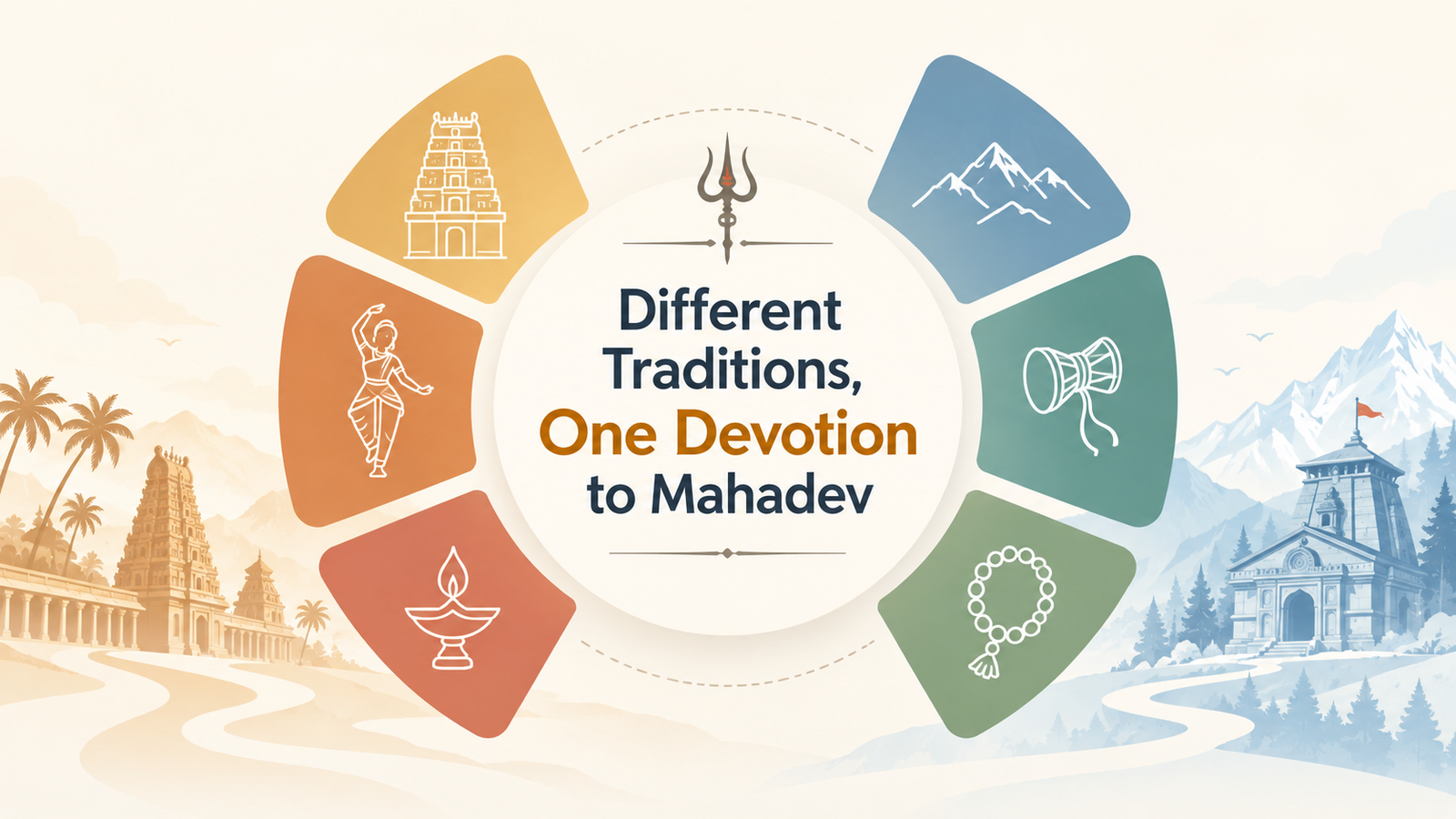
North Meets South at Kedarnath: Different Traditions, One Devotion to Mahadev
A Char Dham Yatra begins long before the mountains appear. Families decide dates, discuss health, arrange registration, plan food, carry medicines and often make a personal or family sankalp. By the time they reach Kedarnath, the pilgrimage already contains habits and commitments carried from home. This article explores north meets south at kedarnath: different traditions, one devotion to mahadev without treating any regional custom as compulsory or universal.
ONE SACRED JOURNEY, MANY WAYS OF LIVING IT
South India contains many distinct devotional traditions, so there is no single South Indian Char Dham custom. Tamil Shaiva families, Sri Vaishnava households, Telugu devotional groups, Kannada-speaking pilgrims and Kerala families may all carry different prayers, foods and temple memories into the Himalayas.
Badrinath has a particularly meaningful bridge to the South. The shrine follows a Vaishnav worship tradition, and the chief priest, known as the Rawal, is traditionally drawn from the Nambudiri Brahmin community of Kerala. For some South Indian devotees, that connection creates a sense that the Himalayan temple is distant in geography but not entirely distant in ritual memory.
Kedarnath can resonate deeply with devotees who grew up visiting major Shiva temples in Tamil Nadu, Karnataka, Andhra Pradesh, Telangana or Kerala. The climate, altitude and trek are dramatically different, but the devotional vocabulary—Mahadev, Shiva nama, vibhuti, mantra and temple discipline—can feel familiar.
Food is often adapted rather than reproduced exactly. Some families carry podi, dry snacks, ready rice mixes or other items that keep well. Others eat locally available vegetarian meals and simply avoid foods they personally do not take. The purpose is to remain nourished without losing the family's sense of order.
Long-distance travel from southern India also changes the logistics. Flights, trains, road transfers and additional rest days may be needed before the mountain section even begins. Good accommodation at the Dhams becomes especially valuable because the pilgrim may already have spent several days reaching Uttarakhand.
The perspective suggested by North Meets South at Kedarnath: Different Traditions, One Devotion to Mahadev becomes clearer when we remember how far many South Indian pilgrims travel before the Himalayan portion even begins. A family may already have completed a flight or long train journey before reaching Haridwar, Rishikesh or another Uttarakhand gateway.
Temple experience also changes dramatically. South Indian devotees accustomed to elaborate gopurams, warm weather and long temple corridors enter a Himalayan landscape where snow peaks, cold air and compact pilgrimage towns create a very different sensory world.
That contrast does not weaken familiarity. Shiva and Vishnu devotion provide a spiritual bridge. Kedarnath may be understood through long-standing Shaiva devotion, while Badrinath can connect naturally with Vaishnava worship traditions familiar across southern India.
The practical result is that rest matters. A family that has travelled thousands of kilometres should not treat the final mountain day as if it were the beginning of the journey. Confirmed accommodation and a slower itinerary can preserve energy for darshan.
Regional language, food and prayer may remain important, but the Yatra also becomes an encounter with northern pilgrimage culture. That exchange is part of what makes the journey memorable.
FOOD, WATER, FASTING AND THE MEANING OF SANKALP
Food on a pilgrimage is rarely only about taste. It can represent discipline, purity, memory, health and family continuity. A person who avoids onion and garlic may be following a satvik preference, a sect-specific practice or simply a household rule that has become emotionally connected to prayer.
Home food can provide reassurance on difficult travel days. Dry items are easier to carry than cooked dishes, while elderly travelers may feel more comfortable eating something familiar. At the same time, food should be packed safely, replaced when stale and balanced with enough fluids and fresh meals.
Fasting also takes many forms. Some devotees skip one meal, some eat fruit, some take only simple vegetarian food and some fast only until darshan. There is no single Kedarnath or Badrinath fasting rule that every pilgrim is expected to follow.
Water deserves the same care. Pilgrims should not let a personal vow lead to dehydration. The Kedarnath route involves physical exertion and Badrinath is also at high altitude, so hydration and medical advice matter.
A sankalp may continue after darshan. A devotee who gave up a habit for the Yatra may wait until returning home before resuming it. Another family may distribute prasad, visit a local temple or complete charity promised before departure.
The best way to understand these practices is to ask what they mean to the person following them. The same act—carrying food, avoiding tea, fasting, drinking only sealed water—can have a devotional meaning for one traveler and a purely practical meaning for another.
PREPARING THE FAMILY FOR THE HIMALAYAN JOURNEY
The spiritual side of Char Dham works better when the logistical side is organised. Uttarakhand's official Tourist Care system requires Yatra registration and advises pilgrims to keep the registration certificate, valid identification and prescribed medicines ready. Warm clothing and responsible travel are also part of the official checklist.
Mountain roads cannot be planned like city roads. Distance may appear short on a map while the actual journey takes much longer because of traffic, weather, road controls and steep terrain. Families should avoid building a schedule that leaves no buffer.
Senior citizens need particular attention. Meal times, medicines, toilet breaks, sleep and walking pace should be discussed before departure. A family that respects an elder's physical limits is often able to complete the Yatra more peacefully than one that tries to keep up with an unrealistic timetable.
Children also need structure. Warm layers, simple food, water, familiar snacks and enough rest can prevent the trip from becoming exhausting. A child should not be expected to follow an adult's fasting vow merely because the family is on pilgrimage.
Pilgrims should keep one small day bag with medicines, identity documents, rain protection, water and essentials. Large luggage is better left at an appropriate lower base when heading to Kedarnath, where carrying unnecessary weight makes the trek harder.
Advance stay planning is especially useful during peak pilgrimage periods. Arriving tired and then searching for a place to sleep can create stress exactly when the family wants to focus on darshan and rest.
PLANNING THE KEDARNATH STAY: MUDRAS KEDARNATH
The Kedarnath leg is physically demanding, which is why choosing a confirmed stay in Kedarnath before starting the upper journey can make a major difference. Pilgrims often search for a hotel near Kedarnath Temple, accommodation in Kedarnath or a simple overnight stay in Kedarnath, but the most important factor is clarity about what the stay actually provides.
Mudras Kedarnath can be considered for a practical pilgrimage stay in the Kedarnath area. Current Mudras information highlights sharing-tent options for 2, 4 and 6 travelers, making Mudras Kedarnath relevant to couples, small families, friends and larger pilgrim groups.
Travelers should approach Mudras Kedarnath as straightforward Himalayan pilgrimage accommodation rather than a city-style luxury hotel. The value is a planned place to rest after a demanding journey, the ability to keep a group together and less uncertainty after reaching the upper area.
Before confirming Mudras Kedarnath, ask about the current tent or stay format, bedding, washroom access, meal arrangements, check-in process and exact approach for your travel date. Seasonal conditions in Kedarnath can change quickly, so old information should never replace current confirmation.
For many pilgrims, an overnight stay near Kedarnath Temple creates a more humane itinerary. Instead of climbing, completing darshan and descending under pressure, the family can arrive, settle at Mudras Kedarnath, rest, complete evening or early-morning darshan and begin the return after proper sleep.
Families searching for rooms near Kedarnath Temple, tent stay in Kedarnath or Kedarnath Yatra accommodation should match the stay to the group size. A Sharing Tent for 2 can suit two travelers; Sharing Tent for 4 can work for a small family or friends; Sharing Tent for 6 may be useful for a larger family or pilgrim group.
The stay at Mudras Kedarnath should support the spiritual purpose. Keep only one-night essentials with you, protect medicines from moisture, carry warm layers and rain protection, and avoid filling the tent with unnecessary luggage.
Advance planning for Mudras Kedarnath is particularly important during weekends, holidays and high-demand Yatra dates because upper-area accommodation choices are limited compared with ordinary hill stations.
RESPECTING OTHER PILGRIMS AND THEIR TRADITIONS
Char Dham etiquette is partly about temple rules and partly about living respectfully among thousands of strangers. The route becomes easier when pilgrims accept that someone else's practice may be unfamiliar without being wrong.
Do not pressure another traveler to eat food they have chosen to avoid. Do not assume a person carrying their own water is being difficult. Do not treat a strict fast as proof of greater devotion or a simple meal as evidence of lesser faith.
Temple queues need patience. Follow local instructions, avoid blocking passages for photographs and give older pilgrims enough space to move safely. A few minutes of consideration can matter more than a loud display of religiosity.
Keep mountain areas clean. Carry waste until a proper disposal point is available, avoid leaving plastic near rivers or paths and respect the people who live and work in the pilgrimage region.
Group leaders should avoid shouting or creating pressure in crowded spaces. Calm coordination is safer and more respectful, particularly when children and senior citizens are part of the group.
The same courtesy applies inside accommodation. Respect quiet hours, shared facilities and other guests' routines. Everyone staying near the Dham has usually had a long day and may be preparing for early darshan.
THE JOURNEY AFTER DARSHAN
The return journey can be spiritually important because it is when the family begins to process what happened. The intense physical effort of the route often gives way to reflection once the mountains are behind.
Some families distribute prasad to relatives or neighbors. Others visit their local temple, complete a promised donation or gather for a simple meal. None of these acts is mandatory, but each can help close the emotional circle of the journey.
A pilgrim who took a sankalp may decide whether to end it immediately after darshan, after leaving Uttarakhand or only after reaching home. The correct point is the one consistent with the intention that was made at the beginning.
Families often discover that the most memorable part of Char Dham was not a photograph but a moment of cooperation: helping an elder, sharing food, waiting for a slower traveler or simply sitting quietly after darshan.
The Yatra can also change future travel habits. A family that experienced the value of advance accommodation, lighter luggage and realistic pacing is usually better prepared for its next Himalayan pilgrimage.
In that sense, Char Dham does not end at the temple gate. The lessons of discipline, patience, simplicity and shared responsibility can travel home with the pilgrim.
The best travel memories often come from unplanned pauses: tea after a cold morning, a conversation with another pilgrim, a shared blanket or the first quiet moment after reaching the Dham.
Char Dham also teaches scale. The mountains remind pilgrims that personal plans are small compared with weather, terrain and the flow of thousands of travelers. Flexibility is therefore not a compromise; it is part of good pilgrimage practice.
A good pilgrimage itinerary is intentionally conservative. It assumes that roads may be slow, queues may be long and someone in the family may need more rest than expected. This is not wasted time; it is what prevents the journey from turning into an argument with the clock.
The emotional experience of darshan can also vary. Some pilgrims feel immediate joy, some become quiet, some cry and some feel almost nothing until hours later. There is no correct emotional response to a sacred place.
Photography should remain secondary to movement and worship. Crowded temple areas are easier for everyone when people avoid blocking passages or delaying queues for repeated pictures.
Families following special diets should identify which rules are essential and which are preferences. This makes it easier to respond calmly when the exact planned meal is unavailable.
Pilgrimage groups should agree in advance on what happens if one person becomes tired, sick or separated. A simple meeting point, shared contact list and clear group leader can prevent panic.
Cold weather changes appetite and energy. Even travelers who usually eat lightly may need warm food and more calories. Devotional discipline should adapt to the physical environment.
The return journey deserves planning too. Fatigue accumulates over several days, so families should avoid scheduling unnecessary long drives immediately after the final darshan.
A stay is valuable when it reduces decisions. Knowing where the family will sleep, eat and keep luggage allows the day to remain centered on the Yatra rather than logistics.
MAKING THE CHAR DHAM JOURNEY MORE MEANINGFUL AND MANAGEABLE
After returning home, families may decide to complete the journey with prasad distribution, charity, a visit to a local temple or a meal shared with relatives. Others may simply rest and return to normal life. There is no requirement that the Yatra end with a public ritual. What matters is whether the pilgrim feels the commitment has been completed in the way it was originally intended.
Future pilgrimage planning often improves because of what the family learned on the first journey. People discover which foods travelled well, how much luggage was unnecessary, how early accommodation should be booked and how much rest elders actually required. These lessons can make a future Char Dham, Panch Kedar or other Himalayan Yatra more comfortable without making it less spiritual. Good preparation and sincere devotion are not opposites; in the mountains, they support each other.
The most practical way to think about Char Dham is to divide the journey into spiritual priorities and physical realities. Darshan may be the reason for travelling, but roads, weather, altitude, food, sleep and group coordination determine how peacefully the family reaches that moment. A pilgrim who treats logistics as part of the sacred responsibility of the Yatra is often better able to protect the mood of prayer than someone who leaves every practical decision until the last minute.
Travel days should be planned around the slowest member of the group rather than the fastest. A younger traveler may be able to move quickly after a short break, while a senior citizen may need regular meals, medicine timing and longer rest. When the itinerary respects the most vulnerable traveler, the entire family usually becomes calmer. This is particularly important in Uttarakhand because a short distance on a mountain map can still involve a long and tiring day.
Accommodation is not separate from pilgrimage discipline. A confirmed stay gives the family a fixed place for medicines, luggage, bathing, changing warm clothes, eating and resting after darshan. It also reduces the emotional pressure that comes from searching for rooms in an unfamiliar town at the end of a long day. That is why advance planning for Kedarnath and Badrinath should happen as soon as the main Yatra dates are reasonably clear.
For the Kedarnath leg, Mudras Kedarnath can be useful when travelers want a simple, planned place to rest in the upper pilgrimage area. The importance of Mudras Kedarnath is not luxury positioning; it is certainty, group coordination and the ability to reach the Dham knowing where the night will be spent. Couples, small families and larger groups can compare the available sharing formats according to the number of pilgrims traveling together.
Before finalizing Mudras Kedarnath, families should ask very direct questions: what is the exact current stay format, how is bedding arranged, what washroom access is available, what should be carried personally, and what happens if weather delays arrival? Clear answers are more valuable than assumptions. Pilgrims should also keep the booking confirmation and contact details accessible offline because network conditions can be inconsistent in mountain areas.
The physical challenge of Kedarnath also changes how food vows should be handled. A person who normally fasts comfortably at home may feel very different after a long climb in cold weather. The family should distinguish between spiritual intention and unnecessary physical risk. Warm fluids, adequate water and enough energy to walk safely do not weaken devotion. A responsible pilgrim adjusts the form of a vow when health genuinely requires it.
Badrinath allows a different rhythm because pilgrims can reach the town by road during the open season. Staying at Hotel Yoga Badrinath can help families settle inside Badrinath before planning temple darshan and nearby spiritual stops. Current information places Hotel Yoga Badrinath near the bus stand, with Badrinath Temple about a 15-minute walk away, so the hotel can function as a practical base rather than a distant transit stop.
The facilities at Hotel Yoga Badrinath matter because Badrinath travel often includes senior citizens and families arriving after a long drive. Private bathrooms, restaurant access, parking, Wi-Fi, room service, baggage storage and elevator access can all reduce friction. The value of Hotel Yoga Badrinath is therefore not only the room itself but the number of separate arrangements the family does not have to make after reaching the Dham.
A slower Badrinath plan can improve the entire experience. Instead of arriving, rushing straight to the temple and leaving the next morning, families can allow the first evening to be about settling in and adjusting to the cold. The next day can begin with darshan, followed by Tapt Kund and Brahma Kapal, while Mana Village can be considered later if weather, road conditions and energy levels allow. This spacing is especially helpful for elders.
The same principle of pacing applies to regional traditions. A family may want to perform a prayer at a particular time, carry specific food or maintain a daily chant, but a pilgrimage route is not a controlled home environment. Traffic, weather and temple queues may alter the schedule. The tradition can still remain meaningful when the family preserves the intention while adapting the exact timing to the realities of the mountain journey.
Pilgrims should also prepare emotionally for the fact that darshan may be brief. Long journeys create expectations, yet the actual time near the deity can be short because of crowd movement and temple management. Families often find greater meaning when they treat the entire journey—preparation, travel, restraint, care for elders, waiting, darshan and return—as the pilgrimage, rather than judging the experience only by the number of minutes spent inside the shrine.
Regional identity can become a source of comfort far from home. Hearing one's own language, sharing a familiar snack or meeting another group from the same state can provide reassurance. At the same time, Char Dham also offers a rare opportunity to observe the devotional cultures of other parts of India. The goal is not to compare whose tradition is superior but to recognize how many different family histories can converge around the same sacred destination.
The journey is also a lesson in practical humility. A well-made plan can still be disrupted by rain, traffic, health or crowd control. Families that accept flexibility usually cope better than groups that treat every delay as a failure. In spiritual terms, patience may become as important as fasting, chanting or ritual. The ability to remain considerate under pressure is often one of the most demanding disciplines the Yatra asks of a pilgrim.
Plan Your Kedarnath–Badrinath Yatra
FREQUENTLY ASKED QUESTIONS
Do all families from one state follow the same Char Dham traditions?
No. Customs vary by family, sect, generation, health needs and personal sankalp. Regional patterns should never be treated as universal rules.
Is no-onion, no-garlic food compulsory during Char Dham Yatra?
No. Some families follow a satvik or personal dietary discipline, but it is not a compulsory rule for every pilgrim.
Can pilgrims carry food from home?
Yes. Many pilgrims carry dry or familiar food for practical, health or devotional reasons. It should be packed hygienically and balanced with safe hydration.
What is a Yatra sankalp?
A sankalp is a personal devotional intention or promise. It may involve prayer, restraint, charity, fasting, giving up a habit or another commitment.
Should senior citizens fast during Kedarnath and Badrinath Yatra?
They should not copy another person's fast without considering health, medicines and medical advice. High-altitude travel can increase nutritional and hydration needs.
Is Char Dham registration required?
Uttarakhand's official Tourist Care portal lists compulsory registration and advises pilgrims to keep the registration certificate and valid ID ready.
Where can pilgrims stay in Kedarnath?
Pilgrims can consider Mudras Kedarnath for a practical Yatra stay. Current Mudras information includes sharing-tent options for 2, 4 and 6 travelers.
How should families plan accommodation?
Book early for busy dates, confirm the exact stay format and keep the location and contact details accessible before entering the mountain route.
How can I contact Mudras Stays for reservation support?
Call 9599190222 for details and reservations.
Where can I follow Mudras Stays?
Follow @mudras.stays on Instagram for travel and stay updates.