
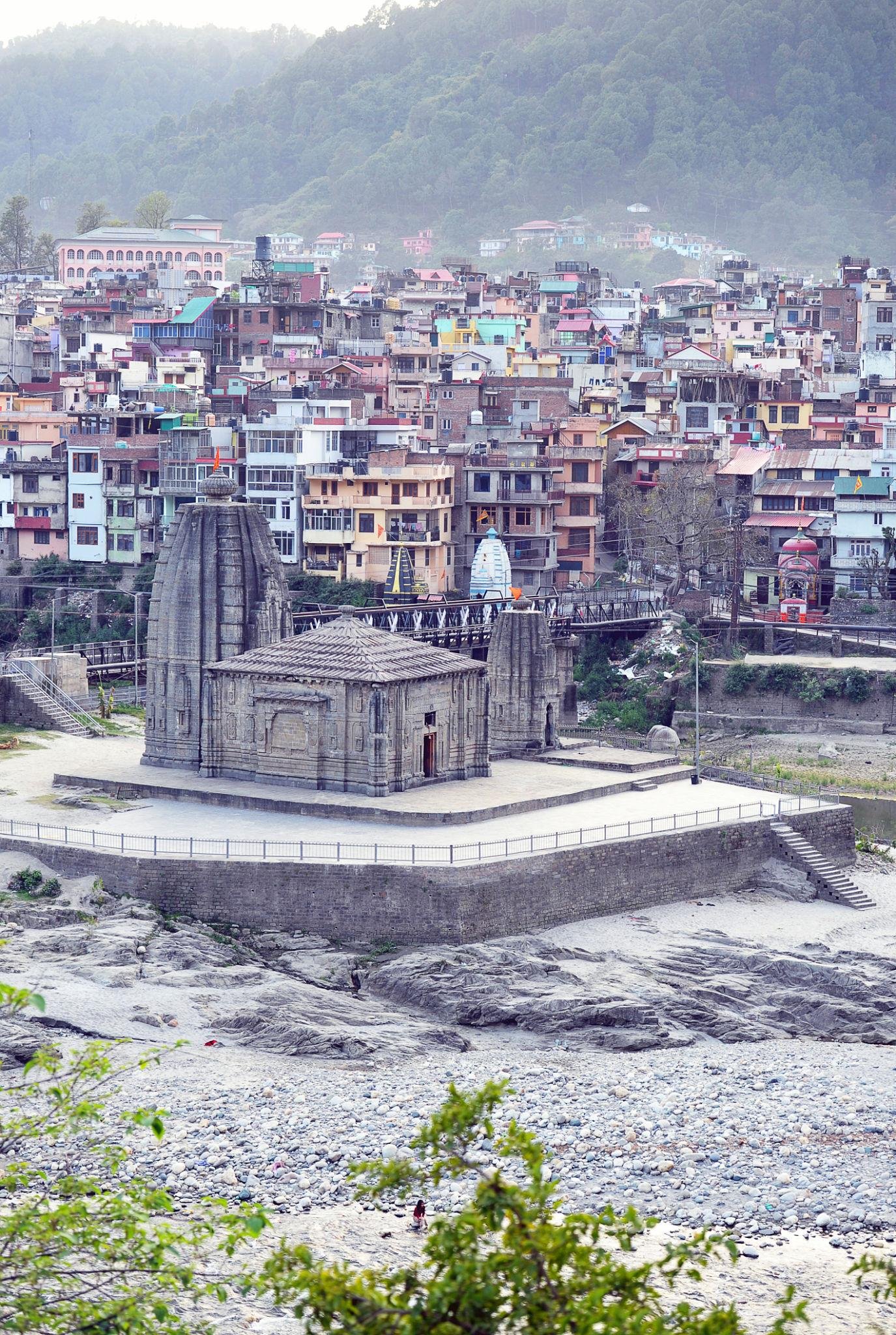
Panchvaktra Mahadev Temple is one of the most important Shiva temples in Mandi, Himachal Pradesh. Standing beside the meeting point of the Beas River and Suketi Khad, the ancient stone shrine is dedicated to Lord Shiva in his Panchvaktra or five-faced form.
The temple’s riverside setting, tall stone shikhara, carved walls, sacred image and protected heritage status make it one of the defining spiritual landmarks of Mandi. The monument appears especially striking when viewed from across the river, where the grey stone temple rises against the closely built houses, bridges and forested hills surrounding the historic town.
Mandi is often known as Chhoti Kashi because of its concentration of old Shiva temples, ghats and sacred riverfront locations. Within this religious landscape, Panchvaktra Mahadev holds a distinctive place.
Bhutnath Temple represents the central Shaivite identity of the old market.
Triloknath Temple worships Shiva as the lord of the three worlds.
Ardhanarishwar Temple presents Shiva and Shakti united within one form.
Mahamrityunjaya Temple represents the meditative and death-conquering aspect of Mahadev.
Panchvaktra Mahadev represents Shiva through five sacred faces and the five fundamental elements of creation.
The shrine is not merely a picturesque riverside structure. It remains an active place of worship where local devotees offer prayers, flowers, water and bilva leaves to Lord Shiva. At the same time, it is a protected architectural monument whose walls, carvings and stone surfaces require careful conservation.
Panchvaktra Mahadev Temple can be reached within Mandi town without a mountain trek. Visitors usually approach through the old-town or riverfront side and complete a short walk to the temple platform.
The exact vehicle access, pedestrian bridge arrangement and nearest parking point may change according to traffic management, river conditions, repairs and local construction. Travellers should confirm the practical approach through their hotel, taxi driver or local residents.
The temple is suitable for Shiva devotees, families, senior citizens, solo pilgrims, photographers, architecture enthusiasts and travellers exploring the spiritual heritage of Mandi.
A visit can be combined with Tarna Devi Temple, Bhutnath Temple, Triloknath Temple, Ardhanarishwar Temple, Mahamrityunjaya Temple, Bhimakali Temple, Ghanta Ghar, Indira Market and the historic neighbourhoods of Purani Mandi.
Travellers searching for hotels near Panchvaktra Mahadev Temple, homestays in Mandi, places to stay near Chhoti Kashi temples or pilgrimage accommodation near the Beas River can use MudrasStays to plan a convenient and spiritually meaningful journey.
## Spiritual Importance of Panchvaktra Mahadev
The Sanskrit word “Pancha” means five, while “Vaktra” means face or countenance.
Panchvaktra therefore refers to the five-faced manifestation of Lord Shiva.
The five faces represent multiple dimensions of one universal divine consciousness. They are traditionally associated with creation, preservation, transformation, concealment and grace.
They may also be connected with five directions, five elements, five senses and five spiritual functions.
The five-faced form communicates that Shiva cannot be understood through only one quality.
He is the silent yogi and the active source of creation.
He is the destroyer of ignorance and the compassionate giver of liberation.
He exists within the visible world of matter while remaining beyond physical form.
At Panchvaktra Mahadev Temple, devotees approach Shiva as the force holding together earth, water, fire, air and space.
This interpretation is especially meaningful because the temple stands directly beside flowing rivers, beneath the open sky and within a stone-and-mountain landscape.
The natural setting becomes part of the temple’s spiritual symbolism.
Stone represents stability and earth.
The rivers represent water and movement.
The lamps and ritual flame represent fire.
The mountain wind represents air.
The open space above the shikhara represents the limitless sky or ether.
The temple therefore offers both a sculptural and environmental expression of Panchvaktra Shiva.
Devotees may pray for courage, family welfare, good health, peace of mind, safe travel, protection and spiritual clarity.
Students and professionals may seek concentration and discipline.
Families may visit before marriages, journeys, new employment or another important stage of life.
Some worshippers return after experiencing what they regard as the fulfilment of a prayer.
These experiences belong to personal faith and should not be presented as guaranteed outcomes.
The temple provides a sacred environment for prayer, emotional strength and reflection. Medical, legal, financial and personal concerns should continue to receive appropriate professional and practical attention.
## The Five Faces of Lord Shiva
Shaiva traditions commonly identify the five faces of Shiva as Sadyojata, Vamadeva, Aghora, Tatpurusha and Ishana.
Different texts and religious lineages may explain their directions, colours, mantras and functions in slightly different ways.
Visitors do not need specialised ritual knowledge to receive darshan. However, understanding the broad symbolism can make the temple experience more meaningful.
### Sadyojata
Sadyojata is associated with creation and emergence.
It represents the continuous appearance of life, thought, possibility and form.
The face reminds devotees that creation is not restricted to a distant beginning of the universe. New beginnings occur whenever a person gains knowledge, makes a responsible decision or begins a constructive phase of life.
Sadyojata is also connected in several traditions with the earth element.
Earth represents stability, form, patience and the physical foundation of existence.
### Vamadeva
Vamadeva represents preservation, beauty, balance and compassion.
It reflects the dimension of Shiva that sustains life rather than only destroying or transforming it.
Vamadeva is often connected with water.
Water adapts to its container, nourishes life and purifies the body and mind.
At Panchvaktra Mahadev Temple, the symbolism of water becomes especially powerful because the shrine stands beside two flowing watercourses.
### Aghora
Aghora represents transformation and freedom from fear.
The name can be understood as “not terrifying” or the state beyond fear.
Although Shiva’s transformative power may appear intense, its purpose is the destruction of ignorance, attachment and harmful tendencies.
Aghora is commonly connected with fire.
Fire changes whatever it touches. It can destroy, but it can also purify, warm and illuminate.
The spiritual meaning is not uncontrolled destruction. It is the disciplined transformation required for growth.
### Tatpurusha
Tatpurusha is associated with meditation, breath, awareness and the inward journey.
It represents Shiva as the supreme yogi whose attention remains steady and undisturbed.
Tatpurusha is often connected with air.
Breath provides the most immediate relationship between the body, mind and environment.
For a pilgrim, the symbolism encourages silence, concentration and conscious prayer.
### Ishana
Ishana represents transcendence, grace, knowledge and the dimension of Shiva beyond ordinary form.
It is frequently understood as the upward or all-pervading face.
Ishana is associated with space or ether, the element within which the other elements exist.
Space cannot be held in the hand, yet nothing can exist without it.
This face reminds devotees that the deepest reality may be present everywhere even when it cannot be seen directly.
## Panchvaktra and the Five Elements
Official Himachal tourism information particularly emphasises the relationship between Panchvaktra Shiva and the five elements.
The five elements, known as the Panchamahabhuta, are Prithvi, Jal, Agni, Vayu and Akasha.
Prithvi is earth.
Jal is water.
Agni is fire.
Vayu is air.
Akasha is space.
Traditional Indian philosophy understands the visible universe and the human body through combinations of these elements.
The purpose of this symbolism should not be confused with a modern medical diagnosis. It offers a philosophical way of reflecting upon the relationship between the body, nature and consciousness.
At Panchvaktra Mahadev Temple, the five-element interpretation creates a strong connection between religious worship and the physical landscape.
The stone temple rises from the earth.
The Beas and Suketi carry water around the site.
Ritual lamps represent fire.
Mountain winds pass through the river valley.
The sky surrounds the shikhara.
A devotee standing within this landscape can experience the five elements not only as an abstract teaching but as an immediate environment.
## Panchvaktra Shiva Image
The principal sacred representation within the temple is associated with the five-faced form of Lord Shiva.
The exact appearance, covering, ornamentation and visibility of the image may change according to worship arrangements and festival decoration.
Visitors should not assume that the inner deity can be photographed.
The sanctum is a sacred and relatively compact space. Devotees should complete darshan without blocking the entrance or interfering with rituals.
The five faces may be interpreted collectively rather than as five separate deities.
They represent one Shiva expressing different cosmic functions.
The form also reminds devotees that reality appears differently according to the direction from which it is observed.
A person may experience Shiva as a compassionate father, disciplined yogi, fierce protector, creator, destroyer or formless consciousness. These experiences do not necessarily contradict one another.
They reveal different aspects of the same divine reality.
## Sacred Location at the Beas–Suketi Confluence
Panchvaktra Mahadev Temple stands at the confluence of the Beas River and Suketi Khad.
A confluence is spiritually important because two moving watercourses meet and continue as one larger flow.
In Hindu traditions, river confluences are often regarded as suitable places for worship, meditation, purification and remembrance of ancestors.
The meeting of waters can symbolise the meeting of different paths, ideas and stages of life.
The Beas is one of the principal rivers of Himachal Pradesh.
It flows through Kullu and Mandi before continuing towards the plains.
Suketi Khad descends through the Mandi region and joins the Beas near the temple.
The location gives Panchvaktra Mahadev a strong visual and spiritual identity. The temple appears to stand between water, town and mountain.
The river also creates practical risks.
Water levels can rise quickly during heavy rain, cloudbursts, upstream discharge or intense monsoon conditions.
Visitors should never enter restricted riverbank areas, cross barriers or stand on wet rocks for photographs.
The water may appear calm while containing strong currents and sudden depth changes.
Children should remain under close supervision.
Religious offerings, plastic, cloth, food and ash should not be thrown into either river.
Respect for sacred water includes preventing pollution.
## The Temple and Mandi’s Riverfront Geography
Historic Mandi developed around the Beas and its tributary valleys.
The rivers influenced agriculture, trade, settlement and temple placement.
Several of Mandi’s important shrines stand near water.
Panchvaktra occupies the confluence.
Panchvaktra’s riverfront setting creates a different experience from Tarna Devi on the hilltop or Bhutnath Temple within the central bazaar.
At Tarna Devi, the pilgrim looks down over Mandi.
At Bhutnath, the devotee experiences the dense old town.
At Panchvaktra, stone architecture meets flowing water.
This variety is one reason Mandi’s temple landscape deserves more than a hurried stop while travelling towards Kullu or Manali.
## History of Panchvaktra Mahadev Temple
The precise original construction date of Panchvaktra Mahadev Temple is not definitively established in the principal official sources.
Architectural studies generally place the surviving temple within the later medieval or early modern period, often broadly around the seventeenth or eighteenth century.
Local accounts sometimes connect restoration or reconstruction with Raja Sidh Sen of Mandi after earlier flood damage.
Other popular traditions attribute the original sacred site to an earlier period or associate it with the Pandavas.
These narratives should be presented cautiously.
The protected monument visible today reflects a long history of worship, repairs, conservation and adaptation to a vulnerable river environment.
A temple can have an older sacred tradition than its surviving architectural form.
Floods, weathering and seismic activity may have damaged earlier structures and required rebuilding.
Visitors should therefore avoid claiming a single exact age unless supported by a specific inscription or archaeological report.
The most reliable statements are that the temple is historic, is constructed in the Nagara or shikhara tradition, contains important stone carving and is protected by the Archaeological Survey of India.
## Royal Mandi and Temple Patronage
The rulers of Mandi supported numerous temples and helped establish the town as an important centre of Shaivite worship.
The foundation and expansion of Mandi involved the construction of royal buildings, markets and shrines.
Bhutnath Temple is closely associated with Raja Ajbar Sen and the establishment of the town.
Triloknath Temple is connected with royal patronage through the ruling family.
Later rulers continued to build, restore and support religious institutions.
Panchvaktra Mahadev belongs to this wider environment of royal Shaivite devotion.
A riverside temple at a major confluence would have served both local residents and travellers moving through the valley.
Royal patronage could provide land, priests, repairs and protection.
Local communities then maintained worship through everyday offerings, festivals and collective care.
## Archaeological Survey of India Protection
Panchvaktra Temple is recognised as a centrally protected monument.
This status confirms that its architectural and historical importance extends beyond the immediate locality.
Protection also places responsibilities on every visitor.
Stone carvings, walls, doorways, pillars and loose architectural fragments must not be touched unnecessarily or moved.
Names, symbols and messages should never be scratched into the temple.
Oil, paint, vermilion, adhesive material and chemical products should not be applied to protected exterior surfaces.
Religious worship should follow the arrangements approved for the active shrine.
A devotional intention does not justify damage to heritage.
Visitors should not sit on carved architectural elements, climb the raised walls or use the stone surfaces as a background platform for staged photographs.
Tripods, professional lighting, commercial filming and drones may require prior approval.
Restrictions introduced for conservation should be followed without argument.
The temple has survived centuries of weather, floods and human use. Responsible behaviour is essential for its continued preservation.
## Nagara and Shikhara Architecture
Panchvaktra Mahadev Temple is built in the North Indian Nagara architectural tradition.
Its principal feature is the tall shikhara rising above the sanctum.
The tower has a strongly vertical character and is divided through projections, bands and carved architectural sections.
The form directs the eye upward from the horizontal stone platform towards the sky.
In Hindu temple symbolism, the shikhara represents the sacred mountain.
The sanctum below forms the concentrated centre of divine presence, while the tower above connects earth with the celestial realm.
At Panchvaktra, this symbolism is reinforced by Mandi’s surrounding hills.
The temple appears as a carved stone mountain within a larger natural mountain landscape.
The shikhara is crowned by an upper element completing the vertical composition. A flag or sacred finial may be present according to current temple arrangements.
Visitors should observe the tower from several permitted viewpoints. Its proportions, projections and carved surfaces appear different according to light and distance.
## Stone Mandapa and Sanctum
The temple structure includes the sanctum and an adjoining hall or mandapa arrangement.
The sanctum contains the principal sacred presence of Panchvaktra Shiva.
The mandapa provides space for devotees to gather, prepare for darshan and participate in worship.
Stone pillars, door frames and exterior walls carry carved architectural details.
The interior may remain comparatively dark because ancient sanctums were designed to concentrate attention on the deity rather than provide bright public space.
Visitors should allow their eyes to adjust instead of immediately using a phone flash.
Flash photography may disturb worshippers and should not be used without permission.
The raised platform protects the temple and establishes a clear boundary between the sacred building and the surrounding ground.
Steps and stone surfaces can become slippery after rain or when river moisture is high.
Stable footwear should be used until the point where shoes must be removed.
## Stone Carvings
Panchvaktra Mahadev Temple contains carvings and decorative stonework across its walls, doorway and tower.
Visitors may observe divine figures, geometric patterns, floral elements, architectural bands and symbolic forms.
Weathering has softened some details.
The riverside location exposes the stone to moisture, sediment, wind and changing temperatures.
Pollution and repeated human contact can create additional damage.
Visitors should not rub stone surfaces, pour water over exterior carvings or apply colour to make details appear clearer in photographs.
A knowledgeable heritage guide can help explain visible motifs, but uncertain figures should not be identified through guesswork.
It is better to describe a weathered sculpture cautiously than to attach an unsupported mythological identity.
## Temple Platform and Open Setting
The temple stands on a broad raised platform beside the confluence.
The platform creates visual separation from the riverbank and provides space for circumambulation, worship and architectural observation.
It also makes the temple highly visible from the surrounding town and bridges.
The open setting allows visitors to view the shikhara without the dense building enclosure found around several old urban temples.
However, the exposed location also means that summer sun, monsoon rain and winter wind can be experienced strongly.
Visitors should carry appropriate protection and avoid remaining in the open area during severe weather.
The platform should remain free from litter, food waste and plastic.
Shoes and personal belongings should be placed only in appropriate areas.
## Pandava Traditions
Some local accounts connect Panchvaktra Mahadev Temple with the Pandavas of the Mahabharata.
Similar traditions appear at many Shiva temples across Himachal Pradesh.
The Pandavas are believed in regional sacred geography to have travelled through the mountains during exile, worshipped Lord Shiva and established lingams or temporary shrines.
Such accounts should be understood as religious tradition rather than archaeological proof that the existing stone temple was constructed during the epic era.
The continued presence of these stories demonstrates how local communities connect their landscape with the Mahabharata.
The spiritual theme is one of endurance, exile, devotion and the search for divine guidance during difficulty.
## Shiva and Parvati Traditions
Popular local narratives may also associate the confluence with the penance of Goddess Parvati or the union of Shiva and Shakti.
Parvati’s tapasya for Lord Shiva is a major theme across Himalayan sacred geography.
The mountains are repeatedly described in Hindu tradition as the home of Parvati, daughter of Himalaya, and as the landscape of Shiva’s meditation.
Visitors should present any temple-specific version as local belief rather than documented history.
The broader philosophical meaning remains important.
Shiva represents consciousness and stillness.
Parvati represents energy, devotion and active life.
Their union represents balance between meditation and worldly responsibility.
## Worship at Panchvaktra Mahadev
Devotees may offer water, flowers, bilva leaves, incense and prayers according to temple customs.
The mantra “Om Namah Shivaya” is commonly recited by Shiva worshippers.
Visitors arranging a special puja should speak with an authorised priest.
The use of milk, oil, colour or other materials should follow temple and conservation regulations.
Panchvaktra is both a living shrine and a protected monument.
A simple offering made respectfully is preferable to large quantities of material that create waste or damage surfaces.
Visitors should maintain the darshan queue and avoid remaining directly in front of the sacred image after completing prayers.
Phones should be kept silent.
Private ceremonies and worshippers should not be recorded without consent.
## Mahashivratri
Mahashivratri is one of the most important occasions for Shiva worship in Mandi.
Devotees observe fasting, prayer, mantra recitation, abhishek and night worship.
Panchvaktra Mahadev may receive a larger number of visitors during the festival period.
Mandi’s wider Shivratri celebration is internationally recognised and brings numerous regional gods and goddesses into the town through decorated palanquins.
The festival reflects the living devta culture of Mandi rather than only one temple’s celebration.
Bhutnath Temple and Lord Madhav Rai hold central ceremonial roles in the wider festival.
Panchvaktra remains an important Shiva shrine within the sacred city throughout the period.
Hotels, transport and parking become heavily demanded.
Travellers should book accommodation early and allow extra time for road restrictions, processions and crowds.
Palanquins, sacred masks and ceremonial objects must not be touched.
Photographers should never block procession routes.
## Shravan and Monday Worship
The Hindu month of Shravan is especially sacred to Lord Shiva.
Devotees may visit Panchvaktra Mahadev on Mondays to offer water, bilva leaves and prayers.
Shravan frequently overlaps with the monsoon season.
The religious importance of the month must be balanced with river and road safety.
Heavy rain can raise the Beas and Suketi rapidly.
Visitors should obey barriers and local warnings.
The temple should not be approached through closed or flooded paths merely because a particular day is religiously important.
A pilgrimage can be postponed when conditions are unsafe.
## Morning Darshan
Morning is one of the best times to visit Panchvaktra Mahadev Temple.
The riverfront is generally quieter, the temperature is comfortable and soft light reveals details in the stone architecture.
Morning darshan can be followed by visits to Bhutnath Temple, Triloknath Temple and the old market.
Early arrival also allows visitors to avoid peak traffic and heat.
Temple opening arrangements may change with season and festivals.
Current timings should be confirmed locally rather than relying entirely on an old online listing.
## Evening Darshan
Evening offers a different atmosphere as lamps, bells and fading light transform the temple platform.
The surrounding town begins to illuminate, while the sound of flowing water remains present.
Visitors should confirm closing times and ensure that the pedestrian or road route remains safely accessible.
During monsoon or periods of high water, evening riverfront visits require additional caution.
Travellers should not remain in isolated or restricted sections after dark.
## Best Time to Visit Panchvaktra Mahadev Temple
The temple can generally be visited throughout the year, although each season creates a different experience.
### Spring
Spring provides pleasant temperatures and improving visibility after winter.
The surrounding hills become greener and daytime conditions are comfortable for walking through Mandi.
Morning and evening may remain cool.
Spring is suitable for families, senior citizens and travellers exploring several temples on foot.
### Summer
Mandi can become warm during summer because it lies at a lower elevation than many mountain tourism destinations.
Early morning and evening are preferable for temple visits.
Visitors should carry drinking water and use sun protection.
The exposed stone platform can become hot under direct sunlight.
Families with small children and senior citizens should avoid prolonged midday exposure.
### Monsoon
The monsoon creates a dramatic riverside environment but requires the greatest caution.
The Beas and Suketi may rise rapidly.
Heavy rain can bring floodwater, debris, mud and dangerous currents close to the temple area.
Visitors must follow all local restrictions and should never approach the river to photograph high water.
Roads across Mandi district may be affected by landslides, falling stones and traffic diversions.
Shoes with reliable grip are essential because stone surfaces can become slippery.
Travel should be postponed during severe warnings.
### Autumn
Autumn is among the best periods for visiting Panchvaktra Mahadev Temple.
Rain generally reduces, the hills remain green and the weather becomes comfortable for exploring Mandi.
Post-monsoon mornings may offer clearer views.
Festival periods can increase visitor numbers, so accommodation should be reserved early.
### Winter
Winter provides cool and often peaceful conditions.
Mandi town generally remains more accessible than high-altitude destinations.
Morning and evening can become cold, and frost or fog may occasionally affect travel.
Snowfall at Panchvaktra Mahadev Temple should not be guaranteed because the town stands at a moderate elevation.
Visitors should carry warm layers and check regional road conditions when arriving from higher areas.
## River Safety
The temple’s confluence location is spiritually beautiful but physically sensitive.
Visitors should remain behind railings and barriers.
Wet rocks, sand deposits and apparently dry river edges can become unstable.
Water releases or upstream rainfall can change conditions quickly.
Children must not be allowed to play near the river without close supervision.
Visitors should not attempt ritual bathing unless an authorised and clearly safe arrangement exists.
The Beas is a powerful Himalayan river, not an ordinary shallow stream.
Monsoon sightseeing beside rising water should be avoided completely.
During a flood warning, visitors should move towards higher and officially designated safe areas.
## Reaching Panchvaktra Mahadev Temple
Panchvaktra Mahadev Temple lies within Mandi town near the Beas–Suketi confluence.
Visitors can approach by local taxi, private vehicle or on foot from central Mandi.
The exact route may involve a road, bridge or pedestrian approach according to current arrangements.
Parking immediately beside the temple may be limited.
A local taxi driver can identify the nearest practical drop-off point.
Travellers staying near Indira Market, Ghanta Ghar, Bhutnath Temple or the bus stand can include the shrine within a broader town itinerary.
Visitors should not carry heavy luggage through the temple route.
Hotel check-in should be completed before sightseeing.
## Accessibility for Senior Citizens
Panchvaktra Mahadev is comparatively accessible because it is located within Mandi town and does not require a mountain trek.
However, the final approach may involve steps, uneven stone surfaces or a short walk.
Senior citizens should wear stable footwear and use assistance where necessary.
The riverside area may become slippery after rain.
Visitors using wheelchairs or significant mobility aids should ask their accommodation provider to verify the latest physical access before arrival.
Old temple thresholds and sanctum entrances may not be fully barrier-free.
Darshan from an appropriate outer point may be more suitable when interior access is difficult.
## Visiting with Children
Families can visit Panchvaktra Mahadev Temple comfortably during suitable weather.
Children should remain under close supervision because of the river, steps and protected stone surfaces.
They should not climb temple walls, sit on sculptures or play beside the water.
The visit can become educational by explaining the five faces of Shiva, five elements and importance of protecting rivers.
Parents should carry drinking water, sun protection and a light snack while ensuring that no packaging is left behind.
## Bhutnath Temple
Bhutnath Temple is one of the central Shiva shrines of Mandi and is closely connected with the founding of the historic town.
It stands near the old market and plays an important role in Mandi Shivratri.
A combined visit to Bhutnath and Panchvaktra allows pilgrims to experience both the busy urban and peaceful riverfront expressions of Shiva worship.
## Triloknath Temple
Triloknath Temple stands in Purani Mandi and is dedicated to Lord Shiva as the master of the three worlds.
Its historic stone architecture and sacred images make it one of the most important nearby temples.
Triloknath, Panchvaktra and Ardhanarishwar together reveal several philosophical manifestations of Shiva within a compact urban area.
## Ardhanarishwar Temple
Ardhanarishwar Temple represents Shiva and Parvati united within one form.
The image expresses the inseparability of consciousness and energy.
A combined Panchvaktra and Ardhanarishwar visit creates a deeper understanding of Shaivite philosophy.
Panchvaktra represents the five cosmic dimensions of Shiva.
Ardhanarishwar represents the unity of Shiva and Shakti.
## Mahamrityunjaya Temple
Mahamrityunjaya Temple contains a distinctive meditative representation of Lord Shiva.
Devotees may pray for courage, wellbeing and spiritual strength.
Religious healing traditions should not be presented as substitutes for medical care.
The temple can be included in a walking or taxi-based Mandi circuit.
## Tarna Devi Temple
Tarna Devi Temple stands on a hill overlooking Mandi and is dedicated to Maa Shyama Kali.
The road and traditional staircase make it accessible according to visitor fitness.
A journey combining Panchvaktra and Tarna Devi creates a complete Shiva–Shakti experience.
Panchvaktra stands beside the rivers.
Tarna Devi watches over the town from above.
## Bhimakali Temple
Bhimakali Temple at Bheuli is another important Goddess shrine near the Beas River.
Its architectural style and riverside setting differ from Panchvaktra.
Visitors should exercise the same river safety precautions during the monsoon.
## Prashar Rishi Temple
Prashar Rishi Temple and Lake lie at high altitude outside Mandi.
The destination requires a dedicated mountain-road journey or organised trek.
It should not be added casually to an already full Mandi temple day.
Current road, weather and accommodation conditions should be verified before travel.
## Rewalsar
Rewalsar is an important multi-faith pilgrimage destination associated with Hindu, Buddhist and Sikh traditions.
It contains a sacred lake, temples, monasteries and a gurdwara.
A two- or three-day Mandi itinerary can include Panchvaktra Mahadev, the temples of Chhoti Kashi and Rewalsar comfortably.
## Suggested One-Day Mandi Temple Itinerary
Begin with morning darshan at Panchvaktra Mahadev Temple.
Spend time observing the shikhara, stone carvings and river confluence from permitted areas.
Continue towards Bhutnath Temple and the old market.
After lunch, visit Ardhanarishwar Temple, Mahamrityunjaya Temple or Triloknath Temple.
Conclude with evening darshan at Tarna Devi Temple or return to Panchvaktra if riverfront access remains safe and the temple is open.
## Suggested Two-Day Itinerary
On the first day, explore Panchvaktra Mahadev, Bhutnath Temple, Ghanta Ghar and the central market.
Stay overnight in Mandi.
On the second day, visit Triloknath, Ardhanarishwar, Mahamrityunjaya, Bhimakali and Tarna Devi.
This itinerary provides a fuller understanding of why Mandi is called Chhoti Kashi.
## Suggested Three-Day Spiritual Journey
The first day can focus on Panchvaktra Mahadev and the central Mandi temples.
The second day can include Rewalsar and nearby sacred sites.
The third day can be dedicated to Prashar Rishi Temple when road and weather conditions are suitable.
Kamrunag, Shikari Devi and Karsog require separate travel plans and accommodation bases.
## Where to Stay Near Panchvaktra Mahadev Temple
Mandi town offers hotels, guesthouses, homestays, lodges and budget pilgrimage accommodation.
The best location depends upon the traveller’s transport and complete itinerary.
### Hotels in Central Mandi
Central hotels provide convenient access to Panchvaktra, Bhutnath Temple, Ghanta Ghar and Indira Market.
They are suitable for visitors exploring the old town on foot.
Parking can be limited, so private-vehicle travellers should confirm arrangements in advance.
### Hotels Near the Bus Stand or Highway
These properties are suitable for travellers arriving by long-distance bus or continuing towards Kullu, Manali, Bilaspur or Dharamshala.
A short taxi journey may be required to reach Panchvaktra and the historic centre.
### Homestays in Mandi
Homestays can provide local meals, practical guidance and a quieter experience.
Hosts may help visitors arrange taxis and understand the best sequence for visiting temples.
Guests should confirm the actual distance from Panchvaktra Mahadev rather than relying only on a general Mandi address.
### Hill-View Stays
Properties on the surrounding hills may offer wide town and river views.
However, they can involve steep access roads or repeated driving.
Families and senior citizens should verify road condition, parking and stairs before booking.
## Choosing the Right Accommodation
Pilgrims focused on Panchvaktra and the old Mandi temples should stay near the central town.
Families should check room size, meals, parking and bathroom facilities.
Senior citizens should prioritise lifts, ground-floor rooms and easy taxi access.
Couples may prefer quieter hill-facing homestays or comfortable boutique properties.
Solo pilgrims can select budget guesthouses close to the temple circuit.
Groups should confirm multiple-room availability, vegetarian meals and suitable vehicle parking.
Visitors attending Mandi Shivratri or Shravan events should reserve accommodation early.
Monsoon travellers should avoid properties in vulnerable low-lying areas and ask about the safest access route during heavy rain.
## Book Stays Near Panchvaktra Mahadev Temple with MudrasStays
MudrasStays helps pilgrims, families and heritage travellers discover hotels, homestays, guesthouses and pilgrimage accommodation near Panchvaktra Mahadev Temple and the sacred sites of Mandi.
Visitors can compare properties according to practical distance from the temple, room type, budget, group size and required facilities.
Booking in central Mandi allows devotees to attend peaceful morning darshan and explore several temples without unnecessary vehicle travel.
Solo pilgrims can search for affordable guesthouses near the old town.
Couples can explore peaceful homestays and hill-view rooms.
Families can choose hotels offering meals, parking and comfortable room capacity.
Senior citizens can prioritise accessible properties with dependable taxi arrangements.
Pilgrimage groups can identify accommodation providing multiple rooms, vegetarian food and suitable vehicle parking.
Travellers combining Panchvaktra Mahadev with Tarna Devi, Prashar Rishi Temple, Rewalsar, Kamrunag, Shikari Devi or Karsog can select separate bases according to the actual road sequence.
A temple-focused booking platform helps visitors avoid choosing a general highway hotel that appears close on a map but is inconvenient for the old-town temple circuit.
## Responsible Temple and Riverfront Travel
Panchvaktra Mahadev Temple is both an active Shiva shrine and a nationally protected monument.
Visitors should dress respectfully and remove footwear wherever instructed.
Photography of the principal deity, sanctum, priests and private rituals should only be undertaken with permission.
Stone carvings, walls and pillars should not be touched, scratched or used to support luggage.
Oil, vermilion, water or colour should not be applied to protected exterior surfaces.
Incense and lamps should be used only in authorised places.
Plastic bottles, wrappers and puja packaging must be carried away.
Nothing should be thrown into the Beas or Suketi.
Visitors must remain behind river barriers and avoid wet rocks.
Children require continuous supervision.
Drones, professional filming and commercial equipment may require permission.
Local priests, guides, taxi drivers, shops and accommodation providers should be treated fairly.
Responsible pilgrimage protects both the temple and the rivers that define its sacred setting.
## The Five-Faced Lord at the Meeting of Rivers
Panchvaktra Mahadev Temple represents a powerful meeting of Shiva worship, sacred water, stone architecture and Mandi’s living spiritual heritage.
The five faces express different dimensions of one universal consciousness.
The five elements connect the divine form with earth, water, fire, air and space.
The Beas and Suketi create a sacred confluence around the temple.
The stone shikhara rises like a mountain above the sanctum.
The protected carvings preserve the skill of earlier builders.
The active worship keeps the monument spiritually alive.
The surrounding temples connect Panchvaktra with the larger identity of Mandi as Chhoti Kashi.
For Shiva devotees, the shrine is a place to seek courage, balance and spiritual clarity.
For families, it provides an accessible pilgrimage within Mandi town.
For senior citizens, road-based access makes the temple easier to visit than remote mountain shrines.
For architecture enthusiasts, the Nagara shikhara and carved stone walls provide an important example of Himalayan temple construction.
For photographers, the temple, rivers, bridges and hillside town offer memorable compositions when heritage and river-safety rules are respected.
For cultural travellers, Panchvaktra explains how Mandi’s identity developed around temples, rulers, rivers and living worship.
For spiritual travellers, the meeting of two rivers provides a natural setting for reflection on unity, change and the movement of life.
Panchvaktra Mahadev Temple should not be treated merely as a quick riverside photo stop.
Its five-faced Shiva tradition, protected architecture and sacred confluence deserve time, prayer and responsible observation.
Plan your pilgrimage to Panchvaktra Mahadev Temple with MudrasStays and experience one of the most important Shiva shrines in Mandi district.
Seek the blessings of Panchvaktra Mahadev, observe the historic stone shikhara and experience the confluence of the Beas River and Suketi Khad.
Combine your journey with Bhutnath Temple, Triloknath Temple, Ardhanarishwar Temple, Mahamrityunjaya Temple, Tarna Devi Temple, Bhimakali Temple, Prashar Rishi Temple and Rewalsar.
Book hotels near Panchvaktra Mahadev Temple, discover homestays in Mandi and explore comfortable pilgrimage accommodation near the sacred temples of Chhoti Kashi through MudrasStays.
Stay closer to your spiritual destinations, attend peaceful morning darshan and reduce unnecessary travel through busy town roads.
MudrasStays connects pilgrims, families and heritage travellers with suitable accommodation near temples and sacred destinations across India.
Begin your Panchvaktra Mahadev Temple journey with a comfortable stay and experience a meaningful pilgrimage centred on Lord Shiva, the five elements, sacred Himalayan rivers and the timeless spiritual heritage of Mandi.