
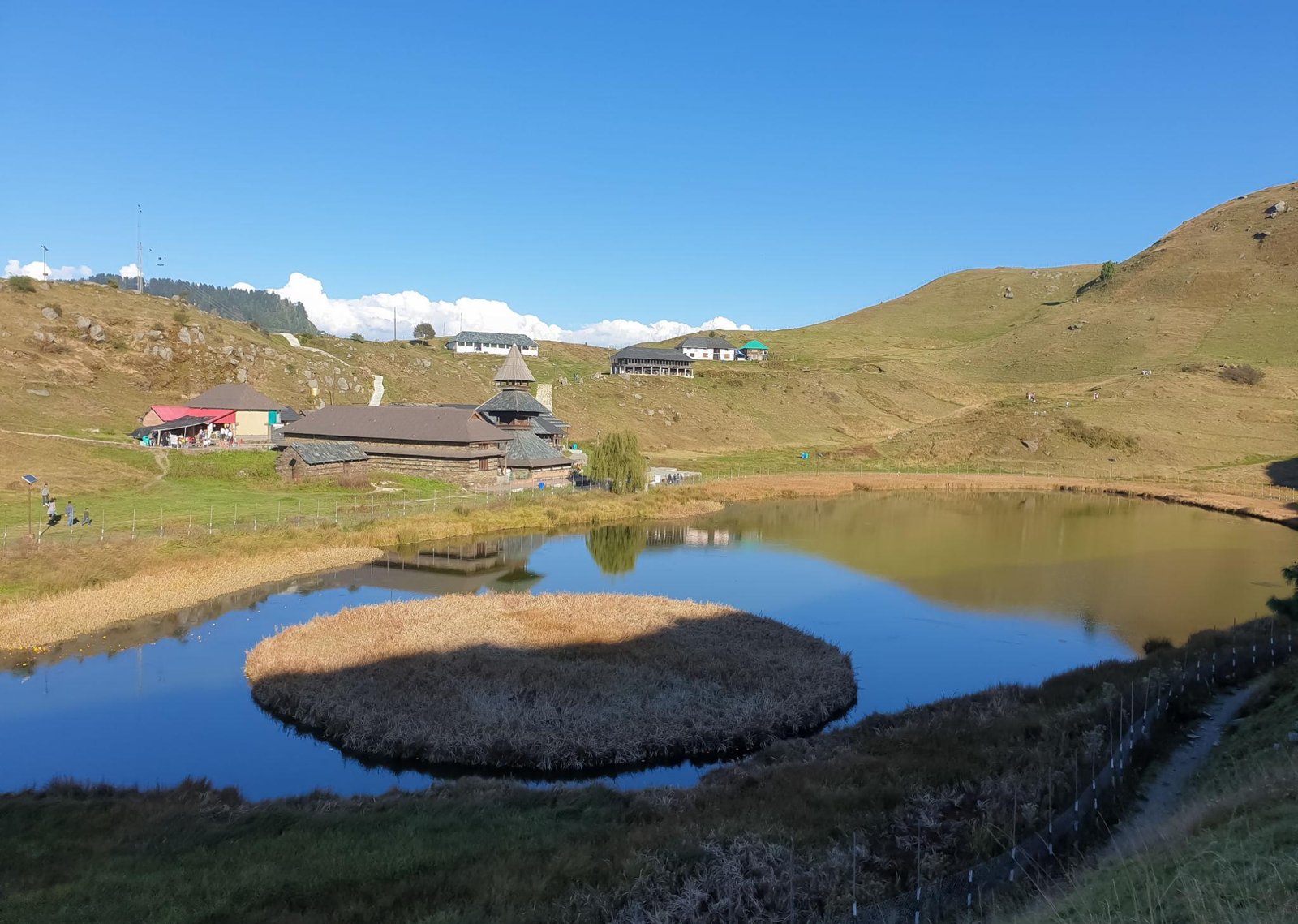
Prashar Rishi Temple is one of the most beautiful and spiritually important pilgrimage destinations in the Mandi district of Himachal Pradesh. Standing beside the sacred Prashar Lake at an elevation of approximately 2,730 metres, the temple is surrounded by rolling alpine meadows, forested mountain slopes and panoramic views towards the snow-covered Dhauladhar ranges.
Also written as Parashar Rishi Temple, the shrine is dedicated to Maharishi Prashar, an important sage of Hindu religious tradition. The three-storeyed wooden temple, deep blue lake, floating vegetated island and high mountain setting create a rare combination of spirituality, architecture, pilgrimage, trekking and nature travel.
The destination lies approximately 45 kilometres from Mandi town. Most visitors approach through winding mountain roads followed by a short walk from the practical parking area. Travellers interested in trekking may also use recognised routes beginning from villages below the lake, subject to current trail, road and weather conditions.
Prashar Rishi Temple should not be viewed only as a picturesque location or weekend trekking destination. The lake and temple form a living sacred landscape worshipped by communities across Mandi, Kullu and neighbouring valleys.
For local devotees, Maharishi Prashar is a guardian, spiritual guide and highly respected regional deity. Religious fairs, ceremonial processions and community traditions continue to connect the shrine with villages spread across the mountains.
The peaceful surroundings make Prashar suitable for pilgrims, families, couples, trekkers, photographers, architecture enthusiasts and travellers seeking a quieter Himalayan experience away from heavily commercialised hill stations.
Visitors searching for hotels near Prashar Lake, homestays near Prashar Rishi Temple, places to stay in Mandi or accommodation along the Prashar route can use MudrasStays to plan a comfortable and geographically practical pilgrimage.
## Spiritual Importance of Maharishi Prashar
Maharishi Prashar is honoured as one of the respected sages of Hindu religious tradition.
He is traditionally identified as the son of Sage Shakti, grandson of Maharishi Vashishtha and father of Maharishi Ved Vyasa, who is closely associated with the compilation of the Mahabharata and several important bodies of sacred knowledge.
Religious traditions attribute teachings concerning dharma, philosophy, astrology, social conduct and spiritual knowledge to Sage Prashar.
Texts bearing his name include the Parashara Smriti and works associated with the Parashara school of astrology, although the development and authorship of ancient texts may involve long traditions rather than one easily documented historical moment.
At Prashar Lake, the sage is worshipped not only as a figure from ancient literature but as the presiding spiritual presence of the mountain.
Local devotees may affectionately refer to the sage through regional terms conveying seniority, protection and respect.
People visit the shrine to pray for family welfare, health, courage, prosperity, children, agricultural success, safe travel and relief from personal difficulties.
Some worshippers visit before beginning an important journey or new stage of life. Others return after experiencing what they regard as the fulfilment of a prayer.
Such experiences belong to personal religious faith and should not be represented as guaranteed outcomes. The temple offers spiritual reassurance, reflection and emotional strength, while practical decisions and professional assistance remain important in everyday life.
The environment surrounding the shrine contributes significantly to its spiritual character. The lake, open sky, changing clouds, mountain wind and distant peaks create a natural setting for prayer and quiet contemplation.
## Sage Prashar’s Meditation at the Lake
According to regional tradition, Maharishi Prashar meditated beside the lake and selected the high mountain landscape as a place of spiritual discipline.
The isolation of the site would have made it especially suitable for tapasya, study and withdrawal from ordinary distractions.
Himalayan religious traditions frequently connect sages with forests, lakes, caves and high mountain meadows. These places symbolise clarity, silence and proximity to the natural forces that shape human life.
The belief that Sage Prashar meditated here gives the lake the character of a tapobhumi—a land sanctified through austerity and spiritual practice.
Visitors may sit quietly in permitted areas, recite prayers or observe the landscape without disturbing worshippers.
The lakeside should not be converted into a loud picnic space. Music, shouting and disruptive group activity reduce the atmosphere valued by both pilgrims and nature travellers.
Meditation at the destination should be approached as a personal spiritual practice rather than as a guaranteed treatment for physical or psychological conditions.
## Origin Legend of Prashar Lake
Mandi district tradition preserves the belief that Prashar Lake was created when Sage Prashar struck the ground with his staff or gurj.
Water emerged from the mountain and formed the sacred lake beside which the sage meditated.
Another popular regional narrative may connect the shape of the lake with Bhima, one of the Pandavas, who is believed in some accounts to have struck or pressed the ground.
Different communities and storytellers may preserve different versions of the origin legend.
These accounts should be understood as sacred mythology and oral tradition rather than geological history.
Their importance lies in the way generations of devotees have interpreted the lake as a divine creation rather than an ordinary body of water.
The story of water emerging through a sage’s action symbolises spiritual power, purification and the ability of sacred knowledge to bring life into an isolated landscape.
Visitors should listen respectfully to local versions without insisting that one oral account must invalidate another.
## The Sacred Prashar Lake
Prashar Lake is a compact high-altitude freshwater lake with an approximate perimeter of 300 metres.
Its colour changes according to sunlight, clouds, season and viewing angle. On clear days, the water may appear deep blue or green, while fog and winter weather can give it a darker, more mysterious appearance.
The lake is considered sacred, and visitors should treat its boundary with the same respect given to the temple.
Entering the water, swimming, washing, throwing coins or discarding offerings should be avoided unless a particular ritual is expressly authorised by temple management.
Plastic bottles, flowers wrapped in synthetic material, food waste and puja packaging should never be thrown into the lake.
The water body is part of a fragile high-altitude ecosystem. Pollution introduced by even a small number of visitors can affect the entire environment.
Barriers or designated walking areas around the lake should be respected. Visitors should not cross fencing merely to obtain a closer photograph.
Children should remain under supervision near the water, particularly during rain, frost or snow.
## The Floating Island
The floating island is the most recognisable natural feature of Prashar Lake.
It appears as a circular or irregular mass of vegetation and organic material that changes position within the lake.
Its visible shape and location may differ between visits because of wind, water movement, seasonal growth and changing conditions.
Local traditions attach spiritual meanings to the movement of the island. Some people interpret its location through seasonal, agricultural or religious beliefs.
These interpretations should be respected as part of regional culture without being presented as scientific predictions or guaranteed signs of future events.
Visitors should not attempt to reach, touch, climb upon or disturb the island.
The lake should be observed from the permitted edge. Throwing objects towards the island or using poles to test whether it floats can damage the ecosystem.
The floating island adds to the sacred and visual character of the lake, but its continued survival depends upon responsible visitor behaviour.
## Unknown Depth and Popular Claims
Popular accounts sometimes describe Prashar Lake as bottomless or claim that its exact depth has never been determined.
Such statements should be treated cautiously unless supported by a reliable scientific survey.
Mountain lakes can contain sediment, organic matter, irregular underwater slopes and changing water levels that make informal measurements unreliable.
The spiritual significance of Prashar Lake does not depend upon presenting exaggerated claims about its depth.
Visitors can appreciate the lake’s sacred traditions, floating island and mountain setting without converting uncertainty into sensational information.
## History of Prashar Rishi Temple
The present temple is attributed by Mandi district records to King Ban Sen and is generally dated to the 13th or 14th century.
The ruler is believed to have supported the construction of the shrine in honour of Maharishi Prashar, who was regarded as an important spiritual protector of the region.
The temple represents a period when the rulers of the western Himalayas maintained close relationships with sages, local deities and religious institutions.
Royal patronage helped establish temples, provide land, support priests and create spaces where communities from different valleys could gather.
Over the centuries, the temple has required maintenance and restoration because it stands in an exposed high-altitude environment.
Timber, slate and stone experience continuous pressure from snowfall, rain, wind, sunlight, frost and temperature variation.
A living wooden temple may contain elements repaired during different periods while preserving an older architectural and religious tradition.
Visitors should therefore not judge the temple’s age solely by whether a particular roof panel, railing or painted surface appears new.
## King Ban Sen and the Mandi Region
King Ban Sen belongs to the historical traditions of the Sen rulers connected with the wider Mandi region.
The construction of a remote mountain temple would have required royal support, skilled craftspeople, transportation of material and cooperation from local communities.
The choice of location reflects the sacred importance already associated with the lake and Sage Prashar.
The temple also strengthened cultural relationships between the valleys surrounding Mandi and Kullu.
Devotees travelling to the shrine shared rituals, music, agricultural traditions and community networks, allowing the pilgrimage to create social connections across geographically separated areas.
Visitors should avoid confusing King Ban Sen with similarly named rulers belonging to other regions or periods.
The exact chronology and contribution of different rulers may vary across historical and oral accounts, but official district information consistently associates the temple with Ban Sen during the 13th–14th century.
## Three-Storeyed Pagoda Architecture
Prashar Rishi Temple is famous for its three-storeyed pagoda-style architecture.
The structure rises through a series of broad, sloping roofs, each level becoming smaller as the temple moves upward.
The multi-tiered roof form is both visually impressive and practical.
Wide eaves help direct rain and snow away from the wooden walls. Steep roof surfaces allow accumulated snow to slide more easily, while the layered structure protects different sections of the building.
The dark slate roof contrasts with carved wooden surfaces, lighter walls, sacred flags and the open landscape around the lake.
The temple’s shape appears different from every viewing angle. From across the lake, it forms a strong vertical landmark reflected in the water. From the courtyard, the carved woodwork and roof details become more visible.
The structure is sometimes described as a pagoda because of its tiered silhouette, although it belongs firmly to the wooden temple traditions of the western Himalayas.
The temple should not be compared superficially with East Asian religious architecture merely because both use layered roofs. Its construction, craftsmanship and sacred functions developed within Himachal Pradesh’s own cultural environment.
## Deodar-Wood Tradition
Regional belief holds that the temple was created from the timber of a single deodar tree.
Another local account says that the construction took approximately twelve years to complete.
These details are best understood as traditional narratives celebrating the extraordinary skill and devotion involved in building the shrine.
Deodar cedar has long been valued in Himalayan architecture because of its strength, workable grain, durability and cultural importance.
The name deodar is linked with the idea of divine or sacred wood, making it especially suitable for temple construction.
Whether every surviving element came literally from one tree cannot be established through ordinary visual observation.
The legend communicates unity: one tree transformed through craftsmanship into a complete sacred structure.
Visitors should not touch carvings repeatedly, scratch the wood or lean bags and equipment against the temple.
Timber can be damaged gradually by moisture, oils, pressure and careless contact.
## Temple Carvings
The wooden surfaces of Prashar Rishi Temple contain detailed carvings representing religious, natural and cultural themes.
Visitors may observe figures of deities, serpents, animals, birds, trees, flowers, leaves and decorative patterns across doors, pillars and exterior sections.
The carvings demonstrate how local artisans translated complex sacred imagery into wood.
Serpent motifs may relate to protection, water, fertility and the underground powers associated with the earth.
Plant and floral patterns can symbolise abundance, continuity and the living energy of nature.
Animal and bird forms reflect the close relationship between Himalayan communities and the environment around them.
Human or divine figures may represent religious narratives, guardians or cultural traditions.
Some carvings have weathered over centuries and may be difficult to identify precisely. Visitors should avoid accepting dramatic interpretations from unreliable sources as certain fact.
A knowledgeable local guide or temple representative may provide more context.
The carvings should be photographed from a respectful distance without flash or physical contact where restrictions apply.
## Sacred Pindi of Maharishi Prashar
The spiritual centre of the temple is the pindi representing Maharishi Prashar.
A pindi is a sacred stone or natural form worshipped as the presence of a deity or spiritual being.
The use of a pindi reflects the principle that divine presence does not always require a detailed human-shaped image.
Devotees may offer flowers, cloth, incense, food or other permitted materials according to local customs.
The precise order of worship should be confirmed with the temple priest.
Photography inside the sanctum or of the pindi should only be undertaken when clearly permitted.
Visitors should not touch, move or place personal objects upon the sacred form without authorisation.
During crowded festivals, darshan may be brief. Pilgrims should remain patient and allow others equal access to the sanctum.
## Maharishi Prashar as a Regional Guardian
Maharishi Prashar is regarded as an important guardian and patron deity across parts of Mandi and neighbouring valleys.
Local communities may invite or represent their deities through palanquins during the important fair held at the lake.
The relationship between Prashar Rishi and other regional deities reflects Himachal Pradesh’s living devta culture.
A deity may have priests, musicians, attendants and hereditary representatives who maintain ceremonial responsibilities.
Processions are not performances organised only for tourists. They are sacred community events with established rules.
Visitors should give deity palanquins sufficient space and avoid touching ceremonial poles, masks, cloth or ornaments.
Photographers must not block the route or stand immediately in front of carriers.
Private consultations, prayers and emotional expressions of devotees should not be recorded without consent.
## Saranauhali Fair
The Saranauhali fair, also written through regional variations such as Saranahuli or Sarnauli, is one of the most important annual events at Prashar Lake.
The fair is held during June and attracts devotees from Mandi, Kullu and surrounding valleys.
Local deities may arrive in decorated palanquins accompanied by priests, musicians, attendants and village communities.
Religious ceremonies, offerings, traditional music and community gathering transform the normally quiet lake into a vibrant pilgrimage centre.
The fair also strengthens cultural relationships between villages separated by mountains and long road journeys.
Travellers planning to attend should confirm the current dates through local authorities, temple management or accommodation providers.
Festival dates may follow a traditional calendar and can change from year to year.
Accommodation and approved camping capacity may become limited. Advance planning is essential.
Roads may experience congestion, and parking near the lake may be regulated.
Families should remain together and select a meeting point in case members become separated.
Senior citizens may prefer visiting before or after the busiest hours.
Visitors should respect religious processions and avoid treating the fair solely as a photography event.
## Rishi Panchami and Other Observances
Some regional traditions also associate Rishi Panchami and other sacred dates with special worship of Maharishi Prashar.
Rishi Panchami honours the great sages and the transmission of sacred knowledge.
The exact calendar, public access and scale of celebrations may vary locally.
Travellers planning a pilgrimage for a particular religious date should verify the current arrangements beforehand.
The temple’s remote location and changing weather make advance coordination particularly important.
## Mandi Shivratri Connection
Maharishi Prashar holds an important place within the wider religious culture of Mandi district.
Mandi’s International Shivratri festival brings numerous local gods and goddesses into the town for a major ceremonial gathering.
Participation and movement of individual deities can differ according to annual arrangements.
Visitors interested in the region’s devta culture may combine Mandi Shivratri with a separate journey to Prashar Lake when the road is open and weather conditions are suitable.
The high-altitude temple should not be assumed accessible merely because a festival is taking place in Mandi town.
## Panoramic Dhauladhar Views
The hills surrounding Prashar Lake offer panoramic views towards sections of the Dhauladhar ranges and multiple layers of the western Himalayas.
Visibility depends entirely on cloud cover, haze, season and weather.
Early morning often provides a better chance of clear views, but no particular peak or panorama can be guaranteed.
During the monsoon, clouds may surround the lake and reduce visibility to a short distance.
In winter, snow can transform the entire landscape while also making access more difficult.
Visitors should avoid walking towards exposed ridges merely to improve photographs.
Wind, fog and loose ground can make apparently gentle slopes dangerous.
The mountain view is part of the destination, but the primary sacred centre remains the temple and lake.
## Meadows Around Prashar Lake
The sloping grasslands around Prashar Lake are among the most attractive features of the destination.
During warmer months, the meadows may become green and support seasonal vegetation.
Later in the year, grasses may turn golden or brown, creating a different but equally striking landscape.
Visitors should remain on recognised paths and avoid damaging wet grassland.
Driving vehicles onto meadows, digging fire pits or creating unauthorised camps can cause erosion and long-term damage.
Flowers and medicinal plants should not be collected.
Livestock may graze in the wider area. Animals should not be chased, fed unsuitable food or disturbed for photography.
The alpine landscape appears resilient but can recover slowly after repeated trampling and waste accumulation.
## Trekking to Prashar Lake
Prashar Lake is popular among trekkers because recognised trails approach the temple through forests, villages and mountain slopes.
Baggi and nearby settlements are commonly used as starting points for trekking routes, although the exact trail, distance and roadhead may change.
Visitors should confirm the current recognised route through a local guide, homestay or tourism source.
A trek should not be attempted solely by following an old online map or social-media video.
Trail diversions, forest growth, landslides, road construction and snow can alter the route.
The walk is generally considered moderate under favourable conditions, but difficulty increases significantly during rain, snow, ice or poor visibility.
Trekkers should carry water, food, warm clothing, rain protection, a torch, first-aid supplies and essential medication.
Shoes with dependable grip are necessary.
Solo travellers should inform their host about their route and expected return time.
Mobile connectivity may be weak or inconsistent.
An experienced local guide is strongly advisable during winter, monsoon, fog or for travellers unfamiliar with Himalayan trails.
## Road Access
A motorable road approaches Prashar Lake from the Mandi side.
Road conditions can vary substantially by season and may include narrow sections, sharp curves, broken surfaces and weather-related damage.
Ordinary cars may reach the upper area during favourable conditions, but vehicle suitability should always be confirmed locally.
After snowfall, the final road may become blocked or unsafe.
During the monsoon, landslides, falling stones and mud can interrupt access.
Local taxis and drivers familiar with the route are generally preferable to self-driving visitors without mountain-road experience.
Vehicles should be parked only in authorised areas.
Visitors should not block turning points, emergency access or routes used by local residents.
A proposed or temporary access arrangement should never be assumed permanent.
## High-Altitude Health Considerations
At approximately 2,730 metres, Prashar Lake is high enough for some visitors to experience breathlessness, headache, fatigue, dizziness or mild nausea.
Travellers arriving directly from low-altitude cities should move slowly and avoid excessive exertion immediately after reaching the lake.
Water should be consumed regularly, but visitors should not overhydrate.
Alcohol and smoking can worsen dehydration and breathlessness.
People with significant heart, lung or mobility conditions should seek suitable medical advice before undertaking a trek or winter visit.
Senior citizens and children should be observed carefully.
Severe headache, confusion, repeated vomiting, difficulty breathing at rest or loss of coordination should not be ignored. The person should descend and seek medical assistance.
Medical facilities near the lake are limited, so essential medicines must be carried from Mandi or another developed town.
## Best Time to Visit Prashar Rishi Temple
The temple and lake create a different experience in every season.
### Spring
Spring marks the gradual transition from winter snow to green mountain conditions.
Snow and ice may remain on shaded roads and trails during the early part of the season.
As temperatures rise, the meadows begin to recover and access generally improves.
Morning and evening remain cold, making layered clothing essential.
Spring is suitable for pilgrims, trekkers and photographers after current road conditions are confirmed.
### Summer
Summer is one of the most convenient periods for visiting Prashar Lake.
The meadows become greener, daylight hours are longer and trekking routes are generally more accessible.
The temperature remains cooler than in the plains, although strong sunlight can be experienced on open slopes.
Visitors should carry water, sunscreen, sunglasses and a cap.
The Saranauhali fair takes place during June and may bring large numbers of pilgrims.
Rooms and authorised accommodation should be reserved early during festival and holiday dates.
### Monsoon
The monsoon transforms Prashar into a dramatic landscape of green slopes, clouds and mist.
The lake and temple may appear and disappear behind moving fog.
Although visually beautiful, monsoon travel requires serious caution.
Heavy rain can cause landslides, falling stones, muddy roads and slippery trails.
Thunderstorms create additional risk in exposed high-altitude areas.
Visitors should avoid standing on open ridges during lightning.
Travel should be postponed during severe weather warnings.
A waterproof jacket is more practical than an umbrella in strong wind.
### Autumn
Autumn is among the best seasons for visiting Prashar Rishi Temple.
Rain generally reduces, visibility may improve and walking conditions become more comfortable.
The meadows gradually change colour, while distant mountain ranges may appear clearer.
Morning and evening temperatures become colder, so warm clothing remains necessary.
Weekdays outside major holidays offer a quieter pilgrimage experience.
### Winter
Winter can cover the lake, temple surroundings, road and meadows in snow.
The landscape becomes exceptionally beautiful but significantly more demanding.
The road may be blocked or unsafe for ordinary vehicles.
Winter trekking requires appropriate footwear, insulating layers, waterproof clothing, navigation and experienced local guidance.
The lake may become partly or substantially frozen depending on weather, but no particular condition can be guaranteed for a booked date.
Visitors should not walk onto lake ice.
Snow depth, hidden water and changing temperatures can make the surface dangerous.
Daylight hours are shorter, and travellers must begin the return journey early.
## Morning and Evening Experience
Morning is generally the most suitable time for darshan and landscape viewing.
The air is quieter, crowds may be smaller and the possibility of clear mountain views is often better.
Visitors staying nearby can attend worship before day visitors arrive from Mandi.
Evening can be deeply peaceful, with changing light, bells and colder mountain air.
However, only travellers with confirmed nearby accommodation should remain until late.
Driving or trekking down unfamiliar routes after darkness is unsafe.
Temple timings can change according to season, weather, festivals and priestly arrangements.
Current information should be confirmed locally rather than relying entirely on older online listings.
## Reaching Prashar from Mandi
Mandi town is the principal transport and accommodation base for visiting Prashar Lake.
The destination lies approximately 45 kilometres from Mandi, but the winding mountain road can make the journey substantially longer than a similar distance in the plains.
Travellers should begin early and keep the complete day available.
Private taxis offer the greatest flexibility for families and groups.
Local buses may operate according to season and road condition, but frequency and return schedules should be confirmed before departure.
A direct same-day journey is possible during favourable conditions, but staying closer to the route can provide a more relaxed experience.
Mandi offers hospitals, markets, pharmacies, restaurants, fuel stations and a broad selection of hotels.
Travellers should complete essential purchases before proceeding towards smaller mountain villages.
## Reaching from Kullu and Bajaura
Alternative approaches may be available from the Kullu, Bajaura or Panarsa side through local mountain roads.
These routes should only be used after confirming current access, road condition and vehicle suitability.
A route appearing shorter on a digital map may involve narrow single-lane roads or damaged sections.
Fuel, food and emergency supplies should be arranged before entering remote stretches.
Visitors travelling from Manali or Kullu may find it more comfortable to stay near Mandi or along the correct approach rather than attempting an excessively long return journey.
## Mandi as a Stay Base
Mandi provides the widest choice of hotels and services for a Prashar pilgrimage.
The town is known as Chhoti Kashi because of its large number of historic temples.
Visitors can combine Prashar Lake with Bhutnath Temple, Triloknath Temple, Panchvaktra Temple and other sacred destinations in Mandi town.
Staying in Mandi is practical for families, senior citizens and travellers using public transport.
An early taxi can be arranged for Prashar, followed by a return before darkness.
Guests should retain flexibility because weather may require rescheduling the lake visit.
## Homestays Along the Prashar Route
Villages along the route may offer homestays, guesthouses and community-run accommodation.
A local stay can reduce morning travel time and provide current information about road and trail conditions.
Hosts may arrange meals, local taxis, trekking guides or packed food.
Facilities can be simpler than those available in Mandi hotels.
Travellers should confirm attached bathrooms, hot water, electricity, heating, parking and mobile connectivity.
The actual distance from a property to the temple should be verified.
A stay described as being near Prashar may still require a substantial mountain drive.
## Accommodation Near Prashar Lake
Limited accommodation may be available around the lake through rest houses, temple-managed facilities, guesthouses or approved seasonal arrangements.
Availability, booking authority, facilities and access can change.
Travellers should never assume that an unreserved room will be available upon arrival.
Temple sarai accommodation may prioritise pilgrims or operate according to local rules.
Government rest houses generally require advance permission or confirmed booking.
Facilities may be basic, particularly during cold weather.
Guests should confirm bedding, meals, hot water, electricity and bathroom arrangements.
Visitors must respect quiet hours and religious customs.
## Camping Near Prashar Lake
Camping has historically been associated with Prashar tourism, but visitors should use only authorised campsites and operators permitted under current local regulations.
Unauthorised camping can damage grasslands, create sanitation problems and increase fire risk.
Tents should not be placed close to the sacred lake, temple, procession routes or restricted ecological areas.
Campfires should not be lit without explicit permission.
Waste, food scraps and human sanitation must be managed responsibly.
Travellers should verify whether camping is currently permitted before carrying equipment or paying an operator.
A permanent hotel or homestay may be more appropriate for families, senior citizens and winter visitors.
## Nearby Temples in Mandi
Mandi town contains several important temples that can be combined with Prashar Rishi Temple.
Bhutnath Temple is one of the principal Shiva shrines of Mandi and is closely connected with the city’s Shivratri traditions.
Triloknath Temple is dedicated to a three-faced form of Lord Shiva and represents another important layer of Mandi’s temple heritage.
Panchvaktra Temple stands near the confluence area of the Beas and Suketi rivers and is dedicated to the five-faced form of Shiva.
A longer pilgrimage can also include Tarna Devi Temple above Mandi town.
These temples are road-accessible and can be visited before or after the high-altitude Prashar journey.
## Rewalsar
Rewalsar is a major multi-faith pilgrimage destination associated with Hinduism, Buddhism and Sikhism.
The town contains a sacred lake, Hindu temples, Buddhist monasteries and a gurdwara.
It requires a separate journey from Prashar and should not be added to an already long mountain day.
A three- or four-day Mandi itinerary can include both destinations comfortably.
## Aadi Purkha Temple and Regional Villages
The wider region around Prashar contains traditional villages and temples that provide insight into local architecture and devta culture.
Aadi Purkha Temple in the Uttarsal region is one such sacred destination.
Roads connecting these villages may be narrow and should be travelled only after obtaining reliable local directions.
Cultural visitors should seek permission before photographing residents, homes or ceremonies.
## Kamrunag and Shikari Devi
Kamrunag Lake and Shikari Devi Temple are important high-altitude destinations elsewhere in Mandi district.
Both require separate travel and trekking plans.
Kamrunag stands at a higher elevation and involves an uphill trail to a sacred lake and temple.
Shikari Devi occupies a remote peak approached through forest roads and final walking sections.
Neither destination should be added casually to a Prashar day trip.
Each requires sufficient daylight, weather preparation and an appropriate accommodation base.
## Suggested One-Day Itinerary
A one-day Prashar pilgrimage is practical from Mandi during favourable weather.
Begin early with a local taxi or suitable vehicle.
Reach the lake during the morning, attend darshan and walk carefully around the permitted lake path.
Spend time observing the temple architecture, floating island and mountain scenery.
Have a simple meal or packed lunch without leaving waste.
Begin the return journey during the afternoon while sufficient daylight remains.
The evening can be spent resting in Mandi.
## Suggested Two-Day Itinerary
On the first day, arrive in Mandi and check into a hotel or homestay.
Visit Bhutnath Temple, Triloknath Temple or the old town.
Arrange a confirmed vehicle for the following morning.
On the second day, travel early to Prashar Rishi Temple.
Attend darshan, explore the lake surroundings and return to Mandi before dark.
This itinerary is suitable for families, senior citizens and first-time visitors.
## Suggested Three-Day Itinerary
The first day can focus on Mandi town and its Shiva temples.
The second day can be dedicated entirely to Prashar Lake and temple.
The third day can include Rewalsar, Tarna Devi Temple or a nearby cultural destination according to the onward route.
Trekkers may replace the road journey with an organised trek and stay near an appropriate route village.
## Choosing Accommodation Near Prashar Rishi Temple
The correct accommodation depends on the traveller’s transport, season and preferred experience.
Mandi is best for developed facilities, hospitals and transport.
A route-side homestay is suitable for trekkers and travellers seeking local guidance.
Limited lake-area accommodation may suit pilgrims with confirmed bookings and realistic expectations regarding facilities.
Families should prioritise meals, parking, safe access and comfortable bathrooms.
Senior citizens should choose properties with minimal stairs and dependable vehicle access.
Couples may prefer peaceful mountain homestays or cottages along the route.
Solo trekkers should select experienced hosts who can arrange guides and monitor expected return times.
Pilgrimage groups should confirm multiple rooms, vegetarian food, driver accommodation and vehicle parking.
Winter travellers must verify heating, bedding and road accessibility.
Monsoon visitors should choose flexible reservations because road conditions may change.
## Book Stays Near Prashar Rishi Temple with MudrasStays
MudrasStays helps pilgrims, trekkers and families discover hotels, homestays, guesthouses and spiritual accommodation near Prashar Rishi Temple, Prashar Lake and Mandi.
The platform is designed specifically for travellers searching for suitable places to stay near temples and sacred destinations across India.
Visitors can compare properties according to practical distance from the Prashar route, room type, budget, group size and required facilities.
Booking accommodation in Mandi allows travellers to arrange an early vehicle, purchase supplies and respond flexibly to changing weather.
A route-side homestay can reduce travel time and provide reliable information about the lake road and trekking trail.
Solo pilgrims can search for affordable guesthouses and local rooms.
Couples can explore peaceful homestays, mountain cottages and nature-oriented stays.
Families can select hotels offering meals, parking and comfortable room capacity.
Senior citizens can prioritise accessible properties and reliable taxi arrangements.
Pilgrimage groups can identify stays offering multiple rooms, vegetarian food and suitable parking.
Trekkers can choose properties capable of arranging local guides, packed meals and route support.
Travellers combining Prashar with Mandi temples, Rewalsar, Kullu or another destination can select accommodation according to the sequence of their journey.
MudrasStays helps visitors avoid booking a general hotel that appears close on a map but is separated from the temple by a long mountain road.
## Responsible Pilgrimage and Lake Protection
Prashar Lake is both a sacred destination and a fragile high-altitude ecosystem.
Every visitor must carry back plastic bottles, wrappers, disposable plates and puja packaging.
Waste should not be buried, burned or thrown down the mountain slope.
Nothing should be placed in the lake unless specifically permitted as part of an authorised ritual.
Visitors should not cross fencing, enter the water or attempt to reach the floating island.
Unauthorised camping and bonfires should be avoided.
Smoking and open flames can create serious fire risks in surrounding forests and dry grassland.
Travellers should remain on recognised roads and trails.
Shortcuts damage vegetation and increase erosion.
Loud music is inappropriate near the temple and lake.
Sacred processions, priests and private worship should only be photographed with consent.
The wooden temple should never be scratched, touched repeatedly or used as support for luggage.
Drones and commercial filming may require religious, local, environmental and aviation permissions.
Visitors should support local drivers, guides, homestays, shops and food providers fairly.
Responsible tourism ensures that pilgrimage income benefits the communities protecting the shrine.
## A Sacred Meeting of Sage, Lake and Himalayas
Prashar Rishi Temple represents a rare meeting of spiritual tradition, wooden architecture, alpine ecology and Himalayan community faith.
The sacred pindi preserves the living presence of Maharishi Prashar.
The meditation tradition connects the mountain with knowledge and spiritual discipline.
The lake-origin legend expresses the power of sacred action to bring water and life into an isolated landscape.
The floating island gives the lake a distinctive natural identity.
The three-storeyed pagoda temple preserves the skill of Himachali craftspeople.
The deodar-tree tradition represents unity, devotion and extraordinary workmanship.
The carvings preserve images of deities, animals, plants and regional culture.
The Saranauhali fair connects villages across Mandi and Kullu through worship, music and processions.
The meadows and Dhauladhar views create a landscape suitable for silence and reflection.
For devotees of Maharishi Prashar, the temple is a place to seek wisdom, guidance and protection.
For families, it offers a meaningful pilgrimage combined with a mountain journey.
For senior citizens, road access can make the shrine approachable during favourable conditions, although altitude and weather must be considered.
For trekkers, the forest routes provide a rewarding journey towards a living sacred destination.
For photographers, the temple, lake, floating island, meadows and mountains offer exceptional visual opportunities when environmental and religious dignity are respected.
For architecture enthusiasts, the three-tiered wooden structure is one of the finest examples of Himachali temple craftsmanship.
For cultural travellers, the fairs and deity traditions provide insight into the spiritual life of Mandi district.
For couples and slow travellers, a nearby homestay offers an opportunity to experience sunrise, changing weather and quieter hours around the lake.
Prashar Rishi Temple should not be treated only as a scenic social-media location or casual picnic destination.
Its real importance lies in the continuing worship of Maharishi Prashar, the traditions preserved by local communities and the relationship between the temple and sacred lake.
Visitors should allow sufficient time for darshan, architectural observation, lake protection and safe mountain travel.
Plan your pilgrimage to Prashar Rishi Temple with MudrasStays and experience one of the most beautiful sacred lake destinations in Himachal Pradesh.
Seek the blessings of Maharishi Prashar, observe the three-storeyed wooden temple and experience the peaceful meadows and panoramic Dhauladhar views surrounding Prashar Lake.
Learn about the regional traditions of Sage Prashar, the creation of the lake, the floating island and the Saranauhali fair.
Combine your journey with Mandi’s Bhutnath Temple, Triloknath Temple, Panchvaktra Temple, Tarna Devi Temple, Rewalsar and other spiritual destinations across the district.
Book hotels near Prashar Rishi Temple, discover homestays along the Prashar route and explore comfortable pilgrimage accommodation in Mandi through MudrasStays.
Stay closer to your spiritual destination, begin the mountain journey early and reduce unnecessary travel on winding roads.
MudrasStays connects pilgrims, trekkers, families and spiritual travellers with suitable accommodation near temples and sacred destinations across India.
Begin your Prashar Rishi Temple journey with a comfortable stay and experience a meaningful pilgrimage centred on Maharishi Prashar, sacred Himalayan waters, traditional wooden architecture and the natural beauty of Mandi.