
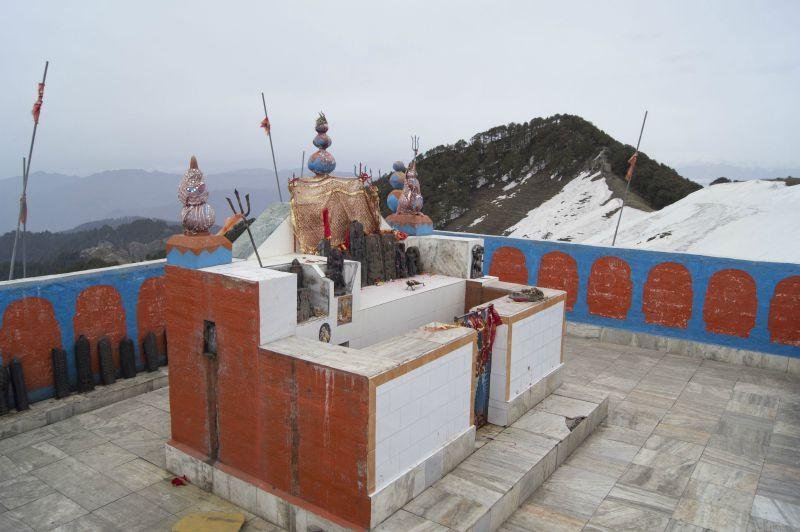
Shikari Devi Temple is one of the most distinctive and spiritually important hilltop temples in the Mandi district of Himachal Pradesh. Situated on the summit of Shikari Peak at an elevation of approximately 3,359 metres, the temple occupies the highest mountain point in Mandi district and is popularly described as the “Crown of Mandi.”
Surrounded by dense forests, open mountain pastures, high ridges and panoramic Himalayan scenery, Shikari Devi Temple offers a remarkable combination of pilgrimage, forest travel, mountain driving and trekking. The temple is dedicated to Shikari Devi, a powerful local manifestation of the Divine Mother traditionally known as the Goddess of Hunters.
Unlike most temples, the principal shrine has no conventional roof above the sacred images. The open-air form of the temple, its exposed summit location, colourful flags, tridents and rows of sacred stone images give Shikari Devi Temple a visual and spiritual identity unlike any other pilgrimage destination in Himachal Pradesh.
The temple is located in the Seraj region of Mandi district and is generally approached through Janjehli, a peaceful mountain valley known for forests, orchards, meadows and village landscapes. Janjehli is the most practical accommodation and transport base for devotees visiting the temple.
Shikari Devi Temple is approximately 18 kilometres from Janjehli through a jeepable forest road. It can also be approached from the Karsog side, which is approximately 21 kilometres from the temple region according to district information.
Although a road reaches close to the temple, visitors should not assume that it is equivalent to an ordinary city road. The route passes through remote forested terrain and may include narrow sections, sharp curves, steep slopes and surfaces affected by rain, snow, maintenance or landslides.
The final approach generally includes stairs or an uphill walk from the practical parking point to the temple courtyard. The exact walking distance may depend on where vehicles are permitted to stop and the condition of the road at the time of travel.
The destination is suitable for pilgrims, families, trekkers, photographers, nature lovers and travellers interested in the local deity traditions of Himachal Pradesh. However, its high altitude and remote location require careful planning.
A visit to Shikari Devi Temple should not be treated as a casual last-minute excursion. Visitors should begin early, check the weather, arrange reliable transport and return before darkness.
## Spiritual Importance of Shikari Devi Temple
Shikari Devi is traditionally worshipped as a protective form of the Divine Mother. Her name is associated with hunters, forest communities and the mountainous landscape surrounding the shrine.
In older Himalayan societies, people regularly entered forests for grazing, collecting wood, travelling between settlements and hunting for survival. These activities involved considerable uncertainty and danger.
Local communities therefore worshipped protective deities who were believed to guard travellers, hunters, shepherds, villages, forests and agricultural land.
Shikari Devi emerged within this cultural and spiritual environment as a guardian goddess of the high mountains.
Devotees visit the temple to pray for courage, protection, family welfare, prosperity, children, health and safe travel. Local residents may seek the blessings of the goddess before important family events, agricultural activity, long journeys or major decisions.
Some pilgrims visit the temple after the fulfilment of a personal vow and offer flags, red cloth, bells, coconuts or other traditional items according to local customs.
Such devotional experiences belong to faith and should not be presented as guaranteed outcomes. The temple’s spiritual value lies in the strength, hope and emotional reassurance received by worshippers.
The summit itself contributes to the religious experience. The journey through forests and the final ascent require patience and effort, encouraging visitors to leave behind ordinary distractions.
At the temple, the open sky, strong mountain wind and distant ranges create a setting that feels separated from everyday life.
For many devotees, this physical openness represents a direct relationship between the goddess, the mountain and the natural world.
## The Roofless Temple
The roofless character of Shikari Devi Temple is its most recognised architectural feature.
The sacred images are housed within an open-air enclosure rather than a fully covered conventional temple building. Painted boundary walls, decorative finials, flags, tridents and religious images define the worship area.
Local belief holds that repeated efforts to construct a roof over the shrine have not succeeded or that the goddess prefers to remain beneath the open sky.
Another widely repeated tradition says that snow does not remain within the sacred enclosure even when the surrounding mountain receives heavy snowfall.
These accounts should be understood as local religious beliefs and observations rather than scientifically guaranteed phenomena.
Shikari Peak is exposed to strong winds, and wind movement can influence how snow accumulates across an open summit. Conditions may differ considerably between individual snow events.
Visitors should never assume that the shrine or approach will be free from snow, ice or dangerous winter conditions.
The absence of a conventional roof gives the temple a powerful visual identity. Worship takes place beneath the open mountain sky, while clouds, sunlight, wind and changing weather become part of the experience.
During clear weather, the sacred images appear against distant Himalayan ranges. During fog, the temple may become surrounded by mist and limited visibility.
Rain, hail or sudden cold can occur at high altitude even when conditions appear comfortable in Janjehli.
Visitors should therefore carry appropriate clothing and avoid relying only on photographs or previous visitors’ experiences.
## Sacred Images and Temple Courtyard
The principal worship area contains a group of sacred stone images associated with Shikari Devi and other divine forms.
Several dark stone figures can be seen within the open shrine. Their exact identities, age and interpretation may be explained differently by local priests and oral traditions.
Visitors should seek guidance from authorised temple representatives rather than assigning identities based only on social-media posts.
Tridents placed around the temple symbolise divine power and protection. The trishul is closely associated with Lord Shiva and powerful manifestations of Shakti.
Flags and red cloth offered by devotees represent prayer, gratitude and personal religious vows.
Every sacred object should be approached respectfully. Visitors should not move stone images, rearrange offerings, remove cloth, lift tridents or touch old religious objects unnecessarily.
The paved courtyard provides space for devotees to offer prayers and observe the surrounding landscape.
During festivals and busy weekends, the courtyard may become crowded. Visitors should avoid occupying central areas for extended photography sessions.
Photography of the sacred images should only be undertaken when permitted. Some devotees may prefer not to be photographed while praying.
Shoes should be removed wherever directed, and modest clothing is appropriate for the shrine.
Puja materials should be purchased in reasonable quantities and placed only in authorised areas. Plastic packaging should be carried back rather than left on the summit.
## Pandava Tradition
Shikari Devi Temple is closely connected with local traditions concerning the Pandavas of the Mahabharata.
According to regional belief, the Pandavas passed through this mountain landscape during their period of exile and established or worshipped the goddess at Shikari Peak.
Some versions of the tradition say that the Pandavas prayed here for success and protection. Others connect the temple with their journeys through the forests and mountains of Himachal Pradesh.
The temple is therefore regarded by many devotees as an ancient sacred place linked with the Mahabharata.
These narratives belong to oral tradition and religious mythology rather than independently verified archaeological history.
Their importance lies in the relationship they create between the temple, local identity and one of India’s most influential sacred epics.
Several Himalayan destinations preserve stories concerning the Pandavas because the mountains are traditionally associated with their exile, pilgrimage and final journey.
Visitors should listen respectfully to local narrations while recognising that different villages and priests may preserve different versions.
The Pandava connection adds cultural depth to the pilgrimage but should not reduce the temple to a mythology-themed attraction. Shikari Devi remains a living goddess worshipped by present-day communities.
## Sage Markandeya Tradition
Local tradition also connects Shikari Peak with Sage Markandeya, one of the respected sages of Hindu religious literature.
The Mandi district tradition states that Sage Markandeya meditated in this area for many years.
Markandeya is widely associated with devotion, spiritual discipline and the worship of the Divine Mother. The Markandeya Purana contains the Devi Mahatmya, an influential text celebrating the victories and divine power of Goddess Durga.
The connection between Sage Markandeya and Shikari Devi therefore fits naturally within the wider Shakta tradition of worshipping the goddess as the supreme protective force.
The exact historical details of the sage’s presence cannot be treated as documented modern history. The narrative should be understood as a sacred association preserved by regional faith.
For spiritual travellers, the tradition reinforces the summit as a place of meditation, austerity and withdrawal from ordinary life.
Visitors may spend time in quiet prayer, but they should avoid occupying the temple courtyard in ways that obstruct local rituals or other pilgrims.
## Why the Goddess Is Called Shikari Devi
The word “Shikari” commonly refers to a hunter. The temple is therefore popularly described as being dedicated to the Goddess of Hunters.
According to local belief, hunters and people entering the forest traditionally sought the blessings of the goddess for protection and success.
The name may also reflect the long relationship between local communities and the surrounding forest environment.
Before modern roads, communication systems and organised emergency services, crossing these mountains required detailed knowledge of weather, wildlife, water sources and trails.
Faith in a guardian deity provided spiritual confidence in an unpredictable landscape.
Today, the name should be interpreted within its historical and cultural setting. The temple is not a destination that promotes hunting or harm to wildlife.
Modern visitors should respect wildlife-protection laws, forest regulations and the ecological importance of the region.
The goddess’s protective identity can be understood more broadly as representing courage, alertness, discipline and respect for nature.
## Shikari Peak: Crown of Mandi
Shikari Peak is the highest summit in Mandi district and is widely known as the Crown of Mandi.
Its elevation provides panoramic views over forests, high meadows, deep valleys and distant Himalayan ranges.
During clear weather, visitors may observe layers of mountain ridges extending in several directions. Snow-covered peaks may be visible depending upon season, atmospheric clarity and cloud cover.
Sunrise and sunset can be particularly attractive, but visitors should plan them with great caution.
A sunrise visit requires leaving Janjehli before daylight and travelling on a remote forest road. Only experienced local drivers familiar with the route should be used.
A sunset visit creates the risk of descending or driving after darkness. Fog can appear quickly, and forest routes may become difficult to follow.
Travellers should never compromise safety merely to obtain a sunrise or sunset photograph.
The summit may remain windy even during calm weather in the valley. Temperatures can fall quickly when clouds gather.
A windproof jacket, warm layer, cap and gloves may be useful outside the warmest months.
Sun exposure can also be strong at high altitude. Visitors should carry water, sunscreen, sunglasses and a head covering.
Mountain views are never guaranteed. Fog, haze, rain and clouds may completely hide the distant landscape.
A cloudy visit can still be meaningful because the temple’s spiritual importance does not depend upon perfect visibility.
## Forest Journey from Janjehli
The journey from Janjehli to Shikari Devi passes through one of the most beautiful forest landscapes in the Seraj region.
Dense tree cover, open pastures and changing mountain views make the route attractive to nature lovers.
The road is described as jeepable, indicating that visitors should expect a mountain track rather than a broad, fully developed highway.
Road conditions can change considerably after rainfall, snowfall, forest activity or repair work.
Travellers should confirm whether the route is currently suitable for ordinary cars. A locally operated taxi or appropriate vehicle may be safer.
Drivers should proceed slowly, use the horn at blind bends and avoid overtaking on narrow stretches.
Passengers should not pressure the driver to travel faster in order to meet a rigid schedule.
Stopping vehicles at sharp bends or unstable edges for photographs is unsafe.
Visitors walking through forest sections must remain on the recognised road or marked trail.
Dense fog can erase familiar visual landmarks, and apparently simple shortcuts may lead towards streams, steep slopes or a different valley.
Every traveller should aim to return before late afternoon.
## Trekking to Shikari Devi
Although vehicles can travel close to the temple under suitable conditions, some travellers choose to walk from Janjehli or from intermediate points.
The full route is a significant high-altitude day walk and should not be confused with the short final climb from the parking area.
Distances may be described differently depending upon the exact trail and road used. Official tourism material commonly places the Shikari Devi route approximately 15 to 18 kilometres from Janjehli.
A full walk requires physical fitness, early departure, suitable footwear and dependable navigation.
Visitors should travel with a local guide if they are unfamiliar with the forests.
A guide can assist with route selection, weather awareness, village customs and emergency decisions.
Trekkers should carry sufficient water, packed food, rain protection, warm clothing, a torch, basic first aid and personal medication.
Mobile-phone batteries should remain charged, but travellers should not depend exclusively on phone navigation or network coverage.
Offline maps may help, although local knowledge remains more reliable in fog or changing trail conditions.
Solo trekking is not advisable during uncertain weather.
Children, elderly travellers and people with medical limitations should use the road-based approach unless they have appropriate preparation.
Trekkers must inform their accommodation provider of their route and expected return time.
## Shikari Devi to Kamrunag Trek
Shikari Devi is connected with Kamrunag through a longer trekking route across high pastures and mountain terrain.
District information describes the journey as approximately 16 kilometres and suitable as a full-day trek.
Kamrunag Lake and Temple form another important spiritual destination in Mandi district. The lake is dedicated to Kamrunag Devta and is surrounded by a forested high-altitude landscape.
The route between Shikari Devi and Kamrunag should be attempted only by experienced walkers with reliable local guidance.
It is not a casual extension of an ordinary temple visit.
Weather can change rapidly, and long sections may be remote. Fog can make navigation difficult, while rain or snow can affect the trail.
Travellers require proper footwear, food, water, warm clothing and an emergency plan.
Accommodation and transport at the finishing point must be arranged before beginning the journey.
Visitors should not attempt to complete Shikari Devi, Kamrunag and a return to Janjehli without understanding the route and available daylight.
## Devidarh and the Extended Trekking Circuit
Devidarh is another scenic destination connected with the wider Janjehli–Shikari Devi–Kamrunag trekking landscape.
Situated within the Jiuni Valley, Devidarh is known for green fields, meadows and dense deodar forest.
The area contains the temple of Mata Mundsan and provides a quieter village and nature experience.
A forest rest house is associated with Devidarh, although current booking, access and availability should be confirmed through the relevant authorities.
The complete circuit should be treated as a multi-destination trekking programme rather than an ordinary road tour.
Visitors interested only in Shikari Devi darshan can return comfortably to Janjehli without attempting the extended route.
Trekkers should obtain current information from local guides because conditions, accommodation and trail markings can change.
## Navratri and Devi Worship
Navratri is an important period for worshippers of Shikari Devi because the festival is dedicated to different forms of the Divine Mother.
Both Chaitra Navratri and Sharad Navratri may attract devotees from Janjehli, Karsog, Thunag, Mandi and surrounding villages.
The temple may be decorated with flags, flowers and sacred cloth. Devotees offer prayers, coconuts, incense, sweets and traditional puja materials.
The remote road and limited parking can become congested during important religious dates.
Pilgrims should book accommodation in Janjehli or another suitable base in advance and begin their journey early.
Large groups should arrange transport, food and return timing before leaving the valley.
Visitors should remain patient during darshan and avoid blocking the shrine for photographs.
The summit may become cold even when festival weather is pleasant in lower settlements.
The exact festival arrangements, puja timings and road restrictions should be confirmed locally because they may change each year.
## Best Time to Visit Shikari Devi Temple
The most suitable period generally depends on road access, weather and the visitor’s physical preparation.
### Spring
Spring begins the transition from winter snow to more accessible mountain conditions.
Snow or ice may remain on shaded roads and near the summit during the early part of the season.
Travellers should confirm access locally rather than assuming the road is open.
As conditions improve, forests begin to display fresh vegetation and the landscape becomes suitable for pilgrimage and walking.
Morning and evening temperatures remain cold, so warm layers are necessary.
### Summer
Summer is one of the most convenient seasons for visiting Shikari Devi Temple.
The Janjehli valley becomes green, forest routes are generally more accessible and daytime temperatures remain comfortable compared with the plains.
The summit can still be windy and cold, particularly under cloud cover.
Weekends and holiday periods may bring larger numbers of visitors. Accommodation should be reserved early.
### Monsoon
The monsoon transforms the region into a lush, mist-covered mountain landscape.
Forests become intensely green, while clouds move rapidly across the summit.
However, heavy rain can make the road muddy or slippery and increase the risk of landslides, falling stones and poor visibility.
Forest trails may become difficult to follow in dense fog.
Visitors should not attempt the journey during severe rainfall, thunderstorms or official weather warnings.
A waterproof jacket is more practical than an umbrella in strong summit winds.
Shoes with dependable grip are essential.
### Autumn
Autumn is among the best periods for visiting Shikari Devi.
Rain generally reduces, the landscape remains green and distant mountain visibility may improve.
Daytime walking conditions are often pleasant, although temperatures fall quickly after sunset.
Sharad Navratri may create additional pilgrimage activity.
Travellers seeking quieter darshan should select an ordinary weekday outside major festivals.
### Winter
Shikari Peak receives heavy snowfall and winter access can become extremely difficult.
The forest road may be blocked, icy or unsafe for ordinary vehicles.
A winter visit should only be considered after obtaining reliable current information from local administration, drivers and accommodation providers.
Visitors should not attempt to drive through snow without a suitably equipped vehicle and an experienced local driver.
Winter trekking requires specialised clothing, navigation and awareness of changing weather.
Snowfall should never be guaranteed for a particular date, and photographs from previous years should not be used to judge current access.
## Altitude and Health Considerations
At approximately 3,359 metres, Shikari Devi Temple stands high enough for some visitors to experience breathlessness, headache, fatigue or nausea.
Most travellers arrive from considerably lower elevations, which means the body has limited time to adjust.
Visitors should walk slowly, remain hydrated and avoid excessive exertion immediately after arrival.
Alcohol and smoking can worsen dehydration and discomfort and should be avoided.
People with heart, lung or serious medical conditions should seek appropriate medical advice before travelling to high altitude.
Children and senior citizens should be monitored carefully.
Persistent severe headache, confusion, breathing difficulty at rest or repeated vomiting should not be ignored. The visitor should descend and seek medical help.
The remote summit has limited medical infrastructure. Essential medicines should be carried from Janjehli, Thunag or a larger town.
## Reaching Shikari Devi Temple
Janjehli is the principal gateway to Shikari Devi Temple.
It is reached by road through the Mandi, Nerchowk and Thunag side, depending upon the traveller’s starting point and current route conditions.
Himachal Pradesh Tourism places Janjehli approximately 85 kilometres from Mandi, while the temple lies another 15 to 18 kilometres beyond Janjehli depending upon the route description used.
Travellers should keep a full day for the temple excursion from Janjehli.
Mandi town offers major markets, hospitals, hotels and transport connections. It can serve as an arrival base, but a direct same-day journey from Mandi to Shikari Devi and back can be extremely tiring.
An overnight stay in Janjehli provides a safer and more meaningful experience.
Karsog offers another approach and can be used by travellers exploring the Karsog Valley.
The temple is approximately 21 kilometres from the Karsog side according to district tourism information, but current road condition and vehicle suitability should be confirmed locally.
The nearest airport commonly referenced for the region is at Bhuntar, followed by a substantial road journey.
Joginder Nagar provides narrow-gauge rail connectivity, although it is far from Janjehli and requires onward road transport.
Most pilgrims reach the destination through road travel from Mandi, Shimla, Kullu or surrounding Himachal regions.
## Janjehli as the Main Stay Base
Janjehli is the most suitable place to stay near Shikari Devi Temple.
The valley offers homestays, guesthouses, small hotels and nature-oriented accommodation.
Staying in Janjehli allows visitors to arrange a local driver, obtain accurate weather information and begin the temple journey early.
Homestay hosts may help with packed meals, local guides and current road advice.
Facilities may be simpler than those in Mandi or Shimla. Guests should confirm attached bathrooms, hot water, meals, heating, electricity and parking.
Properties may be distributed across different villages and slopes, so actual driving time to the Shikari Devi road should be checked before booking.
Families should select accommodation offering meals, comfortable rooms and vehicle access.
Senior citizens should prioritise ground-floor rooms or properties with minimal stairs.
Trekkers should choose hosts familiar with local routes and emergency procedures.
Winter visitors must confirm heating, warm bedding and whether the property’s approach road is open.
## Hotels and Homestays in Karsog
Karsog is a scenic valley known for orchards, agricultural land, temples and traditional villages.
It can serve as an alternative base for approaching Shikari Devi, especially for travellers arriving from the Shimla or Tattapani side.
Accommodation includes local hotels, homestays, guesthouses and orchard properties.
The actual road to Shikari Devi should be confirmed before choosing Karsog as the base because mountain conditions can change.
Karsog can also be combined with Mamleshwar Mahadev Temple, Kamaksha Devi Temple and other regional sacred destinations.
A multi-day Karsog and Shikari Devi itinerary offers a combination of Devi worship, Shiva temples, village culture and mountain scenery.
## Staying in Mandi
Mandi offers the largest selection of hotels, restaurants, hospitals, markets and transport services in the district.
It is a practical arrival or departure base but is not the closest location for early-morning Shikari Devi darshan.
Travellers can stay in Mandi on the first night, continue to Janjehli the following day and visit the temple after adequate rest.
Mandi is known as Chhoti Kashi because of its large number of temples.
Visitors can combine Shikari Devi with Bhutnath Temple, Triloknath Temple, Panchvaktra Temple and other shrines within Mandi town.
A rushed same-day journey between Mandi and Shikari Devi should be avoided, particularly during rain or shorter winter daylight.
## Nearby Attractions and Pilgrimage Destinations
### Janjehli Valley
Janjehli is known for green slopes, forests, traditional villages and a quiet rural atmosphere.
The valley is suitable for short nature walks, slow travel and experiencing Himachali hospitality.
Visitors should respect agricultural land and private homes.
### Kamrunag Lake and Temple
Kamrunag is an important local deity shrine associated with a high-altitude lake.
It can be reached through separate trekking routes and forms part of the extended mountain pilgrimage landscape.
The lake should not be polluted or entered casually, and offerings should follow local regulations.
### Devidarh
Devidarh offers meadows, deodar forests and the temple of Mata Mundsan.
It lies on the broader trekking route connecting Janjehli, Shikari Devi and Kamrunag.
### Karsog Valley
Karsog is known for traditional temples, orchards, village scenery and peaceful accommodation.
It can be included before or after Shikari Devi depending upon the chosen road route.
### Mandi Town
Mandi provides an extensive Shiva pilgrimage experience through its historic temples and riverfront setting.
It is also the principal service centre for the district.
### Rewalsar
Rewalsar is a multi-faith pilgrimage destination associated with Hinduism, Buddhism and Sikhism.
It requires a separate journey from the Shikari Devi region and should be added only when sufficient days are available.
## Suggested One-Day Itinerary
A one-day Shikari Devi pilgrimage is best undertaken from Janjehli.
Visitors should begin early after confirming road and weather conditions.
A local taxi can travel through the forest road towards the practical parking point.
After completing the final walk or steps, pilgrims can attend darshan and spend time observing the mountain scenery.
The return journey should begin while ample daylight remains.
The evening can be spent resting in Janjehli rather than continuing towards Mandi after a tiring day.
## Suggested Two-Day Itinerary
On the first day, travellers can arrive in Janjehli, check into a homestay or guesthouse and explore the nearby valley.
The host or driver can provide current information about the Shikari Devi route.
The second day can begin early with the temple journey.
After darshan, visitors can return to Janjehli for lunch and rest before continuing the next morning.
This itinerary is suitable for families and ordinary pilgrims.
## Suggested Three-Day Itinerary
The first day can include travel from Mandi to Janjehli and an overnight stay.
The second day can be dedicated entirely to Shikari Devi Temple.
The third day can include Devidarh, a local village experience or onward travel towards Karsog.
Trekkers interested in Kamrunag require a separate plan, suitable guides and additional time.
## Choosing Accommodation Near Shikari Devi Temple
The correct accommodation should be selected according to the approach route rather than only the broad destination name.
Janjehli is best for most pilgrims.
Karsog may suit travellers entering from the southern or Shimla side.
Mandi is suitable for transport connections and developed facilities but requires a long onward journey.
Visitors should confirm road access, meals, hot water, heating, parking and mobile connectivity.
Pilgrimage groups should ask about multiple-room availability, vegetarian meals and driver accommodation.
Solo trekkers should choose hosts who can arrange guides and track expected return times.
Families should prioritise safe access and reliable transport rather than selecting an isolated property only for its view.
## Book Stays Near Shikari Devi Temple with MudrasStays
MudrasStays helps pilgrims discover hotels, homestays, guesthouses and mountain accommodation near Shikari Devi Temple, Janjehli, Karsog and Mandi.
The platform is designed specifically for travellers seeking places to stay near temples and spiritual destinations across India.
Visitors can compare properties according to their practical distance from the Shikari Devi route, room requirements, budget, group size and required facilities.
Booking a stay in Janjehli makes it easier to begin early, arrange a local vehicle and receive current information about the forest road.
Solo pilgrims can search for affordable guesthouses and homestays.
Couples can explore peaceful valley properties surrounded by forests and orchards.
Families can select accommodation offering meals, parking and suitable rooms.
Senior citizens can prioritise accessible properties and local transport arrangements.
Pilgrimage groups can identify stays offering multiple rooms, vegetarian food and space for vehicles.
Trekkers can choose properties capable of arranging guides, packed meals and route support.
Travellers combining Shikari Devi with Kamrunag, Devidarh, Karsog or Mandi can select accommodation according to the sequence of their journey.
A temple-focused booking platform helps travellers avoid selecting a general hotel located several hours from the actual pilgrimage route.
## Responsible Pilgrimage and Forest Safety
Shikari Devi Temple stands within a sensitive high-altitude forest and meadow environment.
Visitors must carry back all plastic bottles, food wrappers, disposable plates and puja packaging.
Nothing should be thrown into the forest or down mountain slopes.
Religious offerings should be placed only in authorised locations.
Plastic flags and synthetic cloth should not be tied randomly to trees.
Smoking, bonfires and careless use of incense can create serious forest-fire risks.
Travellers should remain on recognised roads and paths.
Unmarked shortcuts may lead into dangerous terrain and also damage vegetation.
Visitors should not travel through the forest after dark.
Fog can reduce visibility within minutes, making even familiar routes difficult to recognise.
Vehicles should be driven slowly and only by competent drivers experienced with narrow mountain roads.
Parking at unstable edges, sharp bends or places blocking emergency movement must be avoided.
Wildlife should not be fed, chased or disturbed.
Loud music is inappropriate both along the forest route and at the sacred summit.
Visitors should support local drivers, guides, homestays, shops and food providers fairly.
Responsible spending enables tourism to benefit the communities that protect the temple and surrounding landscape.
## A Sacred Journey to the Crown of Mandi
Shikari Devi Temple represents a powerful meeting of Devi worship, forest tradition, Himalayan landscape and local community faith.
Its roofless shrine creates a direct relationship between worship and the open sky.
The high summit provides a sense of spiritual distance from ordinary life.
The Pandava tradition connects the temple with the Mahabharata.
The association with Sage Markandeya links the mountain with meditation and Goddess worship.
The name Shikari Devi preserves the historical relationship between mountain communities, hunters and the protective power attributed to the goddess.
The forests and meadows remind travellers that the sacred character of the destination depends upon environmental preservation.
For Devi devotees, Shikari Devi Temple is a place to seek courage, protection and family welfare.
For local communities, the goddess remains a guardian of the mountains and villages.
For trekkers, the region offers routes towards Kamrunag, Devidarh, Karsog and Janjehli.
For nature lovers, the forests, pastures, sunrise, sunset and snow-range views create a memorable mountain experience.
For families, the jeepable road provides access when conditions are suitable, although careful driving remains essential.
For senior citizens, a local vehicle can reduce the physical effort, but altitude and the final steps should be considered.
For photographers, the roofless shrine, flags, tridents, clouds and Himalayan ranges offer striking opportunities when safety and religious dignity are respected.
For spiritual travellers, the summit provides space for prayer, silence and reflection.
Shikari Devi Temple should not be treated only as a scenic viewpoint or adventure destination.
Its living religious traditions, remote setting and high-altitude risks deserve respect.
Visitors should allow sufficient time for the journey, darshan and safe return.
An overnight stay in Janjehli transforms the trip from a rushed road excursion into a more comfortable and meaningful pilgrimage.
Plan your pilgrimage to Shikari Devi Temple with MudrasStays and experience one of the most extraordinary roofless Devi shrines in Himachal Pradesh.
Seek the blessings of Maa Shikari, travel through the forests of Janjehli and experience panoramic views from the highest summit in Mandi district.
Learn about the local traditions associated with the Pandavas, Sage Markandeya and the guardian goddess of the mountain.
Combine your journey with Janjehli Valley, Devidarh, Kamrunag, Karsog, Mandi and other sacred destinations across Himachal Pradesh.
Book homestays near Shikari Devi Temple, discover hotels in Janjehli and explore suitable pilgrimage accommodation around Karsog and Mandi through MudrasStays.
Stay closer to the temple route, begin the journey early and reduce unnecessary travel on remote mountain roads.
MudrasStays connects pilgrims, trekkers, families and spiritual travellers with suitable accommodation near temples and sacred destinations across India.
Begin your Shikari Devi Temple journey with a comfortable stay and experience a meaningful pilgrimage centred on Goddess worship, Himachali traditions, high-altitude forests and the natural beauty of the Crown of Mandi.