Shri Ram Tirth Valmiki Temple is one of Punjab’s most important Ramayana pilgrimage
destinations and one of the most meaningful spiritual places to visit near Amritsar. Located at Village Kaler on the Chogawan Road side of the district, the sacred complex is traditionally identified with the hermitage of Maharishi Valmiki—the revered sage, teacher and poet associated with the composition of the Ramayana.
The destination is known by several closely related names:
Shri Ram Tirth Valmiki Temple
Shri Ram Tirath
Ram Tirth Temple Amritsar
Ram Tirath Temple
Bhagwan Valmiki Tirath Sthal
Bhagwan Valmiki Tirath Asthan
Maharishi Valmiki Ashram
Sita Mata Luv Kush Janam Sthan
Luv Kush Birthplace Temple
Valmiki Mandir Amritsar
“Tirth” is the Sanskrit-derived spelling, while “Tirath” reflects common Punjabi and North Indian pronunciation. Both normally refer to the same sacred destination west of Amritsar.
Travellers arranging a taxi or searching for accommodation should use the complete destination name:
**Bhagwan Valmiki Tirath Sthal, Village Kaler, Chogawan Road, Amritsar.**
This helps distinguish the pilgrimage centre from local Valmiki temples, Ram temples and other places called Ram Tirth in different parts of India.
Shri Ram Tirth lies approximately 12–16 kilometres west of central Amritsar, depending upon the visitor’s hotel, neighbourhood and chosen road. It is reached by vehicle and does not require a mountain trek.
The complex is extensive and includes a large sacred sarovar, the monumental Bhagwan Valmiki temple, broad courtyards, bridges, colonnaded pathways, memorial huts, a stepped well, smaller shrines, cultural displays, gathering spaces and areas associated through tradition with Mata Sita, Maharishi Valmiki, Luv and Kush.
The present appearance combines two different dimensions of sacred heritage.
The first is the ancient religious tradition that identifies the location with Valmiki’s hermitage and the later Ramayana narrative.
The second is a major modern temple-and-panorama development created to honour Bhagwan Valmiki’s spiritual, literary and social contribution.
Visitors should therefore avoid treating every visible building as an unchanged structure from the Ramayana period.
The sacred association may be ancient within religious memory, while the monumental golden-toned temple, galleries, paved courtyards and visitor facilities belong to modern development.
This distinction respects both faith and historical accuracy.
For devotees of Bhagwan Valmiki, Shri Ram Tirth is a major centre of spiritual identity, dignity, learning and equality.
For followers of the Ramayana, it is connected with Mata Sita’s life after Ayodhya and the childhood of Luv and Kush.
For families, it is an accessible pilgrimage close to Amritsar.
For writers, teachers and students, it represents a journey to the tradition of the Adi Kavi—the first poet.
For cultural travellers, the temple explains how sacred narrative, contemporary architecture and community identity can exist within one living pilgrimage complex.
Travellers searching for hotels near Shri Ram Tirth Valmiki Temple, homestays near Village Kaler, pilgrimage accommodation near Chogawan Road, family hotels near Bhagwan Valmiki Tirath Sthal or places to stay near spiritual destinations in Amritsar can use MudrasStays to plan a convenient and comfortable journey.
## Spiritual Significance of Shri Ram Tirth
Shri Ram Tirth is centred on the traditions of Maharishi Valmiki, Mata Sita and her sons Luv and Kush.
According to Hindu sacred tradition, Mata Sita came to Maharishi Valmiki’s ashram after leaving Ayodhya.
The hermitage became her place of protection and refuge during one of the most emotionally difficult periods of her life.
Luv and Kush are traditionally believed to have been born in this sacred landscape and raised under the combined guidance of their mother and Maharishi Valmiki.
Valmiki is believed to have educated the twins in scripture, poetry, music, ethics, archery, discipline and responsible conduct.
This gives Shri Ram Tirth a distinctive spiritual identity.
The site is not associated only with kingship, war or royal victory.
It is associated with refuge.
It is associated with motherhood during hardship.
It is associated with a teacher protecting and educating children.
It is associated with poetry speaking to power.
It is associated with the dignity that can exist outside palaces and public approval.
A forest hermitage becomes spiritually greater than a royal court when it protects someone facing isolation and prepares the next generation to live with courage and knowledge.
The pilgrimage therefore carries a powerful message for modern families.
Children need more than wealth.
They require emotional security, ethical education, disciplined learning and adults who are willing to protect their dignity.
A community becomes sacred when it provides shelter to those who are vulnerable.
Education becomes sacred when it develops courage and moral judgement rather than obedience alone.
## Maharishi Valmiki
Maharishi Valmiki occupies the central position within Shri Ram Tirth Valmiki Temple.
He is revered as a sage, teacher, poet and the traditional composer of the Sanskrit Ramayana.
He is honoured with the title **Adi Kavi**, meaning the first poet.
The Ramayana is one of India’s foundational sacred and literary traditions. It explores dharma, loyalty, courage, love, exile, grief, kingship, family responsibility and the moral complexity of human decisions.
Valmiki’s importance, however, extends beyond authorship.
At Shri Ram Tirth, he is remembered as:
The sage who provided shelter to Mata Sita
The guardian and teacher of Luv and Kush
The poet who preserved the story of Rama
A spiritual guide associated with transformation
A symbol of education, equality and human dignity
A compassionate figure who responded to suffering
Traditional stories concerning Valmiki’s early life vary considerably.
A widely known devotional narrative describes a person connected with harmful conduct who became aware of the consequences of his actions.
Through meditation, discipline and remembrance of the Divine, he transformed into Maharishi Valmiki.
This account belongs to religious tradition rather than modern documented biography.
Its spiritual teaching remains powerful.
A person does not have to remain permanently defined by past mistakes when genuine recognition, responsibility and transformation occur.
Valmiki represents the possibility of becoming wiser, more compassionate and more responsible.
His story teaches that spiritual transformation requires more than changing one’s public identity.
It requires changing one’s conduct.
## Valmiki as the Adi Kavi
The title Adi Kavi connects Maharishi Valmiki with the beginning of classical Sanskrit poetic expression.
According to literary tradition, the first measured shloka emerged from his grief after witnessing the killing of one bird from a loving pair.
The suffering he observed became poetry.
This story creates a direct relationship between literature and compassion.
Poetry did not begin simply as decoration or entertainment.
It began as a response to pain.
The tradition suggests that a true poet must be emotionally awake to the world.
A writer should recognise injustice, understand grief and communicate experiences that others may ignore.
Language becomes sacred when it helps society reflect upon its actions.
Shri Ram Tirth can therefore be experienced as a literary pilgrimage.
Writers may reflect upon the responsibility of storytelling.
Teachers may consider how education shapes moral awareness.
Students may learn that powerful writing requires observation, empathy and discipline.
The temple’s connection with Valmiki makes it particularly suitable for educational groups, literary organisations and people interested in the relationship between faith and literature.
## Mata Sita at Valmiki Ashram
Mata Sita is one of the most revered and emotionally complex figures within the Ramayana tradition.
She represents dignity, courage, loyalty, endurance and inner strength.
Her identity should not be reduced to silent obedience.
Her story includes exile, abduction, public judgement, motherhood, separation and the effort to protect personal dignity.
According to the Shri Ram Tirth tradition, Mata Sita came to Valmiki’s hermitage after leaving Ayodhya.
The ashram offered her safety away from royal life.
Here she is believed to have given birth to Luv and Kush and raised them with Valmiki’s support.
This makes the pilgrimage centre especially meaningful for people reflecting upon motherhood, social judgement and the responsibility of communities towards women experiencing hardship.
Sita’s association should not be used to romanticise suffering.
The spiritual lesson is not that a person must silently tolerate every injustice.
The lesson is that dignity, courage and responsible support remain possible even in painful circumstances.
Devotees may pray for family wellbeing, emotional strength and the welfare of children according to their faith.
The temple should not be promoted as guaranteeing marriage, fertility, childbirth or the resolution of family conflict.
Prayer may provide hope and emotional strength, while medical, legal and family concerns should receive appropriate practical attention.
## Birthplace Tradition of Luv and Kush
A memorial structure within the complex marks the location traditionally associated with the birth of Luv and Kush.
The twin sons of Lord Rama and Mata Sita are remembered as courageous, intelligent and highly trained children.
They were raised outside the royal palace and did not initially grow up with the privileges associated with their ancestry.
Their strength came from education.
Their confidence came from discipline.
Their moral understanding came from the guidance of Mata Sita and Maharishi Valmiki.
The birthsite tradition gives Shri Ram Tirth an important connection with childhood and parenting.
It teaches that the future of children is not determined only by wealth, family name or social status.
A child’s character is shaped through teaching, affection, boundaries, courage and ethical example.
Families visiting with children can use the pilgrimage to discuss the importance of respecting teachers, protecting parents and developing both knowledge and physical discipline.
## Education of Luv and Kush
Maharishi Valmiki is traditionally believed to have educated Luv and Kush in scripture, music, poetry, archery and moral conduct.
Their education was not divided into isolated academic subjects.
It combined intellectual, physical, artistic and spiritual development.
The twins are believed to have learned the Ramayana and later recited it before Lord Rama and members of his court.
This creates one of the most powerful images within Indian literary tradition.
Children stand before a king and narrate the story of his own life.
Poetry becomes a mirror through which authority is asked to examine itself.
Education becomes an instrument for communicating truth rather than merely following power.
The tradition is especially meaningful for teachers, parents and students.
Good education should not be restricted to examination results or employment.
It should develop communication, judgement, courage, compassion and the ability to question responsibly.
## The Ashwamedha Horse Tradition
A famous narrative associated with Shri Ram Tirth concerns the Ashwamedha Yajna conducted by Lord Rama.
According to the wider epic tradition, a ceremonial horse was released to travel through different territories.
Stopping the horse represented a challenge to the authority of the ruler conducting the ritual.
Luv and Kush are believed to have stopped or captured the horse near Valmiki’s hermitage.
A confrontation followed between the young brothers and members of Rama’s forces.
The children demonstrated remarkable courage and skill before their identity was fully understood.
Versions of the narrative differ in sequence and detail.
Some local traditions connect particular grounds, trees or memorials at Ram Tirth with the episode.
These accounts belong to Ramayana and regional pilgrimage tradition rather than documented military history.
Their deeper meaning concerns identity and moral courage.
Luv and Kush could not be dismissed because of their age or because they had grown up outside a royal court.
Their learning and principles required powerful people to recognise them.
## Hanuman and the Luv–Kush Narrative
Some versions of the Ashwamedha story describe Luv and Kush confronting Lord Hanuman.
The twins are sometimes said to have restrained him during the conflict.
Hanuman represents strength, humility, devotion and complete service to Lord Rama.
The narrative should not be interpreted as permanent hostility between sacred figures.
It belongs to a dramatic episode in which identities were hidden or not yet fully recognised.
The story teaches that courage and knowledge may appear in unexpected forms.
Even an experienced warrior should not underestimate children who have received disciplined training.
Any tree or location identified with the story should be treated respectfully.
Visitors should not drive nails into trees, carve names, apply paint or tie excessive synthetic material around branches.
## The Sacred Sarovar
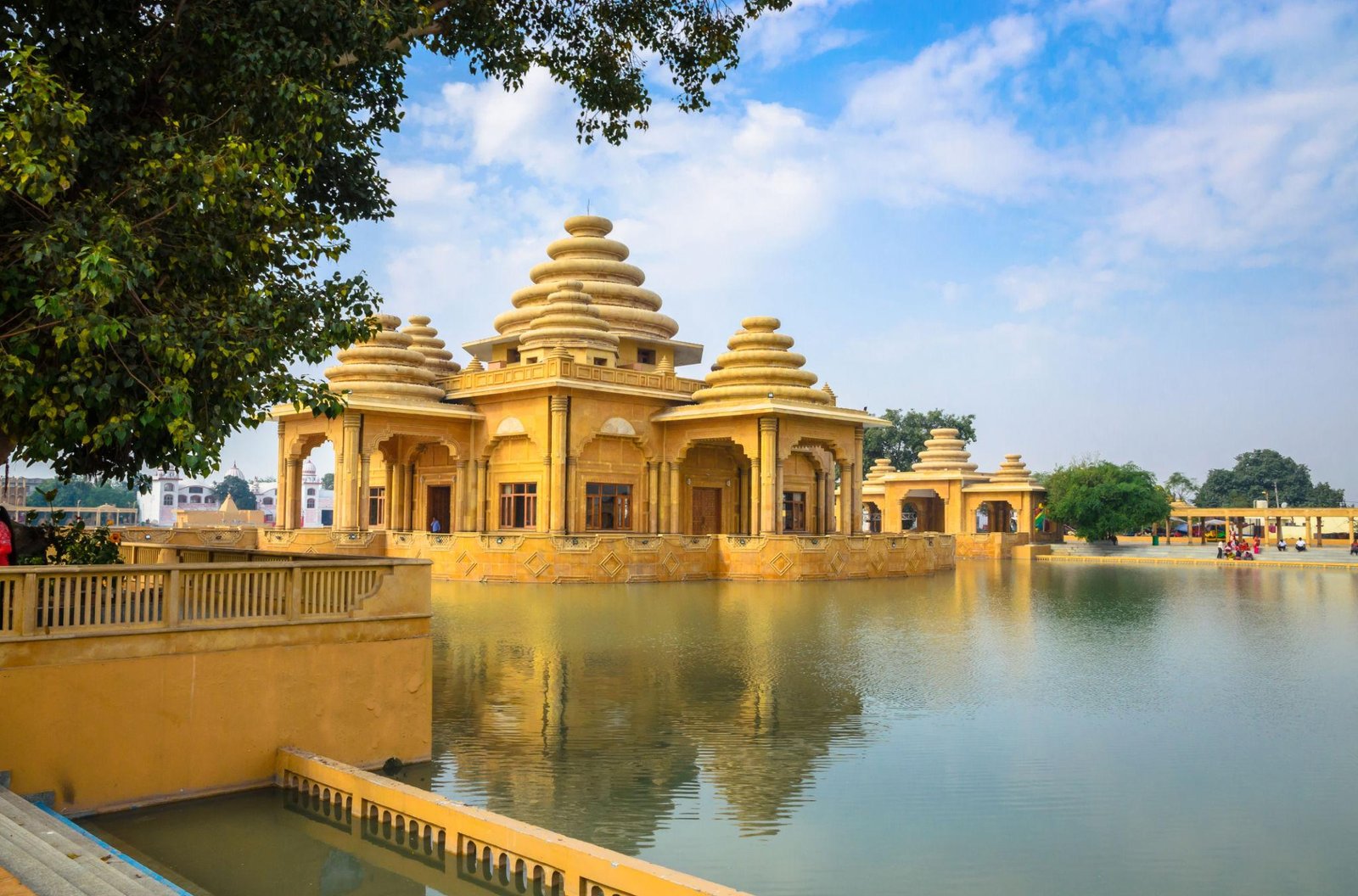
The large sarovar is one of the defining features of Shri Ram Tirth Valmiki Temple.
The golden-toned temple is reflected in its water, creating a strong visual relationship between architecture and the sacred pool.
The sarovar is traditionally associated with Lord Hanuman.
Some accounts say that Hanuman created or enlarged it through movements of his hand or mace.
This story belongs to devotional tradition rather than documented engineering history.
Water represents life, purification, continuity and renewal.
It also creates one of the most important spiritual symbols of the pilgrimage.
A calm water surface receives a clear reflection.
When the water is disturbed, the reflected image becomes difficult to recognise.
In the same way, a mind constantly disturbed by fear, anger or distraction struggles to recognise truth.
A calmer mind becomes more capable of reflection.
Pilgrims may bathe during Kartik Purnima and other important occasions where authorised.
Bathing arrangements should always be confirmed.
Water depth, cleanliness, crowd management and maintenance conditions may change.
Children and non-swimmers must remain supervised.
Soap, shampoo, detergents and chemical products should never be used in the sacred water.
Plastic, packaged offerings, synthetic flowers, cloth and food must not be thrown into the sarovar.
## Meaning of a Ritual Bath
A ritual bath symbolises purification and the intention to begin with greater awareness.
It does not automatically erase the consequences of harmful conduct.
A person remains responsible for apologising, correcting injustice and changing behaviour.
The sacred water should not be promoted as a guaranteed medical treatment.
Visitors with open wounds, reduced immunity or health concerns should make an informed decision before entering.
Those unable or unwilling to bathe can pray from the ghat without losing the spiritual value of the pilgrimage.
## Mata Sita’s Stepped Well
The sacred landscape includes a stepped well traditionally associated with Mata Sita.
A baoli or stepped well allows people to descend towards the changing water level.
Such structures historically served practical needs while also acquiring religious importance.
The Sita well connects the Ramayana tradition with ordinary daily life.
Mata Sita is remembered not only through royal events but also through water, shelter, motherhood and the responsibilities of living within an ashram.
Visitors should follow current safety barriers.
Old steps may be narrow, worn or slippery.
Children should remain supervised.
Coins, plastic and ritual waste should not be placed in the water.
Claims that the well guarantees fertility or cures illness should not be presented as fact.
## Maharishi Valmiki’s Hut
A memorial hut represents Maharishi Valmiki’s ashram and place of spiritual practice.
The current structure should be understood as a sacred memorial rather than an unchanged organic hut surviving physically from the epic period.
Structures made from timber, earth and grass require repeated reconstruction.
A sacred location can retain spiritual continuity even when its shelter changes.
The hut represents simplicity.
Valmiki’s authority did not come from a palace, military power or wealth.
It came from knowledge, meditation, literature and compassion.
The humble hermitage became the setting for one of India’s most influential sacred narratives.
## Mata Sita and Luv–Kush Memorial Hut
Another memorial marks the location traditionally associated with Mata Sita’s residence and the birth of Luv and Kush.
The structure represents refuge, motherhood and resilience.
Sita raised her children away from royal comfort, yet they received a profound education.
The hut communicates an important message.
Human dignity does not depend entirely upon wealth or public approval.
A simple dwelling becomes sacred when it protects life and learning.
Visitors should not touch, damage or place unauthorised offerings upon the memorial structure.
Photography should not obstruct prayer.
## The Modern Bhagwan Valmiki Temple
The monumental Bhagwan Valmiki temple forms the visual centre of the modern complex.
Its golden or sandstone-toned exterior, tiered shikhara-like roof forms, carved pillars, arches and reflection in the sarovar create a distinctive architectural identity.
The temple is reached through developed pathways and is surrounded by colonnades, courtyards and visitor facilities.
The architecture combines contemporary construction with forms inspired by Indian temple traditions.
Its layered tower shapes distinguish it from the tall curving shikharas seen at many North Indian temples.
The broad horizontal composition allows the building to appear closely integrated with the water.
Morning light creates warm reflections.
Evening illumination may give the complex a glowing appearance.
Visitors should remember that polished floors near the sarovar can become slippery.
Running, climbing on railings and leaning over water barriers should be avoided.
## Gold-Plated Image of Bhagwan Valmiki
The principal modern shrine contains a large gold-plated image of Maharishi Valmiki.
The image presents him with the dignity of a sage, author and spiritual teacher.
Devotees may respectfully address him as Maharishi Valmiki, Guru Valmiki or Bhagwan Valmiki according to their religious and community tradition.
Visitors should respect the terminology used by the devotees and the institution.
The image represents more than artistic grandeur.
It acknowledges Valmiki’s contribution to literature, education, transformation and social dignity.
Photography within the shrine should follow current rules.
Visitors should not block the sanctum or treat the image only as a backdrop for personal photographs.
## The Panorama and Museum
Shri Ram Tirth has been developed as a temple-and-panorama complex.
Panorama displays can use models, paintings, sculptures, lighting and visual narratives to present episodes connected with Maharishi Valmiki, Mata Sita and Luv–Kush.
The museum and interpretive spaces make the destination especially valuable for students and visitors unfamiliar with the later Ramayana narrative.
The displays may explain themes such as:
Valmiki’s transformation
The creation of the Ramayana
Sita’s arrival at the hermitage
The birth and upbringing of Luv and Kush
The education of the twins
The Ashwamedha episode
The literary legacy of the Adi Kavi
Equality, dignity and social transformation
Museum opening hours may differ from temple timings.
Maintenance, private functions or festivals can temporarily affect access.
Visitors should not touch models, murals or display cases.
Flash photography may be restricted.
## Sanskrit Library and Learning Tradition
The complex includes a Sanskrit and learning dimension connected with Valmiki’s literary identity.
A library reinforces the understanding that the pilgrimage is not limited to ritual darshan.
It is also associated with knowledge, manuscripts, language and scholarship.
Visitors interested in research should confirm public access and consultation rules beforehand.
Books or manuscripts should never be handled without permission.
Educational institutions and literary groups can consider Shri Ram Tirth as a destination for carefully planned study visits.
## Shri Ram Tirth as a Centre of Equality and Dignity
Bhagwan Valmiki Tirath Sthal has profound importance for Valmiki communities across Punjab and India.
The pilgrimage centre represents spiritual belonging, cultural recognition, literary heritage and social dignity.
Visitors should approach it without caste prejudice, stereotypes or dismissive language.
The temple is not a secondary attraction near Amritsar.
It is a major place of faith and civilisational importance for the communities that have preserved Valmiki traditions.
Respect requires more than following footwear rules.
It requires recognising the equal human and spiritual worth of every person.
The values associated with Bhagwan Valmiki—learning, transformation, compassion and truth—should shape behaviour within and beyond the temple.
## Annual Ram Tirth Fair
The annual fair is the most important festival gathering at Shri Ram Tirth.
Its central observance takes place around Kartik Purnima, the full-moon day of the Hindu month of Kartik, generally occurring in October or November.
The core official fair may be organised across several days, while surrounding market, cultural and pilgrimage activity can extend for a longer period.
Visitors should verify the precise programme for the year of travel.
The fair attracts devotees from Punjab and neighbouring states.
Pilgrims visit the Bhagwan Valmiki shrine, offer prayers at the memorial sites, bathe in authorised areas of the sarovar and participate in religious and cultural programmes.
Temporary markets, food stalls, community services and transport arrangements may be introduced.
Roads and parking areas become extremely crowded.
Families should keep children and senior citizens close.
Groups should choose a meeting point before entering the main complex.
Visitors should carry minimal luggage and follow police and management instructions.
## Kartik Purnima
Kartik Purnima is considered sacred across several Indian religious traditions.
At Shri Ram Tirth, it is associated with pilgrimage bathing, prayer, lamps and the principal annual fair.
The full moon and the temple’s reflection across the water can create a powerful devotional environment.
A sacred date does not remove physical risk.
Visitors should enter the water only in designated areas and according to current instructions.
Deep-water photography and unsafe crowd behaviour should be avoided.
## Floating Lamps and Environmental Responsibility
Devotees may offer floating lamps according to current festival tradition and management rules.
Only approved biodegradable materials should be used.
Plastic bases, metallic foil and synthetic decoration should never be released into the sarovar.
A ritual intended to symbolise light should not create pollution.
Visitors should follow present instructions rather than copying an old photograph or video.
## Valmiki Jayanti
Valmiki Jayanti, also called Valmiki Prakat Diwas, celebrates the life, teachings and literary contribution of Maharishi Valmiki.
Devotional processions, recitations, community programmes, cultural performances and educational activities may be organised.
The date follows the Hindu lunar calendar and changes each year.
The festival offers an opportunity to reflect upon literature, equality, personal transformation and the responsibilities of teachers and writers.
## Ram Navami
Ram Navami celebrates the birth of Lord Rama and generally falls during March or April.
Although Shri Ram Tirth focuses strongly on Valmiki, Sita, Luv and Kush, the complete Ramayana tradition gives Ram Navami significance within the pilgrimage landscape.
Programmes may include recitation, bhajan and prayer.
## Best Time to Visit Shri Ram Tirth
The temple can generally be visited throughout the year.
### October to March
The cooler months offer the most comfortable weather for walking through the extensive complex.
November is especially important because of the annual fair.
December and January mornings may be cold or foggy.
### February and March
Late winter and early spring usually offer pleasant conditions.
These months are suitable for families, educational groups and visitors wishing to avoid festival crowds.
### April to June
Amritsar can become extremely hot.
The broad courtyards and paved surfaces receive strong sunlight.
Visitors should arrive early, carry drinking water and avoid the hottest afternoon period.
### July to September
The monsoon brings humidity and rainfall.
Courtyards, bridges and tank-side pathways may become slippery.
Visitors should wear stable footwear and monitor local weather.
### Kartik Purnima Fair
The festival provides the strongest collective atmosphere but also the greatest crowd pressure.
Visitors seeking quiet exploration should choose another period.
## Suggested Visiting Time
Early morning is generally ideal for a peaceful visit.
The temperature is cooler, the sarovar may be calmer and the temple’s reflection can appear especially clear.
Evening illumination may also be visually attractive, but return transportation should be arranged.
Published opening hours and museum access should be reconfirmed because festivals, maintenance and ceremonial functions can change schedules.
## Reaching Shri Ram Tirth from Amritsar
The temple lies west of Amritsar on the Chogawan Road or Amritsar–Lopoke side.
A taxi, private vehicle or prearranged cab is generally the easiest method of travel.
Auto-rickshaws may accept the journey, but the complete fare and waiting arrangement should be agreed before departure.
Local buses and shared vehicles may operate towards Chogawan, Lopoke or surrounding villages, but frequency and the final connection should be checked locally.
Families and senior citizens are usually more comfortable with a waiting vehicle.
## Reaching from Amritsar Junction
Amritsar Junction is the principal railway station.
A road transfer is required to Shri Ram Tirth.
Visitors arriving with large luggage should first check into accommodation or use secure storage.
Suitcases are unnecessary within the temple complex and can make movement difficult.
## Reaching from the Golden Temple Area
Travellers staying near Sri Harmandir Sahib must pass through or around busy city roads before continuing west.
An early departure reduces congestion.
Ram Tirth should not be scheduled immediately before a train or flight without a generous time allowance.
## Reaching from Amritsar Airport
Sri Guru Ram Dass Jee International Airport is the nearest commercial airport.
The temple requires a road transfer.
Travel time depends upon traffic, the chosen road and the visitor’s hotel location.
A temple visit should not be planned immediately before departure.
## Accessibility for Senior Citizens
Shri Ram Tirth is significantly more accessible than mountain pilgrimage destinations.
The main complex is road-connected and contains broad pathways and developed courtyards.
Some memorial shrines, ghats, bridges and the stepped well may involve stairs or uneven surfaces.
Senior citizens should visit during cooler and quieter hours.
Visitors using wheelchairs should confirm the nearest accessible entrance and route to individual shrines and galleries.
Festival parking may be placed farther from the complex.
A weekday morning usually provides a more comfortable experience.
## Visiting with Children
The temple is particularly suitable for children because of its association with Luv and Kush.
Parents can explain the value of teachers, literature, courage and respect for one’s mother.
Children must remain supervised near the sarovar, bridges, steps and railings.
They should not touch museum displays or climb memorial structures.
School groups should receive a balanced explanation that distinguishes sacred tradition from archaeological proof.
## Temple Etiquette
Visitors should dress respectfully and remove footwear wherever directed.
Phones should remain silent inside shrines and galleries.
Photography of sacred images, priests, memorial rituals and private worship should only be undertaken when permission is clear.
Queue barriers should not be crossed.
Visitors should not touch exhibits, murals or sacred memorials.
Offerings and donations should be made through recognised arrangements.
## Nearby Attractions
### Sri Harmandir Sahib
Sri Harmandir Sahib, popularly known as the Golden Temple, is the central Sikh pilgrimage destination of Amritsar.
Visitors should cover their heads, remove footwear, wash their feet and follow Sikh maryada.
### Durgiana Temple
Durgiana Temple is an important Hindu pilgrimage complex dedicated principally to Lakshmi Narayan and associated with Maa Durga, Ram Darbar, Radha–Krishna, Sheetla Mata and Hanuman traditions.
### Jallianwala Bagh
Jallianwala Bagh is a national memorial associated with the massacre of 1919.
It should be approached with seriousness and respect.
### Partition Museum
The Partition Museum preserves personal histories, documents and objects connected with the Partition of 1947.
Its themes of displacement and survival create meaningful connections with the ideas of exile and refuge associated with Mata Sita.
### Gobindgarh Fort
Gobindgarh Fort presents aspects of Punjab’s military, royal and cultural history.
Opening hours, tickets and programme schedules should be checked before visiting.
### Mata Lal Devi Temple
Mata Lal Devi Temple is known for its colourful mirror work, narrow passages and cave-style devotional route.
Visitors with mobility limitations or claustrophobia should understand the route before entering.
### Pul Kanjari
Pul Kanjari is a heritage site associated with Maharaja Ranjit Singh and the historic Lahore–Amritsar route.
It can be included within a western Amritsar itinerary where current access permits.
### Attari Border
The Attari border ceremony requires a separate road journey, security checks and sufficient time.
It should not be combined with Shri Ram Tirth in an overly compressed schedule.
## Suggested Half-Day Shri Ram Tirth Itinerary
Leave Amritsar early in the morning.
Reach Bhagwan Valmiki Tirath Sthal before the strongest heat or largest visitor numbers.
Walk around the sarovar.
Visit the principal Bhagwan Valmiki shrine.
Pay respect at the memorial huts associated with Maharishi Valmiki and Mata Sita.
Visit the Luv–Kush birthplace memorial and stepped well according to current access.
Explore the panorama or museum if open.
Return to Amritsar around lunchtime.
## Suggested One-Day Spiritual Itinerary
Begin with morning darshan at Shri Ram Tirth.
Return towards central Amritsar and visit Durgiana Temple.
Continue to Sri Harmandir Sahib and participate respectfully in the langar where appropriate.
Visit Jallianwala Bagh or the Partition Museum according to available time.
## Suggested Two-Day Amritsar Pilgrimage
On the first day, explore the Golden Temple, Jallianwala Bagh, Partition Museum and old city.
On the second morning, visit Shri Ram Tirth Valmiki Temple.
Continue to Durgiana Temple, Mata Lal Devi Temple or another appropriate spiritual destination.
## Suggested Three-Day Heritage Journey
Day one can focus on the central Amritsar sacred and historic area.
Day two can include Shri Ram Tirth and selected western Amritsar heritage destinations.
Day three can include Attari, Pul Kanjari or another regional excursion according to current access.
A slower itinerary is more suitable for senior citizens, children and travellers seeking meaningful rather than rushed visits.
## Accommodation Near Shri Ram Tirth Valmiki Temple
Accommodation immediately beside the temple is more limited than in central Amritsar.
The city provides the broadest selection of hotels, guesthouses, homestays and pilgrim accommodation.
The right area depends upon the complete itinerary.
## Hotels on the Western Side of Amritsar
Travellers focused primarily on Shri Ram Tirth can select a property with practical access to Chogawan Road or the western side of the city.
This can reduce the morning journey and unnecessary movement through congested central roads.
## Hotels Near the Golden Temple
These properties are suitable for visitors prioritising Sri Harmandir Sahib, Jallianwala Bagh and the old city.
Vehicle access and parking can be restricted in narrow lanes.
Guests planning a Shri Ram Tirth excursion should confirm the taxi pickup point.
## Hotels Near Amritsar Junction
Railway-station hotels are practical for short stays and travellers arriving by train.
Guests should confirm room quality, parking, luggage storage, breakfast timing and taxi arrangements.
## Hotels in Ranjit Avenue
Ranjit Avenue provides modern hotels, restaurants, wider roads and easier vehicle movement.
It is suitable for families and travellers seeking comfort outside the busiest old-city lanes.
## Homestays in Amritsar
Verified homestays can provide Punjabi meals, residential hospitality and personalised travel guidance.
Guests should confirm attached bathrooms, heating, cooling, parking, meals and transportation.
## Choosing the Right Place to Stay
Travellers focused mainly on Shri Ram Tirth should choose accommodation with convenient western-road access.
Visitors combining the temple with the Golden Temple may prefer a central location.
Families should confirm room capacity, breakfast and parking.
Senior citizens should prioritise lifts, ground-floor rooms and dependable taxis.
Couples may prefer quieter hotels or homestays outside crowded lanes.
Solo pilgrims should select populated and well-connected accommodation.
Groups should confirm multiple rooms, early meals and bus parking.
Fair-period visitors should reserve accommodation well in advance.
Summer guests should verify effective air-conditioning.
Winter travellers should confirm hot water and heating.
## Book Hotels Near Shri Ram Tirth with MudrasStays
MudrasStays helps pilgrims, families, students and cultural travellers discover hotels, homestays, guesthouses and pilgrimage accommodation near Shri Ram Tirth Valmiki Temple and throughout Amritsar.
The platform is designed for travellers searching specifically for places to stay near temples, sacred heritage centres and pilgrimage destinations.
Visitors can compare accommodation according to practical driving distance from Bhagwan Valmiki Tirath Sthal, room category, budget, family size and required facilities.
Booking on the appropriate side of Amritsar can reduce travel through congested areas and make peaceful morning darshan easier.
Families can choose hotels offering comfortable rooms, meals and parking.
Senior citizens can prioritise accessible properties with lifts and reliable taxi services.
Solo pilgrims can search for economical guesthouses in well-connected neighbourhoods.
Student and cultural groups can identify accommodation providing multiple rooms, early breakfast and bus parking.
Travellers attending the Ram Tirth Fair or Valmiki Jayanti can book early and avoid uncertain last-minute availability.
Visitors combining Shri Ram Tirth with Sri Harmandir Sahib, Durgiana Temple, Jallianwala Bagh, the Partition Museum, Gobindgarh Fort, Attari and Pul Kanjari can select accommodation according to the actual geographical sequence of the journey.
MudrasStays helps travellers avoid booking a property that appears close in straight-line distance but lies across congested city roads or requires unnecessary backtracking.
## Responsible Pilgrimage
Shri Ram Tirth is an active place of worship and a major centre of Valmiki faith and heritage.
Visitors should dress respectfully and behave with humility.
Sacred images, memorial huts, priests and private rituals should only be photographed when permission is clear.
Museum displays should not be touched.
The sarovar must not be polluted.
Bathing rules should be followed.
Children should remain supervised around water.
Festival food should not be wasted.
Plastic and disposable material should be placed in designated bins.
Donations should be made through recognised channels.
## Respecting Valmiki Heritage
Visitors should avoid caste-based language, stereotypes and dismissive assumptions.
Bhagwan Valmiki Tirath Sthal represents spiritual faith, cultural identity, literature, equality and social dignity.
Respect requires recognising the importance of the site to the communities that have preserved its traditions.
The values associated with Valmiki—transformation, learning, compassion and truth—should continue beyond the temple visit.
## Respecting Village Kaler
The pilgrimage complex stands within a living village environment.
Residents use the same roads, markets, water sources and public spaces as visitors.
Vehicles should not block homes, agricultural access or emergency routes.
Private land should not be entered without permission.
Residents should not be photographed casually.
Local drivers, priests, volunteers, food providers and accommodation hosts should be treated fairly.
Responsible pilgrimage allows tourism to support the surrounding community rather than creating only traffic and waste.
## A Sacred Landscape of Poetry, Refuge and Learning
Shri Ram Tirth Valmiki Temple represents a powerful meeting of Maharishi Valmiki, Mata Sita, Luv and Kush, sacred water, literature and human dignity.
Valmiki represents transformation, poetry and compassionate wisdom.
Mata Sita represents courage, motherhood and dignity during hardship.
Luv and Kush represent the strength created through education and ethical discipline.
The ashram represents refuge.
The memorial huts represent simplicity and resilience.
The stepped well connects sacred memory with ordinary life.
The sarovar represents renewal and inner reflection.
The Ashwamedha tradition represents the courage to question authority.
The monumental temple represents contemporary recognition of Bhagwan Valmiki’s spiritual and literary contribution.
The panorama helps younger generations understand his teachings.
The annual fair keeps the pilgrimage connected with Punjab’s living cultural calendar.
For Valmiki devotees, Shri Ram Tirth is a central place of faith, identity and spiritual belonging.
For Ramayana pilgrims, it provides a meaningful connection with the later life of Mata Sita and the childhood of Luv and Kush.
For families, it offers an accessible sacred destination without a difficult trek.
For children, it communicates the importance of teachers, courage and learning.
For writers and students, it represents a pilgrimage to the tradition of the Adi Kavi.
For senior citizens, road access and broad pathways make the principal areas manageable when festival crowds are avoided.
For cultural travellers, it demonstrates how inherited sacred memory and modern architecture can exist within one living pilgrimage complex.
For photographers, the golden temple, tiered towers, sarovar and reflections offer memorable images when worship and privacy rules are respected.
For spiritual seekers, Shri Ram Tirth teaches that refuge, education and truthful storytelling can transform suffering into wisdom.
The temple should not be treated merely as a brief sightseeing stop near Amritsar.
Walk around the sarovar without polluting it.
Visit the Bhagwan Valmiki shrine with attention.
Reflect upon Mata Sita’s courage.
Learn how Luv and Kush were educated.
Understand sacred tradition without presenting every story as archaeological proof.
Recognise the pilgrimage centre’s importance to Valmiki communities.
Allow the legacy of the first poet to inspire truthful and responsible speech.
Plan your pilgrimage to Shri Ram Tirth Valmiki Temple with MudrasStays and experience one of Punjab’s most important Ramayana and Valmiki heritage destinations.
Seek the blessings of Bhagwan Valmiki, pay respect to Mata Sita and discover the traditions associated with Luv and Kush.
Explore the sacred sarovar, Valmiki temple, memorial huts, stepped well and cultural panorama.
Combine your journey with Sri Harmandir Sahib, Durgiana Temple, Jallianwala Bagh, the Partition Museum, Gobindgarh Fort, Pul Kanjari, Attari and the wider spiritual heritage of Amritsar.
Book hotels near Shri Ram Tirth Valmiki Temple, discover homestays in Amritsar and choose suitable pilgrimage accommodation through MudrasStays.
Stay on the correct side of the city, attend peaceful morning darshan and reduce unnecessary travel through crowded roads.
MudrasStays connects pilgrims, families, students and cultural travellers with suitable accommodation near temples, sacred water bodies and heritage destinations across India.
Begin your Shri Ram Tirth journey with a comfortable stay and experience a meaningful pilgrimage centred on Maharishi Valmiki, Mata Sita, Luv and Kush, sacred learning and the enduring spiritual power of the Ramayana.