
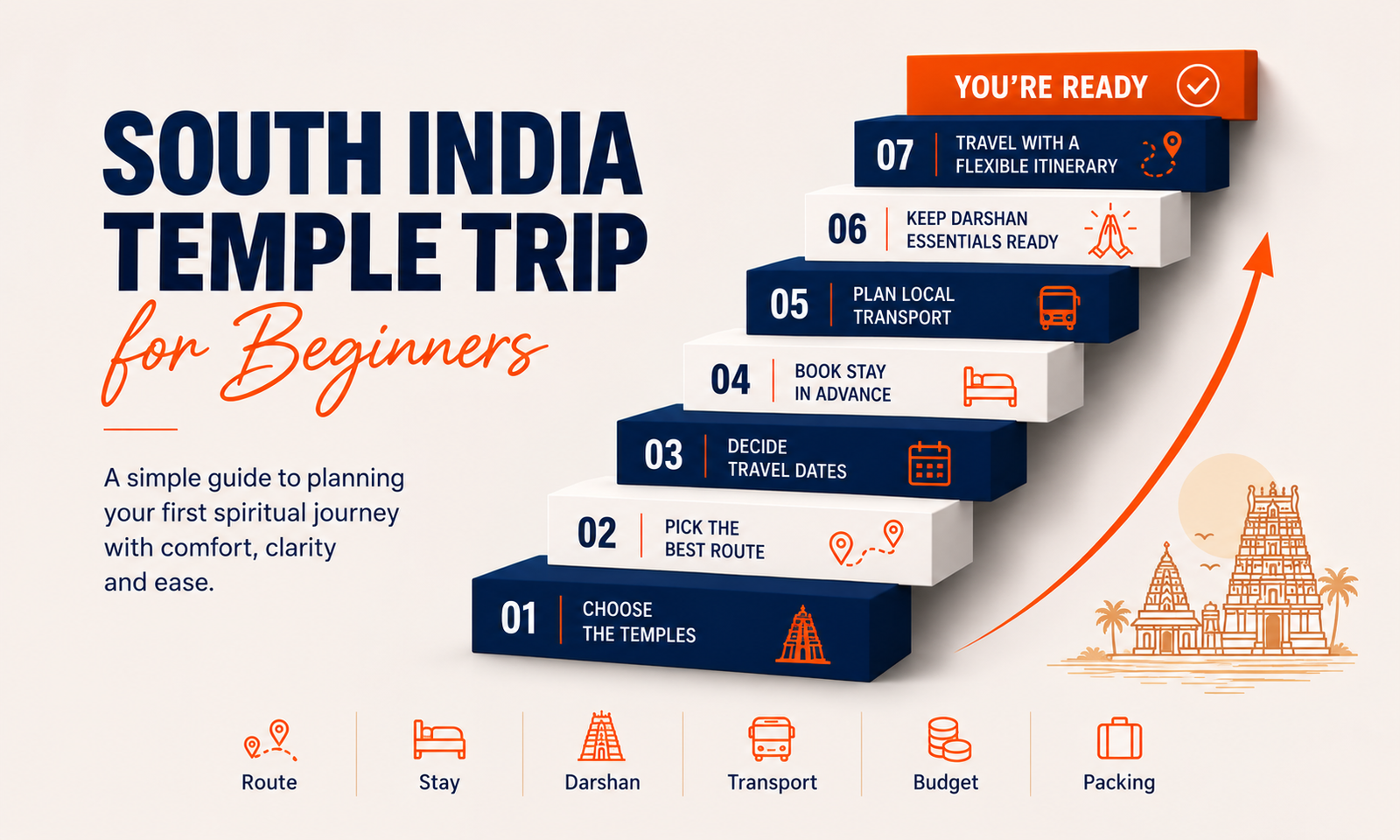
South India Temple Trip for Beginners
Beginners should start with a compact route containing three to five major temples, easy transport and at least one two-night base. Madurai–Rameswaram, Chennai–Kanchipuram or Guruvayur–central Kerala are easier starting formats than an all-South-India circuit.
The challenge is not finding famous temples; it is turning them into a route that respects worship, geography and the physical needs of the people travelling. A useful temple guide therefore has to consider darshan uncertainty, transfer time, weather, festival crowds, local transport and accommodation together. The same temple list can produce a calm pilgrimage or an exhausting one depending on how these variables are sequenced.
This guide is written for first-time travellers, families, senior citizens and pilgrims who want practical planning rather than a simple ranking. Exact timings, ticket categories, dress rules and access arrangements can change, so current official temple guidance should always take priority over an old itinerary.
Temples and Stops to Consider
1. Sri Venkateswara Temple, Tirumala
Sri Venkateswara Temple, Tirumala in Andhra Pradesh is associated with Lord Venkateswara and is one of India’s most prominent Vaishnava pilgrimage centres in the Seshachalam hills. For this article’s purpose, it is useful not only because it is famous, but because it shows how differently South Indian temple travel can work from one destination to another. A pilgrim should understand the religious context before deciding how much time the stop deserves; the same number of kilometres can represent a very different level of effort depending on queues, walking, ritual practices and local access.
Tirupati is the main rail, road and air gateway; the final journey continues to Tirumala under TTD access arrangements. Darshan planning should come before onward transport because queue and reporting arrangements can shape the entire day. Families should avoid scheduling a long onward journey immediately after a demanding darshan, while senior citizens benefit from a slower transfer plan and accommodation that reduces unnecessary walking. If the temple is being combined with nearby attractions, make the main darshan the fixed part of the day and treat secondary sightseeing as flexible.
Accommodation should be evaluated from the traveller’s actual route rather than from advertising language alone. Searches such as hotel near me, hotel near temple, family stay, budget hotel, temple stay or pilgrimage accommodation can help identify options, but the final decision should consider vehicle access, the practical walking path, room suitability and cancellation terms. During festivals, verify whether traffic restrictions could affect the property approach.
2. Meenakshi Amman Temple, Madurai
Meenakshi Amman Temple, Madurai in Tamil Nadu is associated with Goddess Meenakshi and Lord Sundareswarar and is the spiritual and architectural heart of Madurai, known for monumental gopurams and living temple-city culture. For this article’s purpose, it is useful not only because it is famous, but because it shows how differently South Indian temple travel can work from one destination to another. A pilgrim should understand the religious context before deciding how much time the stop deserves; the same number of kilometres can represent a very different level of effort depending on queues, walking, ritual practices and local access.
Madurai has major rail and air connectivity and works well as a southern Tamil Nadu base. Festival periods can transform traffic and crowd conditions across the old city. Families should avoid scheduling a long onward journey immediately after a demanding darshan, while senior citizens benefit from a slower transfer plan and accommodation that reduces unnecessary walking. If the temple is being combined with nearby attractions, make the main darshan the fixed part of the day and treat secondary sightseeing as flexible.
Accommodation should be evaluated from the traveller’s actual route rather than from advertising language alone. Searches such as hotel near me, hotel near temple, family stay, budget hotel, temple stay or pilgrimage accommodation can help identify options, but the final decision should consider vehicle access, the practical walking path, room suitability and cancellation terms. During festivals, verify whether traffic restrictions could affect the property approach.
3. Sri Ramanathaswamy Temple, Rameswaram
Sri Ramanathaswamy Temple, Rameswaram in Tamil Nadu is associated with Lord Shiva and is a major Shaiva pilgrimage centre associated with the Ramayana tradition and revered as a Jyotirlinga. For this article’s purpose, it is useful not only because it is famous, but because it shows how differently South Indian temple travel can work from one destination to another. A pilgrim should understand the religious context before deciding how much time the stop deserves; the same number of kilometres can represent a very different level of effort depending on queues, walking, ritual practices and local access.
Rameswaram is connected by road and rail; Madurai is a common air gateway. Treat the island as a destination rather than a rushed half-day stop, especially if sacred-water practices are part of the pilgrimage. Families should avoid scheduling a long onward journey immediately after a demanding darshan, while senior citizens benefit from a slower transfer plan and accommodation that reduces unnecessary walking. If the temple is being combined with nearby attractions, make the main darshan the fixed part of the day and treat secondary sightseeing as flexible.
Accommodation should be evaluated from the traveller’s actual route rather than from advertising language alone. Searches such as hotel near me, hotel near temple, family stay, budget hotel, temple stay or pilgrimage accommodation can help identify options, but the final decision should consider vehicle access, the practical walking path, room suitability and cancellation terms. During festivals, verify whether traffic restrictions could affect the property approach.
4. Guruvayur Sree Krishna Temple
Guruvayur Sree Krishna Temple in Kerala is associated with Lord Krishna and is one of Kerala’s best-known Krishna pilgrimage centres with a strong temple-town identity. For this article’s purpose, it is useful not only because it is famous, but because it shows how differently South Indian temple travel can work from one destination to another. A pilgrim should understand the religious context before deciding how much time the stop deserves; the same number of kilometres can represent a very different level of effort depending on queues, walking, ritual practices and local access.
Guruvayur is reached by road and rail through central Kerala and pairs naturally with Thrissur. Check current temple entry and dress requirements before arrival. Families should avoid scheduling a long onward journey immediately after a demanding darshan, while senior citizens benefit from a slower transfer plan and accommodation that reduces unnecessary walking. If the temple is being combined with nearby attractions, make the main darshan the fixed part of the day and treat secondary sightseeing as flexible.
Accommodation should be evaluated from the traveller’s actual route rather than from advertising language alone. Searches such as hotel near me, hotel near temple, family stay, budget hotel, temple stay or pilgrimage accommodation can help identify options, but the final decision should consider vehicle access, the practical walking path, room suitability and cancellation terms. During festivals, verify whether traffic restrictions could affect the property approach.
5. Udupi Shri Krishna Temple
Udupi Shri Krishna Temple in Karnataka is associated with Lord Krishna and is a major Vaishnava centre associated with Madhvacharya and the Ashta Matha tradition. For this article’s purpose, it is useful not only because it is famous, but because it shows how differently South Indian temple travel can work from one destination to another. A pilgrim should understand the religious context before deciding how much time the stop deserves; the same number of kilometres can represent a very different level of effort depending on queues, walking, ritual practices and local access.
Udupi is well connected by road and rail, with Mangaluru serving as a common air gateway. The compact temple town works well as a multi-night base for coastal Karnataka. Families should avoid scheduling a long onward journey immediately after a demanding darshan, while senior citizens benefit from a slower transfer plan and accommodation that reduces unnecessary walking. If the temple is being combined with nearby attractions, make the main darshan the fixed part of the day and treat secondary sightseeing as flexible.
Accommodation should be evaluated from the traveller’s actual route rather than from advertising language alone. Searches such as hotel near me, hotel near temple, family stay, budget hotel, temple stay or pilgrimage accommodation can help identify options, but the final decision should consider vehicle access, the practical walking path, room suitability and cancellation terms. During festivals, verify whether traffic restrictions could affect the property approach.
6. Brihadisvara Temple, Thanjavur
Brihadisvara Temple, Thanjavur in Tamil Nadu is associated with Lord Shiva and is a monumental Chola temple forming part of UNESCO’s Great Living Chola Temples. For this article’s purpose, it is useful not only because it is famous, but because it shows how differently South Indian temple travel can work from one destination to another. A pilgrim should understand the religious context before deciding how much time the stop deserves; the same number of kilometres can represent a very different level of effort depending on queues, walking, ritual practices and local access.
Thanjavur is connected by road and rail and fits naturally into the central Tamil Nadu temple belt. Allow time for architecture and inscriptions rather than treating the complex only as a quick photo stop. Families should avoid scheduling a long onward journey immediately after a demanding darshan, while senior citizens benefit from a slower transfer plan and accommodation that reduces unnecessary walking. If the temple is being combined with nearby attractions, make the main darshan the fixed part of the day and treat secondary sightseeing as flexible.
Accommodation should be evaluated from the traveller’s actual route rather than from advertising language alone. Searches such as hotel near me, hotel near temple, family stay, budget hotel, temple stay or pilgrimage accommodation can help identify options, but the final decision should consider vehicle access, the practical walking path, room suitability and cancellation terms. During festivals, verify whether traffic restrictions could affect the property approach.
Start with priorities, not with a map full of pins
Write down the three temples that matter most to the traveller or family. Next, identify their gateway cities and estimate the true transfer effort. Only after this should you add optional stops. Beginners often make the mistake of selecting ten famous temples first and trying to force them into one route. A smaller plan with adequate rest is easier to manage and usually creates a better pilgrimage experience.
Learn the basic temple-travel rules
Expect differences in dress, photography, footwear, mobile-phone policies, permitted bags, darshan systems and festival access. The fact that one temple allowed an item does not mean the next temple will. Check official guidance shortly before travel, carry only what is necessary and use authorised booking channels.
How to Turn the Temple List into a Real Trip
Mark each principal temple as either essential, desirable or optional. Essential temples receive protected time and determine the overnight base. Desirable temples are added when they lie naturally on the route. Optional temples are the first to be dropped when queues, weather or fatigue make the day longer than expected. This simple hierarchy prevents the itinerary from becoming brittle.
For a seven-day journey, one state or one compact cross-border cluster is usually enough. With ten to fourteen days, two clusters can be joined if the transfer between them is sensible. Long multi-state temple tours should include planned rest days. The number of temple names covered is a poor measure of pilgrimage quality if the family spends most of the trip in a vehicle.
Flights are useful for entering or leaving a region, trains can replace tiring intercity drives, and a hired vehicle gives flexibility within clusters. There is no requirement to use one transport mode throughout the trip. Choose the combination that protects the important darshan days and reduces unnecessary fatigue.
Accommodation: How to Choose a Practical Temple Stay
Accommodation is part of the pilgrimage logistics, not a separate afterthought. Searches such as “hotel near me,” “best hotel near me,” “hotel near temple,” “hotels near temple,” “family stay,” “budget hotel,” “affordable stay,” “rooms near me” and “pilgrimage accommodation” are useful for discovering options, but they do not tell you whether the property actually works for your route. A short map distance can still involve barricades, one-way roads, steep walking or a long vehicle detour.
Before you book hotel online, compare the practical walking or driving route to the temple, recent property information and cancellation conditions. Families should confirm room configuration and the needs of children; senior citizens may need easy vehicle access, fewer steps or a lift. If a major festival is taking place, ask whether temporary traffic controls could affect arrival or departure.
One-night stays are efficient for simple transit stops. Multi-night stays are better in temple cities and high-footfall pilgrimage destinations because they allow the group to rest after darshan and avoid checking out before the day’s spiritual objective is complete. The best stay is the one that supports the schedule without adding avoidable fatigue.
Practical Advice for Families and First-Time Pilgrims
Keep one adult responsible for booking confirmations and identity documents, but make sure another family member has copies. Agree on a meeting point before entering crowded temple areas and avoid carrying valuables or large bags that may have to be deposited. Follow current rules for footwear, photography, mobile phones and permitted items; temple policies can differ significantly even within the same state.
Heat, humidity, barefoot walking and long periods of standing can make a normal sightseeing day much more tiring. Drink water outside restricted areas, keep regular medication accessible and plan meals around the ritual schedule. Senior citizens should not be expected to maintain the pace of younger travellers, and children need predictable breaks.
Use official booking channels wherever a temple offers advance darshan, seva or pilgrimage registration. Avoid anyone promising unofficial queue shortcuts or guaranteed access. Save important information offline because mobile connectivity can become unreliable in crowded pilgrimage zones.
Pre-Departure Checklist
Before departure, reconfirm the day’s first temple, hotel check-in, transport and any official booking. Keep a flexible secondary plan so that one delay does not create pressure to rush darshan.
Save identity documents, hotel confirmations and temple bookings offline. Share the route with every adult in the group, keep emergency contacts accessible and decide which optional stop will be dropped first if the day runs late. A pilgrimage itinerary becomes much more resilient when the family agrees in advance that the main darshan is more important than completing every sightseeing point.
Official and Authoritative Resources
Check current temple procedures close to your travel date using official temple administrations, government tourism portals and recognised heritage sources:
- https://www.tirumala.org/
- https://www.incredibleindia.gov.in/en/tamil-nadu
- https://www.keralatourism.org/destination/temples/
- https://karnatakatourism.org/
- https://whc.unesco.org/en/list/250/
Frequently Asked Questions
How many major temples should I plan in one day?
For most travellers, one major temple is a safe primary objective. Add a second only when it is nearby, access is predictable and the group is comfortable.
Should I stay near the temple?
Proximity is useful, but check the real walking or driving route. A slightly farther family hotel with easier vehicle access can be more practical than the closest listing.
How early should I book accommodation?
Book earlier for festivals, weekends, school holidays and fixed pilgrimage seasons. Align hotel dates with confirmed darshan arrangements where relevant.
Are temple rules the same across South India?
No. Dress, entry eligibility, photography, bags and darshan procedures vary by temple. Verify each shrine individually through official sources.
Is road travel better than trains?
A mixed approach is often best. Use rail or air for long intercity sectors and road transport for compact temple clusters where flexibility adds value.
What should senior citizens consider?
Prioritise shorter transfers, easy access, rest, medication timing and realistic queue expectations. Do not force strenuous walking simply to match the rest of the group.
What should I pack for a temple trip?
Carry conservative clothing, required identification, booking confirmations, regular medicines and light essentials. Avoid oversized bags because many temples restrict what can be carried inside.
When should I verify darshan information?
Check once while planning and again shortly before travel. Festival arrangements, ticket systems and local access rules can change.
How do I avoid an exhausting temple itinerary?
Choose fewer priority temples, use regional bases, separate long drives from demanding darshan and preserve flexible time for delays or rest.
Mudras Stays — For Details
For Details: 9599190222
For current stay information at destinations served by Mudras Stays, contact the team or follow the latest updates on Instagram.