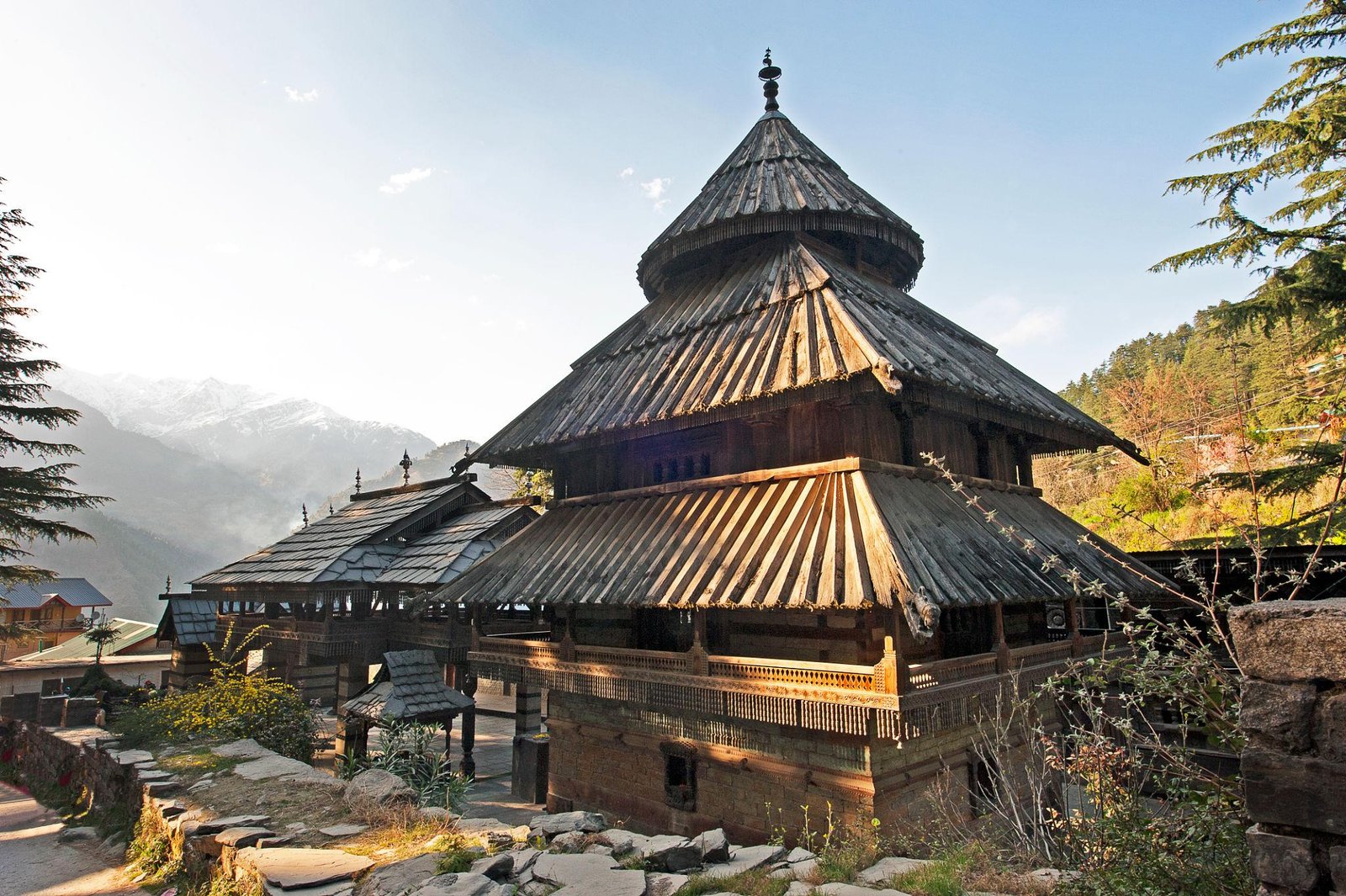
Tripura Sundari Temple is one of the most important wooden temples in Naggar and a major centre of Goddess worship in the Kullu Valley of Himachal Pradesh. Located in the upper part of historic Naggar village, the temple is dedicated to Maa Tripura Sundari, a powerful manifestation of the Divine Mother worshipped through the living religious traditions of the local community.
The shrine is immediately recognisable through its magnificent multi-tiered wooden roof, carved timber walls, stone base, covered courtyard and traditional Himalayan architectural form. Surrounded by forested hills, orchards, old village houses and views across the Kullu Valley, the temple offers a peaceful combination of pilgrimage, architecture, culture and mountain travel.
Tripura Sundari Temple is not simply a sightseeing monument. It remains an active centre of faith associated with Naggar’s religious identity, local festivals, deity processions, agricultural traditions and community life.
Devotees visit to seek the blessings of Maa Tripura Sundari for courage, family welfare, prosperity, children, marriage, education, protection and peace. Local families maintain long-standing relationships with the goddess and participate in ceremonies that have continued across generations.
The temple can be visited throughout much of the year and is comparatively easy to access because it lies within Naggar village rather than at the end of a long Himalayan trek. Visitors may need to walk through sloping village lanes or complete a short uphill approach, but the journey is considerably more accessible than many remote mountain shrines.
Its location makes Tripura Sundari Temple suitable for families, couples, senior citizens, solo pilgrims, architecture enthusiasts, photographers and travellers staying in Naggar, Manali, Kullu or nearby villages.
A visit can be combined with Naggar Castle, Gauri Shankar Temple, the Nicholas Roerich Art Gallery, the Urusvati Himalayan Folk Art Museum, Krishna Temple, traditional orchards and the historic lanes of Naggar.
## Spiritual Importance of Maa Tripura Sundari
Tripura Sundari is one of the most profound forms of the Divine Mother within Hindu Shakta traditions.
Her name can be understood as “the beautiful goddess of the three worlds.” The three worlds may symbolically refer to the physical, subtle and spiritual dimensions of existence or to earth, the celestial world and the intermediate realm.
The word “Sundari” does not refer only to physical beauty. Within spiritual philosophy, it represents the beauty of balance, consciousness, wisdom, compassion and divine order.
Maa Tripura Sundari is worshipped as the supreme feminine energy from whom creation emerges and within whom all forms of life remain connected.
She represents the harmony of spiritual awareness, material life and emotional understanding.
Devotees may approach her as a compassionate mother, a guardian of the village, a source of prosperity and a powerful form of Shakti.
At Naggar, the goddess is deeply integrated with the religious and social life of the community. Her presence is experienced not only through the temple sanctum but also through festivals, sacred masks, ceremonial palanquins, music, dance and relationships with other local deities.
Pilgrims visit the shrine to seek guidance during uncertainty and strength during difficult circumstances.
Couples may pray for harmony and stability in their relationship.
Parents may seek blessings for the health, education and welfare of their children.
Students and professionals may pray for clarity, courage and success.
Families may visit before beginning a new home, marriage, business or significant journey.
Such prayers belong to faith and should not be interpreted as guaranteed outcomes. The temple provides spiritual reassurance and a sacred environment for reflection, while practical decisions and personal responsibilities remain important.
## Tripura Sundari and the Shakta Tradition
In Shakta philosophy, the Divine Mother is regarded as the active energy through which the universe is created, sustained and transformed.
Shiva represents pure consciousness, while Shakti represents the power through which consciousness becomes creation and lived experience.
Tripura Sundari is associated with harmony rather than uncontrolled force. Her worship brings together beauty, knowledge, discipline, compassion and spiritual power.
She is also recognised in several traditions as one of the Mahavidyas, the great forms of divine wisdom. Each Mahavidya presents a different dimension of the universal feminine reality.
The detailed ritual and philosophical traditions connected with Tripura Sundari can be highly specialised. Visitors should not attempt private Tantric practices or repeat rituals found through unreliable internet content.
Ordinary devotees can offer simple prayers, flowers and respectful darshan without participating in complex ceremonies.
Those interested in a special puja should consult the authorised temple priest and follow the customs practised in Naggar.
The local worship of Tripura Sundari also has its own distinctive Kullu identity. It should not be assumed that every ritual performed at another Tripura Sundari shrine elsewhere in India is followed in the same way at Naggar.
Mountain temple traditions often combine wider Hindu philosophy with village-specific customs, oral histories and ceremonial relationships.
## The Goddess as the Presiding Deity of Naggar
Tripura Sundari is widely regarded as one of the principal guardian deities of Naggar.
The goddess is connected with the welfare of the village, its households, agriculture, orchards and seasonal cycles.
In the Kullu Valley, local deities are not viewed only as images permanently confined inside temples. Their ceremonial forms may travel in decorated palanquins, attend fairs, visit other deities and participate in important community occasions.
A local deity may have a priest, ceremonial attendants, musicians, organisers and traditional representatives responsible for carrying out established customs.
This living deity system is one of the most distinctive features of Kullu’s cultural landscape.
For travellers unfamiliar with these practices, it is important to understand that deity processions are sacred community events rather than staged tourism performances.
Palanquins, masks and ceremonial objects should not be touched without permission.
Visitors should move aside when a procession approaches and avoid blocking the route for photographs.
Local residents may bow, offer flowers or respond emotionally to the movement of the deity. Their private acts of devotion should be treated respectfully.
## Traditional Origin Story of the Temple
Local tradition preserves several stories about the origin of Tripura Sundari Temple.
One account says that cattle once grazed in the area before Naggar developed into its later form. Villagers noticed that some cows returned in the evening without giving their expected milk.
Suspecting the cowherd, a resident followed the animals and reportedly saw a young girl drinking milk directly from a cow. When approached, the girl disappeared.
A sacred stone is believed to have appeared at the location, and the villagers recognised the event as a manifestation of the goddess.
The community began worshipping the divine presence and eventually established a temple at the site.
This story forms part of Naggar’s oral religious tradition. It should not be treated as archaeological evidence, but it remains important because it expresses the relationship between the goddess, cattle, agriculture and village life.
Cows represented food security, household prosperity and survival within traditional mountain communities. A divine manifestation connected with a cow therefore carries powerful cultural symbolism.
The story also presents the goddess in the form of a young girl, reflecting the Hindu tradition of respecting feminine divinity in childhood as well as adulthood.
## The Spider-Web Legend
Another popular tradition says that Maa Tripura Sundari created or inspired the temple in the shape of a spider’s web.
According to this account, the goddess assumed the form of a spider and produced a web-like structure that guided the temple’s architectural form.
The layered wooden roofs, interlocking beams and complex carved framework may have encouraged this comparison.
The story should be understood as sacred folklore rather than a literal construction record.
Its symbolism is nevertheless meaningful. A spider’s web is formed through balance, precision and interconnected lines. Every section contributes to the stability of the whole.
Similarly, a Himalayan community depends upon relationships between households, forests, fields, animals, water sources, deities and seasonal cycles.
The legend can therefore be interpreted as expressing the interconnected nature of village life and the belief that the goddess holds the community together.
Visitors may hear different versions of the story from priests, residents and guides. Such variations are natural within an oral tradition.
## History of Tripura Sundari Temple
Tripura Sundari Temple is widely regarded as an old and culturally significant shrine of Naggar.
The exact construction date and original patron are described differently across popular accounts. Some traditions attribute the temple to an earlier ruler of Kullu, while architectural descriptions place its present wooden form within the historic temple-building traditions of the valley.
Because timber structures require periodic repair, replacement and conservation, a living wooden temple may contain elements from different periods.
Roof shingles, beams, railings and exterior wooden panels may be renewed after weather damage while the religious institution and core sacred tradition remain much older.
Visitors should therefore avoid judging the temple’s age solely by whether a particular wooden surface appears new or weathered.
The importance of Tripura Sundari Temple lies in the continuity of worship, the survival of traditional architecture and its central place within Naggar’s community life.
Naggar itself served as the former capital of the Kullu kingdom before the royal centre moved to Sultanpur in present-day Kullu.
The concentration of temples, castle architecture and ceremonial traditions reflects the settlement’s earlier political and religious significance.
Tripura Sundari Temple remains one of the strongest expressions of this heritage.
## Three-Tiered Pagoda Architecture
The most striking feature of Tripura Sundari Temple is its three-tiered wooden pagoda-style roof.
Each roof level becomes smaller as the building rises, producing a balanced pyramidal form that ends in a rounded upper section and sacred finial.
The wide projecting roofs protect the wooden walls and carved surfaces from rain and snow.
The layered roof also distributes weight and provides structural flexibility suitable for a mountain region exposed to changing weather and seismic activity.
The temple is built through a combination of timber and stone. The stone base supports the wooden upper structure, while carved beams, pillars and railings create enclosed and semi-open spaces.
The lower roof spreads broadly across the main structure.
The middle roof reduces in size and emphasises the upward movement of the building.
The upper section becomes more compact and is crowned by a pinnacle or chhatra-like element.
This architectural form creates a strong contrast with Gauri Shankar Temple elsewhere in Naggar, which is dominated by a stone shikhara.
Visiting both temples allows travellers to compare two important Himalayan architectural traditions within the same village.
Gauri Shankar Temple represents a stone-built North Indian tower form.
Tripura Sundari Temple represents the multi-tiered wooden pagoda tradition associated strongly with Himachal Pradesh.
Together, they demonstrate the architectural diversity of historic Naggar.
## Use of Deodar Wood
The temple is commonly described as being constructed principally from deodar wood.
Deodar cedar has traditionally been used in Himalayan buildings because of its strength, durability and natural resistance to certain forms of decay.
The tree also carries cultural and sacred associations within the mountain region.
Temple builders used timber not only as a practical material but also as a medium for detailed carving.
Doors, pillars, brackets, railings and wall panels display the ability of local craftspeople to transform wood into complex sacred architecture.
Visitors should not touch carvings unnecessarily, scratch surfaces or lean heavy bags against the structure.
Old timber can be damaged by repeated handling, moisture, oil and pressure.
Tripods and professional equipment should not be placed against carved walls.
Any restoration activity visible during a visit should be treated patiently. Maintaining a wooden temple in a climate of rain, snow, sunlight and temperature variation requires continuous care.
## Intricate Wooden Carvings
The carved wooden details are among the temple’s most rewarding visual features.
Visitors may observe floral patterns, geometric forms, sacred symbols, decorative bands and carefully shaped wooden elements around the doors, balconies and roof edges.
The carvings reveal the skill of Himachali craftspeople and the importance given to beauty within sacred construction.
Decoration in a temple is not merely ornamental. Repeated patterns can represent continuity, cosmic order and the movement of energy through the structure.
The doorway marks a transition from ordinary village space into the sacred interior.
Visitors should pause before entering, remove footwear where directed and avoid blocking the entrance while taking close-up photographs.
Flash photography inside darker areas may be restricted and should not be used without permission.
Strong lights can disturb worshippers and reduce the dignity of the shrine.
## Sacred Images, Masks and Ceremonial Forms
Tripura Sundari Temple is associated with sacred images and ceremonial masks representing the goddess and related divine forms.
In Kullu’s deity traditions, metal masks known locally through terms such as mohras may form an important part of the deity’s ceremonial presence.
These sacred objects may be displayed, carried in palanquins or used during festivals according to established customs.
They are not costumes, curiosities or museum pieces.
Visitors should never touch a mask, lift a ceremonial cloth or attempt to inspect a palanquin closely without explicit permission.
Local cultural records emphasise that sacred masks are treated as the most powerful representation of the deity.
Their manufacture and handling may involve ritual disciplines and hereditary responsibilities.
During an ordinary temple visit, some ceremonial objects may remain inside restricted spaces.
Visitors should accept these limitations respectfully rather than requesting private viewing or photography.
The exact images visible within the shrine may change according to religious occasions, restoration or ceremonial movement.
Current information should be obtained from the priest.
## Naggar Mela and Sharhi Jatra
The annual Naggar Mela is one of the most important religious and cultural events connected with Tripura Sundari Temple.
Local cultural records describe the festival as taking place in May, traditionally around the middle of the month, although exact dates should always be confirmed for the current year.
The fair celebrates the goddess, the arrival of spring and the beginning of a new agricultural cycle.
Tripura Sundari serves as the principal host deity, while other local deities may arrive in decorated palanquins from surrounding villages.
The festival begins with religious ceremonies and fire rituals according to local tradition.
The deities are brought into the festival area, where musicians, attendants, priests and residents participate in several days of worship and community celebration.
Traditional Nati dance forms part of the cultural programme.
The dance is not merely entertainment. In the context of the fair, it can carry ritual, hereditary and community significance.
Specific groups may hold the traditional responsibility or privilege of performing certain dances.
Visitors should not enter a ritual dance circle without invitation.
Traditional dress, local musical instruments, decorated deity palanquins and the movement of communities from surrounding villages create a vibrant festival atmosphere.
The lanes of Naggar may become crowded, and accommodation demand can increase sharply.
Travellers planning to attend should book hotels or homestays well in advance.
Vehicles may not be able to reach every part of the village during crowded periods, so visitors should be prepared to walk.
Families should supervise children carefully and agree upon a meeting point.
Senior citizens should attend during less crowded hours where practical.
## Deity Processions and Sacred Etiquette
During Naggar Mela and other ceremonial occasions, Tripura Sundari may be represented through a decorated palanquin accompanied by priests, musicians and attendants.
Local belief holds that the deity directs the movement of the palanquin and decides where it stops.
To an outside visitor, sudden movements may appear unpredictable. Adequate space should therefore be maintained around the carriers.
Photographers must not stand directly in the route of an approaching palanquin.
Sacred masks, ceremonial poles and textiles should never be touched.
Visitors should not attempt to pose beside the deity or request attendants to pause a procession for a photograph.
Shoes may be restricted within particular ritual spaces or dance grounds.
Instructions given by temple organisers and village elders should be followed immediately.
Alcohol, smoking and disruptive conduct are entirely inappropriate around the procession.
The festival offers travellers a valuable opportunity to understand Kullu’s living deity culture, but participation must remain respectful.
## Connection with Kullu Dussehra
Tripura Sundari also holds a place within the wider deity traditions associated with Kullu Dussehra.
Kullu Dussehra is distinct from many Dussehra celebrations elsewhere in India. Numerous village gods and goddesses arrive with their ceremonial retinues to honour Lord Raghunath.
Local cultural records describe Tripura Sundari as one of the Naggar deities traditionally associated with participation in this larger gathering.
Annual participation, route, timing and ceremonial arrangements should be confirmed through current official festival information.
Visitors should not assume that the deity will be publicly accessible at a particular time solely on the basis of an older festival account.
Travellers interested in Kullu Dussehra may combine festival attendance in Kullu with a later stay in Naggar to visit the goddess’s home temple.
Accommodation across the Kullu–Manali region can fill quickly during the festival period, making advance booking essential.
## Navratri and Devi Worship
Navratri is another important period for devotees of Maa Tripura Sundari.
Both Chaitra Navratri and Sharad Navratri celebrate different forms of the Divine Mother through prayer, fasting, lamps, offerings and devotional recitation.
The temple may receive additional visitors during these periods.
Devotees may offer flowers, coconuts, sweets, incense, red cloth and other permitted materials.
The exact form of Navratri worship followed at Naggar should be confirmed with the temple priest.
Visitors should avoid applying rituals copied from unrelated temples without local guidance.
A simple prayer offered sincerely is more appropriate than excessive offerings that create waste.
Festival dates change annually according to the Hindu calendar.
Travellers should verify the current schedule before arranging transport and accommodation.
## Morning and Evening Darshan
Morning is one of the most peaceful times to visit Tripura Sundari Temple.
Naggar’s village lanes are quieter, the air is fresh and the wooden structure receives soft mountain light.
Early darshan gives visitors more time to observe the architecture without interfering with larger groups.
Morning also leaves sufficient time to explore Naggar Castle, Gauri Shankar Temple and the Roerich estate.
Evening provides a different atmosphere.
As daylight fades, temple bells, lamps and the quiet sound of the village create a deeply spiritual setting.
Travellers wishing to attend evening worship should stay within Naggar or arrange their return vehicle in advance.
Driving through unfamiliar mountain roads after dark can be difficult, particularly during rain, fog, snow or peak traffic periods.
Temple timings may vary according to season, festivals and ceremonial obligations.
Current timings should be confirmed through the priest, a local host or a reliable guide rather than relying entirely on old online listings.
## Best Time to Visit Tripura Sundari Temple
Tripura Sundari Temple can be visited during most of the year.
### Spring
Spring is one of the most pleasant periods for exploring Naggar.
Fruit trees begin to blossom, fresh leaves appear and daytime weather is generally suitable for walking.
Apple and other fruit blossoms vary according to elevation, temperature and annual weather, so flowering cannot be guaranteed for specific dates.
The annual Naggar Mela is generally associated with May, making late spring culturally important.
Visitors travelling for the fair should reserve rooms early.
### Summer
Summer brings comfortable mountain temperatures compared with the plains.
Naggar may become busier because of tourism in Manali, but it often remains calmer than central Manali.
Morning and evening are ideal for temple visits and village walks.
Direct sunlight can still become strong during the day, so water and sun protection are useful.
### Monsoon
The monsoon turns Naggar green and atmospheric.
Clouds move across the valley, orchards become lush and the dark wooden temple appears especially striking against the wet landscape.
Heavy rain can also cause landslides, falling stones, traffic delays and slippery village paths.
Visitors should carry proper rainwear and wear shoes with reliable grip.
Travel should be postponed during severe rainfall or official road warnings.
### Autumn
Autumn is one of the best periods for temple visits, heritage walks and mountain views.
Rain generally decreases, skies may become clearer and daytime conditions remain comfortable.
Sharad Navratri and the wider Kullu Dussehra season add religious and cultural importance.
Accommodation should be booked early around major festival dates.
### Winter
Winter offers a quiet and peaceful Naggar experience.
Temperatures can become very cold, and snowfall may occasionally affect the village and roads.
Snowfall cannot be guaranteed for a particular travel date.
Stone and wooden pathways may become slippery due to frost or ice.
Visitors should carry thermals, warm jackets, gloves and suitable footwear.
Accommodation providers should be asked about heating, hot water, power backup and road access before booking.
## Reaching Tripura Sundari Temple
Naggar lies on the left-bank side of the Beas Valley between Kullu and Manali.
It is approximately 21 kilometres from Manali and around 26 kilometres from Kullu.
Kullu–Manali Airport at Bhuntar is approximately 36 kilometres from Naggar according to official tourism information.
Most visitors reach Naggar by taxi, private vehicle or local bus from Kullu or Manali.
Traffic through the Kullu–Manali corridor can become heavy during weekends, holidays and peak summer periods.
Actual journey time should be calculated according to current road conditions rather than distance alone.
Within Naggar, the temple is situated in the upper part of the village.
Depending on the accommodation or vehicle drop-off point, visitors may need to walk along sloping lanes or steps.
Large vehicles may not be able to enter every narrow section.
Senior citizens and travellers with limited mobility should ask a local driver about the closest practical approach.
Comfortable walking shoes are recommended because heritage lanes may be uneven or slippery.
## Naggar as a Heritage and Pilgrimage Destination
Naggar was the former capital of the Kullu kingdom and retains a concentration of temples, traditional buildings and cultural institutions.
The settlement stands above the Beas Valley and offers views across orchards, forests and mountain slopes.
Unlike central Manali, Naggar has a smaller village character.
Visitors can walk between old houses, temples, cafés, galleries and local shops while observing the relationship between heritage and everyday life.
Tripura Sundari Temple represents the living Goddess tradition of Naggar.
Gauri Shankar Temple represents historic stone Shiva architecture.
Naggar Castle reflects royal and regional building practices.
The Roerich estate represents the artistic and international history of the village.
A stay of one or two nights allows travellers to experience these places without rushing.
## Gauri Shankar Temple
Gauri Shankar Temple is located below Naggar Castle near the village bazaar.
Dedicated to Lord Shiva and Goddess Parvati, it is known for its stone shikhara and sculptural carvings.
Combining Gauri Shankar Temple with Tripura Sundari creates a meaningful Shiva–Shakti pilgrimage.
The two shrines also allow visitors to compare stone and wooden architectural traditions.
Gauri Shankar Temple is a protected heritage monument, so visitors must follow all conservation rules.
The temples should be approached independently rather than treating either one merely as a photographic stop.
## Naggar Castle and Jagatipatt Temple
Naggar Castle is a historic stone-and-timber structure associated with the former rulers of Kullu.
It demonstrates the timber-bonded building traditions developed for Himalayan conditions.
Within the upper courtyard is Jagatipatt Temple, which houses a sacred stone slab associated with the local deities of Kullu.
Regional tradition says that the stone was brought from near Vashisht by bees.
This story belongs to local belief rather than documented natural history.
The shrine remains important as a ceremonial meeting place connected with Kullu’s deity traditions.
Access, photography and opening arrangements within the castle should be confirmed before visiting.
## Nicholas Roerich Art Gallery
The Nicholas Roerich Art Gallery is one of Naggar’s most recognised cultural attractions.
Roerich was an artist, explorer and thinker who settled in Naggar and painted the spiritual and natural landscapes of the Himalayas.
The estate includes paintings, personal spaces and institutions connected with the Roerich family.
A combined temple and gallery visit offers two different ways of understanding the mountains.
Tripura Sundari Temple presents Himalayan spirituality through living worship and architecture.
The Roerich estate presents the mountains through art, philosophy and cultural exchange.
Current opening days, ticket arrangements and photography rules should be checked before visiting.
## Urusvati Himalayan Folk Art Museum
The Urusvati Himalayan Folk Art Museum forms part of Naggar’s broader cultural landscape.
It contains material associated with Himalayan traditions, crafts and folk culture.
Visiting the museum can help travellers place the temple within the wider cultural setting of the region.
Opening schedules may change, so visitors should verify them before planning a tightly timed itinerary.
## Krishna Temple and Nearby Shrines
Naggar and its surrounding settlements contain several temples dedicated to Krishna, Shiva, Devi, serpent deities and village guardians.
Krishna Temple or Murlidhar Temple can be included according to current access and local guidance.
Visitors should not confuse Tripura Sundari Temple at Naggar with other temples dedicated to similarly named goddesses in Himachal Pradesh or elsewhere in India.
The booking or transport instruction should clearly mention **Tripura Sundari Temple in upper Naggar village near Naggar Castle**.
## Suggested One-Day Naggar Itinerary
Begin with morning darshan at Tripura Sundari Temple.
Spend time observing the wooden pagoda structure, courtyard and carvings.
Continue towards Naggar Castle and Jagatipatt Temple.
After visiting the castle, walk or drive towards Gauri Shankar Temple.
The afternoon can be reserved for the Nicholas Roerich Art Gallery and the Urusvati museum, depending on opening hours.
Conclude the day with evening darshan at Tripura Sundari Temple or a quiet walk through Naggar village.
This itinerary is suitable for visitors already staying in Naggar or arriving early from Manali.
## Suggested Two-Day Itinerary
On the first day, arrive in Naggar and check into a hotel, cottage or homestay.
Explore Naggar Castle, the village bazaar and Gauri Shankar Temple.
Attend evening worship at Tripura Sundari Temple.
On the second morning, return for quieter darshan and detailed observation of the wooden architecture.
The remainder of the day can include the Roerich estate, folk museum, orchards and local village walks.
This itinerary provides a much richer experience than a hurried excursion from Manali.
## Suggested Three-Day Spiritual and Cultural Journey
The first day can focus on Tripura Sundari Temple, Naggar Castle and Gauri Shankar Temple.
The second day can include the Roerich estate, folk museum and other Naggar shrines.
The third day can include nearby destinations such as Jagatsukh, Dashal, Kullu, Basheshwar Mahadev Temple or another suitable local pilgrimage.
Travellers may also continue towards Bijli Mahadev, Manikaran or Manali on separate days according to their interests.
## Where to Stay Near Tripura Sundari Temple
Naggar provides the most convenient accommodation for visiting Tripura Sundari Temple.
Options include heritage hotels, cottages, guesthouses, homestays, orchard retreats and mountain-view properties.
### Homestays in Naggar
Homestays allow travellers to experience local hospitality, regional food and village life.
Hosts may provide useful information about temple timings, festival arrangements, walking routes and nearby attractions.
Visitors should confirm the property’s actual distance from the temple.
A listing described simply as being in Naggar may lie on a different slope or several kilometres from the historic centre.
### Heritage Stays
Naggar’s historic character makes it suitable for heritage accommodation.
Such properties may use stone, timber and traditional architectural details.
Older buildings can contain steep stairs, uneven floors and limited accessibility.
Senior citizens and guests with mobility concerns should verify the room location before booking.
### Cottages and Orchard Stays
Cottages and orchard properties are suitable for couples, families and travellers seeking privacy.
They may offer valley views and quiet surroundings away from the village centre.
Guests should confirm road access, parking and the distance to the temple.
Private orchards should only be entered with the owner’s permission, and fruit should never be picked without consent.
### Hotels in Manali
Manali offers the largest selection of hotels, resorts, hostels and restaurants.
It can serve as a base for a day trip, but visitors must account for traffic and additional travel.
Travellers primarily interested in Naggar’s temples and heritage may find a local stay more convenient.
### Hotels in Kullu and Bhuntar
Kullu and Bhuntar are practical for visitors arriving by air or continuing towards other parts of the valley.
Kullu offers markets, hospitals and transport connections.
Bhuntar provides access to the airport and the routes towards both Manali and the Parvati Valley.
Naggar remains the preferred base for peaceful morning and evening darshan.
## Choosing the Right Accommodation
Pilgrims should select accommodation according to the real walking or driving distance from Tripura Sundari Temple.
Families should check room size, meal availability, parking and bathroom facilities.
Couples may prefer private cottages, heritage rooms or orchard-view stays.
Senior citizens should ask about stairs, road approach and the availability of ground-floor rooms.
Winter travellers should confirm room heating, hot water, warm bedding and power backup.
Monsoon visitors should verify whether the property’s approach road is affected by landslides or slippery conditions.
Guests requiring stable internet should confirm mobile and Wi-Fi connectivity directly with the property.
Pilgrimage groups should check room inventory, vegetarian meals and vehicle parking before arrival.
Travellers attending Naggar Mela should reserve rooms well in advance because the village can become crowded.
## Book Stays Near Tripura Sundari Temple with MudrasStays
MudrasStays helps pilgrims and cultural travellers discover hotels, cottages, homestays, guesthouses and heritage accommodation near Tripura Sundari Temple in Naggar.
The platform is designed specifically for travellers searching for comfortable places to stay near temples and spiritual destinations.
Visitors can compare properties according to their practical distance from the temple, budget, room type, group size and required facilities.
Booking a stay in Naggar allows devotees to attend peaceful morning and evening darshan without repeated travel from Manali or Kullu.
Solo pilgrims can search for affordable guesthouses and local homestays.
Couples can explore heritage rooms, mountain cottages and orchard retreats.
Families can choose properties offering meals, parking and comfortable room capacity.
Senior citizens can prioritise accessible accommodation close to the temple approach.
Pilgrimage groups can identify stays offering multiple rooms and vegetarian food.
Cultural travellers can choose properties convenient for Naggar Castle, the Roerich Art Gallery, Gauri Shankar Temple and the folk museum.
Visitors attending Naggar Mela can search for stays close enough to reduce transport difficulties while avoiding roads that may become congested during the festival.
MudrasStays helps travellers plan a connected Naggar pilgrimage rather than booking a general Manali property located far from the temple.
## Responsible Temple and Village Travel
Tripura Sundari Temple is a sacred wooden structure and requires careful visitor behaviour.
Footwear should be removed wherever directed.
Photography of the deity, sacred masks, sanctum, priests or private rituals should only be undertaken with permission.
Wooden carvings, railings and doors should not be scratched, touched repeatedly or used to support bags.
Incense and lamps should only be used in designated locations because old timber is vulnerable to fire.
Smoking should be avoided throughout the temple area.
Visitors should carry back plastic bottles, wrappers and puja packaging.
Synthetic cloth and plastic decorations should not be tied randomly to trees or temple structures.
During festivals, deity palanquins and masks must never be touched.
Procession routes should remain clear.
Traditional dance areas should not be entered without invitation.
Visitors should respect private homes, orchards and agricultural land within Naggar.
Residents should not be photographed without consent.
Supporting local homestays, cafés, shops, taxi drivers and guides helps tourism benefit the community preserving the temple.
## A Living Centre of Goddess Worship in Naggar
Tripura Sundari Temple represents the meeting of Shakti worship, wooden architecture and the community traditions of the Kullu Valley.
The goddess provides spiritual identity and protection to Naggar.
The three-tiered roof demonstrates the skill of Himalayan temple builders.
The carved wood preserves regional artistic traditions.
The sacred masks and palanquins connect the shrine with Kullu’s living devta culture.
The Naggar Mela connects worship with spring, agriculture, music and community gathering.
The goddess’s participation in wider deity traditions links the village with the religious landscape of Kullu.
The spider-web legend represents balance and interconnectedness.
The story of the divine child and the cow expresses the goddess’s relationship with village prosperity and pastoral life.
For devotees of the Divine Mother, the temple is a place to seek courage, peace and family welfare.
For couples, it offers a sacred environment for prayers relating to harmony and companionship.
For families, it provides an accessible pilgrimage that can be combined with education about architecture and culture.
For senior citizens, the village location avoids the need for a long mountain trek, although sloping lanes should be considered.
For architecture enthusiasts, the shrine is one of the most impressive wooden pagoda temples near Manali.
For cultural travellers, Naggar Mela provides insight into local deities, music, dance and village traditions.
For photographers, the layered roofs, carved timber, courtyard and mountain setting offer memorable visual opportunities when worship and privacy are respected.
For slow travellers, staying in Naggar creates time to experience the temple during quieter morning and evening hours.
Tripura Sundari Temple should not be treated merely as a quick stop between Naggar Castle and the Roerich Gallery.
Its religious importance, architectural detail and living community traditions deserve time and attention.
Plan your pilgrimage to Tripura Sundari Temple with MudrasStays and experience one of the most beautiful wooden Devi shrines in Himachal Pradesh.
Seek the blessings of Maa Tripura Sundari, observe the rare three-tiered pagoda architecture and discover the deity traditions preserved within historic Naggar.
Combine your journey with Gauri Shankar Temple, Naggar Castle, Jagatipatt Temple, the Nicholas Roerich Art Gallery, the Urusvati Himalayan Folk Art Museum, local orchards, Kullu and Manali.
Book hotels near Tripura Sundari Temple, discover homestays in Naggar and explore heritage rooms, cottages and mountain stays through MudrasStays.
Stay closer to the temple, attend peaceful morning darshan and experience Naggar’s spiritual and cultural heritage without unnecessary travel.
MudrasStays connects pilgrims, families and cultural travellers with suitable accommodation near temples and sacred destinations across India.
Begin your Tripura Sundari Temple journey with a comfortable stay and experience a meaningful pilgrimage centred on Maa Shakti, Himachali wooden architecture, local deity traditions and the timeless heritage of Naggar.