
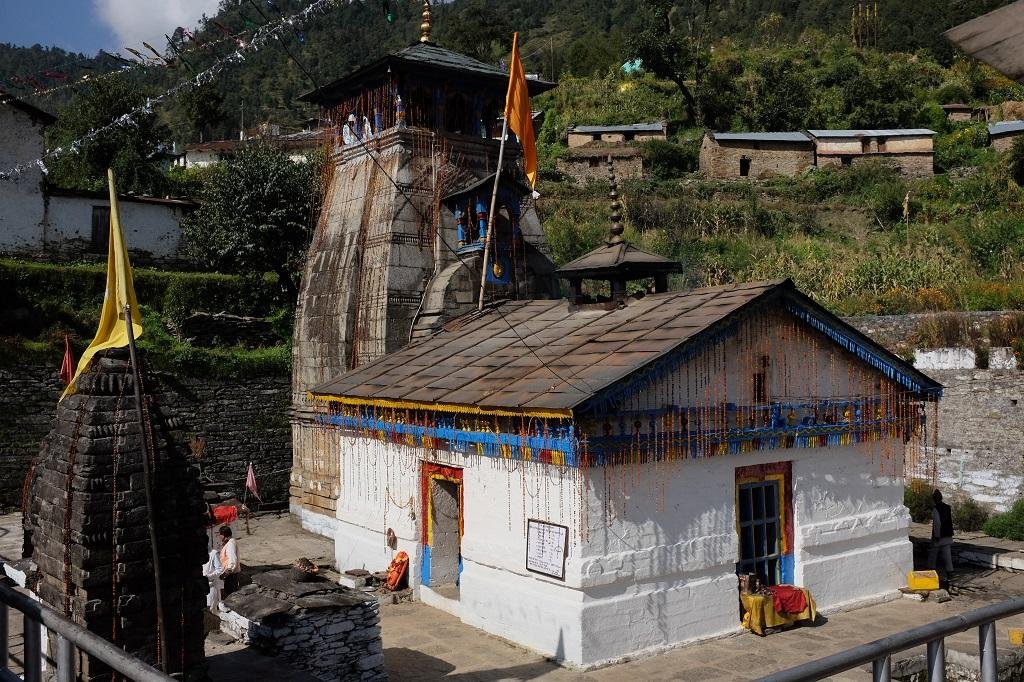
Triyuginarayan Temple is one of the most sacred, romantic and spiritually significant pilgrimage destinations in Uttarakhand. Located in Triyuginarayan village in the Rudraprayag district, the ancient temple is dedicated to Lord Vishnu and is traditionally believed to mark the divine wedding place of Lord Shiva and Goddess Parvati.
Surrounded by the mountains, forests, terraced fields and peaceful villages of the Garhwal Himalayas, Triyuginarayan Temple offers a unique combination of religious importance, ancient architecture, sacred fire traditions and natural beauty. The temple attracts pilgrims, couples, families, spiritual travellers, photographers and visitors travelling towards Kedarnath and other important destinations in Rudraprayag.
Unlike many Shiva temples where Lord Shiva is worshipped as the principal deity, Triyuginarayan Temple is primarily dedicated to Lord Vishnu. Its wider spiritual identity, however, is closely connected with the marriage of Shiva and Parvati. According to Hindu religious tradition, Lord Vishnu participated in the divine wedding as the brother of Goddess Parvati, while Lord Brahma conducted the sacred marriage rituals.
The temple courtyard contains a sacred fire known as the Akhand Dhuni or eternal wedding fire. Devotees believe that this fire has continued from the time of the divine marriage of Shiva and Parvati. The flame is maintained through offerings of wood, and pilgrims approach it with deep reverence.
The sacred fire has made Triyuginarayan Temple an important destination for couples seeking blessings for a harmonious and lasting marriage. Many visitors collect a small quantity of ash from the fire as a blessed reminder of the divine union, subject to the customs and permission of the temple priests.
The combination of a Vishnu temple, the wedding story of Shiva and Parvati and the continuing fire tradition gives Triyuginarayan a distinctive place within the spiritual landscape of India.
## Meaning of Triyuginarayan
The name Triyuginarayan is formed from three words: “Tri,” meaning three; “Yugi,” referring to the cosmic ages or yugas; and “Narayan,” a name of Lord Vishnu.
The name is commonly understood as Lord Narayan worshipped across three yugas or ages. According to religious tradition, the sacred fire and the spiritual importance of the site have continued across multiple cosmic periods.
The name therefore represents continuity, timeless devotion and the enduring presence of Lord Vishnu at this Himalayan shrine.
For pilgrims, Triyuginarayan is not simply an old temple. It represents a sacred place where divine relationships, eternal commitment and spiritual traditions have survived across generations.
The belief that the wedding fire has remained present across the ages gives the temple an atmosphere of continuity. Devotees view the flame as a symbol of loyalty, commitment, purity and the unbroken bond between Shiva and Parvati.
## The Divine Marriage of Shiva and Parvati
The central religious story of Triyuginarayan Temple concerns the marriage of Lord Shiva and Goddess Parvati.
According to Hindu tradition, Goddess Parvati performed intense penance to gain Lord Shiva as her husband. She remained devoted to Shiva despite difficulties and demonstrated spiritual discipline, patience and complete faith.
After accepting her devotion, Lord Shiva agreed to marry her. Triyuginarayan was selected as the place for their divine wedding.
The region is traditionally connected with Himavat, the divine personification of the Himalayas and the father of Goddess Parvati. The mountain setting is therefore considered especially appropriate for the marriage of the daughter of the Himalayas.
Lord Vishnu is believed to have performed the responsibilities of Parvati’s brother during the ceremony. Lord Brahma is traditionally regarded as the priest who conducted the wedding rituals.
Gods, goddesses, sages and divine beings are believed to have gathered at Triyuginarayan to witness the marriage.
The sacred wedding fire was lit in a square havan kund within the temple area. Shiva and Parvati are believed to have completed their marriage rituals around this fire.
For devotees, the ceremony represents the perfect union of Shiva and Shakti. Shiva symbolises consciousness, stillness and spiritual awareness, while Parvati represents energy, devotion, creation and divine feminine power.
Their marriage is therefore understood not only as the union of two deities but also as the balance between complementary forces of existence.
The story has made Triyuginarayan Temple an important destination for married couples, engaged couples and families praying for harmony, mutual understanding and long-lasting relationships.
Visitors should understand that the divine wedding account belongs to sacred Hindu tradition and mythology rather than modern documentary history. Its significance lies in the faith, symbolism and spiritual meaning it has carried for generations.
## The Eternal Wedding Fire
The Akhand Dhuni is one of the most important features of Triyuginarayan Temple.
The fire burns in a havan kund positioned in the temple courtyard. According to religious belief, it is connected with the wedding fire around which Lord Shiva and Goddess Parvati completed their marriage rituals.
The fire is sustained by the temple community and devotees who offer sacred wood according to established customs.
Pilgrims may sit near the fire, offer prayers and seek blessings for marriage, family welfare and spiritual harmony.
Married couples often pray for stability, trust and companionship. Unmarried devotees may seek blessings for a suitable life partner or a positive beginning to married life.
The ash associated with the sacred fire is considered auspicious by many devotees. Any ash should be received only according to temple custom and with guidance from the priests.
Visitors should not touch the fire, add unauthorised materials or attempt to collect ash independently.
The sacred flame must be approached with care. Children should remain under supervision, and loose synthetic clothing should be kept away from the fire.
The Akhand Dhuni should be described as an eternal fire according to temple tradition and religious belief. Its importance is spiritual and symbolic rather than a claim that can be evaluated only through modern historical records.
The continuing presence of the flame allows visitors to participate in a tradition linking present-day worshippers with the divine marriage remembered at the temple.
## Temple Architecture
Triyuginarayan Temple is constructed in the traditional stone architectural style associated with the temples of the Garhwal Himalayas.
Its form is often compared with Kedarnath Temple. The principal shrine has a stone tower rising above the sanctum, while the lower structure contains the entrance and worship area.
The temple’s comparatively simple design reflects the mountain environment in which it was built. Stone construction provides strength against cold weather, rainfall and changing Himalayan conditions.
The whitewashed outer portions, blue detailing, stone roof sections, sacred flags and vertical temple tower create a distinctive visual appearance.
The building does not depend on elaborate decoration or monumental scale for its importance. Its spiritual power comes from the worship of Lord Vishnu, the divine wedding tradition and the sacred fire.
The main image worshipped inside the temple is associated with Lord Vishnu or Narayan. Images and sacred forms connected with Goddess Lakshmi, Lord Shiva, Goddess Parvati and other deities may also be present according to temple tradition.
The temple courtyard contains the wedding fire and provides space for devotees to gather, pray and participate in rituals.
The stone-paved surroundings and traditional village buildings reinforce the feeling of entering an old Himalayan pilgrimage settlement.
Visitors interested in architecture can observe the similarities between Triyuginarayan and other stone temples of the Kedarnath region.
Photography inside the sanctum should only be undertaken when temple authorities permit it. Even when exterior photography is allowed, visitors should avoid blocking the entrance or disturbing religious ceremonies.
## The Sacred Brahma Shila
A sacred stone known as the Brahma Shila is associated with the divine marriage ceremony.
According to temple tradition, the stone marks the place connected with the marriage rituals of Lord Shiva and Goddess Parvati.
The name is associated with Lord Brahma, who is believed to have conducted the wedding ceremony.
Devotees approach the Brahma Shila with reverence and may offer prayers for marital happiness, family stability and spiritual companionship.
The stone should not be climbed upon, treated casually or used merely as a photography platform.
Visitors should follow instructions from the priests regarding the correct manner of worship and movement around the sacred area.
The Brahma Shila, eternal fire and main Vishnu shrine together form the central spiritual experience of Triyuginarayan Temple.
## Sacred Kunds at Triyuginarayan
The temple complex is associated with several sacred water tanks or kunds.
These are commonly identified as Brahma Kund, Vishnu Kund and Rudra Kund. Another source known as Saraswati Kund is traditionally associated with the flow of water feeding the sacred tanks.
Each kund carries a religious association with the principal deities connected with the divine wedding.
The waters are considered sacred by devotees, and pilgrims may use them for ritual purification according to local temple customs.
Religious tradition connects the kunds with the presence of Brahma, Vishnu and Shiva during the marriage ceremony.
Visitors should check whether bathing is currently permitted and follow all instructions issued by the temple authorities.
Water levels, cleanliness and access arrangements may vary according to weather, maintenance and season.
Soap, shampoo, detergent and other chemicals should never be used in sacred water tanks.
Visitors should not throw plastic, coins, food, flowers or religious packaging into the kunds.
The sacred water system is both a religious resource and an environmentally sensitive feature of the temple complex. Preserving its cleanliness is a shared responsibility.
Families should supervise children carefully near the tanks, especially during rain or freezing weather when stone surfaces may become slippery.
## A Sacred Wedding Destination
Triyuginarayan Temple has become increasingly known as a destination for traditional Hindu weddings.
Couples choose the temple because it is believed to be the place where Shiva and Parvati entered into their divine marriage.
A wedding performed near the sacred fire is viewed by many families as an auspicious beginning to married life.
The temple is especially suitable for couples seeking a simple, intimate and spiritually focused ceremony rather than a large commercial celebration.
Traditional wedding rituals may include prayers to Lord Vishnu, worship near the eternal fire and Vedic ceremonies conducted by authorised priests.
However, couples should not arrive assuming that a wedding can be organised without prior approval.
Temple weddings require coordination with the appropriate temple authorities, local administration, priests and service providers.
Arrangements may include permission, ceremony timing, priest services, documentation, accommodation, transport, meals, decoration, photography and waste management.
The number of guests may need to remain limited because Triyuginarayan is a small Himalayan village with restricted infrastructure.
Large decorations, loud music, generators, plastic materials and intrusive commercial setups can disturb the sacred and environmental character of the site.
Couples should prioritise simple, traditional and low-impact arrangements that respect the temple, local community and mountain ecosystem.
A religious wedding ceremony does not automatically replace civil registration requirements. Couples should independently confirm the legal documentation and registration process applicable to their marriage.
Weather must also be considered carefully. Rain, snow, cold temperatures and road conditions can affect wedding schedules and guest travel.
Accommodation should be reserved well in advance, particularly when families require multiple rooms.
MudrasStays can help couples and wedding guests discover nearby homestays, hotels and pilgrimage accommodation according to distance, room capacity and accessibility.
## Blessings for Married and Unmarried Couples
Triyuginarayan Temple attracts visitors at different stages of their personal lives.
Married couples may visit to renew their spiritual commitment, pray for harmony or express gratitude for their relationship.
Newly married couples may include the temple in their honeymoon or pilgrimage journey.
Engaged couples may seek blessings before their wedding.
Unmarried devotees may pray for a compatible life partner and a stable future marriage.
Families may visit together to pray for the happiness and welfare of younger members.
The temple should not be presented as guaranteeing a marriage, resolving relationship problems or producing a particular personal outcome.
Its role is spiritual. Devotees draw hope, emotional strength and symbolic meaning from the divine marriage tradition.
Relationship or legal difficulties should still be addressed through appropriate personal, professional or legal support.
The temple offers a sacred environment for prayer and reflection, but it should not replace practical communication and responsible decision-making within relationships.
## Triyuginarayan Village
The village surrounding the temple is an important part of the pilgrimage experience.
Triyuginarayan is a traditional Himalayan settlement containing stone pathways, homes, agricultural terraces and views of the surrounding Garhwal landscape.
The village atmosphere is quieter than major pilgrimage towns and allows travellers to observe local mountain life.
Residents depend on agriculture, pilgrimage services, local transport, small shops, homestays and seasonal tourism.
Staying within or near the village allows visitors to support local families and experience regional hospitality.
A village homestay may provide simple rooms, home-cooked food and useful guidance regarding temple rituals, weather and road conditions.
Travellers should maintain privacy and avoid photographing residents, homes or ceremonies without permission.
Agricultural fields and village paths are part of local livelihoods rather than public photo sets. Visitors should remain on recognised routes and avoid entering private land.
The slow pace of village life complements the spiritual character of Triyuginarayan Temple.
Instead of rushing through a short temple stop, travellers can stay overnight, attend morning prayers and experience the changing Himalayan light.
## Location and Elevation
Triyuginarayan Temple is situated in Triyuginarayan village in the Rudraprayag district of Uttarakhand.
The village lies at an elevation of approximately 1,980 metres above sea level.
Its mountain location gives it a cooler climate than the plains and provides views of forested slopes, terraced fields and distant Himalayan landscapes.
The temple is connected with the traditional pilgrimage route towards Kedarnath and lies within the wider Sonprayag–Guptkashi region.
Road and walking access arrangements have changed over time as local infrastructure has developed. Travellers should confirm the latest route, vehicle access and parking conditions before departure.
Older pilgrimage routes involved travel from Sonprayag followed by walking. Current practical access may vary according to road construction, weather and local traffic controls.
Visitors should rely on current information from their accommodation provider, local administration or authorised driver rather than only on old online route descriptions.
## Reaching Triyuginarayan Temple
Triyuginarayan can generally be approached through Rudraprayag, Agastmuni, Guptkashi and Sonprayag, depending on the traveller’s starting point and current route conditions.
Rudraprayag is an important regional junction where the Alaknanda and Mandakini rivers meet.
From Rudraprayag, travellers continue through the Mandakini valley towards Agastmuni and Guptkashi.
Sonprayag is one of the principal bases for the Kedarnath pilgrimage and provides road access towards nearby destinations.
The distance between destinations in Rudraprayag district may appear moderate, but mountain driving can take considerable time because of curves, traffic, road work and weather.
Private taxis are generally the most convenient option for families, couples, senior citizens and wedding groups.
Shared vehicles may be available on some routes, but their timing and frequency can vary.
Visitors should confirm whether their vehicle can reach the village directly or whether a final walk is required.
Parking can become limited during weddings, festivals, weekends and the Kedarnath pilgrimage season.
Travellers should follow all local traffic instructions and avoid parking in a way that blocks village roads or emergency access.
## Nearest Transport Bases
Rishikesh and Haridwar are important gateways for travellers arriving from the plains.
Railway connections are commonly used to reach Haridwar, Rishikesh or Dehradun before continuing by road into Garhwal.
Dehradun’s airport serves travellers arriving by air, followed by a long mountain-road journey towards Rudraprayag and Guptkashi.
Because the onward journey is substantial, visitors should avoid planning a late-evening arrival followed by immediate mountain travel.
An overnight stop in Rishikesh, Srinagar Garhwal, Rudraprayag or Guptkashi may make the journey more comfortable.
Travellers should check road and weather conditions, particularly during the monsoon and winter.
## Best Time to Visit Triyuginarayan Temple
Triyuginarayan Temple can be visited across several seasons, but each period offers a different experience.
### Spring
Spring is one of the most pleasant times to visit.
The weather is generally comfortable, village fields become active and the surrounding hills show fresh vegetation.
This season is suitable for pilgrimage, photography, village walks and small wedding ceremonies.
Morning and evening temperatures can still be cold, so visitors should carry warm layers.
### Summer
Summer is a popular pilgrimage period because the wider Kedarnath route receives many travellers.
Daytime weather may be pleasant, although strong sunlight can be experienced in open areas.
Accommodation and transport demand can increase significantly.
Families, couples and wedding groups should book nearby stays well in advance.
Traffic towards Sonprayag and Kedarnath can affect travel times, so extra time should be added to every road journey.
### Monsoon
The monsoon transforms the mountain landscape into a green and misty environment.
However, heavy rainfall can cause landslides, road closures, falling stones and travel delays across the Garhwal region.
Visitors should check official weather and road advisories before travelling.
Wedding ceremonies and fixed schedules require additional contingency planning during the monsoon.
Stone pathways around the temple and village may become slippery. Shoes with reliable grip and suitable rain protection are essential.
### Autumn
Autumn is one of the most favourable periods for visiting Triyuginarayan.
The post-monsoon landscape remains fresh, temperatures are generally comfortable and Himalayan visibility may improve.
This season is suitable for temple visits, photography and traditional wedding ceremonies.
Accommodation should still be booked early during popular dates.
### Winter
Winter offers a quiet and beautiful experience, and snowfall may occur in Triyuginarayan and the surrounding higher areas.
Snow-covered roofs, fields and mountain slopes can transform the appearance of the village.
However, snowfall cannot be guaranteed for any particular date.
Cold temperatures, ice, road conditions and reduced daylight must be considered carefully.
Visitors should carry thermals, insulated jackets, gloves, caps and footwear suitable for snow or frost.
Wedding groups should confirm heating, water availability, vehicle access and backup arrangements before choosing a winter date.
## Morning and Evening Visits
Morning is an excellent time to visit Triyuginarayan Temple.
The village is quieter, the air is fresh and the temple courtyard may be less crowded.
Morning light across the stone temple and surrounding slopes creates a peaceful atmosphere for prayer and photography.
Visitors staying nearby can attend darshan without undertaking a long early drive from Guptkashi or Rudraprayag.
Evening offers a different experience as lamps, the sacred fire and temple prayers become more prominent.
The colder evening air and quieter village environment can make the fire tradition feel especially meaningful.
Travellers planning an evening visit should arrange nearby accommodation because mountain driving after dark can be difficult.
Temple timings and ritual schedules may change according to season and local arrangements. Visitors should verify them before travelling.
## Mahashivratri and Marriage-Related Occasions
Mahashivratri is naturally important because of the temple’s connection with Lord Shiva and Goddess Parvati.
Devotees may visit to offer prayers, remember the divine relationship and seek blessings for spiritual strength and family harmony.
Marriage-related auspicious dates can also bring couples and wedding groups to Triyuginarayan.
The temple may become busy during popular wedding seasons and favourable dates identified according to Hindu traditions.
Travellers seeking ordinary darshan should remain aware that wedding ceremonies may temporarily occupy parts of the courtyard.
Couples and families should cooperate respectfully so that weddings do not prevent regular pilgrims from accessing the temple.
Temple authorities should be consulted regarding ceremony timing, capacity and permitted arrangements.
## Nearby Spiritual Destinations
Triyuginarayan Temple can be combined with several important pilgrimage destinations in Rudraprayag district.
### Sonprayag
Sonprayag is an important stop on the Kedarnath route and lies near the confluence of mountain rivers.
Pilgrims often use the area for transport, registration and onward travel towards Gaurikund.
Triyuginarayan can be included before or after a stay near Sonprayag, depending on road conditions and the traveller’s schedule.
### Gaurikund
Gaurikund is the traditional starting point of the trek to Kedarnath.
The destination is associated with Goddess Parvati and her spiritual practices.
Its connection with Parvati makes it an appropriate addition to a Triyuginarayan pilgrimage focused on the divine marriage story.
### Kedarnath Temple
Kedarnath is one of the twelve Jyotirlingas and a principal Char Dham shrine.
The stone architecture of Triyuginarayan is often compared with Kedarnath Temple.
Pilgrims can visit Triyuginarayan as part of a longer Kedarnath journey, but both destinations should be given sufficient time.
### Guptkashi
Guptkashi is an important pilgrimage town containing the Vishwanath Temple and Ardhanarishwar Temple.
The Ardhanarishwar form represents the combined presence of Shiva and Shakti, making Guptkashi spiritually relevant to the themes of Triyuginarayan.
Guptkashi also offers a wider selection of hotels, markets and transport services.
### Ukhimath
Ukhimath is an important winter seat associated with deities from the Kedarnath region.
The town can be included in a longer spiritual journey through Rudraprayag district.
### Kalimath
Kalimath is a major Shakti shrine in the region and is connected with the worship of Goddess Kali.
It can be combined with Triyuginarayan by travellers undertaking a broader Shiva–Shakti pilgrimage.
### Dhari Devi Temple
Dhari Devi Temple stands above the Alaknanda River between Srinagar Garhwal and Rudraprayag.
Travellers arriving from Rishikesh can visit Dhari Devi before continuing into the Mandakini valley.
### Rudraprayag Sangam
Rudraprayag is one of the sacred Panch Prayags and marks the meeting of the Alaknanda and Mandakini rivers.
The confluence can be included as part of the journey towards Triyuginarayan and Kedarnath.
## Suggested One-Day Visit
A one-day visit may be possible for travellers staying in Guptkashi, Sonprayag or another nearby base.
Visitors should depart early, reach Triyuginarayan Temple, attend darshan and spend time near the sacred fire and kunds.
The remainder of the day can be used for a village walk or return journey.
Trying to combine Triyuginarayan with a demanding Kedarnath trek on the same day is generally impractical.
The temple deserves sufficient time and should not be treated as a rushed roadside stop.
## Suggested Two-Day Itinerary
On the first day, travellers can arrive in Triyuginarayan village or a nearby destination and check into a homestay or guesthouse.
The afternoon can be used to explore the village and attend evening prayers.
The second morning can begin with temple darshan, worship near the sacred fire and visits to the kunds.
After breakfast, travellers can continue towards Guptkashi, Sonprayag or Rudraprayag.
This itinerary is suitable for couples, families and senior citizens who prefer a relaxed journey.
## Suggested Three-Day Spiritual Journey
The first day can include arrival in Guptkashi and visits to Vishwanath Temple and Ardhanarishwar Temple.
The second day can include travel to Triyuginarayan, temple darshan, village exploration and an overnight stay.
The third day can continue towards Sonprayag, Gaurikund or another destination on the Kedarnath route.
Travellers not undertaking the Kedarnath trek may instead visit Ukhimath, Kalimath or nearby mountain villages.
## Where to Stay Near Triyuginarayan Temple
Accommodation is available in Triyuginarayan village and in nearby pilgrimage centres such as Sonprayag, Guptkashi and Sitapur.
The most suitable location depends on the traveller’s itinerary, comfort expectations and transport arrangements.
### Homestays in Triyuginarayan Village
Staying within the village is the most convenient option for early-morning darshan and evening temple visits.
Local homestays may provide simple rooms, home-cooked food and direct access to village life.
Facilities may be more basic than those available in larger towns, so travellers should confirm hot water, heating, meals, parking and bathroom arrangements.
A village stay is especially suitable for spiritual travellers, couples and guests attending a temple wedding.
### Guesthouses Near the Temple
Small guesthouses and pilgrimage properties may be available within or near Triyuginarayan.
These properties are suitable for visitors who prioritise proximity to the temple over luxury.
Families should confirm room capacity and meal arrangements before arrival.
### Hotels in Sonprayag and Sitapur
Sonprayag and Sitapur provide a larger selection of pilgrimage hotels and guesthouses.
These locations may be convenient for travellers continuing towards Kedarnath.
However, actual road travel time to Triyuginarayan should be confirmed before booking.
Traffic regulations during the Kedarnath season can affect vehicle movement and timing.
### Hotels in Guptkashi
Guptkashi offers a broader range of hotels, resorts, guesthouses and homestays.
The town provides markets, restaurants, medical facilities and transport services.
It is suitable for families and travellers who prefer more developed facilities while remaining within the wider pilgrimage region.
### Accommodation for Weddings
Couples planning a temple wedding should assess the total room inventory available near Triyuginarayan before finalising the guest list.
A large guest group may need to be divided across different properties.
Transport between properties and the temple should be planned carefully.
Meals, priest arrangements, decoration, photography, power backup and waste disposal should all be confirmed separately.
Weather-related backup plans are essential for every mountain wedding.
## Choosing the Right Stay
Travellers should select accommodation based on actual road access and practical travel time.
A property may be advertised under the Kedarnath or Triyuginarayan region while still requiring a substantial drive.
Senior citizens should choose properties with minimal stairs and direct vehicle access.
Families should confirm room size, food for children and bathroom facilities.
Winter guests should ask about room heating, blankets, hot water and road accessibility.
Monsoon travellers should verify the condition of the final approach road.
Wedding groups should confirm room blocks, check-in arrangements, meals, parking and early-morning services.
Guests requiring internet connectivity should verify the current mobile network and Wi-Fi situation directly with the property.
Electricity interruptions may occur in mountain areas, so power backup should be checked where essential.
## Book Stays Near Triyuginarayan Temple with MudrasStays
MudrasStays helps pilgrims, couples and families discover homestays, guesthouses, hotels and mountain accommodation near Triyuginarayan Temple.
The platform is designed specifically for travellers looking for accommodation close to temples and pilgrimage destinations across India.
Visitors can search for stays according to their distance from Triyuginarayan Temple, room requirements, group size, budget and onward travel route.
Booking nearby accommodation allows devotees to attend morning and evening darshan without travelling long distances on mountain roads.
Couples planning a temple wedding can explore room options for themselves, their families and invited guests.
Families can search for properties offering meals, parking and larger rooms.
Senior citizens can select stays with convenient access and fewer stairs.
Solo pilgrims can choose simple budget rooms or village homestays.
Pilgrimage groups can identify properties offering multiple rooms, vegetarian meals and vehicle parking.
Travellers continuing towards Kedarnath can compare stays near Triyuginarayan, Sonprayag, Sitapur and Guptkashi according to their complete itinerary.
MudrasStays helps visitors plan not only a room booking but a complete spiritual journey centred around the temples of Rudraprayag.
## Responsible Temple and Wedding Travel
Triyuginarayan is a sacred village and environmentally sensitive Himalayan destination.
Visitors should dress respectfully and follow temple instructions regarding footwear, offerings and photography.
The eternal fire should only be approached according to priestly guidance.
Unauthorised materials should never be placed in the havan kund.
Sacred ash should not be removed without permission.
The kunds must be protected from soap, plastic, coins and waste.
Wedding groups should avoid single-use plastic decorations, excessive sound systems and materials that cannot be removed completely.
Flowers, cloth and ritual waste should be handled according to temple and local environmental instructions.
Vehicle movement should not block village roads or emergency access.
Guests should avoid entering agricultural fields or private homes without permission.
Loud music and disruptive celebration should be limited out of respect for regular worshippers and village residents.
Every item taken to the temple or wedding venue should be removed responsibly.
Local priests, homestays, caterers, drivers and small businesses should be engaged fairly wherever possible so that spiritual tourism benefits the village community.
## A Temple of Eternal Union
Triyuginarayan Temple represents the meeting of devotion, marriage, faith and Himalayan tradition.
The temple is dedicated to Lord Vishnu, yet its most celebrated story belongs to the union of Lord Shiva and Goddess Parvati.
The sacred fire represents commitment that continues through changing circumstances.
The Brahma Shila recalls the rituals through which two divine beings entered a spiritual partnership.
The kunds represent purification and the presence of the principal deities associated with the ceremony.
The village represents the Himalayan community that has preserved these traditions across generations.
For couples, Triyuginarayan offers a sacred setting in which marriage is understood as a spiritual responsibility rather than only a social celebration.
For married devotees, the temple provides a place to pray for understanding, loyalty and companionship.
For families, it offers an opportunity to introduce younger generations to the story of Shiva and Parvati.
For Vishnu devotees, it is an ancient Himalayan shrine dedicated to Lord Narayan.
For Shiva and Shakti worshippers, it is the remembered place of the divine wedding.
For photographers, the stone temple, sacred fire, terraced village and changing mountain weather create a visually memorable destination.
For spiritual travellers, the quiet village and temple courtyard provide space for prayer and reflection.
For pilgrims travelling towards Kedarnath, Triyuginarayan adds an important dimension to the sacred geography of Rudraprayag.
A visit should not be reduced to a brief photograph beside the eternal fire.
Travellers should allow time to understand the temple, pray respectfully and experience the village without rushing.
An overnight stay allows visitors to attend evening worship, experience the quiet mountain night and return for morning darshan.
Plan your journey to Triyuginarayan Temple with MudrasStays and experience the sacred Himalayan destination associated with the eternal marriage of Lord Shiva and Goddess Parvati.
Seek the blessings of Lord Vishnu, offer prayers near the divine wedding fire and explore the sacred kunds and traditions preserved within Triyuginarayan village.
Combine your journey with Guptkashi, Sonprayag, Gaurikund, Kedarnath, Kalimath, Ukhimath and the other sacred destinations of Rudraprayag.
Book homestays near Triyuginarayan Temple, discover pilgrimage hotels near Sonprayag and explore comfortable accommodation around Guptkashi through MudrasStays.
Stay closer to your spiritual destination, attend morning darshan comfortably and reduce unnecessary travel on winding Himalayan roads.
MudrasStays connects pilgrims, couples and families with suitable accommodation near temples and sacred destinations across India.
Begin your Triyuginarayan Temple journey with a comfortable stay and experience a meaningful pilgrimage centred on divine love, spiritual commitment, Garhwali culture and the timeless beauty of the Himalayas.