
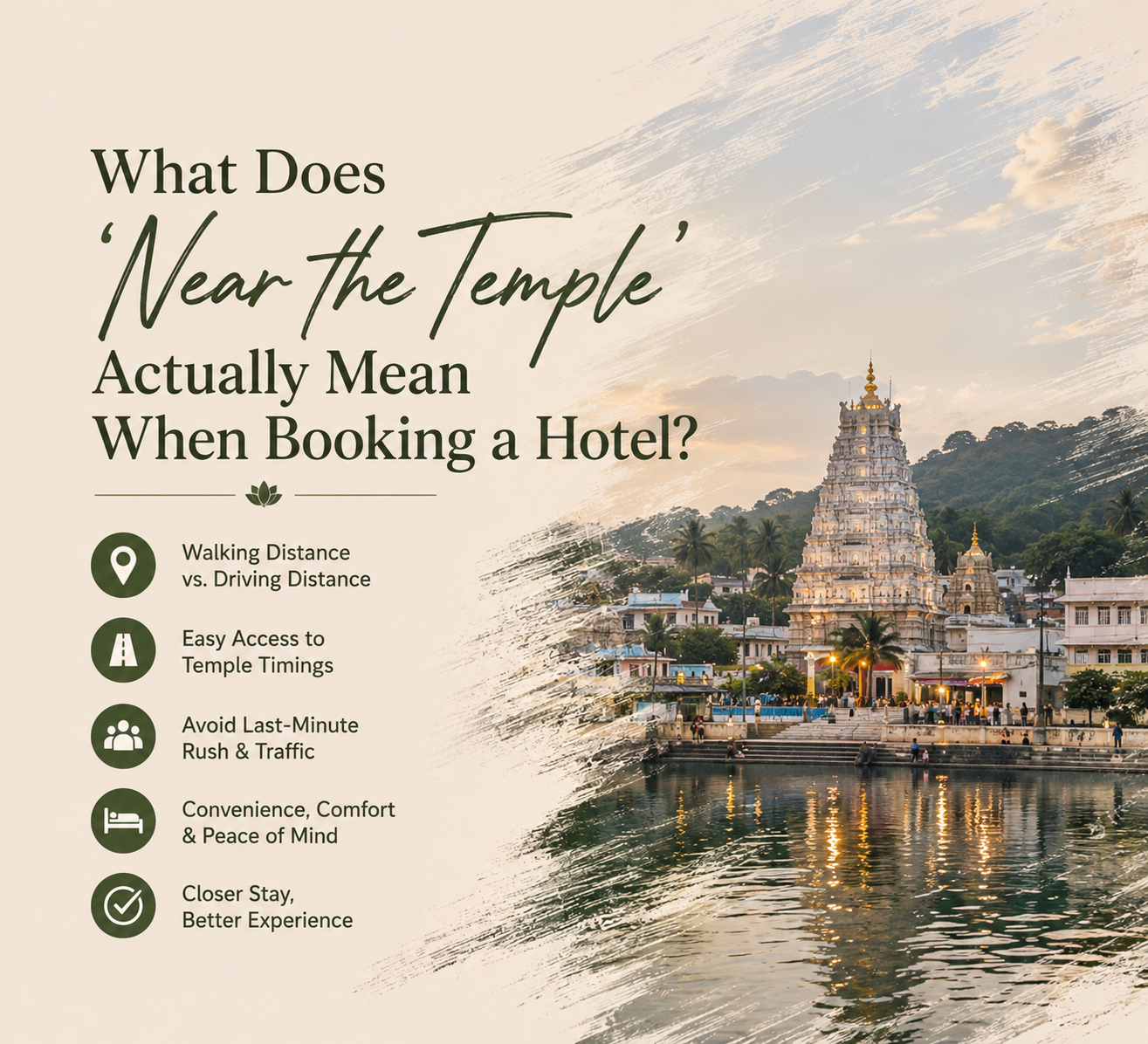
When searching for hotels near temples, travelers frequently come across phrases such as “near the temple,” “close to the temple,” “just minutes away,” or “conveniently located near the shrine.” These descriptions sound reassuring, but they do not always tell pilgrims how easy it will actually be to reach the temple.
A hotel may appear extremely close on a map but require a longer walking route because of temple walls, restricted entry gates, narrow lanes, pedestrian zones, or traffic diversions. Another hotel may be slightly farther away but offer direct road connectivity, convenient auto access, parking, and an easier journey for families and senior citizens.
This is why Mudras Stays encourages pilgrims to evaluate real temple accessibility instead of relying only on a distance number. When choosing the best and budget-friendly hotels near temples, travelers should consider walking time, temple entry gates, road conditions, vehicle access, local transportation, family requirements, and darshan schedules.
WHAT DOES “NEAR THE TEMPLE” ACTUALLY MEAN?
There is no universal hotel-industry definition that determines exactly how close a property must be before it can be described as “near” a temple. The phrase can therefore represent very different distances and travel experiences.
Depending on the destination, “near the temple” could mean:
- A hotel located a few minutes away on foot.
- A property requiring a short auto-rickshaw journey.
- A hotel several kilometres away but within the broader temple district.
- A property close to the temple boundary but far from the visitor entrance.
- A hotel requiring both a vehicle journey and additional walking.
For pilgrims, the useful question is therefore not simply, “Is this hotel near the temple?” It is, “How easily can everyone in my group travel from this hotel to the temple entrance?”
WHY THE DISTANCE SHOWN ON A MAP CAN BE MISLEADING
Digital maps are extremely useful for planning pilgrimage accommodation, but the distance displayed between a hotel and temple does not always represent the journey a pilgrim will actually make.
The real route can be affected by:
- Temple compound walls.
- Designated visitor entrances.
- One-way roads.
- Pedestrian-only streets.
- Security barricades.
- Restricted vehicle zones.
- Crowded markets.
- Temporary traffic diversions.
A hotel that appears only a few hundred metres from a temple may therefore involve a considerably longer walking route.
CHECK THE TEMPLE GATE, NOT JUST THE TEMPLE LOCATION
One of the most important steps when comparing hotels close to temples is identifying the entrance pilgrims actually use.
Large temple complexes may have several gates, but not every entrance is necessarily available to general visitors at all times. Security arrangements and crowd management can also influence which route pilgrims are expected to follow.
Before booking your hotel, check:
- Which gate is normally used for darshan.
- How far the hotel is from that gate.
- Whether vehicles can reach the gate.
- Where the nearest drop-off point is located.
- Whether additional walking is required.
This can provide a much more realistic picture of hotel convenience.
WALKING DISTANCE DOES NOT MEAN THE SAME THING FOR EVERY PILGRIM
A ten-minute walk can be easy for one traveler and difficult for another. Age, mobility, weather, terrain, crowds, and the physical demands of the temple visit itself all influence what constitutes comfortable walking distance.
For example, a young solo traveler may comfortably walk one kilometre through a temple market. The same journey could be challenging for elderly parents, someone carrying luggage, or a family travelling with small children.
Therefore, when a hotel claims to be within walking distance, consider:
- Actual walking time.
- Road surface.
- Steps and slopes.
- Expected crowd levels.
- Weather conditions.
- Mobility of every traveler.
WHEN A WALKING-DISTANCE TEMPLE HOTEL IS IDEAL
A genuinely walkable hotel can provide considerable convenience during a pilgrimage, particularly when the temple is the primary purpose of the journey.
Walking-distance accommodation can be especially useful when:
- You want early morning darshan.
- You plan to visit the temple more than once.
- You want to attend evening aarti.
- You prefer not to depend on taxis or autos.
- The route is comfortable and safe.
- You are visiting for a short stay.
Being able to walk between the hotel and temple can also make the itinerary more flexible.
WHEN A SHORT-DRIVE HOTEL MAY ACTUALLY BE MORE CONVENIENT
The closest hotel is not automatically the best hotel for every pilgrim. In some destinations, properties immediately around the temple may be situated inside crowded markets, narrow lanes, or vehicle-restricted areas.
A hotel a short drive away may offer:
- Better road connectivity.
- Dedicated parking.
- Easier luggage handling.
- Larger rooms.
- Quieter surroundings.
- Better accessibility for elderly guests.
If autos, taxis, or hotel transportation are easily available, a slightly farther property can sometimes provide a better overall pilgrimage experience.
BEST AND BUDGET-FRIENDLY HOTELS BY MUDRAS STAYS
Mudras Stays focuses on accommodation around spiritual and pilgrimage destinations. Instead of evaluating a property solely by star rating or advertised distance, pilgrims can consider the factors that directly influence their temple journey.
When exploring best and budget-friendly hotels by Mudras Stays, travelers can consider:
- Temple proximity.
- Actual walking convenience.
- Room affordability.
- Family accommodation requirements.
- Senior citizen accessibility.
- Vehicle access.
- Nearby food options.
- Overall pilgrimage convenience.
The objective is to help travelers find accommodation that fits the practical requirements of their spiritual journey.
“500 METRES FROM THE TEMPLE” — IS THAT REALLY CLOSE?
A hotel located approximately 500 metres from a temple may sound extremely convenient. In many destinations, it can be. However, travelers should still investigate the route.
Ask whether those 500 metres involve:
- A direct road.
- A crowded market.
- Steps or steep slopes.
- A pedestrian-only lane.
- A longer route to the actual entrance.
Distance without route context provides only part of the information needed to make a good booking decision.
“1 KM FROM THE TEMPLE” — WALK OR TAKE AN AUTO?
One kilometre may be comfortably walkable for some pilgrims, particularly when the road is flat and weather conditions are pleasant.
However, the same distance may feel much longer during:
- Hot afternoons.
- Heavy rain.
- Festival crowds.
- Cold early mornings.
- Long pilgrimage days.
Travelers should therefore assess both distance and conditions before deciding whether a one-kilometre hotel is genuinely convenient.
“2–3 KM FROM THE TEMPLE” — CAN IT STILL BE A GOOD LOCATION?
Yes. A hotel located a few kilometres away can still be a practical choice when road connectivity and local transport are good.
Such hotels may also provide better:
- Parking.
- Room availability.
- Family rooms.
- Pricing.
- Vehicle access.
- Quiet surroundings.
The key is to calculate how long each temple journey will actually take and how much transportation will cost.
WHY TEMPLE PROXIMITY MATTERS FOR EARLY MORNING DARSHAN
Many devotees prefer early morning darshan because of religious significance, temple schedules, or a desire to avoid heavier crowds later in the day.
In these situations, hotel location becomes particularly important.
A nearby property can reduce:
- Early morning transportation dependency.
- Waiting for taxis or autos.
- Travel uncertainty.
- The need to wake considerably earlier.
If early darshan is a priority, check whether you can realistically travel from the hotel to the temple at the required hour.
WHY LOCATION ALSO MATTERS FOR EVENING AARTI
Evening aarti can be one of the most memorable parts of a spiritual journey, but travelers also need to consider how they will return to their hotel afterward.
After spending several hours walking, standing in queues, and exploring the destination, a long return journey can become tiring.
Families with children and elderly parents may particularly benefit from accommodation that provides straightforward access after evening temple activities.
WHAT “NEAR THE TEMPLE” SHOULD MEAN FOR SENIOR CITIZENS
For elderly pilgrims, the best hotel is usually the one that minimizes total physical effort.
This does not always mean selecting the geographically closest property.
Families should evaluate:
- Walking distance.
- Number of stairs.
- Road gradients.
- Vehicle drop-off points.
- Lift availability.
- Ground-floor rooms.
- Availability of local transportation.
A hotel slightly farther away with easy vehicle access may sometimes be more suitable than a property inside a crowded pedestrian lane.
WHAT “NEAR THE TEMPLE” SHOULD MEAN FOR FAMILIES WITH CHILDREN
Families with young children often benefit from accommodation that allows them to return to the room easily during the day.
Children may need:
- Rest between temple visits.
- Regular meals.
- Naps.
- Clothing changes.
- Breaks from crowds and heat.
A practical hotel location can therefore improve the experience for both children and parents.
WHAT “NEAR THE TEMPLE” MEANS FOR LARGE GROUPS
Religious groups and extended families may have different priorities. The hotels closest to major temples can sometimes have limited room inventory or difficult bus access.
Groups may require:
- Several rooms in one property.
- Bus or tempo traveller access.
- Parking.
- Group dining arrangements.
- Easy luggage handling.
A slightly farther property with better group facilities may therefore be more practical.
VEHICLE RESTRICTIONS CAN COMPLETELY CHANGE HOTEL CONVENIENCE
Some temple districts restrict private vehicles, taxis, and autos beyond designated points. This is particularly common around heavily visited sacred sites and during festivals.
A hotel advertised as being only a short drive from the temple may therefore still require considerable walking.
Check:
- Where vehicles are permitted.
- Where the final drop-off point is.
- Whether e-rickshaws or local transport operate inside restricted areas.
- How much walking remains afterward.
WHY PARKING SHOULD BE PART OF YOUR LOCATION DECISION
If you are travelling by private car, the closest hotel may not necessarily be the most convenient.
Properties inside old temple districts may have:
- No on-site parking.
- Limited vehicle access.
- Separate paid parking.
- Difficult luggage unloading.
A hotel slightly farther away with secure parking and easy road connectivity may provide greater convenience for a road-trip pilgrimage.
HOW LOCAL TRANSPORT AFFECTS THE MEANING OF “NEAR”
A hotel three kilometres away in a destination with frequent and affordable e-rickshaws may feel more accessible than a hotel one kilometre away where transportation is difficult to find.
Before booking, investigate:
- Auto availability.
- E-rickshaw availability.
- Taxi availability.
- Typical local fares.
- Early morning transportation.
- Late evening transportation.
Transportation availability can significantly change the practical value of a hotel location.
HOW HOTEL DISTANCE AFFECTS YOUR TOTAL PILGRIMAGE BUDGET
Travelers looking for budget hotels near temples should consider more than the nightly room rate.
A hotel farther away may initially appear cheaper but require multiple paid journeys each day.
Calculate:
- Room rate per night.
- Number of nights.
- Average transport cost per temple visit.
- Number of temple visits.
- Parking expenses.
- Fuel costs where applicable.
This gives a much clearer picture of the true accommodation cost.
WHY A SLIGHTLY COSTLIER NEARBY HOTEL MAY SAVE MONEY
Suppose one property costs slightly more per night but allows your family to comfortably walk to the temple. Another hotel offers a cheaper room but requires four auto journeys every day.
Once transportation is included, the nearby property may become equally priced or even more affordable overall.
This is why Mudras Stays encourages pilgrims to consider total pilgrimage value rather than room price alone.
HOW FESTIVAL SEASON CHANGES TEMPLE DISTANCE
During major religious festivals, normal travel times can change dramatically.
Pilgrimage destinations may experience:
- Large crowds.
- Temporary road closures.
- Traffic diversions.
- Restricted vehicle zones.
- Longer taxi journeys.
- Extended walking routes.
A hotel that is conveniently accessible during ordinary periods may require much more effort during a festival.
WHY WALKING-DISTANCE HOTELS CAN BE VALUABLE DURING FESTIVALS
When roads become heavily congested, a genuinely walkable hotel can reduce dependence on local transportation.
However, travelers should also remember that the streets closest to major temples may become extremely crowded.
Families should balance:
- Temple proximity.
- Crowd levels.
- Walking conditions.
- Noise.
- Accessibility.
“NEAR THE TEMPLE” IN HILL PILGRIMAGE DESTINATIONS
Distance requires a different interpretation at hill and mountain pilgrimage destinations.
A hotel that appears geographically close may involve:
- Steep roads.
- Climbing.
- Trekking.
- Uneven pathways.
- Weather-related difficulty.
Travelers should consider physical effort, altitude, terrain, and accessibility instead of relying only on kilometres.
“NEAR THE TEMPLE” IN OLD TEMPLE CITIES
Historic pilgrimage cities can contain narrow lanes, crowded bazaars, ghats, old neighborhoods, and restricted traffic zones.
In destinations such as Varanasi, Mathura, Vrindavan, Haridwar, Ujjain, Puri, Ayodhya, Madurai, and Rameswaram, travelers should pay particular attention to the actual route between the hotel and temple.
A hotel located slightly farther away on a good access road can sometimes be easier to reach than one positioned deep inside a crowded lane.
WHAT IF YOU ARE VISITING MORE THAN ONE TEMPLE?
Many spiritual journeys involve several temples or sacred attractions within the same destination.
If you plan to visit multiple places, choosing a hotel beside one particular temple may not always be ideal.
A centrally located property may offer better access to:
- Multiple temples.
- Ghats.
- Sacred sites.
- Restaurants.
- Transport hubs.
- Local markets.
Consider the complete pilgrimage itinerary before selecting your accommodation.
LOCATION OR STAR RATING: WHICH MATTERS MORE FOR PILGRIMS?
A premium hotel can provide excellent facilities, but it may not automatically provide the best pilgrimage experience.
For many devotees, the most useful hotel features are:
- Practical temple access.
- Clean rooms.
- Comfortable beds.
- Hygienic bathrooms.
- Hot water.
- Nearby vegetarian food.
- Reasonable pricing.
A clean, well-located budget or mid-range property can sometimes provide greater practical value than a luxury hotel located far from the sacred site.
HOW TO VERIFY A “NEAR TEMPLE” HOTEL BEFORE BOOKING
Use this simple process before confirming your accommodation:
- Find the exact hotel location.
- Identify the temple entrance used by pilgrims.
- Check the actual walking route.
- Check driving or auto travel time.
- Identify vehicle restrictions.
- Check the final drop-off point.
- Consider the mobility of your travel group.
- Estimate local transport expenses.
- Check parking if travelling by car.
- Consider your planned darshan timings.
QUESTIONS TO ASK A HOTEL ABOUT TEMPLE DISTANCE
Before booking, consider confirming:
- How far is the main temple entrance?
- How many minutes does it take to walk?
- Can senior citizens comfortably walk the route?
- Can autos or taxis reach the hotel?
- How close can vehicles get to the temple?
- Is parking available?
- Is transport available before sunrise?
- Is transport available after evening aarti?
These questions provide much more useful information than simply asking whether the hotel is near the temple.
HOW MUDRAS STAYS HELPS PILGRIMS SEARCH MORE PRACTICALLY
Mudras Stays is focused on spiritual destinations and the accommodation requirements of temple travelers.
Pilgrims can explore accommodation relevant to searches such as:
- Hotels near temples
- Best hotels near temples
- Budget hotels near temples
- Hotels within walking distance of temples.
- Family-friendly temple accommodation.
- Senior citizen-friendly pilgrimage stays.
- Affordable spiritual travel accommodation.
The focus is on helping devotees consider the practical relationship between their hotel and pilgrimage itinerary.
A QUICK TEMPLE-PROXIMITY CHECKLIST
- Check the actual temple entrance.
- Check real walking time.
- Check terrain and road conditions.
- Check vehicle access.
- Check the temple drop-off point.
- Consider senior citizens and children.
- Check early morning transport.
- Check evening transport.
- Calculate daily transportation expenses.
- Compare overall convenience with the room price.
SO, WHAT SHOULD “NEAR THE TEMPLE” REALLY MEAN?
For pilgrimage accommodation, “near the temple” should not be defined by one fixed number of metres or kilometres.
A genuinely convenient hotel is one that allows the travelers in your group to reach the temple with reasonable time, effort, and expense.
For one pilgrim, that may mean a five-minute walk. For another family, it may mean a two-kilometre drive with convenient vehicle access. For senior citizens, a slightly farther hotel with a reliable drop-off point may be considerably more comfortable.
The best approach is to evaluate distance, actual travel time, walking conditions, transportation, accessibility, darshan schedule, and total cost together.
LOOK BEYOND THE DISTANCE WITH MUDRAS STAYS
The words “near the temple” should be the beginning of your hotel research, not the end of it. Understanding actual routes, temple gates, walking requirements, transport availability, and family accessibility can help prevent inconvenient hotel bookings.
Mudras Stays helps travelers explore best and budget-friendly hotels near temples with a focus on practical pilgrimage accommodation for solo devotees, families, senior citizens, and spiritual groups.
EXPLORE BEST AND BUDGET-FRIENDLY TEMPLE HOTELS WITH MUDRAS STAYS
FREQUENTLY ASKED QUESTIONS
What does “near the temple” mean in a hotel listing?
There is no single universal distance. A hotel described as near a temple could be within walking distance or require a short vehicle journey, so travelers should verify the actual route before booking.
Does near the temple always mean walking distance?
No. Some hotels described as near temples may still require an auto, taxi, e-rickshaw, or shuttle. Always check actual walking and driving times.
How can I check whether a hotel is really close to the temple?
Locate the actual temple entrance, check the walking and driving routes, verify vehicle restrictions, and calculate realistic travel time.
Is 1 km from a temple considered near?
It can be, but convenience depends on the route, weather, terrain, crowds, and travelers' mobility. A flat one-kilometre route may be easy for some visitors but difficult for others.
Is a hotel 2–3 km from a temple too far?
Not necessarily. If road connectivity is good and affordable local transportation is readily available, a property a few kilometres away can still provide convenient temple access.
What should senior citizens consider when choosing hotels near temples?
Senior travelers should consider walking distance, stairs, road conditions, lift availability, vehicle drop-off points, and total physical effort required to reach the temple.
Should families always book the closest hotel to a temple?
No. Families should balance temple proximity with room size, cleanliness, food availability, accessibility, parking, safety, and the needs of children and elderly relatives.
Can a farther hotel actually be more convenient?
Yes. A slightly farther property can be more practical when it offers direct vehicle access, reliable transportation, parking, larger rooms, or better accessibility.
Why should I consider transport costs when booking a temple hotel?
A cheaper hotel farther away may require several paid journeys each day. Comparing room rates together with transportation expenses provides a better understanding of total pilgrimage cost.
How does Mudras Stays help pilgrims find hotels near temples?
Mudras Stays focuses on spiritual destinations and helps travelers explore best and budget-friendly accommodation according to temple proximity, accessibility, family requirements, senior citizen needs, and overall pilgrimage convenience.