
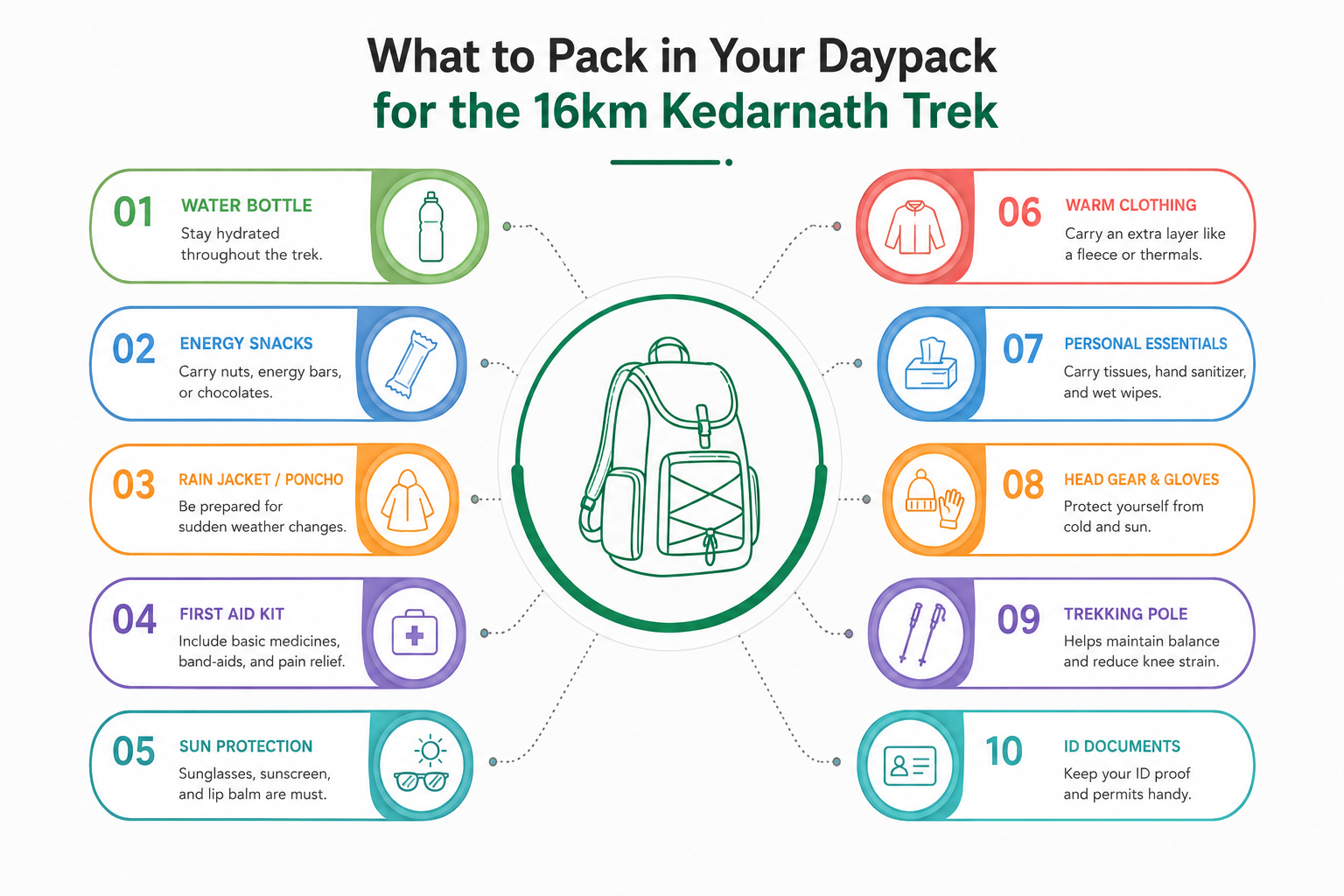
The Kedarnath trek from Gaurikund to Kedarnath Temple is currently described by Uttarakhand Tourism as a 16 km mountain route. It is a medium-to-steep high-altitude trek through changing terrain where weather, temperature and personal energy levels can vary significantly during the day.
The biggest daypack mistake is carrying too much. Every unnecessary kilogram becomes more noticeable as the climb continues. Your objective should be to carry the essentials required for safety and comfort without turning your backpack into another physical challenge.
If you are staying overnight, confirm your hotel in Kedarnath in advance so you know what overnight items are actually necessary.
HOW LARGE SHOULD YOUR KEDARNATH DAYPACK BE?
For many pilgrims, a compact daypack around 20-30 litres is sufficient for essential trekking and overnight items.
The correct size depends on weather, medical requirements and whether you are returning the same day.
THE MOST IMPORTANT RULE: KEEP IT LIGHT
Do not fill every available litre just because the bag has space.
Carry what you genuinely expect to use.
1. WATER
Carry a refillable bottle so you can hydrate during the climb.
Avoid carrying excessive quantities that make the bag unnecessarily heavy.
2. RAIN PONCHO OR WATERPROOF JACKET
Weather can change quickly in the mountains.
Your rain protection should be accessible without emptying the backpack.
3. WARM LAYER
A fleece or lightweight warm layer should remain inside the bag even if you begin the trek feeling warm.
4. INSULATED JACKET
If staying overnight or traveling during colder conditions, carry suitable insulation.
5. WARM CAP
A lightweight woollen cap takes little space and can provide useful warmth after sunset or during cold wind.
6. LIGHT GLOVES
Gloves are particularly useful for early morning and evening conditions.
7. SPARE SOCKS
A dry pair of socks can make a major difference if your footwear becomes wet.
Keep them inside a waterproof pouch.
8. PERSONAL MEDICINES
Carry any regular medication on your person.
Never leave essential medicine in a suitcase stored many kilometres away.
9. SMALL FIRST-AID KIT
Your personal kit can contain:
- Bandages
- Blister pads
- Gauze
- Antiseptic
- Any medication personally advised for you
10. BLISTER PROTECTION
Foot discomfort is one of the easiest ways to make a long trek miserable.
Stop and address rubbing before it becomes a major blister.
11. ENERGY SNACKS
Carry small portions of lightweight food such as:
- Nuts
- Dry fruits
- Energy bars
- Biscuits
- Simple familiar snacks
12. ELECTROLYTES IF APPROPRIATE
Some travelers carry electrolyte sachets for hydration. Anyone with medical restrictions should follow their healthcare professional's guidance.
13. SUNSCREEN
Kedarnath is high altitude, and strong sunlight can occur even in cold air.
14. SUNGLASSES
UV-protective sunglasses can reduce eye discomfort from bright mountain light.
15. LIP BALM
Cold air and wind can dry the lips quickly.
16. PHONE
Your phone serves multiple functions:
- Communication
- Hotel details
- Travel confirmations
- Emergency contact
- Camera
17. POWER BANK
Cold conditions and constant photography can reduce battery life.
18. CHARGING CABLE
A power bank is useless if the correct cable is still in your main suitcase.
19. IDENTIFICATION
Carry appropriate government-issued identification and current Yatra documentation.
20. HOTEL CONFIRMATION
Save your Kedarnath hotel details offline.
This is especially useful when connectivity is inconsistent.
21. SMALL AMOUNT OF CASH
Keep reasonable cash for small purchases where network connectivity may affect digital payment.
22. TISSUES
A small tissue pack is useful and weighs almost nothing.
23. HAND SANITIZER
Carry a small bottle rather than a large family-size container.
24. BASIC TOILETRIES IF STAYING OVERNIGHT
For one night, you generally need only:
- Toothbrush
- Small toothpaste
- Small face wash or soap
- Personal hygiene products
25. QUICK-DRY TOWEL IF REQUIRED
Ask your accommodation in Kedarnath whether a towel is provided before deciding to carry one.
26. BACKPACK RAIN COVER
A pack cover adds another level of protection for your clothes and electronics.
USE INTERNAL WATERPROOF POUCHES
Do not trust one outer rain cover completely.
Place critical items such as medicines and documents inside sealed pouches.
WHAT NOT TO PACK
Avoid filling the daypack with:
- Full-size toiletries
- Multiple outfit changes
- Large cosmetic bags
- Heavy books
- Unnecessary electronics
- Large food quantities
- Full-size bath towels unless required
DO YOU NEED A LAPTOP?
For most pilgrims, no. Leave non-essential work electronics at your road accommodation.
DO YOU NEED MULTIPLE SHOES?
Not in the daypack. Wear the correct trekking pair and carry only lightweight footwear if necessary for the overnight stay.
SHOULD YOU CARRY A CAMERA?
If photography is important, a camera may be worthwhile, but remember that every lens and accessory adds weight.
For many pilgrims, a phone is sufficient.
WHAT SHOULD BE IN YOUR POCKETS?
- Phone
- Small cash
- Tissue
- One snack
Keep valuables secure rather than placing them in open pockets.
WHAT SHOULD BE AT THE TOP OF THE BAG?
- Rain protection
- Warm layer
- Medicine
- Snacks
- Water
WHAT CAN GO AT THE BOTTOM?
- Overnight toiletries
- Spare clothes
- Items unlikely to be required during the climb
PACKING FOR SAME-DAY RETURN
A same-day trek may require less overnight equipment, but do not remove essential weather protection merely to make the bag lighter.
PACKING FOR ONE NIGHT IN KEDARNATH
If you have a confirmed room in Kedarnath, carry only one compact change of clothing and necessary toiletries.
PACKING FOR TWO NIGHTS
Two nights may justify an additional base layer and socks but still does not require a suitcase.
DAYPACK FOR SENIOR CITIZENS
Senior travelers should carry the lightest practical bag possible.
Essential medication should remain with the traveler or responsible companion.
DAYPACK FOR CHILDREN
Children should not be given heavy bags simply because they want to carry their own luggage.
DAYPACK FOR COUPLES
Split shared items intelligently so both travelers do not carry duplicate power banks, first-aid kits and toiletries unnecessarily.
DO NOT IGNORE YOUR BAG'S FIT
A backpack should sit comfortably on the shoulders and back.
Adjust straps before beginning the climb.
WEIGH THE BAG AT HOME
Pack the exact items and walk around with the bag before the trip.
If it feels heavy on flat ground, it will feel heavier after hours of climbing.
HOTEL LOCATION AFFECTS HOW FAR YOU CARRY THE BAG
After reaching Kedarnath, you may still need to walk from the main arrival area to your room.
When comparing hotels near Kedarnath Temple, ask about the real walking route.
COMMON DAYPACK MISTAKES
- Carrying too much water
- Carrying too many clothes
- No rain protection
- No spare socks
- Keeping medicines in main luggage
- Carrying full-size toiletries
- No power bank
- No offline hotel details
- Packing everything in one non-waterproof compartment
FINAL 16KM KEDARNATH DAYPACK CHECKLIST
- Water bottle
- Rain jacket or poncho
- Warm layer
- Insulated jacket where required
- Warm cap
- Gloves
- Spare socks
- Personal medicines
- Small first-aid kit
- Snacks
- Sunscreen
- Sunglasses
- Lip balm
- Phone
- Power bank and cable
- Identification
- Yatra documentation
- Hotel confirmation
- Small amount of cash
- Compact toiletries if staying overnight
VIEW KEDARNATH HOTEL OPTIONS ON GOOGLE
FREQUENTLY ASKED QUESTIONS
How long is the Kedarnath trek?
Uttarakhand Tourism currently describes the Gaurikund to Kedarnath Temple route as approximately 16 km.
How heavy should my Kedarnath backpack be?
There is no universal weight, but it should be as light as practical while still carrying necessary safety and personal items.
Do I need warm clothes during the daytime?
Carry a warm layer even if the trek starts in sunshine because temperature and weather can change.
Should I carry two litres of water?
Carry enough for your needs while considering refill possibilities and backpack weight.
Do I need rainwear in May?
Lightweight rain protection is sensible because mountain weather can change quickly.
Should medicine stay in my main luggage?
No. Essential medication should remain accessible during the trek.
Can I take a suitcase to Kedarnath?
A lightweight backpack is considerably more practical than a large suitcase for the trekking route.
Should I book a hotel before the trek?
Yes, particularly during high-demand periods. You can review hotels in Kedarnath on Google.
What should I ask my hotel?
Ask about location, walking distance, stairs, bedding, bathroom facilities and hot water.
Do I need cash?
Keeping a reasonable amount of cash is useful if connectivity affects digital payment.